Tipsday: Writerly Goodness found on the interwebz, Mar 24-30, 2019

Here we are in April (!) and here’s another week’s worth of informal writerly learnings.

Susan Spann explains how to prepare and use a DMCA takedown notice.  Liz Michalski is biting the bullet (journal) and tracking her writing habit. Barbara O’Neal: spring planting for writers. Heather Webb answers the question: no, really, why do you write? John J. Kelley wonders, whose character is it, anyway? Writer Unboxed

K.M. Weiland shares four pacing tricks to keep readers’ attention, courtesy of Captain Marvel. Helping Writers Become Authors

Jenna Moreci shares her top ten tips for writing your first chapter.


Jules Horne drops by Jane Friedman’s blog to discuss writing for audio: understanding attunement.

Joanna Penn interviews Damon Suede about strengthening your writing with the power of words. The Kobo Writing Life Podcast interviewed Damon a couple of weeks ago and it was both informative and entertaining 🙂 The Creative Penn

Manuela Williams: seven questions to ask when building your author brand. Gabriela Pereira interviews Samantha Downing, Barbara Poelle, and Jen Monroe about the author/agent/editor relationship. Laura Highcove lists five steps to create agency in your writing life. DIY MFA

Chris Winkle examines six stories sabotaged by their tone. Then, Oren Ashkenazi covers six common villain mistakes and how to avoid them. Mythcreants

Alison Flood looks at the rotten side of self-publishing: plagiarism, “book-stuffing,” and clickfarms. The Guardian

I hope you found something you can use in your creative practice or business.

Come back on Thursday for some thoughty inspiration.

Until then, be well, my friends!

tipsday2016

Tipsday: Writerly Goodness found on the interwebz, Mar 17-23, 2019

Here is your weekly batch of informal writerly learnings. Enjoy 🙂

K.M. Weiland wants you to find your thematic principle. Helping Writers Become Authors

Vaughn Roycroft, inspired by Jo Eberhardt’s last post, writes about layers of antagonism and why you should embrace them. Dave King: the lessons of genre. “In fact, here’s a dirty little secret: literary fiction often behaves like just another genre.” Julie Carrick Dalton looks at novel writing intensives as an alternative to the MA. Stephanie Cowell explores her novelist’s journey: the ghost worlds within me. Writer Unboxed

Chris Winkle: narrating a close point of view. Mythcreants

Chris Winkle produces the next instalment in the goal-oriented storytelling series: novelty. Then, Sara Letourneau has a helpful strategy if you’re struggling with flashbacks: try using the PAST method. Writers Helping Writers

Lisa Cooper Ellison offers a primer on schmoozing for introverts: how to network like a pro. Then, Barbara Linn Probst stops by to talk about beta readers: who, when, why, and so what? Jane Friedman

Mary Robinette Kowal shares some great advice for debut authors: so, you’ve been nominated for an award …  She follows up with another pithy piece on status and hierarchy shifts. Check out the series navigation links. This stuff is GOLD.

Helen J. Darling is helping you build your publishing team: your cover designer. DIY MFA

Alexa Donne muddles through the middle.


Janice Hardy digs into her archives for this fun test to check your scene’s narrative drive. Fiction University

Piper Bayard and Jay Holmes (better known as Bayard & Holmes) help you figure out which firearms can’t be silenced. Then, Margie Lawson drops by to discuss creating compelling cadence. Writers in the Storm

Angela Ackerman visits Jami Gold’s blog: creating characters who clash.

Jenna Moreci helps you identify your category (not genre).


Bryan E. Robinson, PhD shares eight ways to stay mentally fit and mindful during the writing process. Writer’s Digest

Nina Munteanu: surfing Schumann’s wave and catching the ion spray. Everything in life is vibration.

And that was Tipsday.

Hope you found something that will take your craft to a new level. Come back on Thursday for some thoughty.

Until then, be well!

tipsday2016

Tipsday: Writerly Goodness found on the interwebz, Mar 10-16, 2019

Another week, another bunch of informal writerly learnings 🙂

There’s not as much as usual, because last week’s Facebook outage sacrificed a whole day’s worth of curation. Sorry, but it’s still the easiest way for me to track my online reading.

Nina Munteanu explains how to stoke the scintillation of inspiration.

Julianna Baggott offers three clues that you may be a more productive writer. Kathryn Craft tells you when to let go of your original inspiration. Writer Unboxed

Christina Delay wants you to invite creativity through meditation. Writers in the Storm

K.M. Weiland says that plot, character, and theme are the greatest love triangle of all time. Helping Writers Become Authors

Elisabeth Kauffman answers a question about character description and POV. Stephanie Jo Harris shares five tips for fearless writing. DIY MFA

Chris Winkle answers a writing question: how do I keep my non-productive immortal race from becoming problematic? Then, Chris teams up with Oren Ashkenazi: five ways your characters can acquire magic. Finally, Oren tackles five more underpowered antagonists. Mythcreants

Jami Gold talks about story threads and fixing the rips in our stories. Victoria Mixon explains how to layer character for believable fiction. Writers Helping Writers

Alexa Donne tries to help you figure out if you’re a good writer.


Mary Hynes: when hope is “punk” and grudge is forgiveness. “Tapestry” on CBC.

Ben H. Winters wonders what the make-believe bureaucracies of science fiction say about us? The New York Times

And that was Tipsday. Come back on Thursday for some fuel for your thoughts.

Until then, be well, my friends!

tipsday2016

Tipsday: Writerly Goodness found on the interwebz, Mar 3-9, 2019

I have a lot of informal writerly learnings for you this week.

By the way, a couple weeks ago, I decided to group posts by blog/source. Are you liking this slight rearrangement, or do you find it more difficult to read? Let me know, if you wish, in the comments. I can always change things back. More whitespace on the page can be helpful for readers.

Oren Ashkenazi examines six common mistakes in fight scenes and explains how to avoid them. Bunny explains how to use the uncanny in your writing. Mythcreants

Greer Macallister explains what it means to be a working writer. Sophie Masson outlines the options for planning your book launch (‘cause not every publisher has budget for that anymore). Donald Maass eschews his usual concise and pithy titles in this installment: nasty, menacing, and murderous protagonists and why we love them. Alma Katsu offers tips for complex historical research. David Corbett writes about what it means to sink into the bog. Kathryn Magendie wants to thank those who encourage us to write and dig deeper. Writer Unboxed

Joanna Penn interviews Sacha Black on how to create heroes and villains for the Creative Penn podcast. Then Bharat Krishnan stops by to discuss how to write diversity authentically. The Creative Penn

James Scott Bell visits Writers Helping Writers: does every protagonist need an arc? Spoilers: yes, but it doesn’t have to be a positive or negative change arc. Sometimes … it’s flat (no change). Janice Hardy stops by later in the week to point out three ways writers tell, don’t show and how to fix them.

Abigail K. Perry examines another of James Scott Bell’s signpost scenes. This time, #8: pet the dog. Brenda Joyce Patterson takes a deep dive into flash non-fiction. Gabriela Pereira interviews Anita Sarkeesian and Ebony Adams for DIY MFA radio. Rachel Thompson list five ways to celebrate women and non-binary authors on International Women’s Day. DIY MFA

Fae Rowan wants to write the perfect book. Spoiler: it’s not possible. What to do instead 😉 Then, Julie Glover wonders, have you forgotten to have fun writing? Writers in the Storm

Susan DeFreitas: when your query reveals a story-level problem. Jane Friedman

Self-rejection: what it is, why you do it, and how to chuck its ass out an airlock. Chuck Wendig, Terribleminds.

Ammi-Joan Paquette is taming the synopsis with these four steps. Writer’s Digest

Jami Gold says, what makes a story uplifting is more than a happy ending.

Rosa Saba: authors irritated by “smug” defense of the Vancouver website they say is stealing their work. Readers, shun ebook.bike. SHUN! The Toronto Star

And that is tipsday for this week. Come back on Thursday for some inspiration and research resources.

Until then, be well, my friends!

tipsday2016

Tipsday: Writerly Goodness found on the interwebz, Feb 24-Mar 2, 2019

All rightie, then! It’s time for some informal writerly learnings.

Lisa Hall-Wilson: how to make dominant female characters likeable. Then, Tiffany Yates-Martin helps you get unblocked and avoid writer’s block. Later still, Orly Konig shares the secrets to turning a lemon into a book. Writers in the Storm

Julia Munroe Martin advises on the care and feeding of the weary writer. Barbara O’Neal is a writer seeking experiences (it’s called filling the well). Then, Jeanne Kisacky asks, what keeps your characters up at night? Writer Unboxed

Jenna Moreci offers her top tips on writing healthy relationships.


K.M. Weiland examines her difficulties with writing: seven things to try when writing is hard. Helping Writers Become Authors

Janice Hardy explains the difference between archetypes, tropes, and clichés. Later in the week, Janice explores one common way writers weaken their descriptions. Fiction University

Emily Wenstrom shares her tips for decluttering your social media accounts.  My latest column came out on Tuesday. How to build an alien: extremophiles. Then, Gabriela Pereira interviews Glynn Stewart about twisting the tropes of military science fiction. DIY MFA

Jerry B. Jenkins stops by Writers Helping Writers to help you write backstory through dialogue.

Chris Winkle wants you to plan super light stories. Mythcreants

Thanks for stopping by and I hope you found something to help you progress in your creative endeavours.

Be well until next time!

tipsday2016

The next chapter: February 2019 update

Here we are in March and the goals I set at the beginning of the year are falling apart.
FebruaryProgress

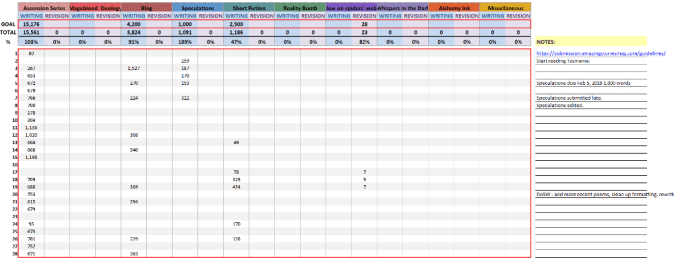
Once again, I managed to meet and marginally exceed my monthly drafting goal for Tamisashki. I aimed for 15,176 words and wrote 15,561, so 103%. Once again, I tried to aim for more production during the week so I could rest on the weekends 🙂

I undershot on the blog again, writing 3,824 of 4,200 words, or 91%.

My latest DIY MFA column was due, and I wrote 1,091 words of my 1,000-word goal, or 109%. Yay there.

My short fiction is where I’ve dropped the ball pen. My intention was to finish my January story and then write a flash piece for February. I didn’t manage to do either. I did write another 1,186 words on my January story and I’m in sight of the end, but then there’s revision, critique, and a final edit to get through before I send it out into the wild.

I ended up writing 47% of my short fiction goal and not even finishing a story. Ah well. I suck at short. It’s something I hope to change, but it’s tough going. I’ve had to cut back the story several times and I keep thinking that sacrificing content makes the story weaker. This isn’t the case, necessarily. It is my perception, though, and probably one of the reasons short is so difficult for me.

I also fell short on the poetry editing. I made it through all the poems that I had previously compiled in the collection, most (but not all) of them previously published and am now in a position of adding in the poems that I have written since I last worked on the project and deciding where they go. I also have to rearrange some of the poems. There is one section that I created that only has three poems in it. I figure I can find places for them elsewhere and make things flow a bit better. Finally, there’s one sprawling poem that I want to restructure. I had done this previously, but I seem to have lost all trace of the document 😦

Because of this change in emphasis, I decided to give it a bit of a break while I rally that part of my writerly brain geared up for the next push. I edited 23 of 28 poems, or 82% of my goal.

Overall, I write 21,662 words of my 22,876-word goal, or 95% for the month. The poetry was the only revision project on my radar right now and so I managed 82% of my revision goal.

Filling the well

I attended the Dbaajmawak Indigenous Writers’ Series on Feb 28, 2019. It was hosted by Greg Scofield in the Brenda Wallace Reading Room at Laurentian University. This session featured authors were Waubgeshig Rice and Rosanna Deerchild.

I’m currently reading Waub’s novel, Moon of the Crusted Snow. I’d picked it up at Wordstock last fall but didn’t have a chance to get him to sign it. Mission accomplished 🙂

Rosanna’s reading of her powerful poetry gave me the shivers several times, prompting me to get her latest collection, calling down the sky, and get her to sign it as well.

I participated in the Writing the Other Building Inclusive Worlds course, and while I didn’t get to several of the writing assignments, the lectures and discussions were great. I’m a newbie in this arena and very hesitant to speak, or write, my thoughts. It was a challenge, but in a good way. I’m finding my way to awareness of my own biases, dismantling my assumptions, and learning to be a good ally, if nothing else.

I also took part in Dan Blank’s Social Media for Writers Facebook group. I enjoy his videos and insights. More than anything else, it confirms that I’m on the right track, though I really do need to put together an author newsletter. It’s work for the future, once I have my poetry collection and short fiction collections out. I’ll probably look at migrating this blog from WordPress.com to a self-hosted version at that time, as well, but again, in the future. And I’ll have to see how other aspects of my life align with these plans.

The month in reading and watching

In terms of books, I finished Kim Stanley Robinson’s The Wild Shore and enjoyed it. I read Bo Bolander’s short story “Our Talons can Crush Galaxies.” I enjoyed it, but it was more for the unconventional form of the story rather than the story itself. I also finished Elizabeth Bear’s Range of Ghosts, which I loved.

I burned through Naomi Novik’s Uprooted and Spinning Silver and loved them both, the latter, if anything, more than the former. It was more about the relationships between the young women of the novel and about what one sacrifices for family. Uprooted is based on the fairy tale of Baba Yaga, and Spinning Silver takes on Rumplestiltskin, but Novik takes both is very different directions from the source material.

Sarah Selecky’s Radiant, Shimmering Light was my more literary read of the month. It was interesting. The protagonist, Lilian, is a social media (mostly Instagram) obsessed creative entrepreneur. She paints animal portraits with auras, a talent (to see those animal auras) she’s had since she was a child. Selecky spent part of her childhood in Sudbury, and so I enjoyed the periodic references to my home town in the novel and Lilian’s latest-spoken wish in the book to get a cottage somewhere in the northeast and devote herself to her work.

Lilian is another unreliable narrator and that’s probably why I didn’t enjoy the book as much as I could have. Though there’s also a lot of female friendship in the novel, it all has a thin, unrealistic veneer, much like our social media obsessed age. The book left me with some major questions that I would have preferred more grounding on, but like Lilian, they’re left floating. It reminded me, in part, of Margaret Atwood’s Lady Oracle, which also left me dissatisfied.

Then, I read Rebecca Roanhorse’s Trail of Lightning. Perfection. It’s the only read this year so far that I’ve given five stars to.

I caught The Incredibles 2, and thought the movie a worthy successor. Jak-Jak is hilarious (I did LOL). The characters all aged and had newer problems to deal with and the writers did a good job or resolving those more personal issues in the midst of the continued super-ban and latest global crisis.

Phil and I enjoyed The Umbrella Academy. I was somewhat disappointed when Vanya lost her mind and went all murder-y and apocalyptic. We discussed it, and there were indications that Vanya’s power used her rather than the other way around, but I was still left wondering why the writers made those particular, misogynist choices. I also understand that Vanya’s arc in the series was different than her arc in the graphic novel (which I would have found more dissatisfying—I Googled) but if they wanted to take her character in a different direction, they could have made braver, more original decisions.

I also finished watching the latest season of Frontier, Jason Mamoa’s passion project, on Netflix. It’s a kind of love/hate show for me. The continual tug of war between the same group of people is getting tiresome. It’s dark, but fairly historically accurate, so far as I can tell. I’ll probably continue to watch it.

And that it for this month’s update.

Until my next blog post, be well, be kind, and stay strong. The world needs your stories!
The Next Chapter

Join me on DIY MFA for my latest column

This time, it’s all about the aliens 🙂

How to build an alien: Extremophiles

Alien-FeaturedImage-575x482

TTFN!

Tipsday: Writerly Goodness found on the interwebz, Feb 17-23, 2019

Good evening, my lovelies! It’s time to peruse your informal writlerly learnings for the week 🙂

Leanne Sowul exposes the battle between time and energy. Later in the week, Bess Cozby shows you four ways to protect your creative brain. And then, Marielle Orff shares five steps to giving an awesome podcast interview. DIY MFA

Vaughn Roycroft: storytelling and stepping beyond the veil. Writer Unboxed

Rachael Stephen explains how to revise your story.


Phoebe Wood shares her strategy for turning your first draft into a second draft.


Angela Ackerman stops by Writers in the Storm to share the One Stop for Writers Fast Track Tool for character creation. Then, Tasha Seegmiller invites you to sit with your discomfort: negotiating difficult critiques. Later in the week, Laura Drake shows you how to exorcise redundant writing.

Becca Puglisi visits Helping Writers Become Authors: seven things your character is hiding.

Oren Ashkenazi: seven signs of bad media analysis. Mythcreants

Diego Courchay describes how an Italian writer’s fictional garden became a place of literary pilgrimage. Atlas Obscura

And that is tipsday for this week. Be sure to check in on Thursday for your weekly dose of thoughty.

Until then, be well!

tipsday2016

Tipsday: Writerly Goodness found on the interwebz, Feb 10-16, 2019

Here we are. How is it already the third week of February? Console yourself with some informal writerly learnings *hugs*

Louise Tondeur guest posts on Jane Friedman’s blog: the myth of plan first and write later (or, you never only write one way).

Rheea Mukherjee joins Writer Unboxed: writing characters who are “smarter” than you.

Kathryn Craft: your story’s valentine to the world (AKA, your query, synopsis, and pages). Writer Unboxed

K.M. Weiland critiques a brave writer’s work to show how paragraph breaks guide the reader’s experience. Helping Writers Become Authors

September C. Fawkes says, look forward, not backward, to pull your reader in. Writers Helping Writers

Margie Lawson stops by Writers in the Storm to help you put fresh faces on the page.

Sara Letourneau offers some further reading on the theme of family. DIY MFA

Becca Puglisi visits DIY MFA: five vehicles for showing emotion.

Chris Winkle: optimizing your story ideas for stronger engagement. Then, Oren Ashkenazi reveals six mistakes that can kill a great plot. Mythcreants

Chuck Wendig says, your ideas aren’t that interesting. This is less about making you feel bad than about making sure your ideas don’t take the place of, like, actual writing. Terribleminds

In honour of Valentines, Jenna Moreci offers her top ten tips for writing sex scenes. [Features discussion of sex and sexuality. Yeah. Even so, had to be said.]


Krista D. Ball rants: why is AUTHOR NAME taking so long to write their next book? This made me wonder if these impatient readers think they own writers? At the cost of $10 to $20 per book? Really? Gear down, people. Reddit

Later in the week, an 11:45 pm amber alert (and subsequent rescind after midnight) in Ontario resulted in a strange outcry of people who didn’t want their sleep disturbed, even after they learned that the child featured in the alert had been murdered. Seriously? Disturb me all night, every night, if it saves a life.

On that boggling note, I leave you until Thursday, when you can come back for some thoughty.

Until then, be well, my friends.

tipsday2016

Tipsday: Writerly Goodness found on the interwebz, Jan 27-Feb 2, 2019

And here I am, back with your weekly dose of informal writerly learnings.

Kathryn Craft: the story that holds you back. Hint: it’s the one you tell yourself. Writers in the Storm

Kim Bullock advises you to vanquish emotional overwhelm to increase productivity. Writer Unboxed

Elizabeth Huergo honors Mary Oliver on Writer Unboxed: walk slowly and bow often.

Cathy Yardley guides you from cool idea to premise. Writer Unboxed

Jo Eberhardt mines her (misspent/not misspent) RPG youth: when your characters have minds of their own. Writer Unboxed

K.M. Weiland shares her nine writing goals for 2019. Helping Writers Become Authors

Manuela Williams shares five simple SEO tips for authors. DIY MFA

Pamela Taylor explains how to create authentic details: keeping secrets. DIY MFA

Bess Cozby shares her experience going for six weeks without social media. DIY MFA

Sofia Ashdown shares her top ten editing tips. The Creative Penn

Chuck Wendig explains the story about the story, or, how writers talk about their books. Terribleminds

Becca Puglisi guest posts on Jerry Jenkins’ blog. Got subtext? Writing better dialogue.

Janice Hardy explains what writers need to know about hooks. Fiction University

Chris Winkle shares lessons from The Maze Runner’s point of view disaster. Then, Oren Ashkenazi tackles the problem with oppressed mages. Mythcreants

I post about writer’s grief. WarpWorld

Sangeeta Mehta lists 19 diversity-focused writing conferences and events in 2019. Writer’s Digest

I hope you found something you need to fuel your creative efforts this week.

Come back on Thursday to get your weekly batch of thoughty.

Until then, be well.

tipsday2016