Tipsday: Writerly Goodness found on the interwebz, July 28-Aug 3, 2019

And here we are in August! It’s time to change direction and indulge in some informal writerly learnings.

Kathryn Craft: where a writer’s story begins. Laurie Schnebly Campbell asks, where, when, why? Writers in the Storm

K.M. Weiland helps you learn five types of character arc at a glance: the two heroic arcs, part 1 of 2. Helping Writers Become Authors

William R. Leibowitz delves into the challenges of believability in writing science fiction. C. S. Lakin

Allison Winn Scotch is writing in the chaos. Meanwhile, Cathy Yardly is addressing anxiety. Writer Unboxed

How to use and eliminate passive voice. Reedsy

Nathan Bransford explains what it costs to self-publish a book.

Sara Letourneau is identifying themes in poetry. Jeanette the Writer extolls the power of punctuation.  DIY MFA

Jami Gold: do we know what we’re capable of?

Peter Gelfan explains how to craft engaging dialogue exchanges. Writers Helping Writers

How to write a fight scene. Reedsy

Angela Ackerman is depicting characters held back by fear. Then, Oren Ashkenazi teaches authorial endorsement 101. Mythcreants

Robert Lee Brewer explains the difference between a lot and allot (and that alot is NOT a word!). Writer’s Digest

Cecelia Watson recounts the birth of the semi-colon. The Paris Review

Thanks for stopping by. I hope you found something helpful.

Until Thursday, be well, my writerly friends!

Tipsday2019

The next chapter: July 2019 update

So … here we are in the dog days of August. The spring may have been a late one but, as it did last year, the temperature rose quickly. We had to use out portable air conditioner a couple of nights in June and a couple more in July. I find myself wondering if the weather will continue hot. It’s interesting (to me) to observe the effects of climate change locally.

The month in writing

July was a quiet month. I continue my review of the Ascension series at a snail’s pace. I’m only up to reviewing the first part of book two at the moment. I blame work, but really, I think I just need a break. I’ve just had five days off and I haven’t looked at it … I may try to turn that around.
JulyProgress

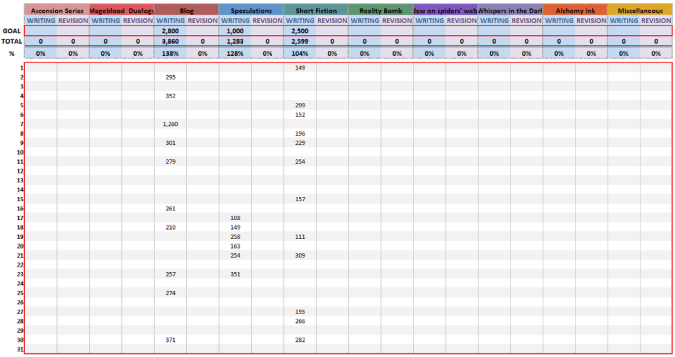
I continue to revise January’s short story. It’s closer, but not quite “there” yet. There’s more work to be done. February’s story waits in the wings. I set myself the goal of writing 2,500 words of short fiction in July and wrote 2,599 words or 104% of my goal.

I blogged 4,695 words of my 2,800-word goal, or 169%. This was largely because I finally got around to writing a book review. I have a backlog of them pending so expect more in the coming weeks. I may have to reconsider my blogging goals accordingly.

Finally, I wrote my latest Speculations column in 1,283 words, or 128% of my 1,000-word goal.

It was a decent month, writing wise, but quiet, as I said.

Filling the well

July 15th marked my 25th wedding anniversary with Phil. I mentioned on social media that it doesn’t seem like that much time has passed and yet I find it difficult to remember life without Phil. That’s not true, I have a lot of pre-Phil memories, but they’ve taken on a surreal quality, like they’re artefacts from someone else’s life.

On the 6th, my sister-in-law threw us a nice, quiet party. Just the Moms and some family friends. It was a lovely day.

The other writerly event I attended was Ad Astra, which was from July 12-14. I went down July 13 and came back July 14, so it was a bit of a whirlwind, but I still attended some great panels and met up with some writerly friends.

What I’m watching and reading

Phil and I watched the last season of Jessica Jones. It was disappointing, but I think that came of trying to turn a non-powered person, Sallinger, into an effective villain who managed to stymie the police, Jessica, Trish, Malcolm and J’s new boyfriend, AKA, headache boy 🙂 Jeri’s sub-plot was all over the place which, in turn, messed up Malcolm’s. Jessica’s reconciliation with Trish was never genuine and it was unsurprising when—SPOILERS!—the newly-minted Hellcat was arrested.

At the end, Jessica’s about to leave New York, dispirited by Trish’s downfall, her adopted mother’s death (following on the heels of her birth mother’s death at Trish’s hands), and her failure to bring Sallinger to justice. She’s broken up with her boyfriend, referred him to Costa as a CI, and handed the key to Alias Investigations to Malcolm.

As she’s purchasing her train ticket to a randomly chosen destination, Killian’s voice tells her how right she is to give up. Jessica’s surrounded by the violet light that is her first nemesis’s signature and she turns away from the ticket counter, smiling, while the camera pans wide and fades to black. Odd choice for a series ending.

We also watched the final season of i, Zombie, which was more satisfying, but a little contrived. I thought that—AGAIN SPOILERS!—Liv and Major’s decision to remain zombie, raising their zombie family and providing a home for all the zombies who couldn’t, or didn’t want to, be cured … odd. Not because they wouldn’t have done it. They would so have sacrificed their human lives to help others, but the reasons for their choosing this life arise so late in the game that it belies their previous and oft-expressed desires to the contrary.

No movies this month.

Reading-wise, I loved Lauren B. Davis’s The Grimoire of Kensington Market. It was a retelling of The Snow Queen but had a feminist flavour and living/mystical stores, which is a trope I’m fond of. I won’t say much more because this is another novel you should really pick up for yourself.

I also read Eden Robinson’s Son of a Trickster and, again, loved it. I find I’m really enjoying indigenous stories these days. I recommend it highly.

I read La Brigantessa, written by writerly friend Rosanna Micelotta Battigelli. This novel was historical fiction set in post-Unification Italy. It focuses on the journey of Gabriella and the event that force her to flee her village to eventually seek sanctuary with the brigands of the Aspromonte mountains.

Then, I read Jim Butchers The Aeronaut’s Windlass, which I enjoyed. I’m looking forward to the next instalment of the Cinder Spires series. While I loved Rowl, I thought it strange that he was the powerful figure in the cat world. Like the great cats, feral populations are generally matriarchies.

I liked the ensemble cast with their unique characteristics and abilities. Bridget’s ability to talk to cats, Benedict’s warrior-born, feline qualities, and the Etherealists’ insanity. This last was fascinating. Every Etherealist is twisted by the etheric forces they work with, but each, in order to control their madness, channels it into one aspect or obsession. Master Ferus needs collections of very specific things, his apprentice Folly can’t speak directly to anyone but her etheric crystals, and Sycorax is obsessed with etiquette and politeness. I’m curious to see more.

Next, I dove into Emma Newman’s Any Other Name, the second in her Split Worlds Series. The first novel left off on an uncomfortable note, with Cathy in an arranged, and forced, marriage. Her mother actually drugs her into acquiescence. The theme continues with Cathy’s new husband alternately trying to convince her to “make a go” of it, and using charms to coerce her into bed so they can a) consummate their marriage before either of their fae lords takes exception and b) conceive the child that is Cathy’s primary obligation in the arrangement.

The fae lords are manipulative in their own ways as are the family patroons. Charmed rings that enforce fidelity, charms that guarantee a boy at conception, and demands that Cathy become duchess of London and to keep up the appearances due her new station.

Meanwhile, Max continues to look into the mystery of the bath chapter’s destruction and Sam grows increasingly concerned about his wife’s promotion and new flat.

I read Story Arcana, by Caroline Donahue, ostensibly about using the major arcana of the tarot as a structure guide for both the novel and the writer’s life. I became aware of Donahue and her book through an interview with Joanna Penn on the Creative Penn podcast. While I found the book useful, it was poorly edited and largely a promotional tool for Donahue’s online course of the same name, site, and podcast. The podcast looks good and I’ll probably tune in. I was just a little disappointed in the presentation.

Finally, I read Joe Mahoney’s A Time and a Place. I enjoyed the story, loved the T’Klee, the novel’s cat-like aliens, and appreciated the parallels to T.H. White’s The Sword in the Stone. The execution wasn’t quite up to the premise, though.

Look forward to reviews of most of these books over the coming months.

And that was this month in this writer’s life.

Until tipsday, be well, be kind, and stay strong. The world needs your stories!
The Next Chapter

Tipsday: Writerly Goodness found on the interwebz, July 21-27, 2019

July is winding down and we’re heading into the dog days of summer: August. We’ve already had more than our share of hot, humid days—fact, I’m not complaining—and I’m trying to make the most of each one. I hope you’ve been making meaningful progress in your creative projects.

It’s time to reward yourself with some informal writerly learnings 🙂

Janice Hardy offers a Sunday writing tip: reveal something new in every scene. Then she wonders, are you asking—and answering—the right story questions? Fiction University

Alexa Donne talks about nailing your beginnings (first sentence through first act).

Tracy Hahn-Burkett says, if you want to make a difference, tell a story. Heather Webb offers some notes from a book tour. Keith Cronin shares some serious lessons from a fool on a hill. Writer Unboxed

K.M. Weiland explains how to make your plot a powerful thematic metaphor. Helping Writers Become Authors

Jenn Walton says, let your imagination run wild. Gabriela Pereira crawls inside the mind of a worldbuilding junkie with Fonda Lee. DIY MFA

Angela Ackerman visits Writers in the Storm to discuss character building for pantsers.

Jenna Moreci discusses some of the differences between flat and round characters.

Justin Attas wants you to create a credible magic system. Writers Helping Writers

Lisa Bell wonders, is your writing plan ready for a crisis? Jami Gold

Chris Winkle explains what storytellers should know about normalization. Choose compassion. Write stories that normalize the positive. Then, Oren Ashkenazi examines five stories with premises that don’t suit their settings. Mythcreants

Structuring a chapter. Reedsy

CBC books recommends ten Canadian science fiction and fantasy books you should be reading.

Ada Hoffman is moving towards a neurodiverse future by writing an autistic heroine. Tor.com

Thanks for visiting. I hope you’ve found something for your writerly toolkit.

If you’re looking for some inspiration or research material, be sure to come back on Thursday for some thoughty links.

Until then, be well, my friends 🙂

Tipsday2019

Tipsday: Writerly Goodness found on the interwebz, July 14-20, 2019

The weeks continue to march along, whether we want them to or not. Summer’s passing too fast! Console yourself with some informal writerly learnings.

Jan O’Hara extolls the life-changing magic of zeroing non-writing commitments. Carol Newman Cronin says, there are no wasted words: power to the pantsers! Julie Carrick Dalton is interrogating characters about their motivations. Writer Unboxed

Manuela Williams looks at five mistakes you’re making with your author brand (and how to avoid them). Pamela Taylor is extrapolating the past. DIY MFA

Reedsy examines the chosen one trope.

Robert Lee Brewer: everyday vs. every day. Writer’s Digest

Jeri Bronson’s married to a coroner and she explains the hows, whys and the WHAT?! Writers in the Storm

Jenna Moreci answers all your critique partner questions.

Lisa Cron poses three simple questions that will unlock your story. Writers Helping Writers

Nathan Bransford explains how authors make money.

Angela Ackerman visits Jami Gold’s blog to explain how to avoid the boring stuff in character descriptions. Then, Kassandra Lamb stops by: what’s the right way to include multiple POVs?

Oren Ashkenazi examines six stories with failed turning points. Mythcreants

Nina Munteanu considers Vonnegut’s ice-nine and superionic ice. Science!

Thanks for stopping by, and I hope you found something you need to help you with your current work in progress.

Until Thursday, be well, my writerly friends!

Tipsday2019

Tipsday: Writerly Goodness found on the interwebz, July 7-13, 2019

Looking for some informal writerly learnings? Here they are!

Jim Dempsey offers some fiction therapy: achieve your writing goals. Juliet Marillier explains why editing matters. Then, David Corbett shares the content of his Thrillerfest workshop about characters in search of a moral compass. Writer Unboxed

Sacha Black explains why every novel needs a sprinkling of fear. Writers Helping Writers

How to write with multiple POVs. Reedsy

Julie Cantrell wonders, should authors break free from their brands? Then, Julie Glover shares seven tips for finding a great critique partner. Writers in the Storm

Jenna Moreci shares her top ten romance tropes.

Rebecca Fish Ewen explains how to draw nothing. DIY MFA

Chris Winkle lists five information technology blunders and how to fix them. Then, Oren Ashkenazi examines five popular tropes writers struggle with. Mythcreants

Show, don’t tell, the Reedsy way.

Nathan Bransford explains why Robert Louis Stevenson’s Treasure Island works. This novel was one of two I focused on for my independent study in grade 12 English class. I have a fondness, and a bias 😉

I’m putting this in tipsday, because reasons. The Lost Words Blessing – The Lost Words.

Thanks for stopping by and I hope you found something useful.

Until Thursday, be well, my writerly friends!

Tipsday2019

Tipsday: Writerly Goodness found on the interwebz, June 30-July 6, 2019

Another week, another batch of informal writerly learnings 🙂

Jeanette the Writer: forewords, introductions, and prologues … oh, my! Then, Tammy Lough wants to help you create your series bible. DIY MFA

K.M. Weiland wants you to take your writing to the next level: whole-life art. Helping Writers Become Authors

Yi Shun Lai: better your writing by being a beginner—every day. Later in the week, Justin Attis warns against some common pitfalls of trying to make your story “unique.” Jane Friedman

Sophie Masson relates the pleasures and pitfalls of writing a multi-POV narrative. Donald Maass is back to the one-word titles: legendary. Bryn Greenwood explains what a ghost heart has to do with writing fiction. “The difference between the memoir I’ll never write and the novels I can’t stop writing is all about processing personal experience into fiction.” Jo Eberhardt: one story, many paths. Writer Unboxed

Tamar Sloan is digging deep into the psychology of a layered story. Writers Helping Writers

Fae Rowan writes about lost love and using your young adult voice. Later in the week, Janice Hardy stops by to explain how to write an opening scene that hooks readers. Writers in the Storm

David Safford explains how to apply helpful writing feedback (and how to know what you can ignore). The Write Practice

Chris Winkle shows you how to avoid melodrama in your writing. Then, Oren Ashkenazi writes about water travel before engines. Mythcreants

Cory Doctorow: I shouldn’t have to publish this in the New York Times. The New York Times

Open Culture reveals how Jane Austen edited her manuscripts with straight pins.

And that was tipsday. I hope you found something you need to help with your current work in progress.

Until Thursday, be well!

Tipsday2019

Tipsday: Writerly Goodness found on the interwebz, June 23-29, 2019

Welcome July! We’ve finally hit summer up here in northeastern Ontario. And it was just Canada Day (yesterday)! It’s time to celebrate with some informal writerly learnings 🙂

CanadaDay

Nathan Bransford explains how to handle multiple protagonists in a query letter. Later in the week, he shares a list of character strengths and weaknesses.

Julie Duffy says, creation is messy—and that’s okay. Barbara O’Neal is writing the next book. John J. Kelley lauds stories that liberate. Writer Unboxed

Abigail K. Perry examines James Scott Bell’s signpost scene #12: mounting forces. Brenda Joyce Patterson takes a deep dive into historical poetry. DIY MFA

Lisa Hall-Wilson wants you to make your setting real with strategic description. Tasha Seegmiller explains how to survive a writing crisis. Laura drake talks ideation: where do ideas come from? Writers in the Storm

Jenna Moreci lists ten reasons you’re not “making it” as a writer.

Again, Alexa Donne riffs on a similar theme: five reasons fiction writers quit.

K.M. Weiland shares four ways to write gripping internal narrative with the help of a brave critique volunteer. Helping Writers Become Authors

What does “plot reveals character” mean? Jami Gold has the answer.

Orly Konig proposes mind mapping as a pantser’s path to plotting. Fiction University

Oren Ashkenazi looks at six stories that focus too much on side characters. Mythcreants

Molly Templeton: YA Twitter can be toxic, but it can also point out real problems. Buzzfeed

Thanks for stopping by, and I hope you found something you need to help move your current creative project forward.

Until Thursday, be well, my friends!

Tipsday2019

Tipsday: Writerly Goodness found on the interwebz, June 16-22, 2019

A nice, plump bunch of juicy informal writerly learnings. Yes. I have fresh strawberries on the brain. I drool watching them ripen in the garden!

Anthea Lawson Sharp (who writes romance as Anthea Lawson and Fantasy as Anthea Sharp) talks about the craft of short fiction. Later in the week, Margie Lawson writes about the power of silence on the page. Writers in the Storm

Vaughn Roycroft shares a father’s legacy. Sonja Yoerg: writing characters with personality using Myers-Briggs. Erika Liodice asks, are you a student? Resounding YES here 🙂 Writer Unboxed

K.M. Weiland makes the final instalment in her Dos and Don’ts of Storytelling According to Marvel series: five ways to earn your audience’s loyalty. Helping Writers Become Authors

Julia Roberts says, writer’s block is a gift (and explains why). Then, H.R. D’Costa shares five ways to ensure readers don’t abandon your book. Jane Friedman

Lisa Lowe Stauffer stops by Fiction University. Jamie Fraser eats an apple: using objects to inject character and world building into dialogue. Later in the week, Janice Hardy explains what setup in a novel actually means and then follows that up with four steps to establish the beginning of your novel.

Chris Winkle makes the next instalment in her goal-oriented storytelling series: tension. Writers Helping Writers

Jenna Moreci offers her definitions of active and passive characters and her tips for writing active characters.

Interestingly, Alexa Donne also expounds on character agency and growth. A theme?

Nathan Bransford explains how to work with a literary agent on edits.

Emily Wenstrom advises what to do when your social media growth stagnates. Here’s my latest speculations column: what psychology and neuroscience contribute to your stories. DIY MFA

Chris Winkle extracts some lessons from the writing of The Name of the Wind. Then, Oren Ashkenazi considers building democracy in your fantasy world. Mythcreants

Tale Foundry introduces us to eight of Sir Terry Pratchett’s clever(est) characters.

Roz Morris shares the “under-arrest” test for ensuring a satisfying ending. Nail Your Novel

CD Covington thinks the Sapir-Whorf hypothesis is good fiction but bad science. Because language. Tor.com

Lynn Neary and Patrick Jarenwattananon celebrate Joy Harjo’s appointment as the first Native American US poet laureate. NPR

That should be enough to see you through until Thursday when I have a tidy batch of thoughty for you 🙂

Until then, be well, my writerly friends!

Tipsday2019

Tipsday: Writerly Goodness found on the interwebz, June 9-15, 2019

Here we are, in mid-June, half-way through the year. Celebrate whatever you’ve accomplished and enjoy some informal writerly learnings 🙂

Arthur Klepchukov says, word count goals shouldn’t be your only goals. Jim Dempsey explains how to respond to criticism. Sarah Callender considers things she forgets to remember when she’s writing a novel: mood. Kathryn Craft: when something good incites story. Writer Unboxed

Julie Glover shares five tips for writing great dialogue from The Gilmour Girls. Barbara Linn Probst takes a fresh look at “writing what you know.” Writers in the Storm

Jenna Moreci returns with part three of her dialogue series: it’s all about tags.

K.M. Weiland lists six requirements for writing better character goals. Helping Writers Become Authors

Jami Gold: are story goals slowing your pace? Writers Helping Writers

Then, Jami follows up on her own blog: can passive goals ever be good for our stories?

Alexa Donne shares her magic editing hack that fixes pacing.

Nathan Bransford lists the most common mistakes writers make. Then he explains what it takes to write a good climax for a novel.

Leanne Sowul wants you to balance the supply and demand of the writing life. DIY MFA

Sarah McGuire explains how to guide a critique. Fiction University

Cat Rose explains how to survive a conference even if you’re an introvert. The Creative Penn

Bunny helps you select classical music to set any scene. Then, Oren Ashkenazi looks at four problematic tropes to drop and what you can do instead. Mythcreants

Jane van Koerverden reports on the $6K literary award to honour YA books written in an indigenous language. CBC

Thanks for stopping by and I hope you found something of value in the mix.

Until Thursday, be well. See you then 🙂

Tipsday2019

Tipsday: Writerly Goodness found on the interwebz, June 2-8, 2019

Here’s a nice bundle of informal writerly learnings for you 🙂

Jael McHenry is making room for silence. Nancy Johnson: what white writers should know about telling black stories. Donald Maass explores the myriad ways in which mystery shapes your story (and returns to the pithy one-word titles). Cathy Yardley offers a snapshot of her writing process. Writer Unboxed

K.M. Weiland explains how to write interesting scenes. Helping Writers Become Authors

James Scott Bell wants you to stay thirsty. Writers Helping Writers

Sara Letourneau is identifying themes in poetry. Laura Highcove wants you to reclaim your agency from writer’s block. Then, Charlene Jimenez describes the five people fiction writers need in their lives. DIY MFA

Jenna Moreci rails against her ten most hated hero tropes.

Fae Rowan suggests these six f-words to create compelling characters. Writers in the Storm

Tara East guest posts on Joanna Penn’s blog: how overwriters can reduce their word count. The Creative Penn

Emily Wenstrom suggests several different tools to track world building in a fantasy series. Writer’s Digest

Chris Winkle explores five relationship dynamics for stronger romances. Then, Oren Ashkenazi explains five ways terrain affects fantasy battles. Mythcreants

Hank Green shares eight things he wished he’d known when he wrote his first book – vlogbrothers

Nathan Bransford thinks this Roald Dahl video is everything. I so love process-y stuff 🙂

And Catherine Ryan Howard shares her process (in parts—more to come): the BIG IDEA.

I hope you enjoyed this curation and found something for your current of next creative project.

Come back on Thursday for your weekly dose to thoughty!

Until then, be well, my writerly friends 🙂

Tipsday2019