Tipsday: Writerly Goodness found on the interwebz, Dec 29, 2019-Jan 4, 2020

It’s the first tipsday of 2020! Get yourself some informal writerly learnings here 🙂

Kris Maze offers some New Year’s reflections on wellness and this writer’s life. Eldred Bird says, let your characters tell the story. Writers in the Storm

Ten qualities an agent wants to see in a writer. Bookends Agency

Bess Cozby suggests five writing resolutions beyond “write every day.” Tammy Lough helps you ramp up your dialogue with help from Isaac Newton. Samantha Hanni shares five ways to aid your editor. DIY MFA

Donald Maass revisits the un-con a second time: emotional tipping points. Barbara Linn Probst shares a 2020 vision. Julianna Baggott wants you to set aside the planning and the pantsing and consider a land of your own invention. Writer Unboxed

Jenna Moreci lists ten things you should do before you write your novel. My favourite bit: Writing a book is hard. Books don’t just fall out of your mind vagina. 😀

Chuck Wendig says that in 2020 you should write with a knife to your back and the cliff’s edge at your feet. Terribleminds

Chris Winkle explains how The Rise of Skywalker finally made Kylo Ren worth redeeming. Mythcreants

Thank you for visiting and I hope you found something to fuel your current work in progress.

Until Thursday, be well!

Tipsday2019

The next chapter: December 2019 update and year-end wrap-up

Here we are at the beginning of a new year and a new decade. The possibilities seem endless. I hope you’ve all set reasonable goals and are diving into your work with passion and compassion.

The month in writing
Dec2019Progress

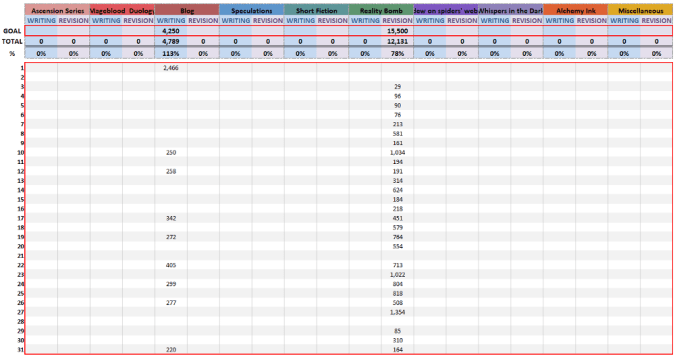
In December, my focus was on continuing to rewrite Reality Bomb. I set my goal at 500 words per day or 15,500 words for the month. I wrote 12,131 words, or 78% of my goal.

The only other thing on my writing plate was this blog. I wrote 4,789 words of my 4,250-word goal, or 113%.

And that’s it.

2019 in review

I started off the year ambitiously, as I always do (more on that in a bit). In addition to finishing drafting book five of my epic fantasy series, Tamisashki, roughly revising RB for presentation to my critique group, blogging, and my bi-monthly Speculations column for DIY MFA, I’d decided to write, revise, and submit one short story per month, revise a poetry collection and two collections of my previously published short fiction.

Add to that my involvement in the critique group, which meant—surprise—critiquing some of my partners’ work, attending Ad Astra, Can-Con, and Wordstock Sudbury, and I had a fuller-than-usual plate. Yes, I was finally over my burnout, but I suspected, even as I set these ambitious goals, that I wasn’t up to accomplishing all of them.

Yeah. While I did revise my poetry collection (and wrote a new poem—yay, me), I only managed to write and revise one short story and start on one more before I realized that the one-story-per-month goal was untenable. I never got to either of the short story collections aside from putting them on my 2019 Writing and Revision Tracker.

I did write one side project, a guest post about writers’ grief for WarpWorld, but that was the only unplanned writing I did.

So, I adjusted my goals. Several times. But what I have on this summary page is what I ended up with.
2019Progress

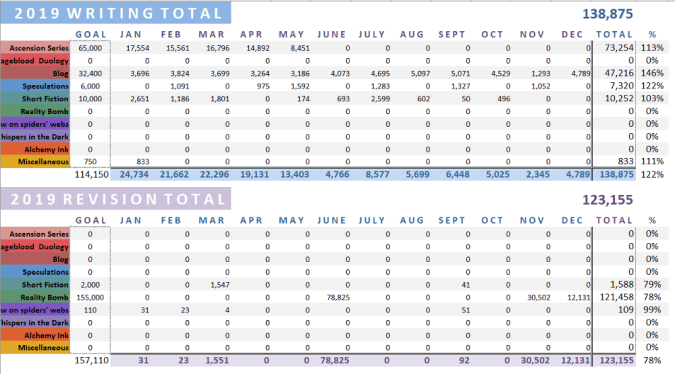
On the writing side of things, I did rather well. Of my collective 114,150-word goal, I wrote 138,875 words, or 122%.

I revised (or rewrote) 123, 155 words of my 157,110-word goal, or only 78%.

Interestingly, the average of my writing and revision percentages is 100%.

Still, between writing and revising, I produced 262,030 words in 2019. That’s over a quarter of a million words. I’m damned pleased with that.

Filling the well

I relaxed in December. I’m fairly certain that I, like many people in northern Ontario, suffer from some degree of seasonal affective disorder (SAD). Self-care is important for me at this time of year. Accordingly, I spent a quiet holiday with family.

Consider me a bear. Winter is my time to hibernate 🙂

What I’m watching and reading

With regard to series, Phil and I watched the new Watchmen series and His Dark Materials in December.

We liked Watchmen because it was consistent with the feeling of the graphic novels and, to some extent, the movie. It was a slow burn to start with, which we don’t mind, particularly in this case, as everything came together in a truly surprising twist. The denouement was satisfying, and the cliffhanger was something that, while I’d be happy to see what happens next, if a second season isn’t in the cards, I would be satisfied with the possibilities it presents without needing a definitive answer.

His Dark Materials was well done, better than the movie, in any case. As in many adaptations, changes were made that would better serve the medium, and I appreciated many of the decisions made for this iteration of Phil Pullman’s novels. I liked the actors and the incorporation of Will’s plotline into this season. A solid season and I hope BBC’s collaboration with HBO will continue.

We started watching Witcher, but it was more of a gap-filler and Phil gave up after the third episode. We didn’t even get through the first episode of the second season of Lost in Space before Phil walked away. I’ll probably pick up both when I’ve made some room on my personal Netflix viewing.

Reading-wise, I grabbed Erin Morgenstern’s The Starless Sea right after Call Down the Hawk. I enjoyed it right up to the ending, which was confusing and unsatisfying for that reason.

Then, I picked up Diana Gabaldon’s collection of novellas, Seven Stones to Stand or Fall. It was a bit of a cheat because I’d read all but two in their individual novella forms. I’m a big Gabaldon fan, though, and I like the way she writes into the gaps in her larger series of books.

Next, I read Tomi Adeyemi’s Children of Virtue and Vengeance. It was okay but suffered from many of the same problems as the first book in the series. The characters are all moving between love and hate for themselves and one another so quickly that I got whiplash. I understand that this is YA and the characters are all teenagers, but there were several points at which I felt that the drama was just too much.

Six of Crows was much stronger than Shadow and Bone. Maybe Leigh Bardugo is better at ensemble casts, or heist plots? The characters were stronger and had more agency. They felt more grounded and complex. Whatever the reason, I enjoyed it.

To finish off the year, I returned to a couple of classics. Charles Dickens’ The Chimes, and A.A. Milne’s Winnie the Pooh. Dickens has a fondness for ghosts and time travel lessons. Winnie was just charming.

I’d set myself a reading goal for the year of 50 books and ended up reading 71 (!) or 142% of my goal.

What’s up in 2020

I think I’ve finally learned my lesson, writing-wise. I’ve focused in on what I need to do and let my ambitions amuse themselves.

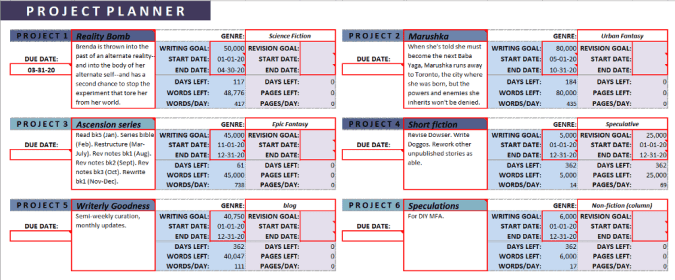
Given my reduced—but still good—production, I’m giving myself until the end of April to finish the rewrite of RB. The core story remains the same, but the content is different enough that it is like writing a new novel. Accordingly, while I counted the work I did in November and December as revision, I’m counting everything in 2020 as writing.

Then, I’m going to begin work on revision/rewriting Marushka. I’d put it up for critique in early 2019 but didn’t feel as strongly about getting back to it as I did about RB. I have to make some decisions about this novel which could entail a significant rewrite … or not. I’ll make those decisions when I review the novel and the critique feedback.

Throughout the year, I’m going to be steadily working on the Ascension series. I should finish my initial reread by the end of January. Then, I’m going to work on the series bible and revision notes on all five novels. By November, I should be ready to tackle revision/rewrites on book one.

I’ll blog, as usual and keep up with my Speculations column. If I can fit it in, I’ll work on some short fiction. I haven’t made any hard and fast goals with respect to the short fiction, though. If it has to go by the wayside, so be it.

The one last thing I’m going to do is shop the poetry collection around, as well as some of my unpublished poems, to see if I can’t do something with them.
2020Goals

I’ll likely attend Ad Astra, Can-Con, and Wordstock again.

So, my plans are much more modest this year. I’m hoping I won’t have to sacrifice much more than the short fiction.

I’ve set my reading goal for 60 books this year, but I’m not sure I’ll achieve it. I put off reading several monster books that I’ll probably tackle in 2020.

By the way, if you like the Writing and Revision Tracker in the screen shots, Jamie Raintree created it. Please do yourself a favour and visit her website to find out more.

That’s it for this update. I generally do them on the first weekend of every month.

Until next time, be well, be kind, and stay strong. The world needs your stories.
The Next Chapter

Tipsday: Writerly Goodness found on the interwebz, Dec 8-14, 2019

Here are some informal writerly learnings to peruse while you’re preparing for, or celebrating, the holidays.

Lori Freeland says that show, don’t tell, are the three most misunderstood words in a writer’s vocabulary. Then, Colleen M. Story shared seven ways writers can overcome holiday anxiety. Julie Glover is saying no to get to a more important yes. Writers in the Storm

Shaelin shares five of her favourite tropes. Reedsy

Rheea Mukherjee makes notes on writer dreams, gratitude, and the anxiety of authenticity. Jim Dempsey wants you to manipulate your reader’s point of view. Sarah Callender asks, is imitating the greats helpful or harmful? Kathryn Craft is manipulating story time for maximum effect. David Corbett shares a lesson in forgiveness from The Crown. Writer Unboxed

K.M. Weiland critiques: ten ways to write a better first chapter using specific word choices. Helping Writers Become Authors

Roz Morris shares five post-NaNoWriMo ways to use the holidays to keep your new writing habits … without revising too early. Nail Your Novel

Abigail K. Perry digs into James Scott Bell’s signpost scene 13: the final battle. Brenda Joyce Patterson takes a deep dive into the essay. Then, Constance Emmett shares five tips for post-publication survival and success. DIY MFA

Robert Lee Brewer points out the difference between lets and let’s. Writer’s Digest

Nathan Bransford offer the eight essential elements of a story.

Chris Winkle shares five ways to make multiple points of view more engaging. Then, Oren Ashkenazi explains why some dark topics are more sensitive than others. Mythcreants

Tim makes some excellent points about writing power escalation. Hello, Future Me

Heidi Fiedler stops by The Creative Penn: five ways to quiet your inner editor.

Jami Gold asks, what’s your core story?

Thank you for stopping by. I hope you’re leaving with some great resources for your current work in progress.

Until Thursday, be well!

Tipsday2019

Tipsday: Writerly Goodness found on the interwebz, Dec 1-7, 2019

Aaaaand … I’m back with some lovely informal writerly learnings for you 😉

Jael McHenry: writing, verbs, and time. Ray Rhamey extols the fun of pantsing. Donald Maass: un-con redux—operation phoenix. Susan Spann cries, curses—foiled again! Cathy Yardley wants you to play to win. Writer Unboxed

Jenna Moreci digs deep to list her top ten dystopian tropes.

Robert Lee Brewer clears up the confusion around lose, loose, and loosen. Writer’s Digest

Emily Wenstrom offers five tips to set (and keep) an author platforming resolution. And here’s my latest Speculations: five awesome ways NASA’s all-woman spacewalk inspires us. DIY MFA

James Scott Bell answers the question, is it necessary to write EVERY day? Then, Angela Ackerman is mastering show, don’t tell. Writers Helping Writers

Writing anti-heroes with Reedsy.

Spencer Ellsworth says, outlines are for revision (say what?)—a different approach for your process. Fiction University

Ellen Brock shares a simple strategy for novel editing.

Chris Winkle shares lessons from the disingenuous writing of Maximum Ride. Then, Oren Ashkenazi considers what makes an antagonistic group problematic. Mythcreants

Thanks for stopping by and I hope you found something you need to fuel your current work in progress.

Until Thursday, be well, my friends.

It’s good to be back.

Tipsday2019

Join me over at DIY MFA for my latest Speculations

This time around we’re drawing inspiration from the real history of women in space.

AllWomanSpacewalk

While you’re there, check out the site, the other columnists, and all of Gabriela’s great resources!

Until next time, be well!

Tipsday: Writerly Goodness found on the interwebz, Oct 20-26, 2019

Counting down to Hallowe’en, NaNoWriMo, and Wordstock Sudbury! Be prepared with this excellent selection of informal writerly learnings 🙂

Jan O’Hara helps you avoid a writing cat-astrophe. Sarah McCoy: confession of a lapsed reader. Heather Webb is writing boldly, without fear. Writer Unboxed

Meg LaTorre catalogues filter words you should remove from your manuscript. iWriterly

Becca Puglisi shows you how to use secondary characters to sway the reader. Eldred Bird explains how to create a multi-use logline. Then, Margie Lawson shows you how to make hugs carry power. Writers in the Storm

K.M. Weiland offers a writer’s guide to understanding people. Helping Writers Become Authors

Bonnie Randall: scaredy-pants! Four breeches—er, breaches—that elicit fear in your characters. Then, Janice Hardy shares two tips that make plotting your novel way easier. Fiction University

Jeanette the Writer shares six things editors want writers to know. Gabriela Pereira interviews Nicole Valentine about pacing, world building, and time travel. Savannah Cordova shares five tips for writing nail-biting suspense. Then, Rayne Lacko offers five ways to write what you want to understand. DIY MFA

Chuck Wendig wants you to find the balance of self-care and tough love. Terribleminds

Chris Winkle: Carnival Row shows us the damage a reveal can do. Then, Oren Ashkenazi analyzes five slow story openings and explains how to avoid them. Mythcreants

Jenna Moreci shares ten tips for creating magic systems.

Christina Bacchilega: how mermaid stories illustrate complex truths about being human. Literary Hub

Thank you for stopping by and I hope you found something useful for the busy writing months ahead.

Until next time, be well!

Tipsday2019

Tipsday: Writerly Goodness found on the interwebz, Oct 13-19, 2019

Another week, another batch of informal writerly learnings. Enjoy!

K.M. Weiland: this is how to transform infodumps into exciting plot reveals. Helping Writers Become Authors

Roz Morris considers what your readers will never notice (and what they will) … a brief point about reader belief and story logic. Nail Your Novel

Dave King talks gatekeepers. Kathleen McCleary: the books that get people talking. Tiffany Yates Martin explains how to train your editor brain. Writer Unboxed

Shaelin Bishop shares seven of her favourite writing tools.

Ethan Ellenberg gives authors the big picture on intellectual property. Jane Friedman

Angela Ackerman lays out the free and paid story feedback options for authors. Later in the week, Savannah Cordova from Reedsy visits: what can the best metaphors in literature teach us about writing? Writers Helping Writers

Abigail K. Perry looks at James Scott Bell’s signpost scene 12: the Q factor. Brenda Joyce Patterson takes a deep dive into novellas and novelettes. DIY MFA

Julie Glover give us more on plotting, pantsing, and personality type. Writers in the Storm

Jami Gold warns you to watch for redundancy in your story.

Jane Friedman reports on current trends in traditional book publishing.

Chris Winkle shares 18 ways for protagonists to contribute. Mythcreants

The complex problems with mental illness in fiction. *Please be aware that this video essay discusses suicide, self-harm, obsessive-compulsive disorder, and other mental health issues. While it’s very well done (in my opinion), the video offers no solutions. If you prefer not to watch, do not click through on this one.* Hello Future Me

Nina Munteanu considers science fiction on water justice and climate change.

Thanks for visiting! I hope you found something to help you progress with your work in progress.

Until Thursday, be well, my writerly friends!

Tipsday2019

Tipsday: Writerly Goodness found on the interwebz, Oct 6-12, 2019

This week’s curation of informal writerly learnings for your consideration.

Julie Glover talks plotting, pantsing, and personality type. [Hehe! I was one of the 87 people on FB who responded to Julie’s question 🙂 ] Lisa Hall-Wilson shares four pro tips for writing the emotional journey in deep POV. [I’m participating in Lisa’s five day deep POV challenge!] Writers in the Storm

Jael McHenry considers the novelist’s necessary evils. Jim Dempsey says, writing is a labyrinth of choices. Sarah Callender forgets to remember that writing can be uncomfortable. Kathryn Craft lists 12 signs that you’re afraid of your work in progress. Writer Unboxed

Janice Hardy explains how to ground (and hook) your reader in your opening scene. Then, Janice shares lessons learned from a decade in publishing. Fiction University

Meg La Torre visits Jenna Moreci and explains everything you ever wanted to know about literary agents.

K.M. Weiland issues a challenge to write life-changing fiction. Helping Writers Become Authors

Sacha Black helps you embrace diversity by writing the character you’re afraid to write. Then, Lisa Hall-Wilson explains how to scare your readers using deep point of view. Writers Helping Writers

Emily Wenstrom explains how (and why) to market yourself. Savannah Cordova shares five highly effective ways to reboot your creative system. DIY MFA

Macy Thornhill shares six ways to stay productive in a creative slump. The Creative Penn

Chris Winkle offers some thoughts on reconciling your character’s choices with your plot. Then, Oren Ashkenazi considers five more underutilized settings in speculative fiction. Mythcreants

Sabrina Imbler reports that the Merriam-Webster of medieval Irish has just got a major update. Atlas Obscura

Mental Floss presents 30 Harry Potter word origins 🙂

Joolz looks at English idioms and where they come from. ‘Cause language!

And that was tipsday. Thanks for stopping by and I hope you found something useful for your current work in progress.

Until Thursday, be well, my writerly friends!

Tipsday2019

Tipsday: Writerly Goodness found on the interwebz, Sept 29-Oct 5, 2019

A nice, compact batch of informal writerly learnings, this week.

Piper Bayard and Jay Holmes list ten character traits of an espionage hero. Later in the week, Janice Hardy stops by and explains what happens when your plot hides behind the details. Writers in the Storm

K.M. Weiland poses five questions to help you choose a protagonist who represents your story’s theme. Helping Writers Become Authors

Nancy Johnson asks, is your book done yet? Donald Maass explores the making of a hero or heroine. Bryn Greenwood talks about what happens after your dreams come true. Cathy Yardley: dare to deliver. Writer Unboxed

Tamar Sloan dig into writerly procrastination, why it happens, and how to break free of it. Then, Angela Ackerman wonders, how do you know if your protagonist is strong enough? Writers Helping Writers

How to write a strong protagonist. Reedsy

Leanne Sowul explains how to find your writing purpose. And here’s my latest Speculations column: five ways to rock NaNoWriMo. DIY MFA

Robert Lee Brewer sorts out the distinctions between imminent, immanent, and eminent. Writer’s Digest

Chris Winkle: six rape tropes and how to replace them. Then, Oren Ashkenazi examines siege warfare before gunpowder. Mythcreants

Thanks for stopping by. I hope you found something to help you wrestle your work in progress into shape.

Be well until Thursday!

Tipsday2019

The next chapter: September 2019 update

Ah, October. My favourite month, mostly ‘cause my birthday 🙂 Yes. I’m a child.

The month in writing

We’re just going to get right to it.

SeptProgress

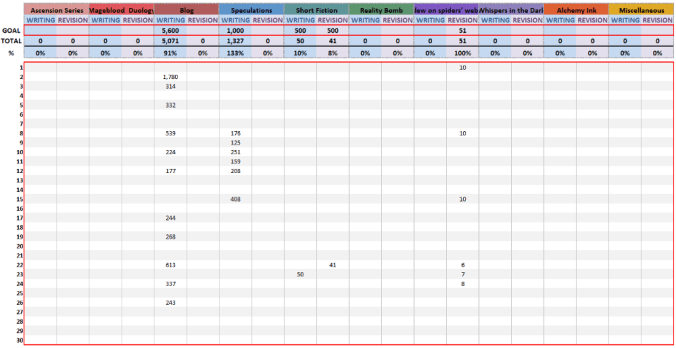
I made the decision to post only two book reviews this month (though one was of two novellas), and so I was a bit short of my blogging goal. 5,071 words of my 5,600-word goal, or 91%.

I got my latest Speculations written and submitted early because I headed down to Toronto for a day-job learning event. I wrote 1,327 words of my 1,000-word goal, or 133%.

I wrote all of 50 new words on short story number two and revised 41 words on short story number one. Even with a meagre 500-word goal for each, that was 10% and 8% respectively.

I went through the poetry collection again. This one, I decided to track by the number of poems revised. 51 of 51, or 100%. I have one more pass to make before the collection is ready for submission. I hope to get that done this month.

I got my second rejection on my poetry. Will send out more submissions.

In non-tracking projects, the read-through of Ascension continues. I’m almost finished with book three and will move onto book for this month.

I’m also 31 handwritten pages into revision notes for the SF novel that didn’t know what it was. It’s shaping up and I should be ready for my stint as a NaNo rebel next month.

I’ve also critiqued another project for my online critique group and have moved on to another.

One thing I’ve learned in the past few months is that you can still be a working writer, even if you’re not producing a lot of words. Not all writing is writing. Sometimes it’s reading, critiquing, planning, and thinking. You have to make space for all of it.

Filling the well

No writerly events in September, but I did get together with a couple of writer friends for and evening of Thai food and chat. It was just what I needed to refresh and refocus.

No pictures. Sorry.

Here are a few of my random photos from the last month instead 🙂

What I’m watching and reading

This month, Phil and I watched Carnival Row. We enjoyed the gritty, alternate world, the murder mystery wrapped up in a tragic origin story, and cheesy prophecy trope. It was nice how most of the story elements were connected to the main plot and so, as events unfolded, the characters developed and changed accordingly.

The final season of Killjoys came to an end in September as well. I didn’t appreciate all the creative choices that were made in this final season. Several of them felt forced, or worse, contrived. The series has always been more fun than philosophical, though, and things ended well.

I finished watching the first season of The Order. It really didn’t know what it wanted to be. Magical university? Werewolf story? Magical revenge tale? Things were tied together loosely, and the ending was disappointing. The titular order erases the memories of the werewolves and steals all their artefacts and research library. Really, I was left wondering why I should care.

Finally, The OA. The first season kind of ruined me with the second to last episode. When the box of incriminating books was found and everyone basically abandoned Prairie, deciding that she must be crazy/delusional, it completely undermined everything that happened in the final episode. Having broken my credibility, the series could not restore it. I basically went through the motions to finish watching, because I prefer to have a complete picture.

I wasn’t going to watch the second season, but I wanted to see how they could possibly move forward. And, honestly, it wasn’t horrible. The second season suffered from some of the same issues as the first, however. I watched it with a sceptic’s eye, distrusting everything the creators asked me to take on faith. Again, things were building to a climax and then, Pairie/Nina and Hap end up jumping to a universe in which they are Brit Marling and Jason Isaacs on a movie set. Oh, yeah. Though Michelle’s soul was retrieved by detective Karim, there was no real resolution for those left behind in the first universe, or for Homer, who finally remembered who he was but was trapped in the second.

I’m glad there won’t be a season three. At least, that’s the word on the interwebz at the moment.

Reading wise, I finished Mary Robinette Kowal’s Ghost Talkers, in which a corps of mediums help the allies in an alternate WWII. Loved. Kowal has indicated that she would like to revisit the world, but her Lady Astronaut books are demanding her time and creative energy at the moment.

I also finished Matthew Hughes’ What the Wind Brings, which he unabashedly calls his magnum opus. This was historical fiction, and I reviewed it last month.

Sarah Gailey’s A Taste of Marrow was next, and I enjoyed this second novella in her alternate America inspired by a strange-but-true plan to import hippos. This was my second posted book review last month and I looked at both novellas, which have been combined in one volume as American Hippo.

After I finished watching the last season of The Handmaid’s Tale, I finally read the book that inspired the series. I enjoyed the book more than some of Atwood’s others, I have to say, though it does share some of the aspects that I found problematic. June is another unreliable narrator, but why wouldn’t she be? The June of the book is never dependably identified by that name, though there is some speculation in the symposium appended to the end of the novel. She lives in fear, far more fear than Elizabeth Moss portrays in the series. She’s far less empowered. June is, essentially, a slave. It makes for an oddly distanced read.

Finally, I read Sean Carroll’s Something Deeply Hidden: Quantum Worlds and the Emergence of Spacetime, which I enjoyed though much of the content was over my head. Frankly, it blew my mind a bit. I read this one for research. It ties into the SF novel I want to revise.

Again, selected reviews will be forthcoming.

And that was September in this writer’s life.

Until next time, be well, be kind, and stay strong. The world needs your stories.

The Next Chapter