Tipsday: Writerly Goodness found on the interwebz, June 27-July 3, 2021

Welcome to another week of informal writerly learnings 🙂 Enjoy!

Erika Liodice explains how to create an authentic setting from a place you’ve never been. Matthew Norman advises, when in doubt, look about. Then, Deanna Cabinian offers some tips from a pregnant lady on deflecting unsolicited writing advice. Nancy Johnson shares three tips for mastering conflict in your novel. Later in the week, Julie Carrick Dalton is crafting climate futures we can survive. Writer Unboxed

Princess Weekes looks at WandaVision and the feminine madness. Melina Pendulum


K.M. Weiland completes her review of the flat archetypal arc with the mentor in part 21 of her archetypal character arcs series. Helping Writers Become Authors

Colleen M. Story lists three reasons writing is a healthy form of escape. Elizabeth Spann Craig

Writing compelling character relationships. Shaelin Writes

James Scott Bell says, act like a professional. Colleen M. Story explains how to tell the difference between procrastination and a true writing crisis. Writers Helping Writers

Princess Weekes loves Octavia E. Butler, the grand dame of science fiction. It’s Lit | PBS Storied

Tasha Seegmiller is exploring a character’s past wound. Then, Julie Glover shares five more quick dialog tips. Writers in the Storm

Emily Zarka looks at the macabre origins of the grim reaper. Monstrum | PBS Storied

My latest speculations: ten AAPI science fiction and fantasy authors to read right now. Later in the week, Lauren Eckhardt shared five ways to catch your golden butterfly. DIY MFA

Why slow adulting is a good thing. The Take

Kristine Kathryn Rusch presents part seven of her fear-based decision-making series: fear and all writers.

Rachelle Shaw lists ten alternative types of short fiction. Fiction University

Jane Friedman breaks down where her money comes from.

The dangerous woman. How we package female sexuality. The Take

Chris Winkle points out what you need to know when planning character arcs. Then, Oren Ashkenazi analyzes six twists that hurt the story. Mythcreants

Nate Berg: stunning new museum brings Hans Christian Andersen’s stories to life. Fast Company

Hank you for taking the time to stop by, and I hope you found something to support your current work in progress.

Until Thursday, be well and stay safe!

The next chapter: June 2021 update

Here we are in July, after a strangely introspective and quiet national holiday—on this side of the border, anyway. I won’t speak for my American friends. With the discovery of nearly a thousand unmarked graves near residential schools, I, and many Canadians of colonist descent, have been examining our collective lack of action with respect to the Truth and Reconciliation Commission’s recommendations.

If you read the calls to action—and I encourage you to—they’re mostly common sense. Ensure that all Indigenous communities have clean water, solid infrastructure, support for health and mental health needs, and so on. Reuniting Indigenous families, doing whatever we can to identify the occupants of unmarked graves, and demanding accountability from the Catholic church (other protestant denominations and the federal government have already apologized, but no further action has been taken) are the least we can do.

And how do we do it? Personal actions are a start, but we can act most powerfully by lobbying our local members of parliament and through voting. If swift action is not taken by the government in power, then we elect a government who will act.

With that, I’ll segue into my usual PSAs:

All lives cannot matter until all BIPOC lives matter.

Wear your masks, wash your hands, and get fully vaccinated. The delta variant wants to undo all our good work. Don’t let it!

The month in writing

The month started out well. I was making headway with Reality Bomb, and once I got the May next chapter update and my Speculations column dealt with, I even manages some more work on the short story I started … in April.

Then work (several days sacrificed to the meeting gods) and meetings (about 10 hours worth) for the Canadian Authors ramped up and my productivity went down.

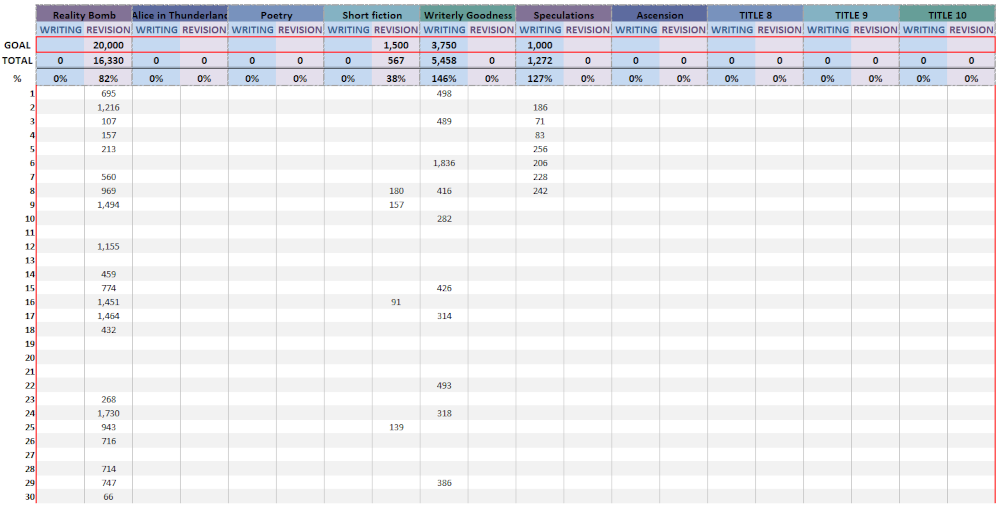
I set myself a goal of revising 25,000 words on RB but adjusted it down to 20,000 words around the middle of the month. I’m into another section where I’m rewriting, not just revising, now, and most days, I’m lucky if I can get 250 words written. There’s a lot of resistance around this section of rewrite, which is how I know that it has to be done. It’s just taking more time than I’d like.

But I rewrote/revised 16,330 words in June, or 82% or my amended goal, so I’m happy enough.

In short fiction, I revised 567 words, or 38% of my 1,500-word goal. Again, I’ve gotten to the point where it’s writing and not revising (the story was only part-written before). This is where I return to the old NaNoWriMo saying: every word’s a victory.

I wrote 1,272 words for my Speculations column, or 127% f my 1,000-word goal. And I submitted it on time. Win!

Finally, I blogged 5,458 words of my 3,750-word goal, or 146%.

Of my total writing goal for the month, I achieved 141%, of my total revision goal, I achieved 79%, and overall, I achieved 90% of my combined goals for the month. Not bad 🙂

Of the projects I’m not tracking, I made progress on my Ascension master document (like that much better than bible …), I did brainstorm a new short story, but I didn’t finish the story from two months ago, or start revisions on another story.

You can only do what you can do.

Filling the well

On June 2nd, I attended another Tiffany Yates Martin webinar through Jane Friedman. Always a good investment, those. I also signed up for TORCon June 10-13 and attended a few sessions, but that was it with respect to writing related events.

I had an appointment with my registered massage therapist on the 10th and I don’t know if it was the weight loss or my ASD diagnosis, but I’ve never had a more relaxing, less painful massage.

On June 20th, I went out to my sister-in-law’s for a lovely afternoon of lawn games and BBQ. I didn’t even take pictures. Just relaxed. So much relax.

Had an appointment with my financial advisor to make a couple of small tweaks to our banking and investments.

And … on the 28th, I called first thing to book my second vaccination. In another week, I will be as fully protected as Pfizer allows 🙂 I did have more pain in my shoulder than I did last time, but I got my shot. I done a #goodjab.

I’m down to 154 lbs, but now most of my clothes are too big. Can I say I hate shopping? First world, privileged white woman problems.

What I’m watching and reading

The latest season of Grey’s Anatomy came to an end in June. Same old, same old. What can I say? It’s a guilty pleasure.

Nancy Drew also finished its season. It was okay. Still not sure I like the ghostbusters version of ND. She resolved the major problem of the season only to have more crop up. Par for the course.

Phil and I watched the second volume of Love, Death, and Robots. Some of the shorts were amusing, others grim. Not bad.

The History of Swearing was amusing, though. I hope they do more, though I think they’ll run out before too long.

I also watched two movies.

The first was Monkey Beach, based on an Eden Robinson novel of the same name. I’d been meaning to watch it since I found out about it (about the same time as the Trickster series came out). It was good. Sad, but hopeful.

Wonder Woman 1984 was bad, but not as bad as I was prepared for it to be. Compared to the first movie, though? Meh.

Only three books on the reading radar this month, but they were all great.

I read TJ Klune’s The House in the Cerulean Sea first. Pure joy. If you haven’t picked it up yet, do it.

Then, I finished Diana Harkness’s The Shadow of Night, to catch up with the series. It’s very interesting to see the differences between the two, and I could really understand the creative decisions behind the adaptation. Doing the book, as written, would not have worked visually. Like them both for different reasons and in their own respects.

Finally, I read The Invisible Life of Addie LaRue. Ohmygodsogood! Just going to leave it there.

And that was the month in this writer’s life.

Until tipsday, be well and stay safe, be kind, and stay strong. The world needs your stories!
Tipsday: Writerly Goodness found on the interwebz, June 13-19, 2021

Welcome back to tipsday, your chance to peruse all the informal writerly learnings 🙂

K.M. Weiland covers the flat archetype of the ruler in part 19 of her archetypal character arcs series. Helping Writers Become Authors

Sue Campbell offers a guide for how to be a great podcast guest. Jane Friedman

Shaelin shares her long journey with confidence as a writer. Shaelin Writes

Elizabeth S. Craig is checking in on goals half-way through the year.

Dave King is managing a motif. Then, Barbara Linn Probst is pausing at the border of fiction. Later in the week, Kristan Hoffman posts on not letting ambition take over. Writer Unboxed

What people get wrong about African American English. Otherwords | PBS Storied

Becca Puglisi has some advice for revising your plot after the first draft. Fiction University

Lucy V. Hay shares eight ways to write your novel’s outline. Then, Jessica Conoley returns to complete your writing support triangle with part 3: accountability. Writers Helping Writers

Nathan Bransford: writers are storytellers, not theme-tellers.

Jane Eyre: why we keep reading it (featuring Princess Weekes). It’s Lit | PBS Storied

Anita Ramirez shares the life of a writer—episode 2: the unthinkable. Then, Angela Yeh is discovering ekphrastic poetry. Later in the week, Marissa Levien says, focus on the story, not the word count. Then, Kate Allen shares five tips for balancing writing and your full-time job. DIY MFA

Barbara Linn Probst is bringing a character to life. Jenny Hansen shares five “rules” that may change your writing future. Writers in the Storm

Kristine Kathryn Rusch continues her fear-based decision-making series with part 6: FOMO and the indie writer.

Chris Winkle shares six ways to add stakes to a mystery. Oren Ashkenazi: what a panic on Twitter revealed about writers today. Mythcreants

Why we need the manic pixie dream boy. The Take

Colleen Romaniuk peruses Painted Voices: Sudbury writers publish chapbook about St. Joseph’s Hospital. The Sudbury Star

Claire Cock-Starkey: a star is born (on the history of the asterisk). Lapham’s Quarterly

Ashawnta Jackson: James Baldwin and the FBI. JSTOR Daily

Open Culture shares a never-televised profile of James Baldwin.

Keyaira Boone compiles this list of 18 books to celebrate Juneteenth. Essence

How Jane Austen’s writing reveals her spiritual side. CBC’s “Tapestry”

Kevin Griffin reports that English Bay’s Berkeley Tower to be covered with Douglas Coupland’s murals. Vancouver Sun

Thank you for taking the time to visit. I hope you found something to support your current work in progress.

Until Thursday, be well and stay safe, my writerly friends!

Tipsday: Writerly Goodness found on the interwebz, June 6-12, 2021

Another week, another batch of informal writerly learnings 🙂 Get ‘em while they’re hot (and not too old)!

Greer Macallister wonders, can writers still be readers? Then, Jim Dempsey provides a guide to style. Kathleen McCleary says, prove it! Kathryn Craft shows you how to heighten tension with a watcher. David Corbett: on killing 22,000 darlings, part 2. Identifying the dead. Writer Unboxed

This is your brain on language. SciShow Psych

K.M. Weiland covers the flat archetype of the parent in part 18 of her archetypal character arcs series. Helping Writers Become Authors

Susan DeFreitas shares six key strategies for emotionally affecting fiction. Then, J. Michael Straczynsky explains why you can’t sell an idea. Ashleigh Renard is selling books on TikTok, no dancing (or crying) required. Jane Friedman

The lotus blossom stereotype. The Take

Jami Gold helps you avoid “talking heads” and other clichés. Then, Jessica Conoley helps you build your triangle of support with part 2: mentorship. Writers Helping Writers

Colleen M. Story lists five signs you have “writer’s DNA.”  Piper Bayard presents seven character lessons from a real-life heroine. Writers in the Storm

Yes, Virginia, the female gaze exists. The Take

Marina Barakatt examines the value of Lumberjanes. Then, Gabriela Pereira interviews Tasha Suri about crafting conflict in epic fantasy. Later in the week, Elizabeth Sumner Wafler explains how she built her side biz as an editor. Then Rebecca D’Harlingue lists five questions to ask before you write a dual timeline novel. DIY MFA

Kristine Kathryn Rusch continues her fear-based decision-making series with traditional writers.

Chris Winkle explains why we have to let go of meta mysteries. Then, Oren Ashkenazi analyzes five stories with weak stakes. Mythcreants

I tried Harley Quinn’s elevator flip (as one does). Jill Bearup

Sudbury’s Scott Overton writes about an alien artefact found in a northern Ontario lake. CBC

Mike Fleming Jr. reports that N.K. Jemisin’s Broken Earth trilogy lands at Sony TriStar in 7-figure deal; author to adapt. Deadline

Thank you for taking the time to stop by, and I hope you found something to support your current work in progress.

Until Thursday, be well and stay safe!

Tipsday: Writerly Goodness found on the interwebz, May 30-June 5, 2021

It’s time, once again, to fill up on informal writerly learnings.

Tom Bentley concerns himself with the fictions of our minds. Kathryn Magendie helps you find your DIY-style voice. Donald Maass wants you to get real. Liza Nash Taylor says, we only see the weeds. Writer Unboxed

K.M. Weiland delves into the flat archetype of the lover in part 17 of her archetypal character arcs series. Helping Writers Become Authors

These shoes will kill you. Jill Bearup

Margie Lawson wonders, what’s your body language IQ? Writers in the Storm

Bella Mahaya Carter says, ask for what you want, writers. Then, Kim Catanzarite shows you how to stoke your mental fire (if you have brain strain). Jane Friedman

Shaelin discusses how to work with a professional editor. Reedsy

Angela Ackerman shares two words that will supercharge your writing career. (Spoilers: good enough.) Jessica Conoley helps you build your writing support triangle with part 1: critique. Colleen M. Story lists seven signs that reveal writing is part of your life’s purpose. Writers Helping Writers

On her own channel, Shaelin explains how to turn an idea into a book. Shaelin Writes

Ambre Dawn Leffler wants you to feed your senses for a bounty of creativity. Then, Pamela Taylor considers the unsavory side of authenticity. Later in the week, Stacey Parkins Millett highlights enduring stories steeped in race. DIY MFA

Pneuma: breath as a magic system. Tale Foundry

Bethany Henry explains how to include mental health issues in your fiction. Fiction University

Kristine Kathryn Rusch brings you part four of her fear-based decision-making series: heads, sand, and traditional publishing.

The wild woman trope: a story of radical self-discovery. The Take

Fay Onyx shows us what respectfully depicting a character adapting to a disability looks like. Then, Oren Ashkenazi analyzes five poorly motivated villains from popular stories. Mythcreants

Thank you for taking the time to visit. I hope you found something to support your current work in progress.

Until Thursday, be well, my writerly friends!

Tipsday: Writerly Goodness found on the interwebz, May 23-29, 2021

Tipsday is here! Fortify yourself for the week with some informal writerly learnings 🙂

Laura Highcove wants you to use your writer’s intuition to solve a problem. Manuela Williams offers you a tool for your poet’s toolbox: line breaks. Later in the week, Ginnye Lynn Cubel helps you write a villain you love. Then, Disha Walia shares five tips to ace the art of retelling. DIY MFA

Janice Hardy helps you make sense of character wants and needs. Fiction University

Princess Weekes considers purity culture and fandom … issa mess. Melina Pendulum

K.M. Weiland looks more closely at the flat archetype of the child in part 16 of her archetypal character arc series. Helping Writers Become Authors

Can we be heroes again? Confronting the banality of modern evil. Like Stories of Old

Tiffany Yates Martin helps you bring your stories to life with nonverbals. Then, Lisa Hall-Wilson shares four ways movement affects deep POV. Writers in the Storm

Then, on Jane Friedman’s blog, Tiffany shows you how to deepen characterization by mining your own reactions. Joe Ponepinto says, don’t tease your reader. Get to the tension and keep it rising. Jane Friedman

Getting feedback from critique partners and beta readers. Reedsy

Gwen Hernandez helps you organize your research notes in Scrivener. Then, Diana Giovinazzo is learning to writer through grief. Heather Webb: being a good literary citizen. Liz Michalski says, right-brained revisers, unite! Writer Unboxed

Nathan Bransford says, don’t start a scene without these four essential elements.

How to write effective description and imagery. Shaelin Writes

Angela Ackerman wants to know if your character has a secret. Writers Helping Writers

Kristine Kathryn Rusch presents part three of her fear-based decision-making series: TV/film.

Chris Winkle lists five common reasons stories screech to a halt. Then, Oren Ashkenazi analyzes five stories that suffer from muddled atmosphere. Mythcreants

Spirited Away – Why work is toxic. The Take

James Whitlock: Netflix’s Sandman has cast Death and a whole lot more of the Dreaming. Gizmodo

Evan Narcisse interviews Ta-Nahesi Coates about saying goodbye to Black Panther. Polygon

William Deresiewicz shares a report: stages of grief (what the pandemic has done to the arts). Harper’s

Emily Wenstrom explains how non-fungible tokens (NFTs) can reward authors and readers. Book Riot

Erin McCarthy introduces us to 56 delightfully unusual words for everyday things. Mental Floss

Thanks for taking the time to visit, and I hope you found something to support your current work in progress.

Until Thursday, be well and stay safe!

Tipsday: Writerly Goodness found on the interwebz, May 9-15, 2021

Welcome to another tipsday, your opportunity to fill up on informal writerly learnings 🙂

KL Burd helps you incorporate social issues into your manuscript. Therese Walsh: spring thaws and the buzz of the muse. Then, Juliet Marillier wants you to consider your author photo. Kathryn Craft wants you to embrace unapologetic characterization. Later in the week, David Corbett recounts his experience murdering 22,000 darlings. Writer Unboxed

Shaelin guides you through the process of content and developmental editing. Reedsy

K.M. Weiland covers the mage’s shadow archetypes in part 14 of her archetypal character arcs series. Helping Writers Become Authors

Star Wuerdemann explains how to find compelling comps for your book. Jane Friedman

Joanna Penn interviews Gail Carriger about The Heroine’s Journey. The Creative Penn

Princess Weekes looks at the literary power of manga. It’s Lit | PBS Storied

Laurence MacNaughton shares three shortcuts to character-driven stories. Then, Savannah Cordova helps you figure out which story structure is right for your novel. Fiction University

Stephanie BwaBwa explains how to use bookstagram to increase your novel’s visibility. Then, Olivia Fisher is all about short stories. Gabriela Pereira interviews Suyi Davies Okungbowa about layers of world building in epic fantasy. Later in the week, Melanie Gibson shares five tips for writing about your mental health journey. DIY MFA

How the self-aware teen movie almost killed the genre. The Take

Marissa Graff explains how to power up individual scenes with a scene tracker. Writers Helping Writers

Margie Lawson touts the power of quirky-smirky assonance and alluring alliteration. Then, Ellen Buikema explains the relationship between stress and creativity. Writers in the Storm

Kristine Kathryn Rusch starts a new series: fear-based decision-making (part one).

Chris Winkle lists five ways to incorporate dreams into your plot. Then, Oren Ashkenazi analyzes five fascinating monsters in speculative fiction. Mythcreants

Kristen Lamb follows the writer’s journey from total newbie to the joy of mastery.

Vicky Qaio reports that Robert J. Sawyer and Silvia Moreno-Garcia are among the finalists for the 2021 Aurora Awards. CBC

Sagal Mohammed interviews Barry Jenkins about avoiding the exploitation of Black trauma in The Underground Railroad. Buzzfeed

Thank you for taking the time to stop by, and I hope you took away something to support your current work in progress.

Until Thursday, be well and stay safe, my writerly friends!

Tipsday: Writerly Goodness found on the interwebz, May 2-8, 2021

It’s another full week of informal writerly learnings. Enjoy!

E.J. Wenstrom explains the relationship between engagement rate and your author platform. Then, Sara Farmer says there’s an Eyre for every era, from cozy to cold-blooded. Later in the week, Leslie A. Rasmussen goes from television writing to novel writing. Then, Melissa Haas suggests five items for cats and the authors who live with them. DIY MFA

Obi-Wan vs. Stabby Crab fight analysis. Jill Bearup

Janice Hardy shares five reasons you’re struggling with your revisions (and how to fix them). Timely! Then, Jenna Harte offers some easy tips to incorporate backstory in your novel. José Pablo Iriarte explains how to punch readers in the feels (a case study). Fiction University

Shaelin shows you how to assess your manuscript. Reedsy

Greer Macallister: the responsibility of world building. Then, Sarah Penner shares 100 content ideas for every stage of your writing career. Donald Maass: it’s inevitable. Desmond Hall has a new edition of Desmond’s Drops for May. Writer Unboxed

Erica Brozovsky: can computers really talk? Otherwords | PBS Storied

K.M. Weiland examines the crone’s shadow archetypes in part 13 of her archetypal character arcs series. Helping Writers Become Authors

Elizabeth Spann Craig explains what it means to show up as an author.

The age of fanfiction. The Take

September C. Fawkes helps you balance your cast of characters. Then, Angela Ackerman shows you how to set yourself up for success before you write a single word. Writers Helping Writers

Janice Hardy shares five ways to keep your protagonist proactive. Later in the week, John Peragine discusses Vella in part 2 of his serializing storytelling series. Writers in the Storm

Jenna Moreci hosts Iona Wayland to discuss writing mental illness.

Desiree Villena shares five tips for crafting an irresistible first line. Flogging the Quill

Kristen Lamb says that characters are the emotional touchstone readers crave.

John B. Thompson shares an excerpt from Book Wars: the new Holy Grail for traditional publishers is direct-to-reader relationships. Jane Friedman

Chris Winkle: your plot s fractal. Then, Oren Ashkenazi analyzes five baffling tech explanations in speculative fiction. Mythcreants

Thank you for taking the time to visit and I hope you took away something to support your current work in progress.

Until Thursday, be well and stay safe, my writerly friends!

Tipsday: Writerly Goodness found on the interwebz, April 25-May 1, 2021

Welcome to the first tipsday of May 🙂 Get your informal writerly learnings while they last (just kidding, the archives are always accessible)!

Kim Bullock: what your protagonist’s Spotify playlist might reveal. Elizabeth Huergo recommends Kathleen Acalá and the extraordinary. Then, Sophie Masson shares her experience writing an exclusive audio novel. With apologies for the earworm, Lisa Janice Cohen says she’s “losing my ambition.” Milo Todd wants you to read outside your lane. Writer Unboxed

Tim Hickson: on writing great character descriptions (and he shares one of Shaelin’s). Hello, Future Me

K.M. Weiland delves into the king’s shadow archetypes in part 12 of her archetypal character arcs series. Helping Writers Become Authors

Shaelin Bishop shares three great writing tips that no one ever talks about. Reedsy

Janice Hardy explains why you should know who your narrator is speaking to. Fiction University

David Kadavy promotes mind management, not time management. The Creative Penn

On her own channel, Shaelin shares her short fiction writing process. Shaelin Writes

Tasha Seegmiller shows you how to build your own MFA experience. Then, Eldred Bird lists five writing tips we love to hate. Later in the week, John Peragine discusses serialized storytelling (part 1). Writers in the Storm

Yara-ma-yha-who: Australia’s Regurgitating, Blood-Sucking Monster. Monstrum | PBS Storied

Susan DeFreitas shares three key tactics for crafting powerful scenes. Then, Catherine Baab-Maguira wonders, what if it takes 12 years to get an agent? Jane Friedman

The paradox of cottagecore. The Take

Richelle Lyn helps you create your own virtual writers sabbatical. Then, Amanda Polick explains how to ignite tension in your story with food and natural disaster. Gabriela Pereira interviews Rena Rossner about weaving together history, folklore, and fairy tale. Later in the week, Finola Austin lists traps to avoid when writing in first person. Then, Angyne Smith shares five tips to make your writers’ circle sing. DIY MFA

Jenna Moreci shares ten self-care tips for when you’re busy AF.

Angela Ackerman explains how to write emotion well: know your character. Writers Helping Writers

Bunny and Svend Phillips collaborate on this list of five tired tropes about teenagers. Then, Oren Ashkenazi explains how Revenger fails at technology. Mythcreants

Kristin Nelson is not a fan of publishing house mergers: a non-love story. Pub Rants

Ashawnta Jackson introduces us to the haiku of Richard Wright. JSTOR Daily

Thanks for stopping by. I hope you found something to support your current work in progress.

Until Thursday, be well and stay safe, my writerly friends 🙂

Tipsday: Writerly Goodness found on the interwebz, April 18-24, 2021

Your weekly batch of informal writerly learnings has arrived. Get them while they’re hot!

Jan O’Hara shares a display hack for your story’s outline. Dave King: the non-writing part of writing. Then, Barbara Linn Probst wonders, why was my protagonist so prickly? Juliana Baggott explains when to reject rejection. Yuvi Zalkow wants you to make something terrible (and make it again). Writer Unboxed

Janice Hardy says infighting is a lousy way to create conflict in your novel. Then, Bonnie Randall deconstructs Deadly Illusions to explain what not to do with your manuscript. Fiction University

K.M. Weiland explores the queen’s shadow archetypes in part 11 of her archetypal character arcs series. Helping Writers Become Authors

Shaelin Bishop shares her top 12 writing tips. Shaelin Writes

Becca Puglisi shares tips for landing a guest posting gig. Then Barbara Linn Probst shares ten different writing tricks to make your point. Later in the week, Laurie Schnebly Campbell explains when, why and how to show emotion. Writers in the Storm

Jane Friedman explains how the pandemic is affecting book publishing. Jane Friedman

Princess Weekes wonders, what’s in a (pen) name? It’s Lit | PBS Storied

Adam W. Burgess touts the magic of queer fiction. Gabriela Pereira interviews C.L. Clark about character, conflict, and world building in fantasy. Janelle Hardy wants you to shift creative resistance using your body. Then, LA Bougeois shares five creativity exercises to fire up your writing muse. DIY MFA

Lisa Hall-Wilson offers four tips for writing your characters PTSD and trauma memories. Writers Helping Writers

The actress trope. The Take

Chris Winkle offers five tips for using an arbitrary magic system. Then, Oren Ashkenazi analyzes five novels with bizarre tangents. Mythcreants

Zoraida Córdova explains what it’s like writing Gamora in ‘Women of Marvel’ #1. Marvel

Camonghne Felix interviews Barry Jenkins about bringing The Underground Railroad to TV. Vanity Fair

Thank you for taking the time to visit, and I hope you found something to support your current work in progress.

Until Thursday, be well and stay safe, my writerly friends.