An anthology launches! A decision is made! Next up: waiting for the fallout …

Life in general
The month started out with the literal bang of the US-Israeli bombing of Iran, what is now being called the 2026 Iran War. The conflict actually brought February to a close, on the 28th, but none of us knew about it until we woke up on March 1st and heard the news.
One of the first group of casualties was mostly schoolgirls. And the evidence pointed to the strike being of US origin, directed by an expert system. For a more nuanced (and frightening) examination, see this article by Kevin T. Baker for The Guardian.
Critics of the operation described it as illegal under US law (only Congress is supposed to be able to declare war), an act of imperialism, and a violation of Iran’s sovereignty under international law.
The US didn’t forewarn or evacuate any of its citizens in the region and now they’re stranded and having to find their own ways out of the war zone.
Yes, Supreme Leader Ali Khamenei is dead, but Trump doesn’t seem to have had any other game plan than shock and awe. It’s all giving entä nyt (Finnish for “now what?”) energy.
For more, check out this article for The Walrus by Shannon Gormley.
It’s all a smokescreen to distract from the Epstein Files, which still haven’t been disclosed in full.
Kristi Noem was moved to the Shield of the Americas (a non-existent organization) and Pam Bondi was under fire.
And the Russia-Ukraine war continues.
And the genocide in Gaza continues.
And so many other conflicts, I can’t remember them all.
At work, things went on as they went on. Another short-term project moved into a holding pattern because of leave and other conflicts. I was invited to observe the delivery of another pilot course. This time, however, I haggled to 3 days of a 5-day course, and I thought I was doing well until DST came along and messed me up (the course started on the 9th). Also, I had a whole week of annual leave following the last day of observation, which was the ultimate relief.
I had other work to complete on the Tuesday and Thursday, anyway.
But on the Wednesday, there was another all-staff meeting, which I anticipated would be about workforce adjustment. Training observation was pushed to before my start time, and I said I’d just show up late. Maintaining boundaries, for the win!
The meeting was not entirely about WFA, but a portion of it was. We now had firmer dates for the process, but no better idea when our potential departure might be beyond a range of dates. For anyone opting into the voluntary departure program, our departure dates will be determined by management, and we’ll find out when a letter is sent to us in late April or early May. The worst-case scenario will leave us (me and Phil) skint for at least a month and with no guarantee when my separation monies or pension might be processed and issued.
Oh, the joy of a drawn-out process with a slow trickle of information which doesn’t help at all …
Then, during my week off, SNOWMAGEDDON hit, the bulk of it on the 15th. We had received 10 cm on Friday already, and they were calling for 50 cm on Sunday. We got that and then some. And thunder snow!
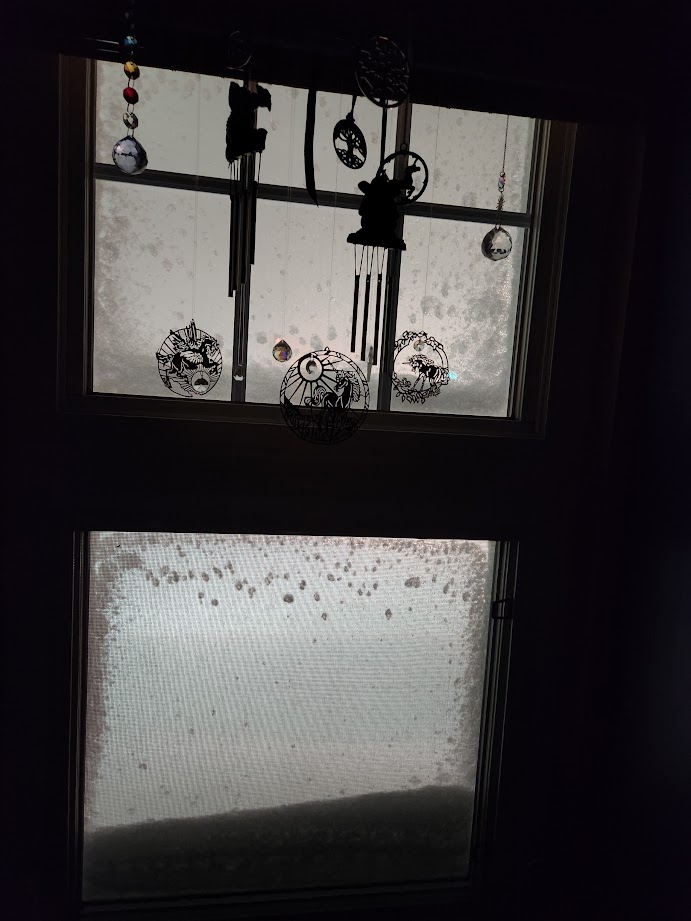



The entire city was shut down on Monday and though they were working hard, they could not guarantee when the snow would be cleared from side streets and sidewalks. Apparently, this winter has been one of the snowiest in Sudbury’s history with 5 metres’ accumulation. The last time we had this much snow was in 1959 (!) And the winter isn’t over yet. We often have snow into April or even May.
On the Monday following the storm, the temperature plunged, making efforts to clear the snow even more challenging. Much of Sudbury remained shut down on Tuesday, largely due to the inability of people to get out of their own driveways or side streets.
Then, on Tuesday night (actually Wednesday morning) Marttila Drive was plowed, and not only that, someone (I’m assuming from the city) followed up and removed the plow shit from the ends of the driveways. Phil was so impressed, he sent a note of thanks to the no doubt feeling-less-than-appreciated municipal workers.
More snow arrived on Wednesday, and on Thursday, the temperature rose above freezing.
The whole time, sidewalks remained unplowed, and I was forced to walk Torvi up and around the apartments at the end of our street. Poor girl couldn’t figure out why we weren’t going on any of our usual routes.
She wasn’t the only one confused by the snow.
On my way home from the SuperCanucks launch (see the month in writing), I hit a wicked pothole that took out our exhaust/muffler/tailpipe. There was nothing to do in the moment but turn on my hazards and crawl home, hoping not to damage anything further as it trailed behind me. Fortunately, I made it home without incident and Phil was able to kluge the muffler and tailpipe back into place with some bailing wire he had in the garage.
The week following, Phil got our poor car to the mechanic and got her repaired.
Then came March 26, the deadline for opting into the voluntary departure program. I completed my form, submitted it, discussed it with my team lead, manager, and director, and promptly took the rest of the day and the next off.
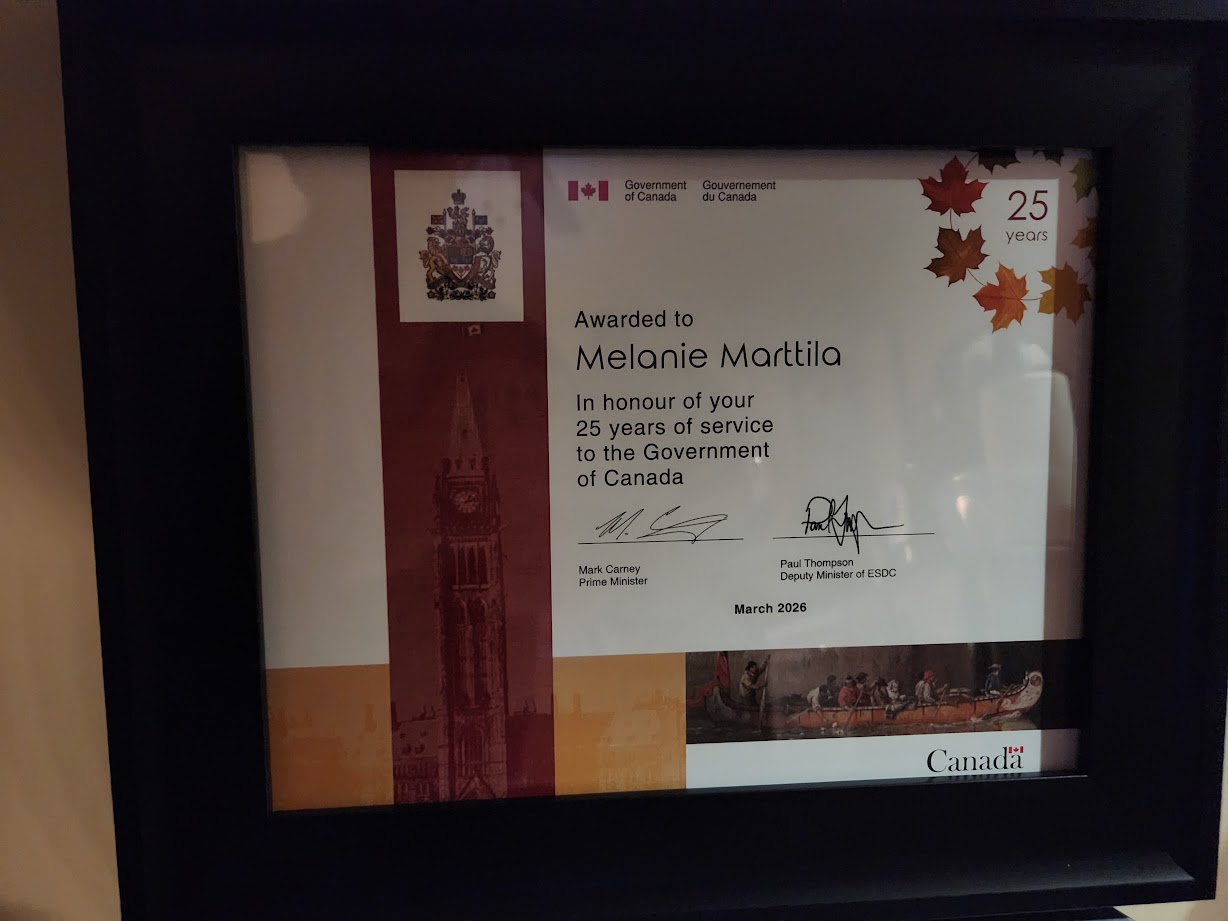
Coincidentally, March 26th was also my official 25-year work anniversary. Bittersweet moment, weird day.
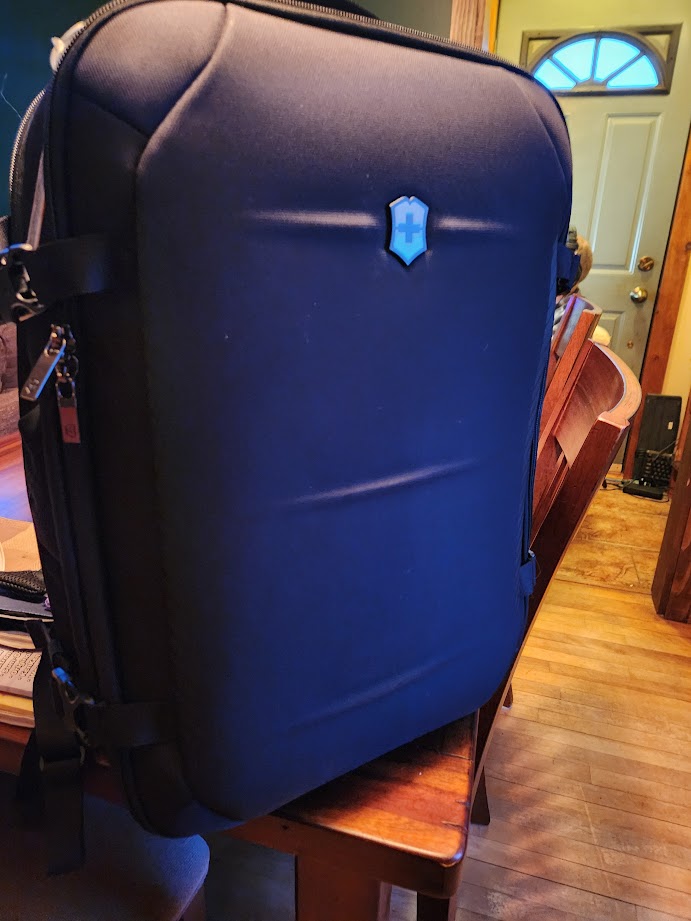
I received my gift, a travel backpack, and my framed certificate the following Tuesday.
There was no sense of relief, because the process isn’t over. There was also no “oh, my god, what have I done?!” moment, either. I’ve been sitting with this decision for long enough that I have no doubt that leaving is the right decision for me.
Now to wait for my official departure date to be determined. I should receive my official letter in early May. Only then will I be able to start contacting human resources, the pay centre, and the pension centre and start getting my arrangements made.
This is not the end of the story.
The month in writing
I started off the month by revising and submitting my flash fiction – yay, me! And then starting in on the story for the contest I registered for last month. It was longer (minimum 3,500 words) and based on a visual prompt. Of course, I took it in my own direction.
A writer friend also registered for the contest suggested we get together on the Friday before the contest deadline and workshop our pieces. Unfortunately, a snowstorm prevented us from meeting up, but we did exchange stories by email, and both submitted (excellent stories, in my opinion) to the contest on time.
Two stories out in the world! I’ll let you know how they do.
Two of my reviews were published in The Maple Tree Literary Supplement back in January. Better late than never?
On the 5th, I received an invitation to participate in a podcast to promote SuperCanucks. The recording will be on Victoria Day Monday, and the episode will focus on superhero pets. When I have more deets, I’ll share them.
Then I was invited to join Neuroverses: An Autism Month/Poetry Month Showcase (link to the EventBright event page) on April 18th organized by Murgatroyd Monaghan. Should be fun!
Matthew del Papa and Andy Taylor, the editors of SuperCanucks, were interviewed by Markus Schwabe on CBC’s Morning North on the 18th.
And on the 20th another article appeared in the Sudbury Star online.
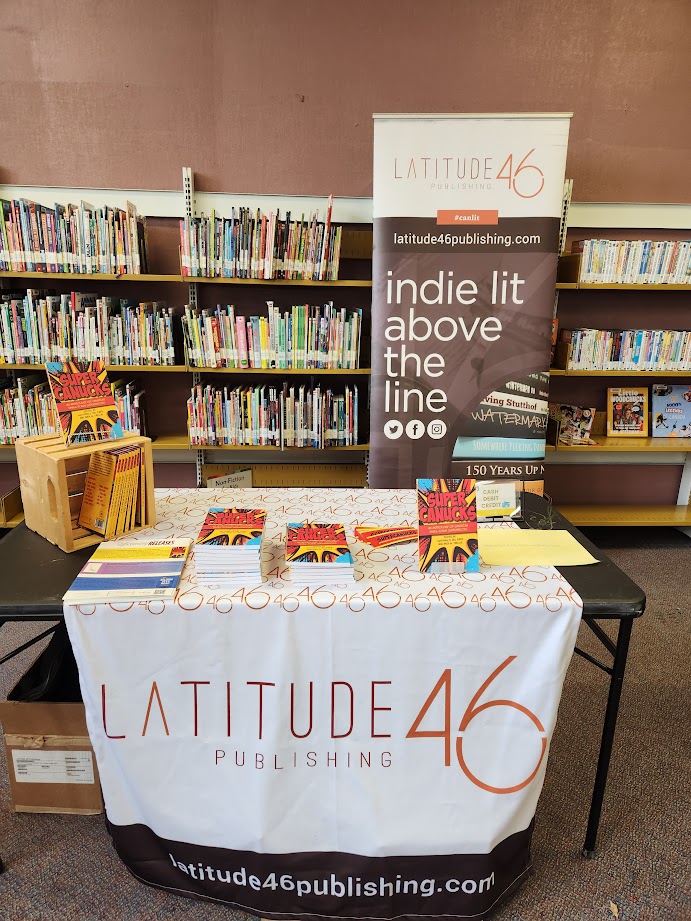
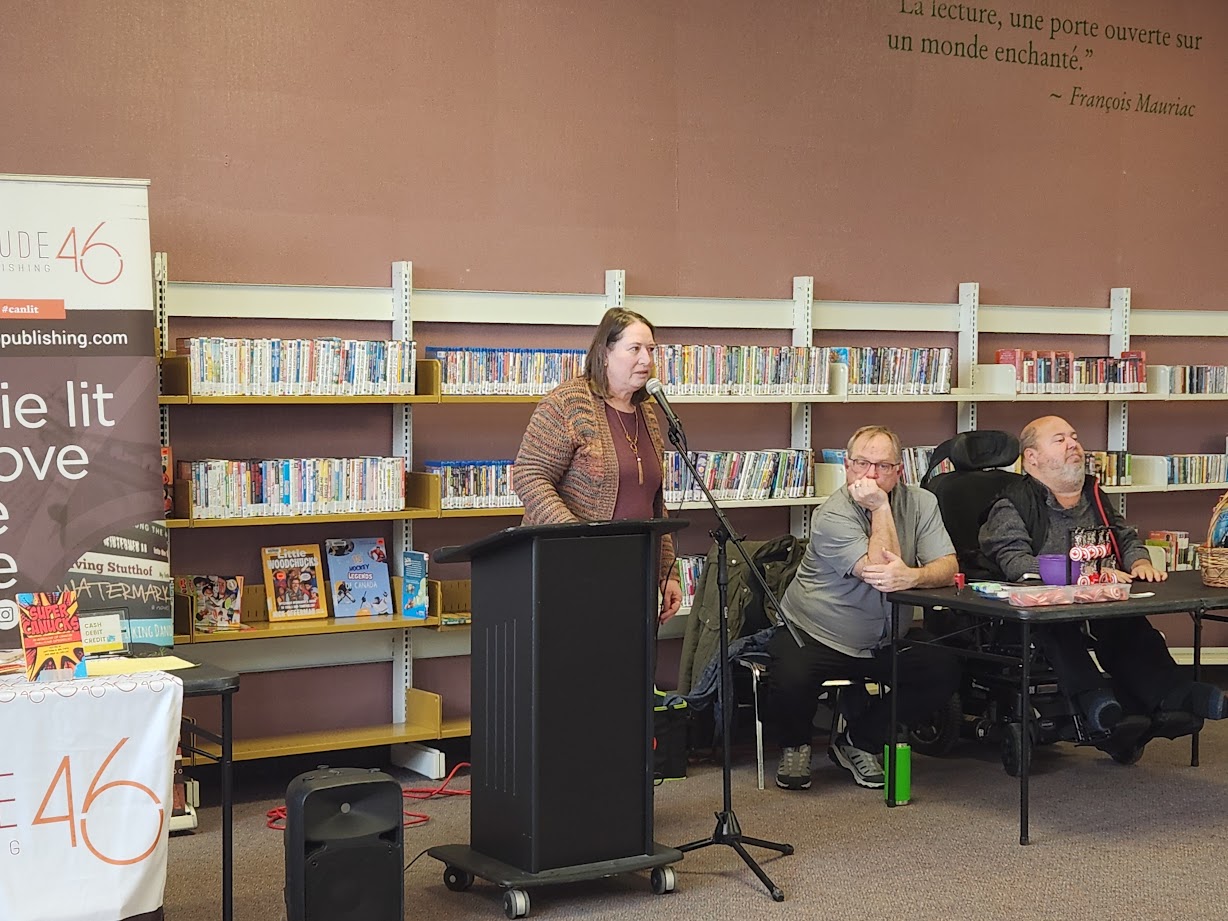
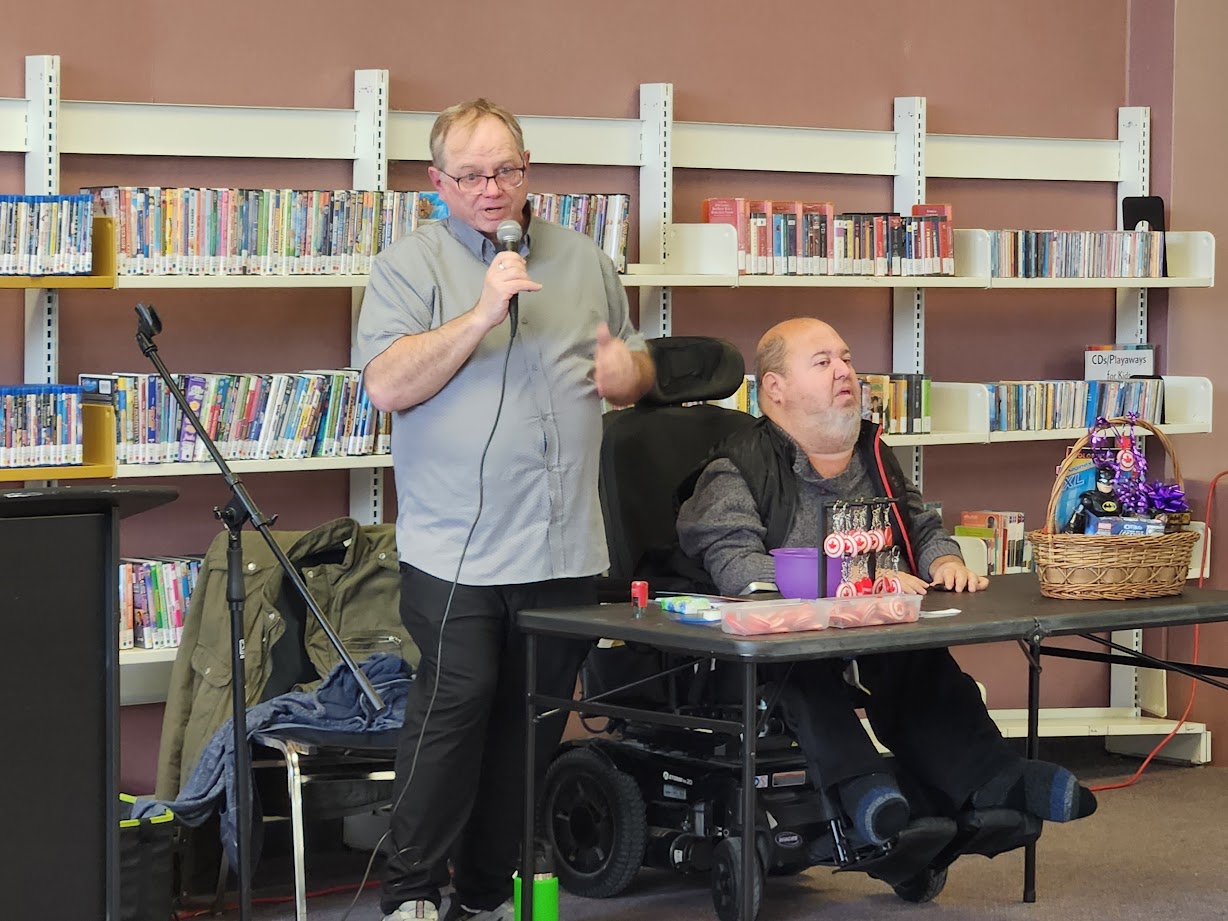
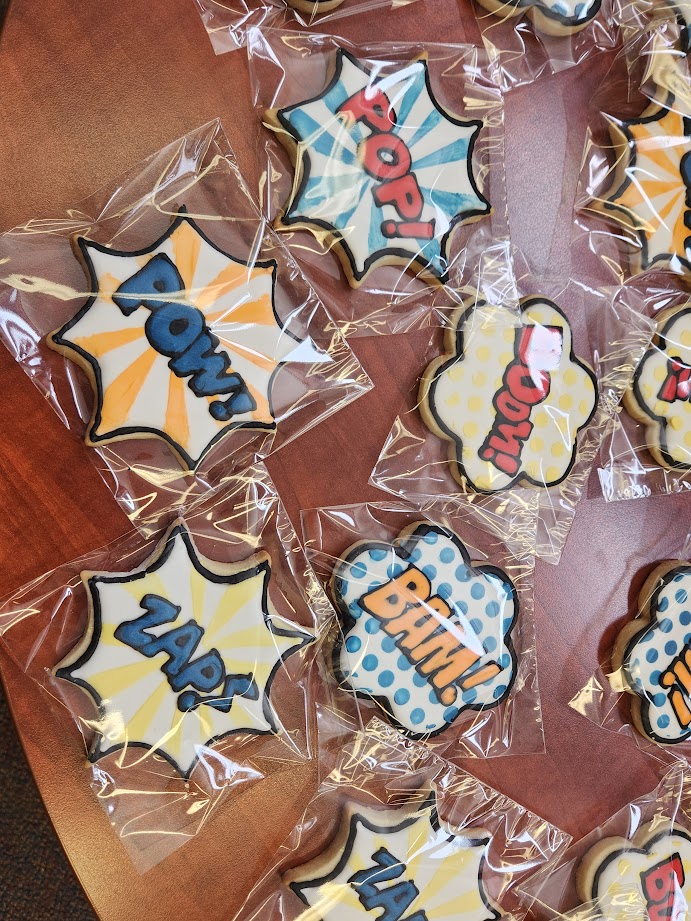
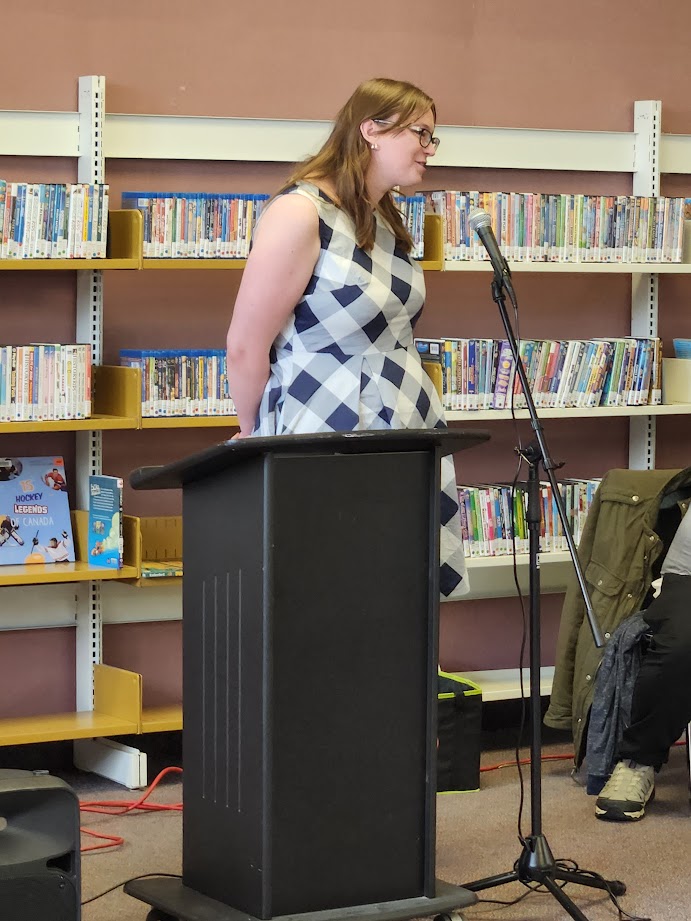
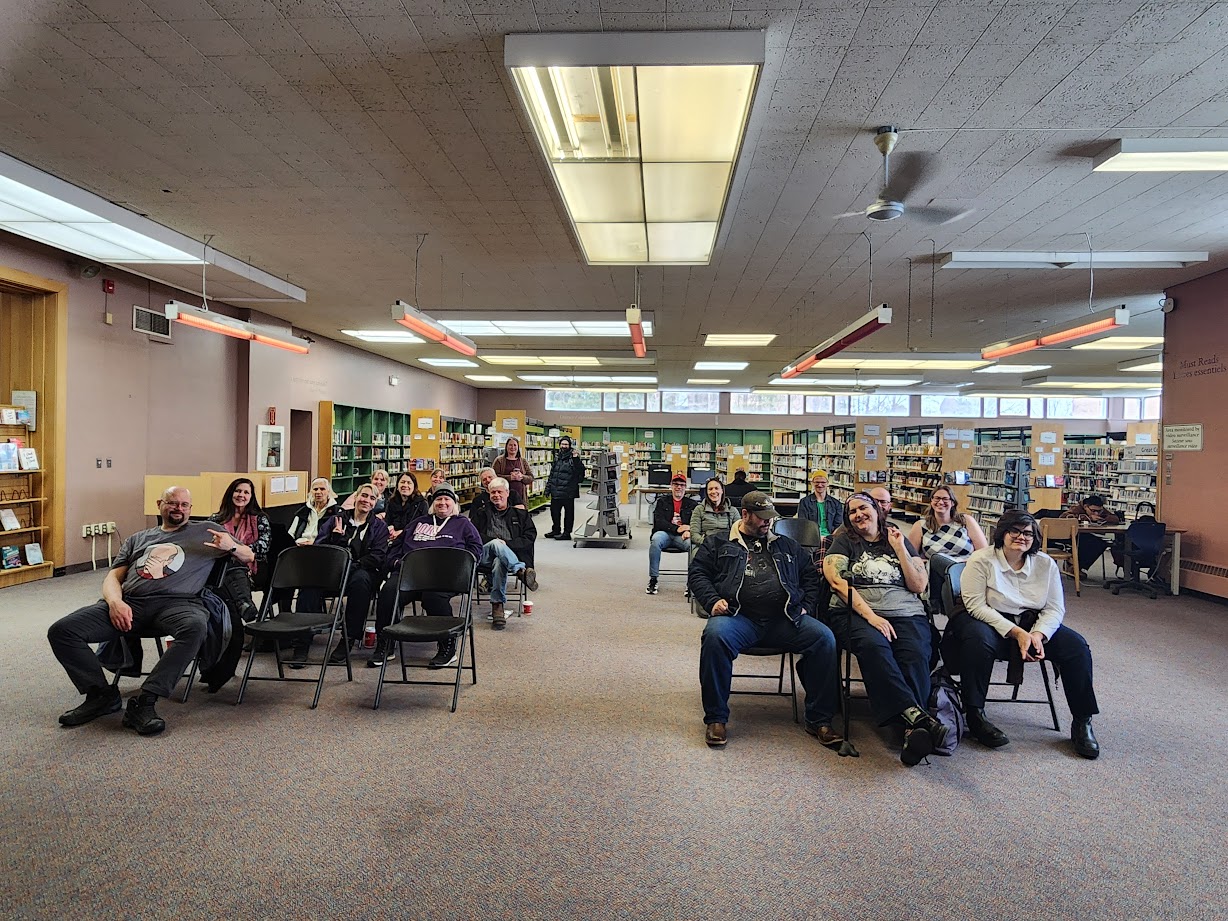
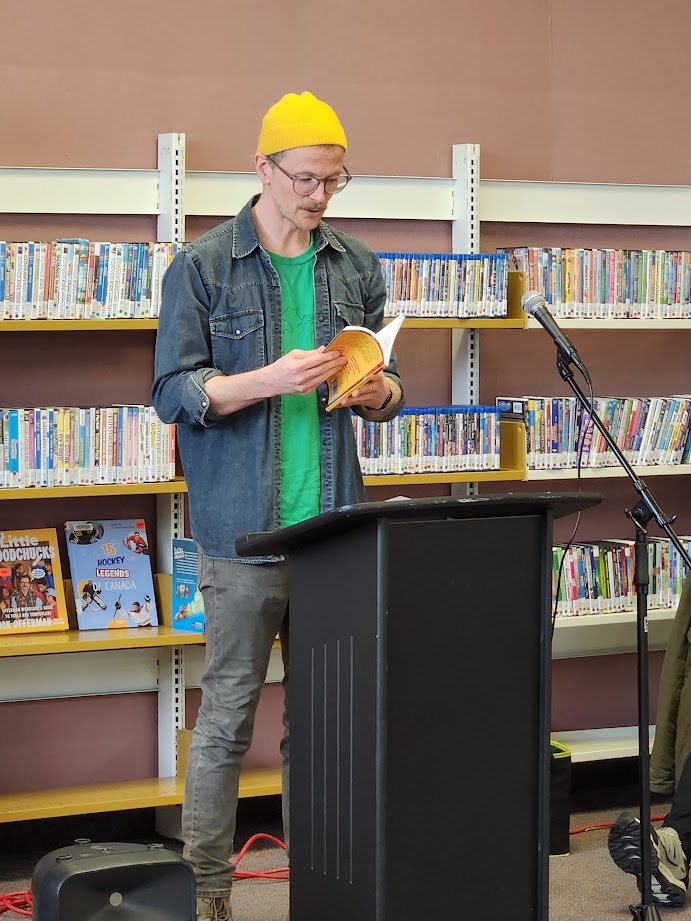
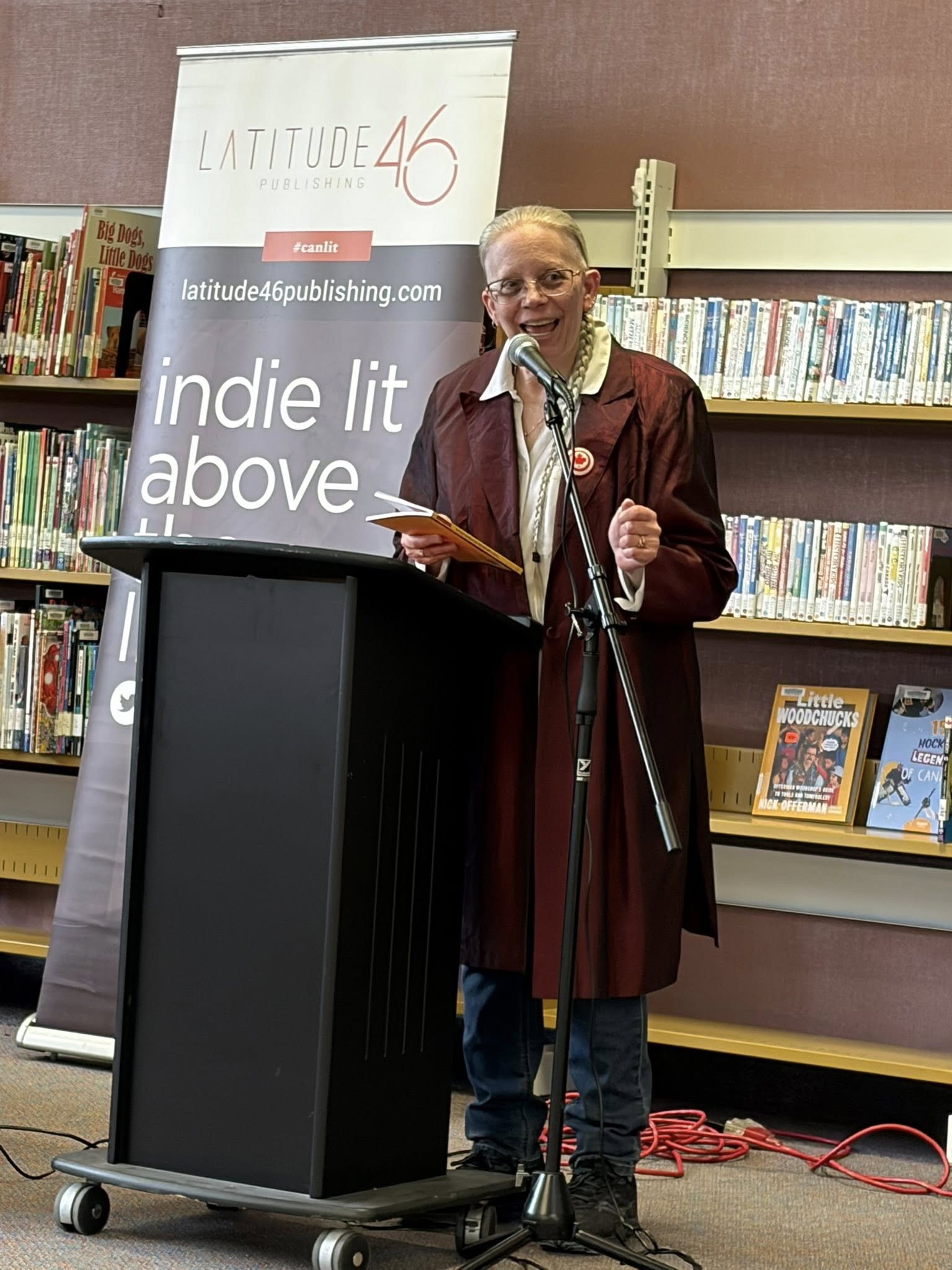
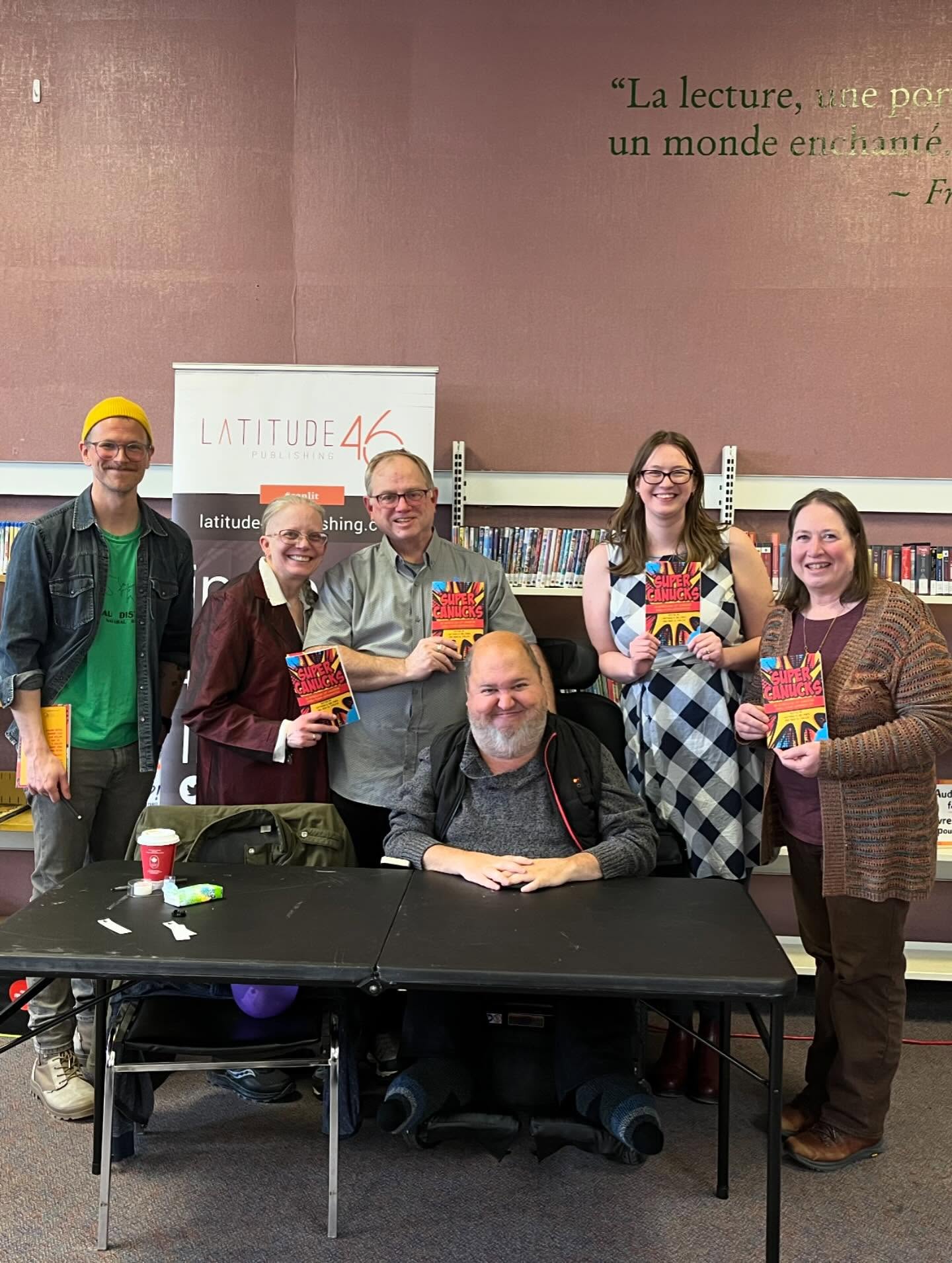
On the 21st, SuperCanucks launched! It was a super afternoon at the Greater Sudbury Public Library’s main branch with a gift basket raffle and swag and superhero-themed cookies from the Homemade Baking Company!
Here are some of the pictures:
I signed up for an interview for a show on the local university radio station, CKLU. Recording next month. I’ll let you know how it goes.
I also put myself forward as a panellist for Can-Con in October.
In writerly business, Wordstock held a visioning session on the 22nd. It was mostly introductions and brainstorming. The results were collected and the board will review for suitability and viability.
The Canada Council for the Arts had their Annual Public Meeting on the 25th.
And the SF Canada board met on the 29th. We discussed getting the organization back out in the world.
Filling the well
The full suckerfish moon and blood moon eclipse (which I did not get up early enough to see) in Virgo was on the 3rd. I watched the eclipse afterward on the time and date YouTube channel, which had some interesting special guests, including NASA’s Noah Petro, who discussed the Artemis mission.
We lost an hour on the 8th with the start of daylight saving time (DST). I keep hoping for a miracle. BC is going permanent DST. Saskatchewan has always been permanent standard time. I signed a parliamentary petition to stop the DST time shift in Ontario. Even the orange maniac wants to do away with the time change. When will it end?
In honour, I’ll trot out my favourite DST meme.

The new ash moon in Pisces was on the 18th.
According to Alina Brown:
“Pisces is the sign of endings, surrender, intuition, grief, imagination, faith, and emotional processing. New Moons usually bring beginnings. But in Pisces, especially this late in the sign, the beginning often comes through closure.
So, this is less about forcing a new chapter open and more about recognizing what is naturally ending so something new can begin.”
Can I tell you how many signs and portents I been getting lately along these lines? The universe is definitely sending me a message.
And spring arrived on the 20th. I tell you, it did not feel much like spring.
In writerly events, I signed up for Outside the Box: Choosing to Follow the Writerly Path with Kim Fahner presented by the Saskatchewan Writers’ Guild on the 5th. It was a lovely presentation.
Also on the 5th was the Canadian Authors Association and SF Canada webinar series Make Your Character’s Life Difficult with Gail Anderson-Dargatz. Fortunately, I had the option of watching the recording.
On the 14th, I stopped by Perk & Pine to nab a signed copy of Liisa Kovala/A.L. Jensen’s Hygge & Homicide. I chatted with her mother who knew several members of my family. It was a lovely event at a great new-to-me café, and they have the best coffee and treats!
Torvi had her annual checkup at the Laurentian Trails Veterinary Clinic (yay!) on the 12th. It was great to see Dr. Andrews again and the new clinic is great Torvi got a clean bill of health, her annual vaccines, flea and tic medication for the year, and some probiotic powder in case she engages in “dietary indiscretion” again. I forgot to bring her fecal sample in, so Phil delivered it the next day. When he walked in, he said, “I am here to give you shit! And here it is.” Everyone laughed. That’s my guy.
I had a lovely week off work from the 16th to the 20th. Snowmageddon (see Life in general) enforced slowness and containment.
On the 23rd, I had my now tri-annual dentist appointment.
On the 28th, I took Torvi for her next de-tufting at Petsmart. Most of her undercoat is gone, but we’re still dealing with fluff-o-rama.
My next therapy appointment was on the 30th. I decompressed from my eventful month, and we conquered two (the last?) value domains. I’m looking forward to whatever we tackle next.
What I’m watching and reading
My first watch of March was to finish the first season of A Knight of the Seven Kingdoms (HBO). I loved this (initially) lighter take on the GoT universe. Dunk is a genuinely good man despite the mistakes he makes. He just tries so hard! And it gets him into trouble more often than not. I loved the relationship between Dunk and Egg/Aeg. And I won’t say any more about it because it is so worth watching.
Next, I watched Fullmetal Alchemist: The Final Alchemy (Netflix). Phil and I had watched the first of these live action versions of one of our favourite anime back in 2020 (Fulllmetal Alchemist, 2017) and the second in 2022 (Fullmetal Alchemist: The Revenge of Scar), when it and the third instalment both came out. Somehow, we forgot that the last one was to be released later in 2022 … until now. Phil confessed he’d “cheated” on me by watching the movie on his own, which prompted me to check it out.
These FMA movies follow the same plot (almost exactly) as the Fullmetal Alchemist: Brotherhood anime series, which reframes the events of previous FMA series. Yes, there have been iterations. I won’t get into the plot, but I will say that the live action adaptation was well done and just as heart wrenching as the anime.
Then, I finished watching Star Trek: Starfleet Academy (CTV Scifi). I loved it! Holly Hunter is amazing! I wasn’t so sure about some of the young characters and there was a lot of young adult angst and hormones flying about, but I think they stuck the landing. One of the best ST series yet!
For more on this, see Charlie Jane Anders’ Buttondown newsletter: Why is it so hard to make Star Stek YA? (And consider subscribing while you’re there!)
Next, I wanted to watch Zootopia 2 (Disney +), but as I hadn’t watched Zootopia yet, I queued it up first.
Zootopia is adorable and surprisingly moving. In a world where anthropomorphic animals live in harmony (more or less) in climate-controlled habitats, young rabbit Judy Hopper’s sense of justice drives her ambition to be the first rabbit to become a police officer, despite her parents’ desire for her to settle into a life of carrot farming. The opening montage establishes Judy’s struggle and eventual triumph in police academy, but on her first day, Chief Bogo assigns her to parking duty. In typical fashion, Judy excels, making twice the citations Bogo assigned her before noon. She is also conned by fox Nick Wilde and foils a robbery, saving the life of a shrew woman in the process (it’s important, trust me). Once back at the station, though, Bogo refuses to recognize Judy’s excellence and, when he similarly dismisses the plea of an otter to find her missing husband, Judy impulsively offers to find the missing otter. Incensed that Judy has undermined his authority, he gives her 48 hours to solve the crime. If she fails, she’s fired. So of course she teams up with the con artist fox …
In Zootopia 2, Judy and (mild spoiler) her new partner Nick are having trouble working together. At a charity gala, which they sneak into against Chief Bogo’s orders, they attempt to stop the theft of the Lynxley family journal that documents the creation of the weather walls that regulate Zootopia’s climate zones, until the thief, Gary De’Snake protests that the journal contains evidence to prove his family’s innocence. When Milton Lynxley orders the journal burned and Gary killed, Judy refuses, and Gary escapes with the journal on a motorcycle driven by a hooded figure. In a fit of rage, Milton orders the current mayor, a former action movie star and horse named Brian Winddancer, to kill Gary, Judy, and Nick and retrieve the journal. Now fugitives, Judy and Nick must track down Gary and prove both their innocence and that of Gary and his pit viper family. They team up with conspiracy theorist and reptile expert beaver, Nibbles Maplestick. As they visit Marsh Market and follow the clues that lead them to Gary, they uncover a conspiracy—yes, there is an actual conspiracy afoot—that could change Zootopia forever. Both movies were awesome fun.
So of course, after these two lighthearted watches, I shifted to Bugonia (Prime). I had enjoyed Yorgos Lanthimos’s Frankenstein meets Pygmalion mash up Poor Things and was fascinated by the feminist exploration of the “monstrosity” of women it presented. Bugonia was nothing like that movie. Teddy Gatz is presented as a radicalized conspiracy theorist who manipulates and abuses his autistic cousin Don. Though it’s revealed that he was abused by his babysitter as a child and that his mother is now comatose after an experimental therapy provided by Auxiloth, and though he’s a caring beekeeper and coworker, any sympathy that backstory earns is completely undone when the Auxiloth CEO Michelle Fuller, who he has kidnapped and accused of being an alien, finds his “laboratory” of preserved body parts and his photo album documenting his many abducted and murdered “suspected aliens.” For her part, Michelle is as cruel and manipulative as Teddy and then some. She treats her employees as slaves and her attempted gaslighting of Don results in his suicide. She then tells the further traumatized Teddy (who apparently really cared for Don) that his mother’s cure is disguised at the antifreeze in her car. After Teddy flees the scene of his mother’s murder-by-antifreeze, Michelle then manipulates him into blowing himself up in a closet (WTF?!). It doesn’t take much. He’s clearly deranged by this time. And then she returns to the mothership where the decision is made to terminate humanity.
It’s an utterly depressing movie. I mean I get the argument that humanity doesn’t deserve the world we have, but, honestly, it’s the 1% and the big corporations and corrupt politicians with their reliance on oil and the colonialism and patriarchy and capitalism that’s messed up the world. There are billions of other humans living on this planet that are doing the best they can in the fucked-up systems we’re subjected to. Does everyone deserve to die because of that? Are we all so irrevocably corrupted that there’s no hope?
Phil and I finished watching season 2 of the live-action One Piece (Netflix), and we loved it! Luffy and the Straw Hats make it through the Red Line, which is a mountain with currents that flow up and then down, appease a whale who is self-harming because he misses his friends (I felt so sad for that poor whale) and start to navigate the Grand Line, where traditional compasses don’t work (!). The whole time they’re fighting off Baroque Works assassins and the Marines. It’s great fun and they do a great job maintaining the surreal feel of the anime.
Then, I finished watching the fourth season of Bridgerton (Netflix). This season focuses on ne’er-do-well second son Benedict, who to this point has been happily living a life of debauchery … until the night of his mother’s masquerade ball, when a mysterious young woman catches his eye. Francesca has a season of upheavals, Violet finds love and heartbreak, Eloise still wants nothing to do with the “marriage mart” and is relegated to minding Hyacinth as she goes through her etiquette lessons in preparation for her coming out, Penelope, now outed as Lady Whistledown, attempts to pursue novel writing, but Queen Charlotte won’t be deprived of her gossip, and Lady Danbury wants to retire from public life. The main story is the Bridgerton take on Cinderella, but it’s done very well. I think this has been one of the better seasons of the series.
Finally, I watched Mercy (Prime). Interesting premise, fun action, but an asshole for a protagonist who didn’t earn his happy-ish ending. I could watch Rebecca Ferguson read an old timey phone book but her performance as an AI judge was about as riveting. Chris Raven is a cop, instrumental in instituting the Mercy AI court system to prevent criminals going free due to human error. Later, he finds himself in the Mercy court, accused of his wife’s murder. In the first half of the film, he only manages to convince Mercy that he’s guilty. He’s an alcoholic who’s checked out of his marriage, his daughter is praying for divorce because even she can see that he’s a lose cannon, and he has no evidence to prove that he didn’t, in fact, kill his wife. There are several unsurprising “twists” and Mercy “glitches,” implying that it’s developing emotions. It’s a mess of a movie.
My first read of March was Liisa Kovala’s Hyyge and Homicide, the first in her self-published Hyyge House Murder series. This cozy mystery (i.e., a mystery involving a crime-solver who is not a law enforcement officer of some description) is set in the fictional town of Lakewood, intended by the author to be a stand-in for anytown, Northern Ontario. Minna Halonen has left her interior design career in Toronto and returned to her hometown. For now, she’s working in her mother Elsi’s store, Nordic Cozy and reacquainting herself with Lakewood. Almost immediately, she is beset by her best friend and event planner Christie, who suggests they buy an old mansion and set it up as a venue for events. Minna hesitantly agrees and when her daughter Sophie, unable to find work in Toronto, post-graduation, also returns home while she gets her bearings, the deal is struck. Minna, Elsi, and Sophie will move into the mansion, Minna will supervise the renovation and interior décor, Sophie will handle their social media and advertising, and Christie will organize events.
Everything seems to be going swimmingly, especially with James, the handsome contractor renovating the mansion, until the Hyyge House grand opening, when Minna finds a body in the breakfast nook. With her new business foundering before it’s gotten off the ground, and everyone involved in the grand opening suddenly a suspect, Minna decides to solve the mystery before it claims anyone or anything else she loves. Also, Hugo Dogberg is adorable. A fun start to a new series.
Then, I listened to The Savior’s Champion by Jenna Moreci. Tobias was apprenticed to one of the best artists in the land until his father was killed and his sister seriously injured in an accident. Now he works as a labourer to make ends meet, but it’s not enough to get his sister the medical treatment she needs and her pain is only getting worse. When his best friend decides to enter the Sovereign’s Tournament and compete to become the Savior’s Champion, Tobias initially scoffs. Until he learns of the money given to the families of the competitors. Though he has no interest in the Savior, he’s desperate to get his sister the treatment she needs. And so, he enters the tournament.
Next, I listened to The Space Within, season 1, an Audible Original first presented as a podcast. Trauma specialist Madelaine Wyle is asked to treat a child who disappeared and can’t remember what happened to her. As she slowly gains Sophie’s trust and begins to unblock her traumatic memories, Maddie learns that there are other people who have disappeared and returned changed. But Maddie also has problems of her own. The daughter she voluntarily surrendered to her ex when he moved to another state for a new job is acting out and wants to live with Maddie. And Maddie has a childhood experience that resonates with those of her patients. When DNA scans reveal that all her patients share the same nucleotide sequences over multiple chromosomes despite not being related, she has to consider the impossible and put her own career at risk in her search for the truth.
Then, I read Margot Lapierre’s Ajar. This poetry collection is an intimate and vulnerable poetic memoir of what it’s like to experience the haunting fracturing of self that often results from mental illness. Content warning: This collection discusses suicidal ideation and attempted suicide.
I enjoyed The Space Within, season 1 so much that I immediately queued up season 2, this time presented as an Audible Original audiobook. I can’t really tell you much about it without spoiling the whole thing, so I’ll let you listen and judge for yourself.
I will say that the ending felt rushed, like the series was cancelled while they were in the middle of recording season 2, and they had to wrap things up fast. There were a lot of unanswered questions, but they tied off as many story threads as they could.
Then, I listened to There is No Antimimetics Division by QNTM (pen name of Sam Hughes). This novel is based on the web series originally published to the SCP (Secure, Contain, Protect) Wiki. Marie Quinn is the Director of the Antimimentics Division of the Unknown Organization (UO). Antimemes, or unknowns are extradimensional entities that feed on memories, effectively making them invisible as they consume the memories of themselves. Think of that whatever-it-is you think you see out of the corner of your eye. That could be an unknown. It’s the job of Quinn’s division to protect humanity from the more damaging unknowns but to do this, they have to a) take a daily regimen of mnestics, to help them notice and retain awareness of unknowns and which cause physical and mental damage with prolonged use, and b) make themselves forget the plans to defeat the more devastating unknowns lest those memories get consumed and their plans exposed. Many of the “smaller” unknowns can be contained or even tamed. Quinn has one of these, called Sunshine, with her at all times and she scrupulously consumes a varied media diet so that Sunshine can eat those memories and leave everything else intact.
But Quinn becomes aware of a decades-long war with apex antimimetic entity U-3125, which destroys upon conception and spreads through shared knowledge. To protect those she loves, Marie erases the knowledge of her husband Adam and other personal connections from her memory (courtesy of Sunshine). She then discovers evidence of an “irreality amplifier” that UO researcher Ed Hix has been working on in secret and which could generate a countermeme capable of destroying U-3125, but when she arrives at the research facility, U-3125 already consuming her colleagues, all she finds is a “memory bomb.” I kind of had to get into this level of detail so you’d have an idea of what the novel is about, but I’ll stop there, because it’s fascinating and thought-provoking and just pain awesome. The novel is also non-linear and includes redacted text and missing letters to reflect the missing memories of the characters in the story. The unknowns are basically new eldritch terrors.
And that was the month in this writer’s life.
Until next month, be well and stay safe; be kind and stay strong. The world needs your stories!
I acknowledge with respect that I am in Robinson-Huron Treaty territory, that the land from which I write is the traditional territory of the Anishinaabe and home of Atikameksheng Anishnawbek and Wahnapitae First Nation.