Tipsday: Writerly Goodness found on the interwebz, Feb 7-13, 2016

Load up your plates my friends, I have lots of nommable readables here 🙂

K.M. Weiland shares her insights into being a person with obsessive-compulsive disorder and a writer. She also offers some tips on how to remain healthy even if you live at a desk.

C.S. Lakin explains how writers can benefit from outlining their scenes. Her scene structure series continues with the opening hook.

Janice Hardy shares five common problems with novel beginnings and how to solve them.

Jamie Raintree shows how the power of consistency builds writing careers.

Lisa Cron shared an older post with our Story Genius class: Three misunderstood pieces of writing advice that can derail your novel. Writer Unboxed. And here’s her most recent post for WU: Where real drama comes from.

Anne R. Allen lists five reasons writers need to use Google+ even though the new Google+ is awful. I must admit, I’ve fallen out of love with G+ these days. I still post there, but if I’m in a time crunch, it’s the first SoMe to be sacrificed.

Kameron Hurley admits her fallibility: We all drop the ball. Another excellence post on the importance of self-care and forgiveness in times of stress.

Related: Allie Larkin writes about the myth of balance for Writer Unboxed.

Jim C. Hines explores the pros and cons of antidepressants.

Chris Winkle gleans lessons from the cinematic writing of I Am Number Four. Mythcreants.

Local author and writerly friend, Paulette Dahl, publishes Love Letters. The Northern Life.

Ken Pisani says, finding an agent is the worst this ever. Publishers Weekly.

You should read this chat on diversity in publishing from The Toast.

The Kenyon v. Clare court case has been all over the feeds this week. Here’s where I heard about it first. Courthouse News Service.

J.K. Rowling will be publishing the script of Harry Potter and the Cursed Child. Publishers Weekly.

This is cool. Mental Floss lists eight things invented by famous authors.

Mental Floss also lists eleven authors who hated the movie adaptations of their books.

Bitch Media presents, Anya to Zombies, an alphabet of graphic novels by women.

This video is sad and beautiful and all kinds of wonderful: The Life of Death. Great storytelling.

Fantasy Fiction Focus features Tim Reynolds.


Historical novelist Tracy Chevalier calls Charlotte Brontë her hero. The Guardian.

William Gibson shares his experience writing Neuromancer. The Guardian.

The secrecy and speculation around the Doctor’s new companion (or not). Radio Times.

A Discovery of Witches series is in development. Deadline Hollywood.

I can hardly wait! Outlander, season two, begins April 9! And here’s the official trailer in case you need a little something something to get excited about 😉

Now, to settle down with some tea and let all this awesome digest!

I’ll be back with some thoughty for you on Thursday 🙂

Tipsday

Why is shifting point of view (POV) problematic?

For the second time in as many weeks, a writer friend has suggested a post to me. This time, it was about POV. In a short story I recently critiqued, the POV (third person, past tense) shifted from a mother to her daughter. I recommended either sticking with one POV, or marking the change with more than just textual cues.

My writer friend indicated that she had a film background and asked if the omniscient POV wouldn’t allow her to shift her focus between characters in a scene.

What follows is my response.

A wee caveat: this is based on my own craft learning to date. I’m happy to lay the burden of expertise at the feet of others 🙂


First, you should check out CS Lakin’s blog: LiveWriteThrive

You may have to go fairly far back in her archives, but she did a series on writing based on film techniques last year. She turned this into a book, Shoot your novel, which you can find on Amazon.

This might appeal to your filmic aesthetic.

Now, having said that, film techniques aren’t the same as POV in writing. Parallels can be drawn, but really, they’re two different things.

POV in writing is about who’s telling the story. Whomever the story belongs to is generally the POV you use.

Why is a shifting POV problematic?
I’ll let you do a little research on this yourself. So many people have written about it. It’s called “head hopping.”

Here’s a starter from our friend Google: https://www.google.com/search?q=head+hopping&ie=utf-8&oe=utf-8

My recommendations? The Write Practice, Marcy Kennedy (she’s Canadian), the Editor’s Blog (Head-Hopping Gives Readers Whiplash), and The Write Editor (The Difference Between Omniscient POV and Head Hopping). Jami Gold and WriterUnboxed are awesome too.

Go ahead. Check them out. I’ll wait while you scan a few of the articles 🙂

In a visual medium, the POV is omniscient, or at most limited third simulated by a voice over. You can’t really “show” the inner thoughts and feelings of a character on screen. So in film, the POV is the camera’s and by extension, the director, producer, and/or editor may have a hand in influencing the final product.

There is such a thing as an omniscient POV in writing, and it used to be used, but it’s not really popular anymore. Further, it’s hard to do well.

In cinematic terms, omniscient translates to the page as a wide shot, interspersed with close ups on various characters, but it’s all external observation. Visually, you have the zoom or cut to give you a clue as to which character or characters are the focus of the scene.

In writing, you have to do something that simulates the zoom to cue the reader that the focus of the scene is now changing. Otherwise, you could end up confusing your reader (who’s talking now? why do I have to hear from this character? why is this important to the scene/story?).

Readers have changed over the last century. This is primarily due to movies and television (where a complete story is told in 30 minutes, an hour, or two hours), video games (complete action smorgasbord), and the internet (e.g. Twitter: describe your day in 140 characters anyone?). Flash fiction and micro fiction now have journals devoted to them. Books have been written in Tweets.

Readers like shorter forms of fiction because they can read a complete story in a limited period of time (think CommuterLit.com).

If the story isn’t short, then the author must continually hook the reader and keep them interested in the story. Part of this is engaging the reader in the story (what’s at stake?) and the character (why should I care?).

Omniscient POV requires readers to pay attention and do a little more work than they might otherwise be inclined to do. It’s not personal. You don’t stick with any one character long enough for the reader to become invested in that character and you’re observing like a camera, never delving into a character’s thoughts or feelings.

A limited third POV focuses intimately on one character: She ran to his side and thought, Is he dead? Oh, please, no.

Some writers, for example George R. R. Martin in Game of Thrones, shift between characters in the limited third POV, but you will find, generally, that an entire chapter will be from one character’s POV.

If an author changes POV characters in the middle of a chapter, the POV will change when the scene changes (therefore one POV per scene) and there will often be a visual cue such as an extra line between the paragraphs, or a symbol like # or * set off in the middle of its own line. Barbara Kyle, Canadian author of historical thrillers set in the Tudor era, uses this latter technique.

A lot of young adult fiction uses first person POV (I, me, my) because it sinks the reader immediately into the thoughts and feelings of the character. This can either cement the relationship (he’s just like me!) or alienate the reader (why won’t he stop whining?). Most first person narratives stick with one character through the entire story.

Then you have the experimental authors who will mix third and first person POVs. Deborah Harkness does this in A Discovery of Witches. Diana Gabaldon did it first, however, in her Outlander series. The protagonist is written in first person and all other POV characters are written in third.

Hardly anyone can write well in the second person POV (you look in the closet and find a boy huddling in the corner). It has been done, but it requires a deft hand and mind. If any form is going to use second person POV, it’s likely a short, flash, or micro fiction story.

This gets even more complicated when you add tenses to your POV. Past and present are the usual choices. I can’t think of a novel written in the future tense in any POV. Again shorter forms may take the pressure of future tense but it feels awkward to read no matter what.

For short fiction, I’d recommend figuring out whose story you’re telling and sticking with that character throughout. If you lose the reader, they’ll put your story down.

If that reader is an editor or a contest judge, your chances of publication may be shot.

I’m just saying 🙂


Was this post helpful to anyone else? Please let me know in the comments. Also, as I mentioned last week, if you have any burning writing questions, I’ll be happy to do my best to answer them. Or refer you to the experts who answer them better than I ever could 😀

And that’s a wrap for this weekend!
Muse-inks

Caturday Quickies: On inspiration

Place as inspiration

As I mentioned in the first of today’s (not-so) quickies, I was in Chatham this week.

The place I stayed in was an amazing hotel called the Retro Suites.  If you’re ever in Chatham, I’d recommend it, just for the fabulous quirk factor.

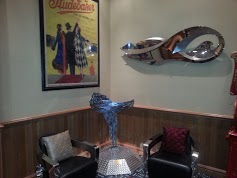
The owner restored classic cars for years and you can see a lot of that material  has made its way into the hotel.  Fenders turned into benches, tools turned into sculpture and art.

retro7

A “school” of vice-grips 🙂

retro6

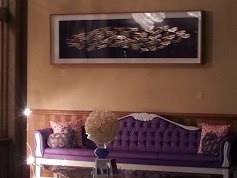
An assemblage of dispirate art and antiques

The owner is a massive collector as well.  Throughout the suites, framed classic movie posters, old microphones (including one from Elvis and one from the Voice of America) and radios, vintage furniture, tables made out of the tail-pieces of WWII bombs, authentic Turkish samovars, and paintings by one of the owners’ family members grace the walls.  He even has a couple of the FAO Schwartz tin soldiers in there.  You can spend hours just wandering around the joint.

A pair of FAO Schwartz tin soldiers with automotive-part furniture

A pair of FAO Schwartz tin soldiers with automotive-part furniture

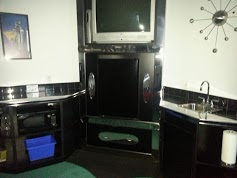
Each suite is decorated in theme.  My suite was the “Chrom-e-delic.”  I’m sure you can see the mod 70s influence 🙂  Go to the site (linked above) and see some of the other suites for yourselves.

retro8retro9

The hotel is actually a block of converted and renovated buildings.  It’s a wonderful maze in there and inspired an idea for my third (of thirteen) original short stories for Kasie Whitener’s Just Write: 2013 Short Story Challenge.

Books as inspiration

I started reading Catherynne M. Valente’s Palimpsest this past week.  Just previous, I finished Deborah Harkness’s A Discovery of Witches, which features as its MacGuffin, a palimpsest, or book within a book.  Picking up Valente’s book next just seemed the logical extension in my mind 🙂

I was struck by Valente’s lyrical style of writing.  It reminded me of a couple of other books I’ve read: Kathryn Davis’s The Thin Place, and Richard Grant’s Views from the Oldest House.  I’m not sure why I associate them, but I think that, once again, it has to be the quirk factor.

This too, is feeding into my new story 🙂

Dreams as inspiration

I’ve often mentioned that I, like many other authors, draw inspiration from my dreams.  I’ve had a couple this week that I’m going to keep in the idea file.

One, though I think I’m going to play with the particulars a bit, is about a family of vampires (hence the playing, I don’t think another book about vampires could be published any time in the next few decades), who hire a human investigator to discover why their fellow creatures want to kill them.

The dream was more detailed, of course, but this is just to give you the basics.

The second dream is a little more bizarre.  A group of refugees (what they’re running from was not clear in the dream) take refuge in what looks like the ruins of a castle, but turns out to be sentient.  Not only that, but as they explore the castle, they come across indications that at least one of them has travelled to the past, and left messages for them to find around the castle.

Definition of inspiration (courtesy of the Miriam-Webster Online Dictionary)

1
a : a divine influence or action on a person believed to qualify him or her to receive and communicate sacred revelation
b : the action or power of moving the intellect or emotions
c : the act of influencing or suggesting opinions

2
: the act of drawing in; specifically : the drawing of air into the lungs

3
a : the quality or state of being inspired
b : something that is inspired <a scheme that was pure inspiration>

4
: an inspiring agent or influence

in·spi·ra·tion·al adjective

in·spi·ra·tion·al·ly adverb

What inspires you?