The one where I post about Dad: A life sentence with mortal punctuation, part 9

You may have noticed that I didn’t post in my series last week.  Truth is, I needed a break from the angsty.  While I feel that this series is important to write, and that I have come to a point in my life that it is necessary to purge certain things, all this exposure of my tender bits is difficult for an introvert like myself.

In the last instalment, I wrote about some of my encounters with death I had during the sixteen years in which I sorted my depressive condition.

About Dad

I love my dad and that’s in the present tense because even though he’s gone in the physical sense, he’s still here with me every day.

In order to tell the tale of his last two years of life, I have to give it context and that begins with his birth.

Dad was the youngest of three brothers and in those days, they lived out at long lake.  Doctors still made house calls for deliveries and that day he was running late.  The woman attending my grandmother, I’m not sure whether she was an actual midwife, or just a family friend, but she told my grandmother to keep the baby in until the doctor got there.

In the story I was told, she said, “cross your legs.”

When the doctor eventually arrived and my father was delivered, he had a brain bleed (subdural haematoma) and almost died right there.  He was given a poor prognosis, but he survived.

Dad was subsequently diagnosed with epilepsy as a child and was on medication from a very young age.

When I was very young, I was his darling.  We’d watch wrestling on the weekends and he’d let me wrestle him on the couch.  Good times 🙂

Then, he fell off the car-port roof, and was hospitalized for a while as a result.

In the years that I was catching all the typical childhood diseases: chicken pox, measles, and mumps (that was terrible, I had them one side at a time so it lasted twice as long as normal 😦 ), by dad was hospitalized for various other reasons.

He had his gall bladder removed.  He developed a hiatus hernia, which was initially mistaken for a heart attack.  He had surgery for that too.  A haematoma developed after that surgery as well.

At home, he’d return from work absolutely exhausted, collapse into his recliner, and fall asleep before dinner was even ready.  After dinner and the evening news, he rarely stayed up late, or fell asleep in the recliner again.

When I hit puberty, things changed again.  I don’t think Dad really knew how to relate to me after that.  His sarcasm became biting, not only with me, but also with my friends.

By then, the malignant hyperthermia had been detected in my family and he had to get tested for that.

Only a few years afterward, Dad suffered his breakdown and was hospitalized for three months as a result.

The spectre of mental illness

For a while, Dad was doing well.  He was getting regular talk therapy and attending a support group.  He started walking everywhere: down to the corner to pick up groceries, out to his get-togethers with the support group (they had coffee klatches outside group).  It seemed, for all intents and purposes, that he was improving.

Then the therapist he was seeing indicated that their sessions would be coming to an end.  Dad should look at trying to get his life back on track, maybe going back to work.

There was a problem with that though.  His employer had disbanded his work unit and there was not job in Sudbury for him anymore.  He couldn’t imagine trying to start over and I’m sure he had anxiety attacks just thinking about it.

Plus, he’d successfully gotten on a disability pension and was, I think, comfortable not working.

Soon, he stopped attending the support group and he stopped walking.  He gained weight and developed sleep apnea.  He also got prostate cancer and though a combination of hormone therapy and radiation put the cancer into remission, Dad suffered the usual after-effects of prostate issues.

His behaviour became more erratic as he went through his manic and depressive phases.  When he was manic, he’d spend like crazy, buying things from the Shopping Channel and Readers’ Digest.  He’d enter every charity lottery he could and spent hundreds on provincial lotteries.

Toward the end of one of his manic cycles, he’d always get struck with buyers’ remorse and his guilt took an odd turn.  He’d start to accuse my mom of trying to leave him, or of hooking up with one of his friends.

When he was depressed, he slept much of the time and tried to undo his financial miscarriages until the next manic phase hit.

My mom was taking care of him as much as she was taking care of my grandfather.  And she was still working.  I worried about her.

Even after my grandfather passed away, Mom didn’t seem to get much time back for herself.  Dad demanded (without really understanding that he did it) every bit of her spare time.  Mom started to go out with friends more as a respite from his illnesses.

By then, he’s also developed an arrhythmia that required the insertion of a pace-maker and was in the early stages of Congestive Heart Failure (CHF).  He started to fall and though his knees required replacement surgery, he was too overweight and his doctor wouldn’t authorize the surgery.

The beginning of the end

On March 4, 2010, I was part of the training team at work and away training.  I got a call to my hotel room late at night.  Phil had had to take my dad to the hospital.  Nothing life threatening.  I was coming home in another day, in any case, and so it wasn’t a situation where I would have to come home, but he just wanted to let me know what was happening.

When I got home, Dad was already out of the hospital.  He was agitated and focused on financial matters.  He’d taken to bed instead of doing his taxes and Mom was worried.

Things got stranger from there and on March 18, 2010, we had to call the ambulance to come get him because he refused to leave bed and refused to eat or take his medications.  Earlier in the week, he had once again been obsessed with their financial situation.  He kept telling Mom that he’d bankrupted them, and while she assured him that was not the case, he kept insisting that she had no idea what he’d done.

At first, Dad was in what was referred to as “ground psych” at the soon to be closed St. Joseph site of the Sudbury Regional Hospital.  Due to his intransigence, he was catheterized, put on IV, and fed food and medications by syringe.  He had to wear diapers as well, because he wouldn’t get out of bed, even to go to the bathroom.

Mom and I visited daily and tried to get him to eat.  What made my heart hurt the most was how he screwed up his face like a little child and clamped his lips shut, turning his head away from the spoon.  This was definitely not my dad.

He continued to say crazy things, that the police were coming to get him; that they were going to have a news conference and put him up as an example of government fraud.  At the same time, he insisted that he didn’t need to be in the hospital.  He was still convinced that he’d bankrupted himself and Mom (not possible as Mom had separated her finances years before because of his manic spending).  He kept asking if we were living on the streets yet, had the bank not foreclosed on the house?

He thought his “fraud” so widespread that it even affected Phil and me, though we were both working full time by this time and doing well by all accounts.  I even told him that we had enough to support Mom, if she needed it, but it made no difference to Dad.

From ground psych, Dad was transferred to the Laurentian site of the hospital on their psychiatric floor.  It was determined that he had suffered a psychotic break, and though not violent, was living in delusion.

We still visited him daily and though still stubbornly clinging to his delusions, Dad eventually started to eat, got off the IV, and through our insistence started the process of getting the catheter removed and out of his diapers.

The psychiatrists on the floor could get nothing out of Dad after a while.  He decided that he’d just not talk about his delusions anymore if they got everyone into such a fluster.  They transferred him out to the medical floor as they could do nothing more for him, and he didn’t appear to be a danger to anyone.

On the medical floor, Dad succumbed to C-Difficile not once, but twice.  He was very inconsistent with his toileting, and remained in diapers.  He was so weak that he couldn’t get out of bed unassisted anymore.

At that point, we were in the position of having to get Dad into a nursing home.  The hospital couldn’t continue to care for him as a patient.  He’d already been there for five months.  Mom couldn’t care for him at home, as the hospital initially suggested.  There were stairs, and she couldn’t lift Dad on her own.  Home care could be inconsistent, and would only cover so many hours in a day.  What would happen at night should he fall or something else take place?

So, we had a family conference with the attending physician, the social worker, Mom, Phil, and me.  Dad seemed to understand what was going on and didn’t object to it.  Mom would have to do some financial manoeuvring to make the arrangement work.

You see, as soon as Dad was in the queue for a nursing home, he was considered an “alternate level of care” patient.  Even while he was in the hospital, he’d be charged the ACL rate, which was about what a nursing home would have cost.

Mom had to file papers for “involuntary separation” so that she and Dad could file their taxes completely separately, for the first time since they were married.

In ensuing weeks, the social worker guided us through the process of selecting a nursing home, and every time my mom signed a form, we were careful to ask, what does this mean?

Dad was transferred again to the hospital’s ALC facility while he waited to be placed in a home.  It was fall by then, and Dad caught C-Difficile at least twice more.  Mom and I became very adept at gowning and gloving before we went in to visit him.

Nurses redoubled their efforts to get Dad out of his diapers and physiotherapists tried to get him up and out of bed.  Sitting upright for a while was all he could manage.  He never supported his own weight again.

Eventually, Mom received the news that Dad would have a bed at Falconbridge Extendacare.  We went in for the intake meeting and left with a mass of reading material.  The place seemed ideal, though.

If Dad could eventually get mobile, even in a wheelchair, there was a pub (the main floor dining room was taken over by a musical group for the evening and they’d be allowed a beer if they wished), an interdenominational faith service several times a week, and an activity room with everything from the internet to flower arranging courses, and they kept canaries and parakeets for the residents.  There was a garden to putter around in outside if he wanted as well.  If he wanted.

The move took place in December of 2010 and Mom and I were impressed with the care he received there.  She still went out to visit him every day, but back in the summer, I’d cut back my own visits to 2 or 3 times per week.  Because of my training obligations, there were some weeks in which I couldn’t visit at all.

Things again began to look good for my dad.  The care was far more consistent at the nursing home, and they were fitting him for a wheelchair.  Mom and I were trying to figure out what his plan would cover and how much extra she could afford to pay for one when Dad set his heart on having a motorised wheelchair.

On Monday, April 4, 2011, Dad was zooming around the halls on what was to become his loaner chair pending the fitting and financial approval for the one we would purchase.  That night, Mom and I were called out to the nursing home.  Sometime after he’d been put to bed, Dad’s CHF went into overdrive and tried to drown him.

He was labouring to breathe, in-and-out of consciousness, unable to speak.  He’d shake and moan from time to time.  The doctor and the minister both came out to talk to us.

Dad was a DNR, that is, no extraordinary measures were to be taken to preserve his life.  He was declared palliative and all medication but those used to keep him “comfortable” were withdrawn.  Mom and I set up a vigil with one of Mom’s friends.

We stayed with him throughout the week and many friends came to visit him.  After the first couple of days, Dad didn’t regain consciousness.  Though I brought books and my laptop to help pass the time, I often sat and just watched him breathe for stretches, held his hand, changed the cold cloths on his head and behind his neck, swabbed his mouth with a damp sponge.

On April 9th, Mom came to relieve me for the evening shift and I went home to bed.  Just after 11, she called and told me to come back right away.  Dad passed away before I got there.

I was still able to say goodbye, though.  What was more important was that I had spent the time with him that week, bearing witness as he taught me what it was to die.  Really, he was showing me all along, and I treasure every moment I spent with him, even the difficult ones.

In memoriam

This is what I characterize as my season of sorrow: from the beginning of March, when he started to show signs of his psychotic break, through March 14, his birthday, March 18, the day he was admitted to hospital, April 4, the day he took his turn for the worse, April 9, the anniversary of his death, and April 15, the anniversary of his funeral.

In a maudlin mood, I might extend that as far as Father’s Day, but a month and a half is enough time to dwell on death.

At his funeral, I read the following poem.  Afterward, I created the picture and we had copies made for the family.
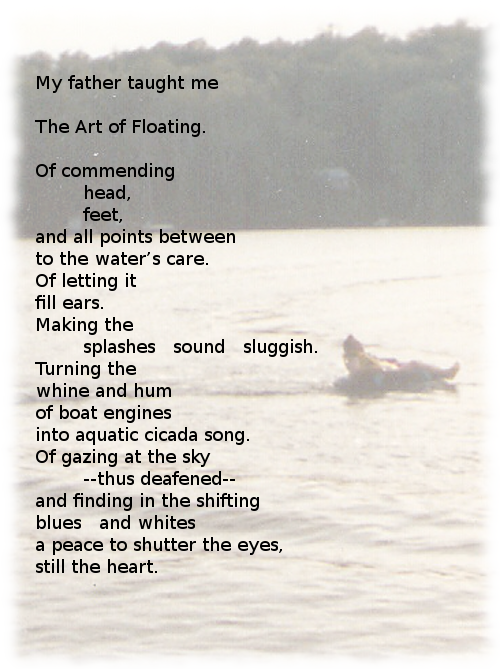
ArtofFloating

The picture is one of my dad tubing at my uncle’s cottage. Sadly, we have no pictures of him floating.


Dad had a nigh on miraculous ability to float.  He could lie on his back in the water, put his hands behind his head, and just float, head, belly, and toes all poking above the surface.  He was unsinkable.  My cousin swears that he caught Dad sleeping that way.  I like to think of my Dad floating away in the afterlife, still unsinkable.

I chose The Water is Wide by Connie Dover as a song for the funeral recessional as well.  Though it’s more of a love song, the water theme prevailed.  While Dad’s gone before her, I like to think that he’ll be back for Mom with the boat when the time comes.

Sadly, I couldn’t find a version of the song to share with you, but I encourage you to give it a listen.  Connie Dover has one of the world’s most beautiful voices.

Next week, the final episode of a life sentence with mortal punctuation: Thoughts on Happiness.  That’s where I’ll tell you a bit about what my experiences with death have taught me about living.

Have a great evening, everyone.
A life sentence with mortal punctuation: part 2

Last week: An early encounter with death.

The year I had my tonsils out

Tonsillitis is hell.  The true infection, the one that leaves your four-year-old self screaming, the monster pain in your ears reaching back into your brain, your throat, latching on with needle-like claws, and shredding.

I remember that.

I remember trying to lie still on my side on the couch while Mom administered oil-based ear medication into my ears, one after the other.  This would hopefully happen before the screaming started, was intended to pre-empt it.   I’d squirm and whine while the medication slowly dripped into my ears, swallowed doses of liquid antibiotics and Tempra (a liquid painkiller for children).

I remember once heading out in the car with my parents and maternal grandparents.  I’m not sure whether it was just for a picnic, or if it was a day trip to a camp site, but it was a ways out of town.  Mom hadn’t thought to bring my medication and just to spite her, my tonsillitis decided to act up.  Big time.

Mom and Nanny (I had to have a different name for this other older lady who wasn’t the same as Grandma, my paternal grandmother) tried to calm me down in the back seat, but I was howling by the time we reached our destination and we couldn’t stay.  I had to be returned home and dosed.

It quickly became apparent that surgery was in order.  Though this was the time during which doctors tried not to perform tonsillectomies, my situation was serious enough that everyone felt there was no other choice.

I don’t remember anything about the surgery itself.  I believe it went off without a hitch.  After the operation, all seemed well, and I returned home enjoying ice cream, popsicles, and TLC.

In the middle of the night, I woke, coughing, had trouble breathing, the air moving in and out of me with a rattling slurp, the sound of milk bubbling through a straw.  The next cough shot a black spatter onto my pyjamas and sheets.  I couldn’t summon the breath to call for my mom right away, my first attempt emerged a thready burble.

Each stuttering breath and cough produced a little more noise, until I was shouting, “Mom!

The light switch flicked on, momentarily blinding me, but one look at the blood and I yelled again, despite the jagged burning in my throat, tried to crawl back from it, but it followed.  I was covered in blood.

My stitches had burst.

A frantic ride to the hospital and the doctor ordered me back into surgery and my parents were ordered out of the examination room, the male nurse assuring them that he could handle getting the intravenous inserted.

He sent Mom away.  It was abandonment, pure and simple.  A four-year old doesn’t distinguish between her parents leaving her and her parents being forced to leave her.

Worse, the nurse tried to stab me.  I showed him.

Mom and Dad were brought back in, allowed to hold my hand, held my legs down, while the newly bandaged nurse taped my arm to a block of wood and did his worst.  In the moment, I hated my parents for that, for letting the nurse hurt me.

I didn’t die, but I came close.

I don’t remember any of the iconic images typical of near-death experiences (NDEs).  No long tunnels.  No doorways of brilliant light.  No voices of lost loved ones calling to me.  No angels; no voice of God.

The road back from that second surgery was a long one.  I’d ingested so much blood, I became incontinent in the most embarrassing way, my family doctor plucked clots of blood out of my ears, and nothing, not even ice cream, tasted good for weeks.  More courses of liquid antibiotics followed, which stained my teeth indelibly and made me self-conscious for years.

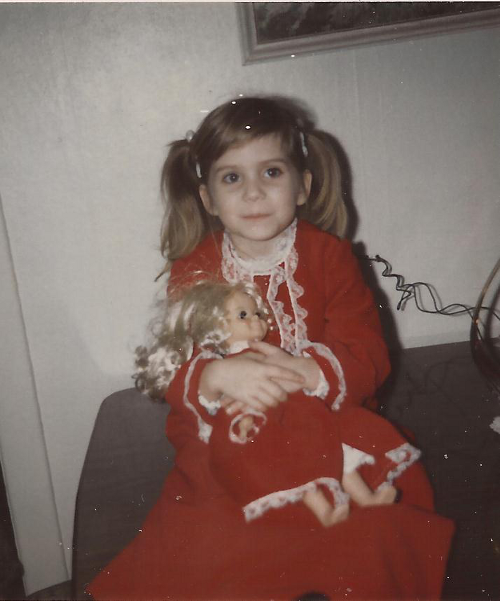
I have a picture of myself right after the surgery, pale, skinny.  It was Christmas, but I couldn’t smile.

Mellie after the operation

Mellie after the operation

What’s stayed with me the most was the dream.

My first night home after the second surgery, I dreamed of my bed, empty.  The cheery yellow and white striped flannel sheets, the blue wool blanket turned down, the dark wood frame with the toy cupboard built in.  Just the bed in a kind of spot light, the rest of the room dark.  The image of the bed receded into the darkness and finally disappeared.

The feeling that I woke up with was that I had died, not that I really understood what that meant, but that I had ceased to exist and that the world I woke up in was a new one.  I had a new life, too.  A second chance.

Now, I’d say that I dreamed of one of those moments at which the infinite iterations of parallel universes converge.  I turned left.  The sensation was profound.

I started to have nightmares about falling, or being abandoned, that troubled me for years,

Deutsch: Engel holt die Seele eines Sterbenden

Deutsch: Engel holt die Seele eines Sterbenden (Photo credit: Wikipedia)

and am firmly convinced that I had spontaneous out-of-body experiences (OBEs) at night.  During the latter, I felt like a helium balloon in a wind storm, flung, sometimes painfully, to the furthest reaches of my tether but always yanked back.  The ‘string’ was attached to my navel.

Try an experiment for me.  Poke your finger into your belly-button.  Press in hard and wriggle it around.  That will give you some idea what having a string attached to it and being hauled around by it feels like.

I’ve heard that the navel is supposed to be an erogenous zone (thanks for that one, Dr. Oz).  Sadly, I’ve never found that to be true.  It’s always been a slightly disturbing feeling for me.  I figure that’s just me.  My wiring isn’t quite what other people might feel is normal.  I’m cool with that.

I’ve written a short story about this experience for my thesis called “Tonsillitis Blues.”  I’ve written short fiction and poetry about it.

This experience is still in me and claws its way out from time to time, like it has today.

Next week, I’ll be delving into the period of my life that I refer to as ‘friend wars.’  These were my first experiences of bullying.  I think I did pretty well, even though I had no idea what it was I was dealing with.  This was also the period when I developed my first defenses against bullying, several of which resulted in my further isolation, and one of which meant that I became a bully myself.

I see the ‘friend war’ years as the time when my predisposition to depression was first anchored in my psyche.  It destroyed my self-confidence.

Have any of you had a non-traditional near-death experience?  A youthful trauma that resulted in years of nightmares?  How about out-of-body experiences?  When were you able to understand what happened to you and how it affected you?  What creativity has emerged from these experiences?

I’ll be posting my interview with Brian Braden shortly.

Talk to you soon!

A life sentence with mortal punctuation: part 1

First: A note about memory, frame, and fiction

I have my memories, but as I get older, I don’t know that the biological hard drive that is my brain hasn’t been corrupted, that the memories reflect the reality that was, or reality as I want it to be.

My memories have also been informed by family stories and sometimes the latter influence the former, so again, I can never be certain of their veracity.

Thinking about this, I remember the academic and theoretical concept of “frames” from my undergraduate studies, now also more than 20 years in my past.  Everyone has their own frame of reference, influenced by their experiences and education, family and individuated world view.

Even if one attempts to be completely truthful, one’s truth can run counter to reality.

The writer cannot express anything but through the filter of their frame.  In this sense, all written work, whether scientific, academic, journalistic, historical, or honestly fictive, has in it the element of fiction.  It cannot help but be influenced by the frame of the writer.

Mathematics may be the only purely objective writing, but even there, unknowns and chaos creep in and beg interpretation.

This is just my opinion, but I wanted to get it out there as a way of saying that even though I write from memory and experience, I am writing a story.  It is my story, but not having time travel at my disposal, I cannot say that this story, based on real life events, is any more “real” than a movie based on the true story of X.

How it all began (yes, I’m really going there)

So, it’s October, 1969, and my mother, nine months pregnant, walks to her regular doctor’s appointment.  Her doctor’s office was at the top of Regent Street hill, and for those of you who don’t live in Sudbury, that’s a really big hill, of San Fransiscan dimensions, even.

The doctor enters the exam room and says, “I didn’t expect to see you.  I thought you’d have your baby by now.”  My mom shrugs and says that everything’s going fine, “but,” she says, “I’ve been having these really strange cramps all day.”

After a brief assessment, the doctor tells her to call her husband and get over to the hospital post-hasty: “You’re in labour, woman!”

My mom’s never been the kind to thrust the agony of my birthing at me.  I don’t know how long she was in labour or how painful it was.  I just know that it was the first, and only, occasion when my maternal grandmother, sober her entire life with that notable exception, got stinking drunk 🙂

Early memories

The only things I remember from my infancy are images.  Moments.  The colourful, plastic Fischer-Price mobile that hung above my crib; a tin, battery-operated locomotive; and this memory, which became a poem:

infant crawls

mother says she was crawling by six months and walking
by eighteen. situate her chronologically as you wish
any month and day in 1970.
reaches linoleum and drags
legs forward.  pivots onto buttocks.
suddenly sees black shoes and white tights,
spill of turquoise dress over thighs.
a contemporary picture reveals the dress in question.
shirred bodice, empire waist, short sleeves poofed and gently
cinched around chubby arms.  her hair is short and blonde, lovingly
held in place by two plastic pink barrettes in the shape of bows.  her baby
teeth are coming in.
fridge holds her attention for a moment.  then something moves
—brown shoes—ma ma.
though she was beginning to speak, her words were
carefully articulated.  not mama, but ma ma; syllables
spat out, exhaled along with breath.
low like this, ma ma is brown shoes and white-pink
calves.  ma ma is also round-white-pink, brown curly, and
long-white-pink ticklers, but they are all ma ma.  they all smell
of comfort.
the brown shoes were around for years, with large, square,
brass-toned buckles.  nylon-sheathed legs above them truncated by
fall of blue dress: straight, simple, homemade, with short sleeves.
horn-rimmed glasses frame hazel eyes and permed, dyed hair.  mother’s
smile was shy and kind.
chubby arms lift hands to grasp.  frustratingly ma ma seems to be between
wriggling grabbers, but cannot be touched.  “ma,” she says, and “ma.”  two
world-shaking clomps later, the long-white-pink lifters bring her up to the
round-white-pink ma ma and pudgy fingers tangle in curly brown.
this is my memory.  i do not ask my mother if she
shares it.

©2012 Melanie Marttila

infant crawls era Mel

‘Dis be me 🙂

Something I don’t remember

My maternal grandmother had a massive heart attack that required a multiple by-pass (not sure how many, just that they had to take the vessels from her leg).  In the wake of the ordeal, she was in a kind of fugue state, conscious, but not talking, not interacting.

My mom was allowed to bring me in to the intensive care unit.  Normally, a baby wouldn’t be permitted, but it was thought that either it was time to say final goodbyes, or that I might somehow remind my grandmother that she had a reason to live.

Fortunately, the latter happened.  My name was the first word she uttered in days.  I have no idea how old I was when that happened.  It’s funny sometimes the affect we have on others, whether we know it or not.

My grandmother was given a dim prognosis: months perhaps.  She lived to see me graduate high school and did not pass away until I was in university.  More on that in a later post in this series.

Grandpa

My first encounter with the spectre of death was the passing of my paternal grandfather.  When I was three, my grandfather was up on his carport roof, shovelling snow, and had a massive heart attack.  I was carefully sheltered from the event.

That year, the local television station broadcast “The Santa Show” which read children’s letters to Santa on the air.  The big Christmas news Santa reported that year was that Rudolph was sick and might not make his annual flight.  In trying to explain the situation to me, Mom told me that Grandpa was in the hospital.

“With Rudolph?” I asked.  Yes, with Rudolph, she said.

Only days later (I think), I was set to play in the snow while my father climbed up to clear that same carport roof.  The job had to be completed.  As he descended, the ladder slipped on the ice, and he fell, calling to my toddler self for help.

Understandably, I thought Daddy was being silly.  Patiently, through his pain, he convinced me, who’d never gone anywhere alone in my brief life, to go to the next-door neighbour for help.  I was frightened out of my wee gourd and Dad had to keep encouraging me to keep going.

Neither of us knew, entangled in our own drama, that Grandpa had died.

I only know this because my mother told me: Grandpa was a man of few words.  He loved to garden, and grew straw flowers so he could engage in dried flower arranging in the winters.  When he watched me, he sat in his chair, often reading the paper, and let me play quietly with his Salada tea figurines.  I still have the wolf.  It sits on my bookshelf along with other memorabilia.

I hardly had the opportunity to get to know him and he was gone.  Dad ended up with a fractured pelvis and was in the hospital over the holidays.

Truthfully, neither event had much of an impact on me, though I always thought that I’d let Dad down when he fell, not that I could have done more than I did, being three and all.  I got used to not having Grandpa around, and life went on.

I think that when you’re very young, death can’t be understood.  It’s therefore far easier to accept.  Absence becomes the new normal.  There’s no introspection or grief, and the grief of others is equally beyond understanding.

Perhaps these early experiences do have a lasting effect.  Maybe the trauma lies dormant, only to surface at a later date and hijack our lives.  For all the time I’ve spent examining my life, I can’t say.  I don’t feel any connection between these early experiences and the person I became.

What about the stories of your lives?  Do you have a memory of a death from your early years?  How did you react, or not?  Can you connect the experience to some trait or tendency that you embody today?  Have any of your early memories inspired your creative work?

Next week:  My first near-death experience and what came of it.

Until then, writerly peeps.  In the meantime, mine your memories for creative gold 🙂

There’s something you should know about me

Photographic illustration of a near-death-expe...

Photographic illustration of a near-death-experience. (Photo credit: Wikipedia)

I’ve almost died … twice

Both times, I was under the knife for what should have been straightforward surgical procedures: a tonsillectomy and an appendectomy.  Both experiences changed me profoundly.  How?  I’ll share that with you in future posts.

I’m reopening the confessional category of my site, My history as a so-called writer, with a series that might strike you as a little morbid.  It’s about death and how it’s shaped my life.  Originally, this was to be a two-part guest post on Monique Liddle’s Bends in the Road, but since them it’s metamorphosed into something a little bigger, and I hope, better.

Yes, I’ve had a couple of near-death experiences, and my father and grandparents have all passed, leaving their marks on my heart and soul, but I’m not just talking about actual death here.  Mental illness and addiction, which I think of as two kinds of personality assassination, have also had their affects on me and my family.

If the ‘you-who-wants-to-live-in-this-world’ dies, even metaphorically, how can that be any better than actually dying?  It’s a question, I believe, that leads many to the depths of depression and suicide, which may seem like the logical conclusion of such ruminations.

I’m starting this series with Bell’s Let’s Talk initiative in mind as well as my impending bell-talkpersonal season of sorrow: my father’s birthday, the anniversary of his admission into the hospital for what proved to be his ultimate decline, the anniversary of his death and funeral, followed by Father’s Day.

I also thought this was a timely topic after listening to Michael Enright’s interview with Bob Ramsay last Sunday on CBC’s The Sunday Edition.  Bob died on the operating table, but didn’t have the typical near-death experience that most people report.  In fact he didn’t remember much of anything at all.  You can visit the link above, see some listener response, and listen to the podcast yourself.

Finally, I’m reading Gretchen Rubin’s The Happiness Project.  I picked it up on the recommendation of a friend and have been reading through it.  It’s a little slow going for me, since I’ve gone through some of what she writes about in my own way previously, and because I just can’t relate to some of the other experiences that she writes about.  I hope to share some of my  insights on happiness throughout this series as well.

On that note, this past week, I read Justine Musk’s blog post on the pursuit of happiness.  I think she has some valid points.

My encounters with death (physical and spiritual) have informed my development as a creative person and shaped the way that I respond to various negative events in my life.

What I’m hoping to accomplish

This isn’t supposed to be purely confessional or self-serving in any way.  I am a what-you-see-is-what-you-get (WYSIWYG) kind of gal, but to be honest, I expose myself as a means of defence.  If I share too much information (TMI), people tend to react in one of two ways:

  1. They never ask me a personal question again and generally leave me alone, or
  2. They understand I choose to share the deeply personal or embarrassing details of my life in an attempt to deepen my connection with the people who are important to me.

It’s a way of knowing who your friends are and of deepening your relationships with the people who mean most to you.

Doing this on my blog has been a bit of a mixed blessing.  I blogged most of my embarrassing, personal stuff early on in Writerly Goodness’s existence, thus ensuring that few people would actually look at it.  I wasn’t really risking much, but I also had no idea if this was the kind of subject material that would resonate with my readership.

I’ve mentioned a few times in various posts about how shy I am.  It would be very difficult for me to speak about these issues in a face-to-face kind of way without getting freaky and spastic.  This has happened, though.  It wasn’t pretty.

So now I’m pulling out the big guns again in an attempt to connect more with my friends on the interwebz and in the hope of sharing something of the themes and interests that inform my writing.  I’d like to start a conversation about these issues without getting self-indulgent because I think they are important to many creative people out there.

It’s an experiment of sorts and I’d love to hear from you.  What do you think about it?  Would it be of value to you?  Would you be willing to put yourself out there, along with me, on this crazy journey?

Let me know.  Please keep in mind that I moderate all comments and I have the dreaded day job.  If your comment doesn’t show up right away, it’s because I haven’t had a chance to review and respond yet.  Rest assured, I make every attempt to respond in a timely manner.  Your comments are important to me 🙂

Writerly Goodness, signing off.