Tipsday: Writerly Goodness found on the interwebz, Dec 18-24, 2016

It’s a week full of informal writerly learnings. My seasonal gift to you, dear reader 🙂

K.M. Weiland offers us the number one way to write intense story conflict. Helping Writers Become Authors

Jamie Raintree wonders, what lights your creative fire? Writers in the Storm

James Preston guest posts on Writers in the Storm: believe in your work—it’s more important than you think.

Laura Drake offers some advanced craft tips on Writers in the Storm.

Becca Puglisi helps us find the sweet spot in which to start. Writers Helping Writers

Dave King dives into writer’s block. Writer Unboxed

Lance Schaubert shares some tips on how to find your working title. Writer Unboxed

Kathleen McCleary guides us back to our story. Writer Unboxed

Heather Webb discovers the power of stepping out, stepping in, and bringing the light. Writer Unboxed

Dan Blank encourages you to be more like yourself. Writer Unboxed

Marcy Kennedy explores how our characters’ apologetic language creates and resolves tension.

Chris Winkle shares some tips on depicting child characters. Mythcreants

Constance Renfrow explains how to streamline your editing experience. DIYMFA

Kristen Lamb tells us the hard truth about publishing.

Chuck Wendig: the key is always hope. Terribleminds

Kameron Hurley speculates about Christmas and the future.

Are those speculative fiction titles on the 2017 Canada Reads Longlist? Oh, yes. They are! CBC

Octavia Butler tried to warn us about politicians who “want to make America great again.” Wired

When David Brin shared this, I thought … woah, Nausica! And these paintings by Jakub Rozalski really do evoke that aesthetic. He’s a little bit steampunk, and a little bit Akira? Design you can trust

Jeff LaSala resolves the eagle conundrum in Lord of the Rings. Tor.com

Remember that piece I shared last week about the Swinton/Cho email exchange? Well, Gene Demby unpacks the kerfuffle for NPR.

Jeanette Ng introduces us to Imagined Cities/Ice Fantasy, the Chinese take on western epic fantasy. Medium

Ooh! And here’s an early look at Blade Runner 2049. Wired

Lynette Rice has an Outlander sneak peek to help see you through droughtlander. Entertainment Weekly

Be well until Thursday, when you can come on back for your weekly dose of thoughty!

tipsday2016

Tipsday: Writerly Goodness found on the interwebz, Oct 16-22, 2016

Just to let you know. I’m participating in #NaNoWriMo this year, but I wasn’t able to take much time off in November. So I’m working. And, I’ll be out of town, training for the day job, for the first week. And I’ll be at Wordstock Sudbury the weekend I get back. And I’ll be helping to launch the SWG anthology, Sudbury Ink. On the weekend of the 12th/13th (the day/date is yet to be determined).

So, it’s going to be a busy month.

As a result, I’m not going to be blogging at all in the month of November. I will be able to complete and schedule the curation posts for the first week (Tipsday on Nov 1st and Thoughty Thursday on Nov 3rd), but, after that, you won’t be seeing another post until December 3rd, when I’ll be doing a double monthly update for October and November.

I just wanted to let you know ahead of time, so you won’t be expecting posts, or wondering where the heck I am.

I’ll be well, and writing 🙂

Your #NaNoWriMo round up for the week:

K.M. Weiland reviews the WriteMind Planner (plus a chance to win!). Helping Writers Become Authors

Janice Hardy guest posts on Kate’s blog: three ways to instantly spot telling.

Chris Winkle shares five ways to hide your foreshadowing. Mythcreants

Vaughn Roycroft suggests the synopsis as a way to revision success. Writer Unboxed

Dave King helps you meet your characters on Writer Unboxed.

Janice Hardy asks, which character is the heart of your story? Fiction University

Writing a series: how much do you need to plan ahead? Jami Gold.

Alex Bloom makes a guest appearance on The Write Practice: what most writers don’t know about screenplay structure.

Steven Pressfield: what works and what doesn’t.

Gail Carriger discusses one of her literary influences, Mercedes Lackey.

Sabaa Tahir picks Patrick Rothfuss’s brain about writing sequels and impostor’s syndrome. Tor.com

Sarah Gailey wants to see more mentally ill women protagonists. Tor.com

Authors share their views on cultural appropriation. The Guardian

Marlon James: why I’m done talking about diversity. Literary Hub

Finally! An infographic that breaks down the big five and their imprints.

Kelsey Campbell-Dollaghan reports on a gorgeous typeface that drove men mad and sparked a 100-year mystery. Gizmodo

Charles Dickens and profanity. Bryan Kozlowski for The Millions.

Azhar A. Alkazwini documents the influence of the Norman Conquest on the English language. Medievalists.net

Five portmanteau words you want to start using. Sad and Useless

Hephzibah Anderson settles in with The Wide Sargasso Sea, the book that changed Jane Eyre forever. BBC

Looking forward to Guardians of the Galaxy, vol. 2? Check out this teaser trailer! Brian Raftery for Wired.

Women will direct every episode of Jessica Jones, season 2. Beth Elderkin for i09.

All the best until Thursday 🙂

See you then! *waves*

Tipsday

Tipsday: Writerly Goodness found on the interwebz, Sept 18-24, 2016

You want moar informal writerly learnings, you say?

Here they are!

K.M. Weiland shares the secret to writing dynamic characters: it’s always their fault. Helping writers become authors

Later in the week, Kate returns with more lessons from the MCU: stay true to your characters.

Tonia Marie Harris guest posts on Writer Unboxed: confessions of an intrepid mermaid.

Lisa Cron digs deeper into the response to her last Writer Unboxed post, in which she posited an alternative to the plotter/pantser dichotomy. It’s hard to own what you believe.

Dave King: give your characters roots. Writer Unboxed

Lisa Janice Cohen shares the seven lessons she’s learned over five years and six novels. Writer Unboxed

Dan Blank: share your voice. Writer Unboxed

Chuck Wendig: here’s how to finish that fucking book, you monster. Terribleminds
Later in the week, Chuck posts: it’s art that will help us survive.

Susan Brooks returns to Janice Hardy’s Fiction University: the importance of genre specificity, part two. Then, Janice guests on C.S. Lakin’s Live, write, thrive: are you making these three common revision mistakes?

Megan Hannum shares five apps that will help you revise your manuscript. DIYMFA

Laura Drake: nail that first line. Writers in the Storm

Chris Winkle shares her insights into creating your antagonist’s journey. Mythcreants

W.B. Sullivan shares six ways to cultivate urgency that will captivate readers. The Write Life

Rebecca Smith: what Jane Austin can teach us about building suspense. Literary Hub

Alice Sudlow posts on the proper order of adjectives.* The Write Practice

*It should be noted that I posted about this in past weeks, including Chuck Wendig’s take.

Indigenous or aboriginal, which is correct? CBC

Roz Morris offers her views on writing as a hobby, an art, a profession, a business, or a vocation. Is there a difference and why is it important? Nail your novel

Kimberly Brock embraces her inner weirdos on Writers in the Storm.

Kirsten Oliphant posts on Jane Friedman’s blog: how to leverage the power of someone else’s platform without being smarmy. Later in the week, Andrea Dunlop shares five questions you should ask yourself when you’re getting ready for a book launch.

So this was a thing that happened:

Writescape profiles Jenny Madore.

Leonard Cohen celebrates his birthday with a present to us. Bob Boilen for NPR.

Buzzfeed lists 28 underused words that you should start using.

Jane Friedman offers her annual state of publishing update.

Publishers Weekly shares the results from their publishing industry salary survey. The trends and disparity are still unsettling.

Susanne Althoff looks at The Bestseller Code and how algorithms could save publishing but ruin novels. Wired

Viet Thanh Nguyen unpacks the complicated issue of diversity in publishing. The Library Journal

Alyssa Wong, Alice Sola Kim, Cat Valente, and Seth Dickenson discuss diversity in science fiction. Leah Schnelbach for Tor.com.

The Fantasy Faction presents part five of their gender and stereotyping in fantasy series: bisexual characters.

Emily V. Gordon says that television writers are doing a better job at portraying characters with mental illness. The New York Times

Keri Walsh: the taming of the bard. Public Books

Watch the PBS trailer for their documentary, Maya Angelou: And still I Rise. The Vulture

More sadness: Terry Jones diagnosed with dementia 😦 The Telegraph

Cinephelia & Beyond takes an in-depth look at Alan Parker’s Angel Heart.

A Nigerian comics startup is creating African superheroes. Lily Kuo for Quartz.

Sarah Gailey posits that Hermione Granger is more than just a sidekick. Tor.com

Watch the Stranger Things kids warm up the Emmy audience with their version of “Uptown Funk.” Entertainment Weekly

And now, I’m a little exhausted.

See you Thursday!

Tipsday

Tipsday: Writerly Goodness found on the interwebz, June 19-25, 2016

I have no idea where all this came from. It was a bountiful week for Writerly Goodness.

Julie Glover guest posts on Jami Gold’s blog: four steps to break grammar rules with style.

Anne Janzer guest posts on Jane Friedman’s blog: how to create an internal mindset conducive to writing.

Barbara O’Neal conducts an experiment in fostering creative flow. Writer Unboxed.

When you don’t want to write: Heather Webb on Writer Unboxed.

Joanna Penn discusses how to banish writer’s block with K.M. Weiland. The creative Penn.

How to plot a book: start with the antagonist. K.M. Weiland’s Helping writers become authors. Later in the week: how (not) to write satisfying action scenes. More lessons from the Marvel Universe movies.

Jami Gold wonders why “unlikable” can be a deal breaker for readers.

MJ Bush offers her keen insight into writing the perfect flaw. Writingeekery.

Dave King explores the work of a master for Writer Unboxed: Jaime Lannister and sympathetic monsters.

Kayla Dean explains how to use story archetypes to subvert expectations. DIYMFA.

DIYMFA radio, episode 100: Unleash your storytelling superpower with Gabriela Pereira.

C.S. Lakin takes a look at the first turning point in your novel. Live, write, thrive.

Chris Winkle offers three painless ways to patch plot holes. Mythcreants.

Jamie Raintree delves into the process of overcoming the emotional obstacles to a writing career. Writers in the Storm.

Five good ideas science fiction teaches us to fear. Oren Ashkenazi for Mythcreants.

Katherine Langrish shares some thoughts on writing meaningful fantasy. Tor.com

Women at WorldCon


Dan Blank: celebrate the arts where you live. Writer Unboxed.

Janet Reid lists the reasons she rejected 25 queries so you can avoid them. She later confesses: so I didn’t get it right the first time . . .

Sarah Negovetich: it’s not you, it’s really not.

Jonny Gellar’s Ted Talk: What makes a bestseller?


This is a weird story from the MFA world. Steven Galloway, chair of UBC’s creative writing program, was fired after an investigation, but under mysterious circumstances. Nobody’s willing to say exactly why. I think anyone reading the articles can infer, but . . . I’ll let y’all judge for yourselves.

Susan Spann explores the legal side of writing for anthologies. Writer Unboxed.

The Active Voice shares the story of Pauline Creeden, who lost her Amazon publishing account through no fault of her own.

Sadness. Lois Duncan died on June 15th at the age of 82. I loved her books. Publishers Weekly.

Jim C. Hines writes about racism and the backlash against black Hermione.

Cory Doctorow revisits Writing the Other, intensely practical advice for representing other cultures in fiction. BoingBoing

The Witch explores America’s essential fear of female power. Dianca Potts for Lenny.

Brainpickings presents Virginia Woolf’s thoughts on the connection between loneliness and creativity.

She-Ra and the fight against the token girl. Maria Teresa Hart for The Atlantic.

Publishers Weekly: Fall 2016 adult announcements in SF, fantasy, and horror.

Indie presses are starting bookstores. Jon Sealy for Literary Hub.

Chemistry explains why old books smell so good. Robin Burkes for Tech Times.

The short film, The Birch, may be creepy, but I think it’s rather heart rending warming 🙂 Rebekah McKendry for BlumHouse.com

James Whitbrook shares Geroge R.R. Martin and Stephen King in conversation: how the fuck to you write so fast? i09. Watch the whole talk. It’s awesome.

Who’s afraid of female Ghostbusters? Dave Itzkoff interviews the cast for The New York Times.

Michael Livingston gets medieval on Game of Thrones’ ‘battle of the bastards.’ Tor.com

Entertainment Weekly shares a sneak peek of the actors who will play Roger and Brianna on Outlander.

Exhausted? I am.

Until Thursday *waves*

Tipsday

Tipsday: Writerly Goodness found on the interwebz, May 15-21, 2016

Fact and fun, all rolled into one . . . curation post 😉

K.M. Weiland shares strategies for writing faster (and why maybe you shouldn’t). Helping writers become authors. Later in the week she shares her number one tip for writing books readers can’t put down.

Chuck Wendig explodes more writing myths as he invites us to crotch-punch the creative yeti. Terribleminds.

Kristan Hoffman puts forth an argument for letting your creativity rest. Writer Unboxed.

Kameron Hurley writes about fame, publishing, and breakout books: dancing for dinner.

Jami Gold helps us understand how plot obstacles affect character agency.

Dave King continues to explore historical fiction pitfalls with this post for Writer Unboxed: sympathetic characters in unsympathetic worlds.

Carly Watters shares five secrets to publishing your debut novel.

Porter Anderson looks at book prices and writing value. Should we have been careful what we wished for? Writer Unboxed.

Five signs your novel may be sexist – against men. Chris Winkle brings a little balance to the table for Mythcreants.

The establishment has always hated the new kids. Kameron Hurley.

Monica Alverado Frazier wonders, do you know how to use a curandera?

Modern witches are so much more than Maiden/Mother/Crone. Natalie Zutter for Tor.com

Daniel José Older reads from Half Resurrection Blues. This man reads like a poet. I could listen to him all day 🙂


John Mullan explores how plots grip us, from Dickens to Line of Duty. The Guardian.

Women swept the 2015 Nebula Awards. Andrew Liptak for i09.

Five science fiction and fantasy novels that treat mental illness with compassion. Barnes & Noble.

This is COOL. Boston’s sidewalks are covered in secret poems. Atlas Obscura.

Lincoln Michel explains why fairy tales are magic for modern fiction. The Guardian.

Dig at the Curtain theatre unearths a Shakespearean surprise. Jill Lawless for Phys.org

Do overused words lose their meaning? Jonathon Sturgeon for Flavorwire.

CBS passes on Nancy Drew adaptation for testing “too female” for line-up (whatever that means). Carly Lane for The Mary Sue.

The BBC shares nine life lessons from Doctor Who.

Two of the shows I liked got cancelled. Fortunately, the end is only the beginning for Supergirl and Marvel’s Agent Carter. Alisdair Stuart for Tor.com

Honest trailers – Game of Thrones, vol. 1 Bewbs!


Come back Thursday for your weekly dose of thoughty!

Tipsday

Tipsday: Writerly Goodness found on the interwebz, April 17-23, 2016

Dialling back on the writerly goodness this week, but there’s still a shit-tonne to share 🙂

Sudbury IS Reading Town Canada. April 30 to May 8, 2016.

K.M. Weiland shares everything you need to know about writing third person point of view (POV). Helping writers become authors.

Dave King writes about writing class accurately in an historical context for Writer Unboxed.

Elsa S. Henry guest posts on Terribleminds about writing blind characters realistically.

K.M. Weiland points out the one major pitfall of writing strong characters. Helping writers become authors.

Becca Puglisi discusses friends as enemies for Writers Helping Writers.

Diverse fantasy is better fantasy. Fantasy Faction.

Oren Ashkenazi lists five signs that your story is racist. Mythcreants.

Ricardo Fayet lists twelve common writing mistakes even bestselling authors make. BookBub.

What’s your potential? Dan Blank on Writer Unboxed.

Jamie Raintree shares her thoughts on the real reason we want to be published. Writers in the Storm.

Awesome process alert! Kameron Hurley discusses why she writes non-chronologically. I can’t. One thing needs to lead to the next for me. But try it out. If it works for you, why not do it? Process is an evolutionary thing.

Janice Hardy explores how to balance writing and working without losing your mind. Fiction University.

Kameron Hurley writes about the slog on the mountain and the calm before the storm.

Related: Lauren Carter writes about climbing gear.

Jim C. Hines considers shield theory as a way of explaining spoon theory to his son.

Publishing news: proposed settlement reached in Harlequin class action suit.

SFWA contracts committee alert.

Nina Munteanu examines the moving target of indie publishing. What every writer and editor needs to know.

I read Janet Reid’s blog religiously. Here’s an excellent post on author/agency agreements.

Carly Watters interviews Kurestan Armada concerning her first year as an agent for the Things I wish I knew series.

Agent Chip MacGregor defines success. MacGregor Literary.

Chris Winkle analyses the fantastic writing of Andy Weir’s The Martian. Mythcreants.

Charlie Jane Anders lists eighteen short stories that pack more of a punch than most novels. Gizmodo.

Michael Peck explores the literature of cyborgs, robots, and other automata. Literary Hub.

Leah Schnelbach wonders why we’re still white-washing Asian characters. Tor.com

These are all kinds of beautiful: Studio Ghibli’s greatest works drawn in Art Nouveau. Go Boiano.

Colm Tóibín on writing. Sentences as rhythm. Sentences as brush strokes. Yummy. Louisiana Channel.

Jeanette Winterson examines Shakespeare’s take on love: bed tricks and broken women. A friend took exception to the dim view of Anne the piece presents, but y’all know not to believe everything you read, right? The Guardian.

The manuscripts of the first two English women writers are now on display. Alison Flood for The Guardian.

Thoughty Thursday is full of videos. See you then.

Tipsday

Tipsday: Writerly Goodness found on the interwebz, Jan 18-24, 2015

Roz Morris with more tales from her masterclasses for The Guardian. This week, your inner horse, johari windows, and finding your character’s true nature.

K.M. Weiland on “on the nose” dialogue, how to recognize it, and how to remedy it.

In her weekly vlog, Katie discovers the one common element in all the books she loves. Want to make sure you have it? Watch and learn.

After a lengthy pause, MJ Bush posts about how to know your character deeply in one step: the back door. Writingeekery.

I have a writer-crush on Chuck Wendig because he writes bad-ass stuff like this: 25 ways to be a bad-ass maker who makes bad-ass stuff.

Dave King writes about forthwringing tonguishness, or, why English is such a mutt language, on Writer Unboxed.

Dan Blank answers the question: why bother with email newsletters? Writer Unboxed.

Christine Frazier of The Better Novel Project interviewed on the writing education, technology (WET) podcast.


Writing is self-hypnosis from Stephen King:


Four plots structures you want to avoid. The New Yorker.

Fabulous bookshelves brought to you by BookBub. My faves? Nine and nineteen.

Why season three of Orphan Black is going to be even crazier. The Nerdist. Yeah, it’s a TV show, but damnit, it’s also great storytelling.

The Guardian. 20 previously unknown Pablo Neruda poems discovered in Chile.

It was a lovely week for writerly goodness.

Enjoy, my friends.

Tipsday

Tipsday: Writerly Goodness found on the interwebz, Nov 16-22, 2014

Roz Morris has some excellent thoughts on choosing a title for your book. It’s more important than you think.

On finding your theme with K.M. Weiland. Guess what? It comes down to your character’s arc 🙂

How your editor can irritate you, and why that’s a good thing. Anne R. Allen with Judy Probus.

Victoria Mixon outlines the three vital steps to creating your protagonist.

Dave King is back on Writer Unboxed with another Buffy-inspired post: Everything I need to know about character, I learned from Buffy.

Jamie Raintree shares three strategies to stay motivated on long-term projects. Thinking through our fingers.

The seven roles of the healer archetype, on the Better Novel Project.

Julie Sondra Decker explores what happens while you wait. In propinquity.

Margaret Atwood came to Sudbury to celebrate her birthday last week. It’s the last time she’s going to make the journey, so we made a thing of it 🙂 TVO’s Steve Paikin (also Laurentian University chancellor) interviewed her.

And then the CBC’s Jessica Pope got a little Atwood action as well.

Ursula K. LeGuin at the National Book Awards. The New Yorker.

And the video:


Ursula K. LeGuin interviewed in The Paris Review.

Outlander’s Gaelic coach offers a crash course. Scotland Now.

Billy Boyd sings “Last Goodbye” for the final Hobbit movie. Entertainment Weekly.

Cary Elwes shares twelve Princess Bride Secrets. LA Weekly.

Seven strange and wonderful fan theories about fantasy and science fiction. i09’s Toybox.

See you on Thoughty Thursday!

Tipsday

Tipsday: Writerly Goodness found on the interwebz, Aug 17-23, 2014

I really tried to get used to the new WordPress editor, but I finally had to give in and activate Classic Mode (Dum-ta-de-dah!). It’s so much easier to apply tags in the classic editor.

Let’s start with some publishing news. From Publishers Weekly, no less. What copyright changes mean for Canadian publishers.

Here’s K.M. Weiland’s weekly podcast/post: Can a character’s arc be a subplot?

Here’s her guest post on the Writer’s Alley on what weather can do for your story.

Then Katie wandered over to the Wordserve Water Cooler to discuss how to make a walk-on character memorable (but not too memorable).

Here’s Katie’s workshops & webinars page if you want to get moar of the good stuff.

And her weekly vlog on how to tighten your tale by streamlining your symbolism.

Anne R. Allen rounds up the usual suspects for her post on five protagonists readers hate.

Roz Morris examines how to write a character with an addiction.

Angela Ackerman guest posted on The Insecure Writers Support Group about how to deepen your conflict by forcing your hero to embrace the grey of morality.

Jan O’Hara considers cadence and its power to affect the reader in this post on Writer Unboxed. I started off as a poet. Believe me, people can tell 😉

Dave King shares his love of bafflgab on Writer Unboxed.

Painting vs. Dramatizing: How to make a scene, on Janice Hardy’s Fiction University.

How one writer kept a productivity streak going for 373 days. Jamie Todd Rubin on 99u.

Jami Gold has some fun discovering how writing changes our brains. Brain science rules 😀

I do a little conference reportage, but today I get to feature Mona Alvarado Frazier’s post about the lessons she learned at the Writer’s Digest Conference. Part two will be coming up next week, if you’re interested.

Lev Grossman writes about finding his voice in fantasy. The New York Times.

Buzzfeed presents the epic writing tips of George R. R. Martin and Robin Hobb.

I was shocked to discover that William Gibson’s Neuromancer is 30 years old. Egad. The Guardian.

25 pieces of life advice from literature, presented by Flavorwire.

A little writer tech for you here. Bookbaby blog posted about proofreading software. Interesting . . .

And that’s the load for this week.

See you on Thoughty Thursday with researchy, inspirational stuff.

Let me know if any of this curation tweaks your muse, will you? I’d love to know how things are going 🙂

Tipsday

Three great books on self-editing

(A.K.A. more writing-book porn!)

Since I started serious writing practice and got down to the business of trying to turn my idea into a publishable work, self-editing has been an obsession of mine.  I started out with a good grounding (2 degrees in English), but soon learned that there is always room for improvement.  Always and forever.

When the publishing boom of the 80s and early 90s changed directions, agents and editors state one principle requirement: write a damn good book, and write it well.

Here are, in no particular order, three books that have helped me immensely.  Just ask my Author Salon critique group, I am the queen of nitery-pickery (I’m not sure why I choose to write it like that, but I suspect it might have to do with the character of Rockery Hud-Peck from The Fintstonesthat’s just how my brain rolls).

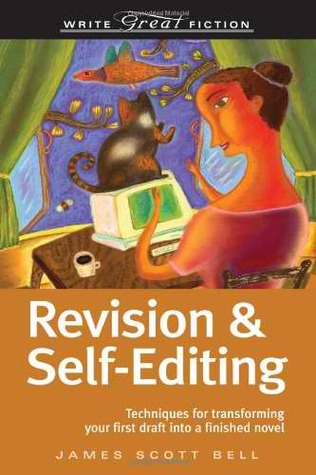
1. Revision & Self-Editing: Techniques for transforming your first draft into a finished novel by James Scott Bell (The Write Great Fictions Series, Writer’s Digest Books, Cincinnati, OH, 2008).

Bell divides his book between self-editing and revision, which he states are two separate processes.  They are 🙂

In his introduction, he references Browne and King’s Self-editing for Fiction Writers: How to edit yourself into print, another of my selections (see below), as well as a slew of writing gurus ranging from Brenda Ueland to Natalie Goldberg and Ray Bradbury.

Bell begins each section by presenting his philosophy of the task, then proceeds through self-editing with various chapters on each aspect of the work (character, plot, POV, etc.), asking probing questions along the way to get the writer deeper into their novel, and offering exercises to assist with the understanding of the element at hand as well as its relevance in self-editing.

When he gets to revision, it’s more about process than elements and analysis, but Bell is equally insightful in his discussion.

Bell is a skilled author and editor.  He writes from his experience in self-editing.  This perspective is what sets my first pick apart from the others.
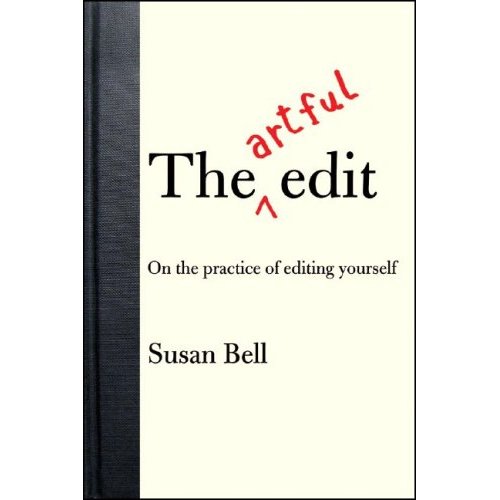
2. The artful edit: On the practice of editing yourself by Susan Bell (Norton, New York, 2007).

Susan Bell is a veteran editor and author, but her authority and perspective derive from the former role.

She breaks the self-editing task into Macro and Micro phases, again, providing examples, checklists, and exercises to deepen understanding. Then Bell offers what she calls her Master Class, provided in the form of experts in different creative fields (photographer, film, etc.) and what each can teach writers about how to make their story come alive.

Finally, she provides an overview of the evolution of editing, fascinating in itself.

Bell applies investigative zeal to her book, and it offers unique insight into the world or authors and editors, their relationships, where one begins and the other ends, and what the writer can do to become both.
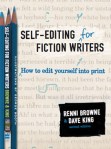
3. Self-editing for Fiction Writers: How to edit yourself into print by Renni Browne and Dave King (Second Edition, William Morrow, New York, 2004).

First published in 1994 by HarperCollins, Self-editing for Fiction Writers is seen by many as one of the definitive works on the subject.

As with the James Scott Bell’s book, Browne and King’s breaks the task of self editing into its elements (characterization, dialogue, voice, etc.) devoting a chapter to each with examples and exercises.

One thing that I appreciate is the first chapter: Show and Tell (emphasis mine).  The point is made, and I fully agree, that while the writer should endeavour to show, that there are some places in your novel where telling is not only appropriate, but necessary.  It is the skilled writer who knows the difference and knows what technique should go where.

I also enjoyed the collaborative tone of the book.  When the authority is identified by “we” and not “I,” something rhetorical and clever happens: readers begin to feel that they are a part of the illustrious editorial team that wrote this book.

It’s an inclusive way of writing that empowers reading-writers to believe in their ability to self-edit.  The doors of the country club have opened, my friends, and we have all been invited in for drinks 🙂

The Wordsmith Studio Goodreads group is currently reading this book and it’s been a wonderful opportunity for me to get reacquainted with some old friends.

I recommend all three books highly (not to show favouritism or anything).

Do you have any books on self-editing that you would recommend?  Share their titles and maybe a few choice words of review in the comments so everyone can benefit from your experience 🙂

Writerly Goodness is calling it a night.