Disclaimer: I am not perfect and neither are my notes. If you notice anything that requires clarification or correction, please email me at melanie (dot) marttila (at) gmail (dot) com and I will fix things post-hasty.

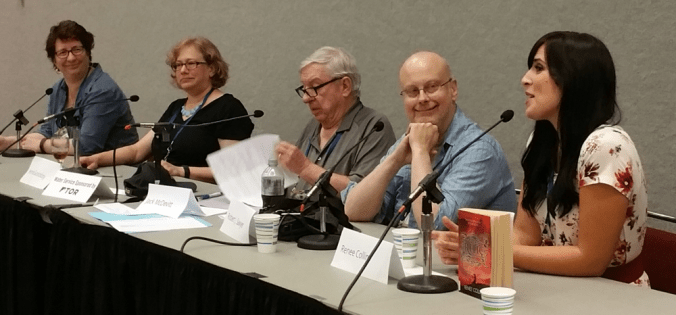
Panellists: Ellen Datlow, Brooke Johnson, Erin Wilcox (moderator), Sandee Rodriguez, Dana Cameron
Joined in progress …
DC: Fairy tales are the intersection between the known and the unknown in a way that other stories aren’t.
BJ: Tone is the defining quality. It’s a sense of magic realism or normalized magic. I’m currently reading the Turnip Princess. It’s meant to be read. Oral storytelling. Fairy tales are mythic, grand and meaningful, larger-than-life, and yet the things that happen are everyday occurrences to the characters of the story.
SR: Folk tales have the element of reality. Fairy tales have no sense of history.
DC: Domesticity is addressed in fairy tales.
EW: There’s a marked different between fairy tales intended for children and those intended for adults.
ED: Modern retellings add sex. The originals were dark enough, though. Look at Hansel and Gretel—they were going to be eaten but ended up stuffing the witch in the oven.
BJ: Fairy tales were cautionary.
EW: In his book, The Uses of Enchantment, Bruno Bettelheim says that the reader divines whatever they want from the fairy tale. What is it that scares you most? Is it that your parents didn’t want you?
DC: Fairy tales were didactic, warnings. What happens when you go out into the world alone? There are only a handful of clever, successful kids who survive. There’s a tale about the young servant of a king, He discovers how the king became so wise—he ate a white serpent. The kid tried it and goes out into the world. He’s kind and curious and eventually becomes a wise king himself. I took the basic tale and moved it into space.
SR: Reading dark fairy tales to young kids beneficial. The story is internalized. They imagine what they would do in that situation. How would they escape? It develops creativity and problem solving skills.
EW: Do fairy tales need to be sanitized? Should they be?
BJ: Disney sanitized everything. Snow White is about persecution and stalking.
ED: Tanith Lee sexualized fairy tales. You can retell fairy tales over in different ways. Hans Christian Andersen had a thing about sacrifice and death. Look at his versions of The Little Mermaid and The Little Match Girl.
EW: Fairy tales from all over the world overlap.
DC: I read Japanese fairy tales when I was eight. There was a boy who drew cats. His drawings came to life at night to save him from a rat demon.
EW: In India they don’t really have fairies, but the national epics are being adapted.
BJ: Tiger’s Curse has Indian influences. It didn’t appeal to Disney. I’m drawn to the dark tales. I write tragic stories.
ED: Read Bullfinch’s Mythology, The Illiad, The Odyssey. Myth isn’t magical enough.
DC: Fairy tales often have bittersweet endings because you can’t go back.
And that was time.
Next week, it’s time for my next chapter update 🙂
Be well and stay strong until then, my friends.
 Always Looking Up