Grades seven through twelve

Art became a kind of salvation for me.  I wasn’t the best, but I was good.  My art teacher said that I was a colourist, and I had no idea what she meant, but I was nonetheless flattered.  If I did know what a colourist was, I might have been even more flattered, because I still liked comic books and graphic novels.

I also started guitar lessons.  I was never quite comfortable with the instrument, but again, I was comfortably mediocre.

I kept on writing and entered a student poetry contest I didn’t place in.

My first attempt at public speaking was lost in a fit of giggles.  My speech was on winter camping, and the best way to keep warm while you slept was to sleep without clothes–oh my!  My classmates enjoyed the effort though, and graded me highly for the entertainment factor alone 🙂

A guest speaker came to my grade seven class.  Unfortunately I don’t remember who he was, though I believe he was a journalist.  I guess you could call it my first workshop.  I wrote a supernatural murder mystery in one sitting and read it out to the class.  I really got into it, dramatizing the voices and everything.  Though empowering, I felt a little like a freak.

Grade eight brought more luke-warm success with a few of my stories read out in class.  My teacher’s final report of the year called me apathetic, however, and I had to fight to get into the advanced level classes in high school, despite having the grades to be so placed.  Just because I’d rather be in a book than in class …

I was bored.  I’d do the work I was supposed to do in class, then pick up whatever book I was reading at the time.  My instructors would approach, I’d show them that I was done, they’d advise me to do my homework, so I’d do that, and pick up my book again.  Then, I’d be advised to work ahead.  I hated school then.  Extra study was the last thing I wanted to do.

None of my writing was ever given into the dubious custody of any of my classmates.  I was even cagey with Margaret and took every well-meant criticism to heart.

I can’t remember exactly when, but I caught the Dungeons & Dragons bug.  Margaret’s Dad got her the Player’s Handbook, and shortly thereafter, we picked up the Dungeon Master’s Guide and Monster Manual.  We started to attend the weekend meetings of the Sudbury Gaming Club at Cambrian College, and eventually tried out other games.  I was a dedicated gamer well into my 20s.

Suddenly, I had another group of people I could consider friends!  And none of them knew me from school.  Bonus.  We went to concerts: Headpins and Helix, Iron Maiden, Twisted Sister …  I was a burgeoning head banger in those days.

When high school hit, with my part time job, boyfriends, and everything else that came with it, my writing started to take a back seat.  I became interested in the visual arts again.  I still wasn’t the best, but I was better than some, and I did well enough.

I didn’t stop writing.  I kept on dreaming and I kept on writing down my dreams.  I have several ideas-in-waiting from those days.

Emotional drama, serious illness, and the death of my grandmother kept me unstable, and unable to see clearly enough to commit to what I loved.  Heck, I couldn’t even figure out what that was …

Also enter into my life great teacher number two, Ms. Chapman.  Her classes instilled in me a passion for literature that while slow to kindle, saw me through the rest of my academic career, such as it was.

Chronologically, what happened next was my first year of university.  You can get that bit of detail by reading How it all started in my Work in progress category.

I’ll pick up the tale again next week with Laurentian University.

High school did not constitute the best years of my life.  Really, I kind of hated it.  My saving grace was Margaret.  Despite all the relationship crap and growing apart that always happens in the fraught teenage years, Margaret remains one of my best friends.

How did your high school years affect your development as a creative person?

Monkey around already!

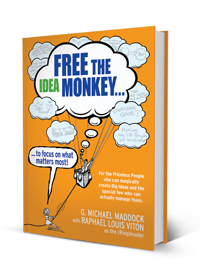
Today, I attended a Webinar sponsored by TrainingIndustry.com and presented by G. Michael Maddock.

In business, there are often synergystic pairings: Walt and Roy Disney; Wilbur and Orvil Wright.  One is the creative genius and the other is the business mastermind.  Maddock calls them the idea monkey, and the ringleader respectively.

At work, I identify with the idea monkey but I also have the focus and vision of a ringleader (I think).  I had to ask the question: can one person be both?

The answer: yes.  If the entrepreneur is in business for herself, she has to be both.  I think because of my writing, which is essentially self-employment, I’ve learned to be self directed as well as creative.

Other interesting learning bits:

Dr. Edward Hallowell, whose research influenced Maddock.  His primary area of research is ADD/ADHD and some of his research has identified similarities between highly creative or innovative people and those diagnosed with ADD/ADHD.

This was an interesting piece, especially given my recent postings on creativity and adversity in My history as a so-called author (A born storyteller … and Three blind mice).

The insight equation: I [statement of fact] because [reason] but [tension].  Example: I want to pay via credit card online because it’s convenient, but I’m afraid of fraud.  (Paypal’s insight).  The critical piece is the but + t (for tension).  So when thinking about a problem to solve with innovation, look for the sexiest butt 🙂

Expertise gets in your way.  Think outside the box?  You can’t read the label if you’re stuck inside the jar.

Finally, intelligence is painful.  You have to learn from your own mistakes.  Wisdom is better.  You get to learn from the mistakes of others.

It’s quite a bit to digest, but like most of the things I learn through my day job, it has implications not only for my work as a trainer and course designer, but also for my creative life.

What have you learned lately that seems to tie into your life in diverse and interesting ways?  Are you an idea monkey, or a ringleader?  If you’re a ringleader, do you like to monkey around?

A born storyteller …

Storyteller is just another name for liar.

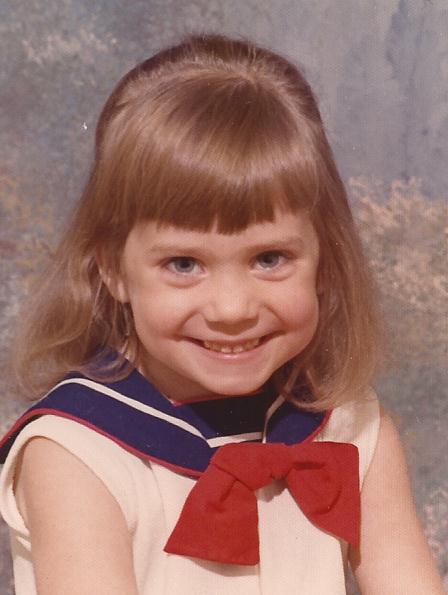
In grade one, I think all my classmates (and teachers) thought of me as a silly giggler, a liar, and cat-lady-in-training.

I didn’t even know how to write properly yet, so I exercised my creativity by telling my classmates in “show and tell” about the latest stray cat that I picked up on the way home.  They’d always run away after a few days and so I could show the class a different picture from the cat book I’d checked out of the library and tell them that my latest find looked just like that.

Daydreaming was also a preoccupation.  Because my dad had epilepsy, it was thought that I might too and that my habit of totally “zoning out” was actually petit mal seizures.  Later in life, I was formally tested for epilepsy and there was absolutely no sign of it.  I’d just delve so deeply into my fantasy world that there was nothing could tear me away.

If I was born 20 years later, I’d probably have been diagnosed as ADHD and drugged into submission.  As it was, I was “spoken to” and ignored.  I was deemed enthusiastic but disruptive by different teachers for different reasons.

Can you see the mischievious? Just call me “wee devil” 🙂

Really, I was painfully shy, and the giggling was a way of deflecting uncomfortable situations, which meant pretty much everything.  To this day, I still laugh when I offer a thought or suggestion to my colleagues or manager at work.  If it’s too radical, my suggestion can always be dismissed as a joke, right?

The daydreaming-at-inappropriate-times thing stayed with me until my mid-twenties, and then I started to get clever about it.  I’d restrict my mental ramblings to my “alone time” so no one would be put off by my apparent disinterest in whatever it was they were saying.  Now I cultivate solitariness.  As I writer, I have reason to, but as a creative soul, I simply can’t do without.

As for the telling of stories, I’ve always wondered what might have happened if someone had recognized what it was I was trying to express and encouraged me to turn those imaginary powers to something else.  If I’d started writing my dreams and stories down earlier, where might I be today?

Ultimately what-ifs and might-have-beens are only intellectual exercises.  None of us have do-overs.

A few months ago, one of the writers I consider to be a mentor, Barbara Kyle, presented this TED talk (via Volconvo) to her creative network: http://www.volconvo.com/forums/content/226-do-schools-kill-creativity.html

It is 20 minutes well-spent, trust me.  Sir Ken is incredibly funny, but his message is dead serious.  Currently, it is not the business of schools to nurture creativity, but to create useful/functional members of society.  I rather agree with Sir Ken, that only by nurturing the creativity of our children will schools produce truly valuable members of the human community.

I’ve also been disturbed by the resurfacing of the ADHD debate.  Are children being over diagnosed/incorrectly diagnosed?  This debate has been around for decades and it still hasn’t been resolved.

Some food for thought:

Were you a creative child smothered by a school system that didn’t recognize what your “acting out” meant?  How did you come to understand your creativity and who helped you through that sometimes agonized and agonizing process?  Did you ever feel less valued or less intelligent because you were more creative than academic?

My Process

Educational Resource:  "Writing process"

Educational Resource: “Writing process” (Photo credit: Ken Whytock)

First, some thoughts about process from other writers:

The thing about process, is that it is, a process.  It changes over time and is as individual as the artist.  For what it’s worth though, this is what I’ve learned about mine …

daydream believer

When I was a kid, I dreamed, and those dreams became the bases of stories.  I didn’t keep a dream journal until much later in my life, but that’s how it started.  In my waking life, I was influenced by the things and people I liked: Siobhan Riddell’s wonderful artwork, Star Wars, G-Force, C.S. Lewis, and Lloyd Alexander.

first thoughts/morning pages/whatever you want to call it

When I was in university, I started to keep a journal, and I have ever since.  I recorded not just my dreams, but also the wonderful insights I gained in my classes.  An interesting thing my roommate taught me about my dream life: I talked in my sleep.  Sometimes I even got up, opened my eyes, and seemed to interact as though I was awake.  I’ve since learned that I am also subject to night terrors and sleep walking.  I once opened all the windows in my apartment in the middle of January and didn’t remember a thing about it …  That’s settled down now that I’m older, but so has my dream life.  I still dream in story, but now the stories my mind tells are all adult ones, about work or other stresses.

clip-rat

When I worked in libraries, I became a clip-rat.  It’s kind of like being a pack rat, but with article clippings.  I’d see something interesting in the New Yorker, or the Saturday Night Post and photocopy it.  I have some articles on economics that I have a story idea about, and a series that the Toronto Star did back in the 90’s about welfare and homelessness that’s fed into another.  When I travel, the daily newspapers left at my room door still yield clippings for the idea file.

my very own science guy

Discussions feed my creativity too.  My husband, Phil, is Mr. Science.  Professionally, he is a network administrator, but in a past career, he was a medical lab technologist.  His hobbies include cosmology, astronomy, and geology.  We have amazing conversations and I have several ideas that have had their genesis from his interesting insights.

forms/genres

Poetry comes alive in the moment: what I see, how I feel.

Short stories come from life events, or arise out of the need to explain them.

So that’s how the process starts, where the ideas come from.

Then they incubate.  It could be minutes, days, months, or years.  It depends on the idea, its purpose, and the genre it decides to be embodied in.

Poetry has the shortest incubation and usually writes itself.  If I revise, that may not happen for a considerably longer period of time.

Short stories are usually written in one sitting, and are usually revised two or three times before submission.  Every returns story is revised again before the next submission.

I’m still discovering what my process is with regard to writing a novel and I suspect it will change significantly before I have it pinned down.  I’ll cover this in a bit more detail in my work in progress category.

ming-ti is everything

(say ming-ti over and over again, very fast … thanks to the Battle Chant grrls for that one!)

I work a day job, and so must write in the evenings and on the weekends.  One of my biggest challenges right now is how to balance my job with my personal and creative lives.

Tools are important.  I have a particular preoccupation with …

ways and means

Though I journal, I don’t have a practice with respect to this aspect of writing.  I’ve tried writing daily, but didn’t find it productive for me.  Now I write in my journal when I have something I want to record.  Sometimes it’s just blather, but I do make a point of writing.  I may not write for a few days, a week, or longer, but then I’ll write several days in a row, or even several times in one day.

I prefer spiral or perfect bound journals that can lay flat, with hard covers in case I’m writing in a place where I there’s no table or other surface to write on.  I have a purple pen to write with.

Poems are sometimes drafted in pen, but most of my fiction writing is conducted on my computer.  I have a desktop and a lap top so I can write in different places in the house, outside, or while traveling.  I have heard that it can be useful to change surroundings occasionally and have done this frequently myself for the following reasons:

  • My day job requires me to travel and I have to write (I can’t do without), so I take my lap top and write wherever I happen to be.
  • When we were renovating my office, and then the bedroom, it wasn’t really possible for me write in my accustomed surroundings.  The lap top became very useful, allowing me to write in the living room, the back yard, or at my Mom’s.
  • Sometimes I just need a change.

be the target

I set goals: a number of pages, or words, a short story revised, or poetry submission prepared.  I try to stick to them, but don’t beat myself up if I can’t meet them.

I write every day.  The rare time that I am too ill, or exhausted, to write, I miss it terribly, so I try at least to do something writing-related: journaling, administrative tasks, research, going over timelines or character sketches, even email counts.  Social media and blogging count too.

alt.creativity

I try to do something else creative that’s not writing.

There was a time that I thought I’d be a visual artist.  I still sketch occasionally: characters, maps, and the like.

I used to sing in the church choir and school choirs when I was a kid.  Later, I joined the Bel Canto Chorus for a season and surprised myself with a successful audition for Theatre Cambrian’s production of Hair in 2000.  Though I haven’t sung publically in years, I still sing, even if it’s just in the car.

I take photos, and some of them have merit beyond the simple recording of events.

I try to get out to the odd concert, or other event, just for fun.

body/mind

I stay minimally active.  If all I do is walk the dog, or walk home from work, I try to do something every day.  I tried jogging for a few years, but I never liked it.

Sudoku, solitaire, and jigsaw puzzles help me relax and help keep my mind engaged.  I used to play Massively Multi-player On-line Role Playing Games (MMORPGs) like Champions, World of Warcraft, City of Heroes, and EverQuest, but I don’t have time for those anymore, even as a reward.  They are very time-consuming, though immensely fun.  A lot of my creativity ended up going into the game as opposed to my writing, so I had to make a choice.  In the end, it wasn’t difficult.

I like to listen to music while I write, but don’t always do so.  I find music relaxing.  It inspires me, though I know some writers can’t have any distraction while they write at all.  I’m fairly eclectic in my musical tastes.  Random selection from my I-Pod: Tori Amos, David Bowie, Sarah Brightman, Kate Bush, Great Big Sea (still a groupie), Sarah Slean, The Fixx, Imogen Heap, Crosby, Stills, Nash and Young, Dala, and Loreena McKennitt.  Though I don’t listen to them often, I also have CDs of Berlioz, the Eddas, Beethoven, Japanese flute, and gamelan music.

Did I mention my tastes were eclectic?

a room of one’s own

I don’t close the door to my office, though I can.  Phil knows to leave me alone while I’m working, but steals in now and then for a kiss.  Even the dog stays away when I’m at my computer.

Plants are a must, as are shelves filled with reference works and fiction yet to be read.  My office is also full of items of personal interest, gifts from friends, masks, and my altar.  With respect to this last, all I’ll state here is that writing has become my spiritual practice as well as my vocation.

don’t feed the muse

I read all the time.  I’m not as fast as I used to be because I don’t have so much time to devote to it, but I still read, and fairly widely.  I try to read something contemporary, perhaps in my chosen genre, then a classic, or another work of fiction outside sf.  Then I read a work of non-fiction, alternating between something for research related, overtly or not, to what I’m writing, and something on the writer’s craft.  My current favourites: Sheri S. Tepper, Guy Gavriel Kay, Diana Gabaldon, Charles de Lint, Ursula K. LeGuin, Heather Sellers, and Donald Maass.

I’m a CBC junkie, particularly “Writers and Company,” “DNTO,” and “Spark.”  I get ideas, inspiration, and insight from them too.

I like shows that have a plot line that carries over seasons: Doctor Who, Buffy the Vampire Slayer, Babylon 5.  I also indulge in Castle and Grey’s Anatomy.  I try to think critically about the plot lines and story.  I watch repeats of the shows I like so I can get deeper into their structure.

the bottom line

Ultimately, everything I do has a purpose, or I can relate it somehow to my creativity.  Everything feeds into process in the end.

Donald Maass writes in The Breakout Novelist: Craft and Strategies for Career Fiction Writers, that most writers, even those who teach creative writing, have no idea what their process is, and I would agree with that.  What I’ve shared here is what I’ve learned in my lifetime of writing to date.  My process is a part of my life and lifestyle.  It changes as I change and it’s difficult to articulate what is process and process alone, distinct from the rest of my life.

Perhaps the point is that there is no distinction.  A writer’s life is her process.  What do you think?

Three Blind Mice

When I was a wee thing, my parents enrolled me in ballet classes.  I think it was because I was such a spirited and energetic girl 🙂

All went well until the first recital.  We were performing “Three Blind Mice.”

I kind of looked like this:

Young Ballerinas, Casa de Cultura, Havana

Young Ballerinas, Casa de Cultura, Havana (Photo credit: travfotos)

I tried to find my old photo in the big box of them I have.  I searched Mom’s collection too, but no luck.  It’ll do …

I was so excited I think I went ballistic, though I honestly don’t remember the specifics.  The instructor had to discipline me, and unfortunately had to do so in front of everyone.  I went from whirling like a dervish to hugging my knees in the corner crying in about two seconds flat.

We were about to go on stage and this wouldn’t do.  Her pep talk wasn’t inspiring, but it straightened me out enough to perform.  After the big night, I told my parents that I didn’t want to dance anymore.

I did do a little bit more later on.  One of the local gymnastics clubs was offering after school classes and I did one or two dance classes that way and about four or five gymnastics classes.  I always liked gymnastics better anyway.

The thing was, I learned a couple of negative things from that first creative challenge:

  1. Teachers are the enemy.
  2. Quitting is easy.

Avoidance of conflict and embarrassment crop up quite a bit in my creative life.  Heck though, I was three at the time.  How in the world was I supposed to know how to handle it?

So why court embarrassment again now, all these years later?  Because when you’re creative (and I think everyone is), you’re usually creative in a whole whack of different ways.  This was just the first way that I manifested my creativity.  I also liked to draw, build things, sing, and I was a fantastic pretender …

So a tip for people who might think they’re “blocked” in whatever creative endeavor they’re currently engaged in: exercise your creativity differently for a while.  It doesn’t have to be anything spectacular; singing in the shower will do.  Or maybe you could dance like a maniac when no one’s around, go see a play or a concert, start a journal, if you’ve never tried, check out an open mic night at a local cafe, or karaoke if you dare, buy a sketch pad from your local grocery or pharmacy and get with the cartoons.

You may find that refocusing your creative mind (or your creative body) will make you wonder why you thought you were blocked in the first place.

What alternate modes of creativity do you engage in?  What do you want to try that you’ve never tried before?  Was there a time in your life when you felt shut down?  What lessons did you learn from that and how did that experience shape you?