Sundog snippet: Chaotic life is chaotic

I will try to keep this a snippet, but there’s a lot happening these days.

Work

The uncertainty continues.

My former manager is continuing in her acting position as senior manager until December 31. In the meantime, one acting manager has yielded to another, this time, a colleague, talented and deserving.

Two other friends from the consultant pool have been appointed to training coordinator, the position I held as an acting consultant for sixteen months. One of my friends will be handling coordination for my business line and the other for another business line. I’m very happy for them. The position will teach them a lot.

The new training is well underway. I delivered the Sudbury session the second and third weeks in September. Then I mentored a couple of acting advisors on our team to help them learn the way we monitor our new agents, post-training.

I’ll be doing a little more mentoring, and taking on the supervision of an agent returning to work.

Then I’ll be getting ready for the next round of training in November. After that, I’m not really sure what’s going to happen.

I got my projects from the summer done, but beyond that, I don’t know if anything more will come of them.

With all the major players in acting roles, we can’t really do more than react.

Phil’s got his own burden at work, but it’s not my story to tell, so I’ll have to leave it at that.

Usually, when things are going well for me at work, they go poorly for him, and vice versa. Now we both seem to be in a bit of a jam.

Home

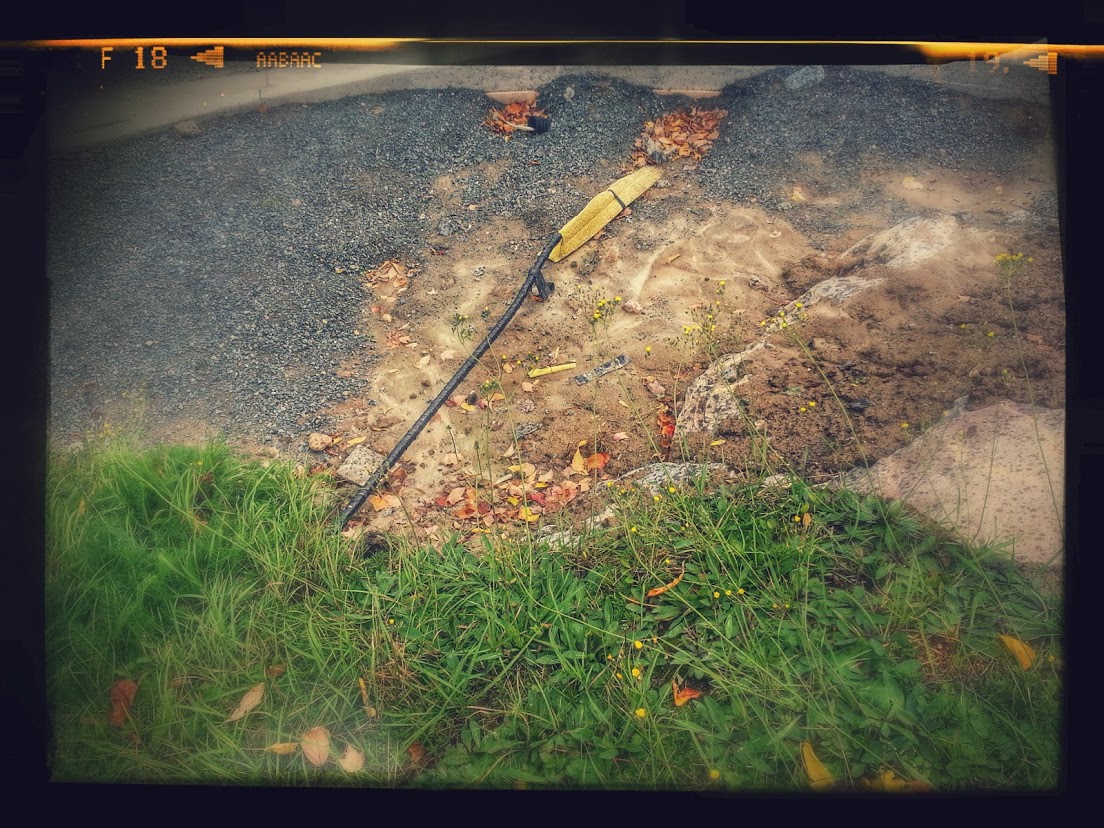
The city engineer stopped by my mom’s last week. Apparently, Union Gas will be by to bury the gas line properly again on Monday.

The Gas Line

Then, the rock will be blasted out. As you can see, the blasting mats are already in place.

The Blasting Mats

Then, they’ll be tearing up the driveway and repaving and, I suppose, getting the retaining wall up.

The engineer is supposed to be coming by with the work order for Phil to sign off on. He says he has a lovely railing for the top of the retaining wall.

You know about Nuala’s troubles from last week’s post. She’s making headway, but after the first glucose curve, the vet increased her dosage of insulin. Her sugars were too high. We’re in a holding pattern there until this Thursday, when we’ll take Nu in for her next glucose curve.

Phil and I are growing accustomed to our new schedule, but between that, the gloomy weather we’ve been having, and work uncertainty, we’re both exhausted.

At least, I’ll have my normal salary to look forward to for the next six months or so. We have some hefty vet bills to pay off.

Creatively

As you may have guessed from my Next Chapter post, I’m trying to focus my energies on my writing. It’s what keeps me sane.

Unfortunately, trying to cram everything in tends to wear me out. I know this, and still, I do it.

When a writing friend came to town last month, I’d intended to meet her. She was reading at my mom’s church on the Sunday and then at the Public Library on the Thursday.

On Sunday, I was feeling poorly and decided not to go. I’m not big into church these days anyway. The week of her visit was also one of two weeks of training I was delivering. When Thursday arrived, I got home from work and essentially collapsed. It wasn’t until after nine that I realized I had missed her presentation.

More recently, I wanted to get out to the launch of an art show another friend was having, but events conspired against me and I couldn’t get away.

It really is true that life is what happens when you’re busy making other plans.

Otherwise

I have a number of friends going through tough times.

They say news, whether bad or good, is supposed to come in threes, but it’s been far more than that, and since I’m such a hermit these days, I often don’t know what’s happened until after the fact.

I can only give them my moral support in most situations and wish them well.

I sincerely hope all of this misfortune comes to an end soon and that life resumes a better balance for everyone.

And that’s where I’ll leave you, with my very best wishes for a speedy recovery, a soothing of grief, a securing of contentment, if not happiness, and a world of ease to all your troubles. This, too, shall pass.

The warmest of hugs to you all.

Sundog snippet

Tipsday: Writerly Goodness found on the interwebz, Aug 24-30, 2014

The impact character: Why every character arc needs one, by K.M. Weiland.

Then Katie moves on to Elizabeth Spann Craig’s blog to write about how you can use backstory to keep readers reading.

Katie’s Wednesday vlog on creating marvellous characters with minimal effort. Last week, she was a little rough on The Monuments Men. See why she loves John Ford’s She Wore a Yellow Ribbon.

Roz Morris explores how Jose Saramago crafted his novel Blindness in a deliberate way and what that might mean for you as a writer.

Dan Blank posted this bit of awesome on Writer Unboxed.

Later in the week, John Vorhaus wrote about how to feel good and fail big.

Chase Jarvis shares twelve secrets for unlocking your most creative work.

Part two of Mona Alvarado Frazier’s lessons learned from the Writer’s Digest Conference: Fifteen strategies to use before you publish.

Agent Carly Watters show you how you can show an agent you’re a career author.

Jami Gold shares her new worksheet: The business plan for writers. Stop that groaning. You know you need one.

A great find this week: The heroine’s journey part one and part two from Flutiebear on Tumblr.

Mythcreants share five rules for retelling old stories. Thinking of a fairy tale retelling?

Gemma Hawdon went away for a five week vacation . . . and didn’t write a word. Find out what she discovered: Are you a ‘true’ writer, or a happy writer?

In his self-effacing and irreverent style, Chuck Wendig shares his thoughts on the writer and depression.

The psychology of writing and the cognitive science of the perfect daily routine on Brainpickings.

What if white characters were described like characters of colour in novels? Buzzfeed books.

The full George R.R. Martin and Robin Hobb discussion video from Fantasy Faction.

Jeff Goins interviews Margaret Roach on how she navigated the maze to become a full-time writer. Podcast.

The creative teacher librarian, Maaja Wentz, interviews Jennifer Lott.


Edge interviews Jonathan Gottschall on how we live our lives in stories.

Flavorwire presents ten stunning writing studios.

From The Atlantic’s archives: The childhood homes of twenty famous authors.

And now, a little writer tech for you. ALLi shares how writers can use voice recognition software for more than just writing.

What the internet of things means for the indie author. Ebook Bargains UK Blog.

Aaaaand . . . we’re done. For this week.

See you on Thoughty Thursday!

Tipsday

Tipsday: Writerly Goodness found on the interwebz July 13-19, 2014

A cavalcade of creative coolness. Just for you.

The July 2014 author earnings report. For those who haven’t already read it.

Anne R. Allen defines traditional publishing and offers some perspective on what’s happening with the Big Five in this changing publishing world.

Carly Watters points out the biggest query letter mistake.

Jamie Raintree writes about what we can and can’t control in the business of writing.

In which Veronica Sicoe shares her method for planning a novel.

The negative character arc series begins. K.M. Weiland.

And moar Katie: What if your antagonist is right?

MJ Bush guest posts on Writers Helping Writers. Three steps to deepening your character with anger.

Reverse engineering your character arc with Jami Gold.

Roz Morris diagnoses and prescribes treatment for a writer’s ailment: The plot hole.

Kristen Lamb discusses the seven deadly sins (and a few virtues) of prologues.

The BookBaby blog asks, are you more creative writing by hand or typing?

Brainpickings features Leonard Cohen on creativity, hard work, and perseverance. Excerpted from Paul Zollo’s Songwriters on Song-writing.

How SF writers predicted the conflict in the Ukraine and how they’re trying to stop it. Slate.

David Brin shared this SF story by E.M. Forster (written in 1909): The Machine Stops.

Grammar Girl, Mignon Fogarty shares ten words whose pronunciation has changed over the years.

Everybody and their dog’s pet hamster has been sharing this around the interwebz ‘cause Weird Al is just so brilliant 🙂


And Kari Maaren sings a lovely little song about CanLit 🙂


Enjoy, my writerly peeps 🙂

Tipsday

Thoughty Thursday: Things that made me go hmmmm on the interwebz June 8-14, 2014

Right now, I’m down in Orillia, Ontario, attending CanWrite! 2014. Started the day with a light breakfast and yoga, and I’m going to get Thoughty Thursday out before the sessions start up after lunch. Life is good.

Dame Judy Dench and Daniel Craig explore the question: Are we truly equal? See what you think . . .

What’s new in the war on Alzheimer’s Disease? from the Psychiatric Times.

Why we need creative confidence from Ideas.TED.com.

The quest to understand consciousness, a TED talk by Antonio Damasio.

Let these stunning photos of incredible storms inspire you. Also from Ideas.TED.com.

More inspirational ideas from i09: 12 futuristic forms of government that could one day rule the world.

All our patent are belong to you (did you catch the pop culture reference?). Tesla Motors makes its patents open source.

The most important sci-fi film never made from the Japan Times. Jodorowsky’s vision of Dune launched the careers of several notables in the field, including Geiger, and influenced moviemaking to the current day. I really want to see this documentary now.

Wired’s absurd creature of the week: the lion’s mane jellyfish. When I visited the Vancouver Aquarium last fall, they were featuring jellyfish. Apparently, they really do like global warming.

This week was pretty thoughty 🙂

Enjoy, my writerly friends, and I hope you garner some inspiration for your writing from this crop of curation.

Thoughty Thursday

Ad Astra day 2: Unleashing your creativity

Panel: Karina Sumner-Smith; Alyx Harvey; Judith Hayman; Leslie Hudson; Sally Headford

SH: If you walk into a grade one class and ask, “who can sing?” everybody raises their hands. Ask, “who can dance?” and the same thing happens. By the time they get to grade six, children have learned the standards and expectations. Only a few of them raise their hands then.

JH: Take risks. Make mistakes. No one will know the difference.

SH: How do the writers on the panel deal with those standards and expectations?

KSS: I have groups of people who read my work at various stages. There are readers for the roughdrafts, then later, beta readers. You have to have a terrifying level of trust in your readers. Seek out your “perfect” reader.

LH: If someone says, “you suck,” it can shut you down. How do you deal with that?

KSS: Chocolate and wine.

LH: We are our own worst critics. The worst are the notes I leave for myself.

Q: As a visual artist, I have to be able to evaluate a piece on its own terms. I benefit most from honest, constructive, criticism. What do you prefer?

KSS: Sometimes I need people to be honest. When I’m feeling vulnerable, I need comfort and tea.

SH: When you get to a low point, what do you do?

LH: Walk the dogs.

KSS: Five-minute dance party.

SH: I need oxygen.

JH: I need repetitive tasks. I’m on the autistic spectrum.

LH: Napping is awesome. You fall asleep and an idea comes to you in your dreams.

KSS: I find creativity breeds creativity.

LH: I’ve gotten into mandalas in a big way. I like needlepoint. Or reasearch.

JH: We’re all a little bit insane. When we enter flow, it’s a sacred space.

SH: I think of it as an alternate reality where creativity exists.

JH: I enter into my creative space with visualization.

LH: You have to protect your creative time.

JH: My day job is easier. It’s structured. At home, it’s different, more challenging.

AH: A day job takes a big chunk out of your day.

Q: Do any of you find you have to make yourself create?

LH: Absolutely. Sometimes you have to tell yourself to sit down and write, honey.

AH: Yes. Do the work.

LH: Sometimes pressure is good. Deadlines motivate.

Q: Do you find having a creative community or space helps?

JH: February Album Writing Month. FAWM. I participate every year.

KSS: NaNoWriMo.

Q: When do you sleep?

SH: It’s incredibly important.

KSS: In your day job, deadlines dictate what you do. I’ve read a health study in which people who get one hour less sleep per night over a seven day period were found to perform worse than people who were drunk. Health studies are fun.

SH: The current work environment is terrible. Multitasking is a myth.

KSS: One in one hundred people can actually multitask. Odd are, it’s not you.

AH: Where do you get your inspiration from?

JH: Everywhere.

KSS: Compost. One day my blender broke and I thought, what if society was built around items that worked on magic instead of electricity, and they all started breaking?

AH: I love my I-pad. If I see something, I snap it.

SH: Too many things can get in the way. If you don’t have a way to capture your ideas, you’ll lose them.

KSS: You can use prompts, or themes.

LH: You train yourself to notice things.

JH: Folklore is the basis for my current song-a-week project.

Q: Is creativity about finding ways to work around our disabilities?

SH: Creativity is part of human culture. It’s part of our history.

JH: Creativity is a process, not a product.

AH: Enjoy the process!

LH: People think that if you’re an artist you have to be miserable. Or that there’s a link between creativity and mental illness. Schizophrenia. Bi-polar.

JH: When I’m feeling manic, creativity is a saving grace.

Q: How do you deal with falling short of your vision?

AH: Let it come out the way it wants. If you force it, your won’t be a s successful.

KSS: If you don’t like it, you can always do it over. Accept it if it’s part of your process.

And that was it.

I have to note, in case you find some of these sessions ending abruptly, that many of them ran to the last second and only broke up when the next group entered the room. Thank you’s and closing remarks were often lost in the shuffle.

More coming tomorrow.

Off to watch Orphan Black now. Clone club!

Thoughty Thursday: Things that made me go hmmmm on the interwebz April 6-12, 2014

Thoughty ThursdayShort weeks are often difficult. You seem to have to do your full week’s work in only four days. Hence the lateness of this post.

The 12 most pervasive lies about creativity.

http://12most.com/2014/04/07/12-pervasive-lies-creativity/

Sleep your way to success (get your mind out of the gutter).

http://goodvibeblog.com/sleep-your-way-to-success/

20 magical tree tunnels.

http://www.boredpanda.com/magical-tree-tunnels/

Northumberland’s cup and ring rock art.

http://www.thejournal.co.uk/news/north-east-news/national-recognition-northumberland-ancient-history-6933058#.U0fJa1QoNSd.facebook

Rachel Sussman on the world’s oldest living things TED talk.

http://www.ted.com/talks/rachel_sussman_the_world_s_oldest_living_things

This professor says he’s photographed fairies. Do you believe?

http://www.manchestereveningnews.co.uk/news/greater-manchester-news/fairies-john-hyatt-rossendale-valley-6909619

Smart ways to beat social media burnout.

http://rebekahradice.com/social-media-burnout/

Yes, this is a commercial, but it’s still a good message. Just ignore the last few seconds.

http://blog.petflow.com/this-3-minute-video-made-me-cry-and-i-never-cry-must-see-for-everyone/

If social networks were the Game of Thrones houses.

http://mashable.com/2014/04/06/game-of-thrones-social-networks/#:eyJzIjoiZiIsImkiOiJfOXdtemp5aG94a2gxZDZzNCJ9

A doggy reunion. Just for the feels.

http://www.huffingtonpost.com/2014/04/04/dog-reunited-with-family-17-months_n_5092228.html

I may have shared this before, but it’s just so cute, I couldn’t resist. Puppy cover of Pharrell’s Happy.

http://blog.theanimalrescuesite.com/happy-puppy-cover/

And that’s a wrap, folks.

Have a happy Easter, everyone!

Introvert is me

quite-bookI just finished reading Susan Cain’s Quiet: The power of introverts in a world that can’t stop talking, and I have to say that it’s changed my life.

I “knew” I was introverted.  I’d seen my results on various Myers-Briggs (and derivative) tests.  I knew I liked to be alone and that I felt really awkward in social settings.  I knew that while I’m a good trainer, that I always felt exhausted afterward.  I just didn’t feel the truth of what being an introvert meant, for me anyway, until I read Cain’s book.

Cain opened my eyes to who and what and introvert is and can be.

When I was a kid, my mom had to stop sending me to my room as a punishment.  I liked it too much 🙂  I’d just get a book, or start playing on my own.  When I was a kid, I compensated for my introversion by being giggly and obnoxious.  Friendships tended to wound rather than comfort.

Now I totally get where I feel my power, why I’m so happy with Phil, and why I’ve been writing since I was seven years old.

Even if you’re not an introvert, if you love someone who is, I’d encourage reading Quiet.  It really is an incredible book.

Writing is the ideal calling for an introvert

A couple of articles for you:

http://theintrinsicwriter.wordpress.com/2013/06/04/are-all-writers-introverts/

http://www.forbes.com/sites/katelee/2012/11/02/susan-cain-on-writing-as-an-introvert/

Just this past week, Porter Anderson posted on Writer Unboxed about the myth of the lonely writer.

http://writerunboxed.com/2013/08/16/are-you-lonesome-tonight-the-dreaded-solitude-of-writing/

Not that all writers have to be introverts.  I’m sure there are many who are not (and I know several of them).  I just think that the writing part of the writing life is easier on us.  It’s the promotional work that’s going to be the killer 😛

In the past few months, I’ve also started following Space 2 Live, a blog on introversion by Brenda Knowles.

Here’s her lovely video: The space we need.

Are you an introvert? An extrovert? Is your partner the same or the opposite?  Do you have introverted children?  The dynamics are potentially endless and every relationship is unique.

I’d love to hear from you.

Writing to prompt: Amanda Socci called me a Brainiac!

So, first things first:

Amanda is participating, with Nina Amir, in the NaNoWriMo alternative, Write Non-Fiction in November, or WNFIN 🙂

Here’s the lovely pic:

Write Non-Fiction in November

Write Non-Fiction in November

As part of the lead up and promotion, Amanda has gone plum prompt crazy!  She’s even giving us prompt-interviews!  I think it’s a fabulous idea (that’s why she’s the Creative Idea Gal).  For those of you who may not have perused my pages, it’ll give us a chance to get better acquainted. Plus some of the answers won’t be found on my pages, so bonus info!

Here’s what Amanda posted on Wednesday.

Here are my answers 🙂

(1) Does the title of your blog, Writerly Goodness, have a special significance?

Writerly Goodness is my creative alter ego.  In my day job, I work in the corporate learning and development world, which is related to, but distinct from, the creative work I do in the evenings and on weekends.  I need to compartmentalize and separate my two working worlds and so, like a pseudo-super hero, I “change costumes” and transform into Writerly Goodness, which is also what I hope to produce 😉  I address this in a post: Do you dress for success?

I’m also an introvert.  Big time.  It’s another part of my daily transformation.  I have to put on the extrovert for my work, especially when I deliver training, and just need to hole up when I get home.  Fortunately, the interwebz give me the virtual distance to engage all my online friends and family without distress.  I haven’t written a lot about introversion yet, but I’ve just finished Susan Cain’s Quiet, and will begin to share some of the insights I’ve gained in the reading.

I joke in my welcome message that I might have a multiple personality disorder, which is more appropriately called a dissociative identity disorder, but while that is not true, I am host to other mental illnesses, most notably depression.  I actually talk about mental illness quite a bit, what experiences have contributed to my condition, how mental illness intersects with creativity, and what I’ve learned in the process of managing my depression.

Finally, Writerly Goodness has a decidedly canine aspect to her: loyal, patient, dedicated.  I can tell her to “fetch, girl!” and she will inevitably return with the words I need 🙂  So maybe WG is the embodiment of my muse?  Oooh!  Hadn’t thought of that before.  Thanks, Amanda!

(2) You write frequently about Caturday Quickies. What does that mean? What is Caturday?

Caturday emerged from a web site called I can has cheezburger?  It’s one of the original sites where LOLcats can be found (cute pictures and animated gifs of cats, or kittehs, as they’re called, with humorous captions).  The site’s mascot is a gorgeous Russian Blue with a hopeful look on his (or her) fuzzy face and with the caption that eventually became the name of the site.

Instead of Saturday, the day became Caturday.

I used to visit “I can has” every day for my feline fix, and eventually their sister-site, I has a hotdog (which gave rise to Sundog instead of Sunday in the same way) for my puppeh pick-me-up.  Eventually, I couldn’t keep up with the number of new posts in a day and realized it was more of an addiction than an entertainment.  Now, I see enough of the shared memes on social media to keep me happy.

I’m an animal lover and I used to own serve two cats. Right now, I have my dog, Nuala, but more on her in a bit.

(3) Are you inspired by your training coordinator job? Do you write about your job?

My day job intersects interestingly with my creative work.  As a writer, I always think stories should educate as well as entertain, and the things that I learn as a trainer contribute to my stories.

Also, my writing translates into instructional design.  I’m a fan of story-based instructional design (surprise, surprise) and I’ve been able to help write a course that won me and my team a Silver Award of Excellence in 2012.

More recently, my grammar Nazi nature has been able to come out and play as I’ve taught five sessions of Business Writing Made Easy to participants in two different business lines.  The second last one was a training-for-trainers version of the course, where I was introducing colleagues to the training material so they, in turn, could deliver it to other staff members.

As a training coordinator, I’m constantly writing reports, training plans, proposals, and briefing notes.  It’s completely different work than writing a story, poetry, or a novel, and my background in rhetoric (BA, Laurentian University 1995, cum laude) has come into play.

I have a category devoted to my learning and development (L&D) side: the Learning Mutt.  As you’ve been so kind as to ask me about that, I’ll write to that point more directly later on.

(4) Why do you call yourself a writing geek? Why do you call yourself a keener?

I’m a writing geek for many reasons, only a few of which I’ll mention here (don’t want to bore y’all).

I love words.  In my university years, I took several courses on the history of the language, old English, middle English, Shakespeare, and 18th Century literature (the days of the first dictionaries).  I love etymology.  I love the evolution of the language—English is such a mutt language, we’ve stolen from or been contributed to by nearly every language at one time or another.

I love the physicality of language, where the sounds are produced.  It’s different for each stage/evolution of English: back in the throat, up in the nose, forward in the mouth, up front through the teeth.

I love accents and dialects.  I love pidgin languages.

You can smell the smoke when I start thinking about words 🙂

I adore the writing process, mine and others.  Nothing makes me more #furiouslyhappy than to read the posts of other writers who share their workspaces, work habits, revision strategies, etc.  I’ve been glued to Elissa Field’s blog while she’s been writing about her revisions.  Endlessly fascinating.

I also love learning about writing.  I’m constantly doing it, even though I have an MA in English literature and creative writing.  I read craft books (and everything else I can get my hands on—I’m a book addict) and I read like a writer, looking for clues, analyzing structure, teasing out the reasoning behind creative choices.

I’ve got a subscription to Writer’s Digest Tutorials and have recently started taking courses, from Dan Blank’s Platform Building course, to a selection of Wana International webinars.

I follow Grammar Girl.

I could go on, but I think you get the idea.

(5) How does being an experiential learner affect your writing?

This is going to be a short one: I learn by doing.

I write, therefore I am.

The only way to improve is to write, and to write every day.

(6) You mentioned that learning and writing go hand in hand. Can you describe how you tie both into one on your blog?

I think I addressed this in my answer to question 3, above, but here’s a little more about it:

When I was back in university, I was amazed at how everything I was learning, from astronomy and biology, through philosophy and psychology, to English, music, and art, intersected in bizarre and wonderful ways.

I find this to be true with my work, as well.

Besides, if I’m going to spend most of my waking hours doing something that is not writing, it better feed my muse in some way.  I just stay open to the possibilities.  Mental popcorn.  Wheee!

(7) You list several cultural references on your blog (Ukrainian Christmas, Algonkian conference, etc.). What inspires you to write about those cultures?

I think the reference to Ukranian Christmas was probably about a friend of mine, who celebrates it, or in my discussion about how I developed my religions/spirituality for my fantasy novel.

The Algonkian Conference is actually a pitch conference that has nothing to do with the Algonquin people.  Though I may have referred to the Ojibwe and Cree nations in my discussion of how I invented some of my languages for my work in progress.

In general, I’m very open to religion and spirituality.  I was raised Christian (Lutheran, specifically) but now identify as agnostic with pagan leanings.  I don’t blog about it too much, though, because I think that both religion and spirituality are very personal things, and while I admire the devout of faith, I don’t think that anyone has the right to tell anyone else what to believe.  That is between the individual and the God of their understanding.

I think I’ll shut up now, before I offend anyone :0

(8) What is the learning mutt side of your brain? How does that impact your learning or writing?

The learning mutt is my day job personality, but it’s more than that.  It’s the part of me that watches the Discovery Channel, follows Bad Astronomer Phil Plait, and was enthralled by Commander Hadfield’s social media campaign from space.  It’s the part of me that reads.  It’s the part of me that takes courses and webinars.  It’s the part of me that wants more, more, MOAR knowledge, regardless of what it might be.

I’m a pop culture junkie, a trivia queen (maybe princess), and creative connections pop out at me from everywhere (mental popcorn mention above).

I don’t have an eidetic memory, or speed-read, or anything, but my brain just wants to fill itself with everything out there, so it is very much like a mutt: a little bit of everything goes into it.

I hope most of it stays there too, another reason I try to keep learning 😉

(9) Does your pup-child Nuala inspire your work? Have you considered writing a non-fiction book about dogs?

All of my dependant quadrupeds, feline or canine, have held special places in my heart.  My husband and I are childless-by-choice, and in a way our pets fill the place of children in our lives.

I also believe that dogs, in particular, are here to teach us how to love unconditionally.

I haven’t thought about writing a non-fiction book about dogs yet.  I don’t think I have enough experiences to fill up a book right now.

I do have an idea for a middle grade book that features a dog as its protagonist, though.  It’s kind of like a Desmond the Dog Detective meets Watership Down, with maybe just a dash of Animal Farm.

Yup, that’s the kind of thing I think up 😛

(10) Your curriculum vitae is impressive! It is also a non-traditional addition to a blog. Has posting your c.v. helped you get noticed, get writing work, be featured on other blogs?

Thank you, but actually, it hasn’t resulted in any of that good stuff.  Nobody’s even “liked” it yet.

When I started my blog, I didn’t have any books that I could promote, so I thought the CV would speak for my experience as a writer.  It was key to my application for professional membership to the Canadian Authors Association.  Maybe when I start querying, agents will start looking me up?  One can only hope 😀

I’ve since added a page to feature the two anthologies including my poetry of which the publisher still has copies to sell, but that hasn’t really resulted in much action either.  At least the publisher hasn’t let me know that he’s run out of copies, or that my page has, in any way, influenced the poetry-reading public 😉

This must be tempered with the fact that a poetry best-seller in Canada means 500 copies sold.  NeoVerse accomplished that goal, if nothing else.

Thanks for giving me this opportunity, Amanda!  This was fun!

What do the rest of you think?  Did you enjoy finding out more about me, or did it leave you cold?  Regardless, I’d love to hear from you.

And please do visit/participate in WNFIN if you are so moved.  That’s Write Non-Fiction in November with Amanda Socci and Nina Amir, just in case you forgot 😉  It’s been a while (long post, whew!).

Tomorrow: Review of Dead Air, and sommat about my trip last weekend.
A life sentence with mortal punctuation: part 3

Last week: A near-death experience thanks to a narsty case of tonsillitis and some ripped stitches.

And now …

Friend wars

I had some friends before school, through Sunday School and swimming lessons, but they lived farther away from me than my mom would let me walk on my own, so I never got to see them outside certain structured activities.

There were also the children of my parents’ friends, but they moved away before I could develop much of an attachment, or hold any memories of them.  For a brief time, the family across the street had children my age, but they too, soon moved away.  Kindergarten was a bit of a blur, but I do remember some of the children I met there: Ronnie-Moe, whose Dad was a fireman, Mytie (I think that was how she spelled it), Paul, and a few others, but these were classmates, not friends per se.

For the most part, I was a happy child.  I was socially inept though.  Not really good at making friends or keeping them.  I compensated for this by being a little different.  I lived in my head a lot.  My teachers called it daydreaming and distraction.

I was also a giggle-puss.  I laughed at the drop of a hat, not only when I found something funny, but also when anything embarrassed me, frightened me, or made me angry.  Laughter was my catch-all reaction, because if other kids thought I was making some kind of joke, usually at my own expense and not theirs, they wouldn’t hate me outright.  They all thought I was weird though, and that didn’t earn me any friends.

My worst childhood crime was being a story-teller (read liar).  For show and tell, I’d make things up.  There was one particularly embarrassing stretch where I was really into cats and desperately wished I could have one.  I couldn’t though, so I made up stray cats that I’d take in and care of for a few days before they ran away.

Often, I wish this inclination had been harnessed earlier, that some kind teacher would have recognized in me the storyteller (not the story-teller, teller of tales, or liar) and helped me turn it in a different direction, but that didn’t happen until grade three.

Sir Ken Robinson

Sir Ken Robinson (Photo credit: eschipul)

I was just a creative kid with insufficient outlet within class to exercise my (even then) considerable abilities.  Last year, I discovered Sir Ken Robinson’s incredible TED Talk, “Do Schools Kill Creativity?”  It validated much of what I’d already figured out on my own.

So I was happy.  But lonely.

Then a young mother with twins (fraternal-brother and sister) my age moved into the apartment up the road from me.  When she saw that I walked to school, she asked my mom if we could all walk to school together.  So the girl, let’s call her Diana, became my first “friend.”

Soon, another young pedestrian joined our little gaggle.  She lived a few blocks further on, but we were all heading in the same direction, so I figured it was fine for her to join us.  Let’s call her Mary.  Diana got territorial, though.  I was her friend first.

Mary was small and thin.  I’m not sure why, but nobody much liked her in grade one.  I was her friend though, and when Diana started acting up, it became problematic.  Diana got physical and she had a temper.  She’d scream and push and punch.

Her behaviour toward Mary bothered me, and at one recess, as Diana was wailing away at me, rather ineffectually, after having pushed Mary down, I had enough.  I grabbed her arms and pinned her against the wall of the school so she couldn’t punch anymore.

I like to think I said something clever like “You don’t own me,” or “I don’t belong to you,” but I probably squeaked out a lame “I’m not your friend,” or just “stop it.”

Diana was in tears, frustrated that she couldn’t bully her way out of the situation.  I wasn’t small, or weak.  I think a teacher intervened, but the outcome was that Diana wasn’t my friend anymore.  She stopped walking to school with me, but Mary was now my BFF.  I’d defended her.  We became inseparable.

Mary was pretty much my only friend through grades one and two.  We’d walk to and from school every day.  Mary came over to play and we went to each other’s birthday parties.

I defended her again one winter from the attentions of a boy.  Of course, I had no clue that his shoving her around and making her cry meant that he liked her.  I just saw him as another bully, so I got into my first fist fight.  He clocked me good on the jaw, but I got my own licks in.  He didn’t bother Mary in front of me again, though.

Mary continued to be a small, thin child, and so to exert her power, she got devious.  She’d argue with me over nothing, routinely “breaking up” with me and then making up the next day as a means of keeping “drama” in our friendship.  When she came over to play at marbles, she decided to make things interesting, no longer content with claiming pretty marbles, by having each of us put up toys as a wager.  She liked to bend the rules in her favour too.  I was content to let her win when the stakes weren’t high but that stopped once I started losing toys.

First, I stopped playing marbles with her, then eventually, I stopped having her over to play altogether.  Mary’s friendship was exhausting.

In grade three, another single mother moved into the apartment up the street.  She had a daughter named Margaret.  No pseudonyms here.  Margaret’s still my BFF though she lives several hours away and most of our conversations are held over FB chat or by email.

While Margaret lived up the street, there was another girl who was interested in putting on talent shows and the like.  There were implications of bullying there too, but nothing that I witnessed.  Also, the other girl was much larger than I and I wouldn’t have been able to do anything about it, but things blew over before long.

Margaret’s Mom moved into a duplex, but it was still within walking distance.  Margaret was fun and funny.  We went to movies together, at first with parents in tow.  She had budgies and a hamster.  Margaret was also a big reader, something I hadn’t latched onto yet.

Mary got a little jealous at that point, but because I was already in the process of separating myself from her, the drama wasn’t as bad as it could have been.

In grade three, my parents got me my first pet, a dog I named Friskey because of her behaviour.  The dog book said to name your puppy according to what it did.  I did what the book said 🙂  I was so excited about my new pet, that I wrote a one-page report about her.  It wasn’t required for class, but when my teacher learned that I’d done it, she encouraged me to read it aloud.

That was the year I started reading and writing.

It was also the first year that cliques developed in the class.  Margaret was popular.  Me, not so much.  I was a tag-along at best.

Grade four was worse.  Years later, when I saw the movie “Heathers,” I could so relate.

Cover of "Heathers - 20th High School Reu...

Cover via Amazon

The Heathers of our school had other names, but they were no less manipulative or cruel, even though they were in elementary school.  I got into trouble a lot that year because of the drama between the cliques.  I think that was the summer I was grounded from seeing Margaret.

I also wrote a play for the Christmas pageant that year.  That didn’t help my popularity either.

Being alone wasn’t a problem for me.  I enjoyed being alone.  Envy was an issue, though.  Without thinking about why, I wanted to be in a clique.  I wanted to be popular.  Failing that, I wanted Margaret to be my friend to the exclusion of others.  When my desires were thwarted, I started to take my frustration out on Margaret, as Diana had on me.  Though it was to a much lesser degree (not that it excuses anything), I’d become the bully I’d previously defended others against.

In grade five, I was the first girl to hit puberty, or at least that’s the way it felt.  My growing breasts became a topic of discussion and ridicule in the change room as were my hairy legs.

The traits I exhibited in grade one had developed and changed over the years.  I now cultivated an air of “weirdo.”  To combat the change room taunting, I tried to claim my glorious boobage, a difficult thing to do when I felt that it was one of the things that made me a freak in the eyes of others.  It only served to cement my strange reputation.

Since grade three, I’d been writing little stories and I kept them in exercise books.  I had wild dreams and shared them with Margaret at recess.  I was a terrible storyteller, though, all rambling and out of order.  I know there were days when Margaret just wanted me to shut up or to get to the point, but I only realized the relative quality of my verbal diarrhoea after the fact.  Sorry Margaret.

When grade six arrived, the friend wars had settled down to a large extent, but there were still a few hard feelings that had to be resolved.

Mary, who’d still been in my life, but to a much lesser extent, made overtures to “bury the hatchet” between us.  She behaved like a real friend for the first time in years and when, after a short while, she asked to see my notebook of stories, I lent it to her.

She used most of a bottle of White-Out on it to obliterate my words.

After that, with the exception of Margaret, I was almost happy to be otherwise friendless.  New cliques formed, included Margaret, and I was again a hanger-on, just so I could remain in Margaret’s circle.  We were still BFFs, but we were also growing up, and apart.

The other members of the clique didn’t like me, and no wonder.  My laugh had become a hyena’s, and I routinely introduced myself in the following manner: Hi, I’m Mel.  I’m weird.  Just to get that out of the way.

I didn’t want any more friends.  Except for Margaret, I’d learned that friends just wanted to prove that they were better than you, to hurt you, and take you down in some way.  It wasn’t a problem with Margaret because she was always the better person in our friendship.  At least I stopped hitting her.  Sorry again, my friend.

Though I stopped sharing my stories even with Margaret, my creativity continued to be an albatross.  This might have been the skewed way I saw things in those days, but it felt true.

Following the friend wars, my self-confidence was shot.  Even in grade three, an off-hand comment could reduce me to tears.  I fled from conflict.  What happened to the girl who held Diana flailing arms and told her to stop?  I couldn’t stand up for anyone anymore, least of all myself.

These were the seeds sown that in later years would take root as depression.

If you haven’t yet, watch Shane Koyczan’s excellent “To this Day.”

Visit The Bully Project.  Watch the movie.

And last week, I saw an awesome documentary on Global’s Currents.  It’s from 2007, but it’s still relevant.  Erin Thomson’s The Bully’s Mark.

Did you have friend wars in the past?  Were you in a clique, or a hanger-on?  Were you a victim of bullying, or a bully?  Both?  How did it shape the person you would become?  How did it affect your creative development?  What lessons did you take away from the experience?  This is an important issue.  Please share if you feel you can.

Next week: Tummy troubles: Appendicitis and my second brush with death.

Bees, wasps, and hornets, oh my!

A different way to look at creativity.

So bees, wasps, and hornets have been on my mind lately.

It started with the bees

Characteristics of common wasps and bees

Characteristics of common wasps and bees (Photo credit: Wikipedia)

Last month, the story was everywhere, on the news, in the paper, on line … A couple, living in Owen Sound, Ontario, discovered that they had not one, but three colonies of bees living in their attic (!)  My first thought was, “how could they not hear all that buzzing?”

The fun bit was how they figured it out: honey started dripping from a crack in the ceiling.

Now I love bees.  The humble bumble is a wonderful conundrum.  While I’ve heard since childhood that bees shouldn’t be able to fly, they clearly do.  They are very important pollinators for plants and several kinds produce lovely honey.

There are stingless bees, but of the bees with stingers, it’s not their first instinct or line of defence to sting.  When they sting, they die, the stinger ripping out the bee’s venom sac in the process.

Because of this, though I know it’s a shameful anthropomorphization, I like to think of bees as pacifists, who in the defence of their hive nobly sacrifice themselves for the greater good.  They’re diligent workers and great creators of communities.

I don’t mind bees.  If they come around, I let them have a sniff, realize I’m not a flower, and move on.  No need to swat.

Wasps are another matter

wasp

I’ve been noticing recently that there are a lot of wasps around and just last week, I saw this article on The Weather Network.

Now wasps retain their stingers and can sting you repeatedly.  They don’t have to worry about dying.

Though I know you should stay still and mind your own business, but it’s difficult to do.  If you’ve ever been stung by a wasp, you know what I mean.  It’s pretty painful.

Wasps are also diligent pollinators and industrious workers.  The material they make their nests out of is commonly called “paper.”

They’re cool in their own way, but I don’t like the mean streak.

And Hornets?  Shudder

Hornets are big wasps.  Their poison is a lot more painful too.

Hornet - Hymenoptera - Vespa crabro

Hornet – Hymenoptera – Vespa crabro (Photo credit: Mick E. Talbot – off line 4 weeks 11/08/2012)

A friend of my mom’s was out in her back yard, gardening.  She dug into the soil … and pierced a hornet’s nest.

The poor woman was stung over every inch of her body.  She was so swollen that she couldn’t move her fingers for the better part of a week.  My mom and a couple of other friends had to go over and do her groceries, help her cook, and do her dishes.

Hornets are the warriors of the bee/wasp world.

In terms of creativity

Are you a sweet, humble bumble?  Do you get aggressive with challenges like a wasp?  Or are you an arts activist like the hornet?

Me?  I’m a bumble 🙂

What I’ve been reading

I just finished reading Fanny Burney’s Evelina.  It was a hold-over from my university days, a book I hadn’t completely read (sorry Dr. Orr).  I just didn’t have the time.  With a full course load of English and other humanities, I often had 20 to 30 books to read a semester.

I had to choose my battles, and unfortunately, Evelina was one I retreated from.  I skimmed, read bits, enough, I thought, to participate in a class discussion.

I should have read it, but I don’t know if I could have appreciated the novel then as I can now.  We all grow up eventually.

The fact is I loved it.  Couldn’t put it down.  It’s a bit surprising.  Burney wrote her novel in the epistolary style, that is, as a series of letters between characters.

I started reading with a certain apprehension.  I mean how exciting could letters be?  Really, it’s just a bunch of exposition, of telling, one of the cardinal sins of writing.  The truth is I found Evelina compelling.

What I learned about storytelling: it’s not essential to be with your characters every minute of every day.  In choosing which parts of the story to relate in the letters, Burney chose the best.  Though a romance, and a novel of sensibility, every scene moves the plot forward, presents a new challenge, or a revelation.

Burney tipped her hat to the pastoral romances of the Renaissance with her protagonist, an orphan, whose mother died in obscurity, rebuffed by a man who refused to acknowledge their marriage.  There is mystery and intrigue.  Evelina discovers a brother she never knew, is perused by several men, only one of whom has any idea of what is truly proper.

It’s a novel of class, showing that the humble peasant raised in retirement can be more noble than lords and baronets and that the unworthy can rise to prominence through marriage and scheming without ever being truly improved by their circumstances.

Satire is a man’s weapon, but Burney puts it in full control of a wonderful supporting female character.  No one is as witty as Mrs. Selwyn 🙂 The crass and coarse are taken to task, and through it all, Evelina perseveres, tries to do what’s right, and is rewarded for her virtue in the end.

I know, it doesn’t sound compelling, does it.  But it is.  Read it.  You’ll see.

BTW, it’s on Project Gutenberg 🙂

TTFN, my writerly friends.