I already mentioned the welcome reception and the morning creative writing circles, but have since launched into panels and sessions without mentioning what happened the evenings of June 13 and 14.
Back-pedalling now …
Open mic and shortlist readings
On June 13, interested parties were encouraged to sign up for the open mic. I did and intended to read the revised opening of my novel as I had at Wordstock, then at supper I heard that the readings would be restricted to five minutes. This was reduced to three by the time I arrived due to the number of last minute sign-ups.
Not having brought my poetry with me that night, I read as much of my opening as I could. It was well-received.
Other readers offered their poetry and stories (one humorous one was about discovering one was having a heart attack while on the toilet – shades of Elvis) the organizers sticking strictly to the three-minute limit.
June 14 was to have been readings from the authors short listed for the CAA Literary Awards, but again, a last-minute change opened the floor to additional readers. I signed up and brought my poetry, a much more appropriate genre for the three-minute limit.
I got to hear the end of the Elvis story and some more great poetry, fiction, and non-fiction.
I enjoyed the readings from the short listed works. With one exception, none of them could show up in person. The man who did was Michael S. Cross, author of A Biography of Robert Baldwin: The Morning-Star of Memory (Oxford University Press).
Michael’s reading was wonderful. I didn’t know Robert Baldwin was such a fascinating character.
Another fascinating author was Jane Doe. She read from her book The Story of Jane Doe. She is an advocate and activist and her story is a compelling one. I encourage everyone who has an interest in women’s issues, advocacy, or the attitudes of the legal system to victims of rape and violent crime to pick up this book.
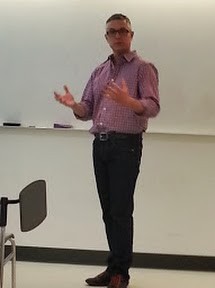
Andrew Pyper
Andrew Pyper
Andrew Pyper is the author of six novels, most recently, The Demonologist.
Andrew’s session was on the afternoon of June 14, and it was as much workshop as presentation.
The session, Getting organized, getting started, focused on the essential elements required before an author begins to write a novel.
- An Idea;
- A Premise;
- A Protagonist;
- A Hook;
- A Structure; and
- An Outline.
He also offered six tips for overcoming roadblocks.
One of the most interesting pieces of his presentation was about ideas. Yes, one must have at least one good idea to propel one’s plot, but the author shouldn’t stop there.
Traditional thought and misconception would imply that one idea must be made big enough to become the basis for a novel. Andrew suggested that rather than one idea expanding to fit a novel, that a multitude of ideas should funnel down and feed into a single novel.
This made a lot of sense to me, and when I think about it, that’s how I write fiction. I never write about one thing.
The premise is distinguished from the main idea of the novel because of its scope. Andrew’s explanation reminded me of Larry Brooks’s.
He offered the following example:
Idea: A modern-day Frankenstein.
Premise: Archaeologists extract DNA from mosquitoes trapped in pre-historic amber and use it to clone dinosaurs. A philanthropist establishes a theme park around the beasts and invites a select group of scientists and family to witness his triumph; then the beasts escape (Jurassic Park).
The key to a premise is “high concept,” a concept that can be evasive. This is why Larry Brooks is forever explaining the difference between idea, concept, and premise on his site 😉
Andrew had us write our premises for the Rob Ford story. As expected, we all had different takes on the well-publicized scandal.
I won’t give away the whole of Andrew’s session, but I will say that it was informative and fun.
Cordelia Strube
Cordelia Strube’s session, on the afternoon of June 15, was mostly workshop. She’d actually had workshops on both afternoons (14th and 15th) and anticipated that conference-goers would attend both, but a miscommunication occurred and the message was never conveyed to attendees.
Cordelia has published eight funny, powerful, sparse, cathartic and critically acclaimed novels, among them Alex & Zee, Teaching Pigs to Sing, The Barking Dog, Blind Night, and Lemon. Her ninth, Milosz was published last year.
Her plan was to have participants from the first session return and revise the work they had started the day before. Those of us who only came on the second day would have to start from scratch.
Cordelia gave us a framework and some strategies for getting into our focused writing. She then distributed horoscopes and a number of other prompts: postcards, small items, all of which were to inform our writing project for the afternoon.
After we were sent off to write however and wherever we wished, the class was asked to share the results of their writing.
It was an excellent session.
________________________________________________________________________
I should take a moment to mention that there were a number of sessions happening concurrently on Friday and Saturday afternoons. I can only report on the ones that I attended.
Specialty sessions, at a nominal additional cost, also took place during the mornings.
There were also agent pitch sessions occurring Thursday, Friday, and Saturday mornings. Though I did not opt into these, they were very popular and booked solid.
I like the way in which they were conducted. Each author was to submit their query letter and first five pages of their novel in advance of the pitch session. I think that this is a much better way to conduct pitches than to do them blindly. It’s better for the agents because they have a sense of the author’s work. It’s better for the writer because they don’t only have their two to five minutes to convey the meat of their novel.
A professional photographer was also on site to take author shots for the attendees. I happily paid the (again, nominal) fee for this. I should have the results next week and I hope they will be better than my efforts to date.
Tomorrow: The final panel, Traditional vs. Self-publishing.
G’night y’all 🙂
 Always Looking Up