Ad Astra 2016, day 1: The influence of Shakespeare on science fiction and fantasy

Disclaimer: I am not perfect and neither are my notes. If you notice anything that needs correction or clarification, please let me know: melanie (dot) marttila (at) gmail (dot) com and I fix things post-hasty.

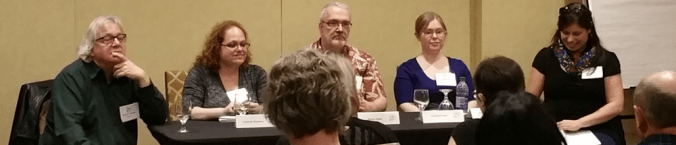
Panellists: Kate Heartfield, Arlene F. Marks, Kate Story
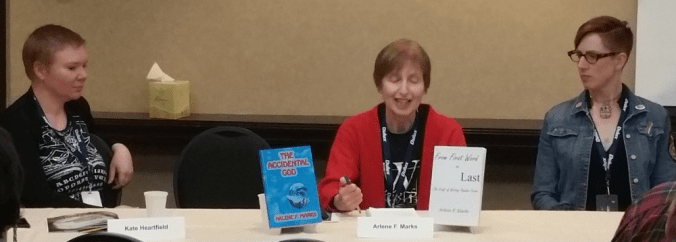
ShakespearePanel

AFM: Shakespeare’s plays were, in his time, entertainment and education. They’re lessons in history, then and now. They also were some of the earliest examples of genre. Hamlet is, in part, a ghost story. MacBeth can be seen as urban legend. A Midsummer’s Night’s Dream is fantasy.

KS: Shakespeare needed to make a living. That’s why he wrote. He was a great enabler of public discourse.

KH: You don’t have to go far to find gender queer characters in Shakespeare.

AFM: The Hogarth Shakespeare series from Penguin Random House is asking well-known authors, like Margaret Atwood, to re-imagine his plays. That’s the brilliance of Shakespeare. You can put any one of his plays into any era or milleu.

KH: A lot of adaptations of his work are coming out because it’s the 400th anniversary of his death.

KS: My father was a scholar in Newfoundland. We had a cultural renaissance in the 60’s and 70’s and we started to make some connections. Maybe we have something to offer to the tradition. I think the spirit of Shakespeare’s time was close to Newfoundland’s now. Shakespeare has always been there and has always been an influence. Shakespeare’s women were far more realistic than the women characters of many modern playwrights.

[Kate then performed the monologue from her story in Carbide Tipped Pens, edited by Ben Bova and Eric Choi. It was a variation of Romeo and Juliet, set in space. She’s currently working on the stage play. I just sat back and enjoyed 🙂 ]

Ian McKellan said in an interview, “Where in the modern world would it be so wrong for two people to fall in love?” It resulted in a 70’s production of Romeo and Juliet set in Belfast.

AFM: In Shakespearean times, it was forbidden for women to go in stage. All women’s roles were played by men, or, more often, boys. The audience was very demanding. If they didn’t like a play, or the actors, they brought rotten vegetables to throw.

KS: He was asking the audience to be clever, to know it’s a man playing a women, pretending to be a man. It engaged the audience, drew them in.

AFM: It’s the fiction of the people. The only publisher that approaches this today is Harlequin, who would hold regular “reader appreciation” luncheons to meet their most popular authors. In Shakespeare’s day, there would be nobles and prostitutes in the same audience. It was whoever had the money to pay.

KS: It was nuts for the theatre. A sixth of the population of London would attend the performances.

KH: The culture of fandom/fanfic has a lot in common with the culture of Shakespeare. There’s nothing more Shakespearean than fanfic. Most of Shakespeare’s plays were drawn from earlier works. He borrowed liberally from Ovid.

Q: Shakespeare’s plays address universal themes. The more popular ones get done. Some might say overdone, but the historical plays are ignored.

KS: My theatre did a gender-swapped Taming of the Shrew.

KH: The film industry has done a better job. My Own Private Idaho, The Hollow Ground series, Looking for Richard.

AFM: A Thousand Acres was the story of King Lear. Shakespeare was brilliant of using every member of the company. There were often comic actors. Characters like Falstaff were written for them. If there were acrobats, he’d give them something to do. They had to be very practical in terms of costuming for these reasons.

KH: Titus Andronicus and Troilus and Cressida were essentially horror. Shakespeare was a great worldbuilder. He was consistent in terms of how fairies, spirits, and witches behaved. His idea of Titania was dark, but comic. Fairies had an alien sense of good and evil.

AFM: He built on the motivations of all his characters.

And that was time.

Next week: The do’s and don’ts of writing erotica (oh, my!).

The next chapter: March 2016 update

In my 2015 year-end update, I said that 2016 would be the year of revision. To this point, I’d only ever revised the one novel, Initiate of Stone. I revised IoS eight times and I recently got a few ideas on how to improve it further as a result of my first run through of Apprentice of Wind.

In the first few days of March, I finished that first review of AoW. I’m going to return to it again, but this time, as I mentioned last month, I’m going to apply what I hope to be improvements to IoS and then move on to AoW.

My idea is to reinforce my voice over the two novels, which is quite different to the other novels I’ve drafted so far. Most of those are in a modern setting. Urban fantasy of various stripes. Though I’ve worked with IoS for so long, when it came to reviewing AoW, because I’d drafted the five other novels in between, I found I’d lost touch with the voice of the series and its characters.

We’ll see how that turns out, later in the year (I hope).

YTDProgress

Year Goals and Totals page

The current draft of AoW stands at 119,590 words. So 120K, which is reasonable for an epic fantasy.

I then moved onto Figments, my YA urban fantasy. It’s considerably shorter, nineteen chapters, and 53,536 words. I know I’ll have to punch that up a bit, but I have a number of ideas to make that happen.

Both of these novels were drafted, let to sit, printed out, read through, mapped, let to sit again, read through again, and then reviewed. I just changed some of the major things, POV, character deletion, consistency over the novels (in the case of AoW), and notes for future revision.

I don’t think I’ll need as many drafts of either AoW or Figments as I needed with IoS to finish them to my satisfaction.

I’m trying something different with Marushka, which I moved on to in the last few days of March.

My revision plan so far has been to review a chapter a day, which was challenging for AoW and Figments, because a number of the chapters of both were several thousand words long. I often found myself up until midnight on a weekday trying to get my work finished before I went to bed.

Marushka was the first novel I drafted using Scrivener and it really changed the way I drafted. The chapters are comparatively tiny (1000 to 1500 words so far) but there are a lot more of them (54).

I didn’t print Marushka out. I didn’t read it through or map it. As I review each chapter, I’m reading it through for the first time and mapping it as I go.

We’ll see if this is more or less productive than printing the draft out, and reading and mapping it out prior to my first run through.

I’m approaching this year of revision as an opportunity to experiment. My process is in continual evolution and, as I learn, from both success and failure, I’m seeing improvement in my process and in my writing overall.

I’m not looking for short cuts as much as efficiencies. I’m not doing any less work, I’m just doing it differently.

Again, we’ll see how it goes.

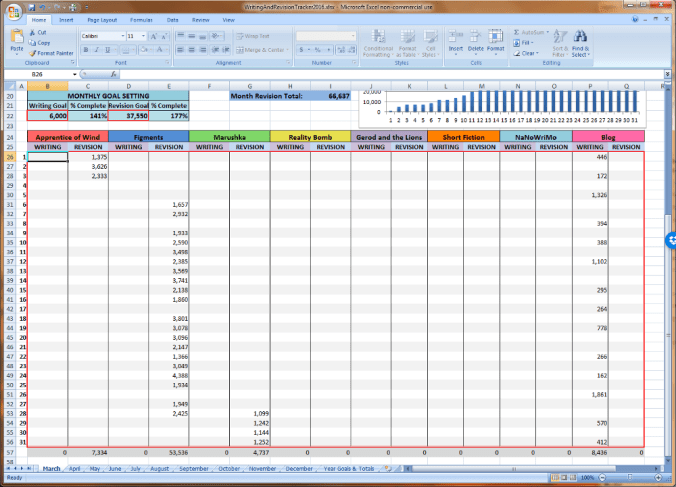
So here’s how the month breaks down.

MarchProgress

MarchProgress1

Want your own Writing and Revision Tracker? Visit http://jamieraintree.com/writing-revision-tracker

  • AoW – 7,334 words revised
  • Figments – 53,536 words revised
  • Marushka – 4,737 words revised
  • Blog – 8,436 words written.

I achieved 141% of my writing goal and 177% of my revision goal.

At this rate, I’ll finish the first run through on Marushka part way through May and move onto Reality Bomb and finally, Gerod and the Lions. Once I’ve got everything reviewed once, I’m going to take a break (which I tend to need in the summer months) and work on my outline for Mistress of Waves, the third book in my Ascension series and NaNo 2016 project 🙂

Then I’ll get back to deeper revisions until November arrives. I may not be able to conquer more than IoS/AoW. Maybe I make it as far as Figments.

Querying continues. I’ve not devoted much time to short fiction recently, though.

As far as conferences and conventions, I’m hitting Ad Astra (April 29-May 1), The Canadian Writers’ Summit (June 15-19, though I’ll only be attending June 17-19), and WorldCon, AKA MidAmericon II (August 17-21). I have paid my fees and reserved accommodation, but it’s all pending leave approval.

I’m holding my breath until I know it’s approved. Once it is, I’ll be able to book my flight to Kansas City.

My employer asks us to apply for leave every six months. We apply in March for the first half of the fiscal year, April to September, and in September for October through March. Approval is subject to seniority and operational demands (peak seasons).

I should know whether this first round of leave requests has been approved by the end of April.

My plans for fall and winter will have to wait on the approval of the second round of leave in October.

I’ll save those potential plans for a later update.

For the remainder of this month, I’ll be offering some Series discoveries posts (fall season, part two, mid-season follies, and anime) and at least one book review (Jane Ann McLachlan’s second Kia novel, The Salarian Desert Game).

As of Ad Astra, the convention reportage will resume.

So there’s lots of Writerly Goodness to look forward to, and of course, Tipsday and Thoughty Thursday curations will continue through the week.

In the meantime, break a bunch of pencils, you wonderful, creative people.

The Next Chapter

CanCon 2015, day 3: The Renaissance vision of utopia

Mini disclaimer: These are my notes and may contain errors. If you have corrections, please email me at melanie (dot) marttila (at) gmail (dot) com and I’ll amend the post directly.

Presenter: Professor Cristina Perissinotto, University of Ottawa

RenaissanceUtopias

My apologies, Cristina, for my poor photography skills 😦

Utopia is from the Greek, meaning ‘no place.’

More’s Utopia was published in 1515. He’s an important scholar. He was essentially optimistic. The king sent him to Flanders where the concept of the book was born. More visited Erasmus and was introduced to a Portugese sailor named Hythloday. The book documents their discussions of Utopia, the miraculous land Hytholday discovered in his travels.

The inhabitants are peaceful, they dress the same, they distribute goods equally among the people, they don’t engage in war, and they don’t use money except when they need to in their dealings with other nations.

The principle explored was this: that humankind, with good laws and education can create a good society.

It hearkens back to Plato’s Republic, which was a philosophical treatise on the nature of justice. The principles of Republic were applied on several occasions, but failed to take hold.

In the Renaissance, it was rediscovered.

Aristophanes, a comedic playwright, wrote The Assembly of Women, which suggested that women would institute a utopian society.

There are also elements of monasticism in utopian societies. Monks are communal, but set apart from society.

There is also the legend of Prester John, who was said to have founded a Christian Kingdom somewhere in Africa. Travelers would return with stories of strange beings with wolf heads, mono-pods, and people with faces on their chests.

The land of Cockaigne is another mythic place. The people there never speak of work or war. They only eat, drink, sleep, play, and dance. Real life is topsy-turvy. Nature is overwhelming. It’s a hedonistic place where people satisfy their needs and wants. There is no spirituality. They espouse anti-Christian values. It’s a symbol of lower class paradise.

Utopia is different.

Everyone works in Utopia. It’s like a machine that only functions if everyone does their part. It’s thought that the idea of Utopia was inspired by tales of the New World.

Arthur Morgan claimed that nowhere was somewhere. He posited that the Incas were the inspiration for Utopia. They had grain warehouses to feed everyone.

A utopian society needs to be insular, however.

Every utopia has the seed of its own dystopia within it.

The Italians loved the idea of utopia, but their efforts to create a utopian society were not focused on the happiness of the people. They aimed at the harmonic ideal. The pre-planned cities of the Quattrocento were an attempt to design such a utopia.

Utopias are not free. In More’s Utopia, there is no travel, a restriction on procreation, and the population is controlled by a pre-determined death age. So that they wouldn’t be a burden on the rest of society, women were killed at 45 and men at 50. Women were relegated to the role of housekeeper and mother. Because the model was a monastic one, it was hard to find a place for women within it.

Dystopias are dysfunctional utopias. 1984, Brave New World. Ernst Callenbach wrote Ecotopia in 1975. It was an ecological utopia.

We don’t believe in the idea of utopia anymore.

The first ‘gated community’ appeared in Florida, run by Walt Disney. It was an attempt at a modern utopia in the 50’s.

Findhorn is a Scottish commune started in the 70’s. It’s a self-sufficient community with green roofs and windmills for energy.

Modern attempts at utopian societies engage with reality. Writers can dream about possible futures.

The bosco verticale, or vertical forest, in Milan is another attempt at an ecological utopia. They want to green the city, use solar and wind power, clean the environment.

The proposed Shimizu Mega-City Pyramid in Tokyo Bay will eventually house a million people.

As we move into the age of space exploration, the search for utopia becomes a blank canvas. It is what we make it.

And that was the end of the last presentation I attended at CanCon 2015. I hope you’ve enjoyed my session notes.

My next convention won’t be until the end of April. Until then, I’ll attempt to entertain you with all the wonderful stuff I’ve learned from movies and television recently, and I might have a book review or two to share. Aside from that, I’ll still be writing my monthly next chapter updates.

Hope everyone has a fabulous vernal equinox. Spring is here (finally)! Though, as usual, we probably have a few more weeks of snow and cold to go around the Sudz.

CanCon 2015, day 3: Whither and how the human exploration of the solar system?

Mini disclaimer: These are my notes and may contain errors. Got corrections? Email: melanie (dot) marttila (at) gmail (dot) com

Panellists: Trevor Quachri, Wolfram Lunscher, Eric Choi

SpaceExplorationPanel

TQ: What do you think would be the most promising method of space travel for the exploration of the solar system?

WL: Nuclear-powered space travel. Once you’re in space, chemical rockets make less sense. NASA has developed a reactor the size of a fridge for interplanetary travel. Financing of the Mars program has been a contentious issue, however, and, for now, the Russians are ahead of the West.

EC: There is a lot of optimism about space travel again. It’s the positive influence of science fiction. Are there negatives to the way fiction portrays space travel?

TQ: Not really. Except, “where’s my rocket pack?” People want access to this technology now. It’s hard to see the destination when the process is so drawn out. We need to encourage science literacy.

WL: 2001: A Space Odyssey shows the way it was supposed to work, the way we thought it would work. There was a lot of optimism. After the moon landing, we were going to establish a presence on the moon in the 70’s and then use that as a step toward Mars, and eventually Jupiter.

EC: Fred Ordway was the advisor for 2001. They showed the use of flat screen monitors and newspads. While we don’t have human exploration of the Jovian system, in terms of the other technology featured in the film, we’ve been there and beyond.

TQ: The human interest aspect is crucial. We lose some of the romance when we compare what’s actually happening with what’s portrayed in science fiction.

WL: Space exploration was a human endeavour in the 50’s ad 60’s. That robots would go first wasn’t part of the picture. Arthur C. Clarke followed up on this with the message the monolith transmitted. There was a documentary on Discovery about a manned mission to another planet. The craft was totally automated.

TQ: In some fiction, automated probes are designed to build habitat and biological bodies for scientists, then the scientists’ consciousnesses are transferred into the remote bodies.

WL: They’re looking at similar possibilities for the moon.

EC: In Stephen Baxter’s alternate history Voyage, Kennedy survives and the mission to Mars is accomplished in the 70’s. They swung around Venus. We know more from robotic probes than the characters were able to gather. What are the hurdles we need to overcome to make this kind of vision happen?

TQ: Public interest needs to be sustained over long periods of time. This is the primary challenge. Science fiction is optimistic that we can overcome the obstacles.

WL: The biggest hurdle is money. We have to invest heavily to make the vision a reality. The money spent on The Avengers: Age of Ultron exceeded the cost of the last probe sent to Mars. The money being generated from the space program isn’t being realized in the same amounts as the money being invested into it. The money comes from the government or military, so it becomes politicized. It’s all quid pro quo. We need to build an industrial space infrastructure that will lead to colonization. There are parallels to be drawn to the discovery of the New World.

EC: William Proxmire, a former US senator, created the Golden Fleece Award, and gave it to scientific experiments that he considered to be the biggest wastes of taxpayer money. A number of them resulted in advances, but it just reflects his misunderstanding of science and scientific enquiry. Niven and Clarke both wrote stories about him. Sagan knew that Proxmire was opposed to SETI, but the senator was also concerned with the nuclear arms race. Sagan framed SETI in terms that were attractive to Proxmire and was able to get support for the project.

Q: How do private enterprises figure in?

TQ: Heinlein pre-figured that private industry would be responsible for our exploration of space. The Military-industrial complex worked toward it. Outside of public good, how do they identify the cost effectiveness of their efforts?

WL: What goes out has to come from somewhere. Rocket Ship Galileo was owned by the older brother of one of the characters. Serenity was bought in a junkyard. Elon Musk doesn’t fund Space X entirely out of his own pocket. NASA is his partner. They’ve faced hardship because of rocket explosions. That’s how research and development goes, though. Sometimes experiments fail.

TQ: In the golden age of science fiction, the archetype was the two-fisted astronaut-explorer. Now characters fit into the Elon Musk or Tony Stark archetype.

WL: In Clarke’s Prelude to Space, the mission tot he moon was funded by the last millionaire in England who bequeathed his fortune to the space program. The general belief is that mad scientists working in basements come up with all of the scientific innovations. In reality international teams of scientists do that work.

TQ: It’s a childhood fantasy, though. People have been building rockets in their back yards.

WL: Larry Niven isn’t just an author. He was involved in the Strategic Defence Initiative, the Citizen’s Advisory Council on National Space Policy, and an advocate for the Single-Stage-to-Orbit concept. He’s advised the Department of Homeland Security.

EC: Elon Musk was asked, how does one make a small fortune in space? His answer? You start with a large fortune. He went to Russia and tried to buy a rocket. It was beyond his means and so he started his own company.

WL: The question of security has been raised. What are they afraid of? That we’ll drag everyone to the trailing edge of technology? It’s so expensive because, to this point, most projects have been one-offs. One shuttle. One space station. Or the numbers have been limited. It’s the opposite of manufacturing. We need to think of efficiency and reusability for space exploration to move into the future.

And that was all we had time for.

Fascinating. Thoughty, even 😉

Next week, I’ll be coming to my last report from CanCon 2015. Sunday was not only a short day because of travel, but it was also the day when I had most of my pitches and blue-pencils scheduled.

It’s been fun. I won’t have more convention reportage to share with you until after Ad Astra at the end of April. In the meantime, I’ll fill up Saturdays with movie madness, series discoveries, and next chapter updates. I might even muster a book review. You never know.

Have a great weekend, everyone!

CanCon 2015, day 2: Getting noticed (in a good way) in the novel and short story slush pile

Yesterday ran away with me, so I’m a bit late.

Panellists: Mike Rimar (co-owner Bundoran Press), Gabrielle Harbowy (managing editor, Dragon Moon Press), and Elizabeth Hirst (editor, Pop Seagull)

SlushPile

MR: What do you want to see?

GH: Electronic submissions simplify the process. You want to submit your absolute best work. Follow the submission guidelines.

EH: When something works well in the submission, it stands out.

MR: When it comes to a query, I need to see three things: word count, genre, pitch.

EH: I like a little personality.

Q: Do you always reply?

GH: When submissions are open, yes. When they’re not, all bets are off.

MR: Usually, we reply within three months. If someone has taken the time to query, we will reply. Nothing’s worse than being left hanging.

GH: Wait 1.5 times what the submission guidelines say, just to give everyone a buffer. I will always respond when we have an open submission period.

MR: Asimov’s can be up to six months.

GH: Lightspeed will reject you before you can hit send. It might be a cliché, but eleven lines is all an editor needs to tell if the submission is for them.

EH: I think that’s true, but I keep readings until I know for sure whether it’s a pass or a request for full.

MR: For the Second Contact anthology, I gave people more of a chance to impress me. Two to three pages.

GH: If I’m suitably impressed, I might check out chapter two.

Q: Can you share some statistics?

EH: We had 70 submissions for the Robotica anthology. We took 18. I found more that I liked, but we couldn’t take them. Love, Time, Sex, Magic was different.

MR: It’s sad when you read a really good story that doesn’t fit.

Q: Will you respond with a ‘please send something else’?

MR: No. If I reject a story, I don’t want to invite further interaction.

GH: I’ll respond with a request for further material if I like what I’ve read.

MR: If we meet face to face, I’ll tell you directly.

Q: Do you respond if someone submits repeatedly?

MR: It hasn’t happened yet.

GH: It’s happened to me. They’re probably not paying attention. I keep a maybe file. It’s about 10% of submissions. 2% receive further consideration and 1% might get published.

MR: What are the technical no-no’s you watch out for?

GH: Not fitting with the publication, not following the submission guidelines. Stupid, nervous mistakes are forgivable.

MR: Keep your queries polite and to the point.

GH: In fiction, it has to be complete. Make sure you include your contact information.

MR: Are you as forgiving with paper submissions?

GH: It’s been ten years and I’ve never received one.

MR: Tricks just make me mad.

Q: Is theft a problem?

MR: Not at all.

GH: If I like it, I’ll buy it.

MR: People can have similar ideas. It’s not copyright infringement.

GH: I choose the one that executes the best.

More great advice from professional editors. I’ll be back on track next week, when we’ll be moving on to day three and speculating sex and sexuality.

CanCon 2015 day 2: Blood spatter pattern analysis

Presenter: Detective Constable Garneau of the Ottawa Police

Note: The Constable introduced himself, explained what his job entails, and the education he needed to do his job. He told us that he hadn’t presented to writers before and that he’s brought along the material that he’d present to an introductory forensics class. Then he told us that he spoke to a writer about what would be important for a writer to know. He was advised to focus on the physical evidence and on the interpretation of that evidence through case studies. We wouldn’t need to know the history of forensic science or much about the physics.

So, he asked us if we would mind terribly if he focused on that material. He also warned us, even though it was in the program, that he would be presenting some graphic material. He was so polite.

BlooSpatterPatternAnalysis

Blood spatter pattern analysis tells the examiner:

  • The direction the blood droplet was travelling;
  • The angle of impact;
  • The mechanism(s) that contributed to the creation of the pattern;
  • The area of origin;
  • The minimum number of impacts for any source of blood;
  • The relative positions of person(s) or object(s) involved;
  • The sequence of event(s); and
  • The identity of the perpetrator.

The most useful evidence is the outliers.

I confirm theories using science. I don’t work for the Crown, or the defence. I work for the court.

Blood behaves according to the principles of physics. It will behave differently, and look differently, on different surfaces.

In lab simulations, I use sheep’s blood, but then I would also have to explain how sheep’s blood behaves similarly to human blood when I present the evidence in court. If I don’t have to use a lot of blood for the simulation, I’ll use my own.

There are three kinds of blood spatter patterns:

  1. Passive;
  2. Spatter; and
  3. Transfers.

Passive blood spatter patterns are affected by gravity and include: drip stain patterns, drip trail patterns, drip patterns, splash patterns, pool patterns, saturation, and flow patterns.

Spatters are caused by a physical action and include: mist patterns, expiration patterns, cast-off patterns, cessation cast-off patterns, projected (e.g. arterial spray) patterns, and impact patterns. Impact patterns are the fun ones. I have to use physics and math to explain them.

Transfers occur when a blood-covered object touches another object, leaving a pattern behind. Transfer patterns include: the transfer stain, the swipe pattern, and the wipe pattern.

Many of us develop morbid senses of humour. It’s a way to protect ourselves from the impact of all the horrible things we see every day.

For impact patterns, we now have software which will map everything out based on our measurements. I could use strings, and in some cases, I have to, but it’s very time-consuming. Dexter does it wrong, by the way. You can be very precise.

I use trigonometry to determine the area of origin/impact.

The rest of the presentation was specific case studies and how the Constable’s blood spatter pattern analysis resulted in a resolution to the crime. In some cases, it was a positive outcome. In some, it was not. Most of the crimes presented were perpetrated by men against women, often their girlfriends, or spouses.

It was gruesome, but fascinating.

Next week: Getting noticed (in a good way) 🙂

Be with the one you love, tomorrow.

Phil and I will be heading to an afternoon movie (Deadpool!) and dinner.

CanCon 2015 day 2: Magic and magical systems

Panellists: Leah Bobet, Kate Heartfield, Jim Davies, Leah Petersen

KH: Why do we choose to systematize magic?

LP: There are so many ways to approach it. I think the goal is to bring something unique to readers. Generally, epic fantasy means systemic magic.

KH: Have reader expectations changed over time?

LP: If you know what you’re aiming for, you have to dig in.

JD: In Alice in Wonderland and The Wizard of Oz, magic is inexplicable. It’s more wonderful because it’s not explained. Observation yields magic. Understanding saps magic of its wonder. The best solution is to have your magic system generate questions in the reader.

LB: Where do you want to go today? Patricia McKillip is more mystical. Lev Grossman is more systemic. Your story is going to dictate the nature of the magic in it. Magical realism liberated the idea of what magic could be. I could be organic. You need the right tool for the job. People read books for different reasons. Is the reader looking to be challenged or are they looking for the familiar?

JD: I read role-playing game books for pleasure. I had trouble getting through Harry Potter because I felt that there wasn’t anything that couldn’t happen.

LB: Authorial fiat may damage your world building drastically. You might end up with one foot on the cliff and one foot in the air.

KH: The question asked in Grossman’s The Magicians is, who gets to have the magic? Harry Potter never explored that question. How do modern authors address this?

LP: In a book I’ve read recently, every culture within the world had its own magic.

JD: The charm of hidden world stories like Harry Potter is that it could be happening right now. Writers could also be lazy.

LB: Some magic systems play with magic and class. Scarcity implies privilege. What would it be like to be special? Knowledge can be magic. Music can be magic. If magic is important in your story can the average person get it? I am special – magic is internal and only the gifted can access it. This thing is special – the magic is external and anyone can use it. Our systems are a reflection of our enthusiasms as authors.

LP: Increasing diversity means that everyone looks at magic differently.

KH: A great example of that is Aliette de Bodard’s House of Shattered Wings.

LB: In The Shadow Speaker, the pathways to knowledge are difficult.

Q: Can magic and technology work together?

LP: Yes. Look at the Powder Mage trilogy. As technology increases, so does magic.

LB: Elizabeth Bear had one of her characters use divination by MP3 shuffle. That would be cool – an app for magic.

KH: Steampunk conflates technology and magic.

Q: How do you decide that the story you’re writing needs magic?

LB: I had an idea for magic using resonance and chords. It was cool stuff theory. Editors make you justify your bullshit, though.

KH: You have to get into the how of it. Science and technology is to science fiction what magic is to fantasy, generally speaking.

LP: I had to think about how the magic in my story world worked, but do my readers really need to know this?

Q: How quantified does the system have to be?

LB: Theme can be your guide. Like Water for Chocolate used food magic. In [Gabriel Garcia] Marquez, the landscape is magic. In The Cooler, the magic was the character’s ability to dampen luck.

JD: How systematized is systematized? Even if you use spells, unpredictable results may render the magic non-systemic.

LB: Magic cooking would be yummy.

Q: When do you go subtle and when do you sensationalize?

JD: Stage magicians are sensational. People who want you to think they have power work more subtly.

LP: It will depend on the story.

LB: If everything is at a 10, they everything is really at a 1.

Q: Can you talk a little about consequences?

LB: Magic can have social consequences, sour relationships. It can be small, cumulative things. Check out Resurrection Man.

KH: The magic user can get to a point where they’re forever changed by the magic. In The Fisher King legend, the king is linked to the land, so the consequences are not just for him, but for all his people.

LP: The price could be to lose your generative ability. You’re sterilized as an initiation. It’s all up front.

JD: In The Runelords, the cost of magic comes from someone else.

LB: For Ged, in the Earthsea trilogy, the cost is his morality.

And that was time.

Next week: Blood spatter analysis (!) A constable from the OPP explains how it’s really done 😉

CanCon2015 day 2: The history of science fiction

Presenter: Dr. David G. Hartwell (and, his site).

DavidHartwell

Sorry for the poor pic. It was the best of the bunch I took 😦

Frankenstein (1818) was actually a collaboration between Mary and Percy Bysshe Shelley. The Bodleian library holds the original manuscripts. They reveal four distinct hands. That it’s the first science fiction written by a woman is therefore debatable.

Aphra Behn, Margaret Cavendish, and Jane Louden could be contenders.

Many of the manuscripts from the early 20th century are now being re-examined.

Facsimile reprints only lasted 15 to 18 years for the research set. Now we have Google Books, Project Gutenberg, and the like.

There have been no organized, concerted efforts dedicated to science fiction. It’s something fun for academic researchers. The early works, in particular, don’t get a lot of attention.

After Shelley, we have Jules Verne (1828 – 1905) and Edgar Allen Poe (1809 – 1849).

Poe was, arguably, not a great writer, but he more or less created genre fiction, specifically mystery, science fiction, and horror.

Kafka (1883 – 1924) and Edward Bulwer Lytton (1803 – 1873) published speculative works as well.

There was a growth in modern nationalism and military invention at the end of the 1800s. The machine gun, the tank, and the air plane. It was largely considered the end of war the way it had always been fought. Governments other than monarchy developed.

More’s Utopia and Plato’s speculations were considered thought experiments. They were never realized.

By the 1890s, there was a large body of work that could be read and mimicked.

George Orwell was considered to have wrote scientific romances.

Currently, it is thought that the ‘important’ science fiction is written in one language, but there are French, German, Polish, and Italian writers in the genre.

Q: What is proto-science fiction?

Science fiction is a conscious effort. If it’s accidental, it’s proto-SF. The second consideration is that there has to have been an audience for the work.

Q: What about other literatures?

There are Arabic texts describing aliens that date back to Medieval times.

Q: Is Tom Swift considered science fiction?

Not really. It’s more adventure.

All imaginative literature got scrunched together and separated from ‘proper’ literature. The fantastic exists in literature since Gilgamesh. That doesn’t mean it was what we consider fantasy.

Q: What’s the difference between a techno-thriller and science fiction?

In the techno-thriller, the changes are temporary. The world reverts to normal. Science fiction tends to change the world permanently.

J.G. Ballard’s work usually involves a disaster of some variety and humanity must live with the results. It’s not the optimistic attitude of most science fiction.

Between 1920 and 1940, the literary establishment had to start excluding written material to maintain their elitism. The typical modernist text of the time was normal life with psychological insight.

John Updike wrote about The World Treasury of Science Fiction. He said it couldn’t be first rate literature.

The attitude of the literary establishment toward science fiction is not acceptable.

Q: Could you comment on Orwell? What about Huxley and Burgess?

Burgess liked reading science fiction, but his only analogue is A Clockwork Orange. Orwell wrote in the tradition of H.G. Wells. He would have been appalled if anyone called him a science fiction author.

Science fiction and fantasy are marketing categories.

Genre is an interaction between the author, the text, and the reader. There’s direct feedback. The traditional genres (literature, drama, poetry) don’t necessarily have that.

There was a fair amount that I didn’t get written down with this particular presentation, but it was still a great source of information. It filled in a few gaps for me from my previous studies. I have a feeling that Dr. Hartwell could have kept going 🙂

That’s it for this week.

I’m off to Bedfordshire (as in bed).

TTFN!

CanCon 2015 day 2: Asteroids

I can’t believe it. I actually had the time between Boxing Day shopping and family dinner this evening to put my post up. I love it when a plan comes together 😉

Happy Boxing Day, everyone!

Panellists: Andrew Barton, Eric Choi, Wolfram Lunscher

AsteroidsPanel

AB: Let me just say this: Armageddon is not a documentary.

WL: Asteroids pass Earth all the time. There’s an asteroid that will pass us on the far side of the moon, about 15,000 miles. The Hallowe’en asteroid. Mining asteroids is feasible, but we’d need rockets bigger than the Saturn 5. Space-X is developing the Falcon Heavy, which could be used for the purpose. Our planetary resource needs could be met by mining four asteroids. There is a parallel between the exploration of space and the exploration of the new world. Spice used to be as expensive as gold until the Spice Islands were discovered. It will be expensive to mine asteroids until we have sufficient access to the resources we need to make it reasonable.

Q: Can a solar mirror be used to melt asteroids?

WL: For resource processing in situ, a solar mirror could be used to smelt minerals. If we can figure out a cost-effective way to mine asteroids, we could become a true space-faring species.

EC: Terrestrial mining is a huge part of the Canadian economy. Can we transfer these skills to the mining of asteroids?

WL: The short answer is, yes. There’s a lot of enthusiasm within the industry for making the leap. Deep mining drills are taking place in Sudbury and a paper is being prepared, a feasibility study.

EC: Back to you Andrew. You said before that Armageddon was science fiction.

AB: I’m not the expert. I’m just and author who likes to write about asteroids. My research tells me that asteroid settlement is possible. James S.A. Corey (actually two co-authors) writes about the Belters, who make a living mining the asteroid belt for water to supply settlements on Mars and Jupiter’s moons. Asteroids are actually spinning rubble piles.

Q: Diverting asteroids away from Earth is supposed to be more effective than trying to blow the up. Are there any practical experiments or is this all fiction?

AB: We could use a kind of gravity tractor to divert asteroids. There’s not a lot of drama in the process, though, so people don’t write about that.

WL: If the asteroid impact is immanent, we would have to try blowing it up. If we can spot the asteroid at least ten years out, we would have the time to mount a mission to divert it.

EC: The budgets for the films Armageddon and Deep Impact were both orders of magnitude greater than the budget astronomers have for asteroid detection.

AB: There’s a probe that has been sent to the inner solar system, to Venus and closer to the sun. It’s intended to detect asteroids orbiting in the inner solar system. There’s danger from that direction, too.

Q: What complications does the spinning of the asteroid pose to landing on it?

AB: It’s problematic because there are voids in the asteroid a probe or landing vehicle could be lost.

And that was time.

Next weekend, I’m going to take a break from CanCon do write my year-end Next Chapter update, and, if I have time, I want to put together a post on how to set up Jamie Raintree’s new writing and revision tracking spreadsheet. I was asked to do this back in the spring by some writer friends who aren’t Excel-savvy, but realized that doing it when the spreadsheet is fresh off the presses would be better. Sorry for the delay, ladies!

We’ll see how it goes 🙂

In the meantime, I hope everyone is safe and cozy with their loved ones and if anyone dared Boxing Day madness, that they’re all home and none the worse for wear (if a little poorer in their bank accounts).

CanCon 2015 day 1: How to pitch

Panellists: Hayden Trenholm, Gabrielle Harbowy, Robert Runte, Elizabeth Hirst, Marie Bilodeau

PitchPanel

Q: What do you want to see/hear in a pitch?

EH: Enthusiasm. If the author loves their book and believes in it, that’s a good sign. Make sure the book you pitch is finished.

HT: Don’t lie. If the book isn’t finished, be up front about it. If the finished book comes in nine months later, that ship has sailed, though.

GH: First impressions count. Don’t ignore the guidelines. One guy wiped his nose before he shook my hand. It didn’t matter what he did after that.

EH: Presentation is key.

HT: I have to know I can send you to a high-end book store. Publishers don’t buy books. We buy authors.

RR: Different editors look for different things. You want to get rejected as quickly as possible. If you’re not a fit for the editor, you have to feel good about that and move on. You’ll find the editor who’s as passionate about your work as you are. I polled my SF Canada colleagues and asked them, ‘what’s the longest you’ve waited for a response?’ Eight years was the longest. That’s a huge chunk of your life.

HT: Pitching is like a job interview. Treat it like that.

EH: I wish the authors well. If it’s not for me, I might suggest someone else.

GH: Don’t argue. All decisions are final.

HT: Some people try to tell me why I’m wrong. It’s like asking for a second date after a failed first one.

EH: You should ask as many questions as they ask you.

HT: You have to make sure it’s the right fit.

EH: I might recommend self-publishing to some pitchers.

GH: But I can’t take a book that’s already been published.

RR: You have to make sure you match your capabilities. Don’t promise anything you can’t deliver.

HT: We don’t know everything. We all do what we can. Self-published books are a tough sell. 55% of Americans won’t read an ebook. Think about what you want. Your expectations should be clear. A bestseller in Canada is about 5000 books. When you choose a small publisher, you have a personal relationship. Our goal is to make the best book we can. If that’s what you want, pitch to a small press.

GH: Bigger presses look at Dragon Moon’s catalogue. We’re happy to send authors on to bigger and better things.

RR: If you’re asked for a synopsis, it’s a blow by blow of everything that happens in the novel, including the end. I need to know the ending. You have to tell me what your book is about.

EH: The ending is not as important to me as the main conflict. What’s interesting about the book? What’s the intrigue? That’s the reason people read.

GH: Premise and plot are not the same thing, though.

HT: People think the book has to be perfect. No. The book has to be interesting. If the book is a shambles in terms of spelling and grammar, we can fix it.

RR: I have to love your book to put the four- to five hundred comments on it that I do on most books. I’ve been giving these talks forever, but I finished my first book and went to pitch it . . . and blew it.

HT: The last person who knows what the book is about is the author.

Q&A ensued.

And that’s the end of day 1. Between Nina’s workshop and this panel, the opening ceremonies took place and after this panel, I went to the Bundoran Press book launch and SF Canada party, where I got to hear GoH Ed Willett read from his latest novel and network with my writerly peeps.

So that was all I did on Friday.

Next week: Asteroids.

Note: I’m not sure if I’ll be able to post on Saturday or if it will have to be pushed to Sunday. Family shenanigans. You know the holiday drill 🙂