SiWC idol 2013

The idea behind this session (the sixth annual, I believe) is for Jack Whyte to read the first page of anonymously submitted stories in his mellifluous accent and sonorous voice.  A panel of four agents: Michelle Johnson, Patricia Ocampo, Nephele Tempest, and Bree Ogden listen until they hear a reason to stop.  At that point, the agent raises her hand.  If two or more agents raise their hands, the reading stops, and the agents explain why.

I am not possessed of an eidetic memory and so I must beg off repeating verbatim the content of the stories or their critiques except to say that the first two were brilliant and made it through the full reading.  On several occasions, including the first two, agents asked for partials on the basis of the reading alone.

What I will do is to share what the agents liked and disliked.  I made fairly detailed notes on that.

The Good

  • A distinctive voice
  • Scene-setting
  • Originality
  • Sensory detail
  • Pacing that accomplishes several things in alternation: dialogue, action, and description used to world-build, offer snippets of back-story, create atmosphere.
  • Raise questions
  • Make the reader want to know what happens next.

The Bad

  • Too much description
  • Not enough action
  • Inauthentic/unrealistic situations, characters, etc.
  • Someone waking up – kiss of death
  • Not identifying the narrator/POV character
  • Too much effort
  • Beautiful writing with nothing behind it
  • Tell us what’s happening – don’t be coy.

The Ugly

Did I submit my first page? Why yes, I did.

Did my first page make it through the reading? Indeed, but one of the agents raised her hand.

The verdict: overwritten.

Truth be told, I felt ill.  Not the end of the world, though.  As we shall soon see.

Next up: The Bestseller Banter panel.

Behind the curtain: How mainstream publishing works

This was a fun panel with an author, an agent, and two editors.  They took us through the publication process at each stage, author, agent, and editor explaining how their part of the puzzle looks.  Then they fielded questions.

I’ve attended panels before that featured all publishers, or all editors, or all agents.  While informative, how everything dove-tailed was missing.  Occasionally, panelists might say that they couldn’t comment or speculate on what others in the process might do or experience.

‘Twas excellent.

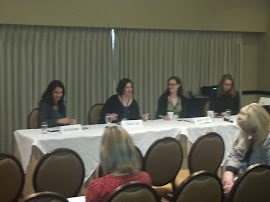
The behind the curtain panelists

The behind the curtain panelists

Panelists: Emily Ohanjanians, editor with Mira Books, the commercial fiction imprint of Harlequin; Eileen Cook, author of YA novels with Simon & Schuster and HarperCollins; Rachel Coyne, agent with Fine Print Literary; Sara Sargent, associate editor with HarperCollins’s children’s imprint, Balzer & Bray.

EC: We’ll start with the author’s search for an agent.  First you have to understand what an agent does.  Most are busy with their current authors and are not actively looking for new authors.  Do your research to find the best fit.  Newer agents will be more available.  Ultimately, it comes down to personal taste.  One agent may not like your voice or style, but another might love it.

RC: I receive 150 to 300 queries per week.  It’s impossible to respond individually.  When I started, that was my intention, but it just can’t be done.  Agents get rejected too, by editors.  There’s a certain disappointment when another agent snags an author from you, especially one that receives an award or does really well.  After I’ve agreed to take on an author, we have a one on one call to discuss next steps.  There is a two page author agreement.  It’s not a contract per se.  Standard percentage is 15% for domestic sales and 20% for foreign, TV, film, and other rights.  Most houses have one agent who is dedicated to subsidiary rights.  Once an author has signed on, the editing begins.  This could mean several rounds, back and forth.  Then the agent will submit to her first round editors.  Usually these are people the agent has an established relationship with.  Sometimes, if several editors are interested, an auction takes place.

SS: At HarperCollins, there are several meetings, one with the acquisitions team during which a profit/loss statement is generated.  The agent is advised of the proposed deal, and negotiation begins.  At the acquisition meeting, everyone sees the property.

EO: It’s the same at Mira, the meeting with the editorial director is followed by the acquisition board meeting, the agent is informed of the proposed deal, and negotiation follows.

Q: Once the book is sold, what happens?

RC: I would make recommendations to the author based on what they hope to achieve.  Usually there is a year between the deal and the publication date, so there is time to implement an author web site or blog, develop social media following, or begin on the next book.  The contract can take anywhere from two weeks to nine months to hammer out.  An advance might be $10,000.  Royalties could be 10%.  First you earn back your advance, then you begin to receive regular cheques.

Q: How does the editor work with the writer on further revisions?

EO: When the launch date is decided upon, it might be a year, or a year and a half, we work backwards, get our endorsements in place, schedule substantial, line, and copy edits, proofing, typesetting, cover art, blurbs, back cover copy, determine the meta data for online sale.

Q: So what happens when you write an editorial letter for the writer, and the writer refuses to budge?

SS: Usually I’ll read and mark up the copy, then prepare a three to ten page editorial letter for the author.  The author will usually sit with it for a few days, then I’ll meet with the author by phone and the author will indicate what they are willing to do and what they are not.  The biggest issue that comes up is characters that are not received as the author intended.  The next is the market: similar books may have tanked for specific reasons that have nothing to do with the quality of the writing.

EC: We work together to reach a solution.  e.g. I hate the character!  My character is brilliant!  How do I show it?

RC: The biggest asset a writer can have is the willingness to be edited.  I like to meet annually with my authors to find out what their plans are for the coming year.

Q: Describe your ideal author.

EO: An insecure author can become overwhelming.  20 emails a day can be draining.  An author coming out of another house might cause me to do some research.  Were there reasons for this?

EC: You have to own your neuroses as an author.  You must be open to communicate.

Q: If your author had to choose between a Canadian and American publisher, which would you recommend?

EC: Commission can be less with a Canadian publisher.  Most American publishers will include Canadian distribution.  The deal is for North American rights, not Canadian or American.  Canada is not considered a foreign market.  Really, your agent is a match-maker, trying to find the best possible home.  It used to be that agents had to be in New York, now they can be anywhere.

RC: There is a right agent and a right publisher for every author/project.

Q: What about e-rights?

SS: They are considered subsidiary rights.

Q: How often do you have to meet in person?

RC: Never if you don’t want to or can’t afford it.

Q: What is your education/experience?

SS: Placement with Disney/Hyperion, BA in English, then an MA in Journalism.

RC: Writer’s Digest Books, Donald Maass Agency, Forward Literary, then Fine Print Literary.

EO: BA in English literature/linguistics, job in finance, but I always wanted to be an editor.  I started working for magazines, then got on with Harlequin, took some courses from EAC and Ryerson in editing, and at every stage, working up through the ranks.

Q: What’s the difference for non-fiction?

EO: It’s based entirely on platform.  Not voice.  Not skill.  Who’s the audience for the book?

RC: Blog-books have been happening recently as well.  Narrative non-fiction works the same as fiction.

EC:  With a novel, you have to have the novel completed before you can query.

RC: With non-fiction, a proposal and platform is often enough.

Q: What should your word count be, and do you talk about series?

SS: Word count isn’t critical.  I’ve never rejected a book on the basis of length.  You should concentrate on one novel per query and treat it as a stand-alone.  It’s important to have a vision, though of how your writing future will look.

RC: We’re not looking so much at the concept, but the creativity of the author.

SS: With children’s literature, you have to be aware of the market.

EC: Not many YA novels are 300,000 words long, but submitting a 20,000 word novel would be too short.

Q: Can an author ever go direct to editor?

EO: If I have the time, I’ll always look.  Why not?  I could find a gem.

Q: When do you know when to stop editing and query?

EC: Write the best book you can.  No matter what you write, you can find an association (RWA, SFWA, etc.). These associations will often offer editing services, or members can serve as critique partners and beta readers.  When you do query, send out five at a time.

Q: Is a rejection a burned bridge?

RC: Not necessarily.  If you revise and resend, there’s a chance that the agent will not remember, but if they do, they are not likely to give you a second chance.  It’s better to try a new project.

Q: How long is it for an editor to respond to an agent?

RC: Between three months to a year sometimes, but the average is three to four weeks.  If there is a closing date or an auction, all interested parties are called.

Q: Do agents want to have input into the author’s platform?

RC: It’s more a matter of making suggestions, showing examples.

SS: In concert with publicity and marketing, publishers may advise.  But if you’re not comfortable on Twitter, you don’t have to use Twitter.

EC: Some agents will advise you with regard to your career in general.  Some agents will never go there.

Q: Have there been books you just couldn’t sell?

RC: Every agent has a book that they felt passionate about, but just couldn’t move.  I make every effort to sell every project, but between 60% and 90% of books signed actually sell.

EC: Hopefully you have more than one book in you.

EO: It’s often the second submission that sells.

RC: Some projects are bought on voice alone.

Q: If you’ve self-published, is it a deal-breaker?

RC: Only if it’s the self-published effort and it’s not sold well.  If it’s a different effort, no problem.

EC: They call us hybrid authors now.

Q: How about posting your work in progress on the internet?

RC: It depends on how much of your novel is out there, and at what stage.  If most of the novel is already “published,” I probably wouldn’t take it.  Do not blog your book.

Q: Can you self-publish one book and e-publish another?  Specifically, the rights on my first novel are reverting to me and I’d like to self-publish.  Meanwhile, I’m in negotiations for my second book.

EC: If your first book is erotica and your second is YA, then they’re not likely to get in each other’s way.

EO: If both books are comparable, you could offer the self-published book at a deep discount.

RC: It would be wise to check with the publisher about to put out your second novel if self-publishing your first is okay.

EO: Be up front with all interested parties.

This brings us to the end of Friday’s sessions.  I’ll have the Friday night and Saturday morning keynotes before moving on to Saturday’s sessions.  We’ll see how far I get tonight.  I’ll be travelling home tomorrow and won’t finish off whatever remains until Tuesday.
The Willing Suspension of Disbelief: Susanna Kearsley

One thing that I must comment upon with a traditional writing conference like SiWC (this is their 21st year) is the frustration of concurrent sessions.  I don’t think there was a time where I didn’t want to attend at least two of the sessions.

This is SO a first world problem, as Chuck Wendig would say.

RT's Giant Book Fair

RT’s Giant Book Fair (Photo credit: rtbookreviews)

So I got over my bad self and made some decisions.  My first one was to attend Susanna Kearsley’s session on writing supernatural aspects of stories convincingly.  Though my stories are all either straight out fantasy or science fiction, it’s always good to have a few more tools in the toolbox.

I’ve been a fan of Susanna since I took a workshop with her in Port Elgin in 1994 (possibly 1995?).  She’d just won the Catherine Cookson Award for her novel Mariana.

Here are my notes:

The mechanics

  • It starts with character.  You must have a likeable, trustworthy, relatable protagonist.
  • The protagonist can be the character who possesses supernatural skill, or they could be the biggest skeptic in the book.
  • Work on the principle of Ockham’s Razor first.  Stated succinctly, the simplest explanation is often the most correct.  People tend to rationalize the unknown.
  • Transition to deductive reasoning.  Think Sherlock Holmes: after every other possibility has been eliminated, what is left, no matter how unlikely, is the truth.
  • Respect both sides of the argument – believers and skeptics.
  • Time travel – paradox.  If you travel into the past and accidentally kill your grandfather, do you cease to exist?
  • Acknowledge accepted beliefs.
  • Research.  All psychology departments usually have parapsychology sub-departments.
  • Seek verisimilitude.
  • Your protagonist’s acceptance of the supernatural should be a gradual process.
  • You need a supporting character, someone who can help or guide your protagonist.  A true believer, or other expert in the area (professor, priest, exorcist, shaman, etc.)
  • Also, you need someone who is an even bigger skeptic than the protagonist.  As the protagonist proves to her or himself and the other skeptic that the supernatural is the only ‘rational’ explanation, he or she is also proving it to the reader.
  • Be aware of the difference between your characters and normal people.  Think of the bit of Eddie Murphy’s RAW of years ago: in the Amityville Horror, the family hears a voice say ‘get out’ and dismisses it, remaining to be assailed by the evil spirits resident in the house.  Murphy said that if the father in that story was a man of colour, he’d tell his family, “Nice place, sorry we can’t stay.  Pack your things, we’re leaving.”  Of course, there was more swearage involved 😉
  • In the handout – two accounts of a UFO sighting.  One from an air force pilot who went through the deductive reasoning process and eliminated all other reasonable alternatives until he was left with a UFO, the other from a man on LSD.  Which would you believe?  Make your protagonist reliable, unless that’s part of her or his journey, to prove what they saw despite obvious reasons not to.
  • Canadian psychic – George McMullen.  Psychometry.
  • Keep your world real, working by the rules you have established.  Naomi Novik made dragons believable.
  • Be consistent.
  • Don’t over-explain.
  • Be aware of our current level of understanding of the supernatural aspect you use in your novel.
  • Choose one thing.  Too much will overwhelm.
  • Stephen King uses wounded heroes.  They are more sympathetic.
  • No coincidence, contrivance, or anything too convenient.
  • We have been raised on nursery rhymes, fairy tales, myths, and legends – we are taught to accept the existence of magic.
  • Where/when we expect to find magic: isolated places and buildings, the woods, old houses, night time, fog or mist, the sea, transitional places like the shore, twilight, dawn, the witching hour.
  • Play with expectations, or play against them.  Against may be the more powerful technique, but it’s also the more difficult to pull off.
  • Avoid cliché.
  • Be aware of cultural biases.
  • Voice is important.  Communication is the goal of writing.  Aim for the grade eight level reader to reach the widest audience.
  • Genres: magic realism, modern gothic, paranormal, paranormal romance, historical.
  • Donald Maass has predicted that eventually, genre will be irrelevant.  It’s a marketing construct.
  • You can cross genres, but do not transcend them!
  • In historical fiction, there will be other explanations for things than there will be in a contemporary novel.
  • The outsider is a powerful thing.  Use this character to explain, gain perspective, but resist the urge to over-explain.
  • There are resources for research in the hand out:
  • http://www.parapsych.org
  • http://www.rhine.org
  • Also check out the Koestler institute of parapsychology.
  • GoogleBooks is a great resource for historical records.
  • Jstore is where you can obtain information from academic journals online.

Friday morning keynote

Each morning, a keynote speaker addresses the conference at breakfast.

For this first day of the conference, it was Simon Clews, Australian author.  His topic was brief, but carried impact: Love, Intimacy, and Hope.

Love is important in writing.

Conditions of love – John Armstrong.

Cover of "THE CONDITIONS OF LOVE: THE PHI...

Cover via Amazon

We write for the love of it, the love of words, and the love of communicating.

We write in the hope of achieving intimacy, reaching an audience, something that has never been more possible with self-publishing and the changes in the industry.

The power is shifting in the author’s favour.

Our audience loves to read and hopes for more words to satisfy that need.

We are the future of writing and publishing.

First, a few notes

Flight from Vancouver to Toronto

Flight from Vancouver to Toronto (Photo credit: Wikipedia)

My flight was seven hours.  I had to be at the airport (a 20 minute drive) an hour ahead of time, fly to Toronto and have a brief layover before boarding my connecting flight to Vancouver.  There’s a three hour time difference between Ontario and BC.

Having arrived in Vancouver, I had to then make my way to Surrey.  I asked hour much it would be for a shuttle.  Even the flat rate was more than I was prepared to spend.

So I back-tracked, bought a train ticket, and rode the sky train for another hour and a half.

At the terminus station, I still had to catch a taxi to get to the hotel.

So, altogether, I spent about ten hours in transit and though it was only four-ish when I got here, I was done.

I checked in, got to my room, and discovered something:

I had to pay for internet access, and I could only pay for either in-room or meeting room access.  I opted for room access, hoping that my smart(-er than me) phone would have enough connectivity to tweet.

After supper and a bath, I went to bed, about eleven pm Pacific, but about two am Eastern time.

I woke up at 3 am.

Though I did my best, I only managed to send one tweet before my phone bogged down altogether.  I haven’t been able to send or receive much of anything since.

Also, Kristin Nelson was unable to attend, her flight from Colorado having been cancelled due to the weather.

I dealt with these small disappointments and have since had an absolute blast (so far).  Will be posting the day’s sessions and my notes as I go, but these will likely be at least a day late.

CanWrite! 2013: Gala and wrap post

Before I begin, I’ll apologize for the apparently drunken photo-taking.  I’m still getting used to the camera in my Galaxy Note II 😛

On Saturday evening (June 15), conference attendees were shuttled out to the Best Western conference centre for out Gala event and announcing of the winners of the CAA literary awards.

Gathering for the Gala

Gathering for the Gala

Our master of ceremonies for the evening was Bruce Pirrie, Second City alumnus and writer for the Red Green Show.

The evening’s events picked up after dinner with an introductory monologue from Bruce about the dubious joys of being a comedy writer.

Then Charles Foran took the podium with an impassioned plea from PEN Canada.  While the organization is best known for its work overseas on behalf of writers and free speech (a current campaign focuses on the events in Turkey), PEN Canada has noticed a disturbing trend here in Canada with the censorship of Canadian scientists and the digital freedom controversy.

Charles Foran

Charles Foran

PEN needs writers everywhere to stand up for the right to free speech and fight the oppression of censorship.  To this end, they are conducting a membership drive until the end of June.  Please consider joining this worthy organization.

Andrew Westoll

Andrew Westoll

Matt Bin

Matt Bin

Next was Andrew Westoll, Author of The Chimps of Fauna Sanctuary.  Andrew presented the stories of three of the Fauna chimps, their individual struggles, and the rewards their caregivers reap.  It was an amazingly touching presentation.

Then, President Matthew Bin introduced the CAA literary awards.  Originally started in 1937, the awards were the “for authors, by authors” recognition of excellence in Canadian literature.  They became the Governor General’s Awards and administration of them assumed by the Canada Council for the Arts.  More recently, in 1975, the Canadian Authors Association has once again started their awards program.

Here is the list of the winners.

It was a fabulous evening and I was inspired by having been a part of it.

_______________________________________________________________________

The rest of the story

I have been a professional member of the CAA since I joined a few years ago.  As such, I have voting privileges at the annual general meeting.  Two years ago, I expressed interest in taking part in the program committee.

This year, I was invited to join it.

The program committee has a fairly sweeping mandate, including the CAA literary awards and the annual conference.  Also on the list of responsibilities are professional development programs (where my greatest interest is), the roving writers program, editor-in-residence program, members’ book catalogue, and contests.  I’m a little daunted but I have great fellow committee members and a great chair to work with.  Our role is primarily to set policy and make key decisions.  We won’t be doing the leg work, but I can see some of that happening.

There are exciting times ahead for the CAA as it also embarks of a “twig” program and membership drive.

The web site is also undergoing a long-overdue revamp and should be far more oriented to service to the CAA’s membership.

I’ve made some writerly connections: Sharif Khan, author of The Psychology of the Hero Soul, John McDonell, and Vikki Vansickle.  I reconnected with some old friends too: Sandra Stewart attended for the weekend only, as did Betty Guenette, another member of the Sudbury Writers’ Guild.  I reconnected with Sue Reynolds and James Dewar (one of my fellow program committee members), who I’d last seen at the Algonkian conference in the fall.  I met a lot of authors, and bought a lot of books (!)

It was a wonderful experience.  I just wish items like Hermione Granger’s Time Turner actually existed, so I could see and experience everything 😉

Coming up: I’ll be returning to my weekends-only schedule, starting with some long-overdue book reviews.

CanWrite! 2013: Day 3 Traditional vs. self-publishing panel

The day 3 (June 15) panel, featured Halli Villegas of Tightrope Books, Sheila Mahoney, Certified Copyeditor and Editors’ Association of Canada Director of Professional Standards, and Tom Taylor, self-published author of Brock’s Agent, Brock’s Railroad, and Brock’s Traitor.

Once again, James Dewar acted as moderator.

JD: Should an author go for a traditional deal, or self-publish?

TT: There are many ways to skin this cat.  I have a publisher in the UK, but did the Canadian editions myself.  All the big marketing budgets have gone by the wayside in any case (Penguin, ECW). You have to invest money in your own promotion regardless.

SM: Know what you’re willing to do.  If you know you can invest the time and money, then do it.  It cost one client $25000, but mistakes were made.  What’s an acceptable risk?

HV: It’s not either/or but how and when?  Speaking tours can be difficult to arrange depending on your genre.  Publishers do have a lot of resources that can help in some situations.  It’s a matter of choice.  For example for academic clients and libraries, there’s Coutts.  They’ll order a set number of copies for distribution to their clients.  Also, there’s BowkerLINK, which offers sales and marketing information.  Publishers can get the proper ISBN barcodes for the cover.  Your books can be featured in catalogues for booksellers and distributors.

TT: It’s business and you have to approach it like that.  Where will your books sell?  Blue Heron Books in Uxbridge is a rare bookstore, very entrepreneurial.  There’s a bakery in the Niagara region where I’ve sold more books (about 300) than at most bookstores.  The owner will talk the books up to customers, many of whom are tourists.  You have to know how to market wisely.

Here’s what I invested and how I recovered the costs:

  • Line edit: $1500
  • Substantive edit: $1500
  • Layout (internal and cover design): $3000
  • Printing: $4000 (2000 copies at $2 each)
  • Total: $10000

To break even, I had to sell 1000 copies of the book at $10 a piece.  Everything else was profit.

SM: Certified editors are best but they don’t come cheap.  Independent editors, some are good and some are bad.  Design is important.  You should make your book a pleasure to read.

TT: I don’t necessarily want everyone to spend $10000 only to fail.  Your comfort level must be considered.  Editing is paramount.  The package is the product (like the media is the message—Marshall McLuhan).

SM: The people who love you are not going to be honest with you.   There’s a difference between line editing and copy editing and substantive editing.  Know what you need and what you’re paying for.

JD: Agents can take over part of the substantive.

TT: Maybe self-publishing is not for you, but if you’ve done the work up front, if you have a fully edited manuscript and a beautiful layout and a lovely cover ready to go, how much more interested will a potential publisher be?  Media coverage is important as well.  Get the word out however you can.  Chapters will take books on consignment too.  Check with your local store.

Ultimately, there were no real answers in this presentation as to whether traditional or self-publishing is better.  It’s an individual decision for every author.  There was a lot of good information that could come in handy regardless of whether you go for a traditional deal or self-publish.

Tomorrow: The Gala and wrap-up post.

See you then!

CanWrite! 2013: Open mic, Andrew Pyper, and Cordelia Strube

I already mentioned the welcome reception and the morning creative writing circles, but have since launched into panels and sessions without mentioning what happened the evenings of June 13 and 14.

Back-pedalling now …

Open mic and shortlist readings

On June 13, interested parties were encouraged to sign up for the open mic.  I did and intended to read the revised opening of my novel as I had at Wordstock, then at supper I heard that the readings would be restricted to five minutes.  This was reduced to three by the time I arrived due to the number of last minute sign-ups.

Not having brought my poetry with me that night, I read as much of my opening as I could.  It was well-received.

Other readers offered their poetry and stories (one humorous one was about discovering one was having a heart attack while on the toilet – shades of Elvis) the organizers sticking strictly to the three-minute limit.

June 14 was to have been readings from the authors short listed for the CAA Literary Awards, but again, a last-minute change opened the floor to additional readers.  I signed up and brought my poetry, a much more appropriate genre for the three-minute limit.

I got to hear the end of the Elvis story and some more great poetry, fiction, and non-fiction.

I enjoyed the readings from the short listed works.  With one exception, none of them could show up in person.  The man who did was Michael S. Cross, author of A Biography of Robert Baldwin: The Morning-Star of Memory (Oxford University Press).

Michael’s reading was wonderful.  I didn’t know Robert Baldwin was such a fascinating character.

Another fascinating author was Jane Doe. She read from her book The Story of Jane Doe.  She is an advocate and activist and her story is a compelling one.  I encourage everyone who has an interest in women’s issues, advocacy, or the attitudes of the legal system to victims of rape and violent crime to pick up this book.

Andrew Pyper

Andrew Pyper

Andrew Pyper

Andrew Pyper is the author of six novels, most recently, The Demonologist.

Andrew’s session was on the afternoon of June 14, and it was as much workshop as presentation.

The session, Getting organized, getting started, focused on the essential elements required before an author begins to write a novel.

  1. An Idea;
  2. A Premise;
  3. A Protagonist;
  4. A Hook;
  5. A Structure; and
  6. An Outline.

He also offered six tips for overcoming roadblocks.

One of the most interesting pieces of his presentation was about ideas.  Yes, one must have at least one good idea to propel one’s plot, but the author shouldn’t stop there.

Traditional thought and misconception would imply that one idea must be made big enough to become the basis for a novel.  Andrew suggested that rather than one idea expanding to fit a novel, that a multitude of ideas should funnel down and feed into a single novel.

This made a lot of sense to me, and when I think about it, that’s how I write fiction.  I never write about one thing.

The premise is distinguished from the main idea of the novel because of its scope.  Andrew’s explanation reminded me of Larry Brooks’s.

He offered the following example:

Idea: A modern-day Frankenstein.

Premise: Archaeologists extract DNA from mosquitoes trapped in pre-historic amber and use it to clone dinosaurs. A philanthropist establishes a theme park around the beasts and invites a select group of scientists and family to witness his triumph; then the beasts escape (Jurassic Park).

The key to a premise is “high concept,” a concept that can be evasive.  This is why Larry Brooks is forever explaining the difference between idea, concept, and premise on his site 😉

Andrew had us write our premises for the Rob Ford story.  As expected, we all had different takes on the well-publicized scandal.

I won’t give away the whole of Andrew’s session, but I will say that it was informative and fun.

Cordelia Strube

Cordelia Strube’s session, on the afternoon of June 15, was mostly workshop.  She’d actually had workshops on both afternoons (14th and 15th) and anticipated that conference-goers would attend both, but a miscommunication occurred and the message was never conveyed to attendees.

Cordelia has published eight funny, powerful, sparse, cathartic and critically acclaimed novels, among them Alex & Zee, Teaching Pigs to Sing, The Barking Dog, Blind Night, and Lemon. Her ninth, Milosz was published last year.

Her plan was to have participants from the first session return and revise the work they had started the day before.  Those of us who only came on the second day would have to start from scratch.

Cordelia gave us a framework and some strategies for getting into our focused writing.  She then distributed horoscopes and a number of other prompts: postcards, small items, all of which were to inform our writing project for the afternoon.

After we were sent off to write however and wherever we wished, the class was asked to share the results of their writing.

It was an excellent session.

________________________________________________________________________

I should take a moment to mention that there were a number of sessions happening concurrently on Friday and Saturday afternoons.  I can only report on the ones that I attended.

Specialty sessions, at a nominal additional cost, also took place during the mornings.

There were also agent pitch sessions occurring Thursday, Friday, and Saturday mornings.  Though I did not opt into these, they were very popular and booked solid.

I like the way in which they were conducted.  Each author was to submit their query letter and first five pages of their novel in advance of the pitch session.  I think that this is a much better way to conduct pitches than to do them blindly.  It’s better for the agents because they have a sense of the author’s work.  It’s better for the writer because they don’t only have their two to five minutes to convey the meat of their novel.

A professional photographer was also on site to take author shots for the attendees.  I happily paid the (again, nominal) fee for this.  I should have the results next week and I hope they will be better than my efforts to date.

Tomorrow: The final panel, Traditional vs. Self-publishing.

G’night y’all 🙂

CanWrite! 2013: Day 2 agents’ panel

After another morning of creative writing and lunch, conference-goers again gathered in the academic building for the 1 pm Agents’ Panel Discussion.

James Dewar acted as moderator for the panel, which consisted of: Sam Hiyate, president of The Rights Factory and Carly Watters, agent at the P.S. Literary Agency.

JD: What are you looking for right now?

CW: Picture books; contemporary YA (thriller/mystery, romance); women’s fiction; upmarket; non-fiction; and multi-media.

SH: New agents are looking for new clients. I’m full up myself, right now, but occasionally I do sign the odd author.  For non-fiction, a platform is essential. Most non-fiction sells on proposal alone.

JD: What can a fiction writer do to obtain representation?

CW: Write an amazing novel.  Platform does not matter.

SH: Debut novelists—sometimes even established ones—can fail to sell.  I like a strong voice, someone who can perform acrobatics with a sentence.

CW: I have a more commercial taste, a Book Club book would appeal to me.

JD: How do you move an “almost there” author to “there”?

SH: I’m a different beast than most agents and will work with the writer to edit the work.  Most agents won’t.  Others will set the writer up with a freelance editor.

CW: I’ll write an edit letter to the writer if the good stuff is REALLY GOOD.  Some books are edited seven times before they are sent to a publisher.  If the writer has the ability to turn their MS around quickly, the chances are better.

SH: My best advice is to find an agent who “gets you.”

JD: What should authors NOT do?

SH: Don’t send your MS in too early.

CW: In a pitch session, do not go through your whole synopsis.

SH: Sometimes the pitch or query can be better than the book.

JD: We’ll open the floor to audience questions (AQ) now.

AQ: Do I need an agent first, or can I approach a publisher directly?

CW: Agent first.  Most larger publishers won’t accept unsolicited manuscripts.

SH: An agent can say “no,” however.  An editor will refer the author to an agent anyway.  Send it and see what happens.

AQ: What does an agent do?

SH: Our job is to create a competitive situation around your book.

AQ: Can you have more than one agent?

SH: We contract exclusively, much like a real estate agent would.  Your book is the property we’re selling.  Our commission is 15% on domestic and 20% on foreign sales.

AQ: In the context of the “Literary Apocalypse” of self- and ebook publishing, do writers even need publishers anymore?

CW: Some agencies have publishing arms, but it gets complicated.

SH: Self-publishing is a new way for agents to discover talent.  Eventually, all the good material gets scooped up by the publishers.  Cases in point: Amanda Hocking, E.L. James, and Hugh Howey.

CW: These are exceptions to the rule.  Agents can’t turn $10k ebook sales into a traditional deal, but if you sell $200k+, that’s different.

SH: In the future, writers will have more control.

AQ: If an author has published a book but is not happy with the rights (terms) is there anything that can be done?

SH: No, if the rights have already been contracted out, that’s it.  Most agents won’t negotiate a bad contract for you, though.  Publishing houses and agencies start out with really talented, committed, and enthusiastic people who are grossly underpaid, for like ten years.  In that time, the ones who can’t maintain their passion leave for greener pastures.  The ones who can, become successful.

The agents’ panel was great, and both Sam and Carly were professional and up front with their insiders’ looks into the publishing world.

Tomorrow: I’ll cover Day 1 and Day 2 evening events, and Day 2 and 3 afternoons with Andrew Pyper and Cordelia Strube.  That will leave the Awards Gala and wrap-up posts.  So three more days, and it’s all over!

Don’t despair, there will be lots more Writerly Goodness coming your way this summer.  Book reviews and hopefully some more author interviews, pupdates (yes, there’s at least one more coming), and updates regarding the backyard office (interesting things afoot there).  I’ll also have some updates on my work in progress and any other conferences or events that I get to.

I will be returning to my weekends-only posting schedule after this week, though.  Blogging every day, though fun for a short period, takes up a lot of writing time (!)  My goal is to have my current revision done before the summer’s out.

Until tomorrow!

CanWrite! 2013: Day 1 publicity and marketing sessions

As promised yesterday, I’m going to talk about the good, bad, and downright ugly.

To start with …

The Good

I’ll start with Vikki Vansickle’s Mapping your Market presentation.

Vikki was enthusiastic, energetic, and clearly loves what she does, on both sides of the board.  Vikki is an author and a marketer, recently moving to Penguin Books (congratulations!).

Vikki has published four middle-grade (MG) novels since 2010.

  • So what do you do when you get published?
  • Celebrate!  Tell EVERYONE.  You never know who your champion will be.  Word of mouth is still king.
  • Do some research (yes, it’s important in marketing too).  How do you find the books you like?  Work outward: How does someone like you in Houston, Whitehorse, or Harrison Hot Springs find the books she likes to read?  That’s where you want to go, to get in front of the wave.
  • Who wants to read your book?  Who needs to read your book?
  • Comparative novels (comps) are critical.  It doesn’t even need to be a novel, as long as it’s in popular culture.  “If you like X, you’ll love XXX!”  “It’s Dirty Dancing without the dirty :)”  “It’s Looking at the Moon meets The Summer I Turned Pretty.”
  • Who is your ideal reader?  Define her in every detail.  Who are your potential readers (again work outward)?
  • Your elevator pitch should be about the length of a Tweet.  You have to tell people what your novel is about in pithy, taut, engaging sentences.
  • Be prepared to wear different hats.
  • Instagram is big with kids.  Facebook’s where their parents are (ew!).
  • Goodreads is great for more mature readers.
  • Writers Cafe (dot) org can help you with critique, beta readers, contests, conferences, etc.
  • Find your niche and identify specialized groups that will help you reach your readers.
  • The Ontario Blog Squad will set up blog tours.  6 blogs.  You create the content.
  • Twitter giveaways.  People love free stuff!  Specify Canada only.  Make sure they enter using a Retweet (RT) and including a hashtag specific to you, your book, or blog.  This helps to spread the word to all of your participant’s followers (and so on, and so on).

The Bad

I won’t tell you the guy’s name, or who he works for, but he’s a publicist.  I thought a publicist would be better spoken, honestly.

His session had some good information, but he was almost too relaxed, too casual.  At times I thought he was bored with the topic.  At times he went off on tangents or mumbled.  He decided to wing it.  He didn’t have a plan.

  • Print ads are not an effective use of funds.
  • Look for web magazines that have “up fronts” (= previews) especially if they have a print tie in.
  • A platform is not essential for fiction writers, but is absolutely key for non-fiction.
  • In fiction, the publisher may work with the writer to build the platform.
  • Build your relationship with your publisher.
  • A P/L or profit /loss sheet may determine what will be expected.  Analysis determines what the most appropriate action or angle may be.
  • Do you have a business or profession related to your book?
  • Books = cultural entertainment product.
  • You have to engage your readership on social media (SoMe).
  • Some publishers spend more $$ on authors than others.  This will be different in the States.
  • If a publicist is assigned, it’s usually for 3 months.  On-shelf promotion (during the initial sales period of the book).
  • Marketing is different for every book.
  • Book trailers are too expensive to be effective.
  • Applications (apps) are even more inefficient and more expensive.

The Downright Ugly

One thing that emerged early on in the session and coloured the remainder of it was that this publicist works for a small imprint of a larger publisher and in non-fiction (politics, sports, world events).  His clients are men and of the imprints authors only a third were women.

He made an off-hand remark about the ladies liking their beach reads.  Fatal mistake when speaking to an audience of 90% women.

To be fair, I have to say that I don’t think the young man realized that he’d just insulted his audience unforgivably.  Even after several women from the audience spoke up and made some very salient points, I’m not sure our publicist got it, or if he did, he was so scared, he didn’t know how to save himself with any grace.

I think it has to do with the publishing environment he works in every day, his mentors, his colleagues.  I think the sexism is so ingrained, so rampant in his sector of the industry, that he wasn’t fully conscious of the prejudices he promoted.

For the remainder of the conference, our publicist was the topic of conversation, and not in a good way.

It immediately brought to mind Chuck Wendig’s posts on sexism and misogyny in publishing.

It’s not a problem that has an easy answer.

Tomorrow: I’ll be moving onto the Day 2 panel and session.