Tipsday: Informal writerly learnings, Feb 19-25, 2023

We’re almost at the end of February. Prepare to welcome March with some informal writerly learnings!

Rachel Teferet offers a social media survival guide for writers. Then, JJ Graham helps you find a writing community as an introvert. Grace Bialecki: location, location, location. Next, Neil Chase lists his top five types of villains in literature. DIY MFA

Why apocalypse stories feel different now. Like Stories of Old

Porter Anderson’s hearing a lot of cyber rattling: when the bot chats. Then, Dave King writes the epilogue on prologues. Thomas Richards explains how to bring your characters to life by writing in three dimensions. Next, Heather Webb suggests some body and mind fitness for writers. Victoria Strauss points out some clauses to watch for: when your publishing contract raises a red flag. Writer Unboxed

Is R a vowel? Otherwords | PBS Storied

K.M. Weiland offers more genre writing tips: how to write historical fiction. Helping Writers Become Authors

Lisa Norman says creating a powerful author website will get the results you want. Then, Kris Maze poses this puzzle: retiring to write, or writing to retire (part 1). Ellen Buikema offers some more tips on writing science fiction (part 2). Writers in the Storm

The politics of loving the bad guy. Princess Weekes

Hank Quense explains book marketing in plain English. Elizabeth Spann Craig

Michelle Barker is getting back into the writing flow. Then, Marissa Graff lists four reasons your action-based scene is failing (and how to avoid it). Writers Helping Writers

Jane explains how authors can build relationships with independent bookstores. Jane Friedman

How to edit a novel. Reedsy

Jami Gold helps you figure out what point of view is best for you.

Tiffany Yates Martin wonders, are you “just”-ifying your writing? Fox Print Editorial

Dan Koboldt considers luck vs. talent vs. perseverance in publishing.

Chris Winkle helps you choose scenes to cover the right information. Then, Oren Ashkenazi analyzes Star Trek’s seven worst antagonistic species. Mythcreants

Lavelle Porter presents an ode to Samuel Delaney. JSTOR Daily

Thanks for stopping by, and I hope you found something to support your current work(s) in progress.

Until Thursday, keep staying safe and well, my writerly friends.

Tipsday: Informal writerly learnings, Feb 12-18, 2023

Welcome to tipsday, where you can get the best of the week’s informal writerly learnings. Enjoy!

Ann Marie Nieves: so you’re interested in hiring a publicist. Jim Dempsey says, write for that someone special. Then, Barbara Linn Probst wonders what actually makes you a better writer? Writer unboxed

K.M. Weiland offers some tips on writing romance. Helping Writers Become Authors

C.S. Lakin explains what story hooks are all about. Live, Write, Thrive

Stories about stories about stories. Tale Foundry

Elizabeth Spann Craig reviews Amazon’s author page updates.

Roz Morris wonders, will AI writing threaten authors’ livelihoods? Nail Your Novel

Jane says negotiation is the one business skill she could grant all writers. Jane Friedman

Suzy Vadori helps you slay your bloated word count. Writers Helping Writers

Nathan Bransford says don’t dribble out morsels of information within a scene.

How to write dialogue. Reedsy

AK Nevermore defines science fiction and fantasy. Then, Lori Walker interviews Courtney Maum about genre-hopping, process, and time management as a working writer. Karmen Špiljak shares the secret ingredient. Next, Sebastián Calderón offers five techniques to connect with your novel. DIY MFA

Janice Hardy shares three ways “show, don’t’ tell” can strengthen your writing. Then, Lynette M. Burrows helps you create characters your readers love and hate. Eldred Bird lists five ways helping other writers helps you. Writers in the Storm

Jenna Harte explains how to find your readers. Fiction University

Tiffany Yates Martin: when will you be a success? Fox Print Editorial

Chris Winkle helps you judge what information your story needs. Then, Oren Ashkenazi analyzes five stories with disappointing prophecies. Mythcreants

Chuck Wendig considers AI and the fetishization of ideas. Terribleminds

Connor Garel explains why M. NorbeSe Philip declared war on her own book. The Walrus

Amna Khalid: the futility of trigger warnings. Persuasion

Thank you for visiting, and I hope you found something to support your current work(s) in progress.

Until Thursday, keep staying safe and well!

Tipsday: Informal writerly learnings, Dec 5-11, 2021

Now I’m back to full-week curation, tipsday is back to its regular size 🙂 Enjoy!

Greer Macallister offers a gift guide for the writer in your life. Then, new contributor Nguyễn Phan Quế Mai considers climbing many mountains. Kathleen McCleary: stories will save you. Then, Kathryn Craft reveals the hidden—but crucial—mad skill. David Corbett: for the sheer joy of it. Desmond Hall drops some writing wisdom: respect for your craft, captain happen, and excavating perspective. Writer Unboxed

Ellen Brock provides her advice for the methodological pantser. In case you need a reminder, Ellen presented her four types of writers about a year ago …

Penny Sansevieri lists ten keys to successful publishing. Then, Colleen M. Story wants you to channel your inner James Bond to boost writing success. Piper Bayard gives you ten steps to get from NaNoWriMo to publication. Writers in the Storm

Jill Bearup says, size does matter …

K.M. Weiland reveals the two halves of the third plot point. (Links to the entire series at the bottom of the post.) Helping Writers Become Authors

Heather Campbell explains how to overcome perfectionism and achieve your writing goals. Then, Tiffany Yates Martin advises when—and whether—to hire a developmental editor. Then, Barbara Linn Probst considers a book launch: baby, art, or product? Jane herself makes a bold statement: yes, social media can sell books, but not if publishers sit on their hands. Jane Friedman

How to self-edit your manuscript. Reedsy

Chuck Wendig delves into the latest publishing controversy: does social media sell books? A vital inquisition! Terribleminds

And Dan Blank offers his reasoned perspective: does social media sell books? We Grow Media

Angela Ackerman explains how symbolism adds depth to a story. Lisa Poisso: when are you ready for professional editing? Writers Helping Writers

The Dragon Lady trope. Regaining her power. The Take

Lauren J. Sharkey is finding the joy of writing. Then, Adam W. Burgess says that if you want to write your best, find your writing community. Angela Yeh shares five ways to change the world with your creativity. DIY MFA

Roz Morris explains how to cope with a hefty report from a developmental editor. Nail Your Novel

Chris Winkle tells you how to keep readers happy with your novel series. Then, Oren Ashkenazi wonders which show is the most engaging, Voltron, The Dragon Prince, or She-ra? Mythcreants

Xiran Jay Zhao does a Chinese cultural breakdown of Shang Chi and the Legend of the Ten Rings.

Kristen Lamb explains how to harness the true power of dialogue: talk is cheap.

Sophie Gilbert reveals what the sexual violence of Game of Thrones begot. The Atlantic

Blair Braverman: I moved to a remote cabin to write, and I hate it. Outside

Thank you for visiting, and I hope you found something to support your current work in progress.

Until Thursday, be well and stay safe, my writerly friends!

Tipsday: Writerly Goodness found on the interwebz, Aug 8-14, 2021

Another week, another batch of informal writerly learnings.

Ann Marie Nieves answers your book PR and marketing questions (part 4). Then, Jim Dempsey wants you to enhance your fantasies with a dose of reality. Kathryn Craft hopes you aim for the “extra” in ordinary. Then, Kathleen McCleary says, sometimes you’re the windshield; sometimes you’re the bug. Gwen Hernandez helps you create a series bible in Scrivener. Later in the week, Dee Willson connects the dots between research, sex, and related remedies. Writer Unboxed

Tim Hickson is killing characters. Hello, Future Me

Lori Freeland is talking location, location, location! Bring your book to life, part 2. Then, Jenny Hansen says, it’s okay to fall down. Eldred Bird contemplates coming out of hibernation. Writers in the Storm

The messy meaning of zombie stories. Like Stories of Old

Janice Hardy says, if you want a tighter point of view, ditch the filter words in your novel. Then, E.J. Wenstrom is creating creatures for speculative worlds. Ann Harth offers a nine-step plotting path to a stronger novel. Fiction University

K.M. Weiland shares three things to know about the ending of a story. Helping Writers Become Authors

Lindsay Ellis shares nine things she wished she knew before publishing her first novel.

Jane Friedman wonders, should MFA programs teach the business of writing? Then, E.J. Wenstrom explains what to know while you write dual point of view. Jane returns to show you how to harness community to build book sales and platform. Jane Friedman

Stefan Emunds examines eight elements that get readers invested in your story. Live, Write, Thrive

Shaelin Bishop explains why she’s a discovery writer. Shaelin Writes

Manuela Williams offers something for your poet’s toolbox: generate ideas and inspiration. Then, Kris Hill promotes worldbuilding using tabletop games. Tori Bovalino: genre-bending and The Devil Makes Three. Later in the week, Sarah R. Clayville shares five bad habits to quit like a champ. DIY MFA

Fire cat or fire cart? The history of Japan’s Kasha. Monstrum | PBS Storied

Marissa Graff says, don’t let excess baggage bring down your character’s plane. Then Angela Ackerman poses problems and solutions for describing a character’s emotions. Writers Helping Writers

Nathan Bransford explains how to come up with good comp titles for your book. Then, Christine Pride walks you through how an editor at a publisher acquires a book. Nathan Bransford

The “asexual” Asian man. The Take

Kellie Doherty introduces us to some of the mythological creatures of Alaska. Fantasy Faction

Chris Winkle: Project Hail Mary shows when flashbacks work, and when they don’t. Mythcreants

Joanna Penn offers a primer on the metaverse for authors and publishing: web 3.0, AR, VR, and the spatial web. The Creative Penn

Souvankham Thammavongsa shares her feelings about winning the Scotiabank Giller Prize. CBC’s The Next Chapter

What to call that weird thing your pet does. Merriam Webster

Megan McCluskey reveals how extortion scams and review bombing trolls turned Goodreads into many authors’ worst nightmare. Time

Thank you for taking the time to visit, and I hope you found something to support your current work in progress.

Until Thursday, be well and stay safe, my writerly friends!

Tipsday: Writerly Goodness found on the interwebz, March 7-13, 2021

We’re half-way through March and heading for the vernal equinox. Reward yourself with some informal writerly learnings.

K.M. Weiland continues her archetypal character arcs series with part five: the king arc. Helping Writers Become Authors

Janice Hardy shows you five places to find your novel’s theme. Then, Janice lists four steps for choosing what details to describe in a scene. Later in the week, Angela Ackerman recommends you do this one thing to write unforgettable characters. Fiction University

Princess Weekes: Lovecraft Country … was just not that good. Melina Pendulum

Lisa Cron returns: still crazy after all these years. Then, Jim Dempsey lists five reasons you need a professional editor. Juliet Marillier celebrates wild women. The Cailleach and Baba Yaga, two of my personal favourites! Later in the week, Kathryn Craft explains how authenticity builds a satisfying author career. Then, David Corbett looks at two approaches to dramatizing character change: Emma vs. Hamlet. Writer Unboxed

Shaelin explains how to convey emotion in your writing. Shaelin Writes

Jane Friedman considers which is better for authors, blogging, or an email newsletter. Then, Lisa Cooper Ellison shares three traps that subvert our ability to receive feedback. Jane Friedman

C.S. Lakin explains how to face down writer fear. Live, Write, Thrive

The ice queen trope, explained. The Take

Kris Maze offers five dialogue quick tips for page-turning fiction. Later in the week, Piper Bayard and Jay Holmes list ten common bedroom object to use as weapons. In a pinch. Writers in the Storm

Jami Gold discusses setting as character. Later in the week, David Duhr wonders, do you focus on the doing or the having? Writing process vs. product. Writers Helping Writers

In defense of basic. What does it meme? The Take

Laura Highcove wonders, why does it feel like you can’t write after a writer’s conference? Then, Manuela Williams explains how to nurture your reader community. Later in the week, Elly Griffiths advises you to follow the feet. Then, Angyne Smith shares five things that saved her novel from oblivion. DIY MFA

Jenna Moreci shares her structuring method.

Lucy V. Hay offers a comprehensive guide of ALL. THE. STORY. STRUCTURES. Informative and somewhat overwhelming. Bang 2 Write

Chris Winkle explains why you should watch out for hindrance characters. Then, Oren Ashkenazi points out five problems with focusing on internal conflicts. Mythcreants

Kristen Lamb extols the art of embracing the suck: commitment matters.

Julian Lucas shows how Octavia Butler reimagines sex and survival. The New Yorker

Stephanie Burt: we live in the world of WandaVision. The New Yorker

Thanks for stopping by and I hope you found resources to support your current work in progress.

Until Thursday, be well and stay safe!

Tipsday: Writerly Goodness found on the interwebz, Jan 17-23, 2021

I’ve gathered lots of informal writerly learnings, this week. Stock up and enjoy!

Janice Hardy provides a lifeline for when writing is no longer fun. Then, Rochelle Melander wants you to dump old myths and discover a new solution to procrastination. Later in the week, Janice is back with five steps to your next novel idea. Fiction University

Jill Bearup investigates the feasibility of fighting in a corset.

Jan O’Hara shares some writing self-care for when the world is afire. Then, Dave King wants you to focus! Therese Walsh describes Jan 20, 2021 as a semi-colon moment. Liz Michalski helps you root down and rise up. Writer Unboxed

Shaelin helps you structure a novel with Freytag’s Pyramid. Reedsy

And then, she covers the Fichtean Curve. Reedsy

Angela Ackerman: authors aren’t your competition. Then, Barbara Linn Probst considers ways of seeing, ways of writing. Writers in the Storm

K.M. Weila presents the three character arcs of the Karpman Drama Triangle. Helping Writers Become Authors

On her own channel, Shaelin Bishop offers 15 tips for writing better short stories. Shaelin Writes

Allison K. Williams explains how to restart your unfinished book. Jane Friedman

Elizabeth Spann Craig is returning to writing after a break.

Savitri and Satyavan: The legend of the princess who outwitted Death – Iseult Gillespie TED-Ed

Lisa Hall-Wilson shares seven ways deep POV creates emotional connections with readers. Writers Helping Writers

Jenn Walton helps your boost your creativity. Anita Ramirez suggests five ways to keep writing through a crisis. DIY MFA

The southern woman trope, explained. The Take

And … gaslighting: what does it meme? The Take

Oren Ashkenazi analyzes five useless powers in popular stories. Mythcreants

David Silverberg: at Bakka-Phoenix, the beloved science fiction and fantasy bookstore, you can let your geek flag fly. The Toronto Star

Matt Galloway interviews Nalo Hopkinson on the ‘joyful’ responsibility of being a leading Black voice in sci-fi writing. CBC’s The Current

Jeffrey Brown and Anne Azzi Davenport: poet tapped for inauguration to spread message of unity. PBS News Hour

And … Amanda Gorman’s inaugural poem.

Thanks for spending some time with me. I hope you took away something to support your current work in progress.

Until Thursday, be well and stay safe!

Tipsday: Writerly Goodness found on the interwebz, Aug 16-22, 2020

Welcome to another week of informal writerly learnings!

Black lives matter. Indigenous lives matter. All lives cannot matter until Black and Indigenous lives matter. This is a fundamental truth.

The EI ERB and CERB have been extended for the third time and three new transitional benefits are being created to support Canadians in this crisis. It’s resulted in chaos at work, but chaos has been the rule since March 15th.

Wear a mask. Wash your hands. Stay within your bubbles and avoid crowded events. Take care and stay safe. You don’t know who you could be putting at risk with careless behaviour.

K.M. Weiland shares five exercises for honing your story instincts. Helping Writers Become Authors

Vaughn Roycroft explains why he prefers novels with prologues. Dave King is discussing fiction in the time of plague. Then, Sarah Penner shares the results of a working-from-home survey: navigating changes to our work environments. Later in the week, Porter Anderson discusses emergent voices. Writer Unboxed

Shaelin Bishop shares some of her favourite writing techniques. Shaelin Writes

Tasha Seegmiller: every novel needs a village. Then, Barbara Linn Probst advises us to read like a writer and write like a reader. Later in the week, John Peragine explains the vital importance of your writing community. Writers in the Storm

The muse trope, explained. The Take

Rochelle Melander suggests some tools for revision. Fiction University

Christina Delay uses the lyrics of “Yesterday” to look back at the first act. Writers Helping Writers

Helen J. Darling helps you build your author newsletter list. Then, Pamela Taylor helps you figure out whether you’re writing historical fiction, or something else. Later in the week, Chere Hughes describes the key features of a no-fear critique. DIY MFA

Susan DeFreitas explains what your first 50 pages reveal. Jane Friedman

Nathan Bransford wants you to be very careful with dreams and hallucinations in novels.

Chris Winkle explains why story structures like the Hero’s Journey don’t work. Then, Oren Ashkenazi analyzes five stories with anticlimactic endings. Mythcreants

What English can’t do. NativLang

Alexandra Alter: “We’ve already survived an apocalypse”: Indigenous authors are changing science fiction. The New York Times

Thanks for visiting and I hope you’re taking away something that will support your current work in progress.

Until Thursday, be well and stay safe.

Tipsday2019

Tipsday: Writerly Goodness found on the interwebz, April 5-11, 2020

Another week of physical distancing has come and gone. Another week of working from home or unemployment, and increasing numbers of confirmed illness, hospitalisation, and deaths from covid-19. There is also hope that, in some areas, at least, that we’re reaching a peak, beginning to flatten or plank the curve.

Treatments are being investigated while a vaccine is in development, but this new normal may pertain until a vaccine is available. I hope that you’re finding a way to navigate the enforced isolation.

My own humble contribution is this curation of informal writerly learnings. Enjoy.

K.M. Weiland lists seven ways writing saves us when life is hard. Helping Writers Become Authors

Susan DeFreitas returns to Jane Friedman’s blog with part two of her developing a writing practice series: community. Then, Susann Cokal suggests that instead of setting a goal, try a writing dare.

Shaelin Bishop explains show, don’t tell, so you can actually understand it. Shaelin Writes

Over on Reedsy, Shaelin lists the pros and cons of past and present tense so you can choose the best one for your story.

Tamar Sloan shares what you need to know to keep the words flowing in difficult times. Writers Helping Writers

Jeanette (the Writer) Smith considers whether you can trust editing software. And here’s my latest column: five books on the tarot for writers. DIY MFA

Jenna Moreci shares her favourite man tropes 🙂

Jami Gold wants you to escape generic storytelling by asking why. Then she helps us understand the past perfect tense.

Janice Hardy helps you identify whether it’s a loss of momentum or writer’s block. Fiction University

Chris Winkle tackles Act II of Dr. Horrible’s Sing-Along Blog. Then, Oren Ashkenazi explains what Tolkien did right—and wrong—when he built Middle Earth. Mythcreants

Kristen Lamb shares the truth about introverts and why isolation is hard on us, too.

Thank you for visiting, and I hop that you’ve found something here to support your current work in progress.

Until Thursday, be well and stay safe.

Tipsday2019

Tipsday: Writerly Goodness found on the interwebz, Jan 26-Feb 1, 2020

Welcome February, Imbolc, Groundhog Day, and the return of the light! We’ve made it through the better part of winter. Reward yourself with some informal writerly learnings.

Janice Hardy: things to consider when adding a point of view character. Fiction University

Jenny Hansen shares tips for Word’s track changes features, her favourite editing lifesaver. Kris Maze: when rejection becomes connection. Writers in the Storm

Kim Bullock: the benefits of sensory deprivation for writers. Ann Marie Nieves says, we need more of that. Writer Unboxed

The Take examines the smart girl trope.

Jami Gold helps you build a bridge from story beginning to main conflict. Writers Helping Writers

Over on her own site, Jami Gold wonders what calls for diversity mean for our writing.

Ellen Brock shares her theory of four types of writers (across two spectra). Very intriguing. I’m looking forward to the next videos in the series.

Nathan Bransford shares his plot framework. Then, he explains why protagonists need to be active.

Emily Wenstrom lists her top 2020 social media trends for authors. DIY MFA

Jane Friedman offers her guide to getting the most out of a writing conference.

Juliette Dunn lists six things writers should know about autistic people. Then, Oren Ashkenazi analyzes six overpowered characters and explains how to fix them. Mythcreants

The Lost Words Blessing – The Lost Words. Don’t think this belongs in tipsday? Listen. Just listen. You’ll understand.

Caught up in the details? Stop overthinking and just write. CBC Books

Thank you for visiting. I hope you take away some great supports for your current work in progress.

Until Thursday, be well!

Tipsday2019

The Canadian Writers’ Summit 2016: Achieving your dream: the shadow side

Disclaimer: I am not perfect and neither are my notes. If you notice anything that needs correction or clarification, please email me at melanie (dot) marttila (at) gmail (dot) com

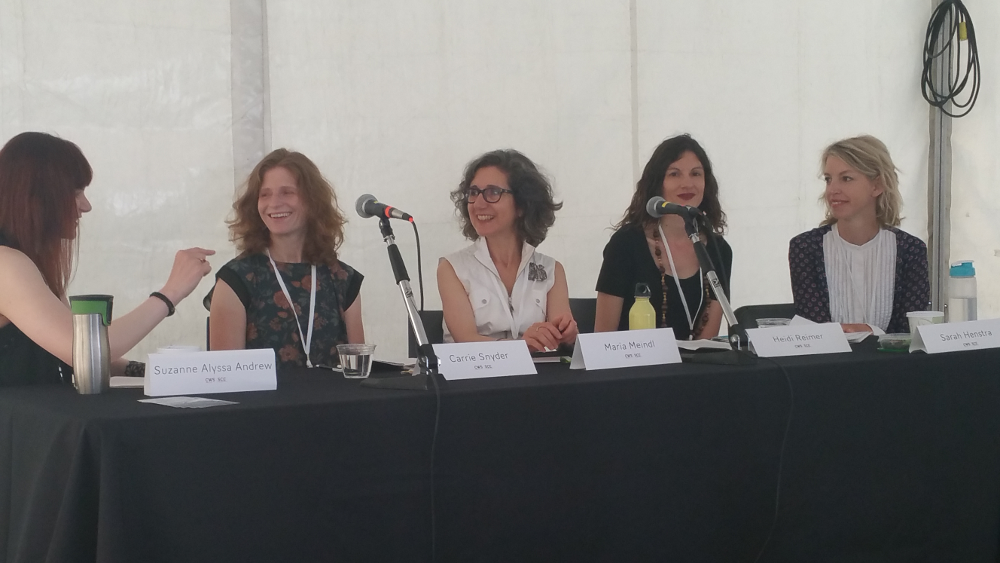
Panellists: Suzanne Alyssa Andrew, Carrie Snyder, Maria Meindl, Heidi Reimer, Sarah Henstra (Moderator)
theshadowside

SH: Everyone talks about the struggle that precedes publication, but what about what happens afterward?

[Panellists introduced.]

What’s been your experience with the shadow side?

HR: I’ve been thinking about this because I achieved my creative goals and felt things nobody I knew had ever mentioned. I finished my novel and I felt depressed rather than elated. My spouse is an actor and he’s experienced in the art of letting go. In his world, it’s a recognized thing that all actors experience. It’s not in mine. When I won the Chatelaine contest, I was elated, and then terrified. I looked up their distribution and readership on line. That amount of exposure made me feel vulnerable. I physically recoiled. Something intensely private was about to become public. I talked to friends about my distress.

MM: I feel like I’ve confronted the connection between success and darkness in my life. My grandmother was Mona Gould. By the time I was a child in the 60’s, her poem, “This was My Brother at Dieppe” was everywhere. When her success faded, she turned to alcohol and became bitter. What I learned from that experience is that success is harmful. It can destroy you. When she died, I received boxes of her materials. It took me five years to sort through it. She started promoting her work at the age of eleven. Her poem was sponsored by an arms manufacturer, but she was a pacifist. She didn’t feel she could object. Now I understand that it’s not success that’s destructive, but the lack of a forum and the means to use it.

CS: I always wanted to be a writer. As I was driving in from Waterloo, I tried to figure out what that seven-year-old girl’s impulse was. I focused everything on becoming an author. I published by first book at the age of twenty-nine. It was written when I was twenty-six. It was another eight years before I published my second novel. In 2012, The Juliet Stories came out and was nominated for a Governor General’s Award. It was a huge moment for me. I embraced the high and I rode it. I wasn’t prepared for not winning, though. I mean, I knew I wasn’t going to but knowing it and experiencing it are two different things. They informed us ahead of the public announcement and I sat with the secret for a week. I felt ashamed. I was afraid of disappointing my kids and everyone else who’d been so supportive of me and my book. I didn’t know how to cope with it. I am so grateful for my blog because I was able to get my experience out there. I almost changed careers. I had my acceptance to McMaster’s midwifery program in one hand and the offer for The Girl Runner in the other. I thought I’d made a mistake in pursuing my dream. Now I’m making a living as a writer. It’s wonderful and it’s amazingly difficult at the same time. It’s hard to be here and to be vulnerable in front of you.

SAA: Everything you’ve all said resonates. I’ve just published my first novel and I, too, have always wanted to be a writer. I went on a book tour and it was the first time my family had heard me read my work. I play bass in a band. It’s a group, a community. We share. In literary circles, I find there’s a lack of transparency, especially about publishing in Canada. I think the reality’s worse than any of us realize. There’s a lot of pressure to market your own book. I invested in promotion. I’m a freelance writer. I don’t regret making that investment. At the time I figured, I’ll worry about it later. Well, it’s later and I’m feeling the financial impact. I have second book paralysis, knowing how hard it was promoting my first. Musicians are open and honest about the challenges. They offer each other advice and strategies. Authors in Canada don’t talk about these issues. We’re worried about seeming ungrateful. It’s very isolating. We need to be more vocal as a community.

SH: Can any of you comment further on shame and vulnerability?

CS: You’re novel is something you’ve worked on for years. It will be judged. There will be reviews. I’m a private person. I work through things in writing. It doesn’t feel right to be so exposed. To create anything of value, you have to go there, though. I was terrified of being changed by success. I can deal with rejection, but I have no experience in dealing with success.

SAA: It’s about being a creative person in the public sphere. You can get so involved in the persona you adopt for the media that you can start to feel schizophrenic. We don’t express our real feelings on social media. Everyone else seems more successful, happier. You compare yourself to others and find yourself wanting. There’s another reality to the one presented on Facebook.

HR: When I was published for the first time (I wrote an essay about the experience) I suffered anxiety and panic attacks. If it’s not discussed openely, everyone thinks it’s only them. I have a novel on submission. I received a rejection and felt relief. I know what to do with rejection. A ‘yes’ involves a whole other world. I was happy to stay in my identity as a rejected writer. You have to redefine yourself in light of success.

SH: Is this a question of gender? We’re all women on this panel.

MM: There’s a line between the inner and outer worlds of the author. There’s a free-floating shame still attached to being a woman and a woman writer in particular. Hélène Cixous once asked, “write? With what right?” We’ve internalized this social message. It’s about taking charge of the narrative. Take hold of the narrative. Be heard. It’s a gendered issue.

CS: Are there any men authors in the audience?

Aud: Yes. When the questions was asked, all the women were nodding and the men were shaking their heads. We don’t talk about the shadow side.

MM: The word authorship, etymologically, it means leadership, mastery. As a woman, I didn’t feel welcomed into that world.

SH: Many authors speak of their novels as their ‘book babies.’ There’s a stigma to post-partum depression. You’re not allowed to feel down after having a human baby. Have you found anything that helps?

SAA: Being someone who had this dream, I had high expectations. Being in a band dialled those expectations back. Check your expectations. Talk about it with other authors. What does success mean to you?

CS: Create a safe, private space in which to create. Don’t get down on yourself if you can’t create while you’re doing publicity. It’s not what I thought the job was. I have to remember why I write. I have to turn off all of my expectations. I’m still a writer, even if I never get published again. I wanted to make a living as a writer. I have. But there are worse things than not making a living as a writer.

HR: I did a releasing ritual. I needed to get all of that stuff out. Society says you should be happy. I felt loss. I had to write it out. I had to acknowledge the feelings and affirm what I wanted.

SH: How do you not miss the moment because you’re rushing on to the next fifty things you have to do? You have to celebrate your successes. Ania Szado says you also have to honour your losses.

MM: When my book came out, my Rabbi did a blessing over the book. It was a wonderful thing, on the Sabbath, so, no selling, no pressure. We were just honouring a life event.

SH: Do you want to say something about your definition of success?

MM: The more I thought about it, the more I realized how much others define success for us. We also internalize those definitions and move the bar.

CS: My ‘word of the year’ was success. It terrified me. To everyone else, it looks like success. To me, it doesn’t feel like success. It has a lot to do with what we expect.

SAA: Amy Winehouse’s definition of success was to sing. That’s it. When she got big, she imploded.

Q: What issues turn you on to writing?

CS: I write because I have something to say. Later, the issues grow out of what I’ve written.

SAA: Despite all the challenges of writing, we all have something to say. The joy of writing is in expressing something, of speaking to your readers.

Q: How do you relate to your readers and how is that relationship affected by the shadow side?

MM: I used to be more involved in small press publication. A man bought my book for a dollar and then returned later to tell me that he was moved. It was a wonderful feeling.

SAA: I started out on fire about online marketing. Eventually, I felt like I was speaking into the void. It wasn’t until I went on tour that I felt it was real. I could talk to people. Writers are rarefied outside Toronto.

CS: I was at a writers’ festival in BC and a woman gave me an envelope. In her letter she asked me how I had known her so intimately? She felt like I had written for her, to her. It was humbling.

SH: When I launched Mad Miss Mimic last year, a girl bought the book, sat down, and didn’t stop reading all night. My favourite thing is when parents send me pictures of their kids reading the books. It’s old school. One reader can change your world.

Q: What kind of support do you look for?

SAA: I get the best support from other writers. I have a wonderful agent, Samantha Haywood, and she held my hand through the process.

Q: What strategy do you use to deal with criticism?

CS: I bounce back really quickly now. I’m as polite as possible in person. Privately, I allow myself 24 hours of bleakness, and then I get over it.

SAA: A lot of critique says more about the critic than the writer.

Q: Do you get requests for information from aspiring writers?

CS: Yes. I have advice on my blog. I’ll respond to individual requests for advice from friends.

HR: Take me out for lunch and I’ll tell you whatever you want to know.

Q: How do you deal with family stuff?

HR: I write what I write and when it goes out into the world, I panic. The Chatelaine article reveals some personal information about my relationship with my dad. I had to tell him when I heard that it would be published. I was worried, but it was good. It’s best to deal with it directly.

And that was time.

Next week, I’m going to post another book review.  It’s a five-star so you can look forward to that 🙂

Be well until next I post, my friends.