CanCon 2015 day 1: How to pitch

Panellists: Hayden Trenholm, Gabrielle Harbowy, Robert Runte, Elizabeth Hirst, Marie Bilodeau
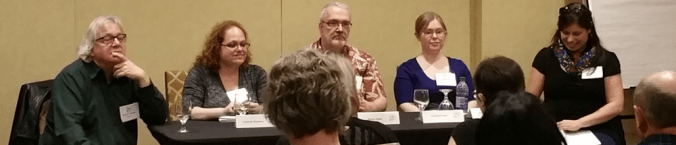
PitchPanel

Q: What do you want to see/hear in a pitch?

EH: Enthusiasm. If the author loves their book and believes in it, that’s a good sign. Make sure the book you pitch is finished.

HT: Don’t lie. If the book isn’t finished, be up front about it. If the finished book comes in nine months later, that ship has sailed, though.

GH: First impressions count. Don’t ignore the guidelines. One guy wiped his nose before he shook my hand. It didn’t matter what he did after that.

EH: Presentation is key.

HT: I have to know I can send you to a high-end book store. Publishers don’t buy books. We buy authors.

RR: Different editors look for different things. You want to get rejected as quickly as possible. If you’re not a fit for the editor, you have to feel good about that and move on. You’ll find the editor who’s as passionate about your work as you are. I polled my SF Canada colleagues and asked them, ‘what’s the longest you’ve waited for a response?’ Eight years was the longest. That’s a huge chunk of your life.

HT: Pitching is like a job interview. Treat it like that.

EH: I wish the authors well. If it’s not for me, I might suggest someone else.

GH: Don’t argue. All decisions are final.

HT: Some people try to tell me why I’m wrong. It’s like asking for a second date after a failed first one.

EH: You should ask as many questions as they ask you.

HT: You have to make sure it’s the right fit.

EH: I might recommend self-publishing to some pitchers.

GH: But I can’t take a book that’s already been published.

RR: You have to make sure you match your capabilities. Don’t promise anything you can’t deliver.

HT: We don’t know everything. We all do what we can. Self-published books are a tough sell. 55% of Americans won’t read an ebook. Think about what you want. Your expectations should be clear. A bestseller in Canada is about 5000 books. When you choose a small publisher, you have a personal relationship. Our goal is to make the best book we can. If that’s what you want, pitch to a small press.

GH: Bigger presses look at Dragon Moon’s catalogue. We’re happy to send authors on to bigger and better things.

RR: If you’re asked for a synopsis, it’s a blow by blow of everything that happens in the novel, including the end. I need to know the ending. You have to tell me what your book is about.

EH: The ending is not as important to me as the main conflict. What’s interesting about the book? What’s the intrigue? That’s the reason people read.

GH: Premise and plot are not the same thing, though.

HT: People think the book has to be perfect. No. The book has to be interesting. If the book is a shambles in terms of spelling and grammar, we can fix it.

RR: I have to love your book to put the four- to five hundred comments on it that I do on most books. I’ve been giving these talks forever, but I finished my first book and went to pitch it . . . and blew it.

HT: The last person who knows what the book is about is the author.

Q&A ensued.

And that’s the end of day 1. Between Nina’s workshop and this panel, the opening ceremonies took place and after this panel, I went to the Bundoran Press book launch and SF Canada party, where I got to hear GoH Ed Willett read from his latest novel and network with my writerly peeps.

So that was all I did on Friday.

Next week: Asteroids.

Note: I’m not sure if I’ll be able to post on Saturday or if it will have to be pushed to Sunday. Family shenanigans. You know the holiday drill 🙂

CanCon 2015, day 1: Ecology and story workshop with Nina Munteanu

It took us a little longer to drive to Ottawa than I thought, so I was late for this workshop. My apologies to Nina and to any of my readers who experience confusion as a result. If you think there’s something missing, you’re probably right 🙂

_____________________________________________________

Overlapping ecosystems are vibrant.

Ecologists ask why and how.

  • Why do species eat this food and not that one?
  • How do the environment, other species, diet, etc. limit population growth?

Adaptive traits:

  • Mimicry
  • Camouflage

Autotrophs (producers – species which produce their own food)

Phototrophs (produce food from light)

The Bracken Fern. Ubiquitous. Found on every continent except Antarctica. Very successful. Carcinogenic. Breaks down vitamin B. Reproduces by both spores and rhizomes.

Fiddleheads contain cyanide. Aggressive symbiosis. They attract ants which in turn defend it against other predators (peonies do this, too, though they don’t contain cyanide).

Nothing else will grow in a hemlock grove. It kills all potentially competitive species.

Some primates live with viruses that cause disease in other species because the monkey is the virus’s ‘ideal’ host. (Mel’s note: I think this was a digression into other forms of symbiosis–monkeys aren’t phototrophs.)

Chemotrophs (produce food from chemical processes)

Heterotrophs (consumers and decomposers, including us)

Parasites

Saprotrophs – fungi and bacteria

Detrivores – insects and earthworms

Lynn Margulis proposed the Gaia hypothesis and symbiogenesis (Google search for more information).

Endosymbiosis – cooperative adaptation.

Darwin’s theory of competition (survival of the fittest) is incomplete. It doesn’t explain altruism.

Symbiosis leads to happiness.

  • Kin selection – the choice to support the reproductive group including sacrifice for the greater good (heroism).
  • Group selection – the choice to limit population growth in favour of x (where x is more food, habitat, etc. for all).
  • Reciprocal altruism – The vampire bat, for example. All hunters may not be successful, but the successful hunters will share their food with the unsuccessful and with mothers/pups (by regurgitation) to ensure the continued strength of the community.
  • True altruism – Dolphins will help humans and other species for no apparent gain. (Mel’s note: they may also rape their own and other species for no apparent reason, but that’s another story.)
  • Communal feeding – Lions in prides.
  • Satellites – In some frog species, the small males will hang out with the big, noisy ones and ‘head off’ the eligible females attracted by their big, noisy brethren.
  • Niche partitioning – competing species that coexist in the same ecosystem by voluntarily partitioning food, habitat, etc..

Adaptation and extremophiles

The brine shrimp of Mono Lake (California) thrive in inland seas with salinity that kills potential predators. They can also survive being dried out.

There are flies that can swim and dive because they carry their own oxygen supplies in air bubbles.

There are bacteria that feed on sulphur.

The Microbes of Lake Untersee in Antarctica live in a super alkaline environment with lots of dissolved methane in the water. They create stromatolites—the largest ever found anywhere.

Bacteria in the Rio Tinto thrive in extreme acidity and high iron content in the water.

The fungi of Chernobyl feed on high levels of radioactivity.

The Atacama Salt Flats in Chile is the most arid desert in the world, yet hypolithic algae have evolved to thrive where no other plant life can.

Tardigrades (also known as water bears or moss piglets) can survive anywhere, even in space (for approximately ten days). They can be revived after a century of desiccation and endure 1000 times the lethal dose of radiation for a human. Technically, they’re not true extremophiles because they have not adapted to prefer, or thrive in these environments. They merely survive.


_____________________________________________________

The rest of the workshop was taken up by an exercise in which we applied ecology to the characters of our stories. How have our protagonists adapted to thrive in adverse conditions, compete against, or mimic, other characters, to become the heroes of our stories? In what ways do they show altruism, and is it true altruism, or another form? How does the unique environment of the story world affect them?

It was a very interesting workshop and I’m sorry to have missed the beginning of it.

Unfortunately, because of my late arrival, I did not get a picture of Nina or the workshop participants.

It was a good start to a great weekend of panels, though.

Come back next Saturday when the CanCon 2015 reportage continues with advice on pitching your novel.