CanWrite! 2014: Writing fantasy with Kelley Armstrong, June 20

I took a little break last week because of the blog tour and interview with Mat, but I’m back and ready to proceed with moar CanWrite! 2014 reportage.

I’ve been interested in Kelley for years, ever since I first heard Brian Henry’s story of how he helped hook Kelley up with her agent, effectively launching her career. Kelley’s version of the tale appears later in the workshop, so I won’t spoil it.

Everybody loves a good origin story 🙂

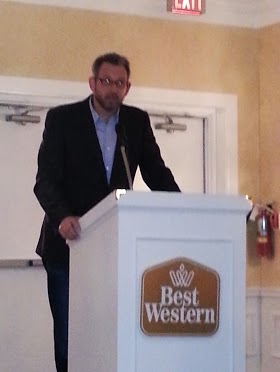
Kelley ArmstrongKelley was a dynamic speaker, hardly ever keeping still long enough for me to snap a decent picture. I won’t torture either you or her with my attempts. Suffice it to say that by the time my phone camera took the shot, she was in mid-speech. So here, instead, is the promo pic she gave the CAA to post on the conference page.


Kelley also likes to sit on desks as she holds forth.

Overall, I found her workshop a fascinating one. She frequently asked a question of the class and had us share our expertise, as a good facilitator should (corporate trainer kudos, Kelley!).

Without further ado, here are my notes from the workshop.


What is fantasy?

Set in an alternate reality; featuring non-human characters; plausible impossibility (Mel’s note: this was my offering. It’s from Brian Aldiss’s Trillion Year Spree.); mystical elements.

What about sub-genres of fantasy?

Steampunk (think Gail Carriger); urban fantasy (what Kelley writes); epic or high fantasy (Tolkien); contemporary; paranormal romance; speculative fiction; magical realism (Alice Hoffman’s Practical Magic).

On writing rules.

There are rules for grammar, spelling, syntax, etc., but with regard to writing a fantasy novel, there are no rules, only guidelines. Following them can definitely improve your chances of being published, but we worry too much about rules.

Don’t worry about the market. Let’s look at an example of a sub-genre that has long been considered flooded.

Current market research reveals that with regard to vampire novels in the last eighteen months there have been:

  • Eighteen deals for new series or standalone titles;
  • Fourteen extensions of current series;
  • Three novels from established novelists in other genres; and
  • One debut.

The “Big Five” are still buying vampire novels. Movies and television series are still being made from these books as well.

Who are the Big Five?

  • Penguin Random House (imprint – DAW)
  • MacMillian
  • Simon & Schuster
  • HarperCollins
  • Hachette (imprints – Little Brown, Hyperion)

All of the Big Five have their imprints. You can publish different books with different imprints.

<Kelley took a few minutes to review her most recently published novels and which imprint and parent publisher each was produced by.>

Bitten was the fourth novel I’d written. The three previous were, a novel about a private investigator (Mel’s note: my notes indicate PI, but it could be something else. My apologies to Kelley if I got this wrong), a traditional fantasy, and a Harlequin Romance, written for their Intrigue line.

Never write to the market. Write what you want to write. If it’s good, it will find an audience.

It takes, on average, about two years for a novel to be published.

Research is important, even in fantasy. Research your setting, history, weapons and armour, etc. Even if your world is a created one, there’s probably something in the real one it was based on.

Here’s how I define a few terms:

Myths have to do with the gods, demigods, avatars, or other similar beings. Folklore relates to fairies and other fantastic races of creatures. Each culture has its own. Legends are real people doing amazing things, generally blown out of proportion after years of retelling.

Can you “break” a myth and retell it in an original way?

Worldbuilding is all about research. You have to have rules and you have to be consistent with them. Or you have to create a convincing “in-world” reason for the rule to be broken.

Part of my research for one of my novels was In the Sleep Room by Anne Collins, a book about sleep deprivation experiments. I also looked into MK Ultra and other military experiments as well. For those who don’t know, MK Ultra was a program that attempted to create an assassin like The Manchurian Candidate.

Urban fantasy usually deals with some form of sub-culture.

How to write your way out of a corner (A.K.A. break your own rules).

First, you have to acknowledge the issue. Then, there are four ways out of your bind:

  • The magical whatnot – a mystical device that will supersede the rules.
  • The lost spell, ritual, or other knowledge – ditto.
  • A new or expanded power – caution: do not use often.
  • Mea culpa – just take responsibility for the “mistake.”

Be careful with these. If the solution to your magical bind sticks around, it can cause trouble for your story in the future (think the transporter as used in Star Trek: The Next Generation). You also don’t want your protagonist becoming too god-like. The easy fix can become a crutch.

Do not give any unnecessary details. If you explain too much, you are bound by the new rules you’ve created. Cover your ass.

How do I know another writer hasn’t already done “this”?

Don’t worry about it. There are no new stories, only new ways of telling them.

What’s the difference between high concept and low concept?

Every agent and editor will have a different definition of this. Sometimes it’s a matter of originality. It’s all in the execution. High concept usually involves global stakes. Low concept is more personal.

<We were then assigned the task of coming up with a concept statement, or logline, for our current works-in-progress. We shared them and critiqued them. Kelley came up with some very inventive ways to rewrite these offerings for greater impact.

The floor was then opened to questions.>

Q: How are you so prolific?

When I got my first deal, my novel was accepted on the condition that I could produce the second novel in the series—as of that time not written—in a very short timeframe. The publisher wanted to release them one after the other.

I was working in the IT field at the time, and though it was a big deal financially, I talked it over with my husband and he said go for it. I also had one young child and was expecting my second. It was a very scary time.

Everyone pitched in to make sure my life didn’t fall apart while I was taking this risk. My sister, who was conveniently in search of a job, became my business manager. When I had enough money, I paid for a housekeeper.

Value your time. Would you rather be doing laundry, or writing your next novel?

Now my kids are helping out too. It’s a family affair.

Q: How did you get your agent?

I’d been writing for a while, in the evenings and on weekends, while I worked. I took a workshop with a man named Brian Henry, and I asked him where I should submit my latest novel (Bitten). He read it for me and called me up one evening to discuss options.

He said, “Helen Heller would love this.” I gulped. Helen Heller? And then Brian continued, “I just can’t tell her what it’s about.”

Later, Brian told me about his conversation with Helen. He’d known her from his work in the publishing industry and he called her up.

“Helen, I have this fabulous new novel that you would just love.”

“What’s it about?”

“Werewolves.”

“Werewolves? If it was anyone but you, Brian . . .”

She read it, however reluctantly, but she loved it and she agreed to sign me as a client.

<The rest, as they say, is history.>

CanWrite! 2014: Publisher Panel, June 20

Christie HarkinCraig PyetteHalli VillegasPanellists: Christie Harkin, Lorimer; Craig Pyette, Random House; Halli Villegas, Tightrope Books.

Moderator: Sue Reynolds


SR: What would make you shout “Eureka!” if it crossed your desk today?

CP: If we’re talking fiction, I’m not likely to shout right away, but something fresh, or new, would make me pay attention.

HV: The writing has to be excellent. The writer has to be willing to work hard in the editorial process. I like unique settings, LGBT, quirky, diverse books. In our best essays anthology, there was a piece about hospitals that was fascinating.

CH: I have a spreadsheet with tic boxes. I have to check off all the boxes to consider the piece. It has to fit into one of our current series, have an urban setting, preferably in the downtown core, it must be edgy, realistic, modern, and not elitist. If I receive something that meets the criteria, I’d shout “Eureka!”

SR: How many books do you consider from your respective slush piles? How do you prefer to be approached?

CP: If you want to submit to a larger house, get an agent. Most of what we produce comes to us through agencies. With regard to your first question, it would be close to none. I can think of one book we accepted from the slush pile. It was non-fiction about the intersection of gun culture/manufacture and hip hop/urban culture.

HV: Every season, there’s at least one book I find in the slush pile. We’re a small press and periodically closed to submissions. Sometimes we put out a call for an anthology. Our most recent was for mystery stories. We also accept projects though grants, like the OAC’s Writers Reserve. If I like the work, I’ll get in touch.

CH: I’ve been with Lorimer for eight months and before that, I was with Fitzhenry & Whiteside. At Lorimer, there is no slush pile. When the list is specific, the submissions are low. We ask for specifics. Read the submission guidelines.

SR: How do you make a business case for a book? In other words, what happens after “Eureka?” How do you sell a book?

CP: The business case is part of the eureka moment. We have to see that there is a robust audience for the book. We talk a lot about comps.

HV: Comps are the first thing sales asks for. Tightrope has built its own market. Readers say, “I trust their aesthetic.” We have our annual poetry and essay anthologies, we’ve published material on plus-sized women. We’re not necessarily focused on the market in general, but on our audience. We published a book titled, How to get a Girl Pregnant, about a gay couple trying to have a baby. The author needs to be part of the process.

CH: We also want proactive authors. They have to be willing to attend conference, Word on the Street, commit to local promotion. The biggest market for kids books is in schools and libraries. Take a look at the curriculum and write book club-like content for teachers so they can teach the novel in class. There was a book about Jacques Plante, but it was too focused and a lot of the kids it was aimed at wouldn’t be able to relate. This morphed into a book about hockey safety in general and how players have contributed to innovation over the years. The revised book had a more universal appeal.

SR: Publishing is a business. You know what you’re looking for. What about international rights and contracts?

CH: If you don’t have an agent, you don’t have any negotiating power. You probably don’t have the knowledge, or the connections. Think seriously before you sign a contract.

HV: We had a South African author who wanted to publish in both countries. I have a North American and European distributor. I don’t like being limited to Canadian rights only. It’s a smaller market. The first print run is 600-1000 books. We’ve just added ebook rights as well. We don’t do commercial fiction, however.

CH: You want your publisher to contract for US rights. More books will sell in the States than in Canada. Lorimer insists on US rights, in fact. If the author wants to retain them, that would be a deal-breaker.

CP: You don’t want your rights squandered. Ask what the publisher wants to do. Random House has a great foreign rights department, but half of our authors aren’t Canadian. We’re a Canadian-oriented publisher, though. With an agent, the world is their oyster.

HV: Big publishers will have a legal department. I don’t. If things get too complicated, I send the writer to an agent or a lawyer.

CH: Yes, an intellectual property (IP) lawyer.

SR: Let’s open the floor to questions.

Q: What’s your risk tolerance?

CP: Keep in mind that the greater the risk, the higher the potential payoff. Last fall was unusual. We published books on Bobby Orr and Chris Hadfield. Colossal risks, but the payoff was huge, too. Sometimes you blow it, but if you’re passionate, you take the risk.

HV: We don’t have a big budget, so we don’t take big risks in the traditional sense. I like to build the ladder rather than climb it.

CH: At Fitzhenry & Whiteside, I had a lot of latitude. My risks paid off. I’ve been lucky. Lorimer is less of a risk-taker, but we will still weigh the pros and cons before making a decision.

Q: What is the process of getting on the bestseller lists?

CP: If we knew that, we’d all be millionaires. That’s putting the cart before the horse. In 2006 Booknet started tracking sales at the cash register for 90% of the retailers in Canada. The Globe & Mail Bestseller list is based on Booknet numbers.

Q: Does politics play a role?

CP: It’s hard sales numbers.

HV: Do you mean, “it’s who you know”?

CP: Maybe there’s the odd favour.

CH: Maybe we can get the book into a reviewer’s hands.

HV: It’s a chicken and egg thing. Some authors will automatically be on the bestsellers lists. Stephen King, Margaret Atwood, Michael Ondaajte.

Publisher's Panel


And that’s all we had time for.

Next week: Writing Fantasy with Kelly Armstrong!

CanWrite! 2014: How to be your own editor with Farzana Doctor June 19

Farzana DoctorThat’s Dr. Farzana Doctor 😉

Learning to edit your work is learning to know when to let go. Maybe that’s what this workshop should be called: Let it go.

This is what I do. You don’t have to do what I do. Do what works for you in your process, but I hope you’ll find some interesting tips and techniques you can incorporate into your process.

First, a couple of definitions:

  • Prose editing is fine tuning: Spelling, grammar, syntax, usage.
  • Revision is substantive, structural, plot-related.

To start the editing process, you must have a completed piece of writing.

What was your intention in writing the piece? That core intention will guide you in the editing process.

Plan the process

Prose editing checklist:

  • Overused or repetitive words. First identify them. Everyone has her or his words. Then, use find and replace to address them.
  • Useless words (Mel’s note: also called zero words, because you can remove them from the sentence without changing the meaning of it) such as, just, only, that, actually, etc.. If you’re not sure what useless words are, Google it.
  • Grammar tics. Again every writer has a weakness. (Mel’s note: mine is commas. I either use too many or too few.)
  • Passive language. Examples: The biscuit was eaten by the dog (the dog ate the biscuit). She was jumping up and down (she jumped up and down).
  • Telling versus showing. Telling has its place, but avoid it where possible. Check your use of adverbs, adjectives, and clichés. These are often signs that you are telling, rather than showing.
  • Dialogue. Tags – do you need them, or would an action beat be better? Do all of your characters sound the same? Said is just fine. Read it out loud to see if it “sounds” right.
  • I start with editing first, because I find it easier. Some writers may not want to do this because it may mean too many wasted words when the revision stage is reached. Editing first works for me.

Revision checklist:

  • Where does the story begin? Is it too early, too late, is there enough action, conflict?
  • The protagonist. What does he want? What prevents him from getting it?
  • Other characters. If you can take her out of the story and not alter it, she should go. Every character should serve the story. Every character should be real, have a background, desires and frustrations of her own.
  • Keep track of plot and subplots. Structure.
  • Description. Is there too much or not enough?
  • Flashbacks. Do they stall the story?
  • Is the ending satisfying? Is it a resting place?

How to do it:

  • Focus. No distractions. Space. Set time, page number, or word count goals.
  • Separate new writing from editing and revision. Could be different times of the day, or different days.
  • Revision iteratively. Editing as you’re going. Must always make progress, however. S.J. Rozan’s method of Iterative Revision – Bookbaby. Start with previous day’s work, and then move on. It’s like a progressive spiral.
  • Change perspective. Step away. Change your font. Read aloud. Print it out. Draw maps. Pretend you are a reader.
  • Create a visual outline. Literally cut and paste your scenes and chapters.
  • Write a synopsis or jacket copy. Write a logline or tagline. Write a poem. Find your theme.

Asking for feedback

  • Who will you ask?
  • When is the best time to obtain a critique?
  • Be specific about what you want/need.
  • Stay general. When did you stall, get bored, get lost?
  • Receive your critiques without resistance. Set it aside. Decide what rings true. Ask for clarification (do not defend).

The rest of the workshop was spent reading and responding to the participants’ works-in-progress.


I must admit, I haven’t thought of purposefully editing first. I have edited too early before, and regretted spending all that time fixing scenes and even chapters that I would eventually delete. For me, I would think that revising first makes more sense.

Similarly, iterative revision doesn’t work for me. I get caught in an endless loop of going further and further back. It doesn’t prime the pump for me, it engages my inner editor too early in the writing process and stalls me.

Overall, I found Farzana’s workshop informative and practical.

I hope that you, too, will find something useful that you can use in your daily practice.

CanWrite! 2014: Agent panel, June 19

Panelists: Sam Hiyate, Carly Watters, Marie Campbell

Sam HiyateCarly WattersMarie Campbell


Moderator: James Dewar

JD: What’s changed in the author-agent-editor relationship over the years?

SH: When I was studying English literature, agents were invisible. Editors shaped the work. Now, there is too much work for an editor to do. Some of that work has devolved upon agents. The leisurely relationship between author and editor is a thing of the past. Editors want a perfectly edited manuscript to they can turn around and sell it to their publishing house.

MC: Whatever golden age there might have been, ended just before I started working in the industry. YA is a big market now. Editors are not so much about developing talent, but about recognizing it. We need to be good “pickers.” Some agents have moved into this gap.

CW: Agents are also fighting against each other to get their authors placed.

JD: How much time do you spend developing authors?

SH: I couldn’t give you a percentage, but somewhere between three and five drafts.

MC: It varies with the client. It could be anywhere from one to twelve drafts.

CW: I spend between three and six months, not just editing, but understanding the vision for the work. The “revise and resubmit” letter might contain one to seven pages of suggested revisions. You have to find out if you can work together. Some agents won’t take on a client without doing an R&R letter. They won’t take the risk.

JD: What are some of the reasons authors don’t respond to your suggestions the way you expect?

CW: The author doesn’t take it seriously. They don’t understand how much work goes into reading and analyzing and preparing the R&R.

MC: I was at a conference last year on a panel reading first pages. The top three, as the prize, would be given consideration, moved to the top of my slush pile. Only one of them responded right away. I read and signed her. The second one just came in last month. Sometimes they’re scared. When you get the opportunity, jump for it. It may not be there in six months.

SH: The easy answer is that Canadians are afraid. Americans want to see the money. Adopt a professional persona. Andrew Pyper wrote five or six books. His agent asked to see what he was working on. He presented it to his agent and the agent asked, “do you have anything else?” It’s a conversation.

MC: I had a conversation with one of my writers who said he had so many ideas he could work on. It’s my job to say, “no, no, no, yes.”

JD: What is exciting you these days?

SH: Ask me when I’ve had a few cocktails.

MC: Because I’ve worked in children’s literature for so long, it’s exciting to see the new work coming in. Because there’s so much of it, the bar is set high. Picture books were dying out, but now they’re coming back.

CW: In the acknowledgements of her second book, one of my authors said that without me, she’d be a starving artist. I was thrilled. It’s the best part of being an agent, being able to grow with your authors.

SH: I can give you an answer now. There is a graphic novel about two girls coming of age in this one summer in cottage country. Canadian writers do this very well. The book was #8 on the New York Times, moved up to #7, dropped off the list, but now a review has come out and we’re waiting to see where it goes.

JD: When you look at a manuscript, what are you hoping to find?

CW: The book always comes first, but I look for potential for book cubs, translations, you never know.

MC: With kids’ books, you have to consider the age of your audience, and then look at merchandizing. Is there series potential? Having said that, I will never say the word “trilogy” again.

SH: It depends on the book. The first may be a distinctively Canadian book, but two or three down the line, it could be a whole different story. Look at Yan Martel. Pi was his fourth book. His first was a collection of short stories.

JD: So, the book is not the end of it.

SH: The moment Pi hit the mainstream, everyone went back to buy his other two novels.

JD: How are Canadian authors doing on the world stage?

SH: That’s a really big question. Ebooks are based around genre. It’s getting harder and harder to sell literary novels. The Luminaries is essentially a thriller written in a literary style.

CW: Canadian authors aren’t as ambitious. They’re too laid back. Literary is still a market. If you’re writing genre, though, consider your setting. An anonymous town that could be anywhere in North America won’t be as problematic for an American publisher.

MC: Writers have come to me and said, “I’ve been successful in Canada. Now I want to break into the American market. Canadian’s are good at problem novels. American’s love them too, but they don’t translate into the UK market. It can affect foreign rights and sales. Consider changing your setting to Detroit.

JD: If you had one piece of advice for emerging writers, what would it be?

MC: Treat it like a business. It’s my business and it’s hard work. It’s creative, but it’s also a business.

SH: If you think your manuscript is perfect, it’s probably not. Make sure you have readers, alphas and betas, and critique groups lines up.

CW: Define what success is for you. Plan for it. Implement the plan.

Q: Is there an art to selecting alpha and beta readers?

CW: You have to give some thought to who your ideal audience is. Find people who are better than you to work with. Read everything.

MC: One of the most successful, grass-roots groups I’ve heard of is a workshop run by an editor.

SH: There isn’t a formula. Getting criticism can destroy your work. Art is not created by committee. Have a conversation with your critique group and your readers. Be discerning.

MC: A book club does not trump an editor. Don’t try to defend your work by saying that your group loved it.

Q: Do books set in other countries, like Australia, do well in Canada?

CW: Good books travel.

SH: Catton (The Luminaries) is from New Zealand.

MC: Children’s books are not sold to or bought by children, but in libraries and schools (teachers, librarians, parents). It can be tricky. For every rule there is an exception.

JD: Is sex okay in a YA novel? We’re seeing a lot more of it.

MC: We call it content.

CW: It needs to be part of a character’s development and not gratuitous.

SH: Erotica is still on the New York Times Bestsellers Lists, but the market may be saturated until the next big thing comes along.

Q: Have you ever turned down something you later regretted?

CW: I haven’t passed on anything that became a bestseller, but maybe I failed to get a deal I wanted, or someone beat me to the punch.

MC: I presented a book to an editor who passed on it, but later, when that book sold and was produced by another house, she pointed to it as her “ideal” book.

SH: Agents compete all the time.

MC: On the adult side, I recommended a book to two colleagues. One passed and the other took it and ran with it. It ended up being on the Globe and Mail bestseller list for eight weeks.

Thank God Harry Potter never crossed my desk!


I’m just going to head right into the panels and sessions for CanWrite! 2014. I’ll give a little perspective in my wrap post at the end.

Since I’m away from home, I don’t have copies of the fiction and poetry I was going to post this weekend with me. I’ll try to get one of those posts up tomorrow.

The next chapter: 2013 in review

I think it’s important to recognize all the good things one accomplishes.  With regard to my writing, 2013 has been a banner year.  I haven’t seen its like in … well a very long time.

You may remember way back at the beginning of the year what I wrote about resolutions, how I’m not fond of them, and how I prefer to make reasonable goals so I can have a chance to reach them.

It worked a charm for me.

I wrote four (soon to be five) new short stories this year and revised six others for submission. This has resulted in three fiction publications (one paid), and another three poetry publications.

While the goal of Kasie Whitener’s Just Write Challenge was to write thirteen stories in 2013, I think that eleven was pretty darn good, considering the other things that I’ve accomplished.

I sent Initiate of Stone for a content edit in January and revised the whole thing twice. I’ve now sent the manuscript to select beta-readers and have sent it off to one agent and will ship it to one editor shortly.

In the mean time, I started on a middle grade fantasy, Gerod and the Lions, and drafted Figments, a YA fantasy, during NaNoWriMo.

Since the end of November, I’ve given myself a bit of a break. I’ve written a crap-load this year (because in addition to the 11 short stories, poetry, revisions, and the 50k+ draft, I’ve also tried to keep things rolling with my blog) and felt the distinct need for a rest before diving back into things in 2014.

Though I was not able to meet my goal of revising my blog (reader response seemed to indicate it wasn’t a priority) or moving to self-hosted WordPress, those goals remain on the list.  This time last year, I managed to accrue 100 followers on my blog. Now I’m over 222. While I’m still considering a newsletter, I continue to hold off. Until I have a novel out, I’m not certain a newsletter will have much value.

This year I also attended the Canadian Authors Association’s (CAA’s) CanWrite! Conference (June) and the Surrey International Writers’ Conference (October). Both were amazing experiences, and I learned a huge amount from the sessions at both conferences.

Currently, though my services haven’t been much requested of recent months, I’m sitting on the CAA’s Program Committee, and so putting some of my efforts into not only the CanWrite! Conference, but also, the Literary Awards, the Roving Writers Program, and other events.

As a reward for all my hard work, I’m going to be investing in Scrivener, thanks to the NaNo

Scrivener (software)

Scrivener (software) (Photo credit: Wikipedia)

reward discount, and purchasing the 2014 Guide to Literary Agents.

As far as what I’m aiming for in the New Year, stay tuned. I’ll have a post on more reasonable goals coming up next week.

books for sale!

books for sale! (Photo credit: bookgrl)

In the meantime, please share your accomplishments. It really helps to put them down in writing. I think when you see everything you’ve managed over the last year in print, you’ll be amazed. I was.

Then celebrate! You were fantastic! And you know what? So was I 😉

Sorry, couldn’t help the Doctor Who reference. Geek girls rule!

LEGO Doctor Who (Collection)

LEGO Doctor Who (Collection) (Photo credit: ChocolateFrogs)

Lauren Carter: Deep Character Workshop, Oct. 6, 2013

I spent the afternoon with Lauren Carter, her mother, Laura (a visual artist with a good feel for story), and five other wonderful writers talking, and writing, about character.

SwarmcoverLauren is on a tour to promote her literary dystopian novel, Swarm, which was released in September by Brindle & Glass publishing.  She’s been to Orillia and Blind River (both places she used to live), and has made a stop in Sudbury for a couple of days before she heads south to continue her journey.

As part of her Sudbury leg, Lauren agreed to offer a writing workshop for the Canadian Authors Association Roving Writers program.  Tomorrow night, she will be giving a reading at the south end branch of the Greater Sudbury Public Library as part of the Luminaries reading series.

Lauren indicated that nothing she had to teach was proprietary and so I’m going to offer a bit of a run down of her workshop.

  • Lauren is a firm believer that there are no rules in writing.
  • People come to writing as artists – organically.
  • Character is important in prose, even in plot-based fiction, someone has to be at the heart of the action.
  • The reader (and therefore the writer) must know those characters intimately.
  • Each writer will have her or his approach.
  • All great art begins at a point of absolute confusion.
  • Writers make decisions about their characters.

Eric Maisel – characters are not people, they are in the novel to serve the writer.

We then reviewed two writing samples: Matadora, by Elizabeth Ruth and Anne of Green Gables by Lucy Maud Montgomery.  We looked at the clues the writers offered about their characters, their backgrounds, the techniques used to engage the reader in the character, how descriptions were used, and so forth.

Lauren passed out a character development questionnaire put together by Kathy Page.  We didn’t use it, however.  Not yet.

Then followed the first of several writing assignments.  This first focused on character description.

Next, we wrote specifically about a possession or place specific to the character, like a purse, car, or room.

Then we focused in on a specific object within the last writing assignment and worked with that.

Finally, after having gotten to know our characters a bit better, Lauren guided us back to the questionnaire and focused the next writing assignment on that.  Having written through a few iterations of describing our characters through physicality, place, and possessions, it was not easier to enter into the details of the list and discover even more.

The last writing assignment took all that we’d learned about our characters and focused on plot. This was set up by another reading from Eric Maisel about “The writer as Experimental Psychologist” taken from his book, What Would your Character Do?

Essentially, plot is a matter of answering three questions:

  1. What does the character want?
  2. Why does the character want it?
  3. How will the character achieve his or her goal (or not)?

After that, it’s a matter of the author rigorously testing the hypothesis she or he has developed until all three questions are answered satisfactorily.

So first, we explored our characters’ psychological make-up; then, we answered the first of the three questions.

Each writing assignment was a free-write and delivered with the instruction to follow the writing wherever it led.  In several cases the characters did, as they are notoriously known to do, their own things 😉

It was a good workshop, and I was happy to have been part of it.

Workshop alert: Lauren Carter Oct 6, 2013

You may remember that I’ve become a member of the Program Committee for the Canadian Authors Association.

The committee is responsible for the annual conference, the Literary Awards, professional development of the membership, and something called the Roving Writers program.

I volunteered to be on the sub-committee for the Roving Writers and our first event will be in a scant week!

Author Lauren Carter will be coming to Sudbury as part of her book tour.  So on Sunday, Oct 6, from 1-4 pm at the Parkside Older Adult Centre in the YMCA building, she will be delivering a workshop on Deep Character.

Here’s the poster with the deets (including how to sign up):

RWTP_Carter Poster

The CAA office will be sending me a copy of the participant list and I will be taking payment (cash or cheque only, please) at the door. The discounted fee of $25 applies to members of the CAA only.

Light refreshments (fruit, muffins, water, and juice) will be provided.

I can’t thank the Sudbury Writers’ Guild enough for their assistance in getting this event off the ground.

Following that, on Monday, Oct 7, Lauren will be at the south end branch of the Greater Sudbury Public Library as part of the first LUminaries reading series.  This has nothing to do with the CAA or the Roving Writers, but I thought I’d spread the word.

She will, of course, have copies of her dystopian literary novel, Swarm, available for sale and signing.

Have a lovely evening!

CanWrite! 2013: Gala and wrap post

Before I begin, I’ll apologize for the apparently drunken photo-taking.  I’m still getting used to the camera in my Galaxy Note II 😛

On Saturday evening (June 15), conference attendees were shuttled out to the Best Western conference centre for out Gala event and announcing of the winners of the CAA literary awards.

Gathering for the Gala

Gathering for the Gala

Our master of ceremonies for the evening was Bruce Pirrie, Second City alumnus and writer for the Red Green Show.

The evening’s events picked up after dinner with an introductory monologue from Bruce about the dubious joys of being a comedy writer.

Then Charles Foran took the podium with an impassioned plea from PEN Canada.  While the organization is best known for its work overseas on behalf of writers and free speech (a current campaign focuses on the events in Turkey), PEN Canada has noticed a disturbing trend here in Canada with the censorship of Canadian scientists and the digital freedom controversy.

Charles Foran

Charles Foran

PEN needs writers everywhere to stand up for the right to free speech and fight the oppression of censorship.  To this end, they are conducting a membership drive until the end of June.  Please consider joining this worthy organization.

Andrew Westoll

Andrew Westoll

Matt Bin

Matt Bin

Next was Andrew Westoll, Author of The Chimps of Fauna Sanctuary.  Andrew presented the stories of three of the Fauna chimps, their individual struggles, and the rewards their caregivers reap.  It was an amazingly touching presentation.

Then, President Matthew Bin introduced the CAA literary awards.  Originally started in 1937, the awards were the “for authors, by authors” recognition of excellence in Canadian literature.  They became the Governor General’s Awards and administration of them assumed by the Canada Council for the Arts.  More recently, in 1975, the Canadian Authors Association has once again started their awards program.

Here is the list of the winners.

It was a fabulous evening and I was inspired by having been a part of it.

_______________________________________________________________________

The rest of the story

I have been a professional member of the CAA since I joined a few years ago.  As such, I have voting privileges at the annual general meeting.  Two years ago, I expressed interest in taking part in the program committee.

This year, I was invited to join it.

The program committee has a fairly sweeping mandate, including the CAA literary awards and the annual conference.  Also on the list of responsibilities are professional development programs (where my greatest interest is), the roving writers program, editor-in-residence program, members’ book catalogue, and contests.  I’m a little daunted but I have great fellow committee members and a great chair to work with.  Our role is primarily to set policy and make key decisions.  We won’t be doing the leg work, but I can see some of that happening.

There are exciting times ahead for the CAA as it also embarks of a “twig” program and membership drive.

The web site is also undergoing a long-overdue revamp and should be far more oriented to service to the CAA’s membership.

I’ve made some writerly connections: Sharif Khan, author of The Psychology of the Hero Soul, John McDonell, and Vikki Vansickle.  I reconnected with some old friends too: Sandra Stewart attended for the weekend only, as did Betty Guenette, another member of the Sudbury Writers’ Guild.  I reconnected with Sue Reynolds and James Dewar (one of my fellow program committee members), who I’d last seen at the Algonkian conference in the fall.  I met a lot of authors, and bought a lot of books (!)

It was a wonderful experience.  I just wish items like Hermione Granger’s Time Turner actually existed, so I could see and experience everything 😉

Coming up: I’ll be returning to my weekends-only schedule, starting with some long-overdue book reviews.

CanWrite! 2013: Day 3 Traditional vs. self-publishing panel

The day 3 (June 15) panel, featured Halli Villegas of Tightrope Books, Sheila Mahoney, Certified Copyeditor and Editors’ Association of Canada Director of Professional Standards, and Tom Taylor, self-published author of Brock’s Agent, Brock’s Railroad, and Brock’s Traitor.

Once again, James Dewar acted as moderator.

JD: Should an author go for a traditional deal, or self-publish?

TT: There are many ways to skin this cat.  I have a publisher in the UK, but did the Canadian editions myself.  All the big marketing budgets have gone by the wayside in any case (Penguin, ECW). You have to invest money in your own promotion regardless.

SM: Know what you’re willing to do.  If you know you can invest the time and money, then do it.  It cost one client $25000, but mistakes were made.  What’s an acceptable risk?

HV: It’s not either/or but how and when?  Speaking tours can be difficult to arrange depending on your genre.  Publishers do have a lot of resources that can help in some situations.  It’s a matter of choice.  For example for academic clients and libraries, there’s Coutts.  They’ll order a set number of copies for distribution to their clients.  Also, there’s BowkerLINK, which offers sales and marketing information.  Publishers can get the proper ISBN barcodes for the cover.  Your books can be featured in catalogues for booksellers and distributors.

TT: It’s business and you have to approach it like that.  Where will your books sell?  Blue Heron Books in Uxbridge is a rare bookstore, very entrepreneurial.  There’s a bakery in the Niagara region where I’ve sold more books (about 300) than at most bookstores.  The owner will talk the books up to customers, many of whom are tourists.  You have to know how to market wisely.

Here’s what I invested and how I recovered the costs:

  • Line edit: $1500
  • Substantive edit: $1500
  • Layout (internal and cover design): $3000
  • Printing: $4000 (2000 copies at $2 each)
  • Total: $10000

To break even, I had to sell 1000 copies of the book at $10 a piece.  Everything else was profit.

SM: Certified editors are best but they don’t come cheap.  Independent editors, some are good and some are bad.  Design is important.  You should make your book a pleasure to read.

TT: I don’t necessarily want everyone to spend $10000 only to fail.  Your comfort level must be considered.  Editing is paramount.  The package is the product (like the media is the message—Marshall McLuhan).

SM: The people who love you are not going to be honest with you.   There’s a difference between line editing and copy editing and substantive editing.  Know what you need and what you’re paying for.

JD: Agents can take over part of the substantive.

TT: Maybe self-publishing is not for you, but if you’ve done the work up front, if you have a fully edited manuscript and a beautiful layout and a lovely cover ready to go, how much more interested will a potential publisher be?  Media coverage is important as well.  Get the word out however you can.  Chapters will take books on consignment too.  Check with your local store.

Ultimately, there were no real answers in this presentation as to whether traditional or self-publishing is better.  It’s an individual decision for every author.  There was a lot of good information that could come in handy regardless of whether you go for a traditional deal or self-publish.

Tomorrow: The Gala and wrap-up post.

See you then!

CanWrite! 2013: Open mic, Andrew Pyper, and Cordelia Strube

I already mentioned the welcome reception and the morning creative writing circles, but have since launched into panels and sessions without mentioning what happened the evenings of June 13 and 14.

Back-pedalling now …

Open mic and shortlist readings

On June 13, interested parties were encouraged to sign up for the open mic.  I did and intended to read the revised opening of my novel as I had at Wordstock, then at supper I heard that the readings would be restricted to five minutes.  This was reduced to three by the time I arrived due to the number of last minute sign-ups.

Not having brought my poetry with me that night, I read as much of my opening as I could.  It was well-received.

Other readers offered their poetry and stories (one humorous one was about discovering one was having a heart attack while on the toilet – shades of Elvis) the organizers sticking strictly to the three-minute limit.

June 14 was to have been readings from the authors short listed for the CAA Literary Awards, but again, a last-minute change opened the floor to additional readers.  I signed up and brought my poetry, a much more appropriate genre for the three-minute limit.

I got to hear the end of the Elvis story and some more great poetry, fiction, and non-fiction.

I enjoyed the readings from the short listed works.  With one exception, none of them could show up in person.  The man who did was Michael S. Cross, author of A Biography of Robert Baldwin: The Morning-Star of Memory (Oxford University Press).

Michael’s reading was wonderful.  I didn’t know Robert Baldwin was such a fascinating character.

Another fascinating author was Jane Doe. She read from her book The Story of Jane Doe.  She is an advocate and activist and her story is a compelling one.  I encourage everyone who has an interest in women’s issues, advocacy, or the attitudes of the legal system to victims of rape and violent crime to pick up this book.

Andrew Pyper

Andrew Pyper

Andrew Pyper

Andrew Pyper is the author of six novels, most recently, The Demonologist.

Andrew’s session was on the afternoon of June 14, and it was as much workshop as presentation.

The session, Getting organized, getting started, focused on the essential elements required before an author begins to write a novel.

  1. An Idea;
  2. A Premise;
  3. A Protagonist;
  4. A Hook;
  5. A Structure; and
  6. An Outline.

He also offered six tips for overcoming roadblocks.

One of the most interesting pieces of his presentation was about ideas.  Yes, one must have at least one good idea to propel one’s plot, but the author shouldn’t stop there.

Traditional thought and misconception would imply that one idea must be made big enough to become the basis for a novel.  Andrew suggested that rather than one idea expanding to fit a novel, that a multitude of ideas should funnel down and feed into a single novel.

This made a lot of sense to me, and when I think about it, that’s how I write fiction.  I never write about one thing.

The premise is distinguished from the main idea of the novel because of its scope.  Andrew’s explanation reminded me of Larry Brooks’s.

He offered the following example:

Idea: A modern-day Frankenstein.

Premise: Archaeologists extract DNA from mosquitoes trapped in pre-historic amber and use it to clone dinosaurs. A philanthropist establishes a theme park around the beasts and invites a select group of scientists and family to witness his triumph; then the beasts escape (Jurassic Park).

The key to a premise is “high concept,” a concept that can be evasive.  This is why Larry Brooks is forever explaining the difference between idea, concept, and premise on his site 😉

Andrew had us write our premises for the Rob Ford story.  As expected, we all had different takes on the well-publicized scandal.

I won’t give away the whole of Andrew’s session, but I will say that it was informative and fun.

Cordelia Strube

Cordelia Strube’s session, on the afternoon of June 15, was mostly workshop.  She’d actually had workshops on both afternoons (14th and 15th) and anticipated that conference-goers would attend both, but a miscommunication occurred and the message was never conveyed to attendees.

Cordelia has published eight funny, powerful, sparse, cathartic and critically acclaimed novels, among them Alex & Zee, Teaching Pigs to Sing, The Barking Dog, Blind Night, and Lemon. Her ninth, Milosz was published last year.

Her plan was to have participants from the first session return and revise the work they had started the day before.  Those of us who only came on the second day would have to start from scratch.

Cordelia gave us a framework and some strategies for getting into our focused writing.  She then distributed horoscopes and a number of other prompts: postcards, small items, all of which were to inform our writing project for the afternoon.

After we were sent off to write however and wherever we wished, the class was asked to share the results of their writing.

It was an excellent session.

________________________________________________________________________

I should take a moment to mention that there were a number of sessions happening concurrently on Friday and Saturday afternoons.  I can only report on the ones that I attended.

Specialty sessions, at a nominal additional cost, also took place during the mornings.

There were also agent pitch sessions occurring Thursday, Friday, and Saturday mornings.  Though I did not opt into these, they were very popular and booked solid.

I like the way in which they were conducted.  Each author was to submit their query letter and first five pages of their novel in advance of the pitch session.  I think that this is a much better way to conduct pitches than to do them blindly.  It’s better for the agents because they have a sense of the author’s work.  It’s better for the writer because they don’t only have their two to five minutes to convey the meat of their novel.

A professional photographer was also on site to take author shots for the attendees.  I happily paid the (again, nominal) fee for this.  I should have the results next week and I hope they will be better than my efforts to date.

Tomorrow: The final panel, Traditional vs. Self-publishing.

G’night y’all 🙂