Thoughty Thursday: Things that made me go hmmmm on the interwebz, Jan 12-18, 2020

This week, I found lots of resources to get your mental corn popping.

Zwikar Oli reports for the Plaid Zebra: moss-growing concrete absorbs CO2, insulates, and serves as vertical garden.

Alex Landon considers similar installations in London: artificial trees absorb as much pollution as 275 regular trees. Secret London

Nathan Bahadursingh says that urban farming is the future of architecture. Architizer

Greta and George

Gosia Wozniacka warns about the dark side of compostable take-out containers. Eater

Alex Ross considers the past and future of the world’s oldest trees. The New Yorker

Five things ravens do. The Raven Diaries

Christian Cotroneo tells the tale of the astonished divers who encounter a massive jellyfish off the coast of England. Mother Nature Network

Chelsea Whyte explains how we can tell where a whale has travelled by the themes in its song. New Scientist

True facts about the ostrich. Ze Frank

Eben Disken: wombats are the improbable heroes of the Australian bushfires, hiding other animals in their burrows. Matador Network

Greg Hogben explains how we broke our promise to Harry. My Daughter’s Army

Melissa Pandika: why does my body jerk when I’m falling asleep? Mic

Joseph Stern shares his perspective on dying in the neurosurgical ICU. The New York Times

Kathrin Glösel: Finland ends homelessness and provides shelter for all in need. Scoop.Me

Anne Quito reviews a survey of 20,000 creatives that suggests group brainstorming is a giant waste of time. Quartz

John Pavlus: computers are learning to see in higher dimensions. Wired

Kelly Richman-Abdou shares five powerful paintings by underappreciated female artist Artemesia Gentileschi. My Modern Met

Thanks for stopping by. I hope you found something you can use to inspire your next creative project.

Until next tipsday, be well, be kind, and stay strong. The world needs your stories.

ThoughtyThursday2019

WorldCon 2016: What’s new in medicine

Disclaimer: I am not perfect and neither are my notes. If you notice anything that requires clarification or correction, please email me at melanie (dot) marttila (at) gmail (dot) com and I will fix things post-hasty.

Panellists: Dr. Brad Aiken, H.G. Stratmann, John Strickland Jr. (moderator), Dr. David Kushner

Research into slowing down the aging process:

  • Telomeres – the caps on the end of a chromosome that include instructions for replication
  • Mitochondria – have a role in regulating the aging process

There are currently 19 different areas of research. Some focus on the mechanism and some focus on the effects and process of aging.

Metformin is a drug used to treat type II diabetes. Some studies have shown that type II diabetics live longer.

Medicine in general is helping people live longer. The oldest documented human lived to be 122 years old.

We’re thinking in terms of health span versus life span. Quality of life is more important than simply living longer.

Aging is a complex process. We don’t fully understand it yet.

NASA has contributed data from their astronauts. The relief of gravity accelerates some aspects of aging.

Space medicine focuses on a small number of subjects, astronauts. Many of the changes that result from space travel reverse once the astronaut is exposed to gravity again.

There have been changes in the eyes. Vision can be negatively affected.

Artificial organs can be printed using 3D printers/matrix machines. An artificial heart has been created this way.

In neurosurgery, they’ve 3D printed skull fragments and in ortho, they’ve printed knee replacements.

In cancer research, they’re customizing treatments and addressing immunodeficiencies by individual genetic profiles.

Genetic medicine means there is no single treatment for a disease. Each treatment is customized to each patient.

In cardiology, they’re making stents that are absorbed into the body. Xenotransplantation, transplanting a pig’s heart into a human body, continues to be pursued.

Crisper is being used to edit genes.

Defibrillators and pace makers represent mechanical human enhancement.

In cases of patients who’ve suffered strokes or brain injury, doctors and researchers are using direct electrical stimulation and fMRI to prompt the brain to “rewire” itself.

Using a combination of a robotic exoskeleton and a brain/computer interface, like the Oculus Rift, paraplegic patients have regained some muscle control. They can’t walk, but they have a much higher quality of life because they’ve been able to overcome incontinence. And they have hope because they can move their limbs, even if it’s only a little bit. [Mel’s note: I actually shared an article on this a few weeks ago on Thoughty Thursday 🙂 ]

In both cases the brain is bypassing the area of damage.

Sensory loss attributable to peripheral nerve issues is still difficult to treat.

Artificial limbs and prosthetics are continuing to improve. Many now use neural interfaces to allow the brain to control the limb.

Spinal cord repair with respect to vertebrae (3D printing again) and discs is also making progress.

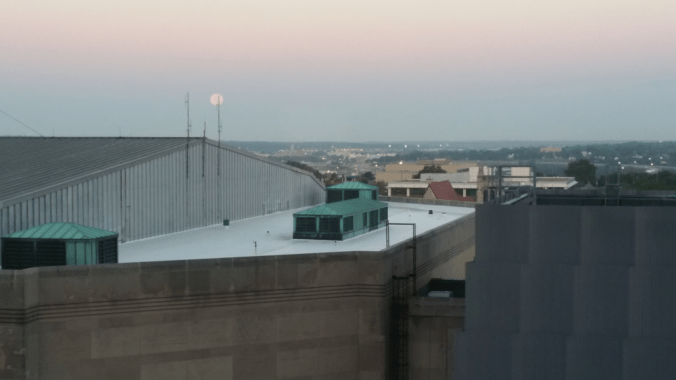
viewfrommyhotel

The view from my hotel room.

And that was time.

Unfortunately, I wasn’t close enough to see who was speaking at any given time, so I haven’t identified who was saying what.

Next week: Is cyberpunk still a thing?

And, of course, Tipsday and Thoughty Thursday will be making their regularly scheduled appearances.

See you on the interwebz!