Have you ever heard of “Pencil Box”?

I was seven years old, in grade three, and my parents got me my first puppy.  I named her Friskey.  My first piece of creative writing was about my dog.  It was unsolicited, but I was allowed, no encouraged, to read it to the class.

You may have the distinct impression from some of my earlier posts, that I’m not fond of school or teachers.  Some of the greatest creative difficulties and nartiest guardians at the gates I’ve faced have been thanks, in part, to various schools and teachers, but teachers have also been some of the greatest guides and mentors in my creative life as well.

Some of my best friends are teachers or professors and I know that they struggle to be among the best in their field.  Though I’m a corporate trainer, I’m a teacher too, and so I will not paint all teachers with the same brush.  Just like people, there are good teachers and bad ones.

The influence of great teachers:

We all have at least one teacher in our past that was important to our development as a person, if not as a writer.  I’ve been lucky enough to have several.

The first great teacher in my life was Mrs. Debbie Arnold.  She was the one who encouraged my early creative efforts in grade three.  She also advised my parents to enroll me in voice lessons as the result of my enthusiastic performance in her music class.

Though professional voice lessons were too expensive, I auditioned for and was accepted into the church choir.  I was also enrolled in an after school piano class.  We didn’t have a piano though, and that caused a few difficulties.  I wasn’t keen on the instructor either, and dropped out before long.

Then there was Siobhan Riddell.  She was an amazing artist even then, though I don’t

This book cover was one of Siobhan’s pieces.

think she was in high school yet.  She and a group of her classmates had made story books and they came into our class to show us.  Hers was a fairy tale and I loved it.

Siobhan’s story was my call to adventure.  In the wake of that revelation, I started drawing characters, super heroines and the like, but what are characters without stories?  So I started writing little stories to go along with them.

I’d been watching CBC’s “Pencil Box” every Saturday.  They featured stories submitted by their young viewers which they dramatized on air.  It was awesome.  That was my first literary submission.  I must confess that while I still have the letter acknowledging the receipt of my story, I never did find out whether it was produced.  My great aunt Florence swore she saw it, but “Pencil Box” went out of production that year and I never did.

Years later in university, I made an enquiry with the CBC, but short of my going down to their archives and finding the dear little thing myself, the costs of paying someone to search for it were prohibitive.  I’ve never gotten back to it.  I don’t even know if those particular archives still exist.

Who was your first great teacher and what influence did he or she have in your life?  Who or what was our first inspiration?  Your first creative effort?  Your first submission?  How did that turn out for you and where did that experience lead you?
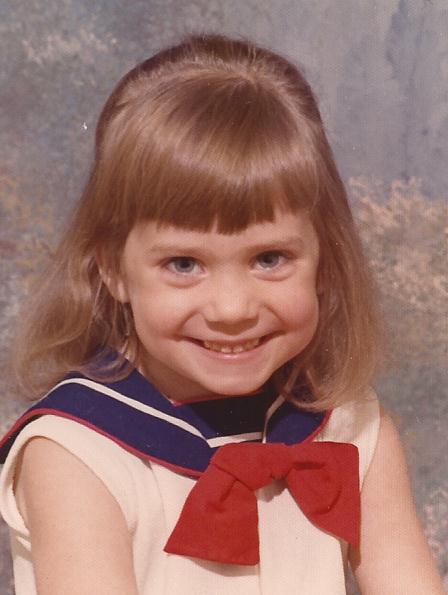
A born storyteller …

Storyteller is just another name for liar.

In grade one, I think all my classmates (and teachers) thought of me as a silly giggler, a liar, and cat-lady-in-training.

I didn’t even know how to write properly yet, so I exercised my creativity by telling my classmates in “show and tell” about the latest stray cat that I picked up on the way home.  They’d always run away after a few days and so I could show the class a different picture from the cat book I’d checked out of the library and tell them that my latest find looked just like that.

Daydreaming was also a preoccupation.  Because my dad had epilepsy, it was thought that I might too and that my habit of totally “zoning out” was actually petit mal seizures.  Later in life, I was formally tested for epilepsy and there was absolutely no sign of it.  I’d just delve so deeply into my fantasy world that there was nothing could tear me away.

If I was born 20 years later, I’d probably have been diagnosed as ADHD and drugged into submission.  As it was, I was “spoken to” and ignored.  I was deemed enthusiastic but disruptive by different teachers for different reasons.

Can you see the mischievious? Just call me “wee devil” 🙂

Really, I was painfully shy, and the giggling was a way of deflecting uncomfortable situations, which meant pretty much everything.  To this day, I still laugh when I offer a thought or suggestion to my colleagues or manager at work.  If it’s too radical, my suggestion can always be dismissed as a joke, right?

The daydreaming-at-inappropriate-times thing stayed with me until my mid-twenties, and then I started to get clever about it.  I’d restrict my mental ramblings to my “alone time” so no one would be put off by my apparent disinterest in whatever it was they were saying.  Now I cultivate solitariness.  As I writer, I have reason to, but as a creative soul, I simply can’t do without.

As for the telling of stories, I’ve always wondered what might have happened if someone had recognized what it was I was trying to express and encouraged me to turn those imaginary powers to something else.  If I’d started writing my dreams and stories down earlier, where might I be today?

Ultimately what-ifs and might-have-beens are only intellectual exercises.  None of us have do-overs.

A few months ago, one of the writers I consider to be a mentor, Barbara Kyle, presented this TED talk (via Volconvo) to her creative network: http://www.volconvo.com/forums/content/226-do-schools-kill-creativity.html

It is 20 minutes well-spent, trust me.  Sir Ken is incredibly funny, but his message is dead serious.  Currently, it is not the business of schools to nurture creativity, but to create useful/functional members of society.  I rather agree with Sir Ken, that only by nurturing the creativity of our children will schools produce truly valuable members of the human community.

I’ve also been disturbed by the resurfacing of the ADHD debate.  Are children being over diagnosed/incorrectly diagnosed?  This debate has been around for decades and it still hasn’t been resolved.

Some food for thought:

Were you a creative child smothered by a school system that didn’t recognize what your “acting out” meant?  How did you come to understand your creativity and who helped you through that sometimes agonized and agonizing process?  Did you ever feel less valued or less intelligent because you were more creative than academic?

How it all started

Maid’s Hall: University of Guelph

So there I was, away at university for the second year, and still no idea what I wanted to do.

I’d started September of 1987 as a fine arts major, but after being dismissed as “an illustrator,” I flirted briefly with psychology before changing to music in January 1988.  In the fall of 1988, I had a rather disastrous classical guitar audition for the practical music program involving performance anxiety and was seriously considering English as my major.

I wrote music and book reviews for The Ontarian, the University of Guelph student newspaper, and helped them with layout.  This was the old fashioned layout with waxed prints of the columns that had to be precisely trimmed and placed on the board.  It was work that suited my wall-flower personality.

My roommate, Sandra Reynolds, though floundering similarly, always had more direction than I did and was a steadying influence on me.  Her sister is Susan Lynn Reynolds, who published Strandia in 1992.  She had drawn maps for Guy Gavriel Kay’s first novels.  He continues to be one of my favourite authors.  Sue’s ex, Michael Hale, had just published The Other Child.  Sandy was working on her own story ideas and with all of this creativity bouncing off the walls of our little dorm room I caught the bug to do more than record my dreams.

I’d started keeping a journal the year before, not only to capture my dreams, but also to capture insights I had in my classes.  It was a wonderful time for me intellectually.  Everything seemed to interrelate in the most interesting ways: my English literature survey course, Introduction to Psychology, Anthropology, Biology, the History of the Language and Old English courses.  Chinese Philosophy kind of blew my mind.  Sadly, little of it translated to academic success.  I was rather mediocre.

With all of these thoughts ping-ponging off one another in my head though, ideas started to occur to me, including the idea that would eventually become Ascension: Initiate of Stone.  I started writing notes.

Sandy invited me out to Mike’s place.  It was winter, snowy, and I ditched the car on the way.  A tree was mere inches away from the passenger side of the car and Sandy (!)  We were able to get a tow out of the ditch and made it to Mike’s, though late.  We still managed a lovely evening of creative chat, I got a tour of Mike’s graphics studio, and we made pie.  We all decided that since the crust was the best part, we’d make a crust pie.  It was fantastic.  Through Sandy and Mike, I learned some great techniques for character development.

I’ll share one:

Early in the character development stage, while you’re still getting to know them yourself, get together with some friends/fellow writers and have them ask you random questions about your characters.  Rapid fire.  You’re not to think about the answers, just come up with them and make notes as you go.  The idea is to access the inner writer who already has a handle on your characters and let that voice answer the questions.  The questions could be anything: what colour are his eyes?  What’s her middle name?  What happened when he was three?  What was her grandmother like?  Did he ever experiment sexually?  No question is forbidden.  It’s organic and very effective.  Nothing is written in stone, either.

If, in the course of your writing, some of those answers no longer hold true, or other answers that seem more appropriate present themselves, then the character changes.  Even to be thinking of these questions and answers through the writing process is helpful for your character development and therefore for the work.

Try it.  You may be amazed.

Sandy was taking Children’s Literature with the incredible Jean Little and Jean was bringing a friend into class to talk about her work.  That friend was Welwyn Wilton Katz.  Though she waggled a finger at me for my lack of research, I did get a chance to talk to her and was inspired by the lecture.  Subsequently, I started reading her novels, and became a fan.

By this time, I had one spiral notebook full and another started.  I had an old portable typewriter that I typed my essays on and started to type bits and pieces out in between essays.  I had no confidence however, and declined to show my stories to anyone.

My lack of direction in school eventually reached a crisis point and I decided to take some time off.

How did you get started on your magnum opus?  What or who inspired you?

Three Blind Mice

When I was a wee thing, my parents enrolled me in ballet classes.  I think it was because I was such a spirited and energetic girl 🙂

All went well until the first recital.  We were performing “Three Blind Mice.”

I kind of looked like this:

Young Ballerinas, Casa de Cultura, Havana

Young Ballerinas, Casa de Cultura, Havana (Photo credit: travfotos)

I tried to find my old photo in the big box of them I have.  I searched Mom’s collection too, but no luck.  It’ll do …

I was so excited I think I went ballistic, though I honestly don’t remember the specifics.  The instructor had to discipline me, and unfortunately had to do so in front of everyone.  I went from whirling like a dervish to hugging my knees in the corner crying in about two seconds flat.

We were about to go on stage and this wouldn’t do.  Her pep talk wasn’t inspiring, but it straightened me out enough to perform.  After the big night, I told my parents that I didn’t want to dance anymore.

I did do a little bit more later on.  One of the local gymnastics clubs was offering after school classes and I did one or two dance classes that way and about four or five gymnastics classes.  I always liked gymnastics better anyway.

The thing was, I learned a couple of negative things from that first creative challenge:

  1. Teachers are the enemy.
  2. Quitting is easy.

Avoidance of conflict and embarrassment crop up quite a bit in my creative life.  Heck though, I was three at the time.  How in the world was I supposed to know how to handle it?

So why court embarrassment again now, all these years later?  Because when you’re creative (and I think everyone is), you’re usually creative in a whole whack of different ways.  This was just the first way that I manifested my creativity.  I also liked to draw, build things, sing, and I was a fantastic pretender …

So a tip for people who might think they’re “blocked” in whatever creative endeavor they’re currently engaged in: exercise your creativity differently for a while.  It doesn’t have to be anything spectacular; singing in the shower will do.  Or maybe you could dance like a maniac when no one’s around, go see a play or a concert, start a journal, if you’ve never tried, check out an open mic night at a local cafe, or karaoke if you dare, buy a sketch pad from your local grocery or pharmacy and get with the cartoons.

You may find that refocusing your creative mind (or your creative body) will make you wonder why you thought you were blocked in the first place.

What alternate modes of creativity do you engage in?  What do you want to try that you’ve never tried before?  Was there a time in your life when you felt shut down?  What lessons did you learn from that and how did that experience shape you?