A life sentence with mortal punctuation: part 2

Last week: An early encounter with death.

The year I had my tonsils out

Tonsillitis is hell.  The true infection, the one that leaves your four-year-old self screaming, the monster pain in your ears reaching back into your brain, your throat, latching on with needle-like claws, and shredding.

I remember that.

I remember trying to lie still on my side on the couch while Mom administered oil-based ear medication into my ears, one after the other.  This would hopefully happen before the screaming started, was intended to pre-empt it.   I’d squirm and whine while the medication slowly dripped into my ears, swallowed doses of liquid antibiotics and Tempra (a liquid painkiller for children).

I remember once heading out in the car with my parents and maternal grandparents.  I’m not sure whether it was just for a picnic, or if it was a day trip to a camp site, but it was a ways out of town.  Mom hadn’t thought to bring my medication and just to spite her, my tonsillitis decided to act up.  Big time.

Mom and Nanny (I had to have a different name for this other older lady who wasn’t the same as Grandma, my paternal grandmother) tried to calm me down in the back seat, but I was howling by the time we reached our destination and we couldn’t stay.  I had to be returned home and dosed.

It quickly became apparent that surgery was in order.  Though this was the time during which doctors tried not to perform tonsillectomies, my situation was serious enough that everyone felt there was no other choice.

I don’t remember anything about the surgery itself.  I believe it went off without a hitch.  After the operation, all seemed well, and I returned home enjoying ice cream, popsicles, and TLC.

In the middle of the night, I woke, coughing, had trouble breathing, the air moving in and out of me with a rattling slurp, the sound of milk bubbling through a straw.  The next cough shot a black spatter onto my pyjamas and sheets.  I couldn’t summon the breath to call for my mom right away, my first attempt emerged a thready burble.

Each stuttering breath and cough produced a little more noise, until I was shouting, “Mom!

The light switch flicked on, momentarily blinding me, but one look at the blood and I yelled again, despite the jagged burning in my throat, tried to crawl back from it, but it followed.  I was covered in blood.

My stitches had burst.

A frantic ride to the hospital and the doctor ordered me back into surgery and my parents were ordered out of the examination room, the male nurse assuring them that he could handle getting the intravenous inserted.

He sent Mom away.  It was abandonment, pure and simple.  A four-year old doesn’t distinguish between her parents leaving her and her parents being forced to leave her.

Worse, the nurse tried to stab me.  I showed him.

Mom and Dad were brought back in, allowed to hold my hand, held my legs down, while the newly bandaged nurse taped my arm to a block of wood and did his worst.  In the moment, I hated my parents for that, for letting the nurse hurt me.

I didn’t die, but I came close.

I don’t remember any of the iconic images typical of near-death experiences (NDEs).  No long tunnels.  No doorways of brilliant light.  No voices of lost loved ones calling to me.  No angels; no voice of God.

The road back from that second surgery was a long one.  I’d ingested so much blood, I became incontinent in the most embarrassing way, my family doctor plucked clots of blood out of my ears, and nothing, not even ice cream, tasted good for weeks.  More courses of liquid antibiotics followed, which stained my teeth indelibly and made me self-conscious for years.

I have a picture of myself right after the surgery, pale, skinny.  It was Christmas, but I couldn’t smile.
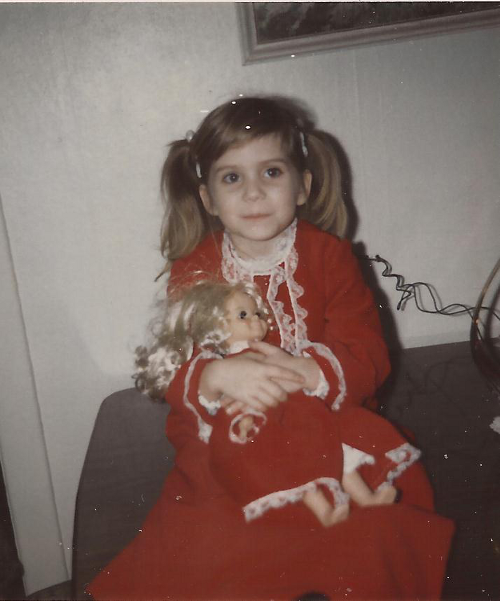
Mellie after the operation

Mellie after the operation

What’s stayed with me the most was the dream.

My first night home after the second surgery, I dreamed of my bed, empty.  The cheery yellow and white striped flannel sheets, the blue wool blanket turned down, the dark wood frame with the toy cupboard built in.  Just the bed in a kind of spot light, the rest of the room dark.  The image of the bed receded into the darkness and finally disappeared.

The feeling that I woke up with was that I had died, not that I really understood what that meant, but that I had ceased to exist and that the world I woke up in was a new one.  I had a new life, too.  A second chance.

Now, I’d say that I dreamed of one of those moments at which the infinite iterations of parallel universes converge.  I turned left.  The sensation was profound.

I started to have nightmares about falling, or being abandoned, that troubled me for years,

Deutsch: Engel holt die Seele eines Sterbenden

Deutsch: Engel holt die Seele eines Sterbenden (Photo credit: Wikipedia)

and am firmly convinced that I had spontaneous out-of-body experiences (OBEs) at night.  During the latter, I felt like a helium balloon in a wind storm, flung, sometimes painfully, to the furthest reaches of my tether but always yanked back.  The ‘string’ was attached to my navel.

Try an experiment for me.  Poke your finger into your belly-button.  Press in hard and wriggle it around.  That will give you some idea what having a string attached to it and being hauled around by it feels like.

I’ve heard that the navel is supposed to be an erogenous zone (thanks for that one, Dr. Oz).  Sadly, I’ve never found that to be true.  It’s always been a slightly disturbing feeling for me.  I figure that’s just me.  My wiring isn’t quite what other people might feel is normal.  I’m cool with that.

I’ve written a short story about this experience for my thesis called “Tonsillitis Blues.”  I’ve written short fiction and poetry about it.

This experience is still in me and claws its way out from time to time, like it has today.

Next week, I’ll be delving into the period of my life that I refer to as ‘friend wars.’  These were my first experiences of bullying.  I think I did pretty well, even though I had no idea what it was I was dealing with.  This was also the period when I developed my first defenses against bullying, several of which resulted in my further isolation, and one of which meant that I became a bully myself.

I see the ‘friend war’ years as the time when my predisposition to depression was first anchored in my psyche.  It destroyed my self-confidence.

Have any of you had a non-traditional near-death experience?  A youthful trauma that resulted in years of nightmares?  How about out-of-body experiences?  When were you able to understand what happened to you and how it affected you?  What creativity has emerged from these experiences?

I’ll be posting my interview with Brian Braden shortly.

Talk to you soon!

A life sentence with mortal punctuation: part 1

First: A note about memory, frame, and fiction

I have my memories, but as I get older, I don’t know that the biological hard drive that is my brain hasn’t been corrupted, that the memories reflect the reality that was, or reality as I want it to be.

My memories have also been informed by family stories and sometimes the latter influence the former, so again, I can never be certain of their veracity.

Thinking about this, I remember the academic and theoretical concept of “frames” from my undergraduate studies, now also more than 20 years in my past.  Everyone has their own frame of reference, influenced by their experiences and education, family and individuated world view.

Even if one attempts to be completely truthful, one’s truth can run counter to reality.

The writer cannot express anything but through the filter of their frame.  In this sense, all written work, whether scientific, academic, journalistic, historical, or honestly fictive, has in it the element of fiction.  It cannot help but be influenced by the frame of the writer.

Mathematics may be the only purely objective writing, but even there, unknowns and chaos creep in and beg interpretation.

This is just my opinion, but I wanted to get it out there as a way of saying that even though I write from memory and experience, I am writing a story.  It is my story, but not having time travel at my disposal, I cannot say that this story, based on real life events, is any more “real” than a movie based on the true story of X.

How it all began (yes, I’m really going there)

So, it’s October, 1969, and my mother, nine months pregnant, walks to her regular doctor’s appointment.  Her doctor’s office was at the top of Regent Street hill, and for those of you who don’t live in Sudbury, that’s a really big hill, of San Fransiscan dimensions, even.

The doctor enters the exam room and says, “I didn’t expect to see you.  I thought you’d have your baby by now.”  My mom shrugs and says that everything’s going fine, “but,” she says, “I’ve been having these really strange cramps all day.”

After a brief assessment, the doctor tells her to call her husband and get over to the hospital post-hasty: “You’re in labour, woman!”

My mom’s never been the kind to thrust the agony of my birthing at me.  I don’t know how long she was in labour or how painful it was.  I just know that it was the first, and only, occasion when my maternal grandmother, sober her entire life with that notable exception, got stinking drunk 🙂

Early memories

The only things I remember from my infancy are images.  Moments.  The colourful, plastic Fischer-Price mobile that hung above my crib; a tin, battery-operated locomotive; and this memory, which became a poem:

infant crawls

mother says she was crawling by six months and walking
by eighteen. situate her chronologically as you wish
any month and day in 1970.
reaches linoleum and drags
legs forward.  pivots onto buttocks.
suddenly sees black shoes and white tights,
spill of turquoise dress over thighs.
a contemporary picture reveals the dress in question.
shirred bodice, empire waist, short sleeves poofed and gently
cinched around chubby arms.  her hair is short and blonde, lovingly
held in place by two plastic pink barrettes in the shape of bows.  her baby
teeth are coming in.
fridge holds her attention for a moment.  then something moves
—brown shoes—ma ma.
though she was beginning to speak, her words were
carefully articulated.  not mama, but ma ma; syllables
spat out, exhaled along with breath.
low like this, ma ma is brown shoes and white-pink
calves.  ma ma is also round-white-pink, brown curly, and
long-white-pink ticklers, but they are all ma ma.  they all smell
of comfort.
the brown shoes were around for years, with large, square,
brass-toned buckles.  nylon-sheathed legs above them truncated by
fall of blue dress: straight, simple, homemade, with short sleeves.
horn-rimmed glasses frame hazel eyes and permed, dyed hair.  mother’s
smile was shy and kind.
chubby arms lift hands to grasp.  frustratingly ma ma seems to be between
wriggling grabbers, but cannot be touched.  “ma,” she says, and “ma.”  two
world-shaking clomps later, the long-white-pink lifters bring her up to the
round-white-pink ma ma and pudgy fingers tangle in curly brown.
this is my memory.  i do not ask my mother if she
shares it.

©2012 Melanie Marttila

infant crawls era Mel

‘Dis be me 🙂

Something I don’t remember

My maternal grandmother had a massive heart attack that required a multiple by-pass (not sure how many, just that they had to take the vessels from her leg).  In the wake of the ordeal, she was in a kind of fugue state, conscious, but not talking, not interacting.

My mom was allowed to bring me in to the intensive care unit.  Normally, a baby wouldn’t be permitted, but it was thought that either it was time to say final goodbyes, or that I might somehow remind my grandmother that she had a reason to live.

Fortunately, the latter happened.  My name was the first word she uttered in days.  I have no idea how old I was when that happened.  It’s funny sometimes the affect we have on others, whether we know it or not.

My grandmother was given a dim prognosis: months perhaps.  She lived to see me graduate high school and did not pass away until I was in university.  More on that in a later post in this series.

Grandpa

My first encounter with the spectre of death was the passing of my paternal grandfather.  When I was three, my grandfather was up on his carport roof, shovelling snow, and had a massive heart attack.  I was carefully sheltered from the event.

That year, the local television station broadcast “The Santa Show” which read children’s letters to Santa on the air.  The big Christmas news Santa reported that year was that Rudolph was sick and might not make his annual flight.  In trying to explain the situation to me, Mom told me that Grandpa was in the hospital.

“With Rudolph?” I asked.  Yes, with Rudolph, she said.

Only days later (I think), I was set to play in the snow while my father climbed up to clear that same carport roof.  The job had to be completed.  As he descended, the ladder slipped on the ice, and he fell, calling to my toddler self for help.

Understandably, I thought Daddy was being silly.  Patiently, through his pain, he convinced me, who’d never gone anywhere alone in my brief life, to go to the next-door neighbour for help.  I was frightened out of my wee gourd and Dad had to keep encouraging me to keep going.

Neither of us knew, entangled in our own drama, that Grandpa had died.

I only know this because my mother told me: Grandpa was a man of few words.  He loved to garden, and grew straw flowers so he could engage in dried flower arranging in the winters.  When he watched me, he sat in his chair, often reading the paper, and let me play quietly with his Salada tea figurines.  I still have the wolf.  It sits on my bookshelf along with other memorabilia.

I hardly had the opportunity to get to know him and he was gone.  Dad ended up with a fractured pelvis and was in the hospital over the holidays.

Truthfully, neither event had much of an impact on me, though I always thought that I’d let Dad down when he fell, not that I could have done more than I did, being three and all.  I got used to not having Grandpa around, and life went on.

I think that when you’re very young, death can’t be understood.  It’s therefore far easier to accept.  Absence becomes the new normal.  There’s no introspection or grief, and the grief of others is equally beyond understanding.

Perhaps these early experiences do have a lasting effect.  Maybe the trauma lies dormant, only to surface at a later date and hijack our lives.  For all the time I’ve spent examining my life, I can’t say.  I don’t feel any connection between these early experiences and the person I became.

What about the stories of your lives?  Do you have a memory of a death from your early years?  How did you react, or not?  Can you connect the experience to some trait or tendency that you embody today?  Have any of your early memories inspired your creative work?

Next week:  My first near-death experience and what came of it.

Until then, writerly peeps.  In the meantime, mine your memories for creative gold 🙂

There’s something you should know about me

Photographic illustration of a near-death-expe...

Photographic illustration of a near-death-experience. (Photo credit: Wikipedia)

I’ve almost died … twice

Both times, I was under the knife for what should have been straightforward surgical procedures: a tonsillectomy and an appendectomy.  Both experiences changed me profoundly.  How?  I’ll share that with you in future posts.

I’m reopening the confessional category of my site, My history as a so-called writer, with a series that might strike you as a little morbid.  It’s about death and how it’s shaped my life.  Originally, this was to be a two-part guest post on Monique Liddle’s Bends in the Road, but since them it’s metamorphosed into something a little bigger, and I hope, better.

Yes, I’ve had a couple of near-death experiences, and my father and grandparents have all passed, leaving their marks on my heart and soul, but I’m not just talking about actual death here.  Mental illness and addiction, which I think of as two kinds of personality assassination, have also had their affects on me and my family.

If the ‘you-who-wants-to-live-in-this-world’ dies, even metaphorically, how can that be any better than actually dying?  It’s a question, I believe, that leads many to the depths of depression and suicide, which may seem like the logical conclusion of such ruminations.

I’m starting this series with Bell’s Let’s Talk initiative in mind as well as my impending bell-talkpersonal season of sorrow: my father’s birthday, the anniversary of his admission into the hospital for what proved to be his ultimate decline, the anniversary of his death and funeral, followed by Father’s Day.

I also thought this was a timely topic after listening to Michael Enright’s interview with Bob Ramsay last Sunday on CBC’s The Sunday Edition.  Bob died on the operating table, but didn’t have the typical near-death experience that most people report.  In fact he didn’t remember much of anything at all.  You can visit the link above, see some listener response, and listen to the podcast yourself.

Finally, I’m reading Gretchen Rubin’s The Happiness Project.  I picked it up on the recommendation of a friend and have been reading through it.  It’s a little slow going for me, since I’ve gone through some of what she writes about in my own way previously, and because I just can’t relate to some of the other experiences that she writes about.  I hope to share some of my  insights on happiness throughout this series as well.

On that note, this past week, I read Justine Musk’s blog post on the pursuit of happiness.  I think she has some valid points.

My encounters with death (physical and spiritual) have informed my development as a creative person and shaped the way that I respond to various negative events in my life.

What I’m hoping to accomplish

This isn’t supposed to be purely confessional or self-serving in any way.  I am a what-you-see-is-what-you-get (WYSIWYG) kind of gal, but to be honest, I expose myself as a means of defence.  If I share too much information (TMI), people tend to react in one of two ways:

  1. They never ask me a personal question again and generally leave me alone, or
  2. They understand I choose to share the deeply personal or embarrassing details of my life in an attempt to deepen my connection with the people who are important to me.

It’s a way of knowing who your friends are and of deepening your relationships with the people who mean most to you.

Doing this on my blog has been a bit of a mixed blessing.  I blogged most of my embarrassing, personal stuff early on in Writerly Goodness’s existence, thus ensuring that few people would actually look at it.  I wasn’t really risking much, but I also had no idea if this was the kind of subject material that would resonate with my readership.

I’ve mentioned a few times in various posts about how shy I am.  It would be very difficult for me to speak about these issues in a face-to-face kind of way without getting freaky and spastic.  This has happened, though.  It wasn’t pretty.

So now I’m pulling out the big guns again in an attempt to connect more with my friends on the interwebz and in the hope of sharing something of the themes and interests that inform my writing.  I’d like to start a conversation about these issues without getting self-indulgent because I think they are important to many creative people out there.

It’s an experiment of sorts and I’d love to hear from you.  What do you think about it?  Would it be of value to you?  Would you be willing to put yourself out there, along with me, on this crazy journey?

Let me know.  Please keep in mind that I moderate all comments and I have the dreaded day job.  If your comment doesn’t show up right away, it’s because I haven’t had a chance to review and respond yet.  Rest assured, I make every attempt to respond in a timely manner.  Your comments are important to me 🙂

Writerly Goodness, signing off.

What happened afterward

Last time on My history as a so-called writer: NEOVerse opened new possibilities 🙂

About the same time that I started working for ACCUTE, my sister-in-law told me to apply for a job with her employer.  I did and before the year was out, I was once again working two jobs at the same time, up to sixty hours a week.

Exhausted, I left ACCUTE and stuck with the better career opportunity.  It was in a call centre, not something I’d generally choose for myself, but in Sudbury at the time, it was a very good job (considering pay, benefits, and pension) and I needed that.

It felt like selling out, though.  Plus, I wasn’t suited to it.  Every negative call stayed with me.  Every anguished personal tale made me feel guilty that I couldn’t do anything to help.  I tried working full-time, but couldn’t hack it long-term and returned to a part-time schedule after six months.

It was at this time that my depression, which I’d been trying to deny since I was seventeen, reared its ugly head in earnest and I had to deal. Medication and therapy provided a short-term solution, but eventually, I weaned myself off the meds and tried to manage my illness through diet, exercise, meditation, and persistent awareness of what my body, heart, and mind were telling me.

They were screaming at me to get out, but I didn’t have any other options.

Term employment led to permanent, a mortgage (negotiated to consolidate our debt including our sizable school loans), and a car loan.

I was an adult now, with an adult job, adult debts, and adult responsibilities.  I was a home-owner.  All creativity seemed to vanish.  Though I was still certain that I wanted to write, I was unable to muster the necessary dedication.  Writing was now something reserved for vacation.

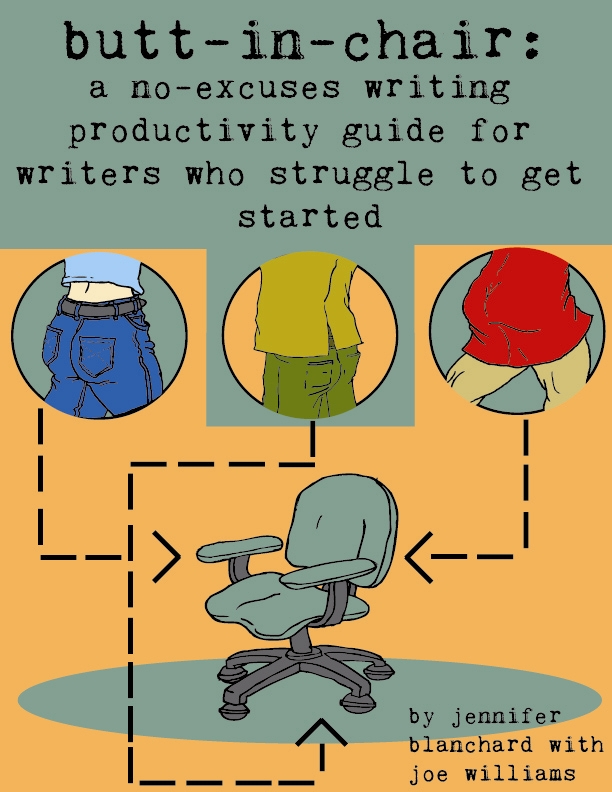
This went on for years.  I tried to wedge my butt in my desk chair, but it never stayed for long.  I did pull out my old project from time to time, but couldn’t focus. I joined the Sudbury Writers’ Guild and attended a fall workshop with Rosemary Aubert.  To be honest, I’d never heard of her before, but the workshop was great and I was inspired.

When my grandfather passed away, part of my small inheritance went toward a lap top computer.  That helped a little too.  I wasn’t chained indoors in the middle of summer anymore.  I wrote more that year.

I was successful in an internal competition at work.  Better pay and a better job.  It was a good thing.  Just before I started, the Sudbury Writers’ Guild scored another coup: Nino Ricci.  That was when my writing life changed.

In the wake of that workshop, I started writing every day.

That was the real beginning of my life as a writer.

Took me long enough, didn’t it?

Gratuitous links regarding the butt in chair phenomenon:

____________________________________________________________________________

This is my last post in My history as a so-called writer for the foreseeable.  Other tales of Writerly Goodness can be found under my categories: Work in progress and Authorial name dropping.  Next week, my blogging schedule will change, so stay tuned.

I will continue to post in Select poetry, Alchemy Ink, Work in progress, and Breaking open the mind, my learning category.

NEOVerse

One of the contests I entered while I was struggling through grad school was for the League of Canadian Poets.  Through that competition, one of my poems was selected for publication in the 1997 (W)rites of Spring.

I read at their gala (with Valerie Senyk, Roger Nash, Sonja Dunn, Katerina Fretwell, and others) and subsequently submitted my poetry to Dr. Laurence Steven, who was now the proud owner of Your Scrivener Press.  He accepted my work and along with the work of two other northeastern Ontario poets, Monique Chenier and Natalie Wilson, he published NeoVerse (1999).

It stood for northeastern Ontario verse, but in a way, it was the beginning of a whole new life for me creatively.

I traveled all over the north giving readings that year: North Bay, Timmins, Sault Ste. Marie, and Parry Sound.  Due in part to my reading activity, I was invited to participate in an event in Caledon called Word Harvest, where several other poets were performing.

Thanks to the publication of my poetry in chapbook form, I was able to become an associate member of the League of Canadian Poets.

Also around that time, I was writing articles for the Sudbury Arts Council (SAC) in the Sudbury Star, after having served on the newspaper’s readers board for a term; I wrote interviews for the Laurentian University Alumni Magazine, and articles for Georgian Bay Today.  GBT didn’t last long.  The way I was to be paid was to sell advertising to local retailers.  I was not then, nor am I now, a salesperson, by any stretch of the imagination.

I put together a few workshops for elementary and high schools, and even one for the Manitoulin Writers’ retreat.

I was also putting together Web pages for the Huntington University Library and for the Art Gallery of Sudbury.  This was the old-fashioned (ha!), type-your-tags-out-in-Wordpad, HTML Web pages.  Eventually I adopted Microsoft FrontPage.

I started to write reviews for the Canadian Book Review Annual, took another short-term contract at the Cambrian College Library, and then two of my Laurentian professors contacted me with an offer of employment.  It would only be a part-time contract, but I could be the executive assistant for an organization called ACCUTE, the association of Canadian college and university teachers of English.

There, I developed another Web site, published the quarterly newsletter, and helped to coordinate their annual conference.

My first year with ACCUTE I did the crazy and auditioned for Theatre Cambrian’s production of Hair.  It was hard work.  Dancing, singing, and acting.  It was also one of the most fun, most amazing experiences of my life.

How about you?  Was there a time in your life when you became creatively fecund? What happened?  If you’re blogging about it, link through in your comments.  I’d love to see what you’ve been up to 🙂

Like, comment, share, subscribe! (The social media equivalent of think-do-create-BE!)

The Windsor years and what they really taught me

Last time on My history as a so-called writer: I found awesomeness at Laurentian University 🙂

I should have just kept writing.   

Unfortunately, I was still insecure about my craft and all of my friends were either heading to teachers’ college, or graduate school, or had already left.  So I thought it was the thing to do, something that had to be done to show that I had “the chops.”

Still living at the mercy of events, I applied to UVic, UNB, and Windsor.  Victoria rejected me outright, New Brunswick said that they would accept me to their academic program, but not to the creative one, but Windsor said they’d take me, so that’s where I went.

Phil was still completing his degree in computer science at Laurentian, so I was on my own.  We took a trip down in August apartment hunting and I signed a lease for a year for a room in a house that was within a five-minute walk of the campus.

I started off filled with hope, but struggled.  My courses in research and methodology, the Pre-Raphealites, and the new Canadian writers were great, but early Canadian women writers was a bomb and because my primary interest was in writing genre, the creative writing part of things did not go very well either.

I even tried to resurrect pieces of the novel idea I conceived of at Guelph, but a very dim view was taken of my fantasy.

I was nearly shamed away from my novel.  It wasn’t worthy.  I wasn’t worthy.  I kept on being asked questions like, “You have this character smoking.  You know that tobacco wasn’t discovered until Europeans reached the New World, right?”  It was all about historical detail.  But my fantasy world isn’t this world, and its history has little to nothing in common with the real world.  “But you just can’t go picking and choosing what you want from history …”  Why not?  Seriously.  What’s to say that I have to write my fantasy like a historical novel?  If I wanted to write historical fiction, then I would.  But I don’t.  (At least not right now.  I have this idea though …)

Therein lay the difficulty.  Submitting two to five pages of my novel at a time wasn’t allowing anyone to really get into the story.  Things would just get to a point where they were developing into something interesting, and then everyone would have to wait until the next week.  Momentum was lost and most of my classmates felt nothing but contempt for my chosen genre.

A lot of comments focused on the impossibility of what I was writing.  “She couldn’t survive what happened to her.”  “That defied the laws of physics.”  My characters are heroes in the epic sense, though.  Their survival hinged on the fantastic nature of their gifts and talents.  They have to be “bigger than life” in order to merit their place in the overall plot.  And magic does defy physics.  Actually, my magick has its own physics (more on that in a future world-building post).

Fantasy, especially the high, epic fantasy that I like to write, is all about the impossible.  I wasn’t trying to straddle the improbable but plausible line that defines most science fiction.  (Although I have an idea or two in that direction as well …)

I tried other stories and genres:  A YA fantasy about a girl whose figments turn out to be real; a post apocalyptic tale featuring a male protagonist; poetry; more traditionally literary short stories.  With the exception of my poetry, my work was largely panned.

My classmate, Laurie Smith, got me involved in the Wayzgoose reading series and some of my poetry was published in the Wayzgoose anthology.  I became editor of Generations, the student-published poetry anthology, and tried my hand at presenting a paper at the ACCCSAL conference (speculative fiction).  So it wasn’t a complete bust.

I have to admit though, with respect to the idea that would become Initiate of Stone, that my characters had no character.  They were merely vehicles to move the plot, which was also evolving at the time.  Theme was also a work in progress.  Still, by the time I was finished at Windsor, or rather by the time Windsor was finished with me, I was well and truly wounded.

My advisor at the time, Alistair MacLeod, did not hide his dismay regarding my choices, and to his credit, I’m sure he was doing his best to guide and support me.  He praised my poetry, and I’m certain that if I’d chosen to move in that direction, we would have gotten along swimmingly.  As it was, the presentation of the work I chose to do, confused him at best, and disappointed him, in the most tragic of senses, at worst.

He was a mentor, a writerly father figure, and his dismay was hard to take.  I was still tender then, and I retreated in defeat.

I’ve talked a lot about teachers, the good, the bad, and the ugly.  You may get the idea that I dislike them, but I don’t.  I’ve had as many positive and supportive teachers as I’ve had teachers that just didn’t understand me, and it’s a matter of timing and circumstances as anything else.

What I took away from my experience at Windsor, though it took me years to discover, is that a teacher’s job is to teach.  The teacher may not agree with the way in which the student wants to apply their knowledge and experience, but that should not be the issue.  Even if the teacher believes that the student is only setting themselves up for failure, it is not the teacher’s responsibility, or even right, to deny the experience of that failure to the student.

Instead, what the teacher should do is his or her best to impart the skills that will enable the student to meet that failure and learn from it, rather than being crippled by it.  If the teacher has such strong reservations that he or she feels that they can honestly not discharge their duty to the student, then she or he should refer the student to someone who can.

It’s not too much to ask.

Mind you, the student should stand up for herself and demand the help she needs.  I still wasn’t very good at confrontation and fled at every turn.  What happened at Windsor was my fault more than anyone else’s.  I have to take responsibility for my poor choices.

I took a year off and once again tried to sort things out, but I was badly damaged.  I worked at both the Huntington and Cambrian College libraries and subsequently became unemployed.  I was entering contests again though and won several, in short fiction and in poetry.  I participated in more readings, and more writers’ groups.

With Kim Fahner, I embarked on what might have been a foolish enterprise: a poetry journal.  The aptly named … like lemmings … only lasted 2 years.  The name was more about the editors than about the poetry, but I’m sure you get the idea.  Kim and I moved on to bigger and better things after that.  It was brilliant while it lasted though.

Then Dani Harris, a former student of mine (I was a Graduate Assistant at Windsor—doesn’t every grad student teach?) let me know that there was a new professor in the English department, Di Brandt.  With Dani’s encouragement, herself and excellent poet, I registered for another year and determined that this time, I would succeed.

I found a new mentor, but I still couldn’t bring myself to trust her fully.  My experiences in writing to that point had only taught me that editors, friends, and teachers couldn’t be trusted with my work.  They’d also taught me that the stories I wanted to tell weren’t the stories that should be shared with anyone.

So I compromised and chose stories that I thought I could tell, that I thought would be accepted.  That was my problem though and not something that I would overcome for some time.  My stories were all of young women finding their way by means of dream, and spiritual quest, and damn good friends.

The one risk was a story that did cross the line and tread into the dreadful world of fantasy.  Initially presenting with obsessive-compulsive disorder and insomnia, my protagonist developed precognitive dreams and telekinesis.  It was the one risk I couldn’t refuse to take.

I wrapped the collection up in shamanism and called it Whispers in the Dark.

Di Brandt was the teacher I needed .  She encouraged me and saw me through to the successful completion of my master’s degree.  For that, I will be forever grateful.

As you might be able to guess, my next great teacher in life was Di Brandt.  With her assistance, I conquered my fears, defended my thesis, and completed that chapter of my life.  I also met Miriam Toews, a friend of Di’s and author of the Governor General’s Award-winning A Complicated Kindness.

Was there a time when you cut and ran?  Did you rally and fight back?  What did you learn from the experience?

Finding awesomeness at Laurentian University

It was a brave new world and I had a newfound dedication to my studies.

Phil didn’t turn out to be a distraction at all, but facilitated my work with his support, and by providing me with a computer on which to write my many essays.  Soon I was spending a lot of time at his place, locked up in the basement with his 286.  I had a computer too, thanks to one of my correspondence courses, but it wasn’t even that powerful.  Seriously.  My mind boggles when I try to remember what life was like back then.

In any event, my renewed academic career was full of B’s, B+’s, A-‘s, and A’s.  I started entering writing contests … and won third place in one.  I wrote a column for Lambda, the Laurentian University Student Newspaper.  My essays began to be featured in the English Literature Society’s annual academic conference, and a couple were recognized by the English department as among the best of the year.  I entered the President’s Award Essay Writing Contest and received and honourable mention.  I also participated in a colloquium on the future of the university.

Enter great teacher of my life number three, Dr. Susan Dobra.  She was from California and ended up returning there after a few years.  While she was at LU, I considered her to be my most significant influence and one of the reasons why I excelled.

Unfortunately, my appreciation of her approached the stalker-ish.  I do hope she’ll forgive me 🙂

Another reason was Dr. Hoyt Greeson, with whom I studied Old English and Chaucer.  I and several of my fellow students joined him on a road trip to Kalamazoo, MI for an academic conference in medieval literature.  It was a great experience to be exposed to the theses and dissertations being written by some of the best and brightest in the field.

A third positive influence and support was Dr. Laurence Steven.  Through him, I entered a program whereby I became a writing assistant.  I essentially taught the composition portion of the first year English literature survey course for a couple of years.  Yes, as an undergrad.  I also tutored through the Writing Across the Curriculum Program.  Laurie was my advisor for my honours thesis project as well, which received the departmental award for best honours project that year.

Honestly, I can’t think of any professor I had at LU that wasn’t a great influence on me.  There was one I didn’t see eye to eye with, but I still benefitted from his class.

I also gained a couple of special friends on the way, Yana and Kim.  Yana was (and remains) a wunderkind.  Yana knew what she wanted from the first: to be a teacher.  Everything she did was focused on that goal and she was a brilliant student.  She also had an interest in writing science fiction.  She was president of the English Literature Society the year I joined.  Through Yana, I started working at the Huntington music library.  It was a student job that would see me through several years.

Kim is a poet and in many ways, a kindred spirit.  We were TA’s and tutors together.

All of us participated in several ELS events including a particularly memorable poetry sweatshop in competition with the professors.  Together we had some grand adventures, becoming groupies of Great Big Sea and following them around the province for a summer.

With Yana, I took karate lessons, and for myself, I joined the Bel Canto Chorus.  Creativity is fed in different ways.

Phil proposed, and we were married July 15, 1994.

Margaret, though she had moved to Port Elgin with her spouse, continued to keep in touch and keep tabs on my creative efforts.  She invited me down to Port Elgin for a workshop with Susanna Kearsley, author of the recently published Mariana and winner of the Catherine Cookson Award.

I took a creative writing course with Dr. John Riddell–Siobhan’s father; don’t you love synchronicity?–and had one of my stories published in an anthology as a result.  I started participating in writers’ groups and became ELS president in my last year of study.  I wrote a short article for Slin Roller magazine.  Thanks to my short story prize and publication, I was invited to write a science fiction story for the flagship issue of Parsec Magazine.  By the time I graduated cum laude in 1995, I was on my way.

Focus is a wonderful thing.  Sometimes it doesn’t happen in school, but at work, or at home.  When you have a particular goal in mind, it’s amazing what you can accomplish.  When and where did the pieces of your creative puzzle first come together in awesomeness?

Hiatus

The last summer I went to the University of Guelph, I got a job videotaping horse shows: an opportunity that presented itself.  I traveled to Ottawa, Edmonton, and Southampton, New York.  In between trips, I edited the videos for sale.  I enjoyed the technical nature of the job.  It was something different from anything I’d done before.

While I was down in New York, my father became ill and went into the hospital.  My mom decided not to tell me until after I returned home.

After what seemed a great start at Guelph, I faltered.  My second serious relationship ended as a result of the third.  I know: it was evil, and I’m sorry for all the pain I caused everyone involved, but it just happened.  Lame excuse, but it’s true.

That was the kind of life I led, or followed, in those days.  I let things happen, or not.  There was no thought that I had a role to play in directing events, making choices.  Evil and pain were my legacy because I did nothing to stop them from happening.  If an opportunity presented itself, I would go with it.  I was a passive observer.  I lived like a victim.  I had to sort things out but I didn’t know where to start.

So I turned my attention back to my crisis-in-waiting.  What did I really want to do and could I afford it?  The specter of the starving artist loomed.  So I got a job at Coles, moved to Toronto, and started working through things.

After a few months, I quit Coles.  You’d have thought I’d really love it there.  I thought that too, but it wasn’t to be.  My parting with Coles resulted from irreconcilable differences bred of personality conflict and my own passivity. No surprise there.

A data-entry job at a food importing company was next and a move from Downsview to High Park.  Another few months went by and I moved to Mississauga.  I got a second, part time job at a veterinary clinic, ended up quitting the data entry job, and worked at the clinic full time.  When I was a kid, one of my aspirations was to be a veterinarian and I was sure that I would one day own a farm.  So the clinic seemed perfect.  It was.  I’ve honestly never felt happier working anywhere else.

I broke up with boyfriend number three, but couldn’t afford to move out.  It was awkward, but I worked evenings and he worked days.  We moved around each other, wounded and wounding.

To stay out of the house as much as I could, I started taking swimming lessons, eventually culminating in becoming a certified lifeguard.  I biked and walked everywhere.  In short, I lost a lot of weight.  I was never healthier.  I took a correspondence course in creative writing, tried to learn French, and signed up for high school science courses that I’d managed to skip at Lockerby.  I got my wisdom teeth removed.  Then I started looking at next steps.

I considered returning to Guelph, going to another university to finish my degree, or doing something completely different and becoming a tradesperson (there was a new incentive grant for women in the trades at the time).

I looked at becoming a veterinary technician (hence the high school science courses).  Ultimately though, I didn’t have the financial resources to stay in Mississauga (or anywhere else) on my own and so moved home to Sudbury and back in with my parents.  Laurentian it was.  English degree it was.  My plans were set by circumstances again, but this time, I had a goal: my intention was to complete my degree and to focus on becoming the best writer I could be.

Of course, as soon as I made that determination, I met the man that would become my husband.  So much for plans 🙂

Lost your way? Stanton Peak, Derbyshire

Lost your way? Stanton Peak, Derbyshire (Photo credit: Thomas Tolkien)

Everyone gets lost on the way.  It’s part of the process.

Grades seven through twelve

Art became a kind of salvation for me.  I wasn’t the best, but I was good.  My art teacher said that I was a colourist, and I had no idea what she meant, but I was nonetheless flattered.  If I did know what a colourist was, I might have been even more flattered, because I still liked comic books and graphic novels.

I also started guitar lessons.  I was never quite comfortable with the instrument, but again, I was comfortably mediocre.

I kept on writing and entered a student poetry contest I didn’t place in.

My first attempt at public speaking was lost in a fit of giggles.  My speech was on winter camping, and the best way to keep warm while you slept was to sleep without clothes–oh my!  My classmates enjoyed the effort though, and graded me highly for the entertainment factor alone 🙂

A guest speaker came to my grade seven class.  Unfortunately I don’t remember who he was, though I believe he was a journalist.  I guess you could call it my first workshop.  I wrote a supernatural murder mystery in one sitting and read it out to the class.  I really got into it, dramatizing the voices and everything.  Though empowering, I felt a little like a freak.

Grade eight brought more luke-warm success with a few of my stories read out in class.  My teacher’s final report of the year called me apathetic, however, and I had to fight to get into the advanced level classes in high school, despite having the grades to be so placed.  Just because I’d rather be in a book than in class …

I was bored.  I’d do the work I was supposed to do in class, then pick up whatever book I was reading at the time.  My instructors would approach, I’d show them that I was done, they’d advise me to do my homework, so I’d do that, and pick up my book again.  Then, I’d be advised to work ahead.  I hated school then.  Extra study was the last thing I wanted to do.

None of my writing was ever given into the dubious custody of any of my classmates.  I was even cagey with Margaret and took every well-meant criticism to heart.

I can’t remember exactly when, but I caught the Dungeons & Dragons bug.  Margaret’s Dad got her the Player’s Handbook, and shortly thereafter, we picked up the Dungeon Master’s Guide and Monster Manual.  We started to attend the weekend meetings of the Sudbury Gaming Club at Cambrian College, and eventually tried out other games.  I was a dedicated gamer well into my 20s.

Suddenly, I had another group of people I could consider friends!  And none of them knew me from school.  Bonus.  We went to concerts: Headpins and Helix, Iron Maiden, Twisted Sister …  I was a burgeoning head banger in those days.

When high school hit, with my part time job, boyfriends, and everything else that came with it, my writing started to take a back seat.  I became interested in the visual arts again.  I still wasn’t the best, but I was better than some, and I did well enough.

I didn’t stop writing.  I kept on dreaming and I kept on writing down my dreams.  I have several ideas-in-waiting from those days.

Emotional drama, serious illness, and the death of my grandmother kept me unstable, and unable to see clearly enough to commit to what I loved.  Heck, I couldn’t even figure out what that was …

Also enter into my life great teacher number two, Ms. Chapman.  Her classes instilled in me a passion for literature that while slow to kindle, saw me through the rest of my academic career, such as it was.

Chronologically, what happened next was my first year of university.  You can get that bit of detail by reading How it all started in my Work in progress category.

I’ll pick up the tale again next week with Laurentian University.

High school did not constitute the best years of my life.  Really, I kind of hated it.  My saving grace was Margaret.  Despite all the relationship crap and growing apart that always happens in the fraught teenage years, Margaret remains one of my best friends.

How did your high school years affect your development as a creative person?

More guardians, more growing up …

I’ve always dreamed very vividly, and in story.  As a child, I was an insomniac, mid-cycle onset.  I’d wake at two or three in the morning and rehearse my dreams until I went back to sleep.  Either that, or tell myself new stories if it wasn’t a dream that woke me.  I told my dream-stories and nightdreams (as opposed to daydreams) to my best friend, Margaret, at lunch and recess.  I dreamed about characters and settings from my favourite television shows and movies: G-Force and Star Wars mostly.

Resources for dreaming and creativity:

I was also big into comics at the time.  Not the typical ones.  I wasn’t fond of the male heroes, and instinctively disliked the groups, in which the women were neither strong, nor independent.  I gravitated toward Wonder Woman, Huntress, Batgirl, and other solo heroines.

Unfortunately, my waking daydreams were also populated by Greg Evigan from “BJ and the Bear,” and Shawn Cassidy from “The Hardy Boys Mysteries.”  For better or worse, Margaret shared in all of that too, and was a regular reader of my stories.

Though I was a huge “Doctor Who” fan, Tom Baker never made it into my dreams, go figure.  More recently though, David Tenant’s made the short-list 🙂

I read C.S. Lewis, Lloyd Alexander, Madeline L’Engle, Zylpha Keatley Snider, and even checked out Pierre Burton‘s The World of OgJoan Aiken, Phyllis Reynolds Naylor, Lois Duncan, and Joan Lowery Nixon joined the list soon after.

Grade six was a rough patch.  Though I’d auditioned and made it into the choir, which was great because I liked to sing, the practices were after school, and one day, I was in an unfortunate situation.  **Those of delicate constitution may want to skip this next part.**  I’d gotten my period, always painful and heavy, even then.  Feeling like crap, and on the verge of bleeding through my clothes, I needed to go home.

My teacher came out into the hall where I was at my locker, preparing to leave, while other students walked the halls and the rest of the choir waited in the room, right next to me, and asked me what I was doing.  “Going home,” I said.  With increased volume, she asked me why.  I tried to tell her that my mom needed me at home.  I wasn’t about to tell her, and everyone else, the real reason.  She berated me for my fickle loyalties and tried to bully me into staying.  I committed to the choir and that meant that I had to be at every practice.  Did I want to be a part of the choir, or not?  Cornered like that, I had no choice.  I quit.  Once again, I was left out of the performance, and the choir, for the rest of the year.

Though I was terribly upset, there was no going back.  I would not be allowed to explain the situation in private.  That wasn’t my teacher’s style.  I wasn’t about to reveal my shame to the class, and wasn’t going to ask my parents to intervene for the same reason.  So I remained embittered for the year.  It was my own fault.  I hadn’t learned the trick of standing up for myself yet.  At the time though, it felt like persecution.

It was another low point on the teacher graph for me.

English: A bottle of Liquid Paper correction fluid

English: A bottle of Liquid Paper correction fluid (Photo credit: Wikipedia)

That same year, someone I thought of as a friend asked to read my stories, and flattered, I consented.  She used an entire bottle of Liquid Paper to obliterate my words.

Another guardian, another lesson: even your friends can’t be trusted.

As you can see, I identify with the hero/heroine’s journey, writer’s journey, or whatever else you’d like to call it.  My guardians have been the defining, or crisis, moments in my creative development.  In that respect, I’m a slow learner.  It took me years to realize that what these people did to me, or to my work, had nothing to do with its value or my own.  I let those formative lessons inform my inner critic (the worst guardian of them all) and it told me that I was worthless.  I believed it for far too long.

So again, I will ask you to share guardian experiences.  Who has put a roadblock in your creative path?  What lessons did you learn?  Did you find a way to overcome your guardians?