Auroras eligibility post

It’s that time of year again. Again? Yeah. Feels weird. But good-weird.

The Aurora Awards eligibility lists are now up, and I have a story and two poems on those lists!

Cover of Through the Portal.

In the Best Short Fiction Category, you will find my short story “The Beekeeper,” which was published in Through the Portal: Tales from a Hopeful Dystopia, edited by Nina Munteanu and Lynn Hutchinson Lee, by Exile Editions, December 31, 2024. ISBN: 9781990773341, pp 178-191.

This story is not available online, but if you get in touch with me, melanie dot marttila at gmail dot com, I can send you a pdf copy.

Cover of Polar Starlight 13.
Cover of Polar Borealis 30.

In the Best Poem/Song category, I have two poems:

“Time and Tide,” Polar Starlight 13, February 2024.

“Vasilisa,” Polar Borealis 30, June 2024.

If you select either linked title, you can download the pdfs of both issues (or any other issue you’d like to read) for free.

If you’re Canadian who loves science fiction and fantasy and can spare $10 for an annual membership in the Canadian Science Fiction and Fantasy Association (CSFFA), please consider joining so you can nominate. You don’t even need to nominate me. There are so many fabulous Canadian authors. This is not a zero-sum game.

But if you want to nominate me, I’d be grateful.

How do you join the CSFFA, you ask?

Simply visit the CSFFA site.

Screenshot of the CSFFA web site.

You will see, front and centre, two options: Not a member yet? and You are a member?

Select the option that applies to you and follow the directions.

Thank you for your time and consideration.


I acknowledge with respect that I am in Robinson-Huron Treaty territory, that the land from which I write is the traditional territory of the Anishinaabe and home of Atikameksheng Anishnawbek and Wahnapitae First Nation.

I have a short story on the eligibility list for the Aurora Awards!

The nomination period is open until April 6, 2024, for the 2024 Aurora Awards, recognizing the best of Canadian SF & Fantasy published in 2023.

This year, I have one eligible work in the Best Short Fiction category, “Psychopomps Are Us,” which was published in Pulp Literature No. 38, Spring 2023. (May 6, 2023. ISSN: 2292-2164. pp 107-116.)

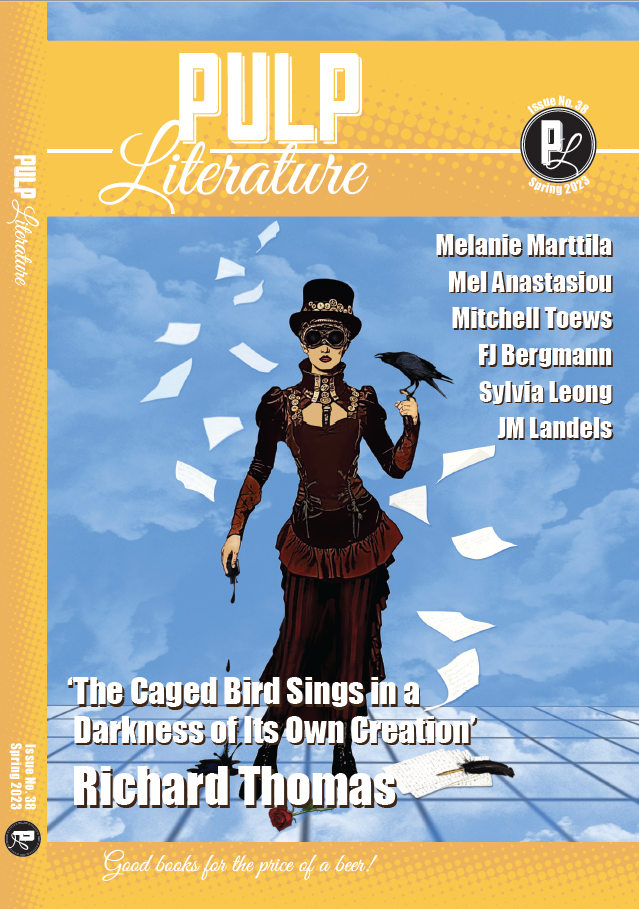
Cover of Pulp Literature Magazine, Issue no. 38, Spring 2023.

I’m proud of this quirky little story told in second person with snarky footnotes. To tell you anything more would spoil the story 🙂 I would be so pleased if PAU made the ballot this year. Consider nominating it, would you?

If you haven’t read it yet, you can support the good people at Pulp Literature by purchasing a copy at the above link 🙂

How to nominate a work for the Auroras

To nominate, you need to be a member of the Canadian SF & Fantasy Association (CSFFA), the organization that administers the awards.

If you’re not a member:

  • Visit the CSFFA web site and select “Not a member yet?”
  • Fill out your name, email, and home province.
  • Select a username and password for the site.
  • Registration is CA$10, which lets you nominate and vote on the final ballot.
  • Once you’re logged in, click on “Pay membership fee with PayPal.” Don’t use PayPal? You can also pay by debit or credit.

Already a member?

  • Visit the CSFFA web site and select “Log in” under “You are a member?” then enter your username and password to access the Awards main page.
  • If you haven’t paid for 2024, click on “Pay Renewal Fee with PayPal.” Don’t use PayPal? You can also pay by debit or credit.

Nominate:

  • Select “Nomination” from the middle of the screen to access the online nomination form.
  • To nominate a work, just select one of the boxes under the category and select the appropriate title of the work you wish to nominate from the drop-down list of eligible works.
  • You can nominate up to five works in each category, but you don’t need to nominate in every category or that many in any category.
  • When you’ve finished nominating in a category, make sure you select the “Update nominations” button for the category, then move to your next category.

And … c’est tout, mes amis!

Tipsday: Writerly Goodness found on the interwebz, May 9-15, 2021

Welcome to another tipsday, your opportunity to fill up on informal writerly learnings 🙂

KL Burd helps you incorporate social issues into your manuscript. Therese Walsh: spring thaws and the buzz of the muse. Then, Juliet Marillier wants you to consider your author photo. Kathryn Craft wants you to embrace unapologetic characterization. Later in the week, David Corbett recounts his experience murdering 22,000 darlings. Writer Unboxed

Shaelin guides you through the process of content and developmental editing. Reedsy

K.M. Weiland covers the mage’s shadow archetypes in part 14 of her archetypal character arcs series. Helping Writers Become Authors

Star Wuerdemann explains how to find compelling comps for your book. Jane Friedman

Joanna Penn interviews Gail Carriger about The Heroine’s Journey. The Creative Penn

Princess Weekes looks at the literary power of manga. It’s Lit | PBS Storied

Laurence MacNaughton shares three shortcuts to character-driven stories. Then, Savannah Cordova helps you figure out which story structure is right for your novel. Fiction University

Stephanie BwaBwa explains how to use bookstagram to increase your novel’s visibility. Then, Olivia Fisher is all about short stories. Gabriela Pereira interviews Suyi Davies Okungbowa about layers of world building in epic fantasy. Later in the week, Melanie Gibson shares five tips for writing about your mental health journey. DIY MFA

How the self-aware teen movie almost killed the genre. The Take

Marissa Graff explains how to power up individual scenes with a scene tracker. Writers Helping Writers

Margie Lawson touts the power of quirky-smirky assonance and alluring alliteration. Then, Ellen Buikema explains the relationship between stress and creativity. Writers in the Storm

Kristine Kathryn Rusch starts a new series: fear-based decision-making (part one).

Chris Winkle lists five ways to incorporate dreams into your plot. Then, Oren Ashkenazi analyzes five fascinating monsters in speculative fiction. Mythcreants

Kristen Lamb follows the writer’s journey from total newbie to the joy of mastery.

Vicky Qaio reports that Robert J. Sawyer and Silvia Moreno-Garcia are among the finalists for the 2021 Aurora Awards. CBC

Sagal Mohammed interviews Barry Jenkins about avoiding the exploitation of Black trauma in The Underground Railroad. Buzzfeed

Thank you for taking the time to stop by, and I hope you took away something to support your current work in progress.

Until Thursday, be well and stay safe, my writerly friends!

Tipsday: Writerly Goodness found on the interwebz, March 27-April 2, 2016

Woohoo! Gotz a crap tonne of Writerly Goodness for you this week! When I get excited, I get profane 😛

Sudbury’s literary festival, Wordstock, is maturing 😉 The Northern Life.

The Aurora Awards (think Canadian Hugos) nominees have been announced.

Controversial writing post of the week: For me, traditional publishing means poverty. But self-publish? No way. Ros Barber for The Guardian. I should have known when Kathy Owen tagged Kristen Lamb, asked her to read the article and respond to it in a blog post, that this was going to raise a few eyebrows (and a few hackles).

I posted it because I wanted to engage people in thoughtful, engaged conversation (which I’m happy to say it did). I share posts and articles for writers on traditional and self-publishing sides of the creative divide. I’ve made my decision after a lot of consideration. Please do me the courtesy of respecting that position. And hella yeah, you know I’ll respect yours.

K.M. Weiland discusses how to know when to write ‘the end.’ Helping writers become authors. Later, she wonders, are you telling the right story? On her author site, Katie urges us to make war, not love, because creativity is an act of defiance.

C.S. Lakin explores the action-reaction cycle in novel scenes. Live, write, thrive. Later, she shows us how to construct scenes using a variety of camera shots.

Catherine McKenzie endures publishing exhaustion on Writer Unboxed.

Jo Eberhardt asks, are you a writer or a storyteller? Admittedly, it’s not such a polarizing question as planner vs. pantser, or literary vs. genre, but in recognizing the spectrum of this apparent dichotomy, could we not find our way to a more balanced view of the more fraught debates? Food for thought. Writer Unboxed.

Tracy Hahn-Burkett wonders whether to TK or not to TK? Writer Unboxed. I did this with my most recent NaNo project. Nothing I left out was critical to the story. It’s all pure research.

Emotional wounds thesaurus entry: being raised by overprotective parents. Becca Puglisi. Writers helping writers.

David Mesick explores creating distinct and grounded anti-heroes. Mythcreants.

Jami Gold (with Angela Quarles) weighs in about writer truth: we’re making it up as we go. I’ve recently said this to a writer friend, and as I mentioned in last Saturday’s update, my process is in continual evolution. We try things out, decide what works (for us) and what needs to be set aside. It can be tough when you learn from established/well known authors. My advice? Do you have to tell them it didn’t work for you? Really? 😉

Angela Quarles guest posts on Fiction University about harnessing your day.

Kathryn Craft offers five tips to sustain you in the query trenches. Writers in the Storm.

Martina Boone helps us decode rejections to identify plotting issues. This only works, of course, if the agent gives you more than a form rejection. Adventures in YA Publishing.

Steven Pressfield advises to analyze your novel like a dream.

Joanna Penn interviews Mark Lefebvre of Kobo Writing Life about how to sell more books. The Creative Penn.

Jane Friedman updates her How to Start Blogging Guide.

Katherine Garcia decries four lies we have to stop telling writers, artists, and other creatives. Everyday Feminism.

I’ve posted this before to great controversy. None of us like change, but we can’t prevent it from happening by ignoring it, especially when there are very good reasons for it. Why you should never, ever use two spaces after a period. Farhad Manjoo for Slate.

Orna Ross says creatives and creativists cultivate independence.

Linda Wasmer Andrews reveals recent research that supports how walking can make you a better writer. Psychology Today.

Five writing retreats to jump start your creativity. The Globe and Mail.

Ursula K. LeGuin on racism, anarchy, and hearing her characters speak. Literary Hub.

Virginia Woolf, the woman who remade the novel. The Independent.

Sarah Hughes examines our enduring fascination with the Brontës. The Guardian.

From alright to zap: an A to Z of deplorable words. Not really. Read ‘em and weep twitch, word nerds. The Guardian.

And this is just fun: Librarian Rhapsody.


Radio Times collects eleven of the best moments from the new Doctor Who.

How Outlander is taking the art of love (and war) to Paris in season two. TV Insider. I can’t believe the wait is almost over! This weekend: droughtlander ENDS!

And this movie looks interesting for the fairy tale set: Tale of Tales. Vanity Fair.

And that should keep you reading through to next week (!) I hope you have a lovely one.

Tipsday

The Next Chapter: September 2014 update

So here we are at the beginning of October, my favourite month, not in least because Samhain (Hallowe’en) was my hatch-day (and yes, I’ve heard them all and would proudly claim to be witch, werewolf, vampire, or anything else you’d care to call me).

September was an interesting month.

I made further progress on Gerod and the Lions. Total word count on the project is 21,423 words, just over half-way for an MG novel, which this is supposed to be. I’m no longer on track to finish by the end of the year for reasons I’ll tell you about shortly, but I figure I’ll be done the first draft in January or February of 2015. Not bad.

I finished mapping and reverse engineering Figments (finally!). One thing I’ve learned from this project is that reverse engineering is tough.

When I worked backward through my plot for Initiate of Stone earlier this year, I was working with a seventh draft. I’d already completed a lot of the structural reorganization that reverse engineering might have indicated was necessary. Though I fine tuned a lot of foreshadowing and really tightened things up, there wasn’t a lot of tearing apart and putting back together.

With Figments, there was. Figments is a first draft, a NaNoWriMo first draft, at that. I’m not ashamed to admit that I lost my way a few times. I ended up listing events in reverse chronological order and then reorganizing them into Victoria Mixon’s holographic structure. In made my head spin.

Another thing I’ve decided is that I’ll head back to the computer for my mapping. It’s just a lot easier than rewriting everything out by hand. The reverse engineering, though, has to be done by hand. It really puts you in a different headspace.

Having accomplished the Figments mapping and reverse engineering, I’ve moved onto Apprentice of Wind. That will take me a while to get a handle on as well. It might as well be a first draft, though I went as far as draft four with IoS and AoW as one honkin’ monster of a novel 😛 I have subsequently changed enough in IoS and cut up parts of AoW that it really is like starting from scratch.

The other thing I started on this month is reworking IoS. I still have betas outstanding, but my writer’s head had to go there. I haven’t gotten very far, just a few chapters, but I think it’s going well. I have enough distance from the novel that I’m seeing a lot of things more clearly than I had before.

This isn’t to say that the outstanding betas work over the last year and a bit has been for nought. I still want to see what you recommend. I’m not above going back and changing even more. I just had to get at it.

I can finally tell you about my mysterious short(-ish) story tale. I had submitted it to Fantasy & Science Fiction Magazine in response to a special call out by C.C. Finlay in the first part of August.

I received word on September 21st that he wasn’t taken with the story (though it was a very nice rejection—thank you!). So, I promptly revised to try and fix what may have been the dear thing’s flaws and sent it off to Writers of the Future.

In reviewing my previous submissions to that contest, I realized that my honourable mention from 2011 was for the same story that I eventually revised and submitted to On Spec: “Downtime,” which should be out in the fall 2014 issue (I’m still so excited about that).

Can’t wait to get my paws on my contributor’s issue. Sorry, drooling there a bit.

Other On Spec news: they won an Aurora Award! W00t! Congratz! So pleased for them. Chuffed even.

Also, Bastion Science Fiction Magazine, the online publication that accepted “The Broken Places” back in June, has become an Amazon bestseller. More W00t! and Gratz! to the good people at Bastion.

Though I decided not to move forward with my self-funded leave this fall, I’ve decided that I still want to attempt to do NaNoWriMo again this year. Yes. That’s while working the day job. Yup. I’m certifiable.

I had considered taking a blogging holiday for a month, and it may come to that if I can’t manage my time and get the words down, but I’d prefer to keep to three posts a week: Tipsday, Thoughty Thursday, and my WWC2014 reportage.

In the last month, you may have noticed that I haven’t posted a lot on Sundays. I’ve found that to be a wonderful gift for the writing side of things. This weekend is an exception. You’ll find out later in my second post of this particular Sunday.

The other thing I’ve tried in the last couple of weeks is to prepare my Tipsday and Thoughty Thursday posts on Sunday and just post them on the appropriate weekday. I think between giving myself Sundays, prepping the weekday posts, and then focusing on my NaNo project to the exclusion of most other creative endeavours for the month, I’ll be able to hack it.

Of course, November will be the acid test. I’m also heading down to Toronto for a couple of days for a Humber School for Writers workshop on November 6 and 7. I just can’t help myself. I have to try.

I’ve already been doing some research on my idea and I’ll be working on a rough outline and further research this month. It’s the strength of this idea that has convinced me to make this crazy NaNoWriMo commitment.

I’ve also joined Jane Ann McLachlan’s street team I’ll talk a bit more about street teams in a future post. Her next novel, a YA science fiction, will be coming out soon. Much excitement there!

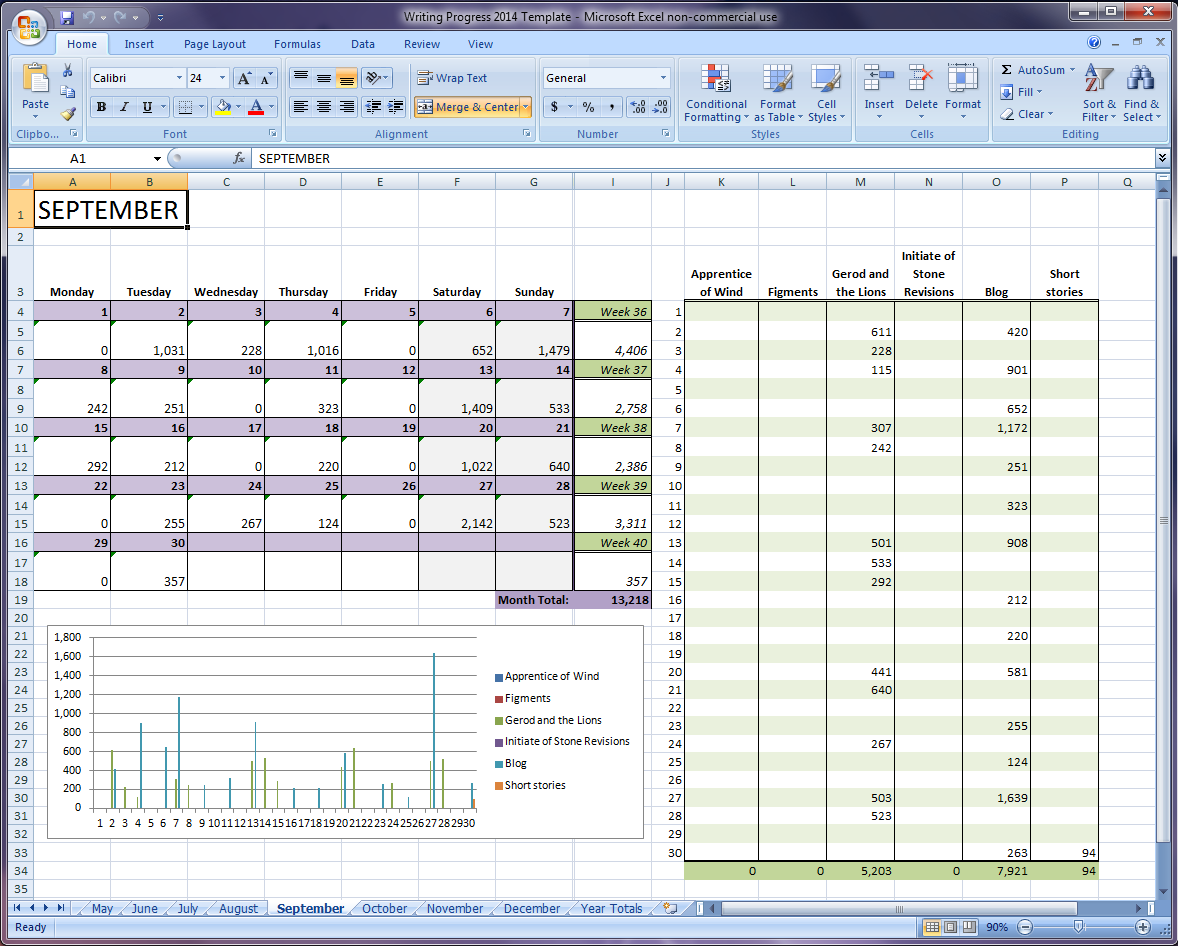
So, here’s how September’s numbers worked out:

September's writing progress

A total of 13, 218 words. Modest, but reasonable.

7,921 on the blog, 5203 on GatL, and a scant 94 on my longish short story (that was after removing and rearranging several hundred, but I never count negative words).

So that was my month in writing.

How have your projects been shaping up? Please share in the comments. I love hearing about your yummy, yummy words.

The Next Chapter