Disclaimer: I am not perfect and neither are my notes. If you notice anything that needs correction or clarification, please let me know: melanie (dot) marttila (at) gmail (dot) com and I fix things post-hasty.
Panellists: Kate Heartfield, Arlene F. Marks, Kate Story
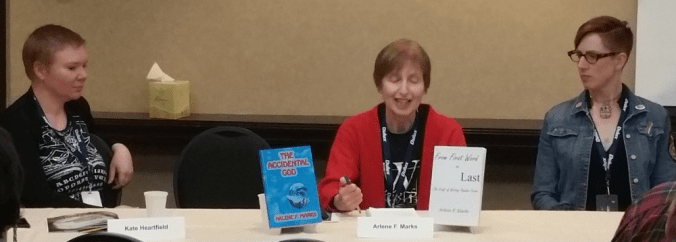
AFM: Shakespeare’s plays were, in his time, entertainment and education. They’re lessons in history, then and now. They also were some of the earliest examples of genre. Hamlet is, in part, a ghost story. MacBeth can be seen as urban legend. A Midsummer’s Night’s Dream is fantasy.
KS: Shakespeare needed to make a living. That’s why he wrote. He was a great enabler of public discourse.
KH: You don’t have to go far to find gender queer characters in Shakespeare.
AFM: The Hogarth Shakespeare series from Penguin Random House is asking well-known authors, like Margaret Atwood, to re-imagine his plays. That’s the brilliance of Shakespeare. You can put any one of his plays into any era or milleu.
KH: A lot of adaptations of his work are coming out because it’s the 400th anniversary of his death.
KS: My father was a scholar in Newfoundland. We had a cultural renaissance in the 60’s and 70’s and we started to make some connections. Maybe we have something to offer to the tradition. I think the spirit of Shakespeare’s time was close to Newfoundland’s now. Shakespeare has always been there and has always been an influence. Shakespeare’s women were far more realistic than the women characters of many modern playwrights.
[Kate then performed the monologue from her story in Carbide Tipped Pens, edited by Ben Bova and Eric Choi. It was a variation of Romeo and Juliet, set in space. She’s currently working on the stage play. I just sat back and enjoyed 🙂 ]
Ian McKellan said in an interview, “Where in the modern world would it be so wrong for two people to fall in love?” It resulted in a 70’s production of Romeo and Juliet set in Belfast.
AFM: In Shakespearean times, it was forbidden for women to go in stage. All women’s roles were played by men, or, more often, boys. The audience was very demanding. If they didn’t like a play, or the actors, they brought rotten vegetables to throw.
KS: He was asking the audience to be clever, to know it’s a man playing a women, pretending to be a man. It engaged the audience, drew them in.
AFM: It’s the fiction of the people. The only publisher that approaches this today is Harlequin, who would hold regular “reader appreciation” luncheons to meet their most popular authors. In Shakespeare’s day, there would be nobles and prostitutes in the same audience. It was whoever had the money to pay.
KS: It was nuts for the theatre. A sixth of the population of London would attend the performances.
KH: The culture of fandom/fanfic has a lot in common with the culture of Shakespeare. There’s nothing more Shakespearean than fanfic. Most of Shakespeare’s plays were drawn from earlier works. He borrowed liberally from Ovid.
Q: Shakespeare’s plays address universal themes. The more popular ones get done. Some might say overdone, but the historical plays are ignored.
KS: My theatre did a gender-swapped Taming of the Shrew.
KH: The film industry has done a better job. My Own Private Idaho, The Hollow Ground series, Looking for Richard.
AFM: A Thousand Acres was the story of King Lear. Shakespeare was brilliant of using every member of the company. There were often comic actors. Characters like Falstaff were written for them. If there were acrobats, he’d give them something to do. They had to be very practical in terms of costuming for these reasons.
KH: Titus Andronicus and Troilus and Cressida were essentially horror. Shakespeare was a great worldbuilder. He was consistent in terms of how fairies, spirits, and witches behaved. His idea of Titania was dark, but comic. Fairies had an alien sense of good and evil.
AFM: He built on the motivations of all his characters.
And that was time.
Next week: The do’s and don’ts of writing erotica (oh, my!).

 Always Looking Up