Tipsday: Writerly Goodness found on the interwebz, July 18-24, 2021

It’s the last tipsday of July? Where the hell has the time gone? And so fast? Ah well, console yourselves with some informal writerly learnings.

Jan O’Hara shares what an unnatural book marketer learned while Marie Kondo-ing her house. Then, Dave King exposes the dangers of editing. Barbara Linn Probst explains what to do when you take a break from your work in progress. Heather Webb says, when the going gets tough, the though get going (in publishing). Late in the week, John J. Kelley offers some tips for when characters meet: close encounters of he initial kind. Writer Unboxed

What is Toph’s character arc? Hello, Future Me

K.M. Weiland: why everyone should write (even if you think you stink). Helping Writers Become Authors

Angela Ackerman promotes writing character descriptions that hook readers. Then, Sudha Balagopal encourages you to flavor your fiction with foreign expressions. Later in the week, Ellen Buikema encourages you to think about why you’ve chosen the road to writing. Writers in the Storm

Copyediting vs. proofreading. Reedsy

Bonnie Randall helps you access deep point of view via description (and a writing exercise). Fiction University

Nathan Brandford wants you to try to separate process from product (outcomes).

Is your book ready for an editor? Reedsy

E.J. Wenstrom shows you how to plan an online book launch. Then, Sara Farmer considers classic girl detectives. Gabriela Pereira interviews Brandie June about character dynamics in a fairy tale retelling. Later in the week, Kim Catanzarite shares five copyediting mistakes you’re probably making (and how to eradicate them). DIY MFA

El Silbón: The Deadly Whistler of the South American Grasslands. Monstrum | PBS Storied

Angie Hodapp shares four ways to create inter-character conflict. Pub Rants

Becca Puglisi helps you figure out whether fight, flight, or freeze is your character’s default response. Writers Helping Writers

Chris Winkle explains how to make large conflicts exciting. Mythcreants

Chimera: mythology’s magical multi-species monster. Tale Foundry

Kathleen Newman-Bremang: it isn’t just Gossip Girl—TV has a major colorism problem. Refinery 29

35 Canadian books to check out this summer. CBC Books

Phil Pirello introduces us to the version of Aliens we never saw. SyFy

Kim Stanley Robinson considers the novel solutions of utopian fiction. The Nation

Davide Tristan: one megahit later, we check in with the creator of Enola Holmes. ABC27

Vicky Qaio reports that Canadian authors C.L. Polk and Silvia Moreno-Garcia among World Fantasy Award finalists. CBC books

Neda Ulaby: when your book publishes in a pandemic. NPR

And that was tipsday. Thanks for taking the time to visit, and I hope you found something to support your current work in progress.

Until Thursday, be well and stay safe, my writerly friends!
WorldCon 2016: Alienbuilding

Disclaimer: I am not perfect and neither are my notes. If you notice anything that requires clarification or correction, please email me at melanie (dot) marttila (at) gmail (dot) com and I will fix things post-hasty.

Alienbuilding

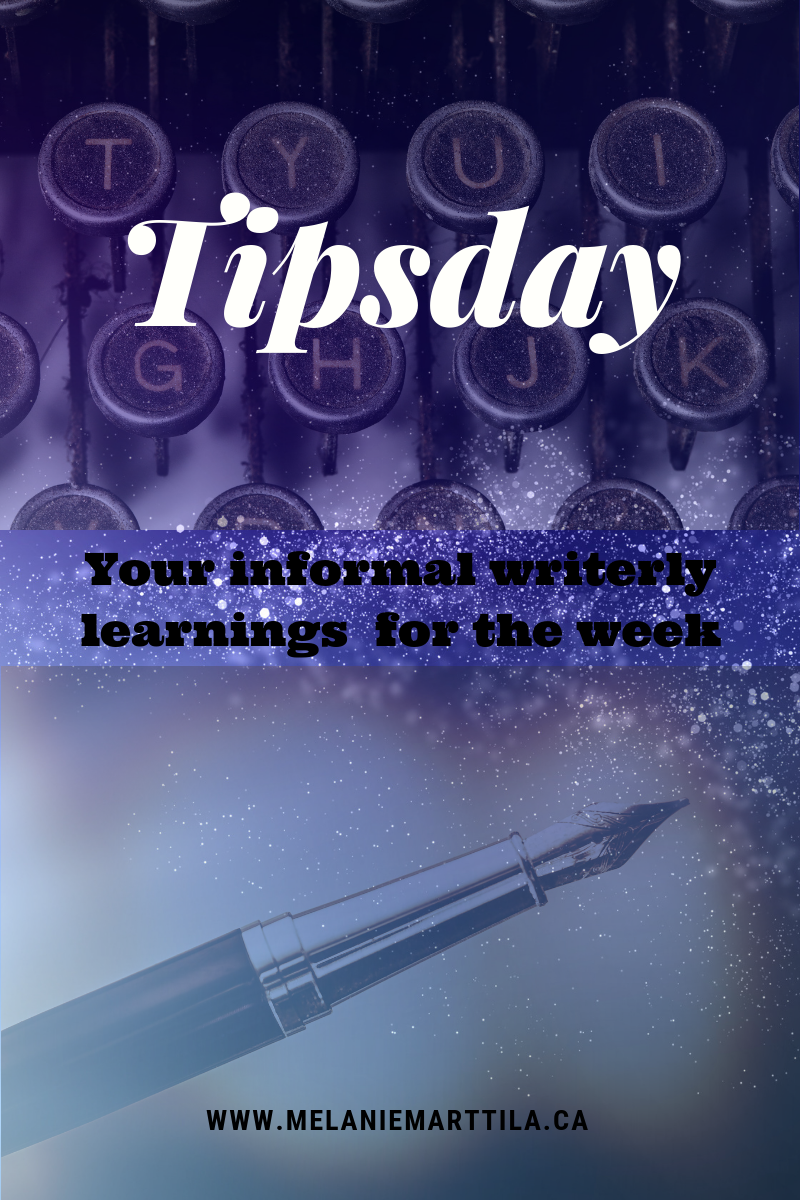
Panellists: Caroline M. Yoachim (moderator), G. David Nordley, Ctein, Larry Niven, Sheila Finch

Joined in progress …

GDN: To build aliens, you have to start with the system, planets, and so on down.

C: When it comes to the aliens themselves, a top-down approach means psychology first.

LN: I’ve created aliens with handles on the skull. Humans have bilateral symmetry on the outside. Inside, not so much. An alien can have two dominant arms for fine manipulation, or one extra-muscular arm for heavy lifting. Why not a dwarf elephant with two trunks and fingers on the trunk-tips?

SF: It happens all at once for me. I have an image of the alien. I take a step back and consider what environment might have produced it. Then, I develop the psychology and language. The metaphors used are linked to physiology.

C: I’m happy to steal if it works. I have a species I based on puppets.

CMY: Do you have to balance strangeness with relatability?

GDN: I’m not bothered by aliens that have commonalities with humans. Our basic drives are all the same.

C: There are special, species-related characteristics. Will aliens have religion? Will they be acquisitive? Are they into body augmentation?

SF: Corvids are acquisitive.

LN: I ask myself, what’s the weirdest thing about an alien? Then I extrapolate back.

SF: Sentience and self-awareness have been proven to exist in animals.

C: One notable characteristic of humans is that we build. If there’s an advanced species out there that doesn’t build, what do they do?

LN: What’s the process of adapting humans to their environments?

CMY: What pitfalls do you see? What are your pet peeves?

GDN: Characters that don’t have survival value.

LN: There was a story based on a hospital station—everyone got sick. [Mel’s note: not every disease will attack every species by the same vector. Zoonosis is not common on Earth. And then, there’s immunity.]

SF: Plant aliens that aren’t done well. Sequoias, for example, would have a chemical intelligence.

C: When the physical worldbuilding isn’t related to the story. If it’s all about the display of worldbuilding prowess, it’s essentially scenery.

CMY: When all the aliens are the same, are they truly “alien” aliens?

GDN: Silicone and oxygen might be able to produce something similar to DNA and RNA. Truly alien aliens are difficult to figure out physiologically and biologically.

SF: With truly alien aliens, their physiology becomes the story. It’s all about explaining how they function.

And that was time.

I’ll have one more WorldCon 2016 session to share with you this month, and it’s more worldbuilding (are you sensing a theme?). Next weekend: Political worldbuilding in science fiction.

Be well, be kind, and stay strong until next I blog.