Disclaimer: I am not perfect and neither are my notes. If you notice anything that requires clarification or correction, please email me at melanie (dot) marttila (at) gmail (dot) com and I will fix things post-hasty.
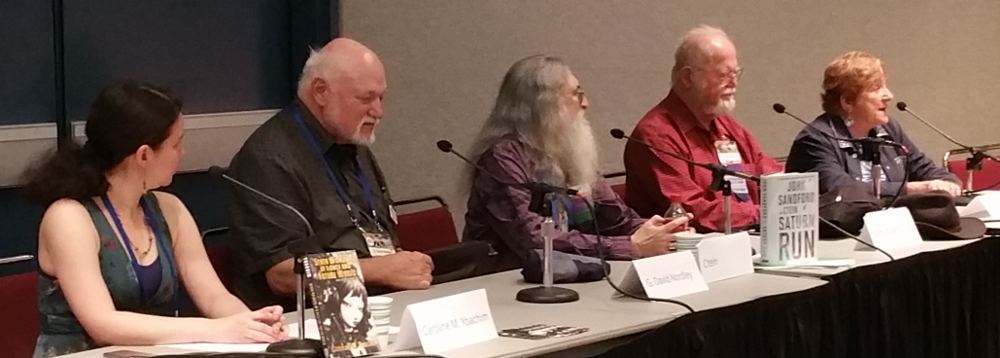
GDN: To build aliens, you have to start with the system, planets, and so on down.
C: When it comes to the aliens themselves, a top-down approach means psychology first.
LN: I’ve created aliens with handles on the skull. Humans have bilateral symmetry on the outside. Inside, not so much. An alien can have two dominant arms for fine manipulation, or one extra-muscular arm for heavy lifting. Why not a dwarf elephant with two trunks and fingers on the trunk-tips?
SF: It happens all at once for me. I have an image of the alien. I take a step back and consider what environment might have produced it. Then, I develop the psychology and language. The metaphors used are linked to physiology.
C: I’m happy to steal if it works. I have a species I based on puppets.
CMY: Do you have to balance strangeness with relatability?
GDN: I’m not bothered by aliens that have commonalities with humans. Our basic drives are all the same.
C: There are special, species-related characteristics. Will aliens have religion? Will they be acquisitive? Are they into body augmentation?
SF: Corvids are acquisitive.
LN: I ask myself, what’s the weirdest thing about an alien? Then I extrapolate back.
SF: Sentience and self-awareness have been proven to exist in animals.
C: One notable characteristic of humans is that we build. If there’s an advanced species out there that doesn’t build, what do they do?
LN: What’s the process of adapting humans to their environments?
CMY: What pitfalls do you see? What are your pet peeves?
GDN: Characters that don’t have survival value.
LN: There was a story based on a hospital station—everyone got sick. [Mel’s note: not every disease will attack every species by the same vector. Zoonosis is not common on Earth. And then, there’s immunity.]
SF: Plant aliens that aren’t done well. Sequoias, for example, would have a chemical intelligence.
C: When the physical worldbuilding isn’t related to the story. If it’s all about the display of worldbuilding prowess, it’s essentially scenery.
CMY: When all the aliens are the same, are they truly “alien” aliens?
GDN: Silicone and oxygen might be able to produce something similar to DNA and RNA. Truly alien aliens are difficult to figure out physiologically and biologically.
SF: With truly alien aliens, their physiology becomes the story. It’s all about explaining how they function.
And that was time.
I’ll have one more WorldCon 2016 session to share with you this month, and it’s more worldbuilding (are you sensing a theme?). Next weekend: Political worldbuilding in science fiction.
Be well, be kind, and stay strong until next I blog.
It took us a little longer to drive to Ottawa than I thought, so I was late for this workshop. My apologies to Nina and to any of my readers who experience confusion as a result. If you think there’s something missing, you’re probably right 🙂
How do the environment, other species, diet, etc. limit population growth?
Adaptive traits:
Mimicry
Camouflage
Autotrophs (producers – species which produce their own food)
Phototrophs (produce food from light)
The Bracken Fern. Ubiquitous. Found on every continent except Antarctica. Very successful. Carcinogenic. Breaks down vitamin B. Reproduces by both spores and rhizomes.
Fiddleheads contain cyanide. Aggressive symbiosis. They attract ants which in turn defend it against other predators (peonies do this, too, though they don’t contain cyanide).
Nothing else will grow in a hemlock grove. It kills all potentially competitive species.
Some primates live with viruses that cause disease in other species because the monkey is the virus’s ‘ideal’ host. (Mel’s note: I think this was a digression into other forms of symbiosis–monkeys aren’t phototrophs.)
Chemotrophs (produce food from chemical processes)
Heterotrophs (consumers and decomposers, including us)
Parasites
Saprotrophs – fungi and bacteria
Detrivores – insects and earthworms
Lynn Margulis proposed the Gaia hypothesis and symbiogenesis (Google search for more information).
Endosymbiosis – cooperative adaptation.
Darwin’s theory of competition (survival of the fittest) is incomplete. It doesn’t explain altruism.
Symbiosis leads to happiness.
Kin selection – the choice to support the reproductive group including sacrifice for the greater good (heroism).
Group selection – the choice to limit population growth in favour of x (where x is more food, habitat, etc. for all).
Reciprocal altruism – The vampire bat, for example. All hunters may not be successful, but the successful hunters will share their food with the unsuccessful and with mothers/pups (by regurgitation) to ensure the continued strength of the community.
True altruism – Dolphins will help humans and other species for no apparent gain. (Mel’s note: they may also rape their own and other species for no apparent reason, but that’s another story.)
Communal feeding – Lions in prides.
Satellites – In some frog species, the small males will hang out with the big, noisy ones and ‘head off’ the eligible females attracted by their big, noisy brethren.
Niche partitioning – competing species that coexist in the same ecosystem by voluntarily partitioning food, habitat, etc..
Adaptation and extremophiles
The brine shrimp of Mono Lake (California) thrive in inland seas with salinity that kills potential predators. They can also survive being dried out.
There are flies that can swim and dive because they carry their own oxygen supplies in air bubbles.
There are bacteria that feed on sulphur.
The Microbes of Lake Untersee in Antarctica live in a super alkaline environment with lots of dissolved methane in the water. They create stromatolites—the largest ever found anywhere.
Bacteria in the Rio Tinto thrive in extreme acidity and high iron content in the water.
The fungi of Chernobyl feed on high levels of radioactivity.
The Atacama Salt Flats in Chile is the most arid desert in the world, yet hypolithic algae have evolved to thrive where no other plant life can.
Tardigrades (also known as water bears or moss piglets) can survive anywhere, even in space (for approximately ten days). They can be revived after a century of desiccation and endure 1000 times the lethal dose of radiation for a human. Technically, they’re not true extremophiles because they have not adapted to prefer, or thrive in these environments. They merely survive.
The rest of the workshop was taken up by an exercise in which we applied ecology to the characters of our stories. How have our protagonists adapted to thrive in adverse conditions, compete against, or mimic, other characters, to become the heroes of our stories? In what ways do they show altruism, and is it true altruism, or another form? How does the unique environment of the story world affect them?
It was a very interesting workshop and I’m sorry to have missed the beginning of it.
Unfortunately, because of my late arrival, I did not get a picture of Nina or the workshop participants.
It was a good start to a great weekend of panels, though.
Come back next Saturday when the CanCon 2015 reportage continues with advice on pitching your novel.

 Always Looking Up