Tipsday: Writerly Goodness found on the interwebz, April 3-9, 2016

Wahoo! Is it possible there’s even more writerly goodness in here then there was last week? Hella yeah!

More exciting local news: Sudbury is part of Reading Town 2016 (think Hockey Town with books) 🙂


Most common writing mistakes, part 50: Info dumps (and how to fix them). K.M. Weiland. Helping writers become authors.

Liz Bureman looks at parataxis and hypotaxis (and how Greek makes you a better writer). The Write Practice.

Sara Letourneau explores how to develop theme in your stories through symbolism. DIYMFA.

Donald Maass discusses relevance for Writer Unboxed.

Juliet Marillier writes about the different responses you can (and should) have to an editorial report. Writer Unboxed.

Roz Morris asks, must plot twists always be misfortunes or disasters? And, where does your story end? Nail you novel.

Daniel José Older offers twelve fundamentals of writing the other (and the self). Buzzfeed.

Marcy Kennedy explores how to read as a writer (part 1).

Real writers don’t self-publish, part two. Kristen Lamb shares her further thoughts on the issue.

Mike Shatzkin wonders what will happen to high-cost non-fiction in the evolving indie world.

C.S. Lakin points out the need for persistence in your writing journey. Live, write, thrive.

Janice Hardy shares her thoughts on challenging yourself, versus setting yourself up to fail. Fiction University.

Kameron Hurley writes about career milestones and prioritizing projects.

Catherine Ryan Howard recounts how the idea for her novel Distress Signals evolved.

How to create a better writing space (and other thoughts on writing). Avoiding Atrophy.

Jennie Nash shares her one page book planner on Kobo Writing Life.

Sarah Selecky shares more writing retreats for your wish list.

Speaking of writing retreats, my friend, Kim Fahner, has just spent the week in Banff with Lawrence Hill. Here are her posts on the experience: Making time to write, and Writing retreats and the friends you meet.

“Mad Men” creator, Matthew Weiner’s reassuring life advice for struggling artists. Fast Company.

Sword and Laser: Interview with Ken Liu.


The Writes of Women: a celebration of female writers and their work.

Stephen Greenblatt explores how Shakespeare lives now for The New York Review of Books.

A Shakespeare first folio was discovered on the Isle of Bute, just in time for the Bard’s 400th anniversary. The New York Times.

The history of typography. Ben Barrett-Forrest.


Christopher Zumski Finke discovers what Battlestar Galactica teaches us about the militarization of police. Yes! Magazine.

Rogue One teaser trailer.


Kate Spencer says, hey dudes, you should be watching Outlander. Esquire.

And that should keep you busy for a while (!)

See you on Thursday for a video heavy dose of thoughty edutainment 🙂

Tipsday

Muse-Inks: Do you need an MA/MFA?

(And a couple series discoveries)

Yeah, so I kind of fibbed again on Thursday because I wasn’t aware of some of my deadlines and involvements.

Today, I’m going to be doing double duty. I’m posting my first DIYMFA launch team post and covering the two series that hadn’t debuted/returned before I went to CanCon last October and then plunged into the lost month that is NaNoWriMo (binge writing).

I’m also reading the ARC of Jane Ann McLachlan’s new YA SF, The Salarian Desert Game, as part of her launch team. That review is due up on the interwebz on Monday, and it will be, but I’ll be holding off on putting it up on my blog until next Saturday.

So. Let’s get to it, shall we?

I’ve written about my MA experience as part of the My history as a so-called writer category, which has been a bit of a confessional/lessons-learned-from-the-writing-life kind of thing.

 The story of my MA

I was in my last year of my BA in English, Rhetoric emphasis, and I was rocking it. I’d gone into university this time (I’d started, dithered, and left to learn some life lessons) with the focused intention of becoming a better writer. I’d been writing for years, since I was in grade three, but had only recently come up with my first idea for an epic fantasy novel.

That intention had provided me with the fuel to really begin my writing life in a more serious way. I’d placed in a local writing contest with a science fiction short story, excelled in my academic writing, and been asked to write an editorial piece for one local magazine and a science fiction short story for the debut issue of another.

Through the creative writing course I’d taken, I would have another fantasy story published in an anthology. I’d written poetry and read my work at various open mic nights and reading series.

In retrospect, I should simply have continued to write. I was developing a kind of momentum that further schooling would only disrupt, but I had no idea about that then.

My friends had all departed for further schooling, teachers’ college and literature MAs, and I was still at that tender stage in the process where I had no confidence in myself. I thought I needed further validation. I thought that attaining my MA would make me a more attractive property.

I was wrong.

In Canada, at the time, there were only four universities offering MFAs: the University of New Brunswick, Concordia University, the University of British Columbia, and the University of Victoria. Two others, Windsor and Saskatchewan, offered the option of doing a creative thesis along with your degree in English literature.

Initially, I just thought I’d apply, see if anyone would accept me, and then make my decision whether to go or not. I’d just gotten married the year before and my husband wasn’t finished his undergraduate degree yet. I wasn’t so keen on being separated from him for so long.

All the MFA programs rejected me out of hand (I should have seen that as a sign). Only one of them, UNB, threw me a bone: we’ll take you in the English Literature program, but not creative writing. Windsor was the only university that accepted me. It was the closest, too, though it was still a nine hour drive away.

I thought at the time that it was doable. I’d be back for breaks and summers. Phil was supportive. We could do this, if it was what I really wanted.

I went for it without giving serious consideration to my chosen genre. I write science fiction and fantasy. Even my more literary efforts contain the element of the otherworldly, ghosts, dreams, visions. I thought that, just like my BA, my MA would yield to my passion and desire.

Then, I attended my first critiquing class. My fellow hopefuls were all of a more mainstream, if not literary, mind. One eventually defended her thesis which was a collection of poetry, all sonnets. I never learned what the other students had chosen to work on.

No one was particularly keen on what I wrote. Well, there was this one guy, but he wrote genre as well. I got stubborn and dug in. My advisor looked at my submitted stories in dismay. What is this? What is real about this story? We weren’t on the same page. We couldn’t relate to each other. He couldn’t help me become a better writer. He just wanted me to be a different kind of writer.

I did my graduate assistantship, which was essentially teaching the first year composition course (without supervision), took my classes in methodology, pedagogy, and English literature of various eras, and tried to write.

I didn’t get a lot of fiction written in those years. I basically revised already existing material and scribbled poetry, the only form of writing I could manage in the time I had between other obligations.

I eventually had a blow out with my advisor, who told me to stop wasting his time (and mine). I withdrew from the program, worked contract jobs, and collected employment insurance in between.

A year later, one of my former students emailed me, telling me that my advisor was going on sabbatical. A Canadian poet, a woman, would be taking his place. I reenrolled, and, over the next year, emailing, and flying down at intervals to meet in person, I wrote my creative thesis, defended it, and fulfilled my final requirement to achieve my MA in English Literature and Creative Writing.

Even so, I’d compromised. I chose the more literary of my stories and, framing the collection in the context of shamanism and shamanic awakening (anthropology and religious studies), I cast an academic light on my fantastic tales.

In the wake of that experience, though, I went into creative withdrawal. I’d internalized the criticisms of my first advisor and was, essentially, blocked.

Throughout the years of my MA and afterward, I continued to win writing contests, in both fiction and poetry, and continued to get published. I tried my hand at publishing a poetry journal with another writer friend of mine, but, after a couple of years, the effort folded.

I continued to work contract jobs until I was invited to apply for my current job by my sister-in-law. Once I worked full time, the writing went underground altogether.

It took me six years and a bout of depression to begin to come back to writing as something I loved, something I needed in my life, rather than an unrealistic dream. I began with a few workshops, and graduated to conferences and conventions. I took online courses. I started to build my platform (such as it is). I tried online critiquing. I tried beta readers. I tried freelance editors.

I pretty much try anything that I think might help me improve.

I’m a writing craft book junkie and I’ve learned over the years that my process is my own. I never take anything at face value. Like a writerly scientist, I experiment. I try a new technique and see if it has value for me. If it does, I incorporate it into my process. If it’s only partly useful, I’ll adapt those pieces to my process (note, my process does not change to accommodate a particular technique, the technique is adapted to fit my process). If it doesn’t work at all, I discard the technique and chalk up the time and effort to a learning experience. We have to fail—many times—before we succeed.

Two of my science fiction short stories were published in paying markets in 2014. I’ve participated three times in NaNoWriMo, “winning” twice. I now have six novels drafted, one of which I’m actively querying. The rest are in revision.

The bottom line is that writing is a way of life for me. It’s not a get rich quick scheme. It’s not my grab for fame and fortune. I’m going to do this for the rest of my life regardless of whether I get the publishing deal I want or not. I’m doing the work and spending the time to make it happen, though. The two short stories weren’t a fluke.

I’ve been published quite a lot over the years. It’s just that most of those were not paying markets. I just haven’t connect with the agent or publisher who thinks my novel is the bee’s knees yet. Yet. It will happen. And if it doesn’t happen with the novel I’m querying now, it will happen with one of the others.

I persist in hope and continue to revise.

And, I continue to learn. I’m a bit of a learning mutt that way 😉
Muse-inks

Bonus content: Series discoveries Fall 2015 con’t

There were only two series that I didn’t get around to reviewing before CanCon and NaNoWriMo monopolized my time in the fall. I’ll try not to be spoilery.

Supergirl

This is another entry in the DC Comics universe, or should I say universes.

Supergirl started out sunny and entered some darker territory toward the end of the season. On the spectrum, it’s between The Flash and Arrow, but, as The Flash has also started treading dark waters, I guess Kara Danvers is closer to Barry Allan than Oliver Queen.

There’s an almost cloying sense of hope in the series, though, that keeps it from being compelling for me. If I miss an episode, I’m not distressed.

I like the character of Cat Grant, who can be surprisingly inspirational. I also appreciate Kara’s adoptive sister, Alex (so nice to see Lexie Grey back on screen), who works for the DEO, a government agency dedicated to defending earth from alien threats. Kick ass, but real, women characters are something I like in a show.

Bringing Dean Cain (the Superman of Lois & Clark) in as Alex’s father was a fun and smart bit of homage.

Sadly, some of the other elements of the show are lacking. The love triangle (no, quadrangle, no, sorry quintangle) is a bit trite and while I believe Kara’s crush on James Olsen, I never quite bought into James and Lucy Lane, Winn and either Kara or Siobhan. Oh, and I forgot the brief flirtation between Kara and Cat Grant’s son, Adam. Man, it’s a soap opera (!)

Hank Henshaw/J’onn J’onzz is underwhelming. My Martian Manhunter is so much more awesome.

Astra/Non have been weak sauce as Kara’s enemies. Maxwell is a bit better, but still one dimensional.

So it’s a solid meh. My apologies.

Grimm

Things took a left turn last season. Sure, Nick and Juliette’s relationship wasn’t going anywhere, so they had to do something. Her transformation into a Hexenbeist was actually a good thing.

Until it wasn’t.

Juliette’s abrupt departure from sanity and eventual (and apparent) death at the hands of Trubel (the other Grimm) felt more of a convenience than true plot development.

The big question for Nick last season was how he, a Grimm sworn to protect humanity from the evil wessen that roam the world, could live with and love a Hexenbeist, the wessen that is the basis of all wicked witches, ever.

So what do they do this season? They pair Nick with Adalind Schade, a Hexenbeist whose wessen aspect has been temporarily suppressed by Rosalee’s folk cure (herb craft).

Yes, Adalind is the mother of Nick’s child (conceived in a convoluted magical plot that resulted in Juliette’s transformation into a Hexenbeist in the first place), but things progressed quickly from “I have to protect my child and therefore the woman who gave birth to him,” to “I’m having sex with the mother of my child while he cries in the other room.”

Yeah. That’s what I thought.

Worse, Juliette returns, somehow deprogrammed, as Eve, who is more Terminator than either human or Hexenbeist.

While the Black Claw plot line holds promise, things aren’t happening fast enough as the writers insist on offering a monster of the week for Nick and his fellow detective, Hank, to fight. Even a trip to the Black Forest and the recovery of an ancient Grimm artefact haven’t saved the show for me.

There are too many moving parts, too many players, to discern the true core story arc.

I wouldn’t be surprised if Grimm doesn’t return next year.

So that’s what I thought of the final two shows I chose to watch in the fall 2015 television season.

Thoughty Thursday: Things that made me go hmmmm on the interwebz, March 27-April 2, 2016

Here’s your thoughty for the week.

Buzzfeed features Katie Joy Crawford, a young photographer who has captured the essence of anxiety in her photographs.

Christine Denewith and Creigh Ferinas debunk eight myths about autism. Everyday Feminism.

Steven W. Thrasher says, don’t tell cancer patients what they could be doing to cure themselves. It’s our urge to do something to help that bites us in the butt here. Just be there. Take care of their kids for a while. Offer to do the running around for an exhausted partner. Hug them, if they can bear it. The Guardian.

Katie Roiphe explores the beauty of our final moments. CBC’s Q.

Silence may help to regenerate brain cells among other important functions. LifeHack.

Dublin observes the Easter Rising centenary. Irish Central.

Lifebuzz shares amazing footage of the Himalayas.

Take a virtual visit to Iceland’s Museum of Witchcraft. ScoopWhoop.

Australia’s Carnegie CETO wave power generator.


Yes. I confess I was attracted to this article by the word ‘unicorn’ (is it any relation to the badass unicorn?) but this rhino ancestor is still amazing. Shaena Montanari for Forbes.

Japan’s Hitomi satellite disappears and reappears mysteriously. Gizmodo.

This is the most detailed map to date of our place in the universe. Vimeo.

Hubble reveals the heart of the Milky Way. Phil Plait for Slate.

Do ravens know what you’re thinking? The California Academy of Sciences.

Your kawaii of the week: orphaned magpie bonds with boy. Photography by Cameron Bloom. This is Colossal.

Costa Rica’s land of the stray dogs is heaven for the unwanted. Bored Panda.

Not as extensive as Tipsday this week, but still, a solid showing in the brain pan department 😀

See you on Saturday for some series discoveries.

Thoughty Thursday

Tipsday: Writerly Goodness found on the interwebz, March 27-April 2, 2016

Woohoo! Gotz a crap tonne of Writerly Goodness for you this week! When I get excited, I get profane 😛

Sudbury’s literary festival, Wordstock, is maturing 😉 The Northern Life.

The Aurora Awards (think Canadian Hugos) nominees have been announced.

Controversial writing post of the week: For me, traditional publishing means poverty. But self-publish? No way. Ros Barber for The Guardian. I should have known when Kathy Owen tagged Kristen Lamb, asked her to read the article and respond to it in a blog post, that this was going to raise a few eyebrows (and a few hackles).

I posted it because I wanted to engage people in thoughtful, engaged conversation (which I’m happy to say it did). I share posts and articles for writers on traditional and self-publishing sides of the creative divide. I’ve made my decision after a lot of consideration. Please do me the courtesy of respecting that position. And hella yeah, you know I’ll respect yours.

K.M. Weiland discusses how to know when to write ‘the end.’ Helping writers become authors. Later, she wonders, are you telling the right story? On her author site, Katie urges us to make war, not love, because creativity is an act of defiance.

C.S. Lakin explores the action-reaction cycle in novel scenes. Live, write, thrive. Later, she shows us how to construct scenes using a variety of camera shots.

Catherine McKenzie endures publishing exhaustion on Writer Unboxed.

Jo Eberhardt asks, are you a writer or a storyteller? Admittedly, it’s not such a polarizing question as planner vs. pantser, or literary vs. genre, but in recognizing the spectrum of this apparent dichotomy, could we not find our way to a more balanced view of the more fraught debates? Food for thought. Writer Unboxed.

Tracy Hahn-Burkett wonders whether to TK or not to TK? Writer Unboxed. I did this with my most recent NaNo project. Nothing I left out was critical to the story. It’s all pure research.

Emotional wounds thesaurus entry: being raised by overprotective parents. Becca Puglisi. Writers helping writers.

David Mesick explores creating distinct and grounded anti-heroes. Mythcreants.

Jami Gold (with Angela Quarles) weighs in about writer truth: we’re making it up as we go. I’ve recently said this to a writer friend, and as I mentioned in last Saturday’s update, my process is in continual evolution. We try things out, decide what works (for us) and what needs to be set aside. It can be tough when you learn from established/well known authors. My advice? Do you have to tell them it didn’t work for you? Really? 😉

Angela Quarles guest posts on Fiction University about harnessing your day.

Kathryn Craft offers five tips to sustain you in the query trenches. Writers in the Storm.

Martina Boone helps us decode rejections to identify plotting issues. This only works, of course, if the agent gives you more than a form rejection. Adventures in YA Publishing.

Steven Pressfield advises to analyze your novel like a dream.

Joanna Penn interviews Mark Lefebvre of Kobo Writing Life about how to sell more books. The Creative Penn.

Jane Friedman updates her How to Start Blogging Guide.

Katherine Garcia decries four lies we have to stop telling writers, artists, and other creatives. Everyday Feminism.

I’ve posted this before to great controversy. None of us like change, but we can’t prevent it from happening by ignoring it, especially when there are very good reasons for it. Why you should never, ever use two spaces after a period. Farhad Manjoo for Slate.

Orna Ross says creatives and creativists cultivate independence.

Linda Wasmer Andrews reveals recent research that supports how walking can make you a better writer. Psychology Today.

Five writing retreats to jump start your creativity. The Globe and Mail.

Ursula K. LeGuin on racism, anarchy, and hearing her characters speak. Literary Hub.

Virginia Woolf, the woman who remade the novel. The Independent.

Sarah Hughes examines our enduring fascination with the Brontës. The Guardian.

From alright to zap: an A to Z of deplorable words. Not really. Read ‘em and weep twitch, word nerds. The Guardian.

And this is just fun: Librarian Rhapsody.


Radio Times collects eleven of the best moments from the new Doctor Who.

How Outlander is taking the art of love (and war) to Paris in season two. TV Insider. I can’t believe the wait is almost over! This weekend: droughtlander ENDS!

And this movie looks interesting for the fairy tale set: Tale of Tales. Vanity Fair.

And that should keep you reading through to next week (!) I hope you have a lovely one.

Tipsday

The next chapter: March 2016 update

In my 2015 year-end update, I said that 2016 would be the year of revision. To this point, I’d only ever revised the one novel, Initiate of Stone. I revised IoS eight times and I recently got a few ideas on how to improve it further as a result of my first run through of Apprentice of Wind.

In the first few days of March, I finished that first review of AoW. I’m going to return to it again, but this time, as I mentioned last month, I’m going to apply what I hope to be improvements to IoS and then move on to AoW.

My idea is to reinforce my voice over the two novels, which is quite different to the other novels I’ve drafted so far. Most of those are in a modern setting. Urban fantasy of various stripes. Though I’ve worked with IoS for so long, when it came to reviewing AoW, because I’d drafted the five other novels in between, I found I’d lost touch with the voice of the series and its characters.

We’ll see how that turns out, later in the year (I hope).

YTDProgress

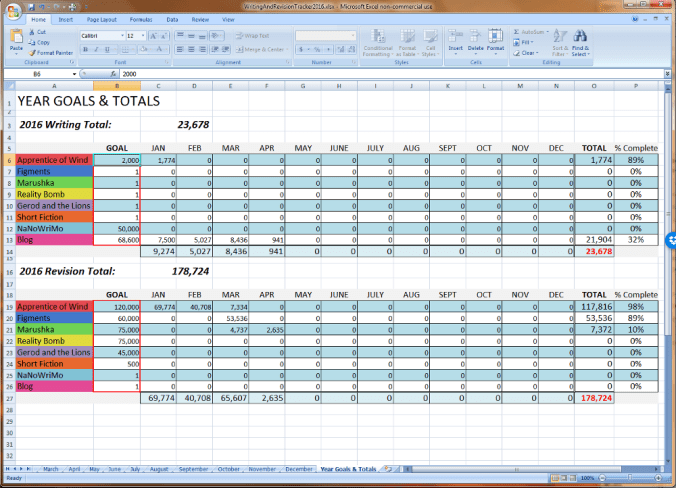
Year Goals and Totals page

The current draft of AoW stands at 119,590 words. So 120K, which is reasonable for an epic fantasy.

I then moved onto Figments, my YA urban fantasy. It’s considerably shorter, nineteen chapters, and 53,536 words. I know I’ll have to punch that up a bit, but I have a number of ideas to make that happen.

Both of these novels were drafted, let to sit, printed out, read through, mapped, let to sit again, read through again, and then reviewed. I just changed some of the major things, POV, character deletion, consistency over the novels (in the case of AoW), and notes for future revision.

I don’t think I’ll need as many drafts of either AoW or Figments as I needed with IoS to finish them to my satisfaction.

I’m trying something different with Marushka, which I moved on to in the last few days of March.

My revision plan so far has been to review a chapter a day, which was challenging for AoW and Figments, because a number of the chapters of both were several thousand words long. I often found myself up until midnight on a weekday trying to get my work finished before I went to bed.

Marushka was the first novel I drafted using Scrivener and it really changed the way I drafted. The chapters are comparatively tiny (1000 to 1500 words so far) but there are a lot more of them (54).

I didn’t print Marushka out. I didn’t read it through or map it. As I review each chapter, I’m reading it through for the first time and mapping it as I go.

We’ll see if this is more or less productive than printing the draft out, and reading and mapping it out prior to my first run through.

I’m approaching this year of revision as an opportunity to experiment. My process is in continual evolution and, as I learn, from both success and failure, I’m seeing improvement in my process and in my writing overall.

I’m not looking for short cuts as much as efficiencies. I’m not doing any less work, I’m just doing it differently.

Again, we’ll see how it goes.

So here’s how the month breaks down.

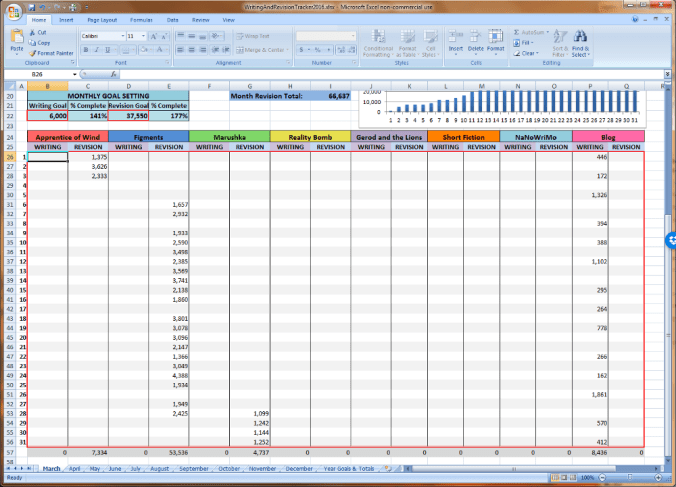
MarchProgress

MarchProgress1

Want your own Writing and Revision Tracker? Visit http://jamieraintree.com/writing-revision-tracker

  • AoW – 7,334 words revised
  • Figments – 53,536 words revised
  • Marushka – 4,737 words revised
  • Blog – 8,436 words written.

I achieved 141% of my writing goal and 177% of my revision goal.

At this rate, I’ll finish the first run through on Marushka part way through May and move onto Reality Bomb and finally, Gerod and the Lions. Once I’ve got everything reviewed once, I’m going to take a break (which I tend to need in the summer months) and work on my outline for Mistress of Waves, the third book in my Ascension series and NaNo 2016 project 🙂

Then I’ll get back to deeper revisions until November arrives. I may not be able to conquer more than IoS/AoW. Maybe I make it as far as Figments.

Querying continues. I’ve not devoted much time to short fiction recently, though.

As far as conferences and conventions, I’m hitting Ad Astra (April 29-May 1), The Canadian Writers’ Summit (June 15-19, though I’ll only be attending June 17-19), and WorldCon, AKA MidAmericon II (August 17-21). I have paid my fees and reserved accommodation, but it’s all pending leave approval.

I’m holding my breath until I know it’s approved. Once it is, I’ll be able to book my flight to Kansas City.

My employer asks us to apply for leave every six months. We apply in March for the first half of the fiscal year, April to September, and in September for October through March. Approval is subject to seniority and operational demands (peak seasons).

I should know whether this first round of leave requests has been approved by the end of April.

My plans for fall and winter will have to wait on the approval of the second round of leave in October.

I’ll save those potential plans for a later update.

For the remainder of this month, I’ll be offering some Series discoveries posts (fall season, part two, mid-season follies, and anime) and at least one book review (Jane Ann McLachlan’s second Kia novel, The Salarian Desert Game).

As of Ad Astra, the convention reportage will resume.

So there’s lots of Writerly Goodness to look forward to, and of course, Tipsday and Thoughty Thursday curations will continue through the week.

In the meantime, break a bunch of pencils, you wonderful, creative people.

The Next Chapter

Thoughty Thursday: Things that made me go hmmmm on the interwebz, March 20-26, 2016

Topics run the gamut in this week’s batch of thoughty. I was hard pressed to know how best to present it all. I hope nothing jars too much. Then again, sometimes you need a week jolt to get the big squishy (brain) into gear 😉

This is why Finland has the best schools. The Syndey Morning Herald.

National Arts Centre to launch indigenous theatre in 2019. The Globe and Mail.

Tay exposes the lies we tell ourselves about racists. New Republic. Peter Bright reviews the Tay AI debacle for Ars Technica.

UN Women ask men and women to switch roles:


One woman tells her story of reporting sexual abuse. The Globe and Mail.

Scaachi Koul: I hope the Ghomeshi verdict makes you fucking furious. You know? It really does. Buzzfeed.

Barbara Moran writes about her mother’s death and how it indicates a greater system failure. The New York Times.

Your drunken aunt was right: the art of the hot toddy. Vinepair.

University Affairs devotes an entire issue to mental health and universities.

Brenda Knowles knows how to save an introvert/extrovert relationship.

Kira Asatryan offers six simple strategies for being happy alone. Time Magazine.

ASAP Thought. Should you trust your astrological sign?


Einstein is (almost) always right. It’s okay to be smart.


The equinox isn’t what you think it is. It’s okay to be smart.


NASA captures the crazy shockwave of an exploding star. Slate.

Earth is about to pass through the tail of Halley’s Comet, giving us a month of meteor showers. IFLS.

Another lovely picture of a strange geological formation on Mars. Slate.

19 pieces on non-human DNA found in the human genome. Yup we got junk in there. IFLS.

Covão dos conchos. A-MA-zing! The real interesting part in about 2:25.


Looks like Monty Python had it right. Rabbits (in medieval times) were deadly! The Poke.

Explore the tear-filled (and slightly creepy) world of Marina Bychkova’s dolls.

The White Wolf Pack shares these lovely photos of ravens. Have I even mentioned that corvus corvus rocks my world?  😉

Hope something in this mix gets those fingers moving on the keyboard. Inspiration’s what this is all about.

All the best until Saturday when my next chapter update lands!

Thoughty Thursday

Tipsday: Writerly Goodness found on the interwebz, March 20-26, 2016

Holy shemoley! Lookit all the Writerly Goodness!

Ok. This is big news around here. Sudbury has a new poet laureate, and its first woman in the role, my awesome soul sister, Kim Fahner! The Northern Life. And here’s the interview she did with Markus Schwabe of the CBC’s Morning North. She had a cold, but it’s still a fabulous interview 🙂 She’s on her way to Banff right now to work with the wonderful Mr. Lawrence Hill!

Jane Friedman points out the pros and cons of maintaining a personal profile versus a professional page on Facebook.

Susan Spann advises us when a book is considered out of print. Writer Unboxed.

Jed Herne guest posts on The Better Novel Project with The Half-Blood Prince guide to question arcs.

Michelle Hoover writes an excellent guest post for Writer Unboxed on the duplicity of a character’s desire.

John J. Kelley explores the art of the plausible for Writer Unboxed.

Barbara O’Neal discusses the matter of talent. Writer Unboxed.

C.S. Lakin offers three ways to keep readers reading past page one. Live, write, thrive.

Tiffany Lawson Inman explains how to build dramatic momentum in fiction. Writers in the Storm.

Janice Hardy explores the ebb and flow of plotting a novel. Fiction University.

K.M. Weiland’s back with five more ways to trim your novel’s word count. Helping writers become authors. Later in the week, she helps us choose the right protagonist.

Kate Elliott gives us the tools to write women characters into epic fantasy without quotas. Tor.com

Awesome: How do we write about diversity when the word has lost its meaning? With Daniel José Older, Ashley Cassandra Ford, and Tanwi Nandini Islam. Elle. (Really? Yuh-huh.)

Steve Kettmann: On knowing what to leave out. Medium.

Victoria Mixon shares her super-easy formula for creating a blurb.

Ruthanne Reid points out the two most important words for writers: don’t quit. The Write Practice.

Kerry Lonsdale writes an open letter to writers at every stage of publishing. Books by Women.

Kameron Hurley ponders her sales.

J.K. Rowling shares rejection letters on Twitter to help beginning authors. The Guardian.

Jamie Raintree explores how to decompartmentalize your art.

Anna Lovind bares herself in this post on the process of creative transformation.

Dan Blank shares what he’s learned from 30 days of vlogging.


Thinking about a writers’ retreat? Sarah Selecky gives you a place to start looking.

Madeleine Dore offers 50 ways to take care of yourself in the arts. Performing Arts Hub.

Robert J. Sawyer shares his creative process with Inverse’s Lauren Sarner.

Where five Canadian authors read. The Globe and Mail.

Buzzfeed lists 21 German words we should be using in English.

Victorian doctors thought reading novels made women incurably insane. History Buff.

On the other hand, art is proven to have mental health benefits. The Butler Collegian.

National Geographic lists its top ten book stores in the world.

Daniel José Older: Notes on love and revolution. Guernica Magazine.

Brainpickings shares Charlotte Brontë’s love letters.

The Telegraph lists ten novels with titles from Shakespeare.

Shakespeare’s skull stolen from grave. BBC.

15 Welsh myths and legends. Wales Online.

Michael Boyle and Daniel A. Kaufman wish Babylon 5 a happy birthday. This is one of my all time favourite series. The Electric Agora.

I don’t know about you, but I’m exhausted!

See you Thursday 🙂

Tipsday

Mel’s Movie Madness: March 2016 edition

Though I have seen more movies recently, I’m going to focus on four: Ant-Man, Deadpool, Sword of Destiny, and Pixels (believe it or not).

Ant-Man

I watched it recently on cable and enjoyed it. Marvel is doing a fairly consistent job of offering an entertaining movie experience, in my opinion, anyway. [Please note: I’ve also watched Avengers: Age of Ultron, but I wasn’t as thrilled with that movie and other reviewers have done a much better job than I can of pointing out its shortcomings.]

I liked the brief frame at the beginning of the movie with a young Dr. Hank Pym facing off against an aged Peggy Carter and Howard Stark, denying them, and the government, access to his technology.

I also appreciated the decision not to pursue this as Hank Pym’s story, per se. I think it makes for a much richer backstory in a more global sense.

Paul Rudd does a good job portraying Scott Lang, an engineer turned ethical thief burglar, who, upon his release from prison determines that he will not, for the sake of his family, continue to pursue his criminal ways. Sure, he was a geeky Robin Hood, stealing the ill gotten gains of corporate America and returning them to the victims customers from whom they were originally obtained, but his ex-wife, now dating a cop with a hate on for Lang, would never let him see his daughter again.

Re-enter Hank Pym, now retired and attempting to foil his former protégé from enacting a corporate takeover and selling Pym’s secret technology (which he has reverse engineered) to the highest bidder.

Pym needs someone expendable, not his daughter, Hope, who has remained in the family tech firm as a spy and who would like nothing more than to carry on her father’s legacy. In short, Pym needs Lang.

Pym’s been hiding more than the Ant-Man suit, though. Hope’s mother, A.K.A. Wasp, was lost in the quantum realm (not adequately portrayed, but we have no scientific context, so what the hey) during her last mission with Pym and was the main reason Pym decided the technology had to be hidden.

Lang is recruited in a so-convoluted-as-to-be-absurd sting operation and his determination to go straight crumples at the first real challenge, but overall, I found the movie entertaining and the denouement satisfying in a sappy way. The teaser in the credits was also satisfying and sets up the next instalment nicely.

Deadpool

I had to drag Phil out to see this one in the theatre. I knew from the trailers that it was going to be all kinds of irreverent, politically incorrect, and infantile humour. Right up our alley (lol).

From the opening freeze frame to the Ferris Beuller’s Day Off teaser in the credits (there was a second, plot-oriented one as well), we loved it. I know a lot of critics have stated their disappointment in the film, but I respectfully disagree. Let them say there’s no accounting for taste. I’m good with that.

Wade Wilson is a killer. He manages to function because of his startlingly off-colour and scatological sense of humour. Post Special Forces, he works as a mercenary, but we have a perfect “save the cat” moment when we get to see the nature of (at least one of) his current assignments. He protects children from bullies.

After he finds the love of his life, the clichéd hooker with a heart of gold (but really, isn’t it a perfect match?), karma catches up with Wade in the form of cancer. There is no cure. So, in desperation, he signs up for the experimental treatment of all experimental treatments, enforced genetic mutation.

Wade’s lucky (kind of). His genetic mutation expresses itself as immortality. He can, essentially, survive any physical injury, even dismemberment. His cancer is cured. The price? He now looks “like an avocado had sex with an older avocado . . . your face is haunting.” It’s really not that bad. Admittedly, he looks like he’s had first degree burns over 100% of his body, but it doesn’t make me want to vomit (c’mon, it’s Ryan Reynolds).

Then, the guy who transformed Wade and tried to kill him kidnaps Wade’s girl. The game is on.

Colossus and Negasonic Teenage Warhead are there mostly to highlight the contrast between the typical X-men we’ve met to this point and Deadpool. Actually, they may provide analogues for the two negative reactions audience members might have to Deadpool as well.

Deadpool exacts his revenge without remorse. He kills. Unapologetically. Even as Colossus tries to “show him a better way” and Negasonic Teenage Warhead reacts with a solid “meh” to everything he says and does, Deadpool bulldozes through his nemesis’s minions, has an epic throw down, and saves his girl.

Of course, he must then face said girl’s displeasure because he left her without a word months ago.

It’s all good in the end, though.

You just have to leave your maturity at the door and enjoy the movie. Seriously.

The Sword of Destiny

This is a Netflix original movie and a sequel to Crouching Tiger, Hidden Dragon. Michelle Yeoh returns as Yu Shu Lien, the only survivor of the first movie. [This is the Chinese tradition. Most stories, except those for children, are tragedies. Please don’t hate a movie because of its genre or tradition.]

Li Mu Bai’s legendary sword, the Green Destiny, becomes the focus of a warlord who wants to possess its power in order to ensure his military domination of the region.

Yu Shu Lien once more becomes involved when she travels to honour the death of the man who has been entrusted with the sword’s protection. She is soon reunited with Meng Sizhao, also known as Silent Wolf, the man she was to marry prior to the events of Crouching Tiger, Hidden Dragon. She thought he’d died fighting the warlord Hades Dai, but Silent Wolf only thought to offer her the choice to marry her true love, Li Mu Bai, and let everyone think he’d died.

There is another young, star-crossed couple, witches, vendettas, and a lot of fabulous martial arts battle scenes. The Sword of Destiny isn’t as epic in scope as the first movie, but it is a solid follow up.

Though it may be a spoiler, they eschew the traditional ending for one more suited to Western audiences.

Pixels

This movie surprised me. I hate Adam Sandler movies on principle, but this one was bearable. Colour me amazed. There were many cringe-worthy moments and a number of huge plot holes, the effects were cheesy (but that’s probably because they were all based on 80’s video arcade games), and the acting was over the top, but it actually has some storytelling chops. And I laughed my ass off. Peter Dinklage in a mullet—gah!

Crazy, eh?

Warning: This one is totally spoilery.

The movie begins with critical backstory. In 1982, Sam Brenner and Will Cooper attend the World Video Arcade Gaming Championships where Ludlow “The Wonder Kid” Lamansoff joins them and they dominate the competition until, in the final, Eddie Plant, the returning champion, defeats Brenner at Donkey Kong.

From this experience, Brenner learns that he is a loser, and it is the lie that defines his life.

Flash forward to adulthood and Brenner is a member of the Geek Squad while his buddy, Cooper, is President of the United States (yes, strains credulity, but bear with it. It’s actually one of the least absurd events in the movie).

After meeting up with his bud, the President, at a local media event, Brenner has to install a new gaming system. The boy, Matty, informs Brenner that he’s received the system not because it’s his birthday, but because his parents are getting a divorce.

Brenner bonds with Matty over gaming, and comforts Matty’s mother, Violet, by revealing his own sad story on infidelity and betrayal. They are both called away after an awkward personal moment and each accuses the other of following them all the way to the White House, where Violet, Lieutenant Colonel Van Patten, has been summoned to an emergency meeting, and Brenner has been called in for moral support.

A strange alien attack has taken place, pixelating a US Military Base in Guam. Brenner recognizes the form of the attack as one of his 80’s video games, but his insane suggestion is dismissed, and so is he.

Lamansoff, now a conspiracy theorist, has hidden away in Brenner’s Geek Squad van and reveals himself to Brenner. At Lamansoff’s basement lair, he reveals a video taped message from the alien enemy. They’ve used 80’s television to deliver their ultimatum.

After the World Video Arcade Gaming Championships, a time capsule of all the arcade games was sent off with one of the deep space probes. Aliens retrieved it, and interpreted it as a declaration of war. They have created light weapons based on all of the 80’s video games and Earth will have three lives, and three chances to beat the aliens. If Earth fails, it will be destroyed.

Brenner and Lamansoff take the tape to President Cooper, and while the military dismisses them again, the aliens attack and destroy the Taj Mahal with Araknoid. They only have one chance left and the President gets the military on board. Violet creates light canons to fight the aliens and Brenner and Lamansoff try to train Navy Seals to fight them.

When the aliens attack next, using Centipede, the Seals prove unable to master the patterns of the game and anticipate the attack. Brenner and Lamansoff must take over and use their expertise to defeat the enemy.

The next challenge is issued. Pac Man will attack New York. Eddie Plant, who is serving time for fraud, is sprung from prison and Toru Iwatani, the inventor of Pac Man, is recruited. Though the team, now called the Arkaders, defeat Pac Man, Toru is injured and Eddie ends up in the drink.

At the victory celebration, Matty discovers that Eddie had cheat codes etched into his aviator shades. Eddie confesses that he used the same trick to defeat Brenner in 1982. The aliens announce that the Arkaders violated the rules of the game and Earth is now forfeit. They abduct Matty.

The Arkaders are stripped of weapons and abandoned; the military will take things from here. Cooper absconds with four light canons, and joins Brenner, Lamansoff, Violet, and a contrite Eddie in an attempt to avert disaster.

The final confrontation pits Brenner against the alien leader in—you guessed it—Donkey Kong. Matty and two other captives stand in the place of the princess as the prize. Brenner struggles until Matty reveals Eddie’s cheating during the battle against Pac Man and back in 1982.

Brenner rallies, beats the game, and saves the world.

Like I said at the outset, this is a deeply flawed movie, but the storytelling works well enough to save it.

I won’t necessarily recommend it, but I had to mention it in this review because it demonstrates the power of solid storytelling.

Yeah. That’s kind of the way I felt O.o

See you on Tipsday.

Mel's Movie Madness

Thoughty Thursday: Things that made me go hmmmm on the interwebz, March 13-19, 2016

Short on the thoughty this week (again).

Since this past week included St. Patrick’s Day, Quirk Books decided to share three magical Irish creatures cooler than Leprechauns.

On St. Patrick’s Day, I went to see a new local Celtic folk band, Fagroongala. Here’s the interview from CBC’s Morning North. They were awesome, by the way 😉

Creativity requires time.


Cree mythology is written in the stars. CBC’s Unreserved.

Rob O’Flanagan takes grief for a walk in the woods. Guelph Today.

Do fame and material success make you happy? Think for yourself.


The #IStandUp #WomenNotObjects campaign highlights the harm done to society by objectifying women.


Apparently, burning NH4Cr2O7 and HgSCN opens a portal to hell . . .


Hope you’ve been inspired. See you Saturday!

Thoughty Thursday

Tipsday: Writerly Goodness found on the interwebz, March 13-19, 2016

A little craft, a little business, and a lot of writerly randomness 🙂

K.M. Weiland shares five ways to trim your novel’s word count (part 1). Helping writers become authors. Later in the week, she helps us learn how to write deep and rich story conflict.

C.S. Lakin explains how novelists can benefit from using cinematic scene structure. Live, write, thrive.

Carly Watters interviews Susan Spann for her things I wish I knew series: navigating publishing contracts.

Mike Shatzkin posits that as the industry changes, publishing houses must make changes, too.

Selena Kitt exposes Kindle Unlimited scammers.

How to write an award winning, bestselling novel. Nathan Filer’s TED Talk:


Neil Gaiman discusses how stories last. BrainPickings.

Yann Martel invites us into his writer’s room. The New York Times Style Magazine.

Books about white, middle-class men send our students the wrong message. Olivia Eaton for The Guardian.

Bustle presents six reasons reading is amazing for your health.

This is just darling: The Chronicle Books Blog shares images of dogs mesmerized by the magic of reading.

Mental Floss lists 40 highfalutin H-words to heighten your vocabulary.

On the other end of the scale . . . cunty, cuntish, cunted, and cunting are added to the Oxford English Dictionary. Jezebel.

Things men say when a woman author confesses her profession. Lenny.

Oooh! Ima see this! Ms. Peregrine’s Home for Peculiar Children.


And that’s Tipsday for this week! Come back on Thursday for your weekly dose of thoughty!

Tipsday