Ad Astra 2016, day 1: The influence of Shakespeare on science fiction and fantasy

Disclaimer: I am not perfect and neither are my notes. If you notice anything that needs correction or clarification, please let me know: melanie (dot) marttila (at) gmail (dot) com and I fix things post-hasty.

Panellists: Kate Heartfield, Arlene F. Marks, Kate Story
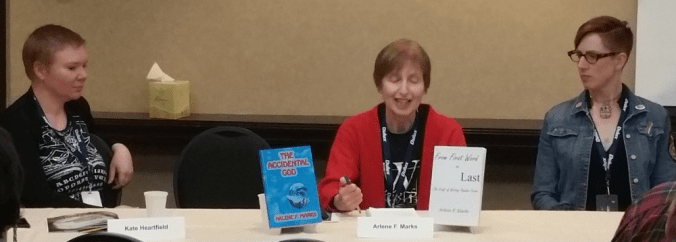
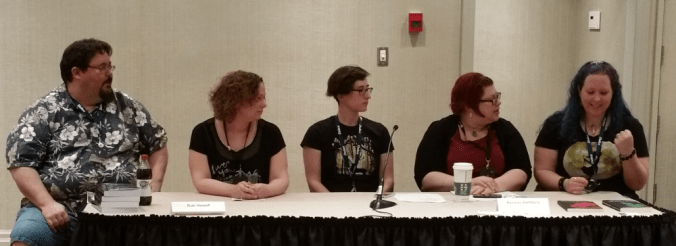
ShakespearePanel

AFM: Shakespeare’s plays were, in his time, entertainment and education. They’re lessons in history, then and now. They also were some of the earliest examples of genre. Hamlet is, in part, a ghost story. MacBeth can be seen as urban legend. A Midsummer’s Night’s Dream is fantasy.

KS: Shakespeare needed to make a living. That’s why he wrote. He was a great enabler of public discourse.

KH: You don’t have to go far to find gender queer characters in Shakespeare.

AFM: The Hogarth Shakespeare series from Penguin Random House is asking well-known authors, like Margaret Atwood, to re-imagine his plays. That’s the brilliance of Shakespeare. You can put any one of his plays into any era or milleu.

KH: A lot of adaptations of his work are coming out because it’s the 400th anniversary of his death.

KS: My father was a scholar in Newfoundland. We had a cultural renaissance in the 60’s and 70’s and we started to make some connections. Maybe we have something to offer to the tradition. I think the spirit of Shakespeare’s time was close to Newfoundland’s now. Shakespeare has always been there and has always been an influence. Shakespeare’s women were far more realistic than the women characters of many modern playwrights.

[Kate then performed the monologue from her story in Carbide Tipped Pens, edited by Ben Bova and Eric Choi. It was a variation of Romeo and Juliet, set in space. She’s currently working on the stage play. I just sat back and enjoyed 🙂 ]

Ian McKellan said in an interview, “Where in the modern world would it be so wrong for two people to fall in love?” It resulted in a 70’s production of Romeo and Juliet set in Belfast.

AFM: In Shakespearean times, it was forbidden for women to go in stage. All women’s roles were played by men, or, more often, boys. The audience was very demanding. If they didn’t like a play, or the actors, they brought rotten vegetables to throw.

KS: He was asking the audience to be clever, to know it’s a man playing a women, pretending to be a man. It engaged the audience, drew them in.

AFM: It’s the fiction of the people. The only publisher that approaches this today is Harlequin, who would hold regular “reader appreciation” luncheons to meet their most popular authors. In Shakespeare’s day, there would be nobles and prostitutes in the same audience. It was whoever had the money to pay.

KS: It was nuts for the theatre. A sixth of the population of London would attend the performances.

KH: The culture of fandom/fanfic has a lot in common with the culture of Shakespeare. There’s nothing more Shakespearean than fanfic. Most of Shakespeare’s plays were drawn from earlier works. He borrowed liberally from Ovid.

Q: Shakespeare’s plays address universal themes. The more popular ones get done. Some might say overdone, but the historical plays are ignored.

KS: My theatre did a gender-swapped Taming of the Shrew.

KH: The film industry has done a better job. My Own Private Idaho, The Hollow Ground series, Looking for Richard.

AFM: A Thousand Acres was the story of King Lear. Shakespeare was brilliant of using every member of the company. There were often comic actors. Characters like Falstaff were written for them. If there were acrobats, he’d give them something to do. They had to be very practical in terms of costuming for these reasons.

KH: Titus Andronicus and Troilus and Cressida were essentially horror. Shakespeare was a great worldbuilder. He was consistent in terms of how fairies, spirits, and witches behaved. His idea of Titania was dark, but comic. Fairies had an alien sense of good and evil.

AFM: He built on the motivations of all his characters.

And that was time.

Next week: The do’s and don’ts of writing erotica (oh, my!).
Debunking creative myths for DIYMFA

This week’s QotW prompt is this:

Today we’re shifting gears a bit. In chapter 6 of DIY MFA, I debunk five myths about creativity. These myths are:

  1. Creativity is an exclusive club, and you can’t be part of it.
  2. Creativity is innate–you either have it or you don’t.
  3. Creativity is driven by chaos, so there’s no way to control it.
  4. Creativity is all about getting that one “Big Idea.”
  5. Creativity is focusing on an idea until it’s perfect.

We were to choose one and run with it.

Gabriela, however, wrote about her struggles with numbers three to five.

So . . . I’m going to tackle one and two.

I’m firmly of the opinion that everyone is creative in their own way and in their own realm of expertise. Just because my creativity expresses itself in the invention of stories doesn’t mean that everyone’s will work the same way.

My husband, for example, is, as I have mentioned before on this blog, Mr. Science. His first career was as a medical laboratory technologist. Now, he’s a network administrator, but he is also a programmer, and technical wizard. His hobbies include geology, astronomy, and cosmology.

Since he works for a charity, he has to find ways to do things economically. This means doing a lot of the work himself. He’s developed the registration system for his employer’s summer camp program. He’s put together their passcard system for the enhanced change rooms. He created their web page (someone else was responsible for the graphics and content) and has it set up so that the other employees in various departments can update content themselves.

Now, he’s working on a new program which will focus on finding work placements for autistic youth. His role is to develop his employer’s documentation and reporting system for the program.

He is so creative in his realm of expertise.

Creativity isn’t just about making art. It’s about making an art out of the work you do.

To shift gears a bit, my weekly curation posts are all about fostering the creativity of my followers.

I long ago realised that I’m not in a place in my career where I feel comfortable imparting writing advice. There’s so much of it out there on the interwebz and it’s shared by people who are far more articulate that I can be at this point.

I follow a lot of these people and so, when I come across a writing post or article that really speaks to me as a writer, I share it. A few years ago, I collected these posts into a weekly curation I call Tipsday. It’s kind of like an informal learning opportunity for writers. I’ve learned so much from the people I follow, I just want to share the wealth of their knowledge.

Other things pop my mental corn. Yes, just sit with that image for a minute. Your skull is a big pan, full of popcorn, apply heat (interesting posts and articles), shake it around, and pop! Pop-pop-pop-pop-pop!

This used to happen all the time in university. I’d see connections between all the seemingly random things I was learning and the ideas would go zinging around inside my head. That’s when I started journaling, and when I started working on my first novel.

I also think about the movie Working Girl in this context. The protagonist, Tess, gets great business ideas from reading the society column and business articles in the paper. Disparate ideas coming together to make awesome.

That’s what Thoughty Thursday is all about.

While Tipsday is pretty much focused on writing, Thoughty Thursday could help anyone be creative in any endeavour. I just hope that the things that interest me might have some kind of positive impact on others.

And so there you have it. My take on creativity. It’s not en exclusive club and it’s not something you have to be born with. It just takes a few juicy ideas to get things going.

I’ll be back tomorrow with more Ad Astra reportage.

TTFN!

Muse-inks

Thoughty Thursday: Things that made me go hmmmm on the interwebz, May 8-14, 2016

Lots of thoughty for your big squishy brains this week!

The Jian Gomeshi case was in the news again this week. Another complainant came forward, but chose not to go to court and accept a peace bond. The agreement? Gomeshi would admit his wrongdoing and apologize publically. Kathryn Borel released this statement outside court after the unsatisfying apology. The Toronto Star.

Sandy Garossino reports that Borel’s counterpunch blindsides Henein and knocks out Gomeshi. National Observer.

The UN champions essential services for survivors of violence against women and girls.


Here are a couple of fabulous articles by Lindy West. First, the ‘perfect body’ is a lie. Then, break the period taboo. The Guardian.

Are you a cool girl? ASAP Thought wants you to help dismantle the patriarchy 🙂


Latinos are now the largest ethnic group in California. The Los Angeles Times.

You may remember that I’ve mentioned in the past how careful we need to be with media reports of scientific studies. This explains why. Last Week Tonight with John Oliver: Scientific Studies.


How World War II changed Walt Disney. Time.

Clint Edwards gleans lessons from The Goonies, and from the loss of unsupervised time for kids. The Washington Post.

John Reed tells a tale almost too creepy to believe: my grandma, the poisoner. Vice.

The CDC releases new statistics on suicide in the US.

And on the other side of the death coin: when patients and doctors disagree about end-of-life care. The Washington Post.

Sarah Kurchak shares depression-busting exercise tips for people too depressed to exercise. The Establishment.

Not to be facetious, but Emily Hartridge lists 10 reasons why . . . she’s grateful to have anxiety.


BigThink offers proven tools for lifting a bad mood.

IndiHope lists 51 Dr. Seuss quotes on happiness.

This is just cool. The brain dictionary, on AmpLIFEied.

Kepler reveals a new bounty of exoplanets, including nine in the ‘Goldilocks’ zone. Phil Plait for Slate.

It’s okay to be smart. The cosmic afterglow:


William Gadoury discovers a link between the constellations and the locations of Mayan cities. YourNewsWire.com

And this is just funny. Ken Ham tried to disprove science using . . . science. Epic fail. Slate.

It’s okay to be smart: the most important moment in the history of life:


Weird science: can corpses turn to stone?


David Bowie on being authentic:


The Buddha Weekly focuses on the consciousness of non-human beings. I’m really sorry. I enjoy the meats 😦

Have a happy Friday, and we’ll see you on the weekend!

Thoughty Thursday

Tipsday: Writerly Goodness found on the interwebz, May 8-14, 2016

All kinds of writerly goodness for you this week!

K.M. Weiland has made no secret of her disappointment in the Star Wars prequel trilogy. In classic Kate fashion, she gleans writerly goodness from the experience. Planning your story: what George Lucas can teach you (not) to do. Helping writers become authors.

Later in the week, she offered eight tips for writing child characters.

Jessi Rita Hoffman explains how to write a thrilling action scene for Writer Unboxed.

Sophie Masson shares the building blocks of great young adult fiction. Writer Unboxed.

Lisa Cron advises: don’t accidentally give your characters a time out. Writer Unboxed.

Margaret Dilloway explores overcoming impostor syndrome for Writer Unboxed.

Christine Frazier shows you why your hero should eavesdrop and make a bad assumption (in four steps). The Better Novel Project.

Janice Hardy looks at writing a character with a gender not your own. Fiction University.

Dan Koboldt offers some tips for creating fundamentalist religions in fantasy.

Chris Winkle offers strategies for defeating the contrivance boogeyman. Mythcreants.

Jami Gold wonders if your plot obstacles are too easy, too difficult, or just right?

Jennie Nash studies great opening lines. The Book Designer.

Chuck Wendig advises us to defy reality and become artists. Terribleminds.

Jami Gold explores how to reach your potential through writing feedback.

Angela Ackerman offers six rules that will keep your critique partnerships golden. Writers helping writers.

Gabriela Pereira interviews Charlaine Harris for the DIYMFA podcast.

Annie Neugebauer says, don’t hate the query—master it! Writer Unboxed.

Janet Reid shares a checklist of things you need to be thinking about between offer and acceptance.

Susan Spann offered some advice on royalty clauses in publishing deals and how authors get paid. Writers in the Storm.

Karina Sumner-Smith guest posts on Janice Hardy’s Fiction University: is a quick release schedule right for you and your books?

My friend, Kim, is back on the road. This time, she spends an afternoon with Margaret Atwood.

Micah Solomon offers three books that will help you to radically improve your writing. BookBaby

Cory Doctorow shares his vision of how publishers, libraries, and writers could work together. BoingBoing.

Delilah S. Dawson wrote this beautiful post on writing and grieving: someday this pain will be useful to you.

Natalie Zutter shares Nnedi Okorafor and N.K. Jemesin in conversation: masquerade, initiation, and science fiction and fantasy. Tor.com

Bustle wants you to diversify your reading list with these 23 LGBTQ books with a person of colour as a protagonist.

What Bustle says your to-be-read list says about your personality.

Ferris Jabr revisits the lost gardens of Emily Dickinson. The New York Times.

Kathryn Hughes looks at the dystopian world of Beatrix Potter. The Guardian.

Shakespeare and death:


Women swept the Nebulas! i09.

Jo Walton reviews Ada Palmer’s Too Like the Lightning for Tor.com.

A Ken Liu short story will be made into a movie. i09.

John Marcotte reports that Marvel is committing to a Black Widow movie (at some unknown point in the future). Heroic Girls.

And, speaking of Marvel, the next X-Men movie is due out May 27th: X-Men Apocalypse.

Here’s the teaser:


And the official trailer:


Buzzfeed shared what was a sneak peek of Outlander’s next episode (I saw it Sunday) but I thought I’d post it anyway. “Ovaries explode!” – funnee.

See you Thursday for some thoughty stuff 🙂

Tipsday

Ad Astra 2016, day 1: The relationship between self-publishers and editors

Disclaimer: I am not perfect and neither are my notes. If you notice anything that needs correction or clarification, please let me know and I’ll fix it post-hasty.

Panellists: Rob Howell, Jennifer Jaquith, Charlotte Ashley, Beverly Bambury (moderator), Vanessa Ricci-Thode

SelfPubAndEditorsPanel

VRT: There are three types of editing: the substantive edit, line editing, and copy editing. The substantive edit is also called a comprehensive edit, or a structural edit. It’s big picture stuff. Does the story make sense, is it compelling, are characters distinct, are story events consistent, are there too many or too few characters? Line editing looks at the story on a paragraph/sentence level. Given your style/voice, is each sentence written well, does each paragraph make sense, do your transitions flow? Copy editing is the nitty, gritty stuff: spelling, punctuation, and so on. There are places where the various editing tasks might overlap. In doing a line edit, some spelling and punctuation might be addressed.

RH: My editor works with me in stages. She’ll address global concerns first, then move on to more detailed editing. My mom’s a professional copy editor, so I have that covered.

BB: I don’t work with a self-publisher who hasn’t had at least one professional edit done on their book. What are the common issues editors see?

JJ: I have a list of hit words. Seems, felt, just, started to, etc.

CA: People who come to me at the wrong stage are a challenge. I love writers who come to be expecting the cost and work involved. Writing is a process of drafting and resting, but some people are on deadlines and they can’t do that.

NRT: Writers make the same mistakes over and over. Mixing tenses, head-hopping, showing versus telling. If you enter into a relationship with your editor, we get to know your particular weaknesses and look out for them.

BB: I look for the crutch words . . . actually, as I see it. Filler words that don’t really add anything to the work.

RH: I am guilty of overusing the shrug. I use it a lot. My editor points it out so I can fix it. You need an editor who can see your faults.

BB: How did your relationship with your editor evolve?

RH: When I was writing academically, I had my ego knocked out through editing. We’d debate the amount of white space on the page.

BB: Editors, how is it from your perspective?

VRT: I use beta readers for structural editing, but otherwise, I depend on my editor.

CA: I write short stories. You don’t get edited until the story is accepted for publication.

JJ: I’m a possessive writer. In technical writing, you hand everything over to the editor. I don’t argue and nine times out of ten, I’ll make the requested changes. Sometimes I don’t know how to improve the piece.

BB: I wrote a piece for Dirge. A friend of mine turned out to be a sexual predator. It was very internal. The editors helped me turn it into a personal essay. You have to trust the process.

CA: I write a lot of non-fiction as well. I once wrote a book review and the editors cut it up. I didn’t know until I saw it in print and at the time, I thought they hadn’t liked it. It turns out it was a matter of the space they had to devote to the review.

RH: If you’re a writer, the most terrifying moment is when you have to send your work off. I know I have someone on my side. It’s still terrifying, but it’s better.

BB: Do you have a success story you’d like to share? What constitutes a successful relationship?

RH: I’m the driver of the race car, the jockey on the horse, what have you. We all do our parts, everything comes together, I read the manuscript one last time, and if I think “I like this,” it’s a job well done.

JJ: You have to understand that the editor wants to like your work. They want to make it better. You have to be open to questions and discussions. You have to make a connection.

CA: A successful client is one who comes back to me. Some don’t come back, or they come back years later and say “you were right.”

VRT: Authors who come back, who are happy with the results, who are willing to do the work.

BB: The editor is rooting for the writer. Everyone needs an editor.

Q: How much time does a substantive edit take?

VRT: It varies, but I can review an 80 to 100 thousand word manuscript in 30 to 40 hours. Sometimes I might recommend a manuscript evaluation. It’s focused on overall strengths and weaknesses.

RH: Scheduling is important. I create a schedule so I can produce consistently. I try to write three books a year. My business model works because I produce. I have 2016 all planned out.

BB: That’s a good point. How far in advance should a writer make contact with the editor?

AC: I like two months lead time.

Q: What’s better proofreading or beta readers? And if you have betas, do you still need a developmental editor?

CA: An editor will be able to tell if your work needs a developmental edit.

VRT: A good editor will be honest.

RH: I chose my beta readers for specific reasons. I have a friend in martial arts who looks specifically at my fight scenes. I have a horse person who looks at logistics and whether I’m treating my fictional horses right or not.

Q: When you’re doing a developmental edit and you hate the story, what do you say?

VRT: I can tell the author that I’m not the right editor for this piece. I’m a member of the Editors’ Association of Canada (EAC) and we make referrals to one another.

CA: When someone says to me they’ve sent the manuscript to 500 agents and 1000 publishers and nobody wants to take it on, I know I have to be cruel to be kind. An editor can’t sell your novel for you.

JJ: I can’t edit horror. I can’t sleep.

CA: There are some issues I can’t handle in a manuscript. Racism or sexism is a definite “no” for me.

BB: As a publicist, I see some things that bother me. People of colour who are stereotypes, pedophilia.

Q: How do you generate a client list?

VRT: I work through the EAC and referrals mostly, but I get some clients through social media and networking.

RH: I have an embarrassing story for you. My editor Kelly and I have known each other forever through the Society for Creative Anachronism (SCA). The first two editors fell through and only after I was working with the third and had my first book out did I find out that Kelly was an editor.

CA: I get most of my clients through word of mouth.

Q: How much should I expect to spend?

CA: A substantive edit usually runs about $2000. Proofreading can be $300. Expect to spend between $500 and $1000 on average.

And that was time.

Next week, one of my favourite sessions from this year’s Ad Astra: The influence of Shakespeare on  science fiction and fantasy.

Best practice epic fail

How’s that for a sensational headline? 😛

Until Gabriela’s book comes out, I’ve decided to tackle her question of the week on Saturdays, and do the Ad Astra reportage on Sundays. We’ll see how things go. I just find that I can’t manage two posts in a day and combining them doesn’t do justice to either topic.

Here was this week’s question:

QOTW 6: What’s one “Best Practice” that didn’t work for you?

“There are a lot of people spouting “best practices” about writing. Write X number of words per day. Write every day. Don’t reread what you write. Don’t share your work until you’ve perfected it. And so forth. Have you ever tried one of these “best practices”? How did it go? Write about that experience.”

I had to think about this for a while.

It was a lot harder than I thought it would be.

Why?

This was the interesting part for me, so I’ll dig in a bit here.

Before I really committed to the writing life, in 2006 or so, I was creatively damaged. Wounded even.

Before that time, I took every piece of writing advice or critique I was given as literary law. I couldn’t differentiate between opinion, advice, personal experience or preference, and what would actually work for me as a writer.

I’ve always been a keener. I like to learn. I also like to be praised for learning well, being a do-bee. I used to feel that any teacher put before me would somehow magically be able to intuit what I needed to know, and give me the tools I needed to achieve my goals.

Yes. I was naive.

During my MA years, I took the opinions of my fellow students, and those of my advisor, a well-respected author of literary fiction and eighteenth century scholar, to heart. My chosen genre (a crime in itself in a literary environment) was crap; my writing was crap; ergo, I was crap.

It’s the progression that many inexperienced writers make.

When, following a few workshops by some award-winning, bestselling authors (Canadian and American, literary and genre), I committed to writing something, every day (I set my sights low at first, aimed for one page and didn’t castigate myself if I only managed a few sentences), I began to examine my process.

I also started to read a lot of writing craft books, follow authors online. I joined social media with an eye to developing my “platform.” I started to take control of my learning.

In my day job, it’s called informal learning.

Formal learning is like a classroom, or a workshop. There are good classes. There are excellent workshops. In these, the instructor offers their knowledge and experience in context and with the caveat that what works for one writer may not work for every writer.

At their worst, though, the teacher—the expert—is the talking head, mama bird, and the students are the baby birds, waiting for ‘dinner’ to be stuffed down their throats. It’s all about trying to consume, or memorize, every bit of wisdom that comes out of the instructor’s mouth.

In informal learning, the learner enters into the learning contract on their own terms and in their own time, having identified what they want to accomplish in the learning experience. Everything is filtered through that goal, and the learner takes or leaves knowledge as they see fit.

It may involve experimentation. What sounds good on the page (or webpage) may not work in practice.

Since my entry into the realm of regular writing practice, I’ve been an informal learner. I never take anything at face value, no matter the source, without examining it critically. If I think it will improve my process, or my writing, I’ll try it out. That’s the acid test. If it works, or I derive some value from the technique, I keep it. If not, I discard it, with all thanks to the teacher for the learning opportunity.

In that light, there hasn’t been much in the way of best practices or writing advice that, if it made it through my filter and I tried it out, didn’t work for me. There are a few things on which my internal jury is still out on, but I haven’t completely discarded the possibility that they could work. Some things take time.

Now, back to the QotW.

The piece of writing advice that I can say that I have considered and discarded, because I knew it wouldn’t work for me, was to dress for success. I’ve written about this before, and the post is still one of my most popular.

The idea was that being a part of the “pyjama patrol” was not showing respect for your art and craft. The writer not only has to show up, but has to “report to work” as a professional writer.

I can see the perspective of the workshop facilitator, an author whom I like and respect, but she writes full time. If I didn’t have a day job, I’d probably feel differently, but since I spend my most productive hours working for someone else, I need to make a clear demarcation between that work and my calling.

When I get home, the business casual clothes I wear to the day job come off and the flannels go on. My husband calls it becoming comfort woman. I want to come to the page having created an environment for myself that says, “this is my time.” I want to be comfortable, cozy even.

In my own way, I do dress for success, but not in the way the workshop facilitator intended 😉

Tomorrow: I’ll be looking at the relationship between self-publishers and editors.

Next week: I’ll be debunking creative myths 🙂

Muse-inks

Thoughty Thursday: Things that made me go hmmmm on the interwebz, May 1-7, 2016

CBC covers of the Fort McMurray wildfire and evacuation. Heart-wrenching.

Before you get teary (all over again), the answer to this somewhat sensationalist headline question is yes. Quite a bit, actually. Meagan Campbell asks, is there hope for the pets of Fort McMurray?  MacLean’s Magazine.

In fact, West Jet made it possible for evacuees to take their pets with them. This feel-good piece from Buzzfeed.

NASA names a facility in honour of Katherine Johnson, the mathematician who calculated astronaut trajectories. Collect Space.

Jon Mooallem reports on the amateur cloud society that (sort of) rattled the scientific community. New York Times Magazine.

Alex Newman shares the story of a nurse who helps the homeless die with dignity. The Toronto Star.

Jerrold C. Winter examines what the reporting on Prince’s death reveals about our understanding of pain management. Slate.

Depression is a disease of civilization: hunter-gatherers hold the key to a cure. Return to now.

Maria Konnikova explores how people learn to become resilient. The New Yorker.

Being vulnerable is one of the more important things to master in our lives. Jodi Fraser for Elephant Journal.

More western doctors are prescribing yoga therapy. Susan Enfield for Yoga Journal.

Steven Pace reviews a study that finds trees are linked to the reduction of psychological stress. PsyPost

Terri Windling shares some May Day love 🙂

Linton Weeks looks at female husbands in the 19th century for NPR history.

I didn’t know where to put this. Something to keep in your back pocket for your next trivia night? Opium soaked tampons were the Midol of ancient Rome. Atlas Obscura.

Melissa Wiley shares stunning photos of Africa’s oldest trees, framed by starlight. The Smithsonian Magazine.

Hefty shares 20 pieces of ingenious street art.

Hope you got a few inklings from this.

Now it’s time to go write 🙂

This weekend: The Ad Astra 2016 reportage begins.

Tipsday

Tipsday: Writerly Goodness found on the interwebz, May 1-7, 2016

And we’re still on a roll 😉

K.M. Weiland offers six tips to help you finish your book. Helping writers become authors.

Janice Hardy helps you get your novel to the finish line: staying focused enough to write (part two). Fiction University. And part three: resisting the shiny, new idea.

K.M. Weiland shares how to harness the dark side of your impact character. Helping writers become authors.

Jami Gold answers the question, what’s the difference between plot and story?

Talking yourself down and talking yourself up: the two-headed dragon of insecurity. Ella Joy Olsen on Women Writers, Women’s Books.

Donald Maass: pixie dust, the secret ingredient to adding sparkle to your writing. Writer Unboxed.

Fantasy Faction explores languages in fantasy.

Chris Winkle offers four tips for depicting characters with disabilities. Mythcreants.

Chuck Wendig: Hello, I have anxiety. How are you?

Sarah Selecky is back with part three of her writing retreats for your wish list series: make your own retreat 🙂

Sarah Letourneau offers five reasons to do market research on your work in progress. DIYMFA.

New research explains how the pen is mightier than the keyboard. The Literacy Site.

Mallory Ortberg looks at publishing, weight, and writers who are ‘hard to look at.’ The Toast. This really pissed me off.

Jael Richardson launches the Festival of Literary Diversity. Donovan Vincent for The Toronto Star.

CBC Books lists twelve Canadian novels that describe living with mental illness.

Buzzfeed shares 21 examples of exquisite handwriting.

Gregory Woods offers his top ten landmarks in gay and lesbian literature. The Guardian.

Nicholas Lezard reviews Seven Miles of Steel Thistles.

Book Riot shares this massive list of 100 science fiction and fantasy novels by women.

Wil Wheaton mansplains the Star Wars: Rogue One hate. The Nerdist.

Alisdair Stuart reviews Captain America: Civil War (without spoilers!). Tor.com

Fire and Launch wonder if Brandon Stark is the hero of Game of Thrones (contains spoilers). Tor.com

Norman Descendants explores the historical truth of Ragnar Lothbrock.

This Harry Potter themed wedding was tasteful as fuck. Buzzfeed.

See you with your weekly dose of thoughty on Thursday!

Tipsday

The next chapter: April 2016 update

April was a steady month of revision. I made it to the two thirds mark in Marushka by the time I left for Ad Astra.

Drafting with Scrivener, as I mentioned before, has resulted in more, but shorter, chapters. It’s meant a more casual pace.

Though I missed a few days of revision for the convention, I made up for it by doubling up for a few days upon my return. I should be on track to finish up with this first run through of Marushka by the Victoria Day long weekend (May 21-23).

Then, I’m moving on to the first run though on Reality Bomb 🙂

I’ll probably need a couple more passes for each work in progress before I’m ready to send them out for editing . . . And I have my eye on a couple of people for that. We’ll see how that progresses, but probably not until next year.

AprilProgress1

Total words revised for April: 37,478, just a hair under 100% of my goal

Total words written (for this blog): 10,498, 187% of my goal (!)

I sent out more queries, and received more thank you but no thank you rejections.

Work on the Sudbury Writers’ Guild anthology, which the guild wants to release in time for the next Wordstock Sudbury in the fall, progresses. We want to have the content and cover ready for June. I have two speculative short stories in the anthology (yay, me!).

There are some more opportunities coming up for short fiction, so I’ll try to get something together for those deadlines.

In June, I’ll be heading to the Canadian Writers’ Summit (June 17-19) and . . . my leave for WorldCon has been approved. W00t! So I’ll be heading down to Kansas City in August (17-21). That’s one of the things I have to do now: book my flight. And check with my buddy. She’s moved recently, so I want to make sure she’s still available for visitations. It will be my first WorldCon, so I’m very excited.

I got an early start on next year’s writing events by registering for Story Masters, May 11-14, 2017. Christopher Vogler (The Writer’s Journey), James Scott Bell (author of LOTS of writing craft books, member of The Kill Zone), and Donald Maass (agent to the literary stars, Writer Unboxed member, and author of numerous publishing and writing craft books). Four days of workshops. Yum!

And that’s all that’s new in this writer’s life.

See you Tipsday!

The Next Chapter

What’s my storytelling superpower and my writer’s Kryptonite?

Because I was away last weekend, I didn’t have a chance to cover my DIYMFA question of the week (QotW) and now I have two to answer (!)

Note, before I begin: superpower and Kryptonite come into play in this context with respect to the kinds of characters I create and the weaknesses in writing those kinds of characters. I have other writerly strengths and weaknesses, but I’ll limit this post to the questions asked.

QOTW 4: What’s Your Storytelling Superpower?

I’ve done the quiz three times so far, and it’s been Protector every time 🙂 Here’s what the result of the quiz says:

Your superpower is writing superheroes! Your favorite characters see their world in danger and will do whatever it takes to protect it and those they love in it. These characters may not wear spandex and capes, but they show almost superhuman fortitude in their quest to prevent disaster, whatever the cost to themselves. From Scarlett O’Hara to James Bond to Iron Man, you’re drawn to characters who stand up to the forces of evil and protect what they believe in.

Looking at the protagonists of my novels (so far) they are all protectors, to a one.

In terms of her series arc, Ferathainn (Fer), is ultimately going to heal the world (literally, the planet). She just doesn’t do it the way the spirit of the world wants her to 😉 In Initiate of Stone—by the way, I’m considering a change in title, but I’ll hang on to IoS in terms of discussing the book on this blog—Fer is out to avenge her friends, family, and the destruction of her village. In Apprentice of Wind, Fer defeats Yllel (temporarily); Book three sees her trying to stop a continental power struggle and war while trying not to become the god-killer her father has told her she will be; In book four, she helps to stop a civil war among the dwergen and liberates the dragons; and in book five, Yllel escapes his temporary prison, forcing Fer to confront the monumental task of healing the world, which will eliminate the threat of the mad god for good. It all revolves around Fer’s solution to god killing, which is what she faces from book two on.

She’s all about saving the world, to a greater, or lesser, degree.

Charlene (Chas), protagonist of Figments, starts out trying to solve the mystery of her father’s murder and ends up becoming a protector-mage, defending the balance between Earth and Regnarium.

Marushka runs away from a distasteful destiny (becoming the next Baba Yaga) but, once out in the world, struggles with her emerging powers and a shadow organization bent on the subjugation of all womankind.

Brenda, protagonist of my new adult science fiction (and yeah, I know it’s a genre stretch, but I have seen them out there), Reality Bomb, fails to stop a fellow PhD in physics candidate from conducting his experiment to prove time travel is possible. As a result, her reality is destroyed, and she is thrown into the past of a parallel reality in which nothing is the same, especially her alternate self . . . except that her former colleague is still working toward his fateful experiment and the destruction of another reality.

Finally, Gerod, protagonist of my MG fantasy, Gerod and the Lions, just wants to save his sister from the Child Merchants. He ends up convincing the king that he should outlaw the Child Merchants altogether.

All protectors. They each become larger-than-life characters and they each want to preserve something or someone. But . . . the way in which they preserve often involves changing the way things are, or are done. So they’re all a bit on the disruptor side of things as well.

DIYMFASuperpower

QOTW 5: What’s Your Writer’s Krpytonite?

The elaboration of the question indicates that the writer’s weakness is often related to her greatest strength.

So I guess the problem for me would be that my characters, by virtue of their talents and abilities, might come off as too perfect to the reader, the stereotypical Mary Sue or Gary Stu.

Not to worry, my characters all have their challenges and foibles.

Fer fears she might become a monster because of her magickal talent (origin story stuff). She has to overcome the trauma she experiences from witnessing the destruction of her village and the murders of the people she loves. It’s some serious PTSD. Though she has to fight battles, physical and magickal, she firmly believes that killing is wrong and has to overcome a lot of self-loathing to come to terms with the reality that killing, right or wrong, is sometimes necessary to serve a greater good.

Charlene has been suffering from depression and insomnia since her father’s death and is obsessed with finding her father’s killer, which she sees as the solution to all her problems. She’s willing to lie and steal (literally—she commits a B&E) to bring the killer to justice. And when she learns that the murderer is one of her parent’s friends, that her mother might be involved, and that she’s the monster to her father’s magical Frankenstein, things get complicated.

Marushka, having been raised in isolation by what most people would understand as a supernatural serial killer and her sentient, chicken-legged hut, is just strange. She doesn’t know how to relate to people. She doesn’t understand body language or facial expressions. Her reactions are very clinical. She just wants a normal life, but comes to understand quickly that it won’t be possible for her, and not just because she’s inheriting Baba Yaga’s powers.

Brenda faces a unique challenge in the alternate reality she’s thrust into. She’s trapped inside her alternate reality self, a woman who is so different from her it shouldn’t be possible. Brenda first has to discover some common ground and a way to reach her alternate self without making her think she’s lost her mind before they can find a way to stop the time travel experiment from unravelling another reality.

Gerod is simpler. He’s small, and, as a consequence, weak, and this frustrates him to no end. Though he tries, he can’t protect either himself or his sister from the Child Merchants, only luck saves him, initially. He can’t rely on his parents, who sold his sister in the first place. Stubbornly, he follows the Child Merchants out of his village, but they are several men who know how to fight, and they have many more children than the ones they bought in Gerod’s village. A failed attempt at a night time rescue ends with Gerod fleeing through the woods . . . and right into the paws of one of the titular lions.

You could say I like being mean to my characters. They kind of have to become bigger-than-life to face the challenges I put in front of them.

My next chapter update will have to wait for tomorrow.

See you then!