Thoughty Thursday: Things that made me go hmmmm on the interwebz, May 29-June 4, 2016

A nice variety this week.

Sudbury’s Health Sciences North put boots on the ground to help the people of Attawapiskat. Carol Mulligan for The Sudbury Star.

Laurentian University is now requiring all arts students to take Indigenous Studies courses. Kudos! CBC.

Morris Davis says he’s fine if goldfish have more patience than Millennials 😉 Ontuitive.

How Mark Zuckerberg led Facebook’s war to crush Google Plus. Vanity Fair.

Portland now generates electricity from turbines installed in city water pipes. Rafi Schwartz for Good.

Phil Plait shares footage of the latest SpaceX landing—from the Falcon 9’s perspective 🙂 Slate.

Here’s how the government on Mars will work, according to Elon Musk. Kurt Wagner for Recode.

I just—I can’t even. Apparently Texas representative Louis Gohmert wants to save us from same sex space colonies . . . ? Phil Plait, getting wacky for Slate.

When everyone got the vote. This is Finland.

For the women with balls who do give a fuck. Kate Rose for Elephant Journal.

Research reveals that a three day work week might be better for people over 40. I hope this research gets confirmed, pronto. Simplemost.

Lolly Daskal lists eight tiny habits that will make you happier. Inc.

A neuroscientist points out a benefit to exercise that’s rarely discussed. Quartz.

This is creepy-weird: there’s a mental illness called walking corpse syndrome that makes people think they’re dead. Medical Daily.

King Tut had a knife made from a meteorite. Slate.

Marian Evans explores Rosslyn Chapel’s ancient bee sanctuary. Bee-loved.

And that was your thoughty for this week.

Thoughty Thursday

Tipsday: Writerly Goodness found on the interwebz, May 29-June 4, 2016

Your Writerly Goodness for the week!

Bonnie Randall upcycles and upends clichés on Janice Hardy’s Fiction University.

K.M. Weiland offers six tips for how to organize your novel’s edits. Helping writers become authors. Later in the week, she provides three resources to help you unlock fascinating character goals.

Leanne Sowul explores learning through failure for DIYMFA.

Kristen Lamb looks at botched beginnings and common first page killers.

Ruth Harris lists nine ways editors can make you look good and seven ways they can make you miserable. Anne R. Allen’s blog.

Julia Munroe Martin asks, are we having fun yet? Why can’t the work of writing be fun? Writer Unboxed.

OMG, I love this! Lauren Carter explores the difference between discipline and devotion.

Juliet Marillier writes about focus, and how to regain it. Writer Unboxed.

Donald Maass characterizes the difference between literary and genre as the difference between scenes and postcards. Writer Unboxed.

Jami Gold wonders, can we track out improvements in writing quality?

Becca Puglisi covers this entry in Emotional Wounds for Writers Helping Writers: Being Stalked.

Here I am, curating the curators again 🙂 Elissa Field shares some great resources in her Friday Links for Writers.

Porter Anderson interviews Aron Levitz of Canada’s WattPad Studios. Porter Anderson Media

Debut novelist Anakana Schofield wonders why media is more interested in her than her novel, and . . . why can’t she get paid? The Guardian.

Sachiko Murakami interviews Anita Anand on the hardest thing about being a writer. Writing So Hard.

This is BEAUTIFUL. Astronomers attempt to date Sappho’s Midnight Poem using the stars. Carey Dunne for Hyperallergic.

Elizabeth Alsop says, the future is almost now. On the power of science fiction storytelling. The Atlantic.

Kim Stanley Robinson explains the technology behind his novel, Aurora. BoingBoing

Storytelling sadness for me: Makiko Futaki, the animator behind some of Studio Ghibli’s best anime, has died 😦 Konbini

Yum! Brit Mandelo wrote an amazing essay about Maggie Stiefvater’s Raven Cycle. Please do not read this if you haven’t read the full series. Major Spoilers! But it’s so good 🙂 Tor.com

This goes in Tipsday. One of my favourite ballads that tells a lovely story 🙂 The Once: Maid on the Shore.


Have fun! See you Thursday.

Tipsday

The next chapter: May 2016 update

The year of revision is progressing steadily.

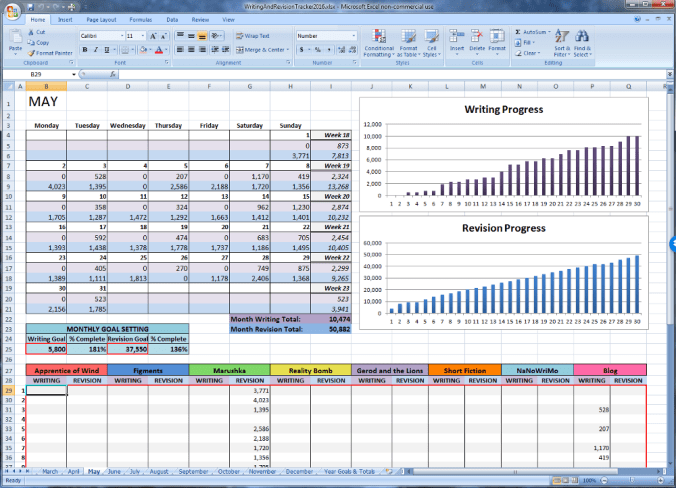
MayProgress

I finished my first run through of Marushka, which ended up at 75,473 words total, 33,258 of which were revised in May, and moved on to Reality Bomb. I revised 17,624 words on that manuscript.

I achieved 136% of my revision goal for May with 50,882 words revised.

All my writing was on Writerly Goodness, and, because I joined Gabriela Pereira’s DIYMFA launch team and have been posting twice each weekend, I’ve achieved 181% of my writing goal for May with 10,474 words on the web.

In other news, I’ve let my querying slip. I’ve received enough form rejections that I have this feeling I need to return to Initiate of Stone and give the manuscript another run. I’ve come up with some ideas to improve my first pages (and other stuff) as a result of working on Apprentice of Wind and I’m not sure I should burn any more agent bridges . . .

At the same time, I want to continue on the chance that I haven’t presented IoS to the agent that will love it. I’ve had success pitching the novel in person to both agents and small publishers, so the idea has merit. It must be the execution that needs work.

Accordingly, I’m probably going to take a break from revising RB for a few days to focus on reworking the first chapter and query of IoS and then get back at it.

I’ve booked my flight to Kansas City in August. I’m one step closer to WorldCon and a visit with a friend who lives in KC. So looking forward.

In the meantime, the Canadian Writers’ Summit is taking place in less than two weeks. I’m looking forward to that, as well, but the scheduling is a bit strange. Because the

CWS is a joint conference between a number of professional writing organizations in Canada, some of the sessions are overlapping. It will make things challenging, but I’m also going to get to attend a great session by Robert J. Sawyer, as well as key note addresses by Jean Little, Kenneth Oppel, and Nalo Hopkinson.

If I had more leave, I might have gone down Wednesday evening to see Lawrence Hill, but I had to make a choice between the CWS and WorldCon/friend visitation. Seeing a new city and an old friend won out 🙂

A new short story idea is brewing for an anthology call later in the year, but I haven’t been paying a lot of attention to short fiction this year, as was the plan. We’ll see if I can keep the idea from blowing up into a novel-sized concept and premise.

I’ve signed up for another online course, this time from one of my favourite authors/writing craft experts, Kate Weiland. It’s another thing I’m looking forward to. We’ll let you know how things go in future updates.

And that’s it for now.

I’m doing too much, as usual, but enjoying every minute of it. I’m really not happy unless I’m learning something/pushing my boundaries.

Hope everyone has a productive, happy-making month!

The Next Chapter

Feeding my creativity

Here’s the prompt Gabriela sent this week for the DIYMFA launch team:

“Coming up with ideas takes practice. You have to train your brain to get creative on demand. You can’t sit around waiting for your muse to show up because she might take her sweet time. Instead, you have to go after your muse. Hunt her down and show her who’s boss. One writer told me he “keeps his muse chained to his desk.”

While I find that mental image of the muse-prisoner hilarious, I prefer to think of it a little differently. I have a shrine to my muse, a small box I call the ORACLE. (Like most things in DIY MFA, ORACLE is an acronym that stands for outrageous ridiculously awesome creative literary exercises.) Just like the ancient Greeks made pilgrimages to oracle temples so they could get guidance and wisdom from their gods, I visit my ORACLE whenever I feel the creative well going dry.

These contents have changed over time, but a few things have stayed constant:

  • Dice: I use dice for writing exercises whenever I need to leave something up to chance. I’ll assign each number an option, and then do whatever the roll decides.
  • Word Box: This small box contains slips of paper with words on them. I pull a few words out of the box at random, and then write a short piece that uses all those words.
  • Image Box: I keep an old chocolate tin filled with photos I clipped from magazines or postcards I picked up at museums. Whenever I’m stuck for ideas, I use those images to spark a story.

These are just a few things I keep in my ORACLE. I also have a paper prototype of the Writer Igniter app, a Writer Igniter deck of cards (also an early prototype for the app), a stack of fortune cookie fortunes, and a pocket-sized book of prompts.

Do you have an ORACLE? If not, treat yourself and start putting one together this week. It took me several years to refine and build my ORACLE, so don’t feel like you have to fill it overnight. Go out, get a nifty container, and start assembling materials to put in it.”
Muse-inks

I don’t have an oracle. I’ve bought decks of story cards, but, I have to confess that I don’t use them. I’m not fond of prompts, honestly, though the idea for one of my novels did result from a prompt. It was a Natalie Goldberg prompt, though, so that may have had an impact on how things turned out 😉

A lot of my story ideas come from my dreams, which, when I can remember them, are quite theatrical/cinematic in scope.

Other ideas come from articles that I read that trigger interesting connections in my head. I talked about the reasons I started my Thoughty Thursday curation a couple of weeks ago. I keep this curation going for myself as much as for others.

I share the posts and articles that make me think, start the mental corn a-popping. Some of those pops ignite story ideas.

I’ve always had story ideas, and more ideas than I knew how to write, especially when I was young. I used to write my stories (so-called) in Hilroy exercise books. I still have them. I still have most of the stories I wrote for school, too.

When I had an idea that I wasn’t sure how to write, I’d write as much as I could about it in one of those notebooks. Eventually, spiral bound notebooks and loose leaf paper replaced the exercise books.

That was the beginning of my idea file.

I mentioned last week as well was that when I was in university, I started making those thoughty connections with all the things I was learning in my classes. Psychology fed into sociology fed into Taoism fed into Old English fed into genetics fed into astronomy.

I started keeping my first journal in those years.

I have a stack of them now.

I keep one beside my bed to capture dream ideas.

I carry one in my purse so I can write down ideas that occur at work or when I’m otherwise away from other means of capturing them. I could use my smart(er than me) phone, but I like the feel of pen on paper. I take all my conference and convention session notes by hand as well.

Also during my university years, I worked in libraries. I learned a lot about research in those years, and, in the course of processing books and magazines to put on the shelves, if I came across an article that elicited a pop, I’d copy it. I called it being a clip rat.

These, too, went into my idea file.

I once clipped an entire series from a newspaper on families living on welfare. I also copied articles on the future of economics. And yes, both of these have story ideas that go along with them.

When the library’s collection was culled, I bought whatever books I could afford from the resulting sale. I accumulated a number of interesting, if slightly out of date, reference books, including an etymological dictionary (in two volumes), a name dictionary, and a couple of collections of popular quotations.

Currently, I read a number of blogs using Feedly. Before Feedly, I used Google Reader (when they announced the end of Google Reader, I was in a panic until Michael Hyatt mentioned Feedly in one of his blog posts).

Things that inspire an idea for a story, I clip to Evernote.

When I start working on a story, outlining, drafting, revising, I do my research in dribs and drabs. I use Evernote to capture online research as well.

Finally, my husband is a great source of ideas. We watch a lot of science fiction, fantasy, historical, and anime series. We have discussions about them. Because my man is Mr. Science, he’ll often have a few things to say about the poor science in a science fiction series. One of my stories was inspired by a discussion we had about Star Trek: The Next Generation.

He’s also very critical of story/plot quality. We can have animated conversations about what writers do and fail to do in the series we like to watch.

I can also fact check some of my SF ideas with him. He’s awesome that way 😀

So, I have lots of ideas and a lot of the resources I need to refine them.

I find that the best way to come up with story ideas is to be present, pay attention, and capture them however you can.

I like to keep things simple.

Tomorrow: It’s next chapter update time 🙂

Next week: DIYMFA will be out on the 10th! I’ll be posting my review to Amazon and Goodreads, and posting it to Writerly Goodness on Saturday.

Have a great weekend!

Thoughty Thursday: Things that made me go hmmmm on the interwebz, May 22-28, 2016

Thoughty Thursday is weird and wonderful this week. Well . . . weird, anyway.

On refugees: a history of the ‘other’ in Sudbury. Nilgiri Pearson for Sudbury.com

This was one of the sad bits of new to come out in Canada this week: Gord Downie, lead singer of The Tragically Hip, diagnosed with terminal brain cancer. The Globe and Mail.

Here’s the sensationalist article: bodies of strange creatures found in the basement of old London home. Design you trust. And now, the real story: the truth behind the viral story of mysterious skeletons in London basement. The Earth Child.

Complain all you want, but your busy schedule may be helping your brain. Angus Chen for NPR.

Angela Hanscom wonders why can’t children stay still in the classroom? It turns out that movement is critical to attention and learning. The Washington Post.

How to be happy: lessons from an Amazonian tribe. Rick Warren for Medium.

A psychologist identifies three elements that determine happiness. Diane Koopman for LifeHack.

Finding 16 cents on the sidewalk helped one person recognize something important about happiness. The Business Insider.

The more I learn about this man, the more I love him. Albert Einstein: racism is a disease of white people. Open Culture looks at his little-known fight for civil rights.

The #HeForShe Media Summit (it’s an hour and a half long) featuring Patricia Arquette and Joss Whedon. UN Women.


Maisha Z. Johnson offers a black feminist’s guide to the racist shit too many white feminists say. Everyday Feminism.

Amanda Vickery says it’s time to bring female artists out of storage. The Guardian.

This is too cool. This Finnish university gives its doctoral graduates a funky top hat and sword. This is so Hogwarts, I have the desire to get my PhD! Oh. Tuition. Dissertation. But top hat and sword!

Jupiter gets his by visible asteroid impacts six times a year. Phil Plait for Slate.

Ed Yong reports a shocking find in a Neanderthal cave in France. The Atlantic.

The gruesome history of eating corpses as medicine. Maria Dolan for The Smithsonian.

Coming up: The next chapter will be coming out this weekend. I might have one more DIYMFA QotW, too! Oh, the writerly life 🙂

Thoughty Thursday

Tipsday: Writerly Goodness found on the interwebz, May 22-28, 2016

Another wonderful week of writerly goodness!

Roz Morris helps writers avoid this plotting pitfall when writing drafts at speed. Nail Your Novel.

Everyone’s getting into video. Should you? Jane Friedman on Writer Unboxed.

Barbara O’Neal makes the case for journaling. Writer Unboxed.

Dan Blank advises you to invest in yourself. Writer Unboxed.

John Vorhaus tells us how to write like the Buddha. You guessed it. Another great post from Writer Unboxed.

Lawrence MacNaughton guest posts on Janice Hardy’s Fiction University. Five questions you need to ask if your story is stuck. Later in the week, Janice is back with how to keep your characters compelling beyond the first draft.

Angela Ackerman explains how to deepen your protagonist by challenging her moral beliefs. Writers helping writers.

Sara Letourneau offers part six of the developing themes in your stories series: the inciting incident. DIYMFA. Later in the week Amy Bearce shares five marketing tips for introverts.

K.M. Weiland also wrote about theme this week: how to create a complex moral argument for your story’s theme. Helping writers become authors.

Chris Winkle shares seven great sources of conflict for romances. Mythcreants.

Steven Pressfield offers his advice on drafting: cover the canvas.

Nina Munteanu shares part two of her writer-editor relationship series: five things writers wished editors knew—and followed.

Marcy Kennedy guest posts on Christine Frazier’s Better Novel Project: five times Katniss nailed deep point of view.

Kameron Hurley confesses that she’s thought about quitting . . . but, don’t quit.

Over on Tor.com, she shares an excerpt from the recently released Geek Feminist Revolution. It’s awesome. You should read the post. And then you should buy the book 🙂

All of us toilers need reminders like this: Rick Riordan on his ‘overnight’ success. It’s from 2007, to give context.

Emma Straub was born to be an author. Alexandra Alter for The New York Times.

Kim Vandels shares the secret to writing great science fiction. The spinning pen.

Airship Ambassador interviews Kate Heartfield about her story “The Seven O’Clock Man” in the Clockwork Canada anthology.

BookBaby offers some tips on how to promote your science fiction on social media.

Good Night Stories for Rebel Girls is an Indigogo success story. The Guardian.

Mental Floss explains why reading makes you a better person with an infographic 🙂

Leila Fadel reports on the delicate task of restoring one of the world’s oldest libraries. NPR.

Louisa Young grew up in J.M. Barrie’s house: we longed for Peter Pan to come for us. The Guardian.

Judith Shulevitz reveals the Bröntes’ secret for The Atlantic.

The teaser trailer for Disney’s live action version of Beauty and the Beast. I’m looking forward to seeing what Emma Watson does with Belle 🙂


Here’s the Ghostbusters UK trailer.


The Little Prince is coming to Netflix August 8 🙂


Laura Prudom explains how Outlander created its most powerful and devastating episode yet. Variety.

And that was Tipsday.

See you Thursday. *waves*

Tipsday

Ad Astra 2016, day 1: Do’s and don’ts of writing erotica

Disclaimer: My notes are not perfect and neither am I. If you see something that needs correction or clarification, please email me at melanie (dot) marttila (at) gmail (dot) com and I’ll fix it post-hasty.

Panellists: Sèphera Girón, J.M. Frey, Matt Bin

JMF: How did you get into writing erotica?

MB: I just wanted to try it out because a friend said that I could make some money writing erotica while I got my other work into shape. I posted short stories on Amazon. I didn’t do any promotion, but I got some sales.

SG: I wanted to send a story to Penthouse letters about giving my boyfriend a blow job, but I didn’t go through with it at my boyfriend’s insistence. Laurie Perkins, an agent and publisher, was asked to bid on a Kama Sutra project. I did not get the contract for that. They wanted to make it into Kama Sutra flash cards, though. I was brought in to help pose the models because the publisher wouldn’t. They were afraid to make a mistake/be accused of harassment. I got a flat rate for that even though the book has been printed in two editions and the cards sell consistently.

JMF: I entered into erotica through fan fiction (1991-1995). I was always interested in the sexuality of characters. I was called by the editor of an anthology—we don’t have enough good porn. My story ended up headlining the anthology. I got another call—I have this gap in my anthology. I don’t have any  . . . alien porn. So I write the story to fill the gap. J.M. Frey can’t be writing erotica, though. I have a YA steam punk novel coming out. So I write erotica under Peggy Barnet. Now the rights for most of those stories have returned to me and I’m putting together an anthology. I’ve also written an erotica novel. Kindle is the place to sell erotica. Exclusive (through KDP Select) makes sense for erotica.

Q: How much should you reveal? How explicit should you get?

JMF: It depends on the character and the story. My alien erotica isn’t explicit. I have a medieval fantasy erotica and the euphemisms are appropriate to the genre. Even in erotica, you have to think about why you’re writing the scene. Are you furthering the plot or revealing character?

SG: I have an astrology-based series. Readers complain that there’s too little sex, and other readers complain that there’s too much. You can’t please everybody.

MB: I’m working in a different arena. I short pieces, two thirds of the story is set up and one third is hard core sex. Do you use penis/vagina or purple helmet/blooming flower? There are only so many ways you can refer to genitalia. Approach the sex from a sensual or emotional perspective. Get into the sensations. How are the characters feeling?

JMF: That’s how you write good erotica. You engage the reader. In The Order of the Phoenix, who didn’t weep when Sirius Black died?

Q: What’s selling the best?

SG: I’ll answer the question I thought you were asking. Before ebooks, it used to be really hard to be an erotica writer in Canada.

JMF: Harlequin has gay and lesbian lines. Fanfic feeds into erotica. People write to fill a void. I’m not interested in writing vanilla boning.

MB: It tends to be the edge fetishes that sell the best. Vampires used to be big. Then, using the word Billionaire in the title was big. Every once in a while Amazon wipes out what it thinks is too taboo.

JMF: It’s hard to make a kink that’s not yours attractive to the reader, though.

MB: Military-based homosexual erotica (army, navy, etc.) and sports homosexual erotica are really hot now.

JMF: If a reader is into something, they’ll buy all of it. You have to remember this with your marketing. My tagline for Peggy Barnet is: tickles your nethers without leaving your brain behind. I write think pieces that are smexy.

MB: Reader in the genre. See what’s out there.

JMF: Ask yourself why you want to write in the genre?

Q: What’s the limit for sex in non-erotica?

JMF: It’s whatever your publisher will tolerate.

SG: I got a Vivid Video contract. I was told to write anything I wanted. I wrote erotic horror. I asked the president of Vivid if anything was off the table and she said, anything but black guys. Savannah doesn’t touch black guys. I was like, there are rules?

JMF: With respect to Diana Gabaldon’s Outlander series. I loved the first three novels. Now, the sex feels self-indulgent. Yes, everybody loves Jamie. Go as far as you want to. If you’re comfortable with your drunk uncle reading it to your grandmother at a family gathering, go for it. My parents have a brag shelf and all my erotica is on it.

Q: Do you get sex writer’s block?

SG: Yes. Sometimes it gets boring.

JMF: I go to the deepest, darkest parts of the internet.

MB: Burnout is a real thing. The motivation of the character is what engages the reader. The trouble is forcing it.

And that was time.

Hope everyone has a fabulous weekend.

See you Tipsday!

Resistance and where it leads

The DIYMFA QotW for week 8:

“Share an example of a time when resistance has pointed you toward a writing project that was juicy and high-stakes . . . and maybe even a little bit scary. Did you face that fear and overcome your resistance? What was the result of pursuing (or not pursuing) that project?”

To be honest, I don’t feel a lot of resistance as far as pursuing a writing project. I tend to follow my instincts, or my muse, if you prefer, and write what the heck I want.

You may see this as a naive attitude, but enough published authors, experienced editors and agents have pointed out the futility of trying to write to the market, that I’ve taken at least that much to heart.

I have an idea file that’s about fifteen novel ideas backlogged. Sometimes it’s hard to decide which one to pursue, but once I’ve decided, I generally stick with it until the draft is done . . . and revised . . . and critiqued . . . and revised . . . and edited . . . and revised . . . and beta read . . . and revised . . . and queried . . . but that’s as far as I’ve gotten (with novels).

I’ve had a couple of science fiction short stories published (for paying markets, even), but even with my short fiction, if I have a suitable idea, I write the piece until it’s done. Substitute submitting for querying in the above novel equation, and I’ve been accepted, worked with the publication’s editors to refine the piece, and been published.

When an editor suggests changes with a piece of short fiction, I’ve been very accommodating. I’ve generally accepted the suggested changes or made clarifications in the particular story elements so the changes are no longer necessary.

I can see pretty clearly and quickly with a piece of short fiction what makes sense to change and what does not.

Where I feel resistance is when, whether a critique partner, editor, or beta reader, someone suggests a major change to a novel I’ve written.

I generally have to sit with the suggested changes for a while, until I can see clearly the reasons why the changes were suggested. Then I can (more) objectively judge whether to adopt them or not.

Case in point: the editor for my first novel suggested eliminating a character. It took me a long time to realize she was right. She’d also suggested eliminating a couple of extraneous point of view characters, which I accepted and changed right away. A critique partner for the same novel didn’t like the number and types of POV I was using, and, initially, I changed everything. Later, however, I realized that my original choices made sense for the story I was telling and after I have eliminated the extraneous POV’s and the extraneous character, I changed everything back.

So, it works both ways for me. Some things I should change but am slow to act on the advice. Other things I change, but then realize there were compelling reasons why I made the decision in the first place.

Really, I’m still working through the whole process, developing my sense as a creator regarding which suggestions and advice to act on and which not to. As things progress, I find myself making better initial creative choices (I think).

I added the ‘I think’ in parentheses because I’m still not sure whether I’ve done this to avoid the criticism and/or potential conflict that results. I avoid conflict in life, generally. I kind of hate it. And really, that’s not a good reason, on its own, to change a creative work.

Ultimately, I’m always open to learning anything about my craft from anyone. I just get reluctant when I’m not sure of the motivation behind the advice I’m given.

Professional or experienced editors, I trust.

Unfortunately, it’s possible to be an excellent writer and not know a thing about editing, or critiquing, or beta reading. Telling me how you would have written the story doesn’t help me. Giving me your reasoning or thought process along with the suggestion allows me to assess your advice and accept it in the spirit it was offered, whether I choose to act upon it or not.

I think this all stems from my experience during my MA, which I’ve written about enough that you’re probably all sick of hearing about it by now 😛

So, Gabriela’s question didn’t really take me in the expected direction, but this is where I experience resistance.

Where do you experience resistance?

Muse-inks

Thoughty Thursday: Things that made me go hmmmm on the interwebz, May 15-21, 2016

A small, but interesting assortment of goodies.

So this happened: Prime Minister Justin Trudeau accidentally elbowed an NDP MP in the process of trying to escort a Conservative MP to his seat. Yes, he shouldn’t have done it. He apologized three times. Gabrielle Gallant explains why associating ‘elbowgate’ with violence against women is an insult to victims. The Globe and Mail.

Aboriginal children express their pain through art and story. Peggy MacDonald for CBC news.

Why we live in an age of anxiety. A special feature by The Guardian including pieces by Paula Cocozza, Lindy West, Chitra Ramaswamy, and Rhiannon Lucy Cosslet.

Anna Lovind searches for a simpler life.

Ruth Whippman says people with more money are less lonely. The Guardian.

The record-breaking temperature trend continues. Phil Plait for Slate.

Portugal runs for four days on renewable energy alone. Arthur Nelson for The Guardian.

Recyclable six pack rings could save a lot of turtles. Popular Mechanics.

What hiking does for the brain is pretty amazing. Michael Pirrone for Wimp.com

Yuval Harari’s latest book predicts the rise of the useless class. CNet.

From ‘little people’ to shape shifters, Lucy Tulugarjuk shares the encounters she’s had with some of the North’s most fascinating otherworldly entities. Edge North.

Dancing with the devil: the history of satanic burlesque. Dirge Magazine.

The Presets: Epic Fail. Shared by a friend following the previous week’s DIYMFA post 🙂


And that was your thoughty for the week.

On Saturday, I’ll be tackling the topic of resistance for DIYMFA.

Thoughty Thursday

Tipsday: Writerly Goodness found on the interwebz, May 15-21, 2016

Fact and fun, all rolled into one . . . curation post 😉

K.M. Weiland shares strategies for writing faster (and why maybe you shouldn’t). Helping writers become authors. Later in the week she shares her number one tip for writing books readers can’t put down.

Chuck Wendig explodes more writing myths as he invites us to crotch-punch the creative yeti. Terribleminds.

Kristan Hoffman puts forth an argument for letting your creativity rest. Writer Unboxed.

Kameron Hurley writes about fame, publishing, and breakout books: dancing for dinner.

Jami Gold helps us understand how plot obstacles affect character agency.

Dave King continues to explore historical fiction pitfalls with this post for Writer Unboxed: sympathetic characters in unsympathetic worlds.

Carly Watters shares five secrets to publishing your debut novel.

Porter Anderson looks at book prices and writing value. Should we have been careful what we wished for? Writer Unboxed.

Five signs your novel may be sexist – against men. Chris Winkle brings a little balance to the table for Mythcreants.

The establishment has always hated the new kids. Kameron Hurley.

Monica Alverado Frazier wonders, do you know how to use a curandera?

Modern witches are so much more than Maiden/Mother/Crone. Natalie Zutter for Tor.com

Daniel José Older reads from Half Resurrection Blues. This man reads like a poet. I could listen to him all day 🙂


John Mullan explores how plots grip us, from Dickens to Line of Duty. The Guardian.

Women swept the 2015 Nebula Awards. Andrew Liptak for i09.

Five science fiction and fantasy novels that treat mental illness with compassion. Barnes & Noble.

This is COOL. Boston’s sidewalks are covered in secret poems. Atlas Obscura.

Lincoln Michel explains why fairy tales are magic for modern fiction. The Guardian.

Dig at the Curtain theatre unearths a Shakespearean surprise. Jill Lawless for Phys.org

Do overused words lose their meaning? Jonathon Sturgeon for Flavorwire.

CBS passes on Nancy Drew adaptation for testing “too female” for line-up (whatever that means). Carly Lane for The Mary Sue.

The BBC shares nine life lessons from Doctor Who.

Two of the shows I liked got cancelled. Fortunately, the end is only the beginning for Supergirl and Marvel’s Agent Carter. Alisdair Stuart for Tor.com

Honest trailers – Game of Thrones, vol. 1 Bewbs!


Come back Thursday for your weekly dose of thoughty!

Tipsday