Tipsday: Writerly Goodness found on the interwebz, Dec 11-17, 2016

Holy cannoli, your informal writerly learnings are back on track this week 🙂

K.M. Weiland shares another way to look at scene structure. Helping Writers Become Authors

Wordplayer Liberty Speidel guest posts on Kate’s blog later in the week: five steps to a thorough book edit.

Jami Gold is now a writing coach on Writers Helping Writers! The revision circle: does my story have too many problems?

Chris Winkle helps us master evocative telling. Mythcreants

Alex Limberg guest posts on Kristen Lamb’s blog. Finish that novel: tips to help you go the distance.

Angela Ackerman explains how to use symbolism to elevate your storytelling. Writers in the Storm

Piper Bayard offers some guidance about what to do after NaNoWriMo. Writers in the Storm

Chuck Wendig, as always, has thoughts on how to create art and make cool stuff in times of trouble. Terribleminds

Andrea Phillips guest posts on Terribleminds: the high goddamned responsibility of fiction.

Orly Konig-Lopez shares her thoughts on Writers in the Storm: why it’s not always about the writing.

Janice Hardy offers five tips to fight your end-of-year writer’s fatigue. Fiction University

Sara Letourneau examines fate versus free will as a literary theme. DIYMFA

Now y’all know, if you’ve been following me for a while, what I think about resolutions, but Bess Cozby shares five strategies you can implement to rock your resolutions in 2017. DIYMFA

Oren Ashkenazi reviews five failed animal companions in science fiction and fantasy. Mythcreants

Devon Murphy interviews Madeleine Thien about her process. Banff Centre for Arts and Creativity

The Globe and Mail interviews A.M. Dellamonica on occasion of the publication of her latest novel.

Scott Dadich announces Wired science fiction dedicated issue 🙂

The changing faces of science fiction and fantasy. The New Inquiry

Sheila Liming shares her memories of Octavia Butler, neighbour. Public Books

Martin Shaw shares his midwinter night’s dream. Medium

Maria Alexander introduces us to the witches of winter. Tor.com

James Whitbrook has this breaking news: David Tennant is the voice of Scrooge McDuck in the rebooted Ducktales. i09

Tilda Swinton sent Jezebel the unedited email exchange between her and Margaret Cho about Doctor Strange, diversity, and whitewashing. Rich Juzwiak reports.

Evan Narcisse: the Sense8 Christmas special says, “happy fucking New Year.” Phil and I are FURIOUSLY HAPPY! i09

Happy holidays to everyone!

We’ll see you back here, next week, for more writerly goodness 🙂

tipsday2016

WorldCon 2016: Oceans, the wettest frontier

Disclaimer: I am not perfect and neither are my notes. If you notice anything that requires clarification or correction, please email me at melanie (dot) marttila (at) gmail (dot) com and I will fix things post-hasty.

Panellists: Christopher Weuve (moderator), Patricia MacEwen, James Cambias, Alyx Dellamonica, Laurel Anne Hill

oceans

Yeah, I know this was supposed to be up yesterday, but yesterday, I finished off my Christmas shopping and then went to a friend’s party (at which I got hammed—don’t worry, it’s a rare occurrence; I think I just had to get some post-shopping/renovation celebration in 😉 ) so I didn’t get much writing done at all.

Life happens.

CW: There’s more space-based science fiction out there than water-based science fiction.

JC: But there are more people who will know if you get it wrong under water than in space.

CW: What, or who, was your inspiration? Frederick Pohl was one of mine.

PM: Nnedi Okorafor’s Lagoon.

AD: Alan Dean Foster. Peter Watts’ Starfish.

LAH: Starfish impressed me with this sentiment: the underwater world is so compelling that even if it scares you, you can’t wait to go back.

JC: There was a boom in the late 60’s and early 70’s. I didn’t enjoy most of it. The contemporary non-fiction on the topic was fascinating, though.

PM: Jacques Cousteau’s grandson has a new book out.

LAH: I met Jacques Cousteau. He was my idol. Few women dove in those days.

CW: James, what was it that left you wanting in the fiction?

JC: The inherent contradiction that the solution to overpopulation was to exploit the continental shelf.

PM: They weren’t talking about the future health of the oceans, or the extinctions that were already happening.

AD: I’m working on a series in which the crisis is the deoxygenation of the oceans.

PM: Canfield makes dire predictions about the future of the oceans.

LAH: Stung!, by Lisa-Ann Gershwin is about the jellyfish overpopulation and what it’s doing to the oceans.

AD: I’ve never had a distaste for ocean-based science fiction. I grew up in the prairies and then moved to Vancouver. I was captivated. The ocean is the connective tissue of planetary economy.

PM: I had no trouble buying into the ocean-based science fiction I’ve seen, but there are things missing. Other sensory systems are a fascinating area. If there’s life on Europa and it has magnetic sensing organs, they’d feel god [Jupiter] passing by every 36 hours. There wouldn’t be a single atheist among them.

CW: 20,000 Leagues Under the Sea was a seminal influence.

LAH: It was impressive. There was a 1945 movie made from the novel.

PM: Verne based it on a real French submarine. It was even called the Nautilus. In the 1800’s they had one they called the turtle. It was intended to scuttle ships, but couldn’t drill through the steel hulls.

CW: there’s no physical evidence that the turtle ever existed, though.

JC: The drive design in The Hunt for Red October, the caterpillar, was more plausible.

AD: I’m as interested in sailing, in the romance of rigging and sail, as I am in the underwater aspect.

JC: The translations of Verne’s work left out the technical aspects of submarines, how they worked.

LAH: His Majesty’s Dragon from the Temeraire series has some good naval battles.

AD: Ursula K. Le Guin’s Earthsea series.

PM: One of the things people tend to gloss over is that when you’re living on board a ship, you’re living in cramped quarters.

AD: It’s a great opportunity for character development and conflict.

JC: The Last Ship is a current attempt at ocean-based science fiction.

PM: Stephen Baxter’s Flood and Brin’s Uplift.

[Very sorry. Not sure who said the following. The ideas were coming fast and furious, but they were interesting ideas, so I had to get some of them down.]

  • Alternate means of communication underwater. Hand signals make sense, but chromatophors would be better.
  • Sub-harmonic or sonic communication.
  • Phosphorescence.
  • Infrared.
  • Plastic garbage is killing off the plankton, which is the basis of the oceanic food chain. They’re developing bacteria that eat plastic. They’re also looking at harvesters that collect plastic and convert it to diesel fuel.

And that was time.

Next Saturday is Christmas Eve, but I’ll still attempt to get my post out on time. Here’s the title for a teaser: Beyond, fantasy creation for the bold.

Be well until next week!

Thoughty Thursday: Things that made me go hmmmm on the interwebz, Dec 4-10, 2016

Time to get that mental corn a-poppin’!

Viola Desmond is chosen as the first Canadian woman on the ten dollar bill. CBC

Rossalyn Warren lists seventeen badass women that made a difference in 2016. Buzzfeed

Brene Brown on the importance of boundaries:


Recent grads share their college experiences on NPR.

David Amsden tells the tale of the gridiron gangster: how a vigilante gambler took down an alleged crime boss. Rolling Stone

Prince EA: Everybody dies, but not everybody lives.


David Szondy reports on how diamonds can turn nuclear waste into nuclear batteries. New Atlas

Nicola Davis reports on the feathered dinosaur tail preserved in amber and what it’s taught us about evolution. The Guardian

Erin Ross: pets help people manage the pain of serious mental illness. NPR

With that in mind, here are some lazy cats:


Meet Radamenes, the caretaker cat:


Juniper Foxx befriends Moose, the dog:


And that’s your edutainment for the week 😉

See you Saturday!

thoughtythursday2016

Tipsday: Writerly Goodness found on the interwebz, Dec 4-10, 2016

Think I’m still in recovery from NaNoWriMo.

K.M. Weiland continues her most common writing mistakes series with part 54: story events that don’t move the plot. Helping Writers Become Authors

Later in the week, Kate shares her advice on what to do when your antagonist takes over your story.

Densie Webb shares her experience receiving (and addressing) the dreaded editorial letter. Writer Unboxed

Donald Maass: putting your purpose on the page. Writer Unboxed

Lisa Cron explains why story is more important now than ever before. Writer Unboxed

Jamie Raintree reviews Lisa Cron’s Story Genius.

Susan Spann returns to Writers in the Storm with this post on finding your agent match.

Gabriela Pereira goes solo on this edition of DIYMFA radio: platform doesn’t have to be painful.

J.M. Frey writes about the terror of the mushy middle book. Fuse Literary

Judith B. Herman lists 25 words that are their own opposites. Mental Floss

Inderjeet Mani: when robots read books. Aeon

I hope you enjoyed your informal writerly learnings for the week 🙂

See you Thursday for some thoughty!

tipsday2016

WorldCon 2016: Mythology as the basis for speculative fiction

Disclaimer: I am not perfect and neither are my notes. If you notice anything that requires clarification or correction, please email me at melanie (dot) marttila (at) gmail (dot) com and I will fix things post-hasty.

kclibrarypl

Panellists: Ada Palmer, Jeffrey Cook, Sheila Finch (moderator), David Farnell, Katie Daniels

SF: Joseph Campbell said that myth and metaphor are the language of dreams. How important is myth in speculative fiction?

JC: The basis of myth is exploration and explanation.

KD: Myth is what endures.

DF: Myth is the story. Science is the vehicle. Even hard science fiction follows mythic patterns.

SF: It’s easy to see the hero’s journey play out in fantasy.

AP: At one point in Jo Walton’s The Just City, a Platonist explains a spaceship to aliens. Myth helps us conceive of alien concepts and means of communication.

JC: Useful myths are universal. They allow us to understand other cultures.

KD: We may have to define most useful. Are we talking about Prometheus or Jason and the Argonauts?

AP: The most useful myths can invoke craftsmanship, finesse.

DF: Do tropes emerge from myths? If you’re writing about Japanese mythology, it’s helpful to dig into the literature and not restrict yourself to what you see in manga.

SF: Jung said that myth conveys a sense of the numinous. They say something different to each person.

DF: Here’s one Japanese myth: the weaver goddess and a cowbird fall in love and stop doing their respective jobs. The Emperor of Heaven separates them, but allows them to reunite in the rainy season. It’s very Romeo and Juliet.

Q: 2001 and Star Wars are myths in their own rights.

AP: Some myths are devoid of awe. Others are full of it. Myths are the metaphysical reality of a world.

Q: What are some of the main themes of myth?

DF: How to deal with death.

JC: A quest of favours. [Mel’s note: In order to achieve the story goal, the protagonist must provide each character who helps her with something they want or need. Things generally get more complicated, and more humorous, as the story progresses, and the series of favours can even be a chain, with the satisfying of one favour being dependent on all the others before. Sometimes the favours cannot be granted until the ultimate goal is accomplished, and then everything falls into place.]

AP: Look for the big questions. Why is there evil? What is death?

And that was time.

Next week: Oceans, the wettest frontier.

Thoughty Thursday: Things that made me go hmmmm on the interwebz, Nov 27-Dec 3, 2016

Just a little thoughty for you, this week. Keep in mind that I was finishing off NaNoWriMo for half the week 😉

Some helpful advice on fact-checking:


Alex Borgella explores several theories on what makes us laugh (and why we should care). Fast Company

Joe Pitawanakwat extols the benefits of cedar bough tea on the Creators Garden blog.

Jonathan Rosen reports on how Africa has found power off the grid. MIT Technology Review

Baback A. Tafreshi lists ten of the best ancient sites for stargazing. National Geographic

Phil Plait invites us to take a swing at the stars. Slate

Jenny Woodman takes a look at the women “computers” who revolutionized astronomy (and paved the way for women in the sciences). The Atlantic

Aw, kawaii! This rescued baby wombat bonds with his caretaker. Alexandra E. Petri for National Geographic.

I hope that popped your mental corn . . . a few kernels, at least.

See you on Saturday for some WorldCon reportage.

<waves>

thoughtythursday2016

Tipsday: Writerly Goodness found on the interwebz, Nov 27-Dec 3, 2016

And it’s the triumphant return of Tipsday!

K.M. Weiland continues her how to outline for NaNoWriMo series with this instalment: how to write a scene outline you can use. Not to worry, links to all previous posts in this series are included. Helping Writers Become Authors

A.E. Siraki guest posts on Jami Gold’s blog. NaNoWriMo: good or bad, let’s move forward.

Jane Friedman asks, do you know what you’re capable of? Writer Unboxed

Julia Munroe Martin shares one of her takeaways from the Writer Unboxed Unconference: how do you want your novel to change the world?

Anne Greenwood Brown examines the pinch point in this post for Writer Unboxed.

Cathy Yardley helps us write when life sucks. Writer Unboxed

Juliet Marillier shares her struggle following the review of her latest series proposal at the Writer Unboxed Unconference: when bad news is good news.

Jo Eberhardt explores intertextuality: stories within stories (within stories). Writer Unboxed

Roz Morris offers three ways to get maximum impact from a story. Nail Your Novel

Oren Ashkenazi examines five characters with too much spinach, and offers advice on how you can avoid the same pitfalls. Mythcreants

Chris Saylor explains the proper use of ellipses and dashes on Marcy Kennedy’s blog.

Heidi Ulrichsen reports on Greater Sudbury Poet Laureate, Kim Fahner’s project to bring poetic grafiti to storefronts downtown. The Northern Life/Sudbury.com

Amanda Michalopoulou looks at how literature teaches us to understand “the other” in these divided times. The Guardian

Ian Failes explains how designers created the stunning alien language in Arrival. Thrill List

Aimee Bender shares her thoughts on why fairy tales still inspire modern female writers. Wired

Bryan Washington wonders why there aren’t more famous black science fiction authors. The Awl

Beth Elderkin (and the whole i09 crew) is hooked on the latest Guardians of the Galaxy, Vol. 2 trailer. Baby Groot is ADORBS!

Referring back to Jo Eberhardt’s piece on intertextuality, Tom Blunt parses Westworld’s literary references. Signature

That’s it for your informal writerly learnings this week. Come back next week for moar. MOAR, I tell you!

By the way, what do you think of my new graphic (keep in mind that I’m not a professional graphic artist)?

Be well until Thursday, when I’ll have a little thoughty for you 😉

tipsday2016

The next chapter: October and NaNoWriMo 2016 update

I’m baaaa-aack!

Didja miss me?

Let’s just get right to the good stuff.

October

As was the case with September and August before it, October was a month in which I was focused on non-word-count-y stuff.

I finished off my read through and note-taking on Apprentice of Wind and the rest of the time I was making notes in preparation for tackling Wavedancer (book three of the epic fantasy series) as this year’s NaNoWriMo project.

I knew that I’d likely be writing the novel into the New Year. 50k is only half the length of any epic worthy of the name 😉

I had some trepidation, however, as I knew I’d be out of town, training for the day job for the first week of November, and I had Wordstock Sudbury upon my return, the launch of the Sudbury Writers’ Guild anthology, Sudbury Ink, the weekend following, and my own, belated birthday celebration the weekend after that.

And I was only able to use two days of vacation leave in November. Otherwise, I was working.

I fully expected a repeat of 2014, during which I was also working. That year, I didn’t even crack 30k, but I went on to finish the draft over the next months.

So, zero words revised in October, but, amazingly, that still puts me at 96% of my revision goal for the year. Yup. I’m just that awesome 😉

And I have my work cut out for me with regard to some additional amendments to Initiate of Stone (one more run through, methinks), as well as a whole slew of revision notes for AoW. As the series arc progresses, I get further insights into what I’ve already written. It’s all good.

I think, more than anything, it was good to immerse myself in the world and characters of the story. It put me in a good place, mentally, to tackle Wavedancer.

As for the writing done in October, all 7,939 words of it were written on this blog.

octoberprogress

NaNoWriMo 2016

I’m a traditionalist. I work on a new novel each NaNo challenge and, this time, I was tackling a work I knew I wouldn’t complete in November, even if I could achieve the word count necessary for a NaNo win.

As I mentioned, above, I had my doubts I’d even manage that.

As a result, I made some decisions, one of which was, with the exception of the curation posts I had prepared for the first week of November (960 words between the two of them), I wasn’t going to blog.

Working around professional and personal commitments, I fought for my writing time.

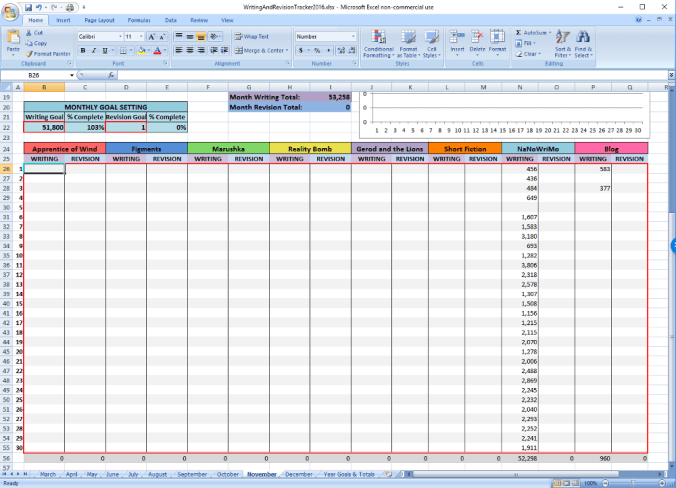
Here’s how things shaped up:

While I was out of town, I didn’t even manage a thousand words a day, and I didn’t write one word on the day of Wordstock Sudbury. I was out, manning the book table, participating in a panel on commercial genre fiction (specifically SF&F), attending a book launch, and reading my poetry. It was a full day.

I started to gain ground on the weekend, though, and though there were still a number of days on which I didn’t achieve the average 1,667 words, there were more days on which I wrote 2,000 or more.nanowrimo_2016_webbadge_winner
And . . . drum roll please . . . I reached November 30 with 52,298 words written.

Flailing Kermit arms! Yaaaaaaaa!
novemberprogress

I also don’t hate what I’ve written, not even during those hard slogging early days. That is, in itself, a triumph 😀

I continue to draft at a more reasonable pace. I’m aiming for 500 words a day, and so far (a whole three days in) I’m exceeding that goal.

Other stuff

I received a very kind rejection for one of the short stories I’d submitted to an anthology call earlier in the year.

Phil finished the renovations on the living room. We’re now, very slowly, cleaning up the house and purchasing our new furniture.

My love isn’t getting any younger, and had decided that next year (after a winter of building bookshelves and stocking them) he’s going to renovate the kitchen, bathroom, and side entry.

I’m happy to report that Phil and I are in good health.

The regular blogging schedule will resume, starting with this post. Tipsday and thoughty Thursday will also be returning. Next week, I’ll be moving on with the next session I took notes on at WorldCon.

I tried a new system for my curation posts in October, leading up to NaNo, that I’m going to return to.

In the past, I spent several hours every Sunday, reviewing my social media shares for the week and linking them with a brief framing sentence in my curation drafts in Word. Then, on the day, I’d copy the text into WordPress, format the links, add the picture, post, and then share to my social media accounts.

I’ll still have to do that this week, but now, I’ll be working smarter, not harder.

Every day, I’m going to spend a little time reviewing my posts of the day and copying them into the curation draft in Word. Then, on Sunday, I copy the text into WP, format, add the pictures, and schedule the posts, so that all I have to do on the day of is share it to my various social media accounts.

Much easier.

If I weren’t so paranoid about hackage and losing work, I might choose to draft right in WordPress, but once bitten, and all that 😉

I just thought I’d share in the event that this might make sense for you.

Next month: It will be another double update. I’ll be reviewing December’s progress and 2016 as a whole (goals and other gorgeous stuff). W00t!

Have yourselves a wonderful week.

Until Tipsday!
The Next Chapter

Thoughty Thursday: Things that made me go hmmmm on the interwebz, Oct 23-29, 2016

Let’s get that mental corn a-poppin’, shall we?

Terri Windling muses upon the death of the year. Myth & Moor

Shahan Russell writes about the mysterious death of Rasputin, the Siberian monk who brought down the Tsar of Russia. War History Online

The Medievalists present the medieval walking dead. Better that the latest series premiere? You be the judge.

Michael Livingston delves into the medieval origins of Hallowe’en. Tor.com

Debby Banham and Christine Voth explore the diagnosis and treatment of wounds in Old English medical collections. Medievalists

Archaeologists make a baffling Celtic find in France. The Vintage News

Ben Thomas shares his research into four great African empires that astonished the world. Medium

Discover Sanxingdui, the ancient Chinese city that’s older than Rome. The Vintage News

The tragedy of Meagen Pilon and human trafficking in Sudbury. Laura Stradiotto for The Sudbury Star.

Ashton Kutcher’s mission to end human trafficking has rescued 6000 people so far. The Earth Child

“Bitch.” Brave New Voices


Anxiety is an invalid excuse. Just Cut the Bullshit

Ephrat Livni: scientists explain how happiness makes us less creative. Quartz

Alan Watts – why your life is not a journey.


Andrew Griffin reports on signals from outer space that scientists believe could be messages from aliens. The Independent

Laura Parker digs into bioinspiration, the thrilling new science that could transform medicine. The Guardian

The man once thought to have spread HIV to America has been cleared by science. James Gallagher for the BBC.

Adam Capay’s treatment reflects poorly on corrections and on government. On all of us, really. The Globe and Mail

Remember Jumpy, the dog who does parkour? Well, he’s also the smartest dog in Hollywood. Amy Nicholson for MTV News.

Moar dog shaming?  Oh yeah! I waste so much time

Cosmic guinea pig.


The Pentatonix cover Hallelujah.


Thoughty Thursday will return, December 8th.

And watch for my two-month next chapter update on December 3rd.

Then, you can find out what I was doing instead of blogging in the month of November 🙂

Be well until then!

thoughtythursday2016

Tipsday: Writerly Goodness found on the interwebz, Oct 23-29, 2016

The informal writerly learnings are here!

Your #NaNoWriMo round up for the week:

Danielle Daniel discusses her memoir, The Dependent, with the ladies of The Social.

Sudbury’s Poet Laureate, Kim Fahner, writes in defense of school libraries. The Republic of Poetry

K.M. Weiland: how to properly motivate your bad guy. Helping Writers Become Authors

Roz Morris shares some thoughts on book marketing. Nail Your Novel

Robin Lovett explains why deadlines are not your worst enemy. DIYMFA

James Scott Bell: writer, this is your job. Kill Zone

Barbara O’Neal explores writing with the knowledge of time. Writer Unboxed

Dan Blank: dealing with a slump. Writer Unboxed

Karen Woodward writes in defense of constraints.

Janice Hardy guest posts on Writers in the Storm: how filtering point of view affects show, don’t tell.

Marcy Kennedy blogs about conflict.

Veronica Sicoe continues her storyworld design series with transportation technologies.

Chris Saylor returns to Marcy Kennedy’s blog with his monthly editorial clarification post: “I could care less.”

Jamie Raintree shares her path to publication (part two!).

Janet Reid addresses the issue of young writers. “Publishing will break your heart. Writing will fill your heart.” Truer words . . .

Joanna Penn interviews Kristine Kathryn Rusch and Dean Wesley Smith on The Creative Penn podcast.

Tamerra Griffen unpacks a situation of academic racism on Buzzfeed: a professor circles the word “hence” on Tiffany Martinez’s paper and notes “This is not your word.” Bonus: here is Tiffany’s response to the incident (linked in the Buzzfeed article).

Foz Meadows explores the relationship between romance and queerness, and the difference between genre and device. Shattersnipe

Meg Elison: if women wrote about men the way men write about women. McSweeney’s

Katherine Langrish explores death in classic fantasy. Seven Miles of Steel Thistles

Sadness. 2016 has taken so many great creators from us. Sheri S. Tepper, 1929-2016.

Award news:

The Governor General’s Award winners announced.

The OAC presents its indigenous arts protocols:


Joseph Boyden speaks out for the #WeMatterCampaign


Baihley Grandison shares a lovely infographic with untranslatable words from other languages. Writer’s Digest

Rajeev Balasubramanyam states that the Nobel committee got it wrong: Ngugi wa Thiong’o is the writer the world needs now. The Washington Post

Christopher Marlowe will be credited as Shakespeare’s co-author in New Oxford editions of the Henry VI plays. Dalya Alberge for The Guardian.

Connie Verzak considers Tobias Menzies to be the Snape of Outlander. The Daily Record

And that concludes my first and last Tipsday for the month of November.

The next Tipsday will be coming your way on December 6th, after the furor of #NaNoWriMo has subsided.

Be well until then, my writerly friends.

Honour your creative path.

Virtual hugs to the awesomesauce that is you!

tipsday2016