Tipsday: Writerly Goodness found on the interwebz, April 12-18, 2020

I hope everyone is staying safe and keeping well. Here’s your weekly dose of informal writerly learnings to help fill some of your time (I know you’re all doing what you can to keep yourselves occupied).

Helen J. Darling says that if you’re finding it hard to write, try keeping a pandemic journal. Sara Farmer considers fiction from Daphne du Maurier to Megan Abbott: the gothic horror of womanhood. Later in the week, Gabriela Pereira interviews Jeff Garvin about dismantling the stigma of mental illness. DIY MFA

Lori Freeland helps you understand point of view: P-O-What? Writers in the Storm

K.M. Weiland explains how to get some writing done: discipline vs. enthusiasm. Helping Writers Become Authors

Jim Dempsey offers a simple guide to symbolism in stories. Kathleen McCleary wants you to fuel your writing with feeling. Barbara Linn Probst shares five ways to light the spark of a novel. Writer Unboxed

Sacha Black wants you to breathe life into your prose with the sense of touch. Writers Helping Writers

Specificity and concrete language. Shaelin Writes

Susan DeFreitas shares part three of her developing a writing practice series: important.  Then, Mathina Calliope reveals the easy-to-fix tense problem that might be tripping up your readers. Jane Friedman

Jami Gold explains the difference between passive and active voice: was and not was. Later in the week, she wonders if pandemic anxiety is forcing everyone to count their spoons.

Chris Winkle breaks down act 3 of Dr. Horrible’s Sing-Along Blog. Then, Oren Ashkenazi looks at six magic systems that need stricter limits. Mythcreants

Writing fight scenes. Hello, Future Me

Chuck Wendig writes about being broken in half but wanting to be whole. Terribleminds

Steve Toase confronts the default: portraying homelessness in fantasy and science fiction. Tor.com

Thanks for stopping by, and I hope you take away something that will support your current work in progress.

Until Thursday, stay safe and well, my writerly friends.

Tipsday2019

Thoughty Thursday: Things that made me go hmmmm on the interwebz, April 5-11, 2020

This week’s curation is a mix of ways to entertain yourself, covid-19-adjacent articles, and general thoughtiness. It’s time to get your mental corn popping.

Sydney Perkowitz: how to see the invisible universe. JSTOR Daily

Jamie Cater says, your cosmic address is the trippiest thing you’ll learn today. Travel + Leisure

Space germs were a literal thing. Why the Apollo 11 astronauts were quarantined. Vox

Brian Ferguson reveals Scotland’s claim to fame as the birthplace of the f-word (and an interesting BBC documentary to watch if you have access). The Scotsman

Erin Blakemore explains why plague doctors wore those strange beaked masks. National Geographic

Arthur C. Brooks shares the three equations of a happy life. The Atlantic

Livia Gershon explains how people during the Depression managed to laugh. JSTOR Daily

Mary Alice Miller: digital burnout was coming, and the pandemic is expediting it. Vanity Fair

Jonathan Watts shares his journey into the Antarctic. The Guardian

Jessica Leigh Hester wants you to let your mind wander with these gloriously detailed maps. Atlas Obscura

Zoe Baillargeon recommends the best online cooking classes and tutorials. The Manual

Camryn Rabideau suggests six indoor gardening projects for *any* size of home. Food52

SciShow introduces us to the white smokers of The Lost City and how they may have had a role in the origin of life on our planet.

Atlas Obscura shares images of Puzzlewood, the inspiration for the Lord of the Rings movie.

Corinne Segal shares this livestream of the bird library for you and your cat(s) to enjoy. Literary Hub

Jonna Jinton – The Wolf Song

Thank you for stopping by. I hope you took away something to inspire your next creative project, or just to fill the well until inspiration strikes.

Until next tipsday, be well and stay safe, be kind, and stay strong. The world needs you … and your stories!

ThoughtyThursday2019

Tipsday: Writerly Goodness found on the interwebz, April 5-11, 2020

Another week of physical distancing has come and gone. Another week of working from home or unemployment, and increasing numbers of confirmed illness, hospitalisation, and deaths from covid-19. There is also hope that, in some areas, at least, that we’re reaching a peak, beginning to flatten or plank the curve.

Treatments are being investigated while a vaccine is in development, but this new normal may pertain until a vaccine is available. I hope that you’re finding a way to navigate the enforced isolation.

My own humble contribution is this curation of informal writerly learnings. Enjoy.

K.M. Weiland lists seven ways writing saves us when life is hard. Helping Writers Become Authors

Susan DeFreitas returns to Jane Friedman’s blog with part two of her developing a writing practice series: community. Then, Susann Cokal suggests that instead of setting a goal, try a writing dare.

Shaelin Bishop explains show, don’t tell, so you can actually understand it. Shaelin Writes

Over on Reedsy, Shaelin lists the pros and cons of past and present tense so you can choose the best one for your story.

Tamar Sloan shares what you need to know to keep the words flowing in difficult times. Writers Helping Writers

Jeanette (the Writer) Smith considers whether you can trust editing software. And here’s my latest column: five books on the tarot for writers. DIY MFA

Jenna Moreci shares her favourite man tropes 🙂

Jami Gold wants you to escape generic storytelling by asking why. Then she helps us understand the past perfect tense.

Janice Hardy helps you identify whether it’s a loss of momentum or writer’s block. Fiction University

Chris Winkle tackles Act II of Dr. Horrible’s Sing-Along Blog. Then, Oren Ashkenazi explains what Tolkien did right—and wrong—when he built Middle Earth. Mythcreants

Kristen Lamb shares the truth about introverts and why isolation is hard on us, too.

Thank you for visiting, and I hop that you’ve found something here to support your current work in progress.

Until Thursday, be well and stay safe.

Tipsday2019

Thoughty Thursday: Things that made me go hmmmm on the interwebz, March 29-April 4, 2020

Here are a bunch of resources and useful information for your time of physical distancing. It’s time to get your mental corn popping.

Rachel Donadio explains how a millennial Prime Minister is leading her country through crisis. Vogue

Rodger Sherman: the eight types of people we turn into on Zoom. The Ringer

Erin Blakemore wonders what people used before toilet paper? Cause toilet stuff is fun 🙂 National Geographic

Amber Gibson: there’s an art to isolation—here’s how to stay centred. Medium

Sherpa says, wash your paws!

Starlight Williams shares five inspiring no-travel experiences. National Geographic

Joe Berkowitz lists 88 movies, music, series, and books releasing in the next month. Fast Company

Jennifer Nalawicki says that you can watch these six flower bloom events from your couch. The Smithsonian Magazine

Mike Mettler lists six must-see rockumentaries to shelter in place with. Sound & Vision

A.R. Williams: untouched 4,400-year-old tomb discovered in Saq’qara, Egypt. National Geographic

Michael Greshko: interstellar space is even weirder than expected. National Geographic

Robin George Andrews reports on the bizarre lifeforms found thriving in ancient rocks beneath the sea floor. Cause extremophiles! National Geographic

Jeff Goodell is concerned about rising tides, troubled waters, and the future of our oceans. Rolling Stone

Marina Koren considers the changes in land, sea, and air that have already resulted from the pandemic. The Atlantic

Chris Sweeny: the wondrous life and mysterious death of golden eagle 1703. The Guardian

Giedrė Vaičiulaitytė shares 30 photos by Julius Kähkönen that look like they come from dreams. Bored Panda

True facts about the giraffe. Ze Frank

Thanks for stopping by, and I hope you took away something to support you in these challenging times, or to inspire your next creative project.

Until next tipsday, be well and stay safe, be kind, and stay strong. The world needs your stories.

ThoughtyThursday2019

Join me on DIY MFA for my latest Speculations

Hey, everyone!

On the last Speculations, I provided a brief introduction to the tarot. This time, I review five books on the tarot for writers.

FiveBooksonTarotforWriters

While you’re there, you might as well peruse the site and the great articles by my fellow columnists. Or have a look at some of the awesome resources Gabriela has put together for you.

Until next time, be well and stay safe!

Tipsday: Writerly Goodness found on the interwebz, March 29-April 4, 2020

As we all adjust to the new normal, some things offer continuity. Here are you informal writerly learnings for the week.

K.M. Weiland presents eight challenges (and solutions) to writing at home. Helping Writers Become Authors

Shaelin also offers her advice on how to balance writing and a remote job. Reedsy

Joanna Penn interviews Mark Leslie Lefebvre about getting your book into libraries and bookstores. The Creative Penn

Janice Hardy lists the pros and cons of studying writing craft. Later in the week, she poses five questions that will make your scenes stronger. Fiction University

Gabriela Pereira exposes an internet abomination. How the Internet Archive’s Open Library hurts readers, writers, and the whole publishing industry. Then, Abigail K. Perry wants you to use the Story Grid scene analysis template to read with purpose. DIY MFA

Matthew Norman shares confessions of a former anti-outliner. Donald Maass: the upside of anxiety. Cathy Yardley explains how to strike a balance between productivity and chaos. Writer Unboxed

Susan DeFreitas shows you how to develop a writing practice, part one: stepladders. Then, Lisa Cooper Ellison is writing from the bottom rung. Jane Friedman

Jami Gold considers whether to italicize character internalization. Then, she considers tenses: what is literary past tense?

Tim Hickson explores (and he really does) writing mental illness in video games. Hello, Future Me

Chris Winkle breaks down act one of Dr. Horrible’s Sing-Along Blog. It’s a fun web movie. Ideal for these times. Then, Oren Ashkenazi analyzes five contrived legal conflicts in speculative fiction. Mythcreants

Jonathan Bailey recounts the bizarre history of the copyright symbol. Plagiarism Today

Thank you for visiting. I hope you took away something to support your current work in progress.

Until Thursday, be well and stay safe, my friends!

Tipsday2019

The next chapter: March 2020 update

And here we are with my first monthly writing update since covid-19 was declared a pandemic. What a difference a month makes.

A month of uncertainty and change

March came in like a lamb. It would leave that way, too, as if it knew that other events would play the lion. The first reports of a novel coronavirus had come out in November (hence the 19 in the virus name) from Wuhan and the first confirmed case in Canada was on January 15. We had no idea what was coming. At worst, I thought we’d be facing another SARS and Canada had weathered that. I’d worked through similar crises before. Or so I thought.

Then, on March 10, the first case was confirmed in Sudbury and a few days later, a second. On March 11, the World Health Organization (WHO) declared covid-19 a pandemic. On March 12, the school boards declared that all schools would shut down for two weeks following March break to enforce quarantine on travellers returning after March break. Our university and colleges closed, as well.

The next week was March break and the first of my coworkers went home on special leave because she had school-aged children. More followed. I had scheduled leave the Thursday and Friday of that week. That weekend, Phil and I made the decision to stop visiting my mom, stop having her pet sit Torvi while Phil was out and about. While there have been no documented cases of covid-19 in pets, if Phil or I are asymptomatic carriers, we could transfer the virus on her fur and as Phil continues to venture out for necessaries, the potential danger is continual. The weekend and the decision were fraught with anxiety and disappointment. When I returned to work on Monday (March 23), half of the office had been sent home to telework. On Tuesday, the rest of us were told to go home. I came in on Wednesday to finish up a few things and collect my plants.

I’ve been working from home since March 26.
2020-03-27 18.01.12

States of emergency were declared at the national and provincial levels. Schools were closed indefinitely, and plans made to teach students virtually. Social distancing was renamed physical distancing. I don’t go out except to walk Torvi and when I do, I’m sure to stay at least two metres away from other pedestrians. Phil is our designated shopping and fetching guy, which works because he’s otherwise unemployed. He’s also performing this service for our moms.

Things haven’t changed much for me. I’m still working (a blessing) but am doing so from home. I don’t have any more time than I normally do, and so I’m not engaging in binge-watching, catching up on learning activities, or seeking distraction. I’m distracted enough by the surreality of the situation.

This is the new normal. And yet changes continue to be announced every day. The chaos has me in a state on continual, low-grade anxiety.

The month in writing

I’d planned to take weekends off and intended to compensate with extra words during the week. This went swimmingly for the first few weeks until covid-19 started to make its presence felt. Then, all bets were off.

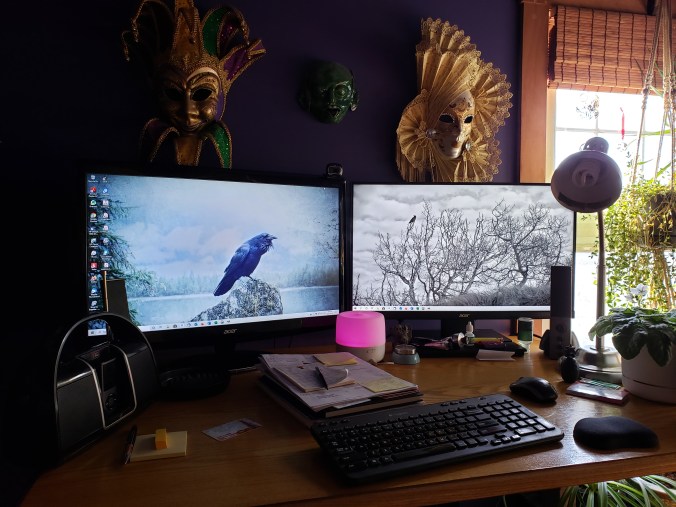
When I came home from the office with the mandate to work from home on March 24, Phil ordered me a second monitor. My workstation at the office has two monitors and we have enough applications open that it really does make things easier. The second monitor arrived on Friday and we set it up after I finished work for the day. After that, I was toast, but I’d planned not to write Friday through Sunday every week in March, anyway, so I didn’t think I would fall too far behind. But I’d already missed Wednesday. The workday was chaotic and the more I tried to finish up and pack up and move home, the more stuff happened that prevented me from doing so.

So, I didn’t write Friday or Saturday and when I got back to it on Monday, my progress was not what I’d hoped.
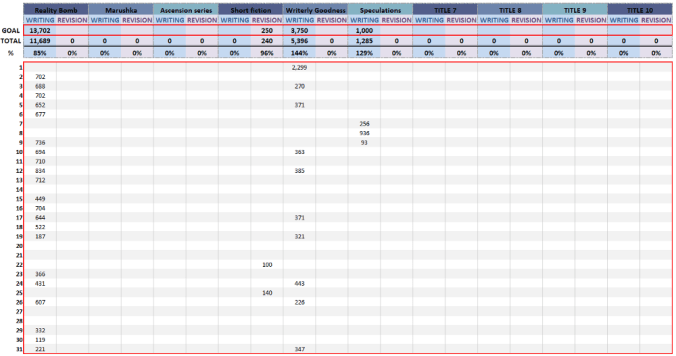
MarchProgress

All this to say that I fell short on my drafting goals for the month again. Of my 13,702-word goal, I wrote 11,689 words, or 85%.

I blew my blogging goal away with my massive review of the split worlds series last month and wrote 5,396 words, or 144% of my 3,750-word goal.

I wrote my latest Speculations column in 1,285 words, or 129% of my 1,000-word goal. It should be coming out this week, so you can look forward to that.

I also revised a short story. There wasn’t as much revision as I’d thought. There was a lot more cutting than writing. I ended up writing 240 new words and cutting close to a thousand. I set myself a 250-word goal for the revision and accomplished 96% of it. I don’t count words cut.

I submitted the revised story to an SF magazine for their open reading period. Wish my words luck.

I received some awesome news that five of my speculative poems have been accepted for publication. I’ll be able to tell you more about that when they’re actually coming out. Stay tuned.

I also finished a critique for one of my partners in the online group and found the time to wrangle all the information I needed to submit our taxes. Yay me 🙂

Interestingly, at 18,370 of my total writing goal of 18,452 words, I came in at 99%. Between writing and revision, I accomplished 98% of my goals. I’ll take it.

Overall, I’m pleased with what I was able to accomplish this month, all things considered.

Filling the well

You wouldn’t think that I’d have anything to report here. You’d be wrong 😉

I’ve recently joined a Facebook group run by Lauren Carter and she organized an online reading through Zoom. I got to read poetry along with other poets, memoirists, non-fiction writers, and other novelists from all over North America. It was lovely and supporting and just the thing I needed.

What I’ve been watching and reading

March’s viewing included Locke & Key. Phil and I enjoyed it and are glad that the series in being renewed. We classified it as horror lite because of the juvenile protagonists. Although there was a truly horrific backstory that cropped up again in later episodes, it wasn’t overwhelming. The twist wasn’t terribly twisty, though. We had it figured out before the reveal. We liked the effects of the various keys and are looking forward to what the show has in store for next season.

We also burned through Altered Carbon. Season two takes place several centuries after the first. Takeshi Kovacs and Poe have travelled all over the known universe in search of Quellchrist Falconer and Tak has worn many different sleeves. The show opens on a scene in a lounge and the singer is Tak’s latest sleeve. She’s killed and Tak’s stack is taken. A virtual meeting with his new “employer” sees Tak lured into a protection detail in return for information on Quell. The bad news? Tak is back on Harlan’s World, the hellhole he and Poe escaped at the end of season one.

When he’s resleeved in Anthony Mackie’s buff body, Tak wakes to the chaos of his new employer’s assassination, which he is promptly framed for. Poe has meanwhile degraded because he refuses to relinquish his “memories” of Lizzie from season one. He glitches dangerously and seems to have an AI version of Alzheimer’s, often forgetting what he was saying, what he was doing, and where he is. The only “cure” is to reboot, resetting him to his factory state. Poe, of course, resists this because he would not only forget Lizzie, but Tak and all the adventures they’ve shared.

I highly recommend this one.

We also watched Aquaman (finally). Eye-candy aside, it was okay. Pretty standard DCEU fare.

This month’s reading started off with Robert J. Sawyer’s Calculating God. This was an older novel, published in 2000, and centers on an alien who comes to Earth, and specifically to the Royal Ontario Museum (ROM) in search of a paleontologist because God seems to be engineering the apocalypse. Sawyer plays with the idea that civilizations only evolve to the point where they either begin to colonize other planets, or they destroy themselves. Add to this the controversial idea of intelligent design. The aliens believe in God and that everything in the universe had been planned and balanced in such a way as to to create life in multiple forms and to direct its evolution.

Two alien species have joined forces to investigate the apparent destruction or disappearance of several other civilizations. Some have, in fact, destroyed themselves. Some have taken refuge in virtual existence to avoid destroying themselves. And one travels to a remote sector of the galaxy for mysterious reasons. An impending supernova (of Betelgeuse, no less) threatens Earth and the other two alien species and the aliens want to join forces with humans to solve the mystery. Thomas Jericho struggles with the aliens’ belief in God because he has lung cancer that’s going to kill him.

A secondary plot devised by two fundamentalist Christians who want to show us Godless Canadians how wrong we are complicates matters. The bombing of a nearby abortion clinic is only a prelude to their main attraction: destroying the ROM’s collection of Precambrian fossils. The ticking clock is threefold. Will the terrorists destroy the fossils, and everyone in the vicinity; will the cancer kill Jericho and doom the interstellar mission to potential failure; or will the supernova make it all pointless?

Sawyer has often said that his stories are, at heart, about optimism. Calculating God is no exception.

Next, I read Ed Willett’s Spirit Singer. The titular character, Amarynth, begins the novel as apprentice to her grandfather. A spirit singer’s job is to sing the souls of the dead into the afterlife, but there’s something wrong. A malevolent presence haunts the between world. It stalks and kills her grandfather, stranding the souls of the people of their village, and Amarynth doesn’t yet know enough to assume his duties. She must find help.

It was a decent YA fantasy, but nothing surprising.

The Gilded Wolves by Roshani Chokshi was another story. A heist plot set in 19th Century Paris in an alternate world in which Babel Fragments endow people with magic. There’s political intrigue and manipulation and a cast of characters that I loved. Not going to say much more because y’all should read this one for yourselves.

Aliette de Bodard’s The Tea Master and the Detective is not what you might expect from the title. The tea master is a disenfranchised ship mind who’s lost her crew and is trying to make ends meet by brewing “teas,” which seem to be neurochemical enhancers. The detective is one of ship mind’s clients who solves mysteries for fun. The mystery she draws the ship mind into? That of a young woman who seems to have voluntarily exposed herself to the deep spaces.

My classical selection of the month was Moby Dick. This was basically Melville’s love letter to the American whaling industry. The story itself could have been told in a small fraction of the words, but the novel is also a palimpsest. Every event becomes a story within the story. And then there’s the chapters on the categorization of whales, the difference between whale oil and spermaceti. I didn’t hate the book, but it was entirely too long.

Finally, I read Sabaa Tahir’s An Ember in the Ashes. I remember when it was being released that someone said it would be the next Game of Thrones. Not quite, but it was an enjoyable read. The characters were engaging, but I did get a little irritated by the duelling love triangles. The world building was excellent, and I have moved on to reading the second in the series.

And that was the month in this writer’s life.

Until next time, be well and stay safe, be kind, and stay strong. The world needs your stories.
The Next Chapter

Thoughty Thursday: Things that made me go hmmmm on the interwebz, March 22-28, 2020

In need of some distraction? You’re in luck. Thoughty Thursday is here to get your mental corn popping 🙂

Alex Beard: can AI ever replace the classroom? The Guardian

Laura Millan Lombrana: the post-virus economic recovery could be a green one. This is the hope of many people I know. Bloomberg

Elizabeth Landau discovers that the Fibonacci sequence is everywhere—even the stock market. The Smithsonian Magazine

Allison Meier: 18th Century lovers exchanged pictures of their eyes. JSTOR Daily

Stevie Keen shares ten photography projects you can do at home. Amateur Photographer

Eric Gross shares photographs of frozen waves in an alpine Colorado lake. PetaPixel

Jessica Stewart shares enchanting photos of Madeira’s Fanal Forest and its 500-year-old trees. My Modern Met

How Earth’s tides gave us life as we know it. SciShow Space

Tom Ward takes us inside Victor Vescovo’s mission to reach the bottom of all the world’s oceans. Wired

Ruth Doherty reports that Google Earth has released virtual tours of 31 of the world’s most incredible national parks. Country Living

Stella’s best leaf jumps of all time 🙂 Joy!

Lydia Schrandt shares ten of the best animal live cams for you to watch. 10 Best

PBS Eons answers the age-old question. The egg came first.

Thank you for stopping by. I hope you take away some inspiration for your next creative project, or just some interesting reading and entertainment to ease your isolation.

This weekend, I’ll be diving into my March next chapter update.

Until then, be well, be kind, and stay strong. Now, more than ever, the world needs your stories!

ThoughtyThursday2019

Tipsday: Writerly Goodness found on the interwebz, March 22-28, 2020

I hope you’re all keeping safe and well.

I’m now working from home and only leaving to walk the dog. Phil continues to be our designated shopper. We’re all remaining as isolated as possible given the circumstances.

While you’re at home, you might have the time to catch up on your informal writerly learnings.

Julianna Baggott is creating in the time of quarantine. Liz Michalski: sea glass. Heather Webb says, the beauty is in the words. John J Kelley: for the love of Moira—the arc of a memorable character. Writer Unboxed

K.M. Weiland touts the power of hopeful stories in a stressful time. Helping Writers Become Authors

E.J. Wenstrom explains how authors can build a true community of fans. Later in the week, Savannah Cordova lists five signs your story’s structure needs work. DIY MFA

Shaelin shares six ways to improve your craft. Reedsy

Barbara Linn Probst visit’s Jane Friedman’s blog to explain the when, why, and how of peer critique and professional editing.

Lisa Hall-Wilson explains how to write compelling emotional triggers. Ellen Buikema explores white space on the page. Writers in the Storm

The Take takes on the weird girl trope.

Chris Winkle helps you make the most of your narrative premise. Then, Oren Ashkenazi explains why zombies aren’t a good pandemic parallel. Mythcreants

Meg LaTorre shares ten fantasy tropes she loves. iWriterly

Jami Gold explains how point of view affects dialogue.

Nina Munteanu: dreams and perceptions and “the other.”

Robert Lee Brewer clarifies fable vs. parable vs. allegory. Writer’s Digest

Adrienne Westenfeld recommends the best books for distancing yourself from reality right now. Esquire

Open Culture introduces us to the world’s first author: the Sumerian High Priestess Enheduanna.

Thank you for visiting, and I hope you took away something to support your current work in progress.

Until Thursday, be well!

Tipsday2019

Thoughty Thursday: Things that made me go hmmmm on the interwebz, March 15-21, 2020

I’ve tried to stay clear of covid-related news. We’re all consuming enough of that and I want to create a space for inspiration and learning and just plain entertainment. Still, there’s covid-adjacent material. I couldn’t avoid it completely.

Still, I hope you can get your mental corn popping in a positive and relatively stress-free manner this week.

Sophia Quaglia says, this ancient fish with arms might be the reason we have hands. Inverse

The wild reasons older people need less sleep. SciShow

Dr. Tracey Marks explains what night terrors are. I used to have these … and sleepwalk. It’s why I have an interest 🙂

Amy McKeever explains why we evolved to feel panic. National Geographic

Diana does 20 easy experiments in about five minutes. You can try these at home! Physics Girl

Liz Hund shares ten iconic museums you can tour online. The Points Guy

Is everyone going crazy? Nothing but Thieves

Be well, be kind, and stay safe and strong. The world needs you … and your stories.

ThoughtyThursday2019