Tipsday: Informal writerly learnings, Feb 27-March 5, 2022

Welcome to tipsday, your opportunity to fill up on informal writerly learnings, every Tuesday (if you want more—moar—check out the archives). Enjoy!

Melissa Haas shares leisure learning links for February 2022. Then, Richelle Lyn shares tales of a solopreneur. Gabriela Pereira interviews Gillian McDunn about neurodiversity, family dynamics and cooking in contemporary middle grade fiction. Dana De Greff helps you open doors in your writing. DIY MFA

Tim Hickson focuses on the most important moment in any story. Hello, Future Me

Kim Bullock introduces us to the little library banned book project. Then, Tiffany Yates Martin reviews some words you’re probably using wrong. Donald Maass: theme vs. meaning. Liza Nash Taylor shares the arc of one author and two book launches in five acts: Freytag’s pandemic. Yuvi Zalkow: storytelling and the Hero’s Journey. Writer Unboxed

The myth of heroic masculine purpose. Like Stories of Old

K.M. Weiland shares five red flags that indicate you might need a break from writing. Helping Writers Become Authors

Tiffany Yates Martin wants you to dig deeper than description for more nuanced characters. Then, James R. Preston wants you to get out from behind the keyboard. Writers in the Storm

How to write your novel’s first chapter. Reedsy

Joanna Penn interviews Johnny B. Truant about pivoting on the creative journey. The Creative Penn

Lisa Poisso recommends best practices for working with an independent editor. Then, Becca Puglisi shares some tips for landing a guest-posting gig. Writers Helping Writers

Nathan Bransford wants you to show your characters getting from point a to point b.

Finding your writing process. Shaelin Writes

Jessica Conoley reveals what your writing is training you for. When you change alongside your book: Q&A with Mansi Shah. Jane Friedman

Chris Winkle explains how to write an unhappy ending. Then, Oren Ashkenazi reveals why sequels don’t erase errors in the first book. Mythcreants

Adze: the shapeshifting firefly from West Africa. Monstrum | PBS Storied

Kristen Lamb is creating dimensional characters with personality traits.

Ashawnta Jackson reveals the short but influential run of Ebony and Topaz. JSTOR Daily

Angelarium: The Book of Angels. Tale Foundry

George Saunders helps you overcome uncertainty in writing. Literary Hub

Priya Sidhar wonders, was Brandon Sanderson’s video about burnout relatable? Medium

Unreliable narrators: why we love to be lied to. The Take

Jonathan Thornton provides a readers’ guide to the Finnish weird in translation. More for my TBR list! Tor.com

Leigh Haber interviews Diana Gabaldon about season six of Outlander. Droughtlander ENDED Sunday! Yay! Oprah Daily online

Thank you for taking the time to visit. I hope you found something to support your current work in progress.

Until Thursday, be well and stay safe, my writerly friends!

The next chapter:  February 2022 update

Welcome to my next chapter update for February 2022! In this post, I talk about my month in writing, what I’ve accomplished and what I haven’t; what I’ve done to maintain my physical, mental, spiritual, and creative health; and what I’ve been watching and reading.

February was a good month, I think, but before we get to the progress part of the update, my monthly PSAs:

All lives cannot matter until BIPOC lives matter.

Even though restrictions are being eased in many areas, covid is now endemic. You may get it, even if you’ve been fully vaccinated, and chances are that you will. But if you are fully vaccinated and boosted, you’re more like to have a mild case. I’d still recommend washing your hands more frequently, maintaining physical distance where possible, and masking when it’s not.

On the news yesterday, I saw that there are still anti-masking/anti-vaccine mandate protests going on. Check yourselves people. There are more important things going on in the world, like the Russian invasion of the Ukraine (and now, apparently, Russian troops are amassing in other places, too). Get your heads out of your asses.

That is all.

The month in writing

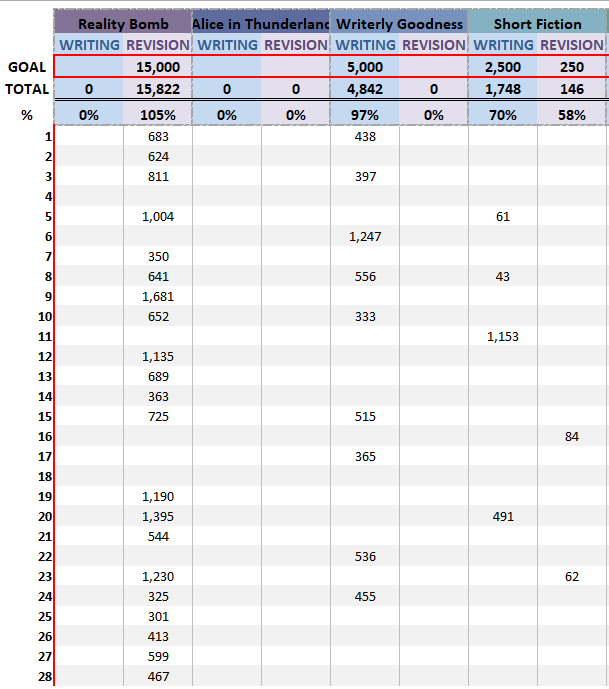
February is the shortest month of the year and I set my revision goal accordingly. Given that I’d barely managed to revise 5,000 words in January, I thought I’d aim for 15,000. I’d reduce to 10,000 if I have to. BUT I didn’t have to!

I revised 15,822 words of Reality Bomb, or 105% of my goal. Yay!

I blogged 4,842 words, or 97% of my 5,000-word goal.

I even wrote and revised a story (!), which I didn’t anticipate. More on that in filling the well. I made room for a 2,500-word piece of short fiction, but the story only ended up being 1,748 words in the first draft. 70% of my goal is great for a story I didn’t intend to write 🙂 I made room for 250 words of revision, but only revised 148 words, or 58%.

In terms of projects I’m not tracking wordcount for, I worked on my Ascension Masterdoc for the first time in months. I was just settling the last dates into my timeline for book one and am now starting work on book two. At this stage, it’s just structural. Adding or deleting or moving chapters around (in my map).

I received an email regarding edits for the short story that was accepted in January, and—there were none (!) That’s the first time that’s happened. Ever. I’ve now also signed the contract and reviewed the page proofs. Look forward to the cover reveal in coming months.

Filling the well

In terms of writerly events, I signed up for Daisuke Shen’s Speculative Fiction Workshop, run through Authors Publish. The course officially ran January 31st to February 25th, but I’m still working through the last couple of weeks, ‘cause work. It was in this course that I received the prompt that inspired my new story. While there are comments and corrections to make, Daisuke was, overall, very supportive of the story and I hope to receive some suggestions about where to submit it when I send my revised story for her review.

I signed up for a couple of free webinars through WordPress.com. They were informative.

My duty to accommodate (DTA) progresses. My doctor filled out the functional abilities form, and I submitted it to my manager. I have an official, but temporary, DTA agreement in place, subject to review in three months (from the date I initiated the process on January 25th).

I am concerned because I’ve been told that once the agreement is made permanent, I will no longer be able to use my sick leave to support my days off. I’ll be officially cut to part time hours. Although the reduction in income is not significant, I am sole support for my household, and even a small reduction in my income may cause hardship. That’s an additional stress I don’t need.

We’ll see what happens in April.

I met with my therapist and support group the day before I met with my manager to discuss my DTA. In both sessions, I’d praised my employer for being so supportive.

It’s disappointing.

Something I didn’t mention last month is that I’m engaged in an assessment process for my position. I’m hoping that qualifying on another pool will help keep me in the position on a permanent basis. Currently, I’m acting (until November 30, 2022). At any time, I could return to my previous position. It’s not the worst thing that could happen, but I worked hard to get this position and I want to keep it for the remainder of my career.

I had my first round of testing mid-February. Will let you know how it all goes in future updates.

My comfort and solace 🙂

What I’m watching and reading

In February, I finished watching Homeland. This series has always been a little depressing because of Carrie’s ongoing struggles with bipolar disorder and the dire nature of the international crises she faces each season. This eighth and final (so far) season is no exception.

Carrie is still recovering from her months-long detention in Russia during which she was deprived of her medication. She has no idea whether she may have disclosed secret information during this time and neither are her superiors, who continue to interrogate her about her incarceration. Saul, however, needs her in the field, and pulls strings to get her there.

The season’s arc is tragic. Carrie must betray Saul to prevent a war, but she redeems herself in the denouement in a way that offers hope.

Phil and I watched the first season of The Legend of Vox Machina. Helmed by the creators of Critical Role, TLoVM will be a balm to any old school role-players out there. In the opening minute, every high-level group of adventurers is killed by an unseen foe. The kingdom is so desperate, they’re scraping the bottom of the barrel, which is where they find and recruit Vox Machina. I won’t say anything more about the series. You’ll know by the above if you’re TLoVM’s target audience.

So. Much. FUN!!

We also watched the first season of Foundation. I loved it. The general atmosphere and effects were >chef’s kiss.< Neither of us have read the book, though, so I can’t tell you how it stacks up. Shuffling Asimov up in the TBR pile.

To keep things symmetrical, I finished reading three books in February.

The first was Brandon Sanderson’s Cytonic, book three in the Skyward Flight series. At the end of book two, Spensa fled into the Nowhere with M-Bot’s AI (in a cleaning drone) and her pet tanix, Doomslug. The Superiority is in negotiations with the Delvers to have the latter destroy all cytonics and the societies that produce them. Spensa has to find a way to stop that from happening by walking a cryptic path through the floating islands of the Nowhere to find the truth of the Delvers and her own nature.

The first problem she’s presented with is that few people ever leave the Nowhere. She soon discovers the reason: the longer a sentient being stays in the Nowhere, the more they forget of their life in the galaxy outside. The only way to hold onto memories is with something called an icon, which Spensa mysteriously has. When she loses the icon, though, it’s a race against time—and memory—to solve the mystery of the Delvers and save the galaxy.

Then, I finished Apocalypse Nyx a collection of short stories by Kameron Hurley. The stories centre on Nyx, the protagonist of Hurley’s God’s War series. They fill in some of the backstory of the characters in Nyx’s crew and share some of their misadventures.

Finally, I finished Blood Like Magic by Liselle Sambury. It’s a futuristic science fantasy that involves genetics and witches in a not-too-distant Toronto. Sambury is a Trinidadian-Canadian author (who I think is currently living in northern Ontario?) and I’m following her career with interest.

Voya Thomas comes of age, and in a witch family, that means passing her Calling, a task given by the ancestors. Voya’s task is to destroy her first love, or risk losing her family’s magic forever.

Aaaaaand … that was the month in this writer’s life.

Until tipsday, be well and stay safe; be kind and stay strong. The world needs your stories!

Thoughty Thursday: Popping your mental corn, Feb 20-26, 2022

It’s time, once again, to get your mental corn popping!

Liz Baker: jury finds Amhaud Arbery’s three killers guilty of federal hate crimes. NPR

David K. Li reports on the sentencing of the officer who killed Daunte Wright. NBC News

Where are the missing Black towns? Every How Did We Get Here, part 3. The Amber Ruffin Show

Sophie Hurwitz: LGBTQ+ Ghanaian refugee faces “cruel” deportation after asylum claim denied in Canada. Xtra*

Olivia B. Waxman and Arpita Aneja reveal the legacy of the Reconstruction Era’s Black political leaders. Time

Cathy Free: she found her father’s segregated schoolhouse decaying in the Virginia woods. Now it’s on its way to being saved. The Washington Post

Vladimir Isachenkov, Yuras Karmenau, Aamer Madhani, and Eric Tucker report that Biden and Putin signal bigger confrontation ahead over Ukraine. CTV News

Alexandru Micu: the Dunning-Kruger Effect, or why the ignorant think they’re experts. ZME Scince

Clark Quinn critiques an article on microlearning: good and bad advice all in one! Learnlets

Maya Wei-Haas: Mars rover takes big steps in its most important mission. National Geographic

Stunning, 360-degree view of Mars from Perseverance Rover.

Rebecca Shedd sheds (sorry, not sorry) light on 15th Century clothing for writers. Then, Shannon Ferretti says it’s like learning to ride a horse. Dan Koboldt

Dominique Potvin considers altruism in birds: magpies outwit scientists by removing each other’s tracking devices. Corvids rule! The Conversation

Florence + the Machine – King

Thanks for spending time with me. I hope you took away something to inspire a future creative project.

This weekend, I should be posting my next chapter update for February.

Until then, be well and stay safe; be kind and stay strong. The world needs your stories (now, more than ever)!

Tipsday: Informal writerly learnings, Feb 20-26, 2022

Welcome to March! Celebrate the coming of spring (and daylight savings? Maybe?) by filling up on informal writerly learnings.

K.M. Weiland shares nine ways to approach relationship dynamics in fiction. Helping Writers Become Authors

Lisa Norman lists five tips for social media detox. Kris Maze suggests some steps to avoid the dreaded burnout, and then she follows up with this: what causes burnout? Writers in the Storm

What is the first quarter debate? Plot structure, pt. 2. Ellen Brock

Elizabeth Spann Craig considers when to stop a series.

Gwen Hernandez shares some Scrivener skills: tag, colour code, and organize with metadata. Then, Kelsey Allagood explains how context influences craft: the rebirth of the author. Deanna Cabinian is letting go of rejection, literally. Then, Victoria Strauss says that if it’s out of the blue, it’s too good to be true: beware solicitation scams. Writer Unboxed

How to write third person limited point of view. Reedsy

Lisa Cooper Ellison: you are not your traumas, but here’s how to write about them. Then, Sangeeta Mehta interviews Laura Zats and T.S. Ferguson: how important is genre when pitching and promoting your book? Catherine Baab-Maguira says that if you can’t stand the sight of your own blood, don’t step into the ring. Jane Friedman

Flashback hack: connecting backstory to the present. Shaelin Writes

Angela Ackerman helps you figure out when to kill a character. Then, E.C. Ambrose explains how to craft a plot out of your historical obsession: spinning a yarn out of history. Writers Helping Writers

Delila S. Dawson lists ten ways to torture people (in fiction). Then, Rob Hart shows us his research toolbox. Terribleminds

How do clichés evolve into memes? Otherwords | PBS Storied

Nathan Branfsord explains how to craft a great mystery in your novel.

Lauren J. Sharkey reveals what MFAs miss about the editing process. Then, Adam W. Burgess reads writer to writer: William di Canzio and E.M. Forster. Gracie Bialecki wants you to learn how to celebrate your manuscript: draft day. Later in the week, Grace Pelley recommends five things to remove from your TBR list. DIY MFA

The imperfect mom onscreen: ending the “selfless mother trope.” The Take

Joanna Penn shares lessons learned for rewriting her first novel over a decade later. The Creative Penn

Chris Winkle explains how to write three types of relationship arcs. Then, Oren Ashkenazi lists five common weapon mistakes in speculative fiction. Mythcreants

Rasha Ali explains how Octavia Butler’s legacy was born out of a bad science fiction movie. USA Today

Carol Saler explains when to capitalize after a colon. CMOS Shop Talk

Thank you for taking the time to stop by, and I hope you found something to support your current work in progress.

Until Thursday, be well and stay safe, my writerly friends!

Thoughty Thursday: Popping your mental corn, Feb 13-19, 2022

It’s time to get your mental corn popping for the last time in February.

Cornelius Fortune introduces the independent voices of the Black American press. JSTOR Daily

Ashawnta Jackson is remembering Emmett Till in song. JSTOR Daily

Police Brutality isn’t new. Every How Did We Get Here (part 2). The Amber Ruffin Show

Frankie Graziano and Laura Wamsley: families of Sandy Hook victims reach $73 million settlement with Remington. NPR

Catharine Tunney reports that the federal government invokes emergencies act for the first time in response to protests. CBC

Andrew Duffy provides a timeline of the occupation of Ottawa. The Ottawa Citizen

Michael Woods and Ted Raymond cover the Ottawa occupation: police hand out leaflets warning downtown protesters to leave. CTV News

Standoff between protestors and massive police operation stretches into night. CBC

Tara Henley says, “Get insanely curious when no one else is curious.” A conversation with Amanda Ripley about the Ottawa occupation and high conflict.

Harold Jarche outlines our new normal in perpetual beta.

Devin Dwyer and Sarah Herndon: “Broken Heart” cases surge during covid, especially among women. ABC News

Benjamin Ryan shares that scientists have possibly cured a woman of HIV for the first time. While the treatment is specific to a subset of patients who have Leukemia in addition to HIV, it could direct new research. NBC News

Carmen Leitch: human neurons found to be surprisingly different from other mammals. Lab Roots

Paul Withers reveals that Facebook to begin laying cable (for Metaverse) through fishing grounds off Nova Scotia. CBC

Move over, JWST! Five new telescopes to get excited about. Dr. Becky

Bob McDonald: astronomers are fighting back against satellite constellations. CBC’s Quirks and Quarks

Victor Tangermann reports that scientists propose permanent human habitat built orbiting Ceres. It’s like something straight out of The Expanse. Futurism

Are we finally on the road to fusion power? SciShow

Structured thermal armor achieves liquid cooling above 1000 degrees Celsius and solves challenge presented by the Leidenfrost effect. It should work for both aero and space engines as well as nuclear reactors. Phys.org

Simon Akam reveals a new story for Stonehenge. The New Yorker

Iceland to end whaling in 2024 as demand dwindles. The Guardian

Thanks for spending some time with me. I hope you found something to inspire a future creative project.

Until next tipsday, be well and stay safe; be kind and stay strong. The world needs your stories!

Tipsday: Informal writerly learnings, Feb 13-19, 2022

It’s the last tipsday of February! Fuel up on informal writerly learnings for the week.

Roz Morris explains how to write a novel with multiple points of view—seven voices. Nail Your Novel

Raya’s queerbaiting of Southeast Asians – the importance of cultural context to queerness (part 3 of SEA critique of Raya and the Last Dragon). Xiran Jay Zhao

Ann Marie Nieves: PR and marketing questions answered, part VI. Dave King recommends cutting your way to freedom. Then, Barbara Linn Probst shares something that might not actually be true. Porter Anderson: ego, “litflation,” and honor(s). Tom Pope is creating without hope and fear. Writer Unboxed

How do we read? It’s Magic (almost)! Be Smart

K.M. Weiland explains how archetypes and story structure are connected. Helping Writers Become Authors

Joanna Penn interviews C. Ruth Taylor about self-publishing in Jamaica and the Caribbean and the importance of diverse voices. The Creative Penn

On worldbuilding: fallen civilizations. Hello, Future Me

Alexander J. Lewis shares his experience going a year without social media as a freelance writer. Peter Desberg and Jeffrey Davis explain how to pitch like a Hollywood pro. Jane Friedman

Christina Delay takes the measure of a character. Then, Fred Koehler takes you from concept to query in ten months. Writers Helping Writers

Well, THIS seems familiar … Jill Bearup

Nathan Bransford explains how to crystalize the stakes.

Colice Sanders wants you to answer the call for diversity. Then, Disha Walia lists the seven deadly sins of speculative fiction (and how to fix them). Lori Walker: going from preparing to write to actually writing. Alexis M. Collazo shares five reasons to start a morning writing routine. DIY MFA

Dealing with writer burnout. Reedsy

Lynette M. Burroughs: things I wish I knew before I published (pat 2). Writers in the Storm

Angie Hodapp is zeroing in on comps (part 1). Then, Kristin Nelson wants you to dance with the right partner at the publishing prom. Pub Rants

Possibly controversial. Rules vs. Craft. Shaelin Writes

Oren Ashkenazi: how useful are Jonathan Franzen’s ten rules for novelists? Mythcreants

Cory Doctorow reveals that a bug in early creative commons licences has enables a new breed of superpredator. Medium

Promises as a magic system. Tale Foundry

Anne Delaney discusses words on the way in: a retrospective. JSTOR Daily

Ellen Gutoskey shares 11 things you should know about Audre Lorde. Mental Floss

Thank you for taking the time to stop by, and I hope you took away something to support your current work in progress.

Until Thursday, be well and stay safe!

Thoughty Thursday: Popping your mental corn, Feb 6-12, 2022

Happy Friday eve! Get your mental corn popping in time for the weekend.

Sarah Burnett reports that Amir Locke, shot by Minneapolis cop, wanted music career. Associated Press

Derecka Purnell interviews Sybrina Fulton about her son, Trayvon Martin: grief over time. The Cut

Systemic racism? No thanks. How did we get here (part 1) | The Amber Ruffin Show

Livia Gershon considers music and spirit in the African diaspora. JSTOR Daily

Matthew Wills: Buffalo Soldiers and the bicycle corps. JSTOR Daily

Diana Opong Kuow reports that, for the first time in generations, Snoqualmie tribe has land. Indian Country Today

Natasha Lennard: anti-trans bills are moving through US state legislatures at alarming speed. The Intercept

Sam Knight examines the misogyny that led to the fall of London’s police commissioner, Cressida Dick. The New Yorker

Sudbury councillors push to establish living wage for city employees. CBC

John Michael McGrath: the loudmouths are losing. When this is all over, remember the helpers. TVO.org

Sharon Pruitt-Young reports that a new program in Canada gives doctors the option of prescribing national park visits. NPR

Anne Trafton: MIT engineers create the impossible—new material that’s strong as steel but lighter than plastic. Remember Star Trek IV? SciTech Daily

Tasnim Ahmed reports that new spinal cord stimulation study puts people with paralysis on their feet again. CNN

NASA fears SpaceX plan for 30,000 satellites could hamper space missions. The Guardian

We’ve never seen this before – JWST. Physics Girl

Ian Semple: nuclear fusion heat record a huge step in quest for new energy source. The Guardian

Tracey Anne Duncan reveals that scientists are trying to figure out how to make your dog live longer. MIC

Hannah Ryan presents the wildlife photo of the year, as chosen by the public. CNN

Thanks for stopping by. I hope you took away something to inspire a future creative project.

Until next tipsday, be well and stay safe; be kind and stay strong. The world needs your stories.

Tipsday: Informal writerly learnings, Feb 6-12, 2022

Another week, another batch of informal writerly learnings. Enjoy!

Sara Farmer shares part two of her auto-buy mystery list. LA Bourgeois says that if you want to find your motivation, ask, “How can I make this happen?” Then, F.E. Choe explains how to develop a disciplined writing practice. Lyn Liao Butler wants you to consider writing from your perspective. DIY MFA

How to write first person point of view. Reedsy

Greer Macallister shares what a month of writing every day taught her. “It’s a balancing act, not a limbo stick.” Jim Dempsey: the story of your dreams. Kathleen McCleary wants you to explore the unknown in your writing: the dark side. Then, Kathryn Craft explains how to repurpose your plot. David Corbett tackles explanation vs. fascination—and a woman in the corner opposite. Writer Unboxed

Ellen Brock provides a writing guide for the methodological plotter.

K.M. Weiland wants you to make story structure your own. Helping Writers Become Authors

Sword lady hits ceiling with sword. Happy anniversary! Jill Bearup

Susan DeFreitas says that if you want to write a great novel, be brave. Then, Lisa Cooper Ellison proposes three things to ask yourself before writing about trauma. Janna Marlies Maron suggests three shifts you need to make to finish your book. Jane Friedman

Tuatha dé Danann, the enchanting faeries of celtic lore. Monstrum | PBS Storied

Margie Lawson offers tips to create a bestselling title. Then, Miffie Seideman provides seven steps for healthy emotional endurance for writers. Shirley Jump shares ten ways to reverse engineer your plot. Writers in the Storm

The Little Mermaid as a queer allegory. The Take

Elizabeth Spann Craig: promo for introverts.

Marissa Graff outlines the zig-zag plot arc. Then David. G. Brown offers three considerations for revising scene by scene. Writers Helping Writers

Nathan Bransford lists essential computer skills for writers.

Is Arcane a dystopia? Tim Hickson thinks not. Two the Future

Chris Winkle explains how to include thoughts from multiple characters without head-hopping. Then, Oren Ashkenazi analyses five stories that spoil their mysteries. Mythcreants

Robert Lee Brewer explains how to write successful queries for any genre of writing (with lots of examples). From 2019, but it’s a timeless topic 🙂 Writer’s Digest

Simon Usborne: forget Wordle! Can you crack the Dickens code? An IT worker from California just did. The Guardian

Thank you for taking the time to visit, and I hope you found something to support your current work in progress.

Until Thursday, be well and stay safe, my writerly friends!

Thoughty Thursday: Popping your mental corn, Jan 30-Feb 5, 2022

Another week, another opportunity to get your mental corn popping.

Alisha Ebrahimji, Holly Yan, and Paul P. Murphy: “I’m just tired of being terrorized like my grandparents were.” More than a dozen HBCUs got bomb threats on the first day of Black History Month. CNN

Omar Jimenez: former officer who shot Laquan McDonald leaves prison. CNN

Julie Hollar: NYT twists stats to insist we need more policing. Fair

Lexi McMenamin: fast-food workers are getting shot on the job. Teen Vogue

Paul Solotaroff introduces us to the man who spent 25 years infiltrating Nazis, the Klan, and biker gangs. Here’s what he learned about far-right extremists in America. Rolling Stone

Terry Trembath reports that puppeteer born in Tsuut’ina Nation says work on Fraggle Rock reboot a dream come true. CBC

The brain trick that makes video possible. Be Smart

Raimund Muscheler explains how ancient ice reveals mysterious solar storm. Lund University

A supermassive black hole forming new stars. Dr. Becky

Katie Hunt introduces us to the man who can explain the first 3 billion years of life on our planet. CNN

Katie Hunt reports that 99-million-year-old flowers found perfectly preserved in amber once bloomed at the feet of dinosaurs. CNN

How you could survive (and prosper) in the Middle Ages. melievalists.net

Ann Powers presents this tiny desk (home) concert by Tori Amos. NPR

True facts about the proboscis monkey. Ze Frank

Thank you for visiting, and I hope you took away something to inspire a future creative project, or that you were educated or entertained by this round up. Maybe both?

Until next tipsday, be well and stay safe; be kind and stay strong. The world needs your stories!

Tipsday: Informal writerly learnings, Jan 30-Feb 5, 2022

Was it a monumental Monday for you? Well, now it’s time to reward yourself with some informal writerly learnings.

Anita Ramirez concludes her writerly journey with a couple of revelations. Then, Angela Yeh is finding nourishment and joy in daily life through the spirit of haiku. Eliza Jane Brazier explains how to write better by not writing. Then, Heather Campbell shares five sneaky ways perfectionism sabotages your writing. DIY MFA

The existential dystopias of Arcane and Squid Game. Hello, Future Me

Tessa Barbosa presents an introvert’s guide to a public online presence. Donald Maass: back story versus the past. Keith Cronin gets an unexpected gift from covid. Then, Rheea Mukherjee is writing with depression. Writer Unboxed

Rape revenge and Promising Young Woman: realism vs. catharsis. Melina Pendulum

K.M. Weiland explains what conflict in fiction really is and why it’s important to plot. Helping Writers Become Authors

What is white room syndrome? Reedsy

Shannon A. Thompson: yes, writers need to hear the hard truths, but warnings can go too far. Then, Eric Newton discusses making difficult decisions about the work left behind when a writer dies. Joe Ponepinto explains how to use telling details to connect description to character. Jane Friedman

Why are cats mythology’s most popular creatures? Fate & Fabled | PBS Storied

Diana Clark wonders how much research is enough. Then, Eldred Bird is building a better villain. Ellen Buikema continues her explorations of sensual writing: using the power of taste in your writing. Writers in the Storm

Why the disabled villain trope is so offensive. The Take

September C. Fawkes shares six cheats to “tell” well (when it’s warranted). Writers Helping Writers

Chris Winkle lists nine personality clashes for character conflicts. Then, Oren Ashkenazi explains why tossing in calamity won’t make your story exciting. Mythcreants

How writers revise: the relentless resilience of Ruta Sepetys. Fox Print Editorial

Point of view: definition and examples for the narrative path. Story Grid

How Disney commodifies culture – Southeast Asians roast Raya and the Last Dragon, part 1. Long, but well worth your while. Xiran Jay Zhao

And part 2:

Part three … yet to come.

Nina Munteanu touts the benefits of expressive writing: the journal writer.

Susan DeFreitas shares the lessons learned during her year of reading every Ursula K. Le Guin novel. Literary Hub

Weike Wang: notes on work. “There’s a masochistic pride to overworking. How heavy a workload can I truly handle? How many plates can I keep in the air?” The New Yorker
Ena Alvarado: animal teachers and Marie de France. JSTOR Daily

Thanks for hanging out with me. I hope you found something to support your current work in progress.

Until Thursday, be well and stay safe.