Tipsday: Writerly Goodness found on the interwebz, Sept 7-13, 2014

Anne R. Allen writes about the biggest mistake new writers make and how to avoid it.

K.M. Weiland returns to her most common mistakes series with this post on why you should show important scenes rather than telling.

Katie’s Wednesday vlog covers how to use a surprising detail to give greater impact to a tragic scene.

And a bonus Katie post: her one-question interview on the Writer.ly Community.

Writing a book? Try Jeff Goins’s five-draft method.

Robin LaFevers writes about the surprising importance of doing nothing on Writer Unboxed.

How to deal with a bad review, by Roz Morris.

After a speaking engagement during which she was asked a lot about the topic, Roz decided to post this ultimate beginner’s guide to ebook publishing.

J.K. Rowling shuts down a homophobic troll. Class act, that Joanne. Refinery 29.

The attic that inspired Charlotte Bronte opens for public tours. The Independent.

Wired Science. How movies encourage audience empathy. Something that might help you with your literary endeavours?

John DeNardo of Kirkus Reviews offers his top picks for speculative reading in September.

Lifehack’s Joseph Hindy offers a list of 25 words you may be using incorrectly.

It’s short and sweet, this week.

See you Thursday!

Tipsday

WWC2014 Day 1: The Perfect Pitch Package with Jacqueline Guest

Before we begin, some context

Jacqueline publishes, and always has published, in the Canadian market. As such, she doesn’t have, nor does she need, an agent. Jacqueline pitches her publisher directly. This is a little different that pitching an agent, or querying an agent.

It’s more like a book proposal. Many of Jacqueline’s tips can be amended slightly for agent queries.


First, you have to make sure your manuscript is perfect. Edit it. Print it out. Read it aloud. Don’t edit on the computer screen. You’ll miss too much on the screen.

There’s an editor’s checklist for writers in the package. This document covers the basics that every editor looks for.

Mel’s note: Jacqueline’s package included a sample query letter, tips on submitting to a publisher, the editor’s checklist for writer’s, a tip sheet from Frank L. Visco called “How to Write Good,” and a page of resources about free and purchased writing software, and recommended writing craft books.

Know your audience.

Do you need an agent? In the American market, yes, but not in the Canadian one. You can pitch directly to a Canadian publisher. Best to make sure that the publisher has American distribution, however.

Contracts are tricky. Check out the Writers’ Union of Canada (WUC) site for assistance.

Everything is electronically generated these days.

Start with the Writer’s Market. It’s published in print annually, but there is also a web site that you can access that is continually updated.

Do your homework. Identify the publishers that publish the kinds of novels you write.

If you use the print version of the Writer’s Market, go to the publisher’s web site to make sure there have been no changes to the editors since the publication date. I’d recommend that you call the publisher to confirm.

What goes in your package:

  • Your query letter.
  • A 1-2 page synopsis.
  • 3 chapters, or the number of chapters/pages/words the publisher specifies.

Format:

  • Double spaced
  • Single sided
  • 1” margins
  • Header: On the left, type the title of the novel and beneath it, your name. On the right insert the page number.
  • Use clips for synopsis and sample pages. Use an elastic when sending a whole manuscript.

There are lots of “How-To” books out there on how to write a query or proposal. Get them from your public library and read them.

I use what I call the two-sentence sell.

In the first sentence, you identify your audience, the word count of your novel, and the story line (Mel’s note: Think tag line).

In the second sentence, identify your novel’s unique qualities, and any marketing points (Mel’s note: For example, if you write middle grade fiction, mention if you’ve prepared teaching guides, or activity guides for librarians. If your book is for adults, you may consider mentioning, or suggesting, book club notes.)

These two sentences must be succinct and on target.

Jacqueline then set us the assignment of writing our 2 sentence pitch.

If you need to include a chapter outline, write no more than 1 or 2 sentences on each chapter.

Everything needs to work together. Print it out and read it aloud. You’ll find more errors and awkward phrasing that way.

If you want to write and learn to write better, you must read.

Jacqueline brought out several resource books that she recommends, including Strunk & White’s Elements of Style.


Jacqueline GuestAbout Jacqueline:

Jacqueline is a Metis writer who lives in a log cabin nestled in the pinewoods of the Rocky Mountain foothills of Alberta.

Her award-winning books are unique in that many of the main characters come from different ethnic backgrounds including First Nations, Inuit or Metis. Her well-drawn characters face issues common to every child such as bullying, blended families and physical challenges and are strong role models for today’s youth. Jacqueline’s historical novels for young readers’ present Canada ’s vibrant past as an exciting read every child will enjoy. Her young adult mysteries address teenage problems in a sensitive way while still providing a great page-turner.

Jacqueline’s interactive curriculum-based History & Literacy Presentations appeal to students in all grade levels and are of interest as they incorporate her own background as she shows how the Metis people are a strong part of the fabric of Canada ’s past. Her Easy Key Writing Workshops provides the EasyKey Method to facing a language arts exam and passing! She also teaches writing how-to’s and encourages children to follow their own literary dreams.

Jacqueline has participated in Mamawenig, the Saskatchewan Aboriginal Literacy Gathering, where she helped shape the direction of Native literacy in Saskatchewan . She has performed pro-bono workshops at the Edmonton Young Offenders Centre, presented for the Cultural Diversity Institute, University of Calgary , Batoche Historical Site and participated in Back to Batoche Days, and Fort Calgary ‘s Metis Cultural Festival. Jacqueline has also presented at the Manitoba Association of Teachers of English, the Alberta Association of Library Technicians as well as numerous Writers’ Conferences.

She is the current Writer-In-Residence for the Marigold Library System and a member of Calgary Arts Partners in Education Society.

Jacqueline has been nominated for a National Aboriginal Achievement Award and the prestigious Esquao Award for outstanding achievement by an Aboriginal woman. She has travelled extensively and as far away as Nunavut to spread the good word on literacy.

A strong advocate of reading, Jacqueline believes the key to the future is through better literacy today.

Thoughty Thursday: Things that made me go hmmmm on the interwebz, Aug 31-Sept 6, 2014

First, because 9/11.

The National September 11 Memorial & Museum

The new head of the Ontario Bar Association goes on record about his struggle with depression. The Toronto Star.

Five supplements that may help with depression. IFLS. Please read the whole post, including the very important caution that you not begin any supplemental regimen without first consulting a medical health professional.

What happens when a therapist who’s counselled patients through loss faces the death of his father? Psychiatric Times.

Renewable energy sources now provide 22 percent of the world’s energy. IFLS. C’mon, people! We can do better than that, can’t we?

Fifteen thou a litre? Holy horseshoe crab blood, Batman! Mind you, I still feel sorry for the poor wee things. They really need to work on that whole synthetic thing a little harder, don’t you think? IFLS.

Deep sea life form that resembles a mushroom could mean a new branch on the tree of life. IFLS.

What makes the rocks of Death Valley “slither”? When one researcher decided to put cameras on the rocks, they found out . . . IFLS.

The silent line: photographer Pierre Folk captures images of a 160 year old Parisian rail line. This is Colossal.

What the fugu? Japanese puffer fish create lovely works of underwater art.

And here’s the video of one of the little guys at work:


What personal space? Dogs without boundaries from Pet Stuff Web.

30 little-known features of your favourite social media, by Kevan Lee for Buffer.

Isabel Allende’s TED Talk on how to live passionately:


Test your Highland IQ with the verra much harder Outlander quiz, from The Daily Record’s Scotland Now.

New Pentatonix video, La La Latch:


Kina Grannis, Tyler Ward, and Lindsey Stirling cover Coldplay’s The Scientist:


See you Saturday, with more WWC2014 🙂

Thoughty Thursday

Tipsday: Writerly Goodness found on the interwebz, Aug 31-Sept 6, 2014

Egad, another month has come and gone. How in the hell did that happen?

Now that we know all about character arcs from K.M. Weiland’s various series on the topic, should every character in your novel have an arc? Hmmmm . . . That way lies madness, methinks.

On her weekly vlog, Katie cites Sunshine Cleaners as an example of how you can use your characters’ professions to make your story more interesting.

Do all of your characters have the same voice, and is that voice yours? Roz Morris shares some tips on how to recognize the problem, and how to fix it.

Donald Maass offers metaphorical writing advice by way of gems and necklaces.

Janice Hardy offers some advice on how to recognize episodic scenes and how to fix them on Fiction University.

A bit of authorial humour, from the New Yorker.

An anatomy of endings, from The New Yorker.

Jim C. Hines guests on Magical Words on the topic of despair.

Here’s to creatives who work a day job, from The Artist’s Road.

A writer’s guide to Canadian Literary Magazines and Journals, from the Magazine Awards blog.

Haruki Murakami lists three essential qualities all novelists and runners share. Open Culture.

The Press Enterprise reports: UC Riverside’s science fiction collection gets a 3.5 million gift.

It’s a bit brief this week, but that’s all that tickled my fancy.

Be back on Thoughty Thursday!

Good words at ya, until then.

Tipsday

Mel’s movie madness

First, a confession: I don’t watch a lot of movies. When I do, it’s an occasion of some variety.

In the case of the first movie I’ll be discussing, Phil and I both had the day off, I was departing for Calgary the next day, and we decided to see it as a “date.” I’ll let you decide what kind of commentary that makes on my life.

I’ll see more movies during the spring and summer because we subscribe to the movie package with our cable so we can watch Game of Thrones.

You may not be surprised to learn that besides Guardians of the Galaxy, I’ve seen a sum total of three not-on-network-TV-yet movies.

Without further self-deprecation, here’s what I learned from these movies:

Guardians of the Galaxy

This movie, in keeping with Marvel’s other recent offerings, was enjoyable. It had no pretensions and knew exactly what it was and what it promised the audience. Further, it delivered on the promise. Always a good thing.

There was an appropriate amount of backstory and it left some healthy gaps for the audience to fill in on their own. I really appreciate it when a movie doesn’t spoon-feed.

I loved the Awesome Mix Vol. 1 and the purpose it served for Peter Quill, A.K.A Star Lord, and his story arc.

When we first see Peter as an adult, dancing to his music as he perpetrates a crime, we learn so much about him. It’s a brilliant bit of visual storytelling.

Similarly, when we meet Gamora and Rocket, and, even Groot, within a very short period of time, we know exactly whom we are dealing with.

Drax, however, was surprisingly one-dimensional. It’s not a great thing when a humanoid tree with a one-word vocabulary has more character than a walking, talking, red-skinned muscle man. ‘Nuff said.

The one thing I didn’t appreciate was how, though wonderful and capable, Gamora fades into the background to let the frankly bumbling Peter take centre stage.

Key writerly takeaways: How to craft backstory; Creating convincing characterization with minimal “screen time.”

Looking forward to a future Inhumans movie from Marvel.

Catching Fire

I watched this one on the way to Calgary courtesy of Air Canada.

Frankly, I was disappointed in this movie. I haven’t read the second in the series, but I have to assume that there’s more to Katniss’s story this time than a weary rehash of The Hunger Games.

Katniss seemed amazingly passive. I expected more.

It really didn’t grip me at all, and I actually struggled to remember what movie I had watched on the plane. That’s bad.

Key writerly takeaways: The second book in a series has to be at least as awesome as the first. Don’t let your reader down. To borrow a phrase from Brandon Sanderson and the Writing Excuses podcast, your protagonist must protag. That is, he or she must ACT.

Oz the Great and Powerful

I’d actually watched part of this on my way out to Vancouver last year for the Surrey International Writers’ Conference (which I’m too poor to attend two years in a row).

I actually caught the whole movie on one of the movie channels a few weeks ago.

I thought it was an interesting take on the Wizard of Oz, but I have to say that this one was a little disappointing too.

Another bumbling, if not bordering on irredeemable, male character surrounded by powerful, dynamic women, all of whom he betrays in some fashion, and yet, he merits the title of great and powerful by the end.

I didn’t buy it and the monkey’s loyalty to Oscar made my ass twitch.

I’m sorry, but blind faith and blind luck just don’t propel a plot in a satisfying way. For me.

Key writerly takeaways: Redemption must be earned and it must ring true. Take extra care with the antihero.

Thor: The Dark World

This movie was okay for me. I enjoyed it, but I’m glad I didn’t pay to see it in a theatre.

The dark elves were physically interesting and I would have liked to see a little more development there, but unfortunately, I got a one-note villain.

While I found Thor to be the usually satisfying eye candy, I was far more interested in Loki. None of the characters received much further characterization or development, except for Selvig. I loved his insanity and his new penchant for nudity.

The biggest disappointment was the relationship between Thor and Jane. She’s supposed to be the love of his life, but he doesn’t even drop her a line when he helps the Avengers save New York.

And they never talk about it. Yes, she gives him a smack, but the implication is that the Bifrost was repaired even before the events of the Avengers movie.

I think playing the whole thing out on the screen would have bored viewers to death, but there has to be some kind of verisimilitude. People in relationships, if they are as committed as they claim, talk about these things.

Even some kind of cut scene where the two emerge from a hallway still arguing and one or the other says something particularly touching that does not drop the issue, but defers it until a more appropriate time. There is, after all, a war to fight and a multiverse to save.

And then there’s Jane herself. She’s brilliant, capable, and relegated to the role of the woman in jeopardy until she becomes empowered by gadget at the end.

Key writerly takeaways: If a secondary character becomes more compelling than your protagonist, you either have to make the secondary character your protagonist, or examine your protagonist’s arc to see how you can make it stronger. A token character of any kind is a bad thing. A good villain needs a motivation and a backstory to come alive.

And that’s what I learned watching movies.

Have you seen any movies recently from which you’ve gleaned some writerly goodness? Let me know in the comments below.

I’ll be deferring my Series Discoveries post until a little later in the television season. At the moment I have a total of three series to discuss, and for one of them, I’ve only seen one episode. Not much to work with.

Coming up: Tipsday and Thoughty Thursday as usual, and more WWC reportage on Saturday.

In the next couple of weeks, an author friend of mine will be coming to town for a couple of speaking engagements, and I might have more work-related posts coming up as I’m heading into training for the next two weeks as well.

By the end of the month, I might have an idea about the relative stability of my team, as well.

There have been gaggles of workers taking pictures of the rock in my front yard and they’ve moved a trailer into the empty lot across the street. Though they have until mid-November to do it, I might have some developments on the road construction saga to report as well.

Mel's Movie Madness

WWC2014 Day 1: Successful self-publishing with Jodi MacIsaac

Jodi MacIsaacAbout Jodi MacIsaac:

She grew up in New Brunswick, Canada. After stints as a short-track speed skater, a speechwriter, and fundraising and marketing executive in the non-profit sector, she started a boutique copywriting agency and began writing novels in the wee hours of the morning. She currently lives with her husband and two feisty daughters in Calgary, Alberta.

Find out about her books.


The current state of the publishing industry is both fascinating and depressing.

The first thing you should do is research. Victoria Strauss’s Writer Beware is a great resource. You’ll be kept aware of all the scams and less-than-reputable publishing services.

The debate about traditional publishing vs. self-publishing is polarized and getting more so every day. The big self-publishing success stories are flukes and outriders, but it is possible to make a living publishing your novels independently.

Indie or self-published books make up:

  • 31% of daily ebook sales;
  • 40% of ebook royalties (greater than Big 5 authors’ ebook royalties);
  • 30% of ebook revenue.

Most self-published books sell fewer than 200 copies.

You have to be professional, patient, and treat your self-publishing as a business—because it is.

Regarding patience, Hugh Howey’s Wool was his eighth book.

Backlist sales are important, but in order to have backlist sales, you have to have a backlist.

You have to be talented, hard working, and obsessive.

If that’s you, self-publishing may be for you.

The pros:

  • 70% royalties;
  • Complete control; and
  • Greater speed to market.

The cons:

  • Little/no bookstore presence;
  • No advance;
  • Up front costs; and
  • No support.

Questions to ask yourself:

  1. Do you enjoy learning?
  2. Are you proactive?
  3. Can you multi-task?
  4. Are you entrepreneurial?
  5. Are you willing to develop a business and marketing plan?
  6. Can you organize and work with a team?
  7. Are you willing to work HARD?

Writing is an art. Publishing is a business.

Roles of the self-publisher:

  • Author;
  • Editor;
  • Copyeditor;
  • Proofreader;
  • Cover designer;
  • Layout and formatting;
  • Scheduling;
  • Marketing;
  • Public relations;
  • Webmaster;
  • Distribution; and
  • Bookkeeper.

These roles can be farmed out, but you have to be able to afford to pay other people to fill them. If you don’t have a lot of money, this may be a problem.

If nothing else, you need to pay for the “big three.”

  1. Editing—substantive, copyediting, and line editing. Yes, you may have to pay three people, or one person three times.
  2. Cover design.
  3. Formatting.

Costs:

  • Substantive edit               $2,000 to $10,000
  • Copyediting                      $1,000 to $5,000
  • Proofreading                    $500 to $1,000
  • Cover design                    $150 to $3,500
  • Formatting                        $100 to $500
  • ISBN                                 Free in Canada/$125 in the US
  • Net Galley                         $399
  • Audiobook narrator           $1200 (or royalty share)
  • Marketing                          $100 to $5,000 (or ??? more)
  • Website                            $100 (hosting and domain registration)

Where to sell

Digital

  • Amazon
  • KDP (Kindle Direct Publishing, Amazon’s exclusive ebook service.)
  • Barnes & Noble
  • Kobo
  • iBookstore
  • Smashwords (distribution to everyone but Amazon until you reach $5,000 in sales)
  • Draft 2 Digital, Bookbaby, etc.

Publish on demand (POD)

  • Lightning Source
  • CreateSpace
  • Lulu
  • Trafford
  • iUniverse
  • Xlibris
  • Author Solutions

Check Writer Beware and Editors & Preditors before you commit. I’ve listed all services here for thoroughness.

Pricing

  • $2.99-$9.99         author receives 70% of every unit sold.
  • Under $2.99        author receives 35% of every unit sold.
  • Over $9.99          author receives 35% of every unit sold.

The best way to sell backlist is to write more books.

Aim for 80% writing/20% business.

Q: What is metadata?

Metadata is data about data. Keywords, categories, etc. You have to be strategic.

Q: What are your best marketing and communications strategies?

Reviews are the number one way to generate sales and word of mouth.

FaceBook ads, in my experience, don’t translate to sales.

Giveaways on Goodreads are a good tactic, especially if you ask for an honest review.

Blog tours are not worth it. It’s a lot of work to generate content for all the blogs, and there’s no evidence that anyone will be encouraged to buy.


Next week: Jacqueline Guest on Preparing the Perfect Pitch Package.

Thoughty Thursday: Things that made me go hmmmm on the interwebz, Aug 24-30, 2014

Anita Sarkeesian is trying to change the way women are depicted in popular media. The trollish reaction to her efforts has driven her out of her home. Shameful. Maybe #NotAllMen but #YesAllWomen. Polygon.

The Huffington Post shares nine things that only depressed people can understand.

I’m pretty sure this is what sent my dad into the hospital. Psychotic depression: under recognized, under treated, and dangerous. Psychiatry Today.

Julian Treasure discusses five ways you can listen better in this TED talk.

Slate Science looks at the similarities between dogs and their humans. It’s all in the eyes.

Imagine what they can build with this kind of scaffold. Maybe a new spine? Skull? Hip? IFLS.

Ten persistent cancer myths debunked courtesy of IFLS.

A mammoth find in Texas, courtesy of CNN. I couldn’t resist. I had to have a little pun.

Meghalaya may be the wettest place in the world, but it’s also one of the most beautiful. In Focus – The Atlantic.

About Imogen Heap’s Entanglement:

Entanglement was originally written “The Twilight Saga: Breaking Dawn,” but the song was rejected by the film makers who thought it was too raunchy for their teenage audience.

Undeterred, Imogen recorded the song for Sparks and filmed what is her most intimate video to date. #sparksfacts

Here’s what Imogen’s boyfriend, director Michael Lebor had to say about it:

“Andy Carne, the art director for the Sparks box set shot some beautiful stills for the front of the Entanglement single and so Imogen and I discussed shooting something that tied in with that.

The picture on the cover looked like a loving embrace, perhaps after a steamy moment and so I wanted to work back from that. The end frame in the video is as close as I could get to the angle and lighting of the still that Andy took.

Imogen has lovely, big floor to ceiling 10ft windows in the house and so I wanted to shoot just using the natural light that flooded in. I had recently been testing a camera (Sony FS700) that had excellent quality slow motion and because we didn’t have a huge amount of time, I thought this would be a great way of shooting a simple video in an emotional and beautiful way. Imogen has great bone structure, great skin and a model like figure so I knew that if we got the right light, the rest would fall into place.

It’s essentially a love story but I wanted it to be unclear as to whether it was imagined or not. The video starts with Imogen on her own and perhaps she is remembering a moment with her lover or waiting for him to arrive, either way, it’s ambiguous as to who this person is, if he is really there or if this happened in the past.

I wanted to build a narrative around the scene but because of time constraints and Imogen’s desire to keep it simple, we stayed within the confines of her bedroom and shot it in a few hours. It is difficult to sustain such a simple music video for five minutes, but that was the length of the song so we had to make it work.

It was a very intimate shoot and I didn’t want anyone else in the room, so it’s just me and Imogen. This of course created a challenge when I was needed for the scene. I used a tripod for those moments but an extra difficulty was that the camera only recorded 10 seconds of ‘super slow motion’ at a time. This meant that after every take I would have to jump up and run across the room to press ‘end record’ on the camera, not wearing very much…

One of my favourite moments in the video is when Imogen looks at the camera and she looks truly in love. It’s something that can’t be captured on a busy set, so it was a magical moment for me.”

And here’s the video (can you tell how much I love Imie?):


Open Culture on Patti Smith’s cover of Nirvana’s “Smells like Teen Spirit.”

Kate Bush’s Before the Dawn live blog from The Guardian.

Baby talks to dog. Too cute for words.


And now for something completely different, watch this kid’s reaction to the ALS bucket challenge. Jezebel.

Back-to-school fun with “Baby’s got class.”


Entertainment Weekly compiles their list of 55 movies your kids need to see before they turn 13. Do you agree?

The CBC’s Terry O’Reilly interviews George Takei about his new documentary. Listen to the podcast.

Diana Gabaldon gets a cameo in the series based on her books. Entertainment Weekly. See? All you have to do is write a mega million bestselling series of books . . .

BuzzFeed Geeky’s definitive ranking of “Firefly” episodes.

The San Diego ComiCon Game of Thrones panel.


What did you think of “Deep Breath,” the first episode of the new Doctor Who series? Well, here’s what Kyle Anderson of the Nerdist thought.

And last, but not least, a little back-to-school Whovian fun with Catherine Tate and David Tenant.


Hope you enjoyed this cornucopia of . . . stuff.

Thoughty Thursday

Tipsday: Writerly Goodness found on the interwebz, Aug 24-30, 2014

The impact character: Why every character arc needs one, by K.M. Weiland.

Then Katie moves on to Elizabeth Spann Craig’s blog to write about how you can use backstory to keep readers reading.

Katie’s Wednesday vlog on creating marvellous characters with minimal effort. Last week, she was a little rough on The Monuments Men. See why she loves John Ford’s She Wore a Yellow Ribbon.

Roz Morris explores how Jose Saramago crafted his novel Blindness in a deliberate way and what that might mean for you as a writer.

Dan Blank posted this bit of awesome on Writer Unboxed.

Later in the week, John Vorhaus wrote about how to feel good and fail big.

Chase Jarvis shares twelve secrets for unlocking your most creative work.

Part two of Mona Alvarado Frazier’s lessons learned from the Writer’s Digest Conference: Fifteen strategies to use before you publish.

Agent Carly Watters show you how you can show an agent you’re a career author.

Jami Gold shares her new worksheet: The business plan for writers. Stop that groaning. You know you need one.

A great find this week: The heroine’s journey part one and part two from Flutiebear on Tumblr.

Mythcreants share five rules for retelling old stories. Thinking of a fairy tale retelling?

Gemma Hawdon went away for a five week vacation . . . and didn’t write a word. Find out what she discovered: Are you a ‘true’ writer, or a happy writer?

In his self-effacing and irreverent style, Chuck Wendig shares his thoughts on the writer and depression.

The psychology of writing and the cognitive science of the perfect daily routine on Brainpickings.

What if white characters were described like characters of colour in novels? Buzzfeed books.

The full George R.R. Martin and Robin Hobb discussion video from Fantasy Faction.

Jeff Goins interviews Margaret Roach on how she navigated the maze to become a full-time writer. Podcast.

The creative teacher librarian, Maaja Wentz, interviews Jennifer Lott.


Edge interviews Jonathan Gottschall on how we live our lives in stories.

Flavorwire presents ten stunning writing studios.

From The Atlantic’s archives: The childhood homes of twenty famous authors.

And now, a little writer tech for you. ALLi shares how writers can use voice recognition software for more than just writing.

What the internet of things means for the indie author. Ebook Bargains UK Blog.

Aaaaand . . . we’re done. For this week.

See you on Thoughty Thursday!

Tipsday

The Next Chapter: August 2014 update

This has been a weird month, writing-wise.

I started out well enough, continued working on Gerod and the Lions, and started revising one of my longer short stories for submission.

Then I went to When Worlds Collide.

It was a great conference, but the pace was killer. They really need to work in proper breaks for lunch and dinner. It’s bad enough that they have eight sessions running at all times, but if you want to eat, you have to grab and go.

Yes, Surrey had more concurrent sessions than WWC, but there were a number that I didn’t regret missing. They kind of organized sessions into streams so that sessions on similar topics wouldn’t conflict with each other.

Maybe it was that I was a little more eclectic in my choices of what to attend at WWC. Maybe it was the extra day where I hiked approximately twelve kilometres in the mountains and canyons of Alberta. Maybe it was the time change and the red-eye flight back to Ontario with only a day off to recover before I returned to work.

I don’t know. Whatever it was, I was exhausted upon my return.

I finished the work on my story and got it submitted. As I mentioned previously, it’s a longer short story, nearly 10,000 words and the magazine to which I’ve submitted it is one of the big markets. I still don’t want to talk about it too much right now because I could come off as cocky. I could just end up jinxing the whole business. Regardless of the outcome, I’ll let you know once it’s transpired.

I just couldn’t get back into GatL, though.

On Collapse

Then I received an email from SARK. She was giving a free conference call on the topic of creative collapse.

It was interesting.

One of her points is that all creative people collapse, whether they admit to it or not, and many of us will need to collapse every once in a while.

Now collapse isn’t a negative thing. It’s more of a phase where we’re not actively writing new words, but maybe working through ideas, researching, editing, and the like. So I’ve been in this place, off and on, for a while now. It’s part of a creative cycle and it seems to me, a natural part.

We have to recognize our need to collapse, give ourselves permission to do so, and remain creatively open throughout our collapse period so that we can return to our work renewed and ready to give ‘er 😀

So aside from blogging, I’ve given myself permission not to write. It’s felt strange. I still have that urge to write, that need, and if I can’t or don’t work on my fiction, I feel very odd. Outside my own skin. Alien.

But I think it’s been a good thing for me, what with everything that’s been going on in my life otherwise.

So tomorrow will be a planning day. I’m going to relax and think about my re-entry into daily writing practice. Perhaps I’ll sign up for a workshop or two that I want to attend in the fall, and think about whether I can tackle NaNoWriMo this year without having time off from work.

I’m going to figure out how I can fit back into my skin and reconcile the two sides of my life.

What I’ve been doing

I’ve been researching a new story idea. I had a dream back in the spring and it stuck around, started making a fuss, so I figured I should pay attention.

I’ve also been letting Katie Weiland’s Character Arcs posts help me sort out a few things that I want to do with Initiate of Stone and Apprentice of Wind.

And, with Phil, I’ve been working my way through Bleach. I’ll get around to talking more about that when I get to my Mel’s Movie Madness and Series Discoveries posts in September.

SFCanada

I can’t tell you how happy I am that I joined SF Canada in the spring. The discussions that happen on the listserv are awesome. The experiences shared are heartening. I’m learning so much just being attentive.

Recently the topic came up of making the leap to full-time writer, something that’s been on my mind a lot recently. Serendipity at work 😉

I’m going to preface this next bit by explaining to my followers in other parts of the world that being a full-time writer, and a full-time genre writer at that, in Canada, is tricky. Our market is a lot smaller (our population is a lot smaller), and even if we aim for an agent or publisher in the States, we throw our hats into the ring with millions of other writers who are vying for the same kind of success.

It can be daunting.

I know a number of authors who manage to make it work, but each path to independence and story is unique.

Some writers have made the leap after having had another career. Some have supportive spouses who have enabled them to devote time to their craft. Some have “taken turns” with their spouses, alternately supporting each other through career transitions. Some have damned the torpedoes and just gone for it. For this last group, the going hasn’t always been easy, but they’ve managed.

As you know, I’m not in a place where I can do that yet.

In conjunction with this discussion was another strand about paying your dues, fine-tuning your craft, your 10,000 hours or your million words, and about newer writers who feel that they can dispense with revision and editing, and that volume alone is the key to success. Quantity vs. quality was a theme that came up a lot.

So did the idea that just because you can, doesn’t necessarily mean you should.

There was discussion about the dreaded “trunk” novel, the novel a writer uses to learn and practice on and speculation as to whether these novels should ever see the light of day.

The whole has been very informative, and, I must say, inspirational. It’s made me want to get back into my work and start mucking around in the words again.

We’ll see where all this takes me.

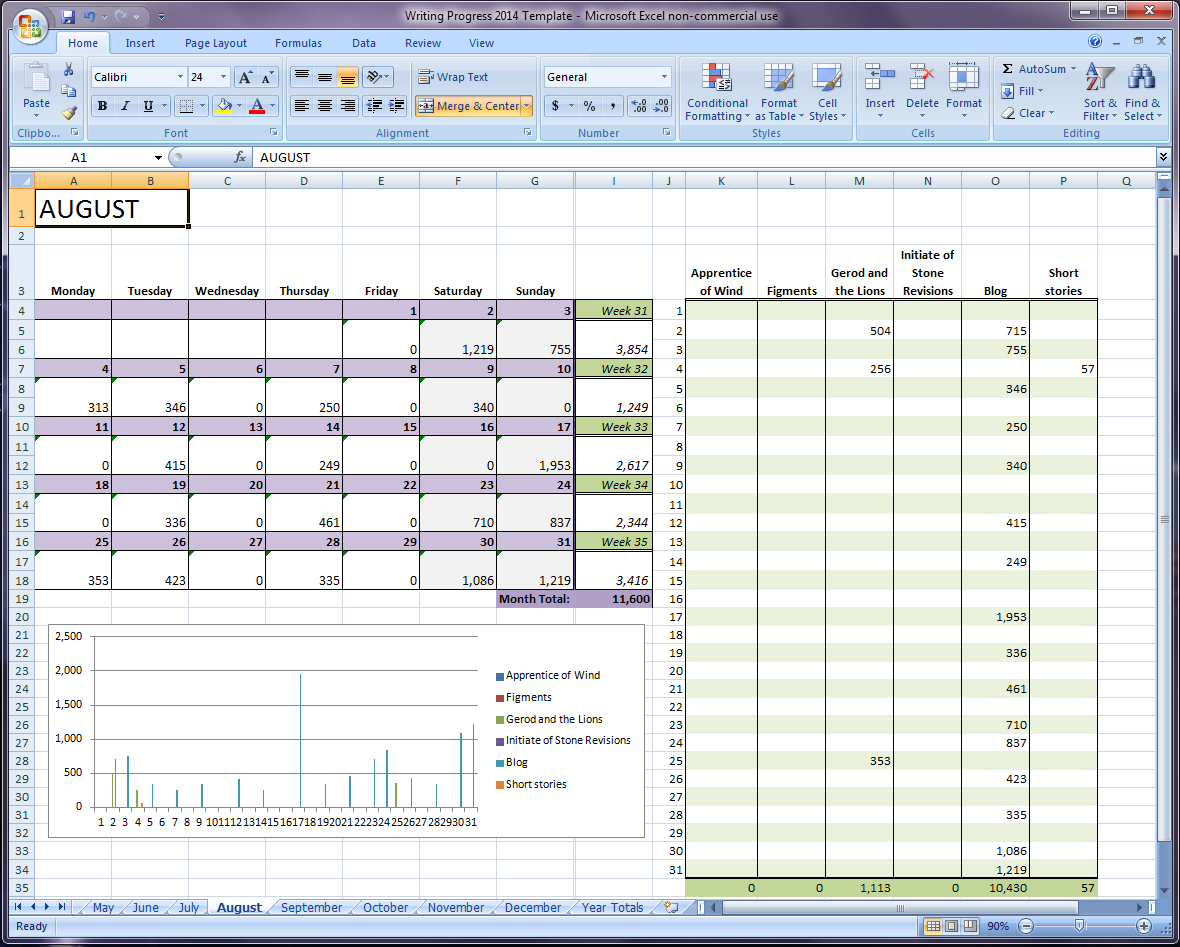
August's writing progress

The stats

My total output for the month has been 11,600 words.

A scant 57 words went into the short story, but were then more than edited out again.

1,113 went into GatL.

And, as ever, the bulk of my words went into this blog. 10,430 to be exact.

I’m still waiting for beta reports. I haven’t finished the mapping of Figments yet, let alone moved on to AoW. Despite the limited progress this month, I’m still on track to finish GatL by the end of the year. So everything is on the cusp of its next evolution. I’m full of optimism.

As I watch my writerly friends publish their second novels, I get a twinge of envy, but I’m trying to convert that into motivation, because, in the end, my writing career is up to me.

It’s time to get back to work.

Farewell until next month, my friends. Wonderful words to you all. Break a pencil*!

*I’ve mentioned in the past that this is the superstitious writer’s “good luck,” but more recently, I’ve realized it might be a, shall we say, Canadian, way of saying Chuck Wendig’s “Art harder, motherfucker!” Yup. Break those keyboards, make those pens bleed ink, crush those pencil leads. I want y’all to art that hard. If you will, I will, too. Deal? 🙂

The Next Chapter

WWC Day 1: Anthology Jam

Panelists: Ron S. Friedman, Randy McCharles, Charles V. Prepolec

RonFriedmanrandymccharlescharlesprepolec


Q: As a writer, how do you approach an anthology? How to you get in?

RM: There are two kinds of anthologies, open and closed. Open anthologies are exactly that. There will be an open submission period. Closed anthologies tend to be by invitation only and some are dedicated to a particular franchise or theme.

CP: Open anthologies are the only chance for newer writers to get published. They tend to be niche and specific. Pitching an anthology to a publisher is difficult these days. People aren’t reading them as much. You can check out the possibilities on ralan.com. Ralan’s good because it will list the rates as well as the contact information. Professional rates are like six cents a word or something like that. I think Innsmouth Free Press has an open call out for She Walks in Shadows, for Lovecraftian stories featuring a female protagonist or deity. Also check out Kickstarter (Mel’s note: I just did a quick search for anthologies and sorted by newest). It’s a way of guaging the market as well as raising funds. Some of them have open reading periods, for example, ChiZine Publications’ Fearful Symetries, which Ellen Datlow edited. Duotrope is another good place to go. It’s reasonable at $50 a year.

RM: Really, you have three options: magazine, open anthology, and collection. There’s no other way to get your short stories published.

Q: Do you write to a particular Anthology’s theme?

RM: Yes. I wrote to theme for Tesseracts: Parnassus Unbound.

CP: You can write to the market.

RF: If you write for a particular anthology and your story doesn’t make it, you can always submit it elsewhere.

RM: You write stories. Keep a “story drawer” and repurpose as required. I had five short stories that I cobbled together for Tesseracts 16. It was published in the anthology, the year’s best, and nominated for an Aurora. Sometimes it’s an issue of money vs. passion.

RF: You can also publish short fiction on Amazon. Kindle Singles.

Q: What rights go to the anthology?

CP: Usually for an anthology it’s first time print rights for about a year.

RM: Short fiction is a one time sale. There aren’t any royalties like for a novel.

RF: Rights are usually considered from date of publication, not date of sale.

RM: Anthologies love reprints because they feed back to sales for the originating anthology.

CP: Gaslight Grimoire had two stories picked up for other publications. You don’t want to be competing with yourself though. If you want to find out more about the market, you can check out The Market List, Writeaholics.net, Towse’s links to online submission guidelines.

RF: Check out the SFWA site as well.

Q: I’d recommend submission grinder.

CP: If you’re heading into this world for the first time, I’d also check things out on preditors and editors.

RM: Your goal isn’t just to sell, but you want to sell to a market that people read. Ask yourself, is this a market that people are reading? Send to the highest paying markets first. They usually have a larger readership.

RF: Bundoran Press will have an open submission period for Second Contact, September 15, 2014 to January 15, 2015.

CP: Small presses are more open to anthologies and collections. Prime Books – Sean Wallace. Edge Science Fiction and Fantasy Publishing – Brian Hades.

Q: How much material do editors request? Do you ever oversubscribe?

RM: Content or contributors may be assigned. Choose between five or six of these authors. The editor may choose. There is going to be a total word limit you have to stay within.

CP: We oversubscribe by about 30%. There will always be people who drop out or don’t follow through.

Q: Can a writer pitch an anthology?

CP: No. Editors, maybe. You could pitch a collection of your own stories, but not an anthology.


Tomorrow: The Next Chapter: August 2014 update.