The Next Chapter: September 2014 update

So here we are at the beginning of October, my favourite month, not in least because Samhain (Hallowe’en) was my hatch-day (and yes, I’ve heard them all and would proudly claim to be witch, werewolf, vampire, or anything else you’d care to call me).

September was an interesting month.

I made further progress on Gerod and the Lions. Total word count on the project is 21,423 words, just over half-way for an MG novel, which this is supposed to be. I’m no longer on track to finish by the end of the year for reasons I’ll tell you about shortly, but I figure I’ll be done the first draft in January or February of 2015. Not bad.

I finished mapping and reverse engineering Figments (finally!). One thing I’ve learned from this project is that reverse engineering is tough.

When I worked backward through my plot for Initiate of Stone earlier this year, I was working with a seventh draft. I’d already completed a lot of the structural reorganization that reverse engineering might have indicated was necessary. Though I fine tuned a lot of foreshadowing and really tightened things up, there wasn’t a lot of tearing apart and putting back together.

With Figments, there was. Figments is a first draft, a NaNoWriMo first draft, at that. I’m not ashamed to admit that I lost my way a few times. I ended up listing events in reverse chronological order and then reorganizing them into Victoria Mixon’s holographic structure. In made my head spin.

Another thing I’ve decided is that I’ll head back to the computer for my mapping. It’s just a lot easier than rewriting everything out by hand. The reverse engineering, though, has to be done by hand. It really puts you in a different headspace.

Having accomplished the Figments mapping and reverse engineering, I’ve moved onto Apprentice of Wind. That will take me a while to get a handle on as well. It might as well be a first draft, though I went as far as draft four with IoS and AoW as one honkin’ monster of a novel 😛 I have subsequently changed enough in IoS and cut up parts of AoW that it really is like starting from scratch.

The other thing I started on this month is reworking IoS. I still have betas outstanding, but my writer’s head had to go there. I haven’t gotten very far, just a few chapters, but I think it’s going well. I have enough distance from the novel that I’m seeing a lot of things more clearly than I had before.

This isn’t to say that the outstanding betas work over the last year and a bit has been for nought. I still want to see what you recommend. I’m not above going back and changing even more. I just had to get at it.

I can finally tell you about my mysterious short(-ish) story tale. I had submitted it to Fantasy & Science Fiction Magazine in response to a special call out by C.C. Finlay in the first part of August.

I received word on September 21st that he wasn’t taken with the story (though it was a very nice rejection—thank you!). So, I promptly revised to try and fix what may have been the dear thing’s flaws and sent it off to Writers of the Future.

In reviewing my previous submissions to that contest, I realized that my honourable mention from 2011 was for the same story that I eventually revised and submitted to On Spec: “Downtime,” which should be out in the fall 2014 issue (I’m still so excited about that).

Can’t wait to get my paws on my contributor’s issue. Sorry, drooling there a bit.

Other On Spec news: they won an Aurora Award! W00t! Congratz! So pleased for them. Chuffed even.

Also, Bastion Science Fiction Magazine, the online publication that accepted “The Broken Places” back in June, has become an Amazon bestseller. More W00t! and Gratz! to the good people at Bastion.

Though I decided not to move forward with my self-funded leave this fall, I’ve decided that I still want to attempt to do NaNoWriMo again this year. Yes. That’s while working the day job. Yup. I’m certifiable.

I had considered taking a blogging holiday for a month, and it may come to that if I can’t manage my time and get the words down, but I’d prefer to keep to three posts a week: Tipsday, Thoughty Thursday, and my WWC2014 reportage.

In the last month, you may have noticed that I haven’t posted a lot on Sundays. I’ve found that to be a wonderful gift for the writing side of things. This weekend is an exception. You’ll find out later in my second post of this particular Sunday.

The other thing I’ve tried in the last couple of weeks is to prepare my Tipsday and Thoughty Thursday posts on Sunday and just post them on the appropriate weekday. I think between giving myself Sundays, prepping the weekday posts, and then focusing on my NaNo project to the exclusion of most other creative endeavours for the month, I’ll be able to hack it.

Of course, November will be the acid test. I’m also heading down to Toronto for a couple of days for a Humber School for Writers workshop on November 6 and 7. I just can’t help myself. I have to try.

I’ve already been doing some research on my idea and I’ll be working on a rough outline and further research this month. It’s the strength of this idea that has convinced me to make this crazy NaNoWriMo commitment.

I’ve also joined Jane Ann McLachlan’s street team I’ll talk a bit more about street teams in a future post. Her next novel, a YA science fiction, will be coming out soon. Much excitement there!

So, here’s how September’s numbers worked out:
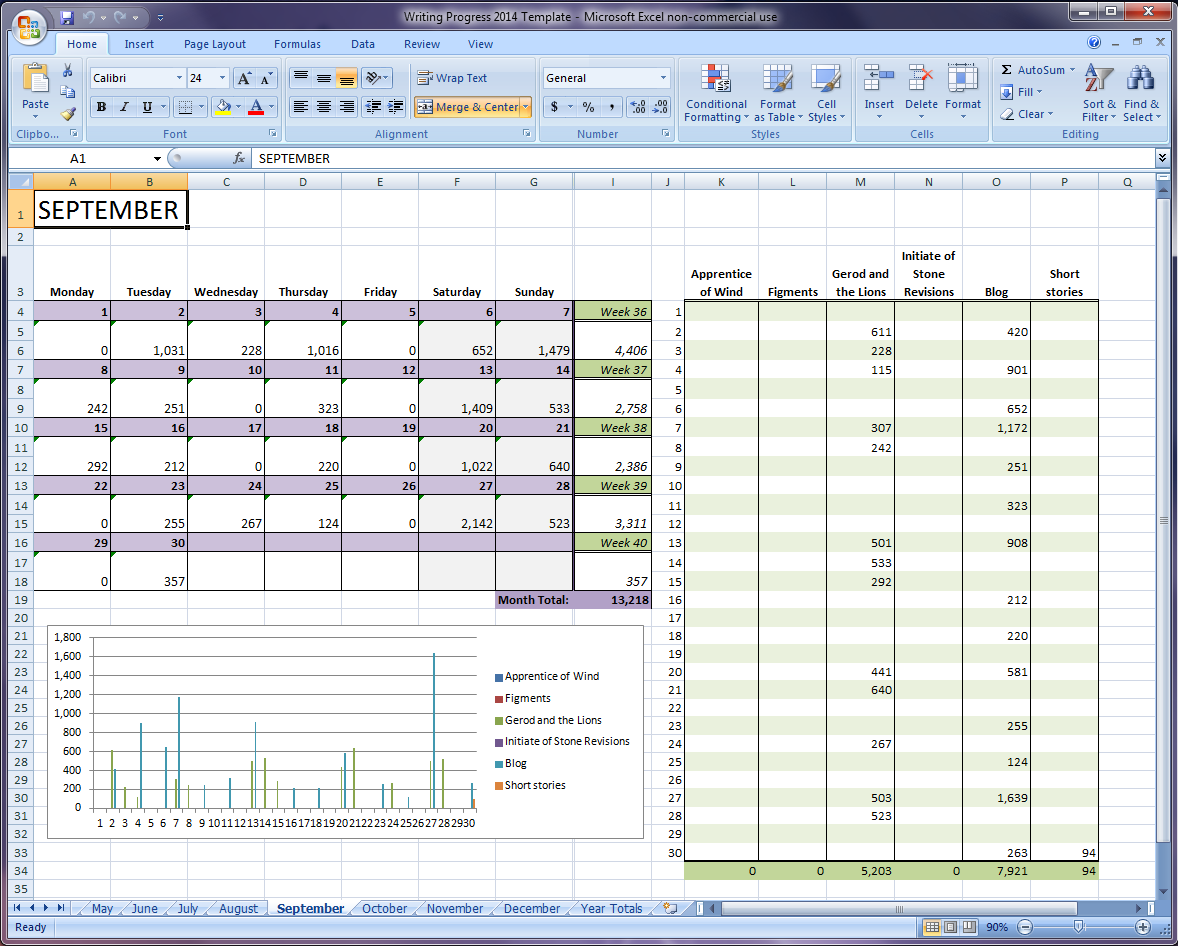
September's writing progress

A total of 13, 218 words. Modest, but reasonable.

7,921 on the blog, 5203 on GatL, and a scant 94 on my longish short story (that was after removing and rearranging several hundred, but I never count negative words).

So that was my month in writing.

How have your projects been shaping up? Please share in the comments. I love hearing about your yummy, yummy words.
The Next Chapter

WWC 2014, day 2: Blending science fiction and fantasy

Panellists: Stacy Dooks, Nina Munteanu, Greg Bechtel, and Ian Alexander Martin

Nina MunteanugregbechtelIan Alexander MartinSD: Genres are breaking down. Clarke’s third law states: Any sufficiently advanced technology is indistinguishable from magic.

NM: Why do we have genres and should we still?

GB: Yes. It’s for the reader. How else will we know what to buy and read?

NM: Publishers and imprints have the genre printed right on the spine, though.

IAM: I say I don’t like categories and genres, but when I go to my publisher, I use them. I may not like it, but I have to use them.

SD: Genre is your navigational touchstone, your compass point. You can get tricked into reading a genre you weren’t expecting. Stephen King is known primarily for horror, but then he published the Dark Tower series.

IAM: Using categories to restrict authors or stories is bogus.

NM: Do we need to re-educate our readers, then?

GB: Word of mouth is how you find out about books. Now it’s moved online.

NM: It started with Amazon. People are finding their books in new ways now.

IAM: Chapters is its own competition. If you buy online you save 20% over the bookstore prices.

NM: Is it still germane to categorize books?

IAM: Categories in bookstores is an American invention. In the 50’s or 60’s it migrated to Canada. Before that, everything was alphabetical by author, regardless of genre or category.

NM: It’s a different way of looking for a book. When you look for a book, do you look for an author, or do you look for a genre?

Q: People who are already published can bend the rules. What about someone who’s writing?

SD: It’s important to establish the ground rules for your universe. Don’t get derailed. Take Star Wars, for instance. It’s the biggest blend of science fiction and fantasy out there. Don’t try to explain the fantasy elements, like midichlorians. Don’t let anything come out of left field.

GB: We all seem to be agreeing that blending science fiction and fantasy can be done and has been done successfully. What advice do we have for the writers in our audience?

NM: To me, it’s all about the reader. When you read my books, you know what you’re getting. It’s about consistency.

SD: You make a covenant with your reader.

NM: As soon as another writer takes over a franchise, the reader can tell.

GB: You can break your rules if you set it up. Foreshadow. (Mel’s note: Kelley Armstrong said much the same thing in her workshop on writing fantasy at CanWrite!)

IAM: You should trust your reader to “get it.”

NM: You can be subtle.

Q: Blending is one thing, but what is genre? Is it the trappings, or are there other criteria?

NM: I teach how to write science fiction at the University of Toronto. That’s one of the first things my students have to learn is how to define the genre. In science fiction, science is the premise, the ‘what if?’ Fantasy doesn’t have to have magic, but it’s based more on myth and folklore.

SD: In Star Wars, you have all the trappings of science fiction, but at its core the story is a mythic one.

NM: Even if there’s something inexplicable about it. Sometimes, it’s better not to explain.

Q: So is it the fantasy element that enables the story?

NM: Take a look at Diana Gabaldon. Her books defy categorization, but when Outlander was first published, it was stuffed in the romance section of bookstores, even though the author insisted on the more general ‘fiction’ category. Sometimes trying to pigeon-hole your novel can backfire. I wrote what I called a romantic science fiction story. An artificial intelligence ran society, but romance was the main thread. It was dark though. Both partners died. It bombed with romance readers. It was well-reviewed, but romance readers hated it (where was the happy ending?) and science fiction readers loved it.

GB: Margaret Atwood is another example. You don’t want to disappoint your readers’ expectations.

Q: Is genre mainly the concern of publishers and marketing departments? Do you need to focus on it when you’re writing?

NM: You need to understand genre and how that’s going to affect where your novel is placed. New writers who blend are not as marketable.

IAM: Not during the creative process, though. Afterward, yes.

Q: Before the 50’s fantasy had to be disguised as science fiction.

Q: As a new author, how should you present your blended novel?

IAM: I’d be more interested in your mix. Do your research. Approach those publishers that have a track record with blended fiction.

GB: Find a publisher that produces novels you like to read and approach them.

NM: Books used to be marketed by genre. Identify what your book is and sell it for what it actually is.

IAM: Online recommendations may not be accurate. Genre is important for retail, library, and the marketing department. It’s not so relevant to the end user/reader anymore. Social interaction is the key to discoverability.

Q: I didn’t understand that Star Wars was a blend. Now that I think of blending in this light, Final Fantasy nailed it. How much does the visual element contribute?

SD: Science fiction and fantasy is a marginalized genre.

IAM: The general reaction is, “You’re reading that? Read [the classics] instead (Asimov, Clark, etc.).”

NM: The visual element enables blending.

GB: Buffy the Vampire Slayer was a wonderful cross-pollination of horror and action-adventure wrapped in a coming-of-age story.

Q: Fantasy is magic-based. It doesn’t necessarily track for me. Can you make a science-based magic system?

IAM: Absolutely. You can do it if you do it well.

NM: Ultimately, fiction is story. Serve the story.

Next week: When words collide day two continues with Mark Leslie.

Thoughty Thursday: Things that made me go hmmmm on the interwebs, Sept 21-27, 2014

Fast Company presents this lovely infographic on humanity’s greatest architectural achievements since pre-history. Fascinating.

Geoglyphs found in Kazakhstan. IFLS.

How fire may cave shaped our preference for evening entertainment. The Economist.

Thirteen misconceptions about global warming from Veritasium.


The top ten unsolved mysteries of science. IFLS. Yes. There’s still stuff we don’t know 😉

The physics of space battles from It’s Okay to be Smart:


David Brin peers into the future of AI and robot brains. Contrary Brin.

Michio Kaku: Science fiction is becoming science fact. THOnline.com.

Scientists band together to Stand up to Cancer. Upworthy.

We’re getting closer to finding a solution to spinal cord injuries. IFLS. Today, rats. Tomorrow, the world 🙂

Your brain makes decisions while you sleep. IFLS. This explains the 3 a.m. epiphany 🙂

Madness and the muse from the Chronicle of Higher Education. Is there a real connection between mental illness and creativity, or are we focusing on the wrong data? As a writer with depression who knows other writers with depression, I’m predisposed to the positive correlation. As Mr. Science likes to remind me, however, correlation is not scientific proof, and the numbers can be manipulated to say just about anything the person collecting them wants. Keep that in mind when you hear about “the latest study on . . .” whatever. While math is the basis of physics, and therefore the hard sciences, statistics tends to be the basis for many of the so-called soft sciences (psychology, sociology, etc.). Numbers can be manipulated by the clever statistician. I’m not saying they always are, but it’s something to think about.

A blood test for depression shows that the disease is not a matter of will. The Huffington Post.

This has been all over the web in the last week: Emma Watson’s speech at the UN on achieving gender equality. #HeForShe


There are seven kinds of English surnames according to Ancestry.com. Which do you have? Though my surname is Finnish, there’s a town in Finland called Marttila. It means St. Martin. So I have a surname based on a place.

Over 25 applications that can make your life easier from the TED blog.

Three Clydesdales born at Warm Springs Ranch. KSDK.com.

And, kind of related, Budweiser’s latest anti-drinking and driving ad is a real tear-jerker. 93.1 WPOC.

This cat is an opera singer. Just add scratchies.


Batman Evolution from The Piano Guys. This is just cool. And it gave me the shivers.


Jimmy Fallon has so much fund with his guests. In this clip, the fabulous Robert Plant!


Sudbury has seen a lot of film crews in the last few years. Here’s a wee news clip about the latest shoot. CTV News Northern Ontario.

And that’s a wrap.

See you Saturday 🙂

Thoughty Thursday

Tipsday: Writerly Goodness found on the interwebz, Sept 21-27, 2014

I keep catching myself as I write these posts. Though I know it’s September, I keep on wanting to type August in the date (!) And here we are, almost at the end of September and I haven’t gotten used to typing the month yet.

Just a wee testimony, I think, to just how tired I am these days 😛 That, or just how crappy a summer it’s been here in northern Ontario. I’m still waiting for a few nice days. Just a few. Can we have August weather in October, please?

Find out why K.M. Weiland says you’ve been writing sentences incorrectly all your life. All about the impact sentence.

The wrong way to write a smart character. Katie gets feisty about Sir Kenneth Branagh’s Jack Ryan: Shadow Recruit.

Jami Gold explores how we can balance emotion in our writing without telling too much.

Laura Drake on the conscious use of adverbs. Writers in the Storm.

Dan Blank wants to help you create capacity on Writer Unboxed.

Chris Winkle shares how to use the heroine’s journey (as outlined by Maureen Murdock) in your novel. Mythcreants.

This is an older i09 post that saw a little renewed circulation this week: The seven deadly sins of religion in science fiction.

33 books to read to celebrate banned books week. BuzzFeed.

Shakespeare’s Hamlet was Irish, not Danish. IrishCentral.

Slow reading helps your brain and eases stress. The Wall Street Journal.

An old favourite from The Oatmeal: how to use a semicolon.

Have a fabulous week, everyone!

Tipsday

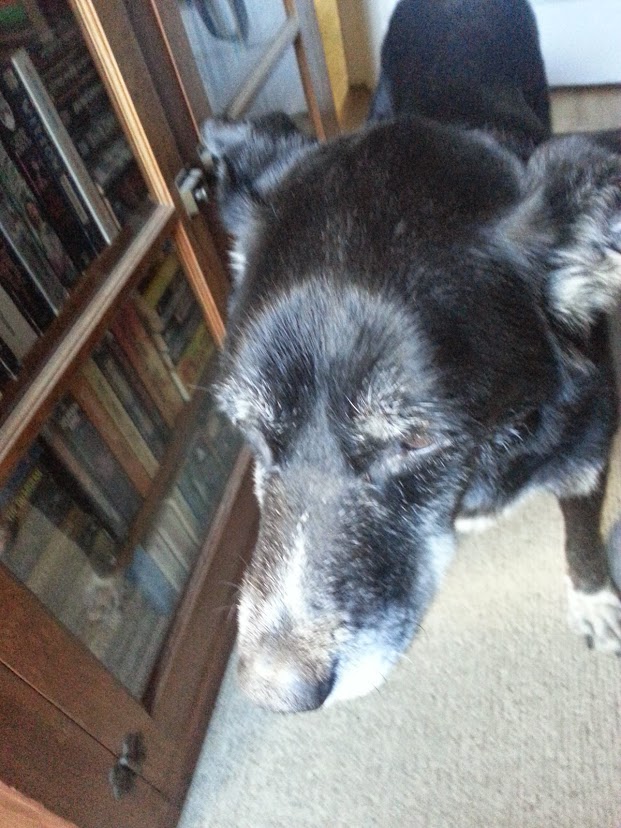
Pupdate, part the whatever

It’s been a while since I’ve posted one of these. Phil and I had, foolishly, fell into complacency, having felt that the worst of Nuala’s troubles were behind us.

Not so, apparently.

When we had seen the veterinarian in June, following up on Nuala’s persistently inflamed and fibrocystic ear canals, we had been sent home with Nu on a regimen on low dose prednisone and periodic flushing of the problematic canals with TryzEDTA. She would be due for further blood tests in September to follow up on her kidney function and liver function to see how she was tolerating the pred.

September hit and Nuala started to behave poorly again. Her ears started to throw off more crud/pus, and we thought we’d up her pred for a bit to see if we could clear it up. She became listless and her bladder control was practically non-existent. She also started to drink a lot of water. A lot. It was so bad that I’d have to restrain her from drinking from puddles when we walked. We had to remember to keep the toilet lid down.

We noticed she was losing weight, too. We theorized, because we both knew the symptoms, that she might be diabetic, but I preferred to remain in denial for a while and hoped that her difficulties resulted from an existing condition that we could treat.

I thought initially that we could wait until the vet called for her follow up blood work, but week before last, we decided we couldn’t wait any longer and made an appointment for this Tuesday just past.

We brought in a urine sample as well, just in case. Turns out it was good that we did.

The first thing we did upon entering the office was to weigh her. It’s something we do every time. If there is any medication to be doled out or adjusted, the vet needs to know her weight.

She was 25 kilograms. The last time we’d weighed her in June, she was 31.4 kilograms. That was a shock.

In the examination room, though he confirmed the increased inflammation/infection in her ears and her poor physical condition, the vet said that we were to return to the lower dosage of pred with an eye to eliminating it altogether. Pred can apparently exacerbate the onset of diabetes. Joy.

He said that his immediate diagnosis would be diabetes, but that he’d actually like to perform the tests to confirm his diagnosis before prescribing anything.

Wednesday, Phil received the call at work: Nu was indeed diabetic, and there were ketones in her urine.

Now, for those of you who don’t know, this is bad. It means that Nu had depleted her fat stores and that her body was now consuming her muscle mass in an attempt to compensate for her inability to metabolize sugar properly.

I noticed that she had been a bit unsteady on her pegs in the last couple of days.

So, we both took off work early on Thursday to get back to see the vet before he left for the day. Unfortunately he wasn’t able to get the insulin pen and supplies he wanted for Nu, but he had some canine insulin and syringes that had been returned by another client. She’d need 12 units of insulin, morning and night.

We were also given new food, a diabetic diet, and advised to feed Nu between three and four cans of it a day (she was doing well on a half a can and a cup of kibble a day before) to bring her weight back up.

And finally, I’ll be taking her back in this coming Tuesday for a glucose curve to see how she’s doing and if we have to adjust the dosage or the food in the next little bit.

In the three days she’s been on the insulin, I’m happy to say that Nuala is already looking better, drinking less, peeing in the house less, and enjoying her usual activities (like eating garbage on our morning walks) again.

The hope is that getting the diabetes under control will also reduce the stress on Nu’s body and reduce the inflammation in her ears, if nothing else. Otherwise, it’s a game of wait and see. We’ll address her health issues as required, moving forward.

This is not new territory for Phil and me. Our cat, Thufir, was diabetic for the last three years of his life. Plus, Phil was a medical laboratory technician in a past career, so he’s cool with the whole injection thing.

The unfortunate part for me is that Nu needs her insulin an hour before her meals, morning and night. So . . . there will be no more sleeping in for Mellie on the weekends. I’ll either have to take up napping (something I’ve never been good at) or try to find some other way to recover from my weekly sleep deficit from working.

Something tells me I shouldn’t have decided to defer my leave with income averaging until the spring.

The important thing is that Nuala is on the road to recovery again.

I hope I won’t be writing another pupdate for some time. My poor dear has been through quite enough.

Next week: I’ll be posting my Next Chapter monthly update. There are still a few days left in the month and I want to make the most of them 🙂

So, this dog walks into a writer’s office and says, “Whatchya up to?”

WWC 2014, Day 1: Evening keynotes

Here we are at the end of day 1 (for me–I know others partied into the wee hours). At other conferences and conventions, guest of honour keynotes are generally spread throughout the event, often at or after a meal.

The When Words Collide organizers chose to do something different.

Prior to the literary festival, there were several master classes offered by the keynote speakers, and the night before, they all delivered their presentations at a branch of the public library.

Between the extra days of leave I would have had to sacrifice, the cost of the master classes, and the expense of a longer stay, I had to opt out of the pre-conference program.

On the first night (formally speaking) of WWC, then, all of the keynote speakers were well into conference mode and had an opportunity to work out the bugs.

The keynotes were presented as a panel, with all of the speakers up on the stage, seated at tables.

Randy McCharles offered a few opening words, and then introduced the first of the speakers.

  1. Jacqueline Guest, author of 18 published novels, spoke about her adventures as aJacqueline Guest touring author. She has been all over the world, in the arctic, and had some very interesting tales to share. The old advice to writers is to write what you know. Travelling and experiencing all the world has to offer is a valuable way of gathering experience that can translate into your writing.
  2. Mark Leslie, of Kobo Writing Life, chose the subject of the mark-lesliehistory of story. From our earliest gatherings to share news around a fire, through the oral traditions of Greece and Rome, the invention of the printing press, and the advent of the novel, to today’s proliferation of traditionally published and independently published novels, novellas, short stories, anthologies, and all other manner of written storytelling, Mark spoke eloquently of the purpose and value of story in our lives. He ended his keynote with this: when words collide, magic happens.
  3. Dorothy (DJ) MacIntosh, author of the (in progress) Mesopotamian trilogy, spoke
    DJ McIntosh

    photo by Robert Rafton

    about passion and how to keep that precious flame burning. She related the experiences, hers and those of other renowned authors, with rejection, and various reactions to rejection letters. How can we keep our passion alive amidst the darkness that can assail us?

  4. Brandon Sanderson, author of—oh, I’ll just say it—a shit load of bestselling fantasy novels including the
    Photo by Nazrilof

    Photo by Nazrilof

    posthumous conclusion of Robert Jordan’s Wheel of Time series, addressed the problem of telling a compelling lie. He started with a grade school experience in which he realized that the story of Columbus and his discovery of the new world was all propaganda. In short, it was a lie, but it’s a lie that has been perpetuated over the years by quality storytelling. You could say that’s when the seed of his desire to become a professional liar was planted. He spoke of Sturgeon’s Law: that ninety percent of everything is crap. He wanted to test that hypothesis and started with Roger Ebert’s movie review site, which revealed between sixty and seventy percent good movies (two thumbs up). He then went to Rotten Tomatoes, a review site contributed to by the movie-going public. He found roughly the same results. There were exceptions, of course. He found one reviewer who didn’t like Return of the King, for example. Reviews are one of the most power tools in any author’s service. Word of mouth is what really translates into sales and a groundswell of support. The bad reviews can be damaging in all kinds of ways. We have to be able to distinguish between someone expressing a personal opinion, e.g. I didn’t like this book, and someone who’s going for the hurt, e.g. this is crap. They are two completely different judgements.

  5. Jack Whyte. I’d seen him last year at the Surrey International Writers’ Conference jack-whyteand knew the power of his presence, but, when Jack took the stage, I put my pen down and sat back. I knew I was about to be entertained. Jack basically extemporized (or, he made is sound like he was), drawing in elements of each of the previous speakers, adding colour with a touch of personal humour, and wrapping up the evening in style.

Next week: We enter day 2 with the Blending Science Fiction and Fantasy Panel.

Thoughty Thursday: Things that made me go hmmmm on the interwebz, Sept 14-20, 2014

Wow, I wasn’t very thoughty this week at all (!) Oh well, enjoy the puppies.

BBC News reports on new discoveries regarding the death of Richard III.

Bloom’s Taxonomy infographic and explanation on Eudemic.

Who better to protect a tiny baby than a huge dog? Wimp.com.

I actually found these underwater dogs rather creepy . . . Mother Nature Network.

I saw this video on Canada AM last week, and then what should show up in my feed? Yup. Baby bear cuteness.


Did you enjoy them? The puppies, I mean? And the bear?

Be back on Saturday with more WWC2014 and, egads, a pupdate.

Thoughty Thursday

Tipsday: Writerly Goodness found on the interwebz, Sept 14-20, 2014

I’ve an interesting variety this week.

How to use rewards and punishments to encourage your character to change, by K.M. Weiland.

Katie shares how she learned to write on her Wednesday vlog.

How to plot your novel with mini arcs. Janice Hardy’s Fiction University.

Marcy Kennedy guests on Fiction University, writing about ways to save money on editing.

Jamie Raintree asks, why are you really stuck on your novel? On Thinking Through our Fingers.

Roz Morris discovered that the pebble phone she conceived of for Lifeform Three, is a little closer to becoming a reality.

How Stephen King teaches writing, by Jessica Lahey for The Altantic.

Eight authors who experienced their biggest successes after 50. BookRiot. Take comfort. I did 🙂

Janna Marlies Maron shares how she used writing to heal her depression without taking drugs on Jeff Goins’s blog.

The real link between the psychopathology spectrum and the creativity spectrum. Scientific American.

How Jane Friedman recovered from three years of chronic back pain. It’s an injury that visits most authors at one point or another.

i09 shares 10 lessons from real-life lessons revolutions that fictional dystopias ignore.

Landmarks of feminism in science fiction, from The Cut.

Obsession and madness mark the best episode of Doctor Who in years. Polygon. Not sure if I agree with this assessment. I think I’m still warming up to Capaldi. Mind you, it’s the best episode so far this season.

Good words at you, my friends.

See you Thursday!

Tipsday

WWC 2014, Day 1: Doctor your book with Randy McCharles

randymccharlesRandy McCharles is active in Calgary, Alberta’s writing community with a focus on speculative fiction, usually of the wickedly humorous variety, with short stories and novellas available from Edge SF&F Publishing, House of Anansi, and Reality Skimming Press. He is the recipient of several Aurora Awards (Canada’s most prestigious award for speculative fiction) and is short-listed in three categories for the upcoming 2014 Awards. In 2013, his short story Ghost-B-Gone Incorporated won the House of Anansi 7-day Ghost Story Contest. Randy’s first Tyche Books publication, Much Ado About Macbeth, will be available in August 2015.

In addition to writing, Randy chairs the award-winning When Words Collide Festival for Readers and Writers as well as organizing various reading and craft events for writers.


As writers, we love our literary children. We are also our own worst critics. We need to find a middle ground, an objective perspective. A peer review or critique groups can be of great value in this respect.

When we write, we see the story in our heads so clearly we may forget to put it all down on paper. We need to learn how to doctor our work.

Self-publishing is another reason. Learning to edit your work can help save costs.

The less work an editor has to do, the better. Also, cheaper. (Mel’s note: even if you think that your work is well-edited, a professional editor will always be able to identify further corrections, whether substantive, copy, or line editing. Also, many freelance editors charge by page or words, so you won’t necessarily save any money if you have 75k well-edited words, or 75k poorly edited ones. With an editor who charges by hour, you might do better.)

Theme will help you keep on track.

Then ensued much discussion regarding the relative merits of David Brin’s The Postman and Suzanne Collins’s The Hunger Games, both books and movies.

Many inexperienced writers choose the wrong place to start the story. Too soon and unimportant events won’t capture your reader’s attention. Too late and the reader won’t be engaged by your character, or you’ll find yourself explaining—telling—events that have just happened. That’s a tell-tale sign you’ve started too late.

Aim for in media res, but don’t misunderstand the technique. Too much action can confuse the reader. Give the reader a reason to care.

Try not to be “married to the line,” that is, if you think you have to start in a particular place because you’ve come up with the “perfect” line, that line may be one of the darlings you have to kill. You have to be willing to set it aside to find the true beginning of your novel.

Other issues are genre-specific. In fantasy or science fiction, you may spend too much time on worldbuilding or on backstory. Sometimes chapter one is just a distraction and your real story starts in chapter two or even three.

Some opening scenes are missing the hook, that story question that will propel the reader through the novel. New York Times Bestselling Authors (NYTBSAs) can get away with this, but not the first time author.

You may also be missing scenes. This comes from writing “in your head” too much.

Unnecessary scenes may be a sign of too much thinking on the page, on the other hand.

We talk about wearing your writer’s hat and your editor’s hat, but what’s missing from the equation is the reader’s hat.

Thoughty Thursday: Things that made me go hmmmm on the interwebz, Sept 7-13, 2014

Once again, IFLS seems to have taken over Thoughty Thursday. I guess I really do fucking love science 😉

Most undergraduates are now being taught by poorly-paid, part-timers. CBC.

Ten surprising benefits of Earl Grey tea. Lifehack.

The Earth’s new address: planet Earth, Solar System, Milky Way, Laniakea. IFLS.

Ten myths about space we need to bust. IFLS.

Underground map reveals the secrets of Stonehenge and nearby “superhenge.” IFLS.

Less than 1% of Sweden’s trash ends up in landfills. We should all aim for this! IFLS.

Your blood type could affect your memory. IFLS.

Tor.com. Improved methods identify half of Viking warriors as women. Are we surprised?

The Daily Mail: how DNA evidence helped track down the identity of Jack the Ripper.

How to stop your brain from hijacking your goals. IttyBiz.

Vi Hart. They became what they beheld: medium, message, and YouTubery.


Thirty old, but useful, names for parts of the body. Mental Floss.

Don’t you just feel like this every Monday morning?


This young pug loves his ball pit.


32 animals being total jerks. Diply.

Hope you thought thoughts, and laughed laughs 🙂

See you Saturday!

Thoughty Thursday