Thoughty Thursday: Things that made me go hmmmm on the interwebz, December 6-12, 2015

Here is your Thoughty for the week.

Colin Gautrey writes about women and bullying for Learn to Influence.

48 things women hear in a lifetime that men don’t:


The Ross Spiral Curriculum. This is kind of mind-blowing.

Emily Hill explores the world of Maori tattooing, or moko, for Wanderlust.

John Hooper unravels the history of the Etruscans for The Guardian.

Phil Plait shares his video of the moon occulting Venus on Slate. Beautiful.

Watch whales swim under the northern lights on NBC News.

Ethnobeat Irkusk percussion groups plays the Baikal Ice.


Story Travelers take a road trip across the UNESCO world heritage sites of Ireland.


Disturbed covers Simon and Garfunkel’s “The Sound of Silence.” Shivers. Rock ‘n’ Roll World Magazine.

It’s kawaii time!

Animals who think they’re puppies:


Hope you enjoyed your edutainment!

See you Saturday for more CanCon 2015 reportage 🙂

Thoughty Thursday

Tipsday: Writerly Goodness found on the interwebz, December 6-12, 2015

It’s been another great week of Writerly Goodness.

Jane Friedman offers her thoughts on privilege and luxury with respect to her productivity. This is particularly interesting in light of my The next chapter update of last week.

Here’s one of the articles Jane links in her post (above): The writing class by Jaswinder Bolina for the Poetry Foundation. I actually shared one of the others last week . . .

Jane later tries to answer the question; do men receive bigger book advances than women?

Why I choose to write publicly about my anxiety. Kameron Hurley.

K.M. Weiland returns to her most common writing mistakes series with this entry: Anticlimactic endings.

David Corbett explores shame, guilt, and hope, referencing other excellent posts by Tom Bentley and Donald Maass, in this post for Writer Unboxed: The redemptive arc.

Lisa Cron continues her exploration of backstory on Writer Unboxed: What we’ve been taught about backstory and why it’s wrong.

Tor.com offers their list of the SFF characters they couldn’t stop talking about in 2015.

Sherman Alexie: How storytelling can create social change. The Take Away.

Elizabeth Gilbert discusses not getting an MFA on The MFA Project.

Open Culture shares 48 hours of Joseph Campbell lectures for free.

Mental Floss offers Edison’s footage of Mark Twain in his home.

Charles Dickens once created an entire library of fake books. He titled them all himself. Someone was wearing his clever trousers. Open Culture.

Karin Scheper wonders whether to conserve or not to conserve on the Medieval Books blog.

Ah, another lovely entry in the Dictionary of Obscure Sorrows. Kudoclasm:


And with that bit of poetry, I leave you.

Until Thursday, mes cheres!

Tipsday

CanCon 2015, day 1: Ecology and story workshop with Nina Munteanu

It took us a little longer to drive to Ottawa than I thought, so I was late for this workshop. My apologies to Nina and to any of my readers who experience confusion as a result. If you think there’s something missing, you’re probably right 🙂

_____________________________________________________

Overlapping ecosystems are vibrant.

Ecologists ask why and how.

  • Why do species eat this food and not that one?
  • How do the environment, other species, diet, etc. limit population growth?

Adaptive traits:

  • Mimicry
  • Camouflage

Autotrophs (producers – species which produce their own food)

Phototrophs (produce food from light)

The Bracken Fern. Ubiquitous. Found on every continent except Antarctica. Very successful. Carcinogenic. Breaks down vitamin B. Reproduces by both spores and rhizomes.

Fiddleheads contain cyanide. Aggressive symbiosis. They attract ants which in turn defend it against other predators (peonies do this, too, though they don’t contain cyanide).

Nothing else will grow in a hemlock grove. It kills all potentially competitive species.

Some primates live with viruses that cause disease in other species because the monkey is the virus’s ‘ideal’ host. (Mel’s note: I think this was a digression into other forms of symbiosis–monkeys aren’t phototrophs.)

Chemotrophs (produce food from chemical processes)

Heterotrophs (consumers and decomposers, including us)

Parasites

Saprotrophs – fungi and bacteria

Detrivores – insects and earthworms

Lynn Margulis proposed the Gaia hypothesis and symbiogenesis (Google search for more information).

Endosymbiosis – cooperative adaptation.

Darwin’s theory of competition (survival of the fittest) is incomplete. It doesn’t explain altruism.

Symbiosis leads to happiness.

  • Kin selection – the choice to support the reproductive group including sacrifice for the greater good (heroism).
  • Group selection – the choice to limit population growth in favour of x (where x is more food, habitat, etc. for all).
  • Reciprocal altruism – The vampire bat, for example. All hunters may not be successful, but the successful hunters will share their food with the unsuccessful and with mothers/pups (by regurgitation) to ensure the continued strength of the community.
  • True altruism – Dolphins will help humans and other species for no apparent gain. (Mel’s note: they may also rape their own and other species for no apparent reason, but that’s another story.)
  • Communal feeding – Lions in prides.
  • Satellites – In some frog species, the small males will hang out with the big, noisy ones and ‘head off’ the eligible females attracted by their big, noisy brethren.
  • Niche partitioning – competing species that coexist in the same ecosystem by voluntarily partitioning food, habitat, etc..

Adaptation and extremophiles

The brine shrimp of Mono Lake (California) thrive in inland seas with salinity that kills potential predators. They can also survive being dried out.

There are flies that can swim and dive because they carry their own oxygen supplies in air bubbles.

There are bacteria that feed on sulphur.

The Microbes of Lake Untersee in Antarctica live in a super alkaline environment with lots of dissolved methane in the water. They create stromatolites—the largest ever found anywhere.

Bacteria in the Rio Tinto thrive in extreme acidity and high iron content in the water.

The fungi of Chernobyl feed on high levels of radioactivity.

The Atacama Salt Flats in Chile is the most arid desert in the world, yet hypolithic algae have evolved to thrive where no other plant life can.

Tardigrades (also known as water bears or moss piglets) can survive anywhere, even in space (for approximately ten days). They can be revived after a century of desiccation and endure 1000 times the lethal dose of radiation for a human. Technically, they’re not true extremophiles because they have not adapted to prefer, or thrive in these environments. They merely survive.


_____________________________________________________

The rest of the workshop was taken up by an exercise in which we applied ecology to the characters of our stories. How have our protagonists adapted to thrive in adverse conditions, compete against, or mimic, other characters, to become the heroes of our stories? In what ways do they show altruism, and is it true altruism, or another form? How does the unique environment of the story world affect them?

It was a very interesting workshop and I’m sorry to have missed the beginning of it.

Unfortunately, because of my late arrival, I did not get a picture of Nina or the workshop participants.

It was a good start to a great weekend of panels, though.

Come back next Saturday when the CanCon 2015 reportage continues with advice on pitching your novel.

Thoughty Thursday: Things that made me go hmmmm on the interwebz, Nov 29-Dec 5, 2015

What you should do in an active shooter situation. I can’t believe we need posts like this, but an ex-pat friend confesses she’s already had active shooter drills at her workplace. The Art of Manliness.

Will Canada be able to resolve the problems of its First Nations as quickly as it’s providing homes for Syrian refugees? It’s a valid question. The Globe and Mail.

Not everything happens for a reason. Bright Side.

The Unbound Spirit offers thirteen things you need to remember if you love a person who suffers from anxiety.

The decline of play can result in the increase in children’s mental disorders. Psychology Today.

This special agent crow proves he’s more than a bird brain. Daily Megabyte.

Brainpickings shares The Silent Friends, a lovely short film about our abiding bond with trees.

Canadian home care is suffering, but what about its patients? The Globe and Mail.

Lovely photograph of a lazy fox. Joop Snijder.

The Budweiser 2015 Superbowl ad, lost dog. The feels.


Phil Plait shares the latest Pluto images on Slate.

Preservationists fight to save forgotten French castle. You know how I like abandoned places 🙂 Wimp.

The last of the granny witches. Appalachian Ink.

The spirit of Mother Christmas. Gather.

Mog’s Christmas Calamity is adorable. Metro.

A Christmas classic:


You, me, Saturday. Let the CanCon 2015 reportage begin!

Thoughty Thursday

Tipsday: Writerly Goodness found on the interwebz, Nov 29-Dec 5, 2015

Gah! Almost didn’t make it, this week. The holiday season is starting to take over (!)

K.M. Weiland offers a final lesson learned from writing Storming: how to choose the right point of view.

Nina Munteanu shares her thought on how to end your novel.

Lance Schaubert picks apart the axiom that there is nothing new under the sun in this post for Writer Unboxed: Old books > new books.

What’s the current Donald Maass is writing about on Writer Unboxed? . . . and the greatest of these is hope.

What Cathy Yardley learned from writing erotica. Writer Unboxed.

So, Chuck Wendig saw this article in The Wall Street Journal and responded, no, ejaculated, most fizzily.

Junot Diaz shares his MIT writing class syllabi with Open Culture.

CBC Books presents its winter reading recommendations.

How the literary class system is impoverishing literature. Literary Hub.

A brilliant spoken word performance that explains depression perfectly. Upworthy.

Air New Zealand’s epic flight safety video:


Grandfather Frost and Baba Yaga: The weird and wonderful world of Russian fairytales. The Guardian.

Futurity examines science fiction’s lasting obsession with Mars.

J.J. Abrams actually said that Star Wars was always a boys’ thing. That toe jam taste good?

Phil and I are enjoying Jessica Jones. Here are a few posts about the show:

Suffering from #droughtlander ? Here’s a trailer for you to drool over. E!Online.

See you on Thoughty Thursday!

Tipsday

The next chapter: October and NaNoWriMo 2015 extravaganza!

In a way, I really enjoyed not posting on the weekends, but I don’t know how else I’m going to share my struggles, accomplishments, and great content like the CanCon 2015 panels I’ll start transcribing next week, unless I resume weekend (and mostly Saturday—today is an aberration) posts.

As I often tell y’all, it’s all writerly goodness 🙂

I’m happy when someone lets me know that I’ve shared something that’s been helpful to them. What’s a writerly girl to do?

Write.

October in a nutshell

My goals for October were to:

  • revise and submit a short story to a contest,
  • resume/catch up on querying,
  • finish Gerod and the Lions,
  • finish my outline for Reality Bomb in preparation for NaNo, and
  • attend CanCon 2015, October 29-November 1.

My short story made it all the way to the short list in Pulp Literature’s Raven Short Story Contest. This was my third ‘near-miss’ this year, having made the short list for the 2014 Friends of the Merrill Contest with one story, and having another short story set aside for special consideration in an anthology call, but ultimately rejected.

I don’t know whether this means I’m improving, or stuck in a rut O.o

I sent out not one, but two batches of queries in October. I’ve also already heard back from a number of agents with ‘thanks, but no thanks’ emails. I’ve decided to give the querying a break for now until the new year. The poor agents will be flooded with hopeful writers and their newly revised NaNo novels. I don’t want to get lost in the inundation. Besides, I have other reasons, which I’ll let you know about shortly.

I didn’t get GatL finished. I did write almost 9k words on the draft and I’m up to the climax, but then I was on the road for CanCon and I figured I’d save myself for the convention and for NaNoWriMo. I’ll resume work on GatL once I’ve finished Reality Bomb. Yes, more news on that coming, too.

I finished my outline for Reality Bomb with days to spare. It was a hand-written free-write in my journal, a ‘draft zero,’ if you will, which I was quite happy with, even though I made one major change that had some interesting cascading effects.

I attended CanCon, with Phil in tow, and, aside from attending a great workshop and two days of great panels, I also booked three blue-pencil sessions and two publisher pitch sessions. Right now, various portions of Initiate of Stone are on under consideration by three (one publisher was unable to attend and gave everyone a chance to pitch electronically after the fact) amazing small Canadian publishers.

That’s another reason why I’m holding off on further querying.

Come the New Year, though, watch out!

My October numbers:

  • GatL – 8,913 words
  • Short fiction – 45 words
  • Blog – 8,444 words
  • Total: 17,402 words.

October was a good month 😀
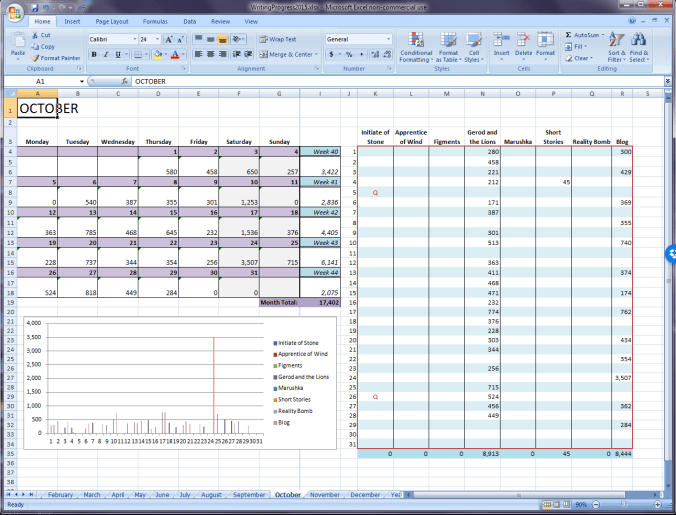
OctoberProgress

NaNoWriMo 2015

The idea for Reality Bomb was a dream that I’d had back in January.

Short pitch: Physics PhD candidate, Brenda O’Connell, fails to stop a misguided colleague from conducting his experiment to prove that time travel into the past is possible, destroying their reality and hurling Brenda into an alternate reality, nearly a year in the past. Nothing about her life in this new reality is what Brenda knows or remembers, but her former colleague is still heading toward a repeat of his catastrophic mistake. Can Brenda stop him before he destroys another reality?

I’ve decided that I like the free-writing, draft zero kind of outline. I’ve tried both more formal and less formal outlines in the past and I think this method really allows me to flesh out the characters and the ideas in a better way. Also, outlining by hand makes me feel as though the outline is more flexible, less permanent, and it facilitates my process better.

November first, I was still in Ottawa. It was also the first day of the time change, so I basically had an hour to write in the morning before I went to my first session. I cranked 1,559 words out and then spent the rest of the day in panels, blue-pencils, and pitches, drove the six hours home to Sudbury in torrential rain (and in the dark), and kind of crashed.

Fortunately, I’d taken the following week as vacation and set myself the goal of writing 30k words before my return to work the next Monday.

I’m glad to say that I accomplished that goal, writing between three and five thousand words each day.

The reason I wanted to get all those words written was that I knew I was going to be working, and travelling to deliver training, for the rest of the month. The week I was on the road was, as I expected, a low-production week. But I wrote, something I hadn’t been able to do the last couple of times I travelled to delivery training. So that in itself was a win.

NaNo-2015-Winner-Badge-Large-Square

And when I got back home I was able to comfortably write between 1,000 and 1,500 words each evening, finishing the month, and winning NaNo, with 55,006 words. The validator missed out on some of the words because I forgot to remove all of Word’s formatting (doh!). Still—writing stuff is awesome!

Including the blog, I wrote 56,994 words in November. Awesome. Indeed.

NaNoWriMo2015

Last year, I only managed 28,355 words while I was working.

What did I do to turn this around?

As I mentioned at the top of this post, I stopped blog posts on the weekends, but still kept up with my Tipsday and Thoughty Thursday curation posts (I couldn’t abandon you completely!).

Front loading my words in that first week off was critical to my success. I figured if I could get the 30k written, that I could ‘coast,’ relatively speaking, for the rest of the month. I would even have room for a day off if I needed it, but I wrote something every day, even if it was only a few hundred words. Also, the momentum I developed over the course of that first week carried me quite far into the month. I never felt stressed or worried that I couldn’t do it this time around.

I didn’t do any much housework. There’s always some of that to do, but I cut back substantially.

I told people. I’ve told people about NaNo in the past, but, with the exception of Phil, no one really got on board. This year, if people forgot, I just told them again. Kindly. Happily. Enthusiastically, even. It kept me accountable.

I wrote as soon as I got home from work and made it my priority before I did anything else. Get your words done first. The rest of life will wait.

Unfortunately, I can’t get up early enough anymore to write before I go to work. So first thing after work is the best I can do.

What did I learn from NaNoWriMo 2015?

I can write 50k (and more) in a month, even while I’m working.

Why is this important? Well, if I get a publishing deal, I’d hope it would be for more than one book, and, generally speaking, publishers want the books to come out fairly quickly (relatively speaking). So I’ve just proven to myself that I can produce when I need to. It’s comforting.

Also, it wasn’t that long ago that I was bemoaning my inability to produce. I was kind of stuck writing very little each day and letting myself get away with the not so occasional day of not writing at all.

I think I’ve been depressed, to be honest. It’s been a very mild recurrence, though. So mild I didn’t even realize what I had on my hands. Having to euthanize Nu back in July probably got to me more that I’d like to think. I thought I was grieving. I was actually shutting down.

Now, thanks to writing, I’m coming back.

What am I working on now?

I’m finishing up Reality Bomb first. I’m up to 58,376 words as of today. I’ve gone back to writing around 500 words a day, but I know I can do more if I need to. About to start chapter 33 of 36, so I should be done soon-ish.

Then I’ll finish up GatL. Finally. Remember when I was saying that about Marushka (last year’s NaNo)? I do finish my shit. Sometimes it just takes a while.

I have another contest to get a short story ready for, and if that doesn’t take me through to the end of the year, I’ll probably get back to work on Apprentice of Wind.

So . . . let’s just take a brief accounting.

  • Initiate of Stone – Adult epic fantasy of about 130k words. In the submission process.
  • Apprentice of Wind – Adult epic fantasy. Drafted at 115k words. Substantial rewrite required to bring it into line with the changes made in IoS.
  • Figments – YA urban fantasy. Drafted at 53k words. Reviewed, mapped, and reverse engineered. Ready for revision.
  • Gerod and the Lions – MG secondary world fantasy. Aiming for a 40k draft.
  • Marushka – YA urban/fairy tale retelling. Drafted at 67k. Awaiting review.
  • Reality Bomb – New Adult science fiction. Aiming for 65k in the completed draft.

That’ll be six novels by the end of this year. In various stages of completion 😉

And I have ideas for another fifteen (or so) more. Oh, this writing life is a good one. And I love it.

See you next Saturday with the first of the CanCon reports.
The Next Chapter

Thoughty Thursday: Things that made me go hmmmm on the interwebz, Nov 22-28, 2015

Not gonna give you my NaNo update this Thursday. You’re going to have to wait until Sunday and my epic Next Chapter update (October and NaNoWriMo). Also, I’m writing the draft through to the end, using my momentum to put this one to rest before the end of the year!

Andrew Rosenthal of The New York Times muses on fear and the high cost of terror.

As a final ‘f-you,’ the failing Harper government made 49 patronage appointments. iPolitics.

On that topic, here’s an infographic on logical fallacies.

Anna Lovind explores the roles we play and the freedom that hides behind them.

Arthur C. Brooks advises us to choose gratitude because it will make us happier. The New York Times.

If you get a PhD in Canada, don’t expect an income commensurate with your investment. In other words, you work for the passion, which, for many, is compensation enough. The Globe and Mail.

There’s a wrinkle in the frontal lobe that has been linked to hallucinations. BBC.

Scientists report that people who talk to themselves are geniuses. LifeHack.

These students planted 800 year old seeds and recovered an extinct variety of squash. Wimp.

The US Government is retiring all research chimpanzees. IFLS.

Michio Kaku wonders if déjà vu is caused by parallel universes. Open Culture.

Phil Plait celebrates two scientific anniversaries. Slate.

David Tennant celebrates 100 years of general relativity. Gizmodo.

Earthables shares 16 examples of fairytale architecture in Norway.

A neuroscientist-artist creates dazzling images of the brain. Live Science.

Take a look at this beautiful kinetic horse sculpture. Make.

Lightning at 7200 frames per second (FPS) is AMAZING. Emphasis on the ZING!

After six years and 720,000 attempts, this photographer captures the perfect kingfisher dive. Bored Panda.

Making art with fire:


Mashable presents this photo-essay on the North American Indian, 1904-1924.

Teddy Girls, the fashion subculture that time forgot. AnOther.

And yes, you read that right at the top of this post. Now that NaNo is over, I’m returning to Saturday posting 🙂 First is Next Chapter, which will be up Sunday instead of Saturday because of a family function this week. Then, I’m rewinding to CanCon 2015 and I’ll be sharing those posts into next year!

Lot’s of Writerly Goodness coming your way.

See you soon.

Thoughty Thursday

Tipsday: Writerly Goodness found on the interwebz, Nov 22-28, 2015

We’re back on track and heading full steam ahead 🙂

K.M. Weiland shares more lessons she learned from writing Storming: How to write multiple antagonists.

And: Seven easy ways to research an historical novel.

Veronica Sicoe is sharing some of the lessons she’s learned from writing The Deep Link and The Prime Rift. Writing out of sequence is the best way to draft.

How to get comfortable with the f-word. Vaughan Roycroft for Writer Unboxed.

Brunonia Barry asks, are you writing for love or money? Writer Unboxed.

Julie Glover guests posts on Jami Gold’s blog about how grammar can strengthen our writing voice.

Angela Ackerman writes about creating characters that readers trust, but shouldn’t. Writers Helping Writers.

Chris Winkle shows us how to write a riveting fight scene. Mythcreants.

Chuck Wendig considers privilege.

The two posts mentioned in Chuck’s:

Further linkage to be clicked.

C.S. Lakin wonders, is backstory killing your books plot? The Write Life.

Shad interviews Nalo Hopkinson on diversity in science fiction for CBC’s Q.

NPR talks to Ta-Nehisi Coates about his work and the painful process of becoming conscious.

Martha Nussbaum explores how storytelling rewires us and why we have to befriend our neediness to be happy. BrainPickings.

Waterstones prepares for a new chapter as the chain returns to profitability. The Guardian.

Damien Walter writes about the genre versus literary debate. It’s a battle in which both side lose. The Guardian.

The BookBaby blog suggests you focus on your book’s back cover copy.

If you’ve enjoyed a good book and you’re a woman, the critics think you’re wrong. The Guardian.

How a Finnish librarian decoded the world’s folklore. Timeline.

The Best Sci-Fi Books presents its list of the 23 best cyberpunk novels.

Be well until Thoughty Thursday!

Tipsday

Thoughty Thursday: Things that made me go hmmmm on the interwebz, Nov 15-21, 2015

This week’s NaNoWriMo update: 50,112 words. Yup, technically, I’ve won, but I’m going to keep going until the end of the month. Possibly beyond. I’m only on chapter 29 of 36 after all. =:D

Sweden vows to become one of the first fossil-fuel free nations. Collective Evolution.

Can drinking more be healthy? Pacific Standard. Now I think we have to look at factors outside alcohol consumption to get the whole picture, but I’ll leave it to you to figure out where you stand on the issue.

The Psychiatric Times revisits Robin Williams’ suicide.

Art heals. The Telegraph.

Teen wins $400,000 for his video explaining Einstein’s Special Theory of Relativity. Motherboard.

Upworthy lists fifteen badass women of World War II. Thinking thoughts? I am!

Puppies learning to howl (we called it doing the O’s):


Can reptiles exhibit joy?


Peace on earth was all it said . . . One Tin Soldier by The Original Caste:


Come back next week for some more Thoughty Thursday 🙂

Be well.

Tipsday

Tipsday: Writerly Goodness found on the interwebz, Nov 15-21, 2015

Slightly smaller batch this week. Then again, I was traveling and training and NaNoWriMo-ing last week. Some things must be sacrificed.

Sudbury’s new small publisher releases its first anthology. The Sudbury Star.

K.M.Weiland continues to share her lessons learned from writing Storming with this post-and-podcast combo: How to write can’t-look-away chapter breaks.

Then Katie busts six stereotypes of strong female characters.

MJ Bush explores writing unforgettable characters. Yes. For realsies. Writingeekery.

Jan O’Hara writes about surviving trout syndrome and electric shocks for Writer Unboxed. What it’s really about? Learned helplessness.

Gwen Hernandez shares some Scrivener fundamentals on Writer Unboxed.

Chuck Wendig welcomes you to the midpoint of your novel. Let it not sag like an overloaded clothesline.

What did Veronica Sicoe learn about writing faster? Read on and find out 🙂

Writers & Authors shares this cute infographic about the eight reasons writers make great friends.

The CBC shares Booknet Canada’s infographic comparing Canadian and American readers.

The secrets hidden in the gilt.


This might be a bit controversial. Chis Winkle shares lessons learned from the bad writing of Battlefield Earth. Mythcreants.

Barnes and Noble lists its best science fiction and fantasy of 2015.

I may have shared this before, but I am so looking forward to The Shannara Chronicles:


And just because: Bustle presents Sesame Street’s eleven best literary moments.

See you next Tipsday for moar Writerly Goodness.

Tipsday