Tipsday: Writerly Goodness found on the interwebz, Jan 10-16, 2016

Of Writerly Goodness, there is much 🙂

Do you re-read your favourite books? K.M. Weiland shares five tips on how you can up the re-readability factor for your novel.

Janice Hardy explains (ha!) what you need to know about show, don’t tell. Fiction University.

C.S. Lakin shares the five essential components of scene structure. Live, write, thrive.

Later in the week, she offers an older post on the same subject: your opening scene.

Jane Friedman shares Mary Buckham’s advice on how writers can craft effective settings.

Chuck Wendig offers five lessons learned from Star Wars: The Force Awakens.

Continuing his ruminations on shame and guilt, David Corbett writes the broken arc for Writer Unboxed.

Lisa Cron wonders, why do we write? Writer Unboxed.

Sarah Callender writes about when to ditch the jammies on Writer Unboxed.

Delilah S. Dawson explains what you really need to call yourself a writer.

Porter Anderson uses Erik Anderson’s discussion of diversity—or the lack thereof—in his reading as a jumping off point to explore the issue of diversity in writing. Writer Unboxed.

Dean Wesley Smith offers some tough love for writers who think they’re starting too late.

Carly Watters compares the various methods of pitching and querying. Which one is best for you?

Susan Spann drops by Writer Unboxed to share some tips for writers on how to obtain reversions of your publishing rights.

Delilah S. Dawson writes about using mindfulness and flow as a way to overcome depression.

Later in the week, she continues with this post: ‘just breathe’ is my new motto.

Inspired in part by Delilah’s posts, Chuck Wendig offers his unique take on self-care for writers. Comfort food for your big, squishy brain.

David Bowie’s death (and her own near-death experience) inspired Kameron Hurley to write this post on creation and legacy: Yes, we’re all going to die.

A horse trainer points out the most common writers’ errors with regard to horses. Dan Koboldt.

Two hundred linguists from the American Dialect Society have declared the singular ‘they’ as word of the year. The Washington Post.

A visual timeline of the future based on famous fiction. Brainpickings.

i09 lists their top 40 science fiction and fantasy books coming out in 2016.

And that was Tipsday!

Come on back for Thoughty Thursday, y’all. Hear?

Tipsday

CanCon2015 day 2: The history of science fiction

Presenter: Dr. David G. Hartwell (and, his site).

DavidHartwell

Sorry for the poor pic. It was the best of the bunch I took 😦

Frankenstein (1818) was actually a collaboration between Mary and Percy Bysshe Shelley. The Bodleian library holds the original manuscripts. They reveal four distinct hands. That it’s the first science fiction written by a woman is therefore debatable.

Aphra Behn, Margaret Cavendish, and Jane Louden could be contenders.

Many of the manuscripts from the early 20th century are now being re-examined.

Facsimile reprints only lasted 15 to 18 years for the research set. Now we have Google Books, Project Gutenberg, and the like.

There have been no organized, concerted efforts dedicated to science fiction. It’s something fun for academic researchers. The early works, in particular, don’t get a lot of attention.

After Shelley, we have Jules Verne (1828 – 1905) and Edgar Allen Poe (1809 – 1849).

Poe was, arguably, not a great writer, but he more or less created genre fiction, specifically mystery, science fiction, and horror.

Kafka (1883 – 1924) and Edward Bulwer Lytton (1803 – 1873) published speculative works as well.

There was a growth in modern nationalism and military invention at the end of the 1800s. The machine gun, the tank, and the air plane. It was largely considered the end of war the way it had always been fought. Governments other than monarchy developed.

More’s Utopia and Plato’s speculations were considered thought experiments. They were never realized.

By the 1890s, there was a large body of work that could be read and mimicked.

George Orwell was considered to have wrote scientific romances.

Currently, it is thought that the ‘important’ science fiction is written in one language, but there are French, German, Polish, and Italian writers in the genre.

Q: What is proto-science fiction?

Science fiction is a conscious effort. If it’s accidental, it’s proto-SF. The second consideration is that there has to have been an audience for the work.

Q: What about other literatures?

There are Arabic texts describing aliens that date back to Medieval times.

Q: Is Tom Swift considered science fiction?

Not really. It’s more adventure.

All imaginative literature got scrunched together and separated from ‘proper’ literature. The fantastic exists in literature since Gilgamesh. That doesn’t mean it was what we consider fantasy.

Q: What’s the difference between a techno-thriller and science fiction?

In the techno-thriller, the changes are temporary. The world reverts to normal. Science fiction tends to change the world permanently.

J.G. Ballard’s work usually involves a disaster of some variety and humanity must live with the results. It’s not the optimistic attitude of most science fiction.

Between 1920 and 1940, the literary establishment had to start excluding written material to maintain their elitism. The typical modernist text of the time was normal life with psychological insight.

John Updike wrote about The World Treasury of Science Fiction. He said it couldn’t be first rate literature.

The attitude of the literary establishment toward science fiction is not acceptable.

Q: Could you comment on Orwell? What about Huxley and Burgess?

Burgess liked reading science fiction, but his only analogue is A Clockwork Orange. Orwell wrote in the tradition of H.G. Wells. He would have been appalled if anyone called him a science fiction author.

Science fiction and fantasy are marketing categories.

Genre is an interaction between the author, the text, and the reader. There’s direct feedback. The traditional genres (literature, drama, poetry) don’t necessarily have that.

There was a fair amount that I didn’t get written down with this particular presentation, but it was still a great source of information. It filled in a few gaps for me from my previous studies. I have a feeling that Dr. Hartwell could have kept going 🙂

That’s it for this week.

I’m off to Bedfordshire (as in bed).

TTFN!

Thoughty Thursday: Things that made me go hmmmm on the interwebz, Jan 3-9, 2016

Aaaannnd, we’re back 🙂

This is cool: National Park passes will be free in honour of Canada’s 150th birthday 🙂 The Edmonton Journal.

And this is weird: Dr. Michael Persinger has been banned from teaching the Introduction to Psychology course. CBC.

Linda Carroll is a life coach who has panic attacks. Here’s what she wishes more people knew. Body Mind Green.

Fifteen things you should know about people who have concealed anxiety. Thought Catalog.

Sleeping with weighted blankets helps insomnia and anxiety. Life Hack.

Is depression a kind of allergic reaction? Caroline Williams for The Guardian.

How to help someone with depression. Ink and Feet.

Clara Hughes opens up about Olympic success and her struggle with depression. CBC.

Some antidepressants cause weight gain, and not a little weight, either. Read this article about Amy Willans’ battle against hunger and fat shaming. The Globe and Mail.

Former neurosurgeon (and writer friend), Swati Chavda, shares her experience with burnout.

They say you have to get out of your comfort zone. Here’s why: Sixteen uncomfortable feelings that mean you’re on the right path. The Unbounded Spirit.

The myth of learning styles persists (and is still being taught). Quartz.

Neanderthal DNA helps resist disease, but gives you allergies. Yay? The LA Times.

The seventh row of the periodic table is completed with the discovery of four new elements. IFLS.

No, Apophis still won’t hit Earth in 2036. Phil Plait, Bad Astronomer, for Slate.

When worlds elide. Phil Plait. Slate.

The Dawn spacecraft gets up close and personal with Ceres. Phil Plait. Slate.

IFLS offers their guide to the best meteor showers of 2016.

Richard Feynman: Why science enhances the appreciation of beauty.


Artist creates an awesome image of the universe. IFLS.

Koko is one smart gorilla. IFLS.

This snowy owl is photogenic. CBC.

Michio Kaku and Noam Chomsky pwn conspiracy theorists. Open Culture.

And that was Thoughty Thursday, folks. See you Saturday!

Thoughty Thursday

Tipsday: Writerly Goodness found on the interwebz, Jan 3-9, 2016

Victoria Mixon returns to Writer Unboxed with this post: four Post-its over our desks.

K.M. Weiland continues her Most Common Writing Mistakes series with part 47: Ineffective setting descriptions.

Communication as a literary theme: a case study, by Gabriela Pereira for DIYMFA.

Chuck Wendig advises: be the writer you are, not the writer other people expect you to be.

Donald Maass writes about tension versus energy for Writer Unboxed.

Kameron Hurley explains why she doesn’t want to be called talented.

Delilah S. Dawson writes about prepping for winter and the seasonal depression that comes with.

Jerry Jenkins shares his guide to how to become and author.

Deena Nataf offers a great trick to sort who from whom. The Write Practice.

Beware of this scam on YA authors by people posing as Penguin Random House employees. Bookish Antics.

David Gaughran identifies several Penguin Random House imprints that are still doing business with Author Solutions.

Joseph Boyden appointed to the Order of Canada. CBC.

The Complete Deaths is a new play that compiles all of the deaths in Shakespeare’s plays in one gory spectacle. The Telegraph.

A brief history of books that don’t exist. Literary Hub.

Harlan Ellison, the author who wrote in bookstore windows. Mental Floss.

The Ottawa Citizen posts its list of the 16 (Canadian) books to watch for in 2016.

Mental Floss lists six book festival towns for you to visit.

The Guardian lists its top ten modern medieval tales.

Tom Waits reads Charles Bukowski’s “The Laughing Heart.”


Here’s a new Outlander trailer to see you through #droughtlander.

W00t!

Come back on Thursday for your weekly dose of thoughty 🙂

Tipsday

CanCon 2015 day 2: The basics of the sword, the katana, and the Viking axe

A quick disclaimer, since I haven’t provided one recently. These posts are transcriptions of my notes from the panels in question. There will be errors. If you can provide clarification of correction of any of the information provided, please do not hesitate to do so. I will make any corrections post hasty.

Update: Feb 4, 2016. Ariella was gracious enough to give me some additional notes 🙂 These have been added with brackets.

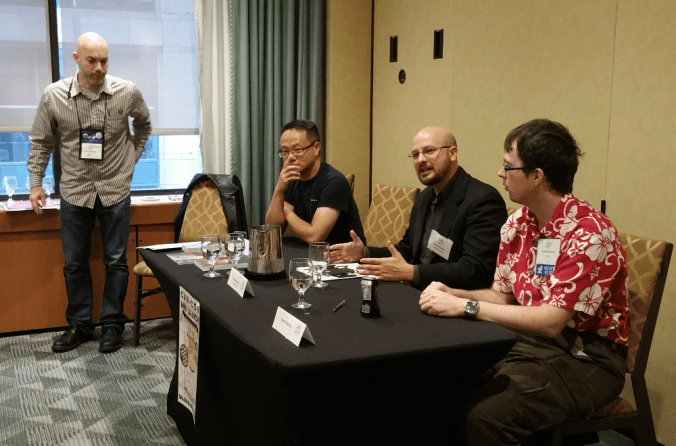
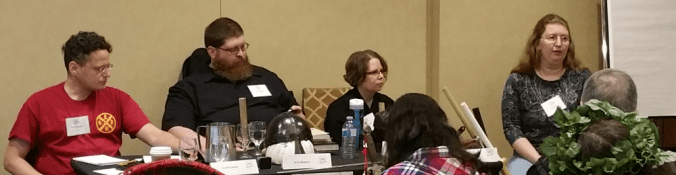
Panellists: Geoff Gander, Kris Ramsey, Reanne Roy, and Ariella Elema

SwordPanel

GG: What bugs you most about how most movies and television shows represent sword fighting?

KR: Flynning. Named after Errol Flynn. It’s all the swahbuckling stuff that would never work in real life. When it’s done well, you can’t tell an actor is Flynning. If not, it’s terrible. The last Three Musketeers movie is an example. You try to stay out of blade range when you’re fighting with a sword.

RR: I hate it when actors fight with a katana and cut through the opponent’s body. It would get stuck. The first two inches of the blade is the dangerous part.

KR: Swords are only for when you’ve run out of all other means of attack.

RR: And samurai using two katana? One is heavy enough. Musashi carried two, but is was a shorter blade and a katana, not two katana.

AE: A ‘case’ of rapiers. It can be done. It’s a flashy trick for duels, but it requires mastery of use in both dominant and non-dominant hands.


KR: Longer weapons tend to flex and it makes them less deadly. A shorter weapon is deadlier. When using two blades, it’s usually one long and one short. The longer blade deflects, and the shorter blade is used to kill.

GG: How has swordplay changed, historically?

AE: With armour, the shield became redundant. [More precisely, the development of complete suits of plate armour in late fourteenth-century Europe made shields less necessary. Having two hands on a sword gives you the leverage to cut faster with a longer blade.] The second hand was used on the sword for more power. The Germans placed the emphasis on speed. [IIRC, this comment was specifically about the differences in style between Italian and German masters in the fifteenth century. Fiore dei Liberi, an Italian master, seems to have been fond of moving into close range. His treatise, The Flower of Battle, has a lot of instructions for grappling, disarms, and pommel smashes in the face. The German masters, especially the later ones, tend to put more emphasis on the things you can do a little farther out at cutting range. This may be a reflection of the fact that Fiore was teaching people who were likely to face heavily armoured opponents, while the later Germans had a tradition of holding unarmoured tournaments.] When fighting in a tournament, knights fought at sword range.

KR: There was an older, battlefield style that included bo, naginata, and grappling.

Q: When did they stop having tournaments?

GG: It depends on the culture.

AE: I wrote my PhD dissertation on it. Trial by Battle in France and England. Tournaments ran from about 1050 – 1250. The last big tournament was in France in 1455. [1455 was the year of the last judicially-sanctioned trial by battle in the territory of what is now France. Subsequent duels were not organized by courts of law. The last trial by battle in England that came to blows was in 1456, but there were some outlying attempts to revive the practice in the 1650s and the early nineteenth century. Fencing tournaments of one sort or another have existed pretty much continuously since the Middle Ages.] There were outliers as late as the 1650’s. By and large, fire arms took over. Usually, they missed each other.

KR: There were cavalry charges with swords as late as WWII.

AE: By that time, though cavalry was a combination of horses and vehicles.

KR: A very good book on the subject is Swords and Swordsmen by Mike Loades.

GG: Who are the lead smiths now?

AE: Charles Jevins (?). [Charles Jevons is a terrific maker of aluminum practice swords. His site is here: http://www.swordcrafts.com/] He uses aluminium these days. Weight and balance of a steel sword can be duplicated, but there’s greater safety because of a thicker edge. You can get steel swords as well. It will run you anywhere between $300 and $2500.

Q: What was the historical cost of a sword?

KR: It’s hard to say. Again, it would depend on the culture. Initially, Japanese swords were made from crap steel. Then, they learned how to make it durable. It took months to craft and took two smiths to make. They’d quench them in clay.

AE: In the thirteenth century, the cost was about 12 pence. That’s about two weeks of wages for the average peasant. [Here’s a place where the Historical European Martial Arts community has collected some data on medieval European sword prices: http://www.fioredeiliberi.org/phpBB3/viewtopic.php?f=4&t=18566]

KR: The Vikings were very poor. That’s why they raided. They had to go out to get what they needed to survive.

Q: In 1966, I bought a Japanese katana for $400.

KR: Now they’re made in a Chinese factory.

Q: Can anyone carry a sword, or do you need a permit?

AE: In Canada, it’s technically legal, but you could cause a disturbance by walking around with one and get into trouble that way. I have white lady privilege, though. I can walk through the financial district of Toronto carrying my sword. Only the panhandlers notice. [I admit to having done this quite close to the financial district. It was probably dumb. I don’t recommend trying it yourself: results may vary. Sword canes almost certainly fall under the category of concealed knives, but I don’t know of any legal cases that have set definitive precedents on the matter. I’m a medieval legal historian, not a lawyer, so don’t take anything I say for legal advice. 🙂 ]

Q: How about cane swords?

AE: It’s a grey area. It could be considered a concealed weapon.

Q: What do you think of the sword work in Sparticus?

AE: The fight director might be Philippine influenced. The theory is that the Medieval Arabs taught everyone sword fighting. [My personal hypothesis is that medieval Arab sword arts influenced both Chinese and European fencing theory. There are quite a few medieval martial arts treatises in Arabic that have not yet been edited or translated into any European language. The oldest one dates from the mid ninth century CE.]

KR: There are only so many ways you can move with a sword.

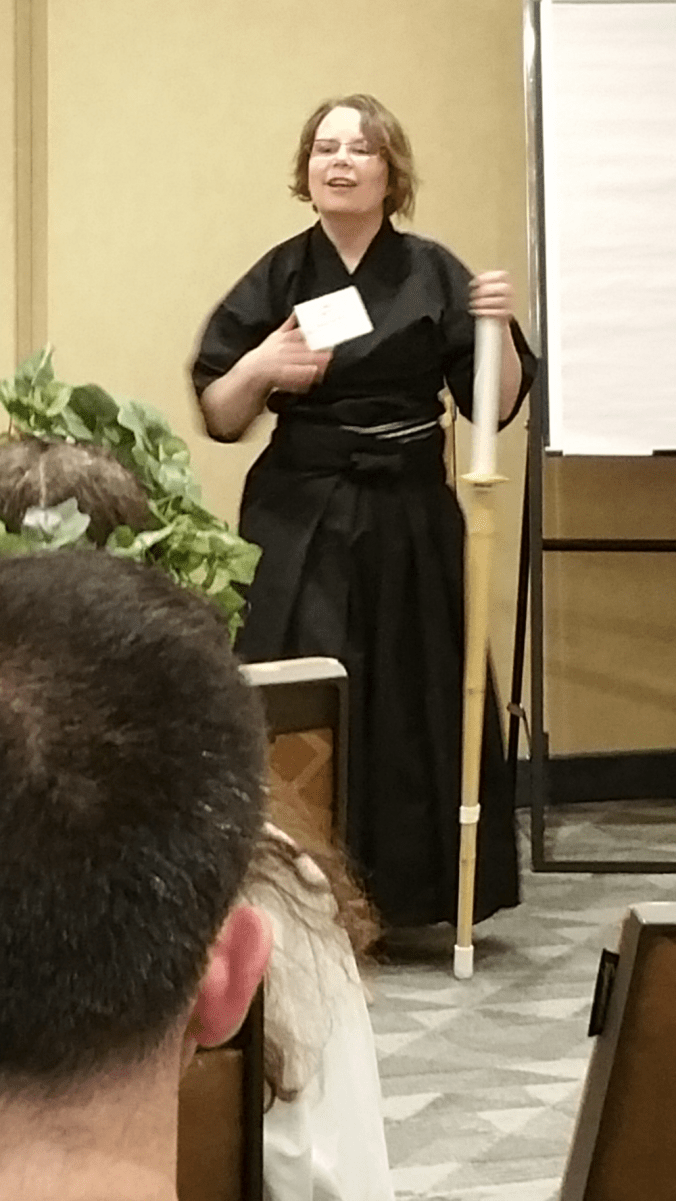
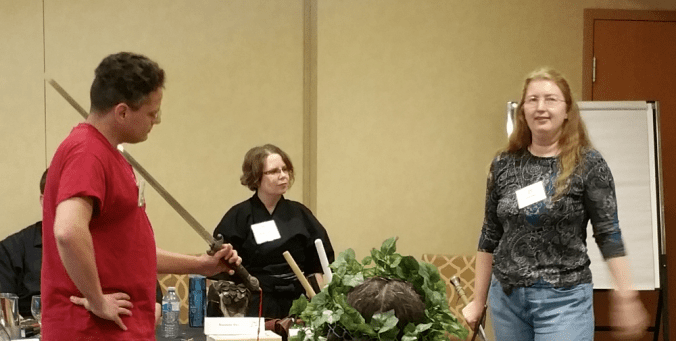
Demo ensued.

KatanaDemo

KatanaDemo2

SwordDemo

We didn’t really get into the Viking axe, sorry to say.

Next week, we’ll delve into the history of science fiction from an academic perspective.

Hope everyone has a fabulous weekend!

Thoughty Thursday: Things that made me go hmmmm on the interwebz, Dec 27, 2015-Jan 2, 2016

Just a wee bit of thoughty today. Guess I wasn’t quite ready to let go of the holidays 😦

The weird science hidden in Canadian money:


Visit the subterranean cisterns of Victorian England. Beautiful abandoned places. Atlas Obscura.

Perihelion 2016. Phil Plait, Bad Astronomer, for Slate.

Researchers create a genetic map of the British Isles. Absolutely fascinating. Medievalists.

Holy calamari! This giant squid (just a baby at 12 feet) hung around for a photo op in Japan. The Washington Post.

The tiny hydra may be immortal. Live Science.

I hope there’s something in there that will tickle your fancy.

See you on the weekend!

Thoughty Thursday

Tipsday: Writerly Goodness found on the interwebz, Dec 27, 2015-Jan 2, 2016

Not off to a raging start in 2016. I have a feeling that there’s lots of Writerly Goodness yet to come, though.

K.M. Weiland shares her five step plan to analyze your favourite books (A.K.A. read like a writer).

And here are five ways Katie says will help you make better writing resolutions in 2016.

Jami Gold talks story beginnings.

Oren Ashkenazi shares six overused tropes and how to avoid them. Mythcreants.

And he returns with six clichés to watch out for. Mythcreants.

The ten self-editing mistakes writers make and how to fix them. These are some excellent pointers 🙂 Cathy Presland for Author Unlimited.

Emergence and depression: an interview with Charlotte Ashley.

Jane Friedman offers five industry issues for writers to watch in 2016.

If you’ve seen SW:TFA, you may remember that island where Ray finds you-know-who at the end. Guess what? It’s a real place: Skellig Michael, in Ireland. Irish Central.

Though Seth Abramson say he loved the film, he still found 40 ‘unforgivable’ plot holes in SW:TFA. BEWARE: HERE BE SPOILERS. The Huffington Post.

See you on Thursday for a wee (and I mean wee) bit of thoughty.

Tipsday

The next chapter: December 2015 update and a year in the writerly life

Another year has come and gone. This one flew, but was filled with both Writerly Goodness, and sadness.

First up: December 2015

DecemberProgress

I kept drafting Reality Bomb until it was complete. By December 20, it was, at a tidy 65,556 words (total). 10,550 of those were written in December.

Then, I moved on, or back, to Gerod and the Lions, finishing that draft on December 31, with 45,012 total words in the draft (not bad for a MG novel) and 6,252 of those words written in December.

I also revised and submitted two short stories, but the net words were negligible, so I didn’t enter them into the Excel.

Finally, I wrote another 6,647 words on the blog.

My total production for the month: 23,449 words. That’s my second best month after November (and you know what happened then) for non-revision work.

2015 in review

Did I accomplish everything I wanted to in 2015?

Mostly. And I did better in some respects than I hoped. So, yay me 🙂

I did finish my last (for now) revisions of Initiate of Stone and started querying. I also took several query letter writing workshops and revised my query many times. Currently, the novel, or excerpts of same are on submission with several small publishers. I’ll be following up this month. If those submissions bear no fruit, I’ll be returning to the querying in February.

I did map and reverse engineer Apprentice of Wind and Figments. Both are ready for revision. I’ll be starting on AoW tonight, or tomorrow. I just gave the existing draft another read-through. And yes, I’m now in the everything-I-write-is-shit phase of the revision process. This, too, shall pass 😛

I finished Marushka, but have not mapped or reverse engineered the draft yet. This will come later in 2016, which I am going to call The Year of Revision.

I finished GatL (see above).

I won NaNoWriMo with Reality Bomb and subsequently finished the draft (again, see above).

I revised and submitted short stories to 17 contests and open anthology calls. That’s more than I ever have in the past.

I did not write any new stories.

I have exhausted the available markets for my one long short story and have received sufficient feedback that I believe the piece to be the beginning of a novel, rather than a true short story. It will be slotted into the drafting schedule when I get through the current spate of revision.

It was a year of near misses. I made the short list in two contests and merited a second reading in one anthology call, but ultimately failed to make the final cut in each case.

At the eleventh hour, however, I had two short stories accepted into the as yet untitled Sudbury Writers’ Guild anthology, which, though work will continue throughout the year on revision, editing, cover design, layout, and all that funky stuff, I don’t think will be published this year. You never know, but we’ll see.

I did deliver my How to get published workshop in February.

I attended Ad Astra in April and CanCon in October.

I did not attend the writing retreat in the summer. I tried to attend another, smaller writing workshop in August by the same author, but my plans were derailed by work.

I organized two great workshops delivered by Jane Ann McLachlan and Madeleine Harris-Callway in May and June, respectively, and participated in Wordstock 2015.

On the downside, my dog, Nuala, died of kidney failure in July, which sent me into a bit of a tailspin, but I wrote through it, with only one month of I-can’t-bear-the-thought-of-writing-ness (August).


2015Progress

Let’s look at the numbers:

  • 68,784 words written and/or revised for Initiate of Stone (remember, my strategy was to halve the words revised so as not to skew the overall numbers too much)
  • 20,856 words written on Gerod and the Lions
  • 39,034 words written on Marushka
  • 65,556 words written on Reality Bomb
  • 1,676 words of short fiction written and/or revised, and
  • 83,289 words written on this blog

That’s a grand total of 279,195 words!

That’s more than 100k more words than my 175,480 total in 2014. Last year, I called that a fuckload. So 2015 was a mega-fuckload?

This ramble is to say that I am incredibly pleased with 2015’s production.

2016: The year of revision

I realized last month, in the wake of NaNo, that if I did complete the drafts of Reality Bomb and GatL by the end of the year, I’d have five novels (aside from IoS) on my hands. Five unrevised novels.

So, guess what Ima do this year? Yup. Revise and edit those suckers to within an inch of their wordy lives.

Using Jamie Raintree’s new and improved Writing and Revision Tracker, I’ve established some lofty goals for myself, like 37,550 words of revision a month every month but November and December. And this year, I’m counting every word, because Jamie’s spreadsheet accounts for revision separately.

Plus, anywhere between two and seven thousand words of new writing each month (mostly blogging) except for November (2K on the blog and 50K for NaNo) and December (between 6 and 7K on the blog and potentially another 50K to finish off NaNo, which I hope to be book three in the Ascension series—epic fantasy = epic word count).

I’ll also be continuing to revise and submit some short fiction, map and reverse engineer Marushka and Reality Bomb (and GatL, if I can get to it) and outline Mistress of Water for NaNo.

Like I said, my goals this year are lofty. I won’t be disappointed if I don’t reach them all, but I find that if I set high goals, I tend to stretch to reach them. There are certain areas in which I can push myself outside of my comfort zone and be pretty damned happy about it. I lurve the writing life.

All of that means that I intend to aim for a super-duper mega-fuckload of production in the coming year.

Wish me luck (break a pencil) 😉

I’ll also be working toward a more balanced approach to writing and revising in the future. I’d like to draft two novels a year, one in NaNo, and one outside it, and work on revision and editing around the drafting. But that is for ensuing years. I have to get on top of my current drafts, first.

Conference and convention-wise, I’ll be returning to Ad Astra (April 29 – May 1), possibly attending the Canadian Writers’ Summit (June 15-19) and . . . I’ll be attending my first WorldCon (Aug 17-21)!

Leave pending, of course.

I have no idea what’s going to be happening with me at work in the next year or so. Right now, I’m in another acting position until Feb 12, but I have applied for the next consultant’s assessment process and pool. Also, we’re re-entering contract negotiations this year. We could be successful, or we could be going on strike. I’ve been designated essential in the latter case, and will have to work, regardless.

So it’s a crap shoot at work for the foreseeable.

If I can negotiate another leave with income averaging sometime in this next year (I’ve tried twice before for November and been asked to defer for operational reasons) Phil and I may be welcoming a new little squirmer into our home. We want the time to house train the new pup and enjoy the milk breath and buttery belly to its utmost 🙂

And that was my best imitation of Janus, looking back, and looking forward.

All the best to all of you in the coming year.

The Next Chapter

Thoughty Thursday: Things that made me go hmmmm on the interwebz, Dec 20-26, 2015

Here’s to having a Thoughty New Year!

Cameron Diaz sums up the meaning of happiness. The Huffington Post.

Lauren Alix Brown: In your 30s, you’ll discover that happiness is just persistence and sheer will. Quartz.

Yvette Cooper says that online sexism is so out of control we can no longer control it. The Guardian.

It was the winter solstice last week, and Newgrange is one of the most magical places in the world to experience it. Irish Central.

Phil Plait got in on the solstice action, too. Slate.

Is your brain a computer, or is it a quantum orchestra, tuned to the universe? Interalia Magazine

So, Space-X launched its latest Falcon 9 rocket last Sunday night. And guess what? They stuck the landing 🙂 Both events were reported by Phil Plait, Bad Astronomer, for Slate.

No, this asteroid that passed by Earth on Christmas Eve did not cause earthquakes . . . Slate.

Pluto’s moon in near-perfect alignment. Space.com.

These are cool: sky wolves. I don’t care if they’re Photoshopped. They’re awesome. The White Wolf Pack.

Take a visual tour of New York’s most beautiful subway station, abandoned since 1945. Hyperallergic.

China’s ghost cities: the largest urbanization movement in the world. CBC’s The Current.

This 800 year old Icelandic hymn is pretty damned special. Pulptastic.

I haz a want. Samurai hoodies 🙂 Rocket News 24.

More evidence of the cleverness of crows from Phys.org.

So they built this hotel over an elephant migration route . . . Mental Floss.

David Wong shares the real meaning of Christmas that everyone forgets. Cracked.

Have a great time tonight and celebrate with the ones you love.

The future is yours to make. Make the most of it!

Thoughty Thursday

Tipsday: Writerly Goodness found on the interwebz, Dec 20-26, 2015

Here’s a little Writerly Goodness for you 🙂 Looks like I really did take a holiday last week. Yay me!

K.M. Weiland talks about coincidences in your fiction and what mistake in means you might be making.

C.S. Lakin calls these stylistic devices. I call them rhetorical figures. I lurves me some rhetoric. I blame the politicians for rhetoric’s pejorative connotation 😦 However you choose to look at them, they’re a lot of fun and can add something special to your writing.

Dan Blank says that creative work is performance. Writer Unboxed.

Why writers need human connection. Jamie Raintree guests on Writers in the Storm.

Chris Winkle shares lessons learned from the awkward writing of The Sword of Truth. Mythcreants.

George R.R. Martin uses it. So does Robert J. Sawyer. Find out why Wordstar is the preferred word processor for these authors.

And speaking of nifty writer tech, here’s Jamie Raintree’s new writing and revision tracker*. This is the spreadsheet that revolutionized my attitude toward my writing. I hope it will do the same for you 🙂

*This year, Jamie’s made the spreadsheet fairly foolproof. You can only enter data into certain cells. So much easier. I’ll still do a little post on how to set it up, but it won’t be as extensive as I thought based on past years.

Before you launch a Patreon for your writing, read this. Nicole Dieker for The Write Life.

Madeleine Monson-Rosen recounts the twelve happy accidents that helped save science fiction. i09.

Now this is my idea of a happy Christmas: Jolabokaflod. NPR.

Hope you had a wondrous holiday.

See you Thursday!

Tipsday