Thoughty Thursday: Things that made me go hmmmm on the interwebz, April 10-16, 2016

It’s mega-thoughty Thursday this week 😉

This is the next emergent issue in Canada: the quality of life in First Nations. This is our Prime Minister’s next big challenge. One First Nation has become the focus of media, recently, but it is not the only place where living conditions have been shown to be deplorable.

Attawapiskat in the news:

Just because our Prime Minister’s a geek (and yes, I realize he was dodging a question, but he did it well, don’t you think?).


Sandra Martin explains why we need better end-of-life policies in seniors’ residences. The Globe and Mail.

North Carolina passed ridiculous legislation that discriminates against transgendered people in the name of safety. Lindsay King-Miller covers the issue for role reboot.

Carla Ciccone wrote an article to warn women about Jian Gomeshi and it nearly destroyed her life. Chatelaine.

Samhita Mukhopadhyay wonders, will ‘it’s on us’ finally put an end the sexual assault on America’s college campuses? I hope so. It’s time and long past. Mic.com

Jia Tolentio explains how empowerment became a product for women to buy. The New York Times Magazine.

Leah McLaren explains why she’s teaching her son to embrace the ‘girlish.’ The Globe and Mail.

James Phelps, MD, makes the distinction between borderline personality disorder and bi-polar disorder. The Psychiatric Times.

The Mighty shares the secrets of people with anxiety.


Nancy C. Andreasen shares the secrets of the creative brain. The Atlantic.

I didn’t know where to put this tasty tidbit: How to see all the companies tracking you on Facebook and block them. Tech Insider.

The Shell Grotto in Margate, England.


Göbeklitepe. An amazing ancient site.


Photos of the Fukushima exclusion zone show how nature has taken over in a few years. BoredPanda.

Phil Plait debunks the planet nine comet scare for Slate.

Yuri Milner develops Breakthrough Starshot. CBC.

Phil Plait presents a tale of three Jupiters in four parts. Part one: A lonely young Jupiter wanders the galaxy. Part two: A Jupiter analogue orbits another star. Part three: Jupiter’s brother has three suns. And, finally, part four: Great Jupiter’s ghost! Slate.

Where do minds belong? In this fascinating essay, Caleb Scharf speculates on the fate of human, and alien, intelligence. Aeon.

Ariana Eunjung Cha examines Sean Parker’s revolutionary project to ‘solve’ cancer for The Washington Post.

Sarah Laskow considers the original copy of the Malleus Malificarum in Cornell’s witchcraft collection for Altas Obscura.

Food in its growing state 🙂 Bright Side.

Dog shaming always makes me smile. They know we’ll always forgive them 😉 Here are a couple of sites to bookmark in case you need a mid-week pick-me-up. Dogshaming and Dog Shame Awards.

Be Deutsch! Just AWESOME.


All the best.

See you on Saturday!

Thoughty Thursday

Tipsday: Writerly Goodness found on the interwebz, April 10-16, 2016

I can’t believe how much writerly goodness I have for you this week. WTF’s going on here, anyway?

Angela Ackerman wonders, why do characters resist change? Writers helping writers.

David Corbett argues that conflict isn’t the engine of story. Writer Unboxed.

Lisa Cron explains what ‘let it go’ really means. Writer Unboxed.

Sarah Callender helps us create delightful, messy characters with the humble ampersand. Writer Unboxed.

Lance Schaubert talks talecraft on Writer Unboxed.

Jami Gold explores paragraph breaks and voice in her building blocks of writing series.

Janice Hardy helps you get what’s in your head onto the page. Fiction University.

Margie Lawson shows us how to make strong writing stellar. Writers in the Storm.

Chris Winkle shares some tips on narrating layout and position. Mythcreants.

Kelly Simmons explains how your personality type wreaks havoc on your writing and offers ten things you can do about it. Writers in the Storm.

In times of doubt, Chuck Wendig advises you to write what you love. Terribleminds.

Leanne Sowul offers some tips to keep writing when times are tough. DIYMFA.

K.M. Weiland shares twelve ways to rock your novel research. Helping writers become authors. Later in the week, she explained how to moderate reader reactions to character sins.

I’m curating the curators, now 😉 Elissa Field shares a number of quirky research sources for writers on her Friday links for writers.

Jamie Raintree offers the three most common query mistakes and advice on how to fix them.

Roz Morris shares a discussion on the benefits of editors from Author Fringe 16.

Nina Munteanu writes part two of her ecology, women, and science fiction post: praxis. Great discussion with some of Canada’s best women SF writers and editors.

Kim Fahner shares some of her lessons learned from her week in Banff with Lawrence Hill (and meeting with Alice Major). Upon her return, she struggled with decompressing and managing her creative energy.

The first of three posts by Jim C. Hines on trigger warning shenanigans inspired by Stephen Fry’s poorly thought out comments: Trigger warnings are censorship, and other nonsense. He returned the next day with Trigger warnings as an impediment to healing and mental health. Here’s the third instalment: when trigger warnings attack!

John Grisham and Donna Tartt headline the author protest of Mississippi’s anti-LGTBQ law. Electric Lit.

Doctors and psychiatrists may soon prescribe fiction to help youth with mental illness. <This is me, cheering like Kermit—yaaaaaaaaaaay!> The Guardian.

Rod McDonald, Canadian designer of the typeface Classic Grotesque, heads for Manhattan launch party. The Toronto Star.

An interview with transplanted Sudburian, Matthew Murphy. Quebec reads.

Sian Cain covers Sir Terry Pratchett’s memorial for The Guardian.

Hedgehogs are the keepers of order and knowledge in Slavic fairy tales. Tiny Donkey.

Ten facetious book dedications that actually got published. Books rock my world.

Orna Ross shares a Celtic creation story.

This is awe-inspiring: The librarian who saved Timbuktu’s cultural treasures from al Qaeda. The Wall Street Journal.

Film dialogue from 2000 screenplays, broken down by gender and age, shows how sexist movies are. Polygraph.

No trailer for this yet, but Story of Your Life looks like it might be a good SF film to check out. Movies.com

Cheryl Eddy previews another fairy talish movie due out this year: A Monster Calls. i09

We have to wait until November (no way I’m wishing is here any sooner—love spring, summer, and fall!). Fantastic Beasts and where to find them.


But this weekend! Eeeeeee! Game of Thrones, season six. I really hope they make up for last year.


And that is Tipsday for this week.

Hope you are all well and writing wicked stuff 🙂

Tipsday

An origin story and series discoveries, anime edition

As I mentioned last week, I’m on Gabriela Pereira’s DIYMFA launch team (yes, the book is coming out shortly). In preparation for the launch, Gabriela has been asking us weekly questions related to DIYMFA (the site, the newsletter, the course, and the book).

This week’s question is: What is your origin story?

How this ties into DIYMFA: Gabriela has recently asked what our writerly superpower was. For the record, mine is character, which I consider to be the well-spring of all things story. In keeping with that theme, all superheroes have origin stories.

Here’s mine.

Author origins

Even pre-origin, I was a creative wee bug. Read, I was a big fibber. The other kids were more honest. They called me a liar.

It wasn’t anything big or flashy. When I was a kid, in grade one (five years old), I really wanted a pet. I was obsessed with cats and took those books out of the library to read, well, gaze at longingly. I was just learning to read.

In show and tell every day (practically) I’d tell the tale of the latest stray cat I’d found and taken in. When the other kids (and teacher) asked me about the last cat, it invariably, and conveniently, had run away.

By the time I was in grade three, I wrote a little essay (well, I was seven), on my puppy, Friskey. I named her and misspelled her name. I’d like to say it was purposeful, but I rather think I just didn’t know how to spell.

Also in grade three, there was a special presentation by the grade five students. They’d all written and illustrated story books.

The moment I saw Siobhan Riddell’s version of St. George and the Dragon, I was hooked. Hard. I made my first submission, to the CBC’s “Pencil Box,” later that year.

And that was it. I’ve been writing—and in love with writing—ever since.

Series discoveries: Anime update

Series Discoveries

Phil and I have eased off on the anime, but we still watch Fairy Tail, and now World Trigger, as they are released (weekly). Actually, they are both now in hiatus as the animators work on the next seasons.

Fairy Tail went through some backstory in this season with Fairy Tail: Zer0. It is the tale of how a young Mavis met with some intrepid treasure hunters and through a series of adventures founded the wizard guild, Fairy Tail. Zeref even makes an appearance.

Next season promises to be about the rebuilding of the guild, which, after the Tartaros arc, had disbanded and all of its members departed for parts unknown.

The storytelling is decent, but, as with most anime, there are gaps in logic or plot that irritate. It’s still all about the power of friendship, though.

World Trigger focused mostly on rank wars, which is where the manga dwells these days as well. Osamu, Kuga, and Chika are trying to make it to A-rank so they can go on away missions to the neighbour worlds in the hope of rescuing Chika’s brother and friend, who disappeared and are assumed abducted. They’re also in search of Kuga’s companion, Replica, an autonomous trion soldier, who’d sacrificed himself to save Osamu and Chika when Aftokrator, a neighbour world, attacked.

As the season ended, not one, but two other neighbour worlds would be coming into contact with Mideen, where World Trigger takes place. Rank wars were to continue, but the A-rank Border teams  would have to defend against the neighbours.

Osamu and his team of three are in a bit of a crisis as well. Osamu, though a good strategist, has very little trion, the energy that allows Border agents to use the neighbour triggers. He also has very little experience and has come up against a wall. He is struggling, and holding his team back.

Chika, though she has an amazing amount of trion, is young and kind enough that she can’t bear to target people.

Kuga, a neighbour himself, has lots of trion and lots of experience and so the team’s success has rested largely on his shoulders.

Osamu has tried to recruit a fourth member for their team, but has so far been unsuccessful.

Log Horizon has still not returned.

We watched the second season of RWBY and the story is getting darker. The huntresses in training have watched their academy, and their world, come tumbling down around them.

At the end, Yang had her hand cut off and she and Ruby were recovering at home with their father after the attack that destroyed their academy. Blake had run away after her confrontation with her former boyfriend and his terrorist faction ended disastrously. Weiss had been recalled to her family’s estate in the city.

The enemy, still a little too amorphous and mysterious for my liking, controls the beasts of Grimm and has stolen the powers of one of the four maidens, Spring.

Ruby, unwilling to let the enemy’s apparent victory go unanswered, takes off with two other former students from the academy to try to set things right.

We’ll see if the third season appears and if it answers any of the outstanding questions the series has so far left viewers with.

A new addition to our viewing line-up has been God Eater.

Post-apocalyptic Japan has been overrun by the Aragami, fearsome beasts that seem to revel in mindless destruction. With the exception of a few huge, very powerful Aragami, they don’t exhibit much intelligence.

To combat these fearsome beasts, scientists isolated the genetic material that mutated animals into Aragami in the first place. Though early experiments were disastrous, they eventually figured out that there were certain humans who would be enhanced by this genetic material rather than be taken over by it.

Lenka Utsugi is one of these humans, a God Eater. He is trained and given a weapon called a God Arc, which bonds with the wielder.

When an Aragami is killed, its ‘core’ is harvested. These cores can be used to power God Arcs, but are more important in the construction of Aegis, a domed settlement in which the remnants of the human race are to shelter.

There’s a lot more to it than that. Suffice it to say that Phil and I are enjoying it and watching the show while we wait for the others to return. We’re getting a little deeper into backstory, but the conspiracies in this series are still a little hazy for my liking.

And that’s it for this week.

I’ll see what the next DIYMFA question of the week is, but I may tackle that and midseason follies (to date). The week following is Ad Astra, and so I probably won’t blog that weekend. I’ll be too busy taking notes of the sessions I attend so that I’ll have lots of reportage ready to go after April’s next chapter update.

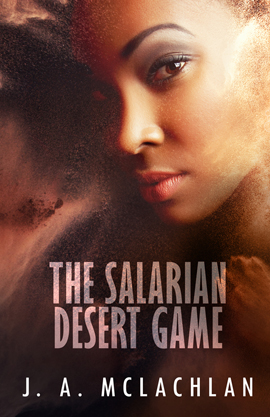
Review of Jane Ann McLachlan’s The Salarian Desert Game

SalarianDesertGame

What Amazon says:

What if someone you love gambled on her life?

Games are serious business on Salaria, and the stakes are high. When Kia’s older sister, in a desperate bid to erase their family debt, loses the game and forfeits her freedom, Kia is determined to rescue her.

Disguised as a Salarian, Kia becomes Idaro in order to move freely in this dangerous new culture. When she arrives on Salaria, she learns it’s a world where a few key players control the board, and the pawns are ready to revolt. Kia joins the conflict, risking everything to save her sister. As if she doesn’t already have enough to handle, Agatha, the maddeningly calm and unpredictable Select who lives life both by-the-book and off-the-cuff shows up to help, along with handsome Norio, a strong-willed desert girl with her own agenda, and a group of Salarian teens earning their rite of passage in the treacherous desert game.

What can an interpreter and former thief possibly do in the midst of all this to keep the people she loves alive?

Edge’s video intro, by Jane Ann McLachlan:


My thoughts:

In my review of Jane Ann’s first Kia and Agatha novel, The Occasional Diamond Thief, I said that Kia learns the truth about herself by learning the truth about others.

This trend continues in The Salarian Desert Game.

Kia, not long returned from her adventures on Malem, is translating at The Salarian Night Games, a form of high stakes gambling, in which losers agree to indentured servitude in the Salarian crystal mines until their debt is paid.

Her sister plays, and loses, and Kia, though prevented by doing anything in the moment but protesting because of her role as translator, determines to travel to Salaria and free her sister.

As she is preparing to depart, she is summoned by the OUB, the interplanetary religious authority. Yes, she must go to Salaria, but as translator for the Select Agatha, and she is forbidden from attempting to save her sister. The mission is all. It was foreseen in a vision and cannot be denied or abandoned.

Worse, Kia will not only have to travel in disguise, but the OUB asks her to surgically erase her identity and assume that of Idaro, a half-Salarian girl who died years earlier.

When Agatha and Kia, sorry Idaro, arrive on Salaria, they are separated and everything falls apart. Alone, Idaro visits her estranged grandmother, Matriarch Ryo, and tries to figure out what she can do to find and help Agatha and get back on her mission to save her sister.

To maintain her cover, though, Idaro must join the Salarian Desert Games, a coming of age ceremony which pits fifteen year old girls against the desert of Salaria and its poisonous denizens. It’s survival of the fittest, and Idaro must survive more than the desert’s snakes and scorpions and the distrust and schemes of her fellow candidates.

The scope of this novel is on a grand societal scale, addressing racism, slavery, misandrogy (Salaria is a Matriarchy), terrorism, and the other consequences these institutionalized practices.

In discovering this alien world, Kia, and the reader, must reflect on the evils of our societies, reflected in the mirror of the novel.

When she first emerges from the surgery that will change her into Idaro, Kia hardly recognizes herself. By the end of the novel, she’s not only learned who Idaro is, but who Kia is, and how far she’s willing to go to save those she loves.

Once again, Jane Ann has written an amazing novel.

My highest recommendation.

My rating:

Five out of five stars!

About the Author:Jane Ann McLachlan

J.A. McLachlan was born in Toronto, Canada. She is the author of a short story collection, CONNECTIONS, published by Pandora Press and two College textbooks on Professional Ethics, published by Pearson-Prentice Hall. But science fiction is her first love, a genre she has been reading all her life, and Walls of Wind is her first published Science Fiction novel. Her new science fiction novel is The Occasional Diamond Thief. She is represented by Carrie Pestritto at Prospect Agency.

Robert J. Sawyer reviewed The Walls of Wind and had this to say:
“Look out, C. J. Cherryh! Step aside, Hal Clement! There’s a new master of truly alien SF, and her name is J. A. McLachlan. THE WALLS OF WIND is doubtless THE debut novel of the year.”
— Robert J. Sawyer, Hugo Award-winning science fiction author

You can learn more about J. A. McLachlan and her books on her website at: http://www.janeannmclachlan.com

Connect with Jane Ann on Facebook: https://www.facebook.com/janeann.mclachlan

What others are saying about her:

“In ways SF readers can favorably compare with icons of the genre, such as Ursula K. Le Guin, James Tiptree Jr. and Robert J. Sawyer, WALLS OF WIND boldly weaves anthropology, psychology, drama, future history, even meteorology, into a tapestry of viewpoints and epiphanies that propel McLachlan’s characters toward a necessary and illuminating change in their collective relationship. … If you read no other “alien” authors this year, don’t miss WALLS OF WIND.”
– Bookreporter

Read the full review:
http://www.bookreporter.com/reviews/walls-of-wind-a-science-fiction-novel

“I loved it from the first page and couldn’t put it down!!”
Domenico Maniscalco

“The writing is excellent and never gets in the way of the story (which is very important to me); The characters are well drawn and believable.”
Peter Barron

“I loved the writing style of the author; her characters are diverse and very real.” Steve

Thoughty Thursday: Things that made me go hmmmm on the interwebz, April 3-9, 2016

I hope you’re all visual learners, ‘cause this thoughty Thursday’s jam-packed with videos!

It’s autism acceptance month 🙂

Photographer, Michelle Marshall, documents Afro-Caribbean gingers. Black Girl Long Hair.

Ten inspiring Muslim women every person should know.


Mike Veny: Mental illness is an asset. TED Talk.


A psychiatrist thinks the key to happiness might be swallowing the right bacteria. Business Insider.

Things about anxiety nobody talks about. The Mighty.


Six reasons why touch is amazing. ASAP Thought.


Vi Hart muses on the tools we use.


Crash course physics is here! Phil Plait for Slate.

The first photograph of light as both particle and wave. Phys.org

The music of the spheres. Literally. EWAO.

Jessica Cail on NOVA’s secret lives of scientists 🙂


WWF Hungary released this amazing video – Paper world. Vimeo.

It’s okay to be smart asks, how do bees make honey?


And for your entertainment:

MsMr – Wrong Victory


And Florence + The Machine. Queen of Peace & Long and Lost.


Enjoy, my friends.

See you on Saturday for an origin story and some anime series discoveries.

Thoughty Thursday

Tipsday: Writerly Goodness found on the interwebz, April 3-9, 2016

Wahoo! Is it possible there’s even more writerly goodness in here then there was last week? Hella yeah!

More exciting local news: Sudbury is part of Reading Town 2016 (think Hockey Town with books) 🙂


Most common writing mistakes, part 50: Info dumps (and how to fix them). K.M. Weiland. Helping writers become authors.

Liz Bureman looks at parataxis and hypotaxis (and how Greek makes you a better writer). The Write Practice.

Sara Letourneau explores how to develop theme in your stories through symbolism. DIYMFA.

Donald Maass discusses relevance for Writer Unboxed.

Juliet Marillier writes about the different responses you can (and should) have to an editorial report. Writer Unboxed.

Roz Morris asks, must plot twists always be misfortunes or disasters? And, where does your story end? Nail you novel.

Daniel José Older offers twelve fundamentals of writing the other (and the self). Buzzfeed.

Marcy Kennedy explores how to read as a writer (part 1).

Real writers don’t self-publish, part two. Kristen Lamb shares her further thoughts on the issue.

Mike Shatzkin wonders what will happen to high-cost non-fiction in the evolving indie world.

C.S. Lakin points out the need for persistence in your writing journey. Live, write, thrive.

Janice Hardy shares her thoughts on challenging yourself, versus setting yourself up to fail. Fiction University.

Kameron Hurley writes about career milestones and prioritizing projects.

Catherine Ryan Howard recounts how the idea for her novel Distress Signals evolved.

How to create a better writing space (and other thoughts on writing). Avoiding Atrophy.

Jennie Nash shares her one page book planner on Kobo Writing Life.

Sarah Selecky shares more writing retreats for your wish list.

Speaking of writing retreats, my friend, Kim Fahner, has just spent the week in Banff with Lawrence Hill. Here are her posts on the experience: Making time to write, and Writing retreats and the friends you meet.

“Mad Men” creator, Matthew Weiner’s reassuring life advice for struggling artists. Fast Company.

Sword and Laser: Interview with Ken Liu.


The Writes of Women: a celebration of female writers and their work.

Stephen Greenblatt explores how Shakespeare lives now for The New York Review of Books.

A Shakespeare first folio was discovered on the Isle of Bute, just in time for the Bard’s 400th anniversary. The New York Times.

The history of typography. Ben Barrett-Forrest.


Christopher Zumski Finke discovers what Battlestar Galactica teaches us about the militarization of police. Yes! Magazine.

Rogue One teaser trailer.


Kate Spencer says, hey dudes, you should be watching Outlander. Esquire.

And that should keep you busy for a while (!)

See you on Thursday for a video heavy dose of thoughty edutainment 🙂

Tipsday

Muse-Inks: Do you need an MA/MFA?

(And a couple series discoveries)

Yeah, so I kind of fibbed again on Thursday because I wasn’t aware of some of my deadlines and involvements.

Today, I’m going to be doing double duty. I’m posting my first DIYMFA launch team post and covering the two series that hadn’t debuted/returned before I went to CanCon last October and then plunged into the lost month that is NaNoWriMo (binge writing).

I’m also reading the ARC of Jane Ann McLachlan’s new YA SF, The Salarian Desert Game, as part of her launch team. That review is due up on the interwebz on Monday, and it will be, but I’ll be holding off on putting it up on my blog until next Saturday.

So. Let’s get to it, shall we?

I’ve written about my MA experience as part of the My history as a so-called writer category, which has been a bit of a confessional/lessons-learned-from-the-writing-life kind of thing.

 The story of my MA

I was in my last year of my BA in English, Rhetoric emphasis, and I was rocking it. I’d gone into university this time (I’d started, dithered, and left to learn some life lessons) with the focused intention of becoming a better writer. I’d been writing for years, since I was in grade three, but had only recently come up with my first idea for an epic fantasy novel.

That intention had provided me with the fuel to really begin my writing life in a more serious way. I’d placed in a local writing contest with a science fiction short story, excelled in my academic writing, and been asked to write an editorial piece for one local magazine and a science fiction short story for the debut issue of another.

Through the creative writing course I’d taken, I would have another fantasy story published in an anthology. I’d written poetry and read my work at various open mic nights and reading series.

In retrospect, I should simply have continued to write. I was developing a kind of momentum that further schooling would only disrupt, but I had no idea about that then.

My friends had all departed for further schooling, teachers’ college and literature MAs, and I was still at that tender stage in the process where I had no confidence in myself. I thought I needed further validation. I thought that attaining my MA would make me a more attractive property.

I was wrong.

In Canada, at the time, there were only four universities offering MFAs: the University of New Brunswick, Concordia University, the University of British Columbia, and the University of Victoria. Two others, Windsor and Saskatchewan, offered the option of doing a creative thesis along with your degree in English literature.

Initially, I just thought I’d apply, see if anyone would accept me, and then make my decision whether to go or not. I’d just gotten married the year before and my husband wasn’t finished his undergraduate degree yet. I wasn’t so keen on being separated from him for so long.

All the MFA programs rejected me out of hand (I should have seen that as a sign). Only one of them, UNB, threw me a bone: we’ll take you in the English Literature program, but not creative writing. Windsor was the only university that accepted me. It was the closest, too, though it was still a nine hour drive away.

I thought at the time that it was doable. I’d be back for breaks and summers. Phil was supportive. We could do this, if it was what I really wanted.

I went for it without giving serious consideration to my chosen genre. I write science fiction and fantasy. Even my more literary efforts contain the element of the otherworldly, ghosts, dreams, visions. I thought that, just like my BA, my MA would yield to my passion and desire.

Then, I attended my first critiquing class. My fellow hopefuls were all of a more mainstream, if not literary, mind. One eventually defended her thesis which was a collection of poetry, all sonnets. I never learned what the other students had chosen to work on.

No one was particularly keen on what I wrote. Well, there was this one guy, but he wrote genre as well. I got stubborn and dug in. My advisor looked at my submitted stories in dismay. What is this? What is real about this story? We weren’t on the same page. We couldn’t relate to each other. He couldn’t help me become a better writer. He just wanted me to be a different kind of writer.

I did my graduate assistantship, which was essentially teaching the first year composition course (without supervision), took my classes in methodology, pedagogy, and English literature of various eras, and tried to write.

I didn’t get a lot of fiction written in those years. I basically revised already existing material and scribbled poetry, the only form of writing I could manage in the time I had between other obligations.

I eventually had a blow out with my advisor, who told me to stop wasting his time (and mine). I withdrew from the program, worked contract jobs, and collected employment insurance in between.

A year later, one of my former students emailed me, telling me that my advisor was going on sabbatical. A Canadian poet, a woman, would be taking his place. I reenrolled, and, over the next year, emailing, and flying down at intervals to meet in person, I wrote my creative thesis, defended it, and fulfilled my final requirement to achieve my MA in English Literature and Creative Writing.

Even so, I’d compromised. I chose the more literary of my stories and, framing the collection in the context of shamanism and shamanic awakening (anthropology and religious studies), I cast an academic light on my fantastic tales.

In the wake of that experience, though, I went into creative withdrawal. I’d internalized the criticisms of my first advisor and was, essentially, blocked.

Throughout the years of my MA and afterward, I continued to win writing contests, in both fiction and poetry, and continued to get published. I tried my hand at publishing a poetry journal with another writer friend of mine, but, after a couple of years, the effort folded.

I continued to work contract jobs until I was invited to apply for my current job by my sister-in-law. Once I worked full time, the writing went underground altogether.

It took me six years and a bout of depression to begin to come back to writing as something I loved, something I needed in my life, rather than an unrealistic dream. I began with a few workshops, and graduated to conferences and conventions. I took online courses. I started to build my platform (such as it is). I tried online critiquing. I tried beta readers. I tried freelance editors.

I pretty much try anything that I think might help me improve.

I’m a writing craft book junkie and I’ve learned over the years that my process is my own. I never take anything at face value. Like a writerly scientist, I experiment. I try a new technique and see if it has value for me. If it does, I incorporate it into my process. If it’s only partly useful, I’ll adapt those pieces to my process (note, my process does not change to accommodate a particular technique, the technique is adapted to fit my process). If it doesn’t work at all, I discard the technique and chalk up the time and effort to a learning experience. We have to fail—many times—before we succeed.

Two of my science fiction short stories were published in paying markets in 2014. I’ve participated three times in NaNoWriMo, “winning” twice. I now have six novels drafted, one of which I’m actively querying. The rest are in revision.

The bottom line is that writing is a way of life for me. It’s not a get rich quick scheme. It’s not my grab for fame and fortune. I’m going to do this for the rest of my life regardless of whether I get the publishing deal I want or not. I’m doing the work and spending the time to make it happen, though. The two short stories weren’t a fluke.

I’ve been published quite a lot over the years. It’s just that most of those were not paying markets. I just haven’t connect with the agent or publisher who thinks my novel is the bee’s knees yet. Yet. It will happen. And if it doesn’t happen with the novel I’m querying now, it will happen with one of the others.

I persist in hope and continue to revise.

And, I continue to learn. I’m a bit of a learning mutt that way 😉

Muse-inks

Bonus content: Series discoveries Fall 2015 con’t

There were only two series that I didn’t get around to reviewing before CanCon and NaNoWriMo monopolized my time in the fall. I’ll try not to be spoilery.

Supergirl

This is another entry in the DC Comics universe, or should I say universes.

Supergirl started out sunny and entered some darker territory toward the end of the season. On the spectrum, it’s between The Flash and Arrow, but, as The Flash has also started treading dark waters, I guess Kara Danvers is closer to Barry Allan than Oliver Queen.

There’s an almost cloying sense of hope in the series, though, that keeps it from being compelling for me. If I miss an episode, I’m not distressed.

I like the character of Cat Grant, who can be surprisingly inspirational. I also appreciate Kara’s adoptive sister, Alex (so nice to see Lexie Grey back on screen), who works for the DEO, a government agency dedicated to defending earth from alien threats. Kick ass, but real, women characters are something I like in a show.

Bringing Dean Cain (the Superman of Lois & Clark) in as Alex’s father was a fun and smart bit of homage.

Sadly, some of the other elements of the show are lacking. The love triangle (no, quadrangle, no, sorry quintangle) is a bit trite and while I believe Kara’s crush on James Olsen, I never quite bought into James and Lucy Lane, Winn and either Kara or Siobhan. Oh, and I forgot the brief flirtation between Kara and Cat Grant’s son, Adam. Man, it’s a soap opera (!)

Hank Henshaw/J’onn J’onzz is underwhelming. My Martian Manhunter is so much more awesome.

Astra/Non have been weak sauce as Kara’s enemies. Maxwell is a bit better, but still one dimensional.

So it’s a solid meh. My apologies.

Grimm

Things took a left turn last season. Sure, Nick and Juliette’s relationship wasn’t going anywhere, so they had to do something. Her transformation into a Hexenbeist was actually a good thing.

Until it wasn’t.

Juliette’s abrupt departure from sanity and eventual (and apparent) death at the hands of Trubel (the other Grimm) felt more of a convenience than true plot development.

The big question for Nick last season was how he, a Grimm sworn to protect humanity from the evil wessen that roam the world, could live with and love a Hexenbeist, the wessen that is the basis of all wicked witches, ever.

So what do they do this season? They pair Nick with Adalind Schade, a Hexenbeist whose wessen aspect has been temporarily suppressed by Rosalee’s folk cure (herb craft).

Yes, Adalind is the mother of Nick’s child (conceived in a convoluted magical plot that resulted in Juliette’s transformation into a Hexenbeist in the first place), but things progressed quickly from “I have to protect my child and therefore the woman who gave birth to him,” to “I’m having sex with the mother of my child while he cries in the other room.”

Yeah. That’s what I thought.

Worse, Juliette returns, somehow deprogrammed, as Eve, who is more Terminator than either human or Hexenbeist.

While the Black Claw plot line holds promise, things aren’t happening fast enough as the writers insist on offering a monster of the week for Nick and his fellow detective, Hank, to fight. Even a trip to the Black Forest and the recovery of an ancient Grimm artefact haven’t saved the show for me.

There are too many moving parts, too many players, to discern the true core story arc.

I wouldn’t be surprised if Grimm doesn’t return next year.

So that’s what I thought of the final two shows I chose to watch in the fall 2015 television season.

Thoughty Thursday: Things that made me go hmmmm on the interwebz, March 27-April 2, 2016

Here’s your thoughty for the week.

Buzzfeed features Katie Joy Crawford, a young photographer who has captured the essence of anxiety in her photographs.

Christine Denewith and Creigh Ferinas debunk eight myths about autism. Everyday Feminism.

Steven W. Thrasher says, don’t tell cancer patients what they could be doing to cure themselves. It’s our urge to do something to help that bites us in the butt here. Just be there. Take care of their kids for a while. Offer to do the running around for an exhausted partner. Hug them, if they can bear it. The Guardian.

Katie Roiphe explores the beauty of our final moments. CBC’s Q.

Silence may help to regenerate brain cells among other important functions. LifeHack.

Dublin observes the Easter Rising centenary. Irish Central.

Lifebuzz shares amazing footage of the Himalayas.

Take a virtual visit to Iceland’s Museum of Witchcraft. ScoopWhoop.

Australia’s Carnegie CETO wave power generator.


Yes. I confess I was attracted to this article by the word ‘unicorn’ (is it any relation to the badass unicorn?) but this rhino ancestor is still amazing. Shaena Montanari for Forbes.

Japan’s Hitomi satellite disappears and reappears mysteriously. Gizmodo.

This is the most detailed map to date of our place in the universe. Vimeo.

Hubble reveals the heart of the Milky Way. Phil Plait for Slate.

Do ravens know what you’re thinking? The California Academy of Sciences.

Your kawaii of the week: orphaned magpie bonds with boy. Photography by Cameron Bloom. This is Colossal.

Costa Rica’s land of the stray dogs is heaven for the unwanted. Bored Panda.

Not as extensive as Tipsday this week, but still, a solid showing in the brain pan department 😀

See you on Saturday for some series discoveries.

Thoughty Thursday

Tipsday: Writerly Goodness found on the interwebz, March 27-April 2, 2016

Woohoo! Gotz a crap tonne of Writerly Goodness for you this week! When I get excited, I get profane 😛

Sudbury’s literary festival, Wordstock, is maturing 😉 The Northern Life.

The Aurora Awards (think Canadian Hugos) nominees have been announced.

Controversial writing post of the week: For me, traditional publishing means poverty. But self-publish? No way. Ros Barber for The Guardian. I should have known when Kathy Owen tagged Kristen Lamb, asked her to read the article and respond to it in a blog post, that this was going to raise a few eyebrows (and a few hackles).

I posted it because I wanted to engage people in thoughtful, engaged conversation (which I’m happy to say it did). I share posts and articles for writers on traditional and self-publishing sides of the creative divide. I’ve made my decision after a lot of consideration. Please do me the courtesy of respecting that position. And hella yeah, you know I’ll respect yours.

K.M. Weiland discusses how to know when to write ‘the end.’ Helping writers become authors. Later, she wonders, are you telling the right story? On her author site, Katie urges us to make war, not love, because creativity is an act of defiance.

C.S. Lakin explores the action-reaction cycle in novel scenes. Live, write, thrive. Later, she shows us how to construct scenes using a variety of camera shots.

Catherine McKenzie endures publishing exhaustion on Writer Unboxed.

Jo Eberhardt asks, are you a writer or a storyteller? Admittedly, it’s not such a polarizing question as planner vs. pantser, or literary vs. genre, but in recognizing the spectrum of this apparent dichotomy, could we not find our way to a more balanced view of the more fraught debates? Food for thought. Writer Unboxed.

Tracy Hahn-Burkett wonders whether to TK or not to TK? Writer Unboxed. I did this with my most recent NaNo project. Nothing I left out was critical to the story. It’s all pure research.

Emotional wounds thesaurus entry: being raised by overprotective parents. Becca Puglisi. Writers helping writers.

David Mesick explores creating distinct and grounded anti-heroes. Mythcreants.

Jami Gold (with Angela Quarles) weighs in about writer truth: we’re making it up as we go. I’ve recently said this to a writer friend, and as I mentioned in last Saturday’s update, my process is in continual evolution. We try things out, decide what works (for us) and what needs to be set aside. It can be tough when you learn from established/well known authors. My advice? Do you have to tell them it didn’t work for you? Really? 😉

Angela Quarles guest posts on Fiction University about harnessing your day.

Kathryn Craft offers five tips to sustain you in the query trenches. Writers in the Storm.

Martina Boone helps us decode rejections to identify plotting issues. This only works, of course, if the agent gives you more than a form rejection. Adventures in YA Publishing.

Steven Pressfield advises to analyze your novel like a dream.

Joanna Penn interviews Mark Lefebvre of Kobo Writing Life about how to sell more books. The Creative Penn.

Jane Friedman updates her How to Start Blogging Guide.

Katherine Garcia decries four lies we have to stop telling writers, artists, and other creatives. Everyday Feminism.

I’ve posted this before to great controversy. None of us like change, but we can’t prevent it from happening by ignoring it, especially when there are very good reasons for it. Why you should never, ever use two spaces after a period. Farhad Manjoo for Slate.

Orna Ross says creatives and creativists cultivate independence.

Linda Wasmer Andrews reveals recent research that supports how walking can make you a better writer. Psychology Today.

Five writing retreats to jump start your creativity. The Globe and Mail.

Ursula K. LeGuin on racism, anarchy, and hearing her characters speak. Literary Hub.

Virginia Woolf, the woman who remade the novel. The Independent.

Sarah Hughes examines our enduring fascination with the Brontës. The Guardian.

From alright to zap: an A to Z of deplorable words. Not really. Read ‘em and weep twitch, word nerds. The Guardian.

And this is just fun: Librarian Rhapsody.


Radio Times collects eleven of the best moments from the new Doctor Who.

How Outlander is taking the art of love (and war) to Paris in season two. TV Insider. I can’t believe the wait is almost over! This weekend: droughtlander ENDS!

And this movie looks interesting for the fairy tale set: Tale of Tales. Vanity Fair.

And that should keep you reading through to next week (!) I hope you have a lovely one.

Tipsday

The next chapter: March 2016 update

In my 2015 year-end update, I said that 2016 would be the year of revision. To this point, I’d only ever revised the one novel, Initiate of Stone. I revised IoS eight times and I recently got a few ideas on how to improve it further as a result of my first run through of Apprentice of Wind.

In the first few days of March, I finished that first review of AoW. I’m going to return to it again, but this time, as I mentioned last month, I’m going to apply what I hope to be improvements to IoS and then move on to AoW.

My idea is to reinforce my voice over the two novels, which is quite different to the other novels I’ve drafted so far. Most of those are in a modern setting. Urban fantasy of various stripes. Though I’ve worked with IoS for so long, when it came to reviewing AoW, because I’d drafted the five other novels in between, I found I’d lost touch with the voice of the series and its characters.

We’ll see how that turns out, later in the year (I hope).

YTDProgress

Year Goals and Totals page

The current draft of AoW stands at 119,590 words. So 120K, which is reasonable for an epic fantasy.

I then moved onto Figments, my YA urban fantasy. It’s considerably shorter, nineteen chapters, and 53,536 words. I know I’ll have to punch that up a bit, but I have a number of ideas to make that happen.

Both of these novels were drafted, let to sit, printed out, read through, mapped, let to sit again, read through again, and then reviewed. I just changed some of the major things, POV, character deletion, consistency over the novels (in the case of AoW), and notes for future revision.

I don’t think I’ll need as many drafts of either AoW or Figments as I needed with IoS to finish them to my satisfaction.

I’m trying something different with Marushka, which I moved on to in the last few days of March.

My revision plan so far has been to review a chapter a day, which was challenging for AoW and Figments, because a number of the chapters of both were several thousand words long. I often found myself up until midnight on a weekday trying to get my work finished before I went to bed.

Marushka was the first novel I drafted using Scrivener and it really changed the way I drafted. The chapters are comparatively tiny (1000 to 1500 words so far) but there are a lot more of them (54).

I didn’t print Marushka out. I didn’t read it through or map it. As I review each chapter, I’m reading it through for the first time and mapping it as I go.

We’ll see if this is more or less productive than printing the draft out, and reading and mapping it out prior to my first run through.

I’m approaching this year of revision as an opportunity to experiment. My process is in continual evolution and, as I learn, from both success and failure, I’m seeing improvement in my process and in my writing overall.

I’m not looking for short cuts as much as efficiencies. I’m not doing any less work, I’m just doing it differently.

Again, we’ll see how it goes.

So here’s how the month breaks down.

MarchProgress

MarchProgress1

Want your own Writing and Revision Tracker? Visit http://jamieraintree.com/writing-revision-tracker

  • AoW – 7,334 words revised
  • Figments – 53,536 words revised
  • Marushka – 4,737 words revised
  • Blog – 8,436 words written.

I achieved 141% of my writing goal and 177% of my revision goal.

At this rate, I’ll finish the first run through on Marushka part way through May and move onto Reality Bomb and finally, Gerod and the Lions. Once I’ve got everything reviewed once, I’m going to take a break (which I tend to need in the summer months) and work on my outline for Mistress of Waves, the third book in my Ascension series and NaNo 2016 project 🙂

Then I’ll get back to deeper revisions until November arrives. I may not be able to conquer more than IoS/AoW. Maybe I make it as far as Figments.

Querying continues. I’ve not devoted much time to short fiction recently, though.

As far as conferences and conventions, I’m hitting Ad Astra (April 29-May 1), The Canadian Writers’ Summit (June 15-19, though I’ll only be attending June 17-19), and WorldCon, AKA MidAmericon II (August 17-21). I have paid my fees and reserved accommodation, but it’s all pending leave approval.

I’m holding my breath until I know it’s approved. Once it is, I’ll be able to book my flight to Kansas City.

My employer asks us to apply for leave every six months. We apply in March for the first half of the fiscal year, April to September, and in September for October through March. Approval is subject to seniority and operational demands (peak seasons).

I should know whether this first round of leave requests has been approved by the end of April.

My plans for fall and winter will have to wait on the approval of the second round of leave in October.

I’ll save those potential plans for a later update.

For the remainder of this month, I’ll be offering some Series discoveries posts (fall season, part two, mid-season follies, and anime) and at least one book review (Jane Ann McLachlan’s second Kia novel, The Salarian Desert Game).

As of Ad Astra, the convention reportage will resume.

So there’s lots of Writerly Goodness to look forward to, and of course, Tipsday and Thoughty Thursday curations will continue through the week.

In the meantime, break a bunch of pencils, you wonderful, creative people.

The Next Chapter