Two approaches to novel structure I recommend you check out!

I’m no expert with regard to writing a novel.  Admittedly, I’m still revising my first one, and while I’ve had some modest success with my poetry and short stories, I’m a complete n00b when it comes to the mechanics of the novel.  I’m learning as I go and I’ll share these bumbling lessons in my Work in Progress category, but for this week’s Alchemy Ink, I thought I’d do a little curating.

In the past couple of weeks, I’ve come across two of approaches that attracted me and that I intend to follow through to their blogging conclusions.

Why did I gravitate to these two writing bloggers?

The short answer is that I’m floundering.  I’m working with a peer group in Author Salon and part of that entails the presentation of my project in a formatted profile.  I’ve never queried an agent before, never participated in a pitch slam, or in a workshop that focuses on developing a pitch, hook, synopsis, or any of the other components of the profile.

In recent weeks, both the critiques of my peers and the advice of AS staff have brought several things to my attention:

  • My synopsis misses the mark.  The synopsis we’re asked to produce for the AS profile must be between 200 and 300 words and so is what’s been described to me as the short synopsis.  This is something that might fit into a query letter and could be analogous to the blurb on the back of a book.  The specific form still escapes me at the moment.
  • My hook line doesn’t ‘hook.’
  • My conflict statement isn’t well-defined.  My plot is very complicated and I can’t seem to distil everything into a concise, yet clear statement that addresses internal, interpersonal, and plot level conflicts.
  • I didn’t have a series title, and the title of the novel didn’t resonate with most of my readers.  This is still in flux.  I’ve chosen a series title and changed the working title of the novel, but there were reasons that I chose the original.  I won’t go into those here, but at least one peer thinks the original was better.
  • My original novel was far too long.  I’ve had to cut it in half and that’s changed a whole whack of things.  When initially confronted with this, I was defensive, and unwilling to move, but after my initial panic, I recognized that I didn’t have to take the scorched earth policy and destroy what was a 295,000 word opus.  So I’ve chosen to break the novel up, using the mid-point as the new climax and am editing down from there to a neat 110,000 words.
  • My climax and denouement are not well defined.  This owes to the above re-envisioning of my novel.  Reworking a mid-point to a climax has brought with it its own challenges.

Other issues have become apparent to me in the process:

  • My protagonist’s story arc is not dynamic in its early stages.  There’s a lot of internal conflict, and some interpersonal, but not much that relates overtly to the plot.  It all relates to the larger story arc, but that doesn’t become apparent until later on in the novel.
  • There’s a lot of disembodiment going on.  This is a tough one.  I can fix the POV issues that contribute to some of this, but dream/out of body experiences and shamanic journeying are central to the story.  I’ll have to let this incubate for a while and write through some of the possibilities.

I’m going to need some help working through all of this.

So what are the two approaches already?

Karen Woodward and the Starburst method

I caught on to Woodward with Part 3 and backtracked through her blog posts from there.  There are ten parts/steps to the process, so I’m going to be following Woodward through them from here on out.

Part 1 entails creating a one sentence description of your story.  This equates to what, in screenwriting circles, is called a log line, or what AS is calling the hook line.  That alone made my Writerly Goodness ears perk up (Didn’t know my authorial alter ego was a dog?  Take a look at the site mascot 😛 ).

Part 2 takes that one sentence and creates from it a five sentence paragraph.  This might make a zippy short synopsis.  Woodward discusses the three act structure here as well, another takeaway from the screenwriting world that has been successfully applied to novel writing.

Part 3 expands each sentence into its own paragraph.  By now, I think I have a decent idea of where the Starburst method is heading, but I’m still curious enough to follow through with it and see where it leads me.

K.M. Weiland and the Secrets of Story Structure

Late to the party with Weiland as well, I didn’t pick up on her series until part three, and was reminded of it this week when Porter Anderson reposted a link to part five in this week’s edition of Jane Friedman’s Writing on the Ether.

Why I like Weiland’s approach

What struck me immediately was that Weiland’s secrets are both organic in nature, having emerged from her own process and experience, and very clear.  Ideas and insight started to pop as soon as I read her first post.

Part 1 answers the question: Why should authors care?  It made complete sense to me.

Part 2 deals with the hook in its story structure form as opposed to the hook line that AS wants.   Still, the way Weiland describes the hook offers insight into what (perhaps) should and shouldn’t be present in a hook line.  It’s the question that the protagonist, and therefore the reader, needs to answer.  For the writer, it propels the plot; for the protagonist, it sets her feet on the hero’s journey; and for the reader, it keeps him or her reading until the question is answered.

Part 3 covers the first act.  How do you introduce your characters, the setting, and the plot stakes?

Part 4 defines and illustrates the first plot point.  What is the first major plot point and how does it differ from the inciting incident and the key event?

Part 5 goes into more detail with regard to the inciting incident and the key event.  At each stage, Weiland uses the same set of examples to illustrate what she’s talking about and solidifies the takeaways in point form at the end of her posts.  Excellent blogging form 🙂

These last three together are important factors to consider in writing the first part of your novel, what AS calls your “First 50 Pages,” but admits could be as many as 100 pages.  This is also part of what’s critiqued  in the AS process and something I may have to rewrite substantially.

I’ll summarize by reiterating my invitation to check out both of these blogs.

Have you come across any excellent online resources regarding novel or story structure?  Please share!

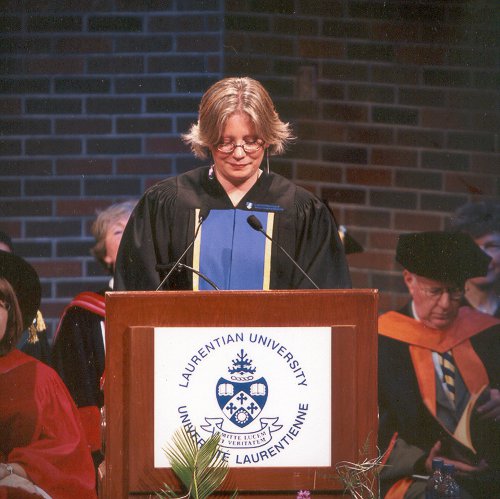
Laurentian University Convocation 2007

June 2, 2007.

A friend of mine and fellow writer, Kim Fahner, much involved with the Laurentian University Alumni Association was scheduled to give the Alumni welcome address at the June 2 ceremony.  She was unable to fulfill the commitment and suggested me as a replacement.

Though the occasion required me to read a bilingual speech, I believe that I did so competently, thanks to the gracious assistance of another friend, Sue Brunet 🙂

The true opportunity arising from this event was the chance to meet Robert J. Sawyer who was the key speaker and honourary doctorate recipient that day.

While I must admit I was incredibly shy and probably came off as a bit of a doofus, I was very pleased to meet Mr. Sawyer and his address regarding the future and his vision of it was excellent.

Have you ever heard of “Pencil Box”?

I was seven years old, in grade three, and my parents got me my first puppy.  I named her Friskey.  My first piece of creative writing was about my dog.  It was unsolicited, but I was allowed, no encouraged, to read it to the class.

You may have the distinct impression from some of my earlier posts, that I’m not fond of school or teachers.  Some of the greatest creative difficulties and nartiest guardians at the gates I’ve faced have been thanks, in part, to various schools and teachers, but teachers have also been some of the greatest guides and mentors in my creative life as well.

Some of my best friends are teachers or professors and I know that they struggle to be among the best in their field.  Though I’m a corporate trainer, I’m a teacher too, and so I will not paint all teachers with the same brush.  Just like people, there are good teachers and bad ones.

The influence of great teachers:

We all have at least one teacher in our past that was important to our development as a person, if not as a writer.  I’ve been lucky enough to have several.

The first great teacher in my life was Mrs. Debbie Arnold.  She was the one who encouraged my early creative efforts in grade three.  She also advised my parents to enroll me in voice lessons as the result of my enthusiastic performance in her music class.

Though professional voice lessons were too expensive, I auditioned for and was accepted into the church choir.  I was also enrolled in an after school piano class.  We didn’t have a piano though, and that caused a few difficulties.  I wasn’t keen on the instructor either, and dropped out before long.

Then there was Siobhan Riddell.  She was an amazing artist even then, though I don’t

This book cover was one of Siobhan’s pieces.

think she was in high school yet.  She and a group of her classmates had made story books and they came into our class to show us.  Hers was a fairy tale and I loved it.

Siobhan’s story was my call to adventure.  In the wake of that revelation, I started drawing characters, super heroines and the like, but what are characters without stories?  So I started writing little stories to go along with them.

I’d been watching CBC’s “Pencil Box” every Saturday.  They featured stories submitted by their young viewers which they dramatized on air.  It was awesome.  That was my first literary submission.  I must confess that while I still have the letter acknowledging the receipt of my story, I never did find out whether it was produced.  My great aunt Florence swore she saw it, but “Pencil Box” went out of production that year and I never did.

Years later in university, I made an enquiry with the CBC, but short of my going down to their archives and finding the dear little thing myself, the costs of paying someone to search for it were prohibitive.  I’ve never gotten back to it.  I don’t even know if those particular archives still exist.

Who was your first great teacher and what influence did he or she have in your life?  Who or what was our first inspiration?  Your first creative effort?  Your first submission?  How did that turn out for you and where did that experience lead you?

What got me going again

Last time on work-in-progress:

In an environment rich in creativity and ideas, I started to write my first novel.  When I left that environment, I abandoned the project … sort of.

The thing is that those two spiral-bound notebooks full of my scribbling, typewritten pages full of corrector tape, and the few scattered dot matrix print-outs, never really left me. The novel was called Rain then, after the main character.  As the title might tell you, my idea started with my protagonist.  The story was hers, and all about her journey.  All the other characters grew out of her story.

Over the next years, I tried refining my opening paragraphs.  I worked on a prologue, and a couple of pivotal scenes.  I wanted scope, breadth, space.  I felt I had to develop my world and my characters kind of got lost in the shuffle.

I enrolled in a creative writing course by correspondence and received my first computer as a part of that deal.  In between writing assignments, I worked at my novel again.  It was in fits and starts though, no dedicated time.  I wasn’t really sure what I wanted to do with the story and where I wanted it to go.  The name changed to Rayne.  Could that count as progress?

After some soul searching about what I wanted to do with my life, I decided to complete the bachelor’s degree I started at the University of Guelph.  I chose Laurentian University in Sudbury, and felt that focusing on an English degree would be my best bet.  My ambition was to become the best writer I could be.  I’d turn the academic world to my purpose.

My writing improved substantially during my years at LU and workshops like Susanna Kearsley‘s gave me a boost.  So too, did my slew of writing successes: a contest win; a short story written for the premiere issue of Parsec Magazine; a regular column in Llambda (LU’s student newspaper); an article in Slin Roller Magazine.  It never translated into my opus though.

I made another fateful (and ultimately foolish) decision to pursue my education by completing a master’s degree in English literature and creative writing at the University of Windsor.  Though I trotted out my novel (and other novel ideas) there, because my chosen genre was fantasy, my work was disparaged.  After leaving discouraged, and returning to complete my degree with a thesis composed of vaguely literary short stories framed by the shamanic journey, I felt defeated rather than victorious, and couldn’t look at my novel for a long time.

After Windsor, I had some modest success in other creative endeavors: poetry and short stories.  Every once in a while, though, I’d have to pull out the old notes.  Once I got my lap top computer, things took off a little more.

By the time I’d joined the Sudbury Writers’ Guild in 2004, and attended Rosemary Aubert‘s workshop in 2005, I’d closed in on the fifty-page mark (oft-revised and agonized over).  I still wasn’t writing every day though.  I just couldn’t get my butt wedged firmly enough in the chair.  There was always something else that needed to be done first.

Then came Nino Ricci.  One of the SWG had met him and managed to arrange for him to come to Sudbury.  It was to be a weekend of workshopping our stories/novels/poetry.  In the course of the workshop, Nino talked about his own development as a writer, his years at York University, and his own challenges with his thesis advisor.  From that weekend, I learned that perseverance and passion win out.  I also knew that I had a long way to go on my novel, but the only way I could get there would be to write it.

Writing

Writing (Photo credit: J. Paxon Reyes)

Another thing Nino said that settled in was that his first drafts, at least at that time, were written to get his ideas out.  Sometimes the next draft was completely different.  Sometimes, he didn’t even refer to the first.  I’d heard the message many times over the years that first drafts didn’t have to be perfect, or even particularly well-written.  First drafts have to be written, though.  I finally understood.

I started writing every day and was amazed at how easy it was.  I made a commitment, a decision.  I was finally taking control of my creative life.  The initial goal was simply to write.  Once my practice was consistent and the habit ingrained, I aimed for a page a day, then two.

I emailed Nino after the workshop to thank him for the opportunity and to let him know the influence he’d had on my creative life.  Always gracious, Nino wrote back with some kind words of his own.

Even though I had a full time job by this time, I kept at it, and two years later, I’d finished my first draft.

How did you start writing your novel?  Was it a focused effort, or did you struggle?  Did mentors appear to guide you, or were you confronted by guardians at the gates?

Why spoilers are good for writers

River Song (Doctor Who)

River Song (Doctor Who) (Photo credit: Wikipedia)

Spoilers!
~~River Song, Doctor Who

So I was driving back from Ottawa last fall, listening to DNTO, on which there was a brief feature about spoilers.

The issue was people who skipped to the end of the novel they were reading.  Clare Lawlor was firmly of the opinion that reading the end of a book before you got there was a bad thing.  A study showed, however, that people generally enjoy a book more if they know the ending …

I immediately thought how I’ve never been bothered by knowing the end, whether of a

Cover of "The Sixth Sense (Collector's Ed...

Cover via Amazon

book, in a movie, or anything else.  I regularly read the ending of a book.  When someone innocently disclosed the twist at the end of the Sixth Sense, I still went to see the movie, and I still thoroughly enjoyed it.

I wondered why that was, and the answer slowly surfaced: even if I know the ending, I still enjoy reading the book because I like to find out how the story goes.  I’ve been doing it for years.

When I travel, I have my starting point and destination in mind.  Knowing where I’m going allows me to enjoy the journey.  The same goes for a book.  If I know where the author is headed, then I can get into the mechanics of the novel more.  As a writer, that’s where my enjoyment in reading comes from: finding out how the writer got from point A to point B.

So here’s my tip for writers: read the ending, if you can bear to, and then read the book.  As a writer, you’ll start seeing where the author has planted clues to the ending, how the plot has been structured, and how the protagonist goes from beginning to end.  It will save you some time if your habit is to read once for enjoyment, and then to reread for analysis.

You may balk at the thought, but trust me, spoilers are great for writers.

If you do give it a try, please let me know how it goes.  Are spoilers good or bad for you?

Nino Ricci

October 21-22, 2006.

Through long-standing member Rosanna Batigelli, the Sudbury Writers’ Guild was able to arrange a workshop with Nino Ricci.

The first day of the workshop was devoted to the author sharing the insights into the writing life that he learned through his experiences.

One of the most helpful stories shared (for me) concerned Nino’s struggles through graduate school.  I was still grappling with a pretty powerful “guardian at the gate” of my own and his tale gave me hope and inspiration.  Not to be overly dramatic, but it spoke to my writer’s soul.

While working on his graduate degree at York University, Nino’s advisor was none other than W.O. Mitchell.  He’d given Nino some negative feedback, but Nino, though discouraged, determined to find his own way through the novel.

We all have our gatekeepers to circumvent, and if a Governor-General’s Award winner could be successful despite his, then it gave me hope that I might be able to as well.

On the second day, we workshopped our poetry, short stories, and novel excerpts.  I received some excellent feedback and to this day, I credit the workshop with inspiring my own rededication to the writing life.  You may remember last week, I mentioned that I’d been writing agnostic for years …

After this workshop, I dedicated myself to daily writing practice in a way I frankly never had before.  Despite work and other life challenges, I had my first draft finished just under two years later.  It may not seem like a monumental accomplishment, but it was the first full draft of a novel I’d ever written.  It taught me a lot, and I have Nino Ricci to thank for it, at least in part.

A born storyteller …

Storyteller is just another name for liar.

In grade one, I think all my classmates (and teachers) thought of me as a silly giggler, a liar, and cat-lady-in-training.

I didn’t even know how to write properly yet, so I exercised my creativity by telling my classmates in “show and tell” about the latest stray cat that I picked up on the way home.  They’d always run away after a few days and so I could show the class a different picture from the cat book I’d checked out of the library and tell them that my latest find looked just like that.

Daydreaming was also a preoccupation.  Because my dad had epilepsy, it was thought that I might too and that my habit of totally “zoning out” was actually petit mal seizures.  Later in life, I was formally tested for epilepsy and there was absolutely no sign of it.  I’d just delve so deeply into my fantasy world that there was nothing could tear me away.

If I was born 20 years later, I’d probably have been diagnosed as ADHD and drugged into submission.  As it was, I was “spoken to” and ignored.  I was deemed enthusiastic but disruptive by different teachers for different reasons.

Can you see the mischievious? Just call me “wee devil” 🙂

Really, I was painfully shy, and the giggling was a way of deflecting uncomfortable situations, which meant pretty much everything.  To this day, I still laugh when I offer a thought or suggestion to my colleagues or manager at work.  If it’s too radical, my suggestion can always be dismissed as a joke, right?

The daydreaming-at-inappropriate-times thing stayed with me until my mid-twenties, and then I started to get clever about it.  I’d restrict my mental ramblings to my “alone time” so no one would be put off by my apparent disinterest in whatever it was they were saying.  Now I cultivate solitariness.  As I writer, I have reason to, but as a creative soul, I simply can’t do without.

As for the telling of stories, I’ve always wondered what might have happened if someone had recognized what it was I was trying to express and encouraged me to turn those imaginary powers to something else.  If I’d started writing my dreams and stories down earlier, where might I be today?

Ultimately what-ifs and might-have-beens are only intellectual exercises.  None of us have do-overs.

A few months ago, one of the writers I consider to be a mentor, Barbara Kyle, presented this TED talk (via Volconvo) to her creative network: http://www.volconvo.com/forums/content/226-do-schools-kill-creativity.html

It is 20 minutes well-spent, trust me.  Sir Ken is incredibly funny, but his message is dead serious.  Currently, it is not the business of schools to nurture creativity, but to create useful/functional members of society.  I rather agree with Sir Ken, that only by nurturing the creativity of our children will schools produce truly valuable members of the human community.

I’ve also been disturbed by the resurfacing of the ADHD debate.  Are children being over diagnosed/incorrectly diagnosed?  This debate has been around for decades and it still hasn’t been resolved.

Some food for thought:

Were you a creative child smothered by a school system that didn’t recognize what your “acting out” meant?  How did you come to understand your creativity and who helped you through that sometimes agonized and agonizing process?  Did you ever feel less valued or less intelligent because you were more creative than academic?

How it all started

Maid’s Hall: University of Guelph

So there I was, away at university for the second year, and still no idea what I wanted to do.

I’d started September of 1987 as a fine arts major, but after being dismissed as “an illustrator,” I flirted briefly with psychology before changing to music in January 1988.  In the fall of 1988, I had a rather disastrous classical guitar audition for the practical music program involving performance anxiety and was seriously considering English as my major.

I wrote music and book reviews for The Ontarian, the University of Guelph student newspaper, and helped them with layout.  This was the old fashioned layout with waxed prints of the columns that had to be precisely trimmed and placed on the board.  It was work that suited my wall-flower personality.

My roommate, Sandra Reynolds, though floundering similarly, always had more direction than I did and was a steadying influence on me.  Her sister is Susan Lynn Reynolds, who published Strandia in 1992.  She had drawn maps for Guy Gavriel Kay’s first novels.  He continues to be one of my favourite authors.  Sue’s ex, Michael Hale, had just published The Other Child.  Sandy was working on her own story ideas and with all of this creativity bouncing off the walls of our little dorm room I caught the bug to do more than record my dreams.

I’d started keeping a journal the year before, not only to capture my dreams, but also to capture insights I had in my classes.  It was a wonderful time for me intellectually.  Everything seemed to interrelate in the most interesting ways: my English literature survey course, Introduction to Psychology, Anthropology, Biology, the History of the Language and Old English courses.  Chinese Philosophy kind of blew my mind.  Sadly, little of it translated to academic success.  I was rather mediocre.

With all of these thoughts ping-ponging off one another in my head though, ideas started to occur to me, including the idea that would eventually become Ascension: Initiate of Stone.  I started writing notes.

Sandy invited me out to Mike’s place.  It was winter, snowy, and I ditched the car on the way.  A tree was mere inches away from the passenger side of the car and Sandy (!)  We were able to get a tow out of the ditch and made it to Mike’s, though late.  We still managed a lovely evening of creative chat, I got a tour of Mike’s graphics studio, and we made pie.  We all decided that since the crust was the best part, we’d make a crust pie.  It was fantastic.  Through Sandy and Mike, I learned some great techniques for character development.

I’ll share one:

Early in the character development stage, while you’re still getting to know them yourself, get together with some friends/fellow writers and have them ask you random questions about your characters.  Rapid fire.  You’re not to think about the answers, just come up with them and make notes as you go.  The idea is to access the inner writer who already has a handle on your characters and let that voice answer the questions.  The questions could be anything: what colour are his eyes?  What’s her middle name?  What happened when he was three?  What was her grandmother like?  Did he ever experiment sexually?  No question is forbidden.  It’s organic and very effective.  Nothing is written in stone, either.

If, in the course of your writing, some of those answers no longer hold true, or other answers that seem more appropriate present themselves, then the character changes.  Even to be thinking of these questions and answers through the writing process is helpful for your character development and therefore for the work.

Try it.  You may be amazed.

Sandy was taking Children’s Literature with the incredible Jean Little and Jean was bringing a friend into class to talk about her work.  That friend was Welwyn Wilton Katz.  Though she waggled a finger at me for my lack of research, I did get a chance to talk to her and was inspired by the lecture.  Subsequently, I started reading her novels, and became a fan.

By this time, I had one spiral notebook full and another started.  I had an old portable typewriter that I typed my essays on and started to type bits and pieces out in between essays.  I had no confidence however, and declined to show my stories to anyone.

My lack of direction in school eventually reached a crisis point and I decided to take some time off.

How did you get started on your magnum opus?  What or who inspired you?

My Process

Educational Resource:  "Writing process"

Educational Resource: “Writing process” (Photo credit: Ken Whytock)

First, some thoughts about process from other writers:

The thing about process, is that it is, a process.  It changes over time and is as individual as the artist.  For what it’s worth though, this is what I’ve learned about mine …

daydream believer

When I was a kid, I dreamed, and those dreams became the bases of stories.  I didn’t keep a dream journal until much later in my life, but that’s how it started.  In my waking life, I was influenced by the things and people I liked: Siobhan Riddell’s wonderful artwork, Star Wars, G-Force, C.S. Lewis, and Lloyd Alexander.

first thoughts/morning pages/whatever you want to call it

When I was in university, I started to keep a journal, and I have ever since.  I recorded not just my dreams, but also the wonderful insights I gained in my classes.  An interesting thing my roommate taught me about my dream life: I talked in my sleep.  Sometimes I even got up, opened my eyes, and seemed to interact as though I was awake.  I’ve since learned that I am also subject to night terrors and sleep walking.  I once opened all the windows in my apartment in the middle of January and didn’t remember a thing about it …  That’s settled down now that I’m older, but so has my dream life.  I still dream in story, but now the stories my mind tells are all adult ones, about work or other stresses.

clip-rat

When I worked in libraries, I became a clip-rat.  It’s kind of like being a pack rat, but with article clippings.  I’d see something interesting in the New Yorker, or the Saturday Night Post and photocopy it.  I have some articles on economics that I have a story idea about, and a series that the Toronto Star did back in the 90’s about welfare and homelessness that’s fed into another.  When I travel, the daily newspapers left at my room door still yield clippings for the idea file.

my very own science guy

Discussions feed my creativity too.  My husband, Phil, is Mr. Science.  Professionally, he is a network administrator, but in a past career, he was a medical lab technologist.  His hobbies include cosmology, astronomy, and geology.  We have amazing conversations and I have several ideas that have had their genesis from his interesting insights.

forms/genres

Poetry comes alive in the moment: what I see, how I feel.

Short stories come from life events, or arise out of the need to explain them.

So that’s how the process starts, where the ideas come from.

Then they incubate.  It could be minutes, days, months, or years.  It depends on the idea, its purpose, and the genre it decides to be embodied in.

Poetry has the shortest incubation and usually writes itself.  If I revise, that may not happen for a considerably longer period of time.

Short stories are usually written in one sitting, and are usually revised two or three times before submission.  Every returns story is revised again before the next submission.

I’m still discovering what my process is with regard to writing a novel and I suspect it will change significantly before I have it pinned down.  I’ll cover this in a bit more detail in my work in progress category.

ming-ti is everything

(say ming-ti over and over again, very fast … thanks to the Battle Chant grrls for that one!)

I work a day job, and so must write in the evenings and on the weekends.  One of my biggest challenges right now is how to balance my job with my personal and creative lives.

Tools are important.  I have a particular preoccupation with …

ways and means

Though I journal, I don’t have a practice with respect to this aspect of writing.  I’ve tried writing daily, but didn’t find it productive for me.  Now I write in my journal when I have something I want to record.  Sometimes it’s just blather, but I do make a point of writing.  I may not write for a few days, a week, or longer, but then I’ll write several days in a row, or even several times in one day.

I prefer spiral or perfect bound journals that can lay flat, with hard covers in case I’m writing in a place where I there’s no table or other surface to write on.  I have a purple pen to write with.

Poems are sometimes drafted in pen, but most of my fiction writing is conducted on my computer.  I have a desktop and a lap top so I can write in different places in the house, outside, or while traveling.  I have heard that it can be useful to change surroundings occasionally and have done this frequently myself for the following reasons:

  • My day job requires me to travel and I have to write (I can’t do without), so I take my lap top and write wherever I happen to be.
  • When we were renovating my office, and then the bedroom, it wasn’t really possible for me write in my accustomed surroundings.  The lap top became very useful, allowing me to write in the living room, the back yard, or at my Mom’s.
  • Sometimes I just need a change.

be the target

I set goals: a number of pages, or words, a short story revised, or poetry submission prepared.  I try to stick to them, but don’t beat myself up if I can’t meet them.

I write every day.  The rare time that I am too ill, or exhausted, to write, I miss it terribly, so I try at least to do something writing-related: journaling, administrative tasks, research, going over timelines or character sketches, even email counts.  Social media and blogging count too.

alt.creativity

I try to do something else creative that’s not writing.

There was a time that I thought I’d be a visual artist.  I still sketch occasionally: characters, maps, and the like.

I used to sing in the church choir and school choirs when I was a kid.  Later, I joined the Bel Canto Chorus for a season and surprised myself with a successful audition for Theatre Cambrian’s production of Hair in 2000.  Though I haven’t sung publically in years, I still sing, even if it’s just in the car.

I take photos, and some of them have merit beyond the simple recording of events.

I try to get out to the odd concert, or other event, just for fun.

body/mind

I stay minimally active.  If all I do is walk the dog, or walk home from work, I try to do something every day.  I tried jogging for a few years, but I never liked it.

Sudoku, solitaire, and jigsaw puzzles help me relax and help keep my mind engaged.  I used to play Massively Multi-player On-line Role Playing Games (MMORPGs) like Champions, World of Warcraft, City of Heroes, and EverQuest, but I don’t have time for those anymore, even as a reward.  They are very time-consuming, though immensely fun.  A lot of my creativity ended up going into the game as opposed to my writing, so I had to make a choice.  In the end, it wasn’t difficult.

I like to listen to music while I write, but don’t always do so.  I find music relaxing.  It inspires me, though I know some writers can’t have any distraction while they write at all.  I’m fairly eclectic in my musical tastes.  Random selection from my I-Pod: Tori Amos, David Bowie, Sarah Brightman, Kate Bush, Great Big Sea (still a groupie), Sarah Slean, The Fixx, Imogen Heap, Crosby, Stills, Nash and Young, Dala, and Loreena McKennitt.  Though I don’t listen to them often, I also have CDs of Berlioz, the Eddas, Beethoven, Japanese flute, and gamelan music.

Did I mention my tastes were eclectic?

a room of one’s own

I don’t close the door to my office, though I can.  Phil knows to leave me alone while I’m working, but steals in now and then for a kiss.  Even the dog stays away when I’m at my computer.

Plants are a must, as are shelves filled with reference works and fiction yet to be read.  My office is also full of items of personal interest, gifts from friends, masks, and my altar.  With respect to this last, all I’ll state here is that writing has become my spiritual practice as well as my vocation.

don’t feed the muse

I read all the time.  I’m not as fast as I used to be because I don’t have so much time to devote to it, but I still read, and fairly widely.  I try to read something contemporary, perhaps in my chosen genre, then a classic, or another work of fiction outside sf.  Then I read a work of non-fiction, alternating between something for research related, overtly or not, to what I’m writing, and something on the writer’s craft.  My current favourites: Sheri S. Tepper, Guy Gavriel Kay, Diana Gabaldon, Charles de Lint, Ursula K. LeGuin, Heather Sellers, and Donald Maass.

I’m a CBC junkie, particularly “Writers and Company,” “DNTO,” and “Spark.”  I get ideas, inspiration, and insight from them too.

I like shows that have a plot line that carries over seasons: Doctor Who, Buffy the Vampire Slayer, Babylon 5.  I also indulge in Castle and Grey’s Anatomy.  I try to think critically about the plot lines and story.  I watch repeats of the shows I like so I can get deeper into their structure.

the bottom line

Ultimately, everything I do has a purpose, or I can relate it somehow to my creativity.  Everything feeds into process in the end.

Donald Maass writes in The Breakout Novelist: Craft and Strategies for Career Fiction Writers, that most writers, even those who teach creative writing, have no idea what their process is, and I would agree with that.  What I’ve shared here is what I’ve learned in my lifetime of writing to date.  My process is a part of my life and lifestyle.  It changes as I change and it’s difficult to articulate what is process and process alone, distinct from the rest of my life.

Perhaps the point is that there is no distinction.  A writer’s life is her process.  What do you think?

Rosemary Aubert

October 29-30, 2005.

I was just beginning to find my feet as a practicing author.  I’d been writing agnostic for years 🙂  You know how that goes, don’t you?  Your bum just won’t believe in the existence of the chair enough to stay in it?

A member of the Sudbury Writers’ Guild came through and brought Rosemary Aubert to Sudbury for a two-day workshop.

Rosemary had some very valuable insights not only about the writer’s craft, but also about the publishing industry.