The next chapter: June 2014 update

Hey all!

I must say that June was a blockbuster month for me.

It started with the publication of my science fiction short story “The Broken Places” being published in Bastion Science Fiction Magazine. Still so excited about that.

I attended June’s @M2the5th Twitter chat with Roz Morris, focusing on her Nail Your Novel series. I’m learning quite a bit from these, and though we cancelled July’s because, Independence Day, we’ll be getting back to our monthly schedule in August.

A comment on last month’s update had me a little concerned about what my readers might be taking away from these posts. It seems May’s update was taken as a warning about social media. If the warning was timely and helpful, great, but it’s not the message I hoped to convey.

I have now finished reading my ARC of K.M. Weiland’s forthcoming Jane Eyre: Writer’s Digest Annotated Classics. I’ll be posting a review later in the month, so stay tuned for that.

The adjustable desk is working out very well, and I’m now standing for longer between rests. At work, I read a post from a learning and development blogger in which he discussed his experience with his standing desk, which he described as continual fidgeting.

He uses a kitchen stool to take a periodic break from standing and has discovered that he can’t write while standing (!) Thankfully, that hasn’t been my experience.

CanWrite! 2014 was a great time, as usual. I’ve been blogging the panels, sessions, and workshops I’ve attended on a weekly basis.

Another piece of exciting writerly news arrived when I returned home from the conference: another speculative short story, “On the Ferry,” made it into the top ten in the When Words Collide writing contest.

This means I’ll appear in their chapbook anthology, In Places Between, though I’ll have to wait until the conference to find out if I’ve placed. Still. Squee-worthy.

Last month, I had a blogging disruption around the arrival of my desk and spent most of my non-blogging writing time working through Initiate of Stone, all of that work in long hand. Though I completed a lot of work on IoS, I wasn’t able to capture a word count from it.

In last month’s update, I mentioned I would be getting back to countable writing.

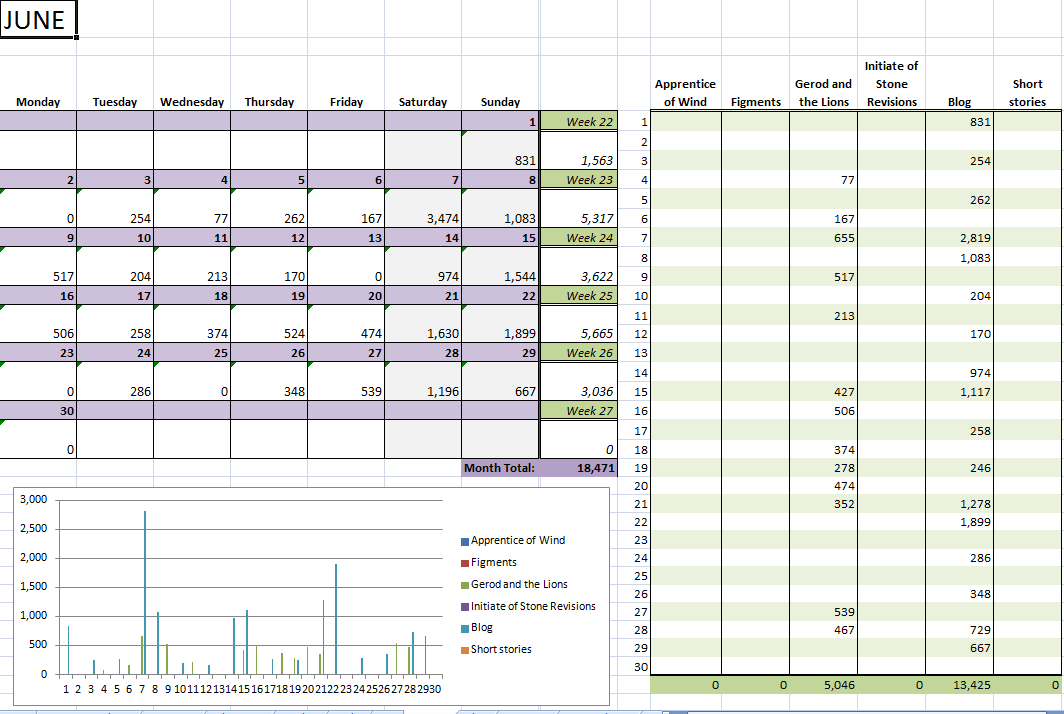
June's writing progress

June’s total word count: 18,471!!!!!

13,425 of those words were on my blog, but 5,046 were written in Gerod and the Lions. I set myself a goal of 5k for the month on that project, and I made it. The draft is now just over 10k words and I’ll have a workable draft by the end of the year 😀

I only just started working on Figments (my NaNo project from last year) as I had worked on IoS last month. In all fairness, I have a little more to do with Figments than I had to do on IoS.

First, I’m mapping it. This is something I picked up from reading Donald Maass’s The Breakout Novelist. For each chapter, I list the title, page count, word count, the first and last lines (both hooks, one to draw the reader into the chapter and the other to propel the reader onward), the purpose of the chapter, in story terms, the internal and external conflicts, and finally, what changes for the story, and for the POV character as a result of the chapter.

These are actually from several separate exercises in Maass’s workbook, but I’ve cobbled them together to create my map. These are like index cards and I can rearrange them as needed when I work on the structure of the story. I can see where I might have to divide longer chapters, and fairly easily pick out plot points, pinch points, reversals, etc.

Once I get the mapping done, I’ll fiddle with Figments’s structure and tighten things up, work through a beat sheet ala Roz Morris, and finally reverse engineer the plot with Victoria Mixon’s holographic structure.

June has taught me that I can’t draft one project and then work by hand on another project simultaneously. I’m going to try alternating and see how that goes.

And that is all the Writerly Goodness I have for you tonight.

How are your works-in-progress coming, my friends?

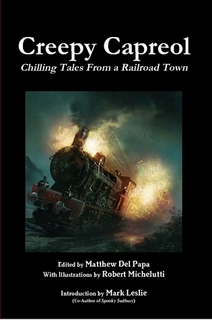
Coming up this month: An interview with author and editor Mat Del Papa on his new anthology Creepy Capreol, I take another shot at the writing process blog hop, the review of Katie’s book, more CanWrite! reportage, and a couple of poems with creation stories.

The Next Chapter

CanWrite! 2014: Publisher Panel, June 20

Christie HarkinCraig PyetteHalli VillegasPanellists: Christie Harkin, Lorimer; Craig Pyette, Random House; Halli Villegas, Tightrope Books.

Moderator: Sue Reynolds


SR: What would make you shout “Eureka!” if it crossed your desk today?

CP: If we’re talking fiction, I’m not likely to shout right away, but something fresh, or new, would make me pay attention.

HV: The writing has to be excellent. The writer has to be willing to work hard in the editorial process. I like unique settings, LGBT, quirky, diverse books. In our best essays anthology, there was a piece about hospitals that was fascinating.

CH: I have a spreadsheet with tic boxes. I have to check off all the boxes to consider the piece. It has to fit into one of our current series, have an urban setting, preferably in the downtown core, it must be edgy, realistic, modern, and not elitist. If I receive something that meets the criteria, I’d shout “Eureka!”

SR: How many books do you consider from your respective slush piles? How do you prefer to be approached?

CP: If you want to submit to a larger house, get an agent. Most of what we produce comes to us through agencies. With regard to your first question, it would be close to none. I can think of one book we accepted from the slush pile. It was non-fiction about the intersection of gun culture/manufacture and hip hop/urban culture.

HV: Every season, there’s at least one book I find in the slush pile. We’re a small press and periodically closed to submissions. Sometimes we put out a call for an anthology. Our most recent was for mystery stories. We also accept projects though grants, like the OAC’s Writers Reserve. If I like the work, I’ll get in touch.

CH: I’ve been with Lorimer for eight months and before that, I was with Fitzhenry & Whiteside. At Lorimer, there is no slush pile. When the list is specific, the submissions are low. We ask for specifics. Read the submission guidelines.

SR: How do you make a business case for a book? In other words, what happens after “Eureka?” How do you sell a book?

CP: The business case is part of the eureka moment. We have to see that there is a robust audience for the book. We talk a lot about comps.

HV: Comps are the first thing sales asks for. Tightrope has built its own market. Readers say, “I trust their aesthetic.” We have our annual poetry and essay anthologies, we’ve published material on plus-sized women. We’re not necessarily focused on the market in general, but on our audience. We published a book titled, How to get a Girl Pregnant, about a gay couple trying to have a baby. The author needs to be part of the process.

CH: We also want proactive authors. They have to be willing to attend conference, Word on the Street, commit to local promotion. The biggest market for kids books is in schools and libraries. Take a look at the curriculum and write book club-like content for teachers so they can teach the novel in class. There was a book about Jacques Plante, but it was too focused and a lot of the kids it was aimed at wouldn’t be able to relate. This morphed into a book about hockey safety in general and how players have contributed to innovation over the years. The revised book had a more universal appeal.

SR: Publishing is a business. You know what you’re looking for. What about international rights and contracts?

CH: If you don’t have an agent, you don’t have any negotiating power. You probably don’t have the knowledge, or the connections. Think seriously before you sign a contract.

HV: We had a South African author who wanted to publish in both countries. I have a North American and European distributor. I don’t like being limited to Canadian rights only. It’s a smaller market. The first print run is 600-1000 books. We’ve just added ebook rights as well. We don’t do commercial fiction, however.

CH: You want your publisher to contract for US rights. More books will sell in the States than in Canada. Lorimer insists on US rights, in fact. If the author wants to retain them, that would be a deal-breaker.

CP: You don’t want your rights squandered. Ask what the publisher wants to do. Random House has a great foreign rights department, but half of our authors aren’t Canadian. We’re a Canadian-oriented publisher, though. With an agent, the world is their oyster.

HV: Big publishers will have a legal department. I don’t. If things get too complicated, I send the writer to an agent or a lawyer.

CH: Yes, an intellectual property (IP) lawyer.

SR: Let’s open the floor to questions.

Q: What’s your risk tolerance?

CP: Keep in mind that the greater the risk, the higher the potential payoff. Last fall was unusual. We published books on Bobby Orr and Chris Hadfield. Colossal risks, but the payoff was huge, too. Sometimes you blow it, but if you’re passionate, you take the risk.

HV: We don’t have a big budget, so we don’t take big risks in the traditional sense. I like to build the ladder rather than climb it.

CH: At Fitzhenry & Whiteside, I had a lot of latitude. My risks paid off. I’ve been lucky. Lorimer is less of a risk-taker, but we will still weigh the pros and cons before making a decision.

Q: What is the process of getting on the bestseller lists?

CP: If we knew that, we’d all be millionaires. That’s putting the cart before the horse. In 2006 Booknet started tracking sales at the cash register for 90% of the retailers in Canada. The Globe & Mail Bestseller list is based on Booknet numbers.

Q: Does politics play a role?

CP: It’s hard sales numbers.

HV: Do you mean, “it’s who you know”?

CP: Maybe there’s the odd favour.

CH: Maybe we can get the book into a reviewer’s hands.

HV: It’s a chicken and egg thing. Some authors will automatically be on the bestsellers lists. Stephen King, Margaret Atwood, Michael Ondaajte.

Publisher's Panel


And that’s all we had time for.

Next week: Writing Fantasy with Kelly Armstrong!

Thoughty Thursday: Things that made me go hmmmm on the interwebz June 22-28, 2014

Another thoughty week runs the gamut from the sublime to the absurd. Just for you, my thoughty friends 🙂

This is from the learning and development side of my life, but, I figured, why not share the love? The social learning blog offers 22 free elearning and graphic design resources.

Author Media created this infographic that gives you ALL the sizes for all images on the most popular social media. Cheat sheet? AWESOME!

New technology for books! Check out the booktrack. Posted by Laurence MacNaughton on Jane Friedman’s blog.

All work and no play makes Johnny . . . crazy? Watch this TED talk and see what you think:


Five ways animals suffer from mental illness from ted.ideas.com. Phil and I have always been convinced we raise neurotic pets . . .

From the Telegraph: phobias may be memories passed down in our genes from our ancestors. Whoa, dude.

Brainpickings presents the theology of rest. “Rest, instead of being something passive, is actually an act of resistance.”

Try the Celtic version of the zodiac. The Celtic tree calendar from Irish Central.

A literary travel guide to the UK from ShortList.

Ted.ideas.com asks which country does the most good for the planet?

Six sites gain world heritage site status. Discovery news.

How much room would we need to supply the entire world with solar energy? I Fucking Love Science has the scoop.

Have a closer look at Europa with National Geographic. I love Europa. Wrote a poem about her once 🙂

The Atlantic present more of the entrants in the 2014 National Geographic Traveler Photo Contest.

Love pugs? How about Game of Thrones? A couple of creative souls decided to put the two together and this is what they came up with:


HelloGiggles brings us an ode to sloths.

Wired’s absurd creature of the week: the assassin bug. More like creepy creature. Gives me the wiggins.

The truth about public toilet seats from Lifehacker.

And now that you’re suitably grossed out, I shall bid thee adieu!

The best in edutainment. Nothing’s too good for my writerly friends 🙂

Thoughty Thursday

Tipsday: Writerly Goodness found on the interwebz June 22-28, 2014

Happy Canada Day, writerly peeps!

Red-Maple-Leaf-for-Canada-Day

Publishing news of the week: Writer’s Digest dumps Author Solutions. What David Gaughran thinks of the move.

Roz Morris explains how to write from an outline and still be creative. My subtitle: How to bend it like Morris 😉

The third and final instalment of K.M. Weiland’s flat character arc series: The flat character arc in the third act.

MJ Bush wrote a guest post for Writers Helping Writers on how regret can deepen your character’s arc.

Training your internal editor with Mary Robinette Kowal.

Writers, what do you fear? Dan Blank offers some compelling thoughts on how to deal on Writer Unboxed.

66 facts you may not have known about the English language from The Huffington Post.

John Vorhaus lets his wordy whimsy out to play on Writer Unboxed.

14 pieces of brilliant short fiction from Art.Mic.

Five hundred fairy tales discovered in Germany, brought to you by The Guardian. I can’t wait to get into these!

See you on Thoughty Thursday!

Tipsday

Sundog snippet: Another piece of the office puzzle falls into place

Since it’s not the end of the month yet, I’m not going to put out The Next Chapter until next weekend. That way, if anything else happens in the next day or so, I can capture it for you 😉

Also, I’m only going to dole out the CanWrite! sessions once a weekend to draw out the suspense learning. There’s one more panel, two sessions, and the wrap post to go. Why so few? I’ll tell you all about it in the wrap post, which will have some tips for preparing to go to conferences. Stay tuned!

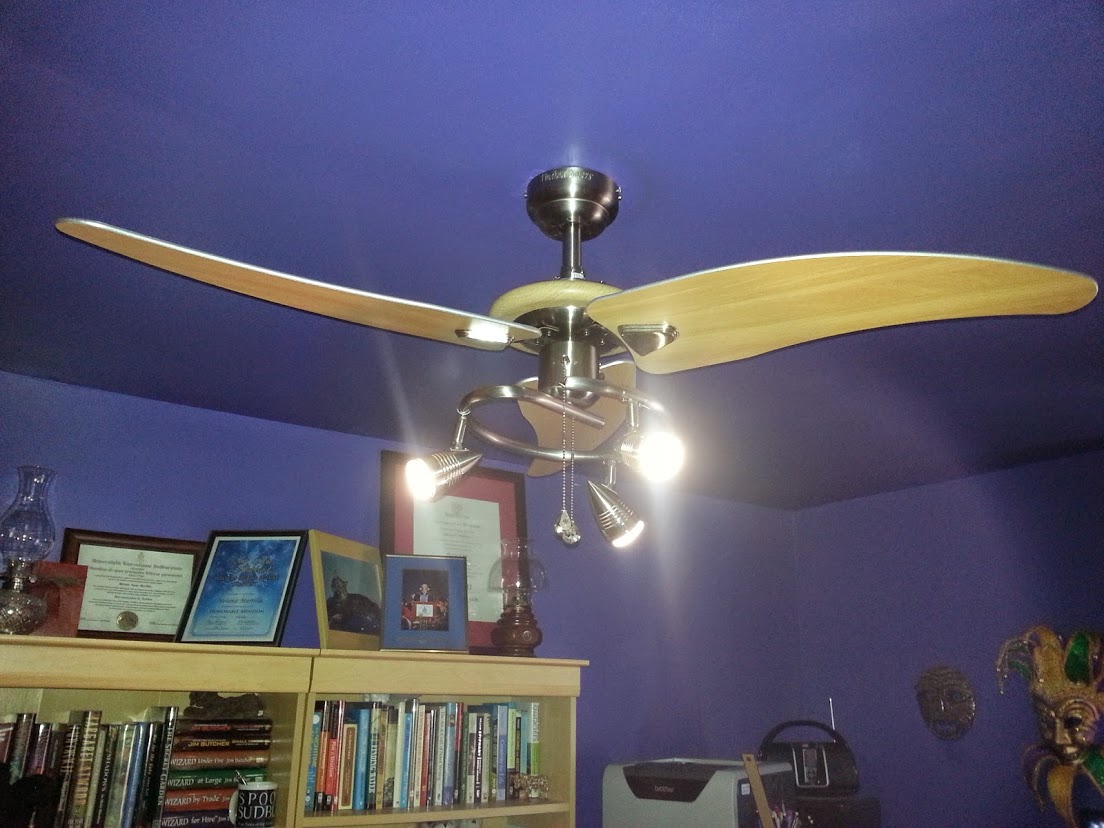
So this is just a quick post to show you that Phil finally installed the new ceiling fan in my office (yay!). Actually, the ceiling fan was purchased a few years ago, when we renovated our bedroom. It’s been sitting around, languishing in its box since then.

You don’t want to know how long it’s been since I renovated my office . . .

I still have to refinish my office door, but that has to wait until I have some dedicated time.

CeilingFanLove

Isn’t she sweet?

It’s much better than the old one (as the Ikea commercial says) which is about to be chucked to the curb. The old one still worked, but the motor had a nasty hum that made me doubt I could safely use it for long periods of time. It’s free to a good home, and I’m sure it will disappear long before garbage day. We have a lot of wise and environmentally conscious scavengers in the area.

And I’ve really needed it this weekend. It’s the first really hot weekend of the year (in the 30 degree Celsius range, plus humidex) and we don’t have air conditioning. It’s made the house bearable.

The gazebo in the back yard is still in a state of chaos and now has wood (from my mom’s deck reno) piled up for storage.

This weekend, Phil and I also went out and priced landscaping stone, crusher dust, gravel, and recycled rubber patio tiles. Over the course of the summer, Phil is going to construct a retaining wall around the patio, filling in the gaps about the concrete footings he poured (and re-poured) last year, and resurface the patio with the rubber tiles.

Then, he’s going to make a raised garden for me in the back yard with the stone, and create a stone (or possibly rubber tile) path between our two sets of entry steps. It’s a lot of work and a fair amount of cash, but if he works away at it in dribs and drabs, maybe he won’t exhaust either himself, or our bank account.

That’s all for today.

See you again on Tipsday!

BTW, like my new bit of Canva art?

Sundog snippet

CanWrite! 2014: How to be your own editor with Farzana Doctor June 19

Farzana DoctorThat’s Dr. Farzana Doctor 😉

Learning to edit your work is learning to know when to let go. Maybe that’s what this workshop should be called: Let it go.

This is what I do. You don’t have to do what I do. Do what works for you in your process, but I hope you’ll find some interesting tips and techniques you can incorporate into your process.

First, a couple of definitions:

  • Prose editing is fine tuning: Spelling, grammar, syntax, usage.
  • Revision is substantive, structural, plot-related.

To start the editing process, you must have a completed piece of writing.

What was your intention in writing the piece? That core intention will guide you in the editing process.

Plan the process

Prose editing checklist:

  • Overused or repetitive words. First identify them. Everyone has her or his words. Then, use find and replace to address them.
  • Useless words (Mel’s note: also called zero words, because you can remove them from the sentence without changing the meaning of it) such as, just, only, that, actually, etc.. If you’re not sure what useless words are, Google it.
  • Grammar tics. Again every writer has a weakness. (Mel’s note: mine is commas. I either use too many or too few.)
  • Passive language. Examples: The biscuit was eaten by the dog (the dog ate the biscuit). She was jumping up and down (she jumped up and down).
  • Telling versus showing. Telling has its place, but avoid it where possible. Check your use of adverbs, adjectives, and clichés. These are often signs that you are telling, rather than showing.
  • Dialogue. Tags – do you need them, or would an action beat be better? Do all of your characters sound the same? Said is just fine. Read it out loud to see if it “sounds” right.
  • I start with editing first, because I find it easier. Some writers may not want to do this because it may mean too many wasted words when the revision stage is reached. Editing first works for me.

Revision checklist:

  • Where does the story begin? Is it too early, too late, is there enough action, conflict?
  • The protagonist. What does he want? What prevents him from getting it?
  • Other characters. If you can take her out of the story and not alter it, she should go. Every character should serve the story. Every character should be real, have a background, desires and frustrations of her own.
  • Keep track of plot and subplots. Structure.
  • Description. Is there too much or not enough?
  • Flashbacks. Do they stall the story?
  • Is the ending satisfying? Is it a resting place?

How to do it:

  • Focus. No distractions. Space. Set time, page number, or word count goals.
  • Separate new writing from editing and revision. Could be different times of the day, or different days.
  • Revision iteratively. Editing as you’re going. Must always make progress, however. S.J. Rozan’s method of Iterative Revision – Bookbaby. Start with previous day’s work, and then move on. It’s like a progressive spiral.
  • Change perspective. Step away. Change your font. Read aloud. Print it out. Draw maps. Pretend you are a reader.
  • Create a visual outline. Literally cut and paste your scenes and chapters.
  • Write a synopsis or jacket copy. Write a logline or tagline. Write a poem. Find your theme.

Asking for feedback

  • Who will you ask?
  • When is the best time to obtain a critique?
  • Be specific about what you want/need.
  • Stay general. When did you stall, get bored, get lost?
  • Receive your critiques without resistance. Set it aside. Decide what rings true. Ask for clarification (do not defend).

The rest of the workshop was spent reading and responding to the participants’ works-in-progress.


I must admit, I haven’t thought of purposefully editing first. I have edited too early before, and regretted spending all that time fixing scenes and even chapters that I would eventually delete. For me, I would think that revising first makes more sense.

Similarly, iterative revision doesn’t work for me. I get caught in an endless loop of going further and further back. It doesn’t prime the pump for me, it engages my inner editor too early in the writing process and stalls me.

Overall, I found Farzana’s workshop informative and practical.

I hope that you, too, will find something useful that you can use in your daily practice.

Thoughty Thursday: Things that made me go hmmmm on the interwebz June 15-21, 2014

I think I have to declare this the week of TED. A fair amount of TED talk here. All excellent, as TED talks tend to be.

Just a bit of politics here. The Northern Gateway pipeline is that other pipeline, but it’s a Canadian thing, so some of you may not have heard. Here’s an interesting article about the lies that have been told in an attempt to push the project through.

Kudos to the UK where teaching creationism is now banned in state-run schools. I Fucking Love Science.

A man dedicated to fighting woo: The Huffington Post interviews James Randi (The Amazing Randi).

Just to offer some balance, a post on meditation from one of the woo-pitchers Randi debunks. Actually, I don’t think Randi has an issue with meditation, or its potential benefits, just all the other stuff that tends to get glommed in with it.

More IFLS: How neurons decide whether you cope or become stressed.

TED talk from David Anderson: Your brain is more than a bag of chemicals.

And related, from the Wall Street Journal: Our brains are made for enjoying art.

A TED talk from Mihaly Csikszentmihalyi on the secret of happiness, flow.

Another TED talk from Steven Johnson: Where good ideas come from.

TED talk from Colin Stokes. What are today’s movies teaching our kids? This kind of goes with the article on strong female characters from this past Tipsday. Hint strong doesn’t equal pew-pew-pew!

Jim C. Hines responds to a blog post entitled “The naive idiocy of teaching rapists not to rape.” Read to get the goods.

An interesting article from Irish Central on the black Irish and their history.

Entertainment Weekly interviews David Benioff and Dan Weiss about the season 4 finale of Game of Thrones.

And Maisie Williams on her character, Arya.

One of my favourite pair of singer/songwriters: Dala 🙂


And just for laughs: What do you Poupon?

It was a fairly thoughty week! Enjoy, my friends 🙂

Thoughty Thursday

Tipsday: Writerly Goodness found on the interwebz June 15-21, 2014

There’s a little bit of everything this week. A little craft advice, some blogging tips, love for the word nerds and the book worms, writerly brain science, and a couple of thoughtful pieces about women in fiction and making it in the world of fandom.

Part two of K.M. Weiland’s how to write a flat character arc series.

Later in the week, Cathy Yardley wrote a guest post for Katie: Six tips to outline your novel faster.

Jan O’Hara discusses McKee’s four tips on writing a BIG story on Writer Unboxed.

Anne R. Allen’s blogging essentials for authors.

In related news, Roz Morris answers the question, how much time should an author spend blogging and building websites?

10 words that started out as errors from Grammar Girl, Mignon Fogarty.

Moar wordnerdery from ideas.ted.com: 20 words that used to mean something completely different.

24 quotes that will inspire you to write more from Buzzfeed.

Also from Buzzfeed, 37 books every creative person should read.

Back with ideas.ted.com, six science fiction and fantasy books for the app generation.

Benedict Cumberbatch reads Kurt Vonnegut’s letter to McCarthy after the burning of (among other books) Slaughterhouse Five.


I just saw Lisa Cron tweet about this NY Times article: This is your brain on writing, by Carl Zimmer.

Tasha Robinson’s post on The Dissolve, We’re losing all our strong female characters to Trinity Syndrome, caused a bit of a furor on the SFCanada listserv, and elsewhere on the interwebz.

Jim C. Hines shares his Continuum guest of honour speech. It’s kick-ass. Then again, Jim’s good at that kind of thing 😉

Enjoy, my writerly peeps.

Tipsday

CanWrite! 2014: Agent panel, June 19

Panelists: Sam Hiyate, Carly Watters, Marie Campbell

Sam HiyateCarly WattersMarie Campbell


Moderator: James Dewar

JD: What’s changed in the author-agent-editor relationship over the years?

SH: When I was studying English literature, agents were invisible. Editors shaped the work. Now, there is too much work for an editor to do. Some of that work has devolved upon agents. The leisurely relationship between author and editor is a thing of the past. Editors want a perfectly edited manuscript to they can turn around and sell it to their publishing house.

MC: Whatever golden age there might have been, ended just before I started working in the industry. YA is a big market now. Editors are not so much about developing talent, but about recognizing it. We need to be good “pickers.” Some agents have moved into this gap.

CW: Agents are also fighting against each other to get their authors placed.

JD: How much time do you spend developing authors?

SH: I couldn’t give you a percentage, but somewhere between three and five drafts.

MC: It varies with the client. It could be anywhere from one to twelve drafts.

CW: I spend between three and six months, not just editing, but understanding the vision for the work. The “revise and resubmit” letter might contain one to seven pages of suggested revisions. You have to find out if you can work together. Some agents won’t take on a client without doing an R&R letter. They won’t take the risk.

JD: What are some of the reasons authors don’t respond to your suggestions the way you expect?

CW: The author doesn’t take it seriously. They don’t understand how much work goes into reading and analyzing and preparing the R&R.

MC: I was at a conference last year on a panel reading first pages. The top three, as the prize, would be given consideration, moved to the top of my slush pile. Only one of them responded right away. I read and signed her. The second one just came in last month. Sometimes they’re scared. When you get the opportunity, jump for it. It may not be there in six months.

SH: The easy answer is that Canadians are afraid. Americans want to see the money. Adopt a professional persona. Andrew Pyper wrote five or six books. His agent asked to see what he was working on. He presented it to his agent and the agent asked, “do you have anything else?” It’s a conversation.

MC: I had a conversation with one of my writers who said he had so many ideas he could work on. It’s my job to say, “no, no, no, yes.”

JD: What is exciting you these days?

SH: Ask me when I’ve had a few cocktails.

MC: Because I’ve worked in children’s literature for so long, it’s exciting to see the new work coming in. Because there’s so much of it, the bar is set high. Picture books were dying out, but now they’re coming back.

CW: In the acknowledgements of her second book, one of my authors said that without me, she’d be a starving artist. I was thrilled. It’s the best part of being an agent, being able to grow with your authors.

SH: I can give you an answer now. There is a graphic novel about two girls coming of age in this one summer in cottage country. Canadian writers do this very well. The book was #8 on the New York Times, moved up to #7, dropped off the list, but now a review has come out and we’re waiting to see where it goes.

JD: When you look at a manuscript, what are you hoping to find?

CW: The book always comes first, but I look for potential for book cubs, translations, you never know.

MC: With kids’ books, you have to consider the age of your audience, and then look at merchandizing. Is there series potential? Having said that, I will never say the word “trilogy” again.

SH: It depends on the book. The first may be a distinctively Canadian book, but two or three down the line, it could be a whole different story. Look at Yan Martel. Pi was his fourth book. His first was a collection of short stories.

JD: So, the book is not the end of it.

SH: The moment Pi hit the mainstream, everyone went back to buy his other two novels.

JD: How are Canadian authors doing on the world stage?

SH: That’s a really big question. Ebooks are based around genre. It’s getting harder and harder to sell literary novels. The Luminaries is essentially a thriller written in a literary style.

CW: Canadian authors aren’t as ambitious. They’re too laid back. Literary is still a market. If you’re writing genre, though, consider your setting. An anonymous town that could be anywhere in North America won’t be as problematic for an American publisher.

MC: Writers have come to me and said, “I’ve been successful in Canada. Now I want to break into the American market. Canadian’s are good at problem novels. American’s love them too, but they don’t translate into the UK market. It can affect foreign rights and sales. Consider changing your setting to Detroit.

JD: If you had one piece of advice for emerging writers, what would it be?

MC: Treat it like a business. It’s my business and it’s hard work. It’s creative, but it’s also a business.

SH: If you think your manuscript is perfect, it’s probably not. Make sure you have readers, alphas and betas, and critique groups lines up.

CW: Define what success is for you. Plan for it. Implement the plan.

Q: Is there an art to selecting alpha and beta readers?

CW: You have to give some thought to who your ideal audience is. Find people who are better than you to work with. Read everything.

MC: One of the most successful, grass-roots groups I’ve heard of is a workshop run by an editor.

SH: There isn’t a formula. Getting criticism can destroy your work. Art is not created by committee. Have a conversation with your critique group and your readers. Be discerning.

MC: A book club does not trump an editor. Don’t try to defend your work by saying that your group loved it.

Q: Do books set in other countries, like Australia, do well in Canada?

CW: Good books travel.

SH: Catton (The Luminaries) is from New Zealand.

MC: Children’s books are not sold to or bought by children, but in libraries and schools (teachers, librarians, parents). It can be tricky. For every rule there is an exception.

JD: Is sex okay in a YA novel? We’re seeing a lot more of it.

MC: We call it content.

CW: It needs to be part of a character’s development and not gratuitous.

SH: Erotica is still on the New York Times Bestsellers Lists, but the market may be saturated until the next big thing comes along.

Q: Have you ever turned down something you later regretted?

CW: I haven’t passed on anything that became a bestseller, but maybe I failed to get a deal I wanted, or someone beat me to the punch.

MC: I presented a book to an editor who passed on it, but later, when that book sold and was produced by another house, she pointed to it as her “ideal” book.

SH: Agents compete all the time.

MC: On the adult side, I recommended a book to two colleagues. One passed and the other took it and ran with it. It ended up being on the Globe and Mail bestseller list for eight weeks.

Thank God Harry Potter never crossed my desk!


I’m just going to head right into the panels and sessions for CanWrite! 2014. I’ll give a little perspective in my wrap post at the end.

Since I’m away from home, I don’t have copies of the fiction and poetry I was going to post this weekend with me. I’ll try to get one of those posts up tomorrow.

Thoughty Thursday: Things that made me go hmmmm on the interwebz June 8-14, 2014

Right now, I’m down in Orillia, Ontario, attending CanWrite! 2014. Started the day with a light breakfast and yoga, and I’m going to get Thoughty Thursday out before the sessions start up after lunch. Life is good.

Dame Judy Dench and Daniel Craig explore the question: Are we truly equal? See what you think . . .

What’s new in the war on Alzheimer’s Disease? from the Psychiatric Times.

Why we need creative confidence from Ideas.TED.com.

The quest to understand consciousness, a TED talk by Antonio Damasio.

Let these stunning photos of incredible storms inspire you. Also from Ideas.TED.com.

More inspirational ideas from i09: 12 futuristic forms of government that could one day rule the world.

All our patent are belong to you (did you catch the pop culture reference?). Tesla Motors makes its patents open source.

The most important sci-fi film never made from the Japan Times. Jodorowsky’s vision of Dune launched the careers of several notables in the field, including Geiger, and influenced moviemaking to the current day. I really want to see this documentary now.

Wired’s absurd creature of the week: the lion’s mane jellyfish. When I visited the Vancouver Aquarium last fall, they were featuring jellyfish. Apparently, they really do like global warming.

This week was pretty thoughty 🙂

Enjoy, my writerly friends, and I hope you garner some inspiration for your writing from this crop of curation.

Thoughty Thursday