The Narcoleptic Madonna Launch, Dec. 7, 2012

Lovely night!  Music, poetry, and beautiful art.  Inspiring in all kinds of ways 🙂  Thanks, Kim, for putting together a wonderful evening.

My apologies though, for being late (!)  I knew I needed $6 for parking, but I was hoping that I’d be able to pay on exit and get some change at the launch, or, failing that, there would be some place on campus to get change, whether it be a change machine or store.  There was a store, but the vague directions of “down the hill” didn’t really help.  So I ended up stopping at a couple of different places and essentially going most of the way back home before I got the change I needed, returned, paid, parked, and finally got in.

It’s all on me, but I missed some of Kim’s opening remarks, including some very kind ones about myself.  If it’s possible to kick yourself in the ass, toe first (‘cause, come on, that’s the only way to do it so it counts), then I’d be doing it.

The day itself was a bit of a crap shoot for me.  I was ill (still am), but damned if I’d miss Kim’s launch and I am SO glad I made it.  Enough about me.
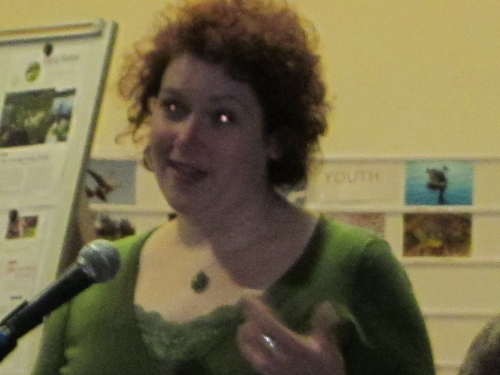
Kim Reading1Ever the gracious hostess, Kim started off with her acknowledgements to the people in her life who’ve been teachers, mentors, and friends on the way, to the artists who have influenced her and the experiences she’s had that have shaped her craft.

As mentioned in the interview I posted last week, The Narcoleptic Madonna has been twelve years in the making, and most of that time, Kim has been primary care-giver for her parents, both of whom have passed away.  Kim also struggled with depression.  This journey of love and loss, recovery and the process of reclaiming the self is the journey that Kim describes in the pages of TNM.

I’m not going to share any of her poetry here.  For that, you can friend Kim on Facebook, follow her blog, The Republic of Poetry, or, best of all, buy TNM, Braille on Water, and You Must Imagine the Cold Here, or any of the other anthologies that her work may be found in.  The experience of reading Kim’s poetry is well-worth the price of admission.

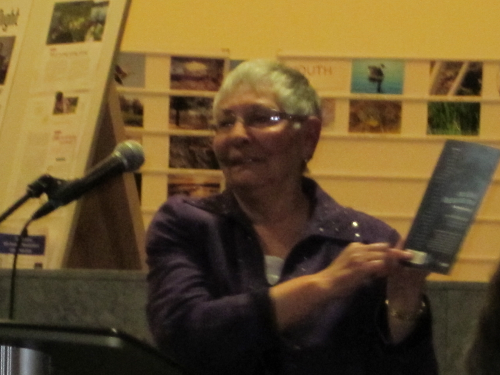
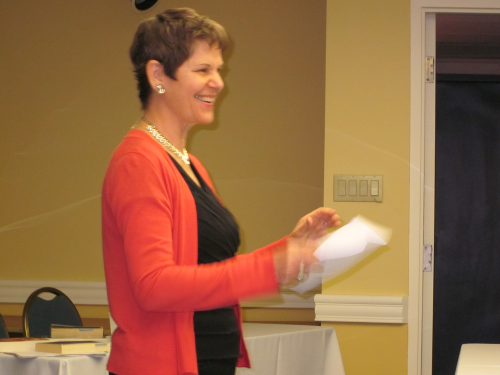
Kim reads with wit and élan, the genesis and process of her work as much a part of her presentation as the poetry.  At several points, she had the audience in stitches, and reached out to specific communities within her fandom (Catholic, fellow teachers, students, family, Irish heritage, etc.) with particular poems.

After Kim’s first set, she invited The Wild Geese of the Sudbury Branch of the ComTheWildGeesehaltas Ceoltoiri Eireann up to perform.  She sang “The Fields of Athenry” with them, her soulful vibrato pulling the tenderness and sorrow out of each verse and chorus.

In the second set, Kim delved into some of the darker moments of the past twelve years.  Then she moved into the process of how she began to reclaim her life and happiness.  She also read one poem that emerged from her recent visit to the Anam Cara Artist’s and Writer’s Retreat.

A second set of music from The Wild Geese followed in which Kim sang “Red is the Rose.”

After a brief but heartfelt thank you, we were released to refreshments, book-purchasing, and the long line-up for the signing.  Kim also made available a family “puffed wheat” recipe for those who’d been clamouring for it 🙂
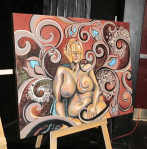
TrishStenbaughArt2I took a few moments to appreciate the backdrop for the event, the evocative art of Trish Stenabaugh, who contributed the cover art for TNM.

In the line-up, I had a chance to chat with a number of friends, Doctors Shannon Hengen and Marilyn Orr from Laurentian University, Karen Baglole, a mutual friend and owner of The Ultimate You, one of the best aesthetician/day spa joints in town, Irene Golas and Vera Constantineau from the Sudbury Writers’ Guild, and some other mutual friends.

By the time I reached Kim with my five copies, I could tell that the wrist cramps were KimSigningsetting in, but she bore up well and continued to smile and share a laugh with her friends throughout.

Several of the attendees have been posting to Facebook since last night that Kim’s event was the Best. Launch. EVAR.  I tend to agree.  Kim puts on a launch like she would a dinner party, inviting us into her world, asking us to make ourselves comfortable, and sharing her life and love generously.  Kim gives us gifts and we are happy to reciprocate.

Bask in the glow, my poetic soul-sista!  Ya done good 🙂

An interview with Kim Fahner

Kim FahnerKim Fahner lives and writes in Sudbury, Ontario, where she teaches English at Marymount Academy.  She had published two books of poems, You Must Imagine the Cold Here (Your Scrivener Press, 1997) and Braille on water (Penumbra Press, 2001).  This new book, The Narcoleptic Madonna, is also being published by Penumbra Press (2012).  Kim is a member of the Writers’ Union of Canada, The League of Canadian Poets, and PEN Canada.  She worked with Timothy Findley through the Humber School for Writers back in the late 1990s.  Most recently, she served on the editorial board of the ezine, terra nord/north.

_______________________________________________________________________

WG: First, hugs and thanks for virtually gracing me with your poetic presence here on Writerly Goodness.  I’m really excited about the launch of The Narcoleptic Madonna on Friday, December 7, 7pm, at Thorneloe University Theatre.

TNM will be your third poetry collection.  Could you comment on how, from the poet’s perspective, your work has evolved from You Must Imagine the Cold Here, through Braille on Water, to TNM?

KF:  If I consider how my work has evolved over the years, since the publication of my first little book of poems in 1997, I find some aspects echo through all three collections, but I also find that I have grown both as a person and as a poet.  This is to be expected.  My early poems were often lengthy, wordy and more narrative in nature.  I still have narrative work, but it might be more of a ‘narrative lyric’ in style and form.  My most recent poems, some unpublished, are purposeful experiments in poetics.  In August of this year, I attended an ekphrastic poetry workshop at the Anam Cara Writers’ and Artists’ Retreat in Eyeries, on the Beara Peninsula, Co. Cork, Ireland.  I had, prior to that, written a few ekphrastic poems, but now I am very enamoured of the genre.  That wonderful retreat was led by Seattle poet, Susan Rich, and attended by poets from around the world.  Since then, I’ve been playing with the idea of persona poems and dabbling more and more in the ekphrastic field.  I’m trying to stretch out in a poetic yoga pose, so to speak.  I want to continue to challenge myself to evolve as a poet.

WG: How or from where do the ideas for your poems come to you?

KF:    I think, as many poets might say, my ideas for poems come from life itself.  I find that I am always observing others.  Poets need to be in the world, but not always of the world, if that makes any sense.  We must hover on the margins, so as to better see how people behave in the world.  I get poetic ideas when I’m walking my dogs.  I find inspiration in nature, something that is prevalent here in Northern Ontario.  I also love to travel and I find that traveling often inspires me to write.

WG: What themes does TNM address?

KF:  This new collection, The Narcoleptic Madonna, seems to have a few key thematic threads running through it.  The most obvious, to me, is that of the idea of journeying to find oneself.  I often find that I must journey outwardly in order to go inside.  By traveling, I journey within myself and uncover new layers of being.  Sounds elitist, but it’s not.  It’s just a heightened awareness of who and what you’re made of, and how you fit into the world around you.  The collection covers poetry that was written over a twelve year period of time.  During the last ten years, I spent a great deal of time taking care of my parents as they became ill and then died.  This was transformative to me, in terms of how I defined myself and how I saw myself.  As a result of that, a number of the poems in NM deal with life, love, death, and the recreation of spirit that comes after death.  It really is a collection that speaks to the phoenix-like quality of life itself.  There are endings, but those endings always seem to spawn new beginnings.  I’m not saying it’s easy to recreate oneself after losing someone you love, but it’s necessary and unavoidable.  That process, of walking someone through the last years of their life, isn’t an easy one, but it did serve as inspiration for poetry and for reflection on lessons learned.  I also spent a great deal of time dealing with depression.  This, too, was a painful, but transformative process for me.  Sometimes you have to hit rock bottom in order to recreate yourself.  That seems to have been part of my process, as a person, and that process is reflected in my work.

WG: I’m a big fan of writing process.  Could you say a few words about your process as a poet?

KF:   I’m not the best at revision.  Usually, when I’m not experimenting with purposeful poetic exercises like ekphrasis or persona, I tend to find that lines discover me!  Usually, when I’m walking, images come to visit.  Sometimes they come to me in dreams, but if I don’t write them down, they disappear.  Other times, when I’m driving through the city on the way to work, I see people and begin to wonder at their lives.  A poem comes to me quickly, in a rush of lines or a first stanza.  Then, I might leave it for a day or so, but whenever I return to it, the poem writes itself in a rush.  I fiddle with it a bit, initially, but then it sits on its own for a few days.  When I return, I slice and dice it a bit, but I’m nowhere near the expert at revision as some of my poet friends are.

WG: Given all of the above, how long did TNM take to come together for you?

KF:  The final part of the collection, its acceptance by publisher John Flood and Penumbra Press, has birthed itself over the last ten months or so.  I had submitted the manuscript to another press, but it was rejected.  Then, I sent the collection to John and he had it for a while.  He emailed me in January or Februrary of 2012 and said he was interested in publishing the work.  I was thrilled.  The last few months, from September onward, has been a time or editing, proofreading and revision.  I love working with John because he has decades of experience in working with poets, so he often sees things in my work that I would rather ignore.  He’ll suggest revisions that, initially, I might resist.  That’s all ego, though, as I always initially feel ‘Oh, I can’t change that….it’s my poem.’  Once I get past the idea of resisting the suggested revision of my work, I always get to a place where I see that his edits are things that make my poems stronger, leaner, and more than what they were before.  I trust him implicitly now and I know he sees my work with more objective eyes.

The actual writing of the manuscript, though, has stretched over a twelve year period.  The topics of the poems vary, but I notice that I am always a keen employer of metaphor in my work.  It’s my favourite poetic device, I am sure!  I think in metaphor on a daily basis, and I know I teach through metaphor as well, so it makes sense that metaphor plays such a key role in my work.

WG: Is there anything else you’d like to share about NM?

KF:   I’m just very excited to have this book come into the world.  My only regret is that my parents aren’t here to share in it.  Without them, without their support, I would never have come this far in my life as a poet.  They were always supportive of my creative sidnarcolepticcovere.  When I decided not to do a PhD in English years ago, in my mid-twenties, because I was worried about what academia would do to my creative work, they were the first to reassure me that I wasn’t making a mistake.  The certainty that they had in my gift, in my talent, was comforting.  I just wish they were still here to see NM arrive in the world.  I think they would have loved it.  It’s dedicated to their memory and I hold them close to my heart.

WG: Thank you for dropping by Writerly Goodness, and for your time and thoughtfulness in sharing these insights.

_______________________________________________________________________

The countdown to Kim’s launch has begun!  In six days she’ll be at Thorneloe University Theatre reading from her brand-spanking new book.  Will you be there?  I certainly will!

Our Lakes Shall Set Us Free – November 6, 2012

A chilly night for a poetry anthology launch, but as several of my Sudbury Writers’ Guild friends were featured in its pages, I couldn’t resist the opportunity to blog the event 🙂

A very well-attended event, as it turned out.  Parking was at a premium at the Living with Lakes Centre of Laurentian University.  With the poetry of 26 of the Northeast’s best and brightest featured, 15 of them reading that night, and with family and friends in tow, the lobby was filled to capacity.

Editor of the anthology, Roger Nash, started off the evening in lieu of publisher Laurence Steven, who was unfortunately ill.  Roger spoke of the anthology’s inception, the contest that generated its content, and how he was able to encourage Margaret Atwood (not having read her Web site and not knowing that she didn’t do such things) to write an introduction for the collection.

The Dean of Humanities and Social Sciences spoke to the interdisciplinary evolution of Laurentian’s programs: students in the sciences may minor in social sciences or humanities, and vice versa.  The Director of the Living with Lakes Centre then offered a few words about his support for the anthology and how the centre is invested in the local arts community.

Then the poets in attendance were invited to come up and read.

Tom Leduc, the contest winner, read his poem “My Northern Lake.”

Mandy Steele, the youngest poet in the anthology, asked her father to read her poem, “White Water.”

Kim Fahner read “Tai Chi on Ramsey,” a poem inspired by fellow writer Rick DeMeulles.

Irene Golas, fellow SWG member, read not only her haiku sequence, “Weekend at a Northern Lake,” but also returned later in the evening to read the tanka sequence of her Breccia collaborator, Ignatius Fay.

Dillon Daveikis recited her poem, “A Lake’s Journey,” from memory.

Rebecca Salazar read “First Alchemy”; Danielle Pitman, “The Dive”; and Dr. Dieter Buse read his poem, “To Children Under Ninety in a City of Lakes.”

Connie Suite read her poem, “Born to Fish” and 90-year old Greg O’Connor asked his daughter to read his poem, “Gone Fishing.”

Christine Poropat read “Pure Dreams” and Rosemarie Mirfield read “World Under.”

The evening came to a close on two more SWG members, Betty Guenette, reading “Poor Minnow,” and Margot Little reading “Shell-Shocked.”

It was a wonderful night of great poetry in a variety of forms.  The anthology is divided into themed grouping of poems: Our Lakes Shall Set Us Free, Voyaging, Taking the Plunge, Gone Fishin’, The Seasons, and Urban Jungle Lakes.

The first printing of the anthology, priced at a reasonable $12, is already almost sold out.

Get yours while they last 🙂

Three bits of Writerly Goodness in October 2012

I’ve been on the road quite a bit this month.  Specifically, from Oct. 16-18, 24-28, and 29-31.  So I hope you’ll forgive the lack of posting.  I did warn you 🙂 Normally, blogging while I’m away isn’t a huge problem, but recently, I’ve been travelling so much that I’m plain exhausted.

I think the cold I caught Thanksgiving Day (here in Canada) is finally going away, but the fact that I got sick at all (first virus in two years) tells me that I’m overdoing it.

So here is the first of two catch-up posts for the month of October.  Tomorrow, I’ll blog on various things that have been happening on the learning mutt side of my life.

We Grow Media’s “Build Your Author Platform” course

I signed up for this in September, having missed the course earlier in the year.  Knowing what a busy few months I’d have ahead of me, I probably should have waited until the next one, but it doesn’t look like things will get much better at work, so ultimately, there was no time like the present … then.

Dan Blank’s course was enlightening with respect to narrowing focus, targeting our ideal audience, and making use of tools like Google Analytics.  The weekly insider calls were productive and encouraged community building within the course.  Unfortunately, these and the specialist calls took place during the day and I couldn’t take part in most of them.

They were recorded, however, and so even though I couldn’t participate in them, I could still reap the benefits of the calls with Joanna Penn, Joel Friedlander, Jeff Goins, and Jane Friedman.  Those calls were worth the cost of the course alone.

I can’t really give much more away without starting to discus the materials in depth and those belong to Dan.  Suffice it to say that while I wasn’t able to participate in October as much as I wanted to, I have the course materials on hand and will make use of them often in the months to come.

Having said that, I think the course is best suited to those with some technical savvy but just getting going, and who also have a product to promote (novel, non-fiction, poetry collection, etc.).  The participants who had no background in social media or blogging whatsoever tended to have greater difficulty, and those like myself, who do not have a recently published work to promote couldn’t necessarily narrow down our focus sufficiently to make the most of Dan’s lessons.

For the former group, I might recommend Dan’s Social Media 101 and Blogging 101 courses offered through Writer’s Digest University.  Links to these can also be found on the We Grow Media site (linked above).

Khara House’s October Submit-O-Rama

I intended to get some submissions done over the course of October anyway, so I thought I’d join in the fun of Khara House’s October submit-o-rama.

The challenges varied from three submissions per week, through to a submission every day of the month, to the alpha-challenge in which you’d do the same but submit to magazines, contests, and journals in alphabetical order.  There was also a name game challenge to submit to publishers according to the letters of your name, and a create your own challenge.

I chose the last and settled on one submission a week.  I cheaped out, I know, but I honestly couldn’t manage more.  Anticipating the travelling I’d have to do in the latter half of the month, I submitted twice in the first two weeks and then decided I’d try, but not kill myself, for the remainder of the month.  That way, I met my challenge and didn’t overwhelm myself further.

I’ve received one rejection so far and the remaining ones are still up in the air.  Fortunately, my rejection included a request for other material, so I’m looking at it as a positive.

Khara had forums up on her site: Our Lost Jungle (linked above) as well as an event page on Facebook.  There were a handful of dedicated but insane writers (my opinion only) who managed 31 submissions in the month through various challenges.  Kudos to them!  They worked so hard and I’m sure they’ll be reaping the rewards for some time to come.

Now most of them are onto the November challenges of NaNoWriMo (national novel writers month) and PAD (poem a day).  I wish them the best and am sure that they will do smashingly!  And of course, our dear Khara deserves praise for putting everything together and giving everyone the kick in the pants they needed to get their work out there!

New York Comes to Niagara

I wanted to attend this conference last year, but ended up not being able to due to work commitments.  So when the conference Web site announced that applications were being accepted, I jumped on board.

NYCtN is an Algonkian pitch conference and writers first have to apply, submitting a short synopsis and writing sample before they are accepted and able to register.  When I made it through that stage, I immediately registered and booked my hotel room. 

Then came the 88-page guide and half a dozen emails with accompanying assignments.  My work was set out for me.

Now I have to make something clear.  My goal in going the conference was just to find out what the heck a pitch conference was, how it worked.  I’m an experiential learner and sometimes reading about something just doesn’t cut it.  So again, to be clear: I had no expectations.  I fully expected to have every agent and editor in the place reject me out of hand.

And I went prepared for that outcome.  This is not to say that I wrote anything but the best pitch I was capable of or that I blew off any of the assignments.  I’m a keener.  That would be impossible.  I just wasn’t pinning my hopes or self worth on the result of the conference.

Until it started.

Once the first pitch panel took place, which I, keener that I am, volunteered for, I was caught up in the hype.  I forgot about my humble goal and suddenly, I felt the pressure to sell.  It didn’t help that I was told in no uncertain terms that my novel was dead in the water and that traditional fantasy of any variety wouldn’t sell to anyone.

Nor was it particularly useful that I was advised to either throw out my created world and place the story in a historical setting (not my novel), or failing that, that I should set aside Initiate of Stone and focus on a more commercial project until my money-making capacity could be well-established and that I could then bring out the snoozer and rely on my reputation to coast me through what would surely be a slump in my writing career.

Please note: this was my interpretation of the advice, not the actual advice given.  You’ll understand if I wasn’t particularly clear-headed about it.

I lived in that illusory and completely self-induced angst for two days until, thanks to a friend, I remembered why I came to the pitch conference in the first place.

I revised my pitch but did not alter my project and I was true to my original intention and to IoS.  I pitched it and received some positive response.  Then I had to disappoint (seriously, the worst thing I can do to anyone in my book and pure torture for me) the person who had done everything in his power to guide me in the direction of success.

Here’s what I learned:

  • A pitch conference is all about the commercial viability of the pitch and its ability to obtain the interest of an agent or editor.  You have to back your pitch up of course, but the only thing that anyone will hear at the conference is your pitch.  For all intents and purposes, your novel might as well not exist.
  • It’s best not to bring only one idea/pitch, and if for one reason or another you only have one, you can’t be invested in it.  If you are, then a pitch conference may not be your best bet.  There are often opportunities to have your pitch critiqued before the pitch session opens.  If one idea doesn’t pass muster, keep pulling them out and throwing them against the wall until something sticks.
  • It’s common to pitch an idea for a novel that you haven’t written yet.  So long as you have the time and dedication to bang it out, this is acceptable, even expected.  I might go so far as to suggest that it’s a good idea to have your novel ideas plotted out and maybe even a few key scenes written, but that you may need to be flexible enough to accept suggestions that will drastically alter your novel.  This is harder to do with a project that you’ve invested months or years in writing.
  • If you’re like me, and reading these pieces of advice isn’t really enough, if you have to experience a pitch conference for yourself and you only have one project, one you’ve invested time in and are attached to, then stay true to your intent and be prepared to hear some things that you won’t want to accept.  Keep in mind that these things are going to be said to you with the best of intentions: to make you a viable career author.  If you’re not ready for that, so long as you understand that and keep all the excellent advice you receive in mind, you’ll be fine.

One way or the other, you and your work will emerge stronger on the other side.

Algonkian conferences have helped many writers achieve success.  Just visit their site and read the testimonials.  It’s a great opportunity that if you’re ready for, you shouldn’t pass up.

Besides, you usually get excellent advice outside the pitch panels and sessions as well.  In this case, Barbara Kyle delivered several sessions on plot and structure and Amy and Duncan McKenzie delivered an informative and entertaining session on improvisational techniques.

I even got some sight-seeing in 🙂

I highly recommend attending an Algonkian conference, or any pitch conference, and found it had the potential to be profoundly life-changing.

Writerly Goodness, signing off 🙂

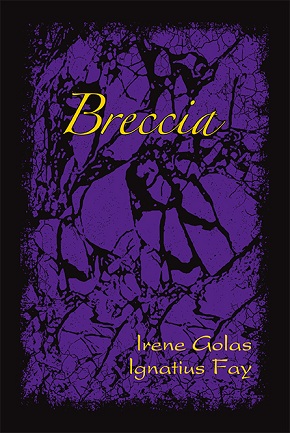
Breccia: An interview with Ignatius Fay and Irene Golas

Irene Golas discovered the world of haiku when she purchased a slender volume of Japanese nature poetry in a gift shop in Elmvale, Ontario. She was immediately drawn to the brevity and concision of the haiku form. Her first haiku were published in 2005, followed by her first tanka in 2006.

Ignatius Fay is a retired invertebrate paleontologist who began writing haiku and related forms of poetry primarily for his own pleasure and as a means of personal expression. His first published poem appeared in 2008, the same year he published a small book of haiku/senryu, Haiga Moments: pens and lens, with photographs by Ray Belcourt, of Leduc, Alberta. In 2011, he published Points In Between, an anecdotal history of his early years.

Irene and Ignatius have been published in many print and online journals, including Acorn, Eucalypt, Frogpond, and The Heron’s Nest. Irene’s poems have also been chosen for a number of anthologies. Both authors reside in Sudbury, Ontario.

___________________________________________________________________________

WG: How long have the two of you been working together?

Irene: I’d known about Ignatius since 2008, but it took me a while to find any contact information. I emailed him in the summer of 2010, asking if he’d be interested in corresponding about the art and craft of haiku. There aren’t many haiku poets in town! At first we talked in general terms about books, haiku and other poetry. Soon we were exchanging haiku books and journals and some of our unpublished work. By the fall of 2011, we had developed a mutual trust and a respect for the other’s judgment. This is when the idea of a collaborative publication first came up.

Ignatius: Irene and I are alike in that we are straightforward when asked an opinion. Our intent is always positive, to help each other become better poets. I don’t think a collaboration would have worked had we not first gone through this process.

WG: Whose idea was Breccia? When did you actually begin work on it?

Ignatius: I suggested we consider doing something jointly. After toying with the idea for a time, we got down to it in January 2012.

Irene: We were ready to prepare the manuscript for publication by the end of July. Since then we’ve spent good chunks of time writing promotional material and otherwise spreading the word about Breccia.

WG: By the way, who came up with the name, Breccia? What is its significance?

Ignatius: Irene suggested the title. She was unfamiliar with the term when she read it in one of my poems. I was referring to the Sudbury Breccia, a rock formation that is part of the Sudbury Basin. Both the basin and the breccia were formed by an asteroid impact about 1.85 billion years ago. The nickel-iron-copper ore bodies of the Sudbury area are all associated with this rock.

A breccia is made up of fragments of preexisting rock that have been re-cemented. By analogy, our collection may be considered a haiku ‘breccia,’ poems from two sources cemented together to form a unique whole.

Irene: When Ignatius sent me his manuscript, there were a few poems about his childhood in Levack. They shone a light on a way of life that was unique. It occurred to me that the Sudbury area should have a larger presence in our book. Sudbury is our home, after all, and has shaped our lives in so many ways. I encouraged Ignatius to write more. He did, expanding his focus to include details of miners’ lives and the changing face of Sudbury. I added several of my own and soon we had a ‘Sudbury Breccia’ section.

WG: This type of collection is rather rare in that it is a collaboration and in the way your poems are intermingled. What made you decide on this format?

Ignatius: Our original intention was to put together a small collection of selected and new haiku and senryu. A poem had to satisfy us both to make the cut. A fair number of poems were edited or rewritten.  We ended up with more good poems than expected. Then we complicated matters by deciding to include tanka and haibun.

Irene: At the same time, we began to discuss layout. We wanted Breccia to be a true collaboration rather than a joint publication with two sections, one for his poems, one for mine. We also wanted something different from the traditional grouping by season, something with a more organic feel. Eventually we decided to integrate our poems, creating several extended sequences in which each poem suggests some relationship to the immediately preceding poem.

WG: Breccia is 208 pages long. That’s a lot of poetry. Did you find the sequencing difficult? How long did it take?

Irene: Sequencing turned out to be the longest part of the process. And the most satisfying. We spent hours trying to get short bits of sequence to feel right, then emailed it to the other. Often the response brought suggested changes. Occasionally, emails passed each other in cyberspace and we found we had very different ideas for the next part of the sequence. This process alone took more than two months.

WG: How did you like the experience of collaboration?

Ignatius: Delightful. We’re a good match. Sure, there was lots of hard work, but we work well together. We share an interest in the English language and a commitment to our art.

Irene is an extremely efficient editor…far better than I. She has such patience and attention to detail. Many of my poems have benefited from her insights. She is straightforward in her criticism, encouraging growth. And she doesn’t hesitate to praise something I’ve written that she likes.

Irene: We both look for honest assessment of our work. We strive for improvement, which includes acknowledging a weakness in our poetry when it is pointed out and being open to editorial suggestions.

WG: Why did you choose to self-publish Breccia?

Irene: We both got the same story when we looked into traditional publishing. Finding a publisher for your first book can be a long, drawn-out process. Then it may take a couple of years for the book to appear. Our biggest concern was getting our work out there. And Ignatius had some experience with the process, which is becoming increasingly popular.

Ignatius: Another problem with using a traditional publisher is the need to travel and do personal appearances to promote the book. My inability to do that lowers our prospects significantly.

WG: This was a strictly do-it-yourself project. Did the two of you also design the cover and do the layout?

Irene: Yes, we did everything. From the beginning, we agreed we wanted this to be 100% our project. But I have to give credit to Ignatius for carrying the weight when it came to the actual layout and other aspects of desktop publishing. He’s been in graphic layout and design for 22 years.

WG: What was the most difficult part of publishing Breccia?

Irene:  Definitely the promotional writing. First we had to distill the essence of what Breccia is about – a slow process. Then we had to present that essence – sell it, really – in a catchy way, often in a hundred words or less. Too often we found ourselves reverting to a dense academic style of writing, or reaching for clichés.

Another challenge was reworking this material into different packages – a flyer, a press release, and at least half a dozen blurbs. To avoid sending out carbon copies, we had to rephrase, augment, emphasize or completely delete things from one piece to the next. A case of “how many ways can you serve hamburger?”

Ignatius: For me, the most difficult part was not being able to work regularly with Irene in person. Face-to-face, so much more can be accomplished in a short time. But my health and Irene’s other obligations were limiting factors.

Thank goodness for email! Much of the work was done through the back and forth of emails. It could be frustrating, waiting for a response or trying to iron out a miscommunication, but it allowed us to proceed. We may never have completed the project without it.

_______________________________________________________________________

You can purchase Breccia on Lulu.

Related articles:

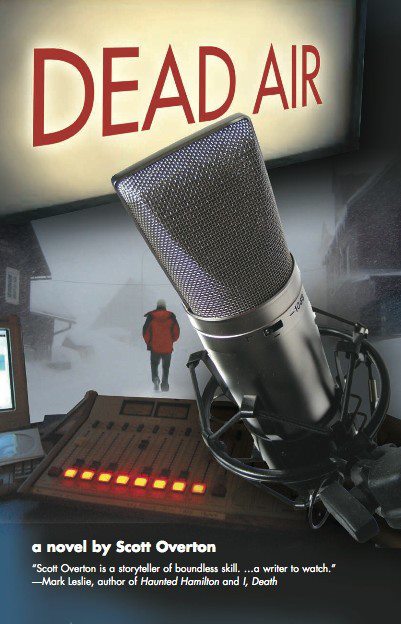
Shivering yet? Seasonal chill? No, it’s just Dead Air

An interview with Scott Overton.

Scott Overton is a radio morning man on Rewind 103.9 FM in Ontario, Canada, who blames his off-kilter perspective on years of lost sleep from waking at 4:00am. His short fiction has been published in magazines including On Spec and Neo-opsis, and the anthologies Tesseracts Sixteen, and Canadian Tales of the Fantastic, among others. His first novel Dead Air (a mystery/thriller) is now available from Scrivener Press, while several SF novels are looking for good homes in the publishing industry. When not writing, Scott’s passions include scuba diving and a couple of collector cars, in which he hopes to someday find enough story inspiration to make them tax deductible.

Scott’s webpage is www.scottoverton.ca

An interview with Scott Overton.

Scott Overton is a radio morning man on Rewind 103.9 FM in Ontario, Canada, who blames his off-kilter perspective on years of lost sleep from waking at 4:00am. His short fiction has been published in magazines including On Spec and Neo-opsis, and the anthologies Tesseracts Sixteen, and Canadian Tales of the Fantastic, among others. His first novel Dead Air (a mystery/thriller) is now available from Scrivener Press, while several SF novels are looking for good homes in the publishing industry. When not writing, Scott’s passions include scuba diving and a couple of collector cars, in which he hopes to someday find enough story inspiration to make them tax deductible.

Scott’s webpage is www.scottoverton.ca

_______________________________________________________________________

Thank you, Scott, for taking the time to visit Writerly Goodness in advance of Dead Air’s launch on October 11, 2012 (Living with Lakes Centre, Laurentian University – be there or be … oblong).  I’m very pleased to have you with me, if virtually.

WG: For those of my readers who may not know what your novel is about, could you give them a brief synopsis?

Scott: Sure. It’s about a radio morning man named Lee Garrett who makes a joke on the radio about a neo-Nazi gang and a few days later he finds a death threat left for him. Then a series of incidents of mischief and vandalism turns into outright attempts on his life. Someone wants him dead, and he doesn’t know who or why.

WG: Where did the idea for Dead Air come from?

Scott: I’m a morning radio broadcaster myself, and I was struck by the vulnerability of even small-scale celebrities. People think they know us, but we don’t know them. And it’s very easy to make an enemy without meaning to, or even knowing that you have. I also wanted to explore how an ordinary person would try to cope with such a devastating threat (as opposed to some Hollywood hero who’d just get a gun and blow the bad guys away).

WG: Writing process is a personal interest of mine.  Would you be able to speak to your process in writing Dead Air?

Scott: It took at least five years to write the first version of Dead Air because I was working full-time and was involved in quite a bit of charity work. I worked on it whenever I could: evenings, weekends, and vacation time, but was impossible for me to stick to a routine because of my other commitments. Fortunately I have an upstairs room that became my study and interruptions were discouraged (even when I was hogging the family’s only computer!)

My writing habits are better now, though I still can’t tolerate any distractions or listen to music. I don’t know how writers can do that and still feel the rhythm of their words.

WG: Dead Air is a thriller, but you’ve had a fair amount of recent publishing success in another genre.  If readers would like to find more of your work, where would they look?

Scott: Everything else I’ve written would be considered science fiction or fantasy, though often with thriller elements. I’ve been fortunate to have seven short stories published and, as a Canadian, I’m particularly proud to have been published in the two top Canadian SF magazines, On Spec (twice) and Neo-opsis, as well as the quintessential Canadian SF anthology series, Tesseracts (I have a story in the latest edition, Tesseracts Sixteen). So I feel like that’s the Triple Crown of SF in our country. Now I really hope I can get my SF novels published.

WG: How did you first start writing?

Scott: I’ve been writing stories ever since I was a child, and briefly tried to write full-time in my twenties, but couldn’t stick with it long enough to break in. I’ve always been determined to become a published author, so when I came up with the concept for Dead Air I just went for it, and I’ve been writing consistently ever since.

WG: Getting back to Dead Air, how did you get your contract with Laurence Steven of Your Scrivener Press?

Scott: I’ve always had a lot of respect for the quality of the manuscripts he chooses and the books he produces. My friend and mentor, Sudbury author Sean Costello, spoke highly of his own experience working with Laurence. Scrivener Press is also a recommender for the Ontario Arts Council’s Writers Reserve grants. I applied for a grant to rewrite Dead Air, Laurence recommended it to the OAC, and when the MS was ready I submitted it to Laurence. I didn’t get his answer for about six months, but he says that was because he was trying to work out the timing of the publication. He’s a busy guy.

WG: Finally, aside from your launch on October 11, are there any other upcoming events you’d like to promote, and where can readers purchase your book?

Scott: I’m sure I’ll be doing more readings and book signings at Chapters and places like that, but nothing has been scheduled yet. The book is available directly from Scrivener Press (though the web site’s a little behind on the direct purchase linkage), and I understand it’s now in stock at Chapters in Sudbury and likely Coles, too. Online it can be ordered through Amazon and Chapters-Indigo.

Scott, thanks for joining me 🙂

________________________________________________________________________

Don’t miss the launch of Scott Overton’s thriller Dead Air! Thursday, October 11, 2012, at the Vale Living with Lakes Centre, 6:30-9:30 pm: free admission and refreshments. (Scott will be reading from the book at 8 pm.) More info at http://www.scrivenerpress.com/default.asp?id=580


My Journey to the Misty Lands – Guest blog post by John Rice

John William Rice (1942-) was born in Iroquois Falls Ontario to parents of Scots/Irish/Welsh ancestry, spent his public school years in Charlton Ontario, and quit school after completing grade eight. In the spring of 1968, he returned to school under a government upgrading program, completed high school and studied electronics at Northern College of applied arts and technology where he earned the nick name, “The Whisky Poet.”

After graduating in 1971, he began a 34-year career as an instrument technician at International Nickel Company. Along the way, he married and fathered two sons. His wife Patty died from cancer in 2003. John retired in 2005 and after completing a book of verse, From the Heights to the Enchanted Places, he plunged head first into his fantasy novel, Keeper of the Sword.

John lives and writes in Sudbury, Ontario and can be reached on twitter, @keeperofthsword, on Facebook, and on his blog.

My Journey to the Misty Lands

I lie on my bed, let Return of the King, the last volume of Lord of the Rings drop from my hands, and close my eyes. My mind drifts far away from my small room in the Piccadilly Hotel, far away from Vancouver, and far away from my job as a sheet metal helper at Humble Manufacturing, to Middle earth, where I march with Frodo and Sam toward Mount Doom.

The sounds of feet shuffling outside my door bring me back to harsh reality. I prop myself up on the pillow, rummage around in the rickety dresser drawer for a pen and scribbler, and write, “Keeper of the Sword” across the top of the page. Images of a completed epic poem dance through my mind and I bend all my thoughts to the first word, the first line, but nothing comes. I struggle for a while, still nothing comes, and it seems my muse, such as it is, eludes me once more. “Someday,” I whisper, “Someday I’ll write it.”

I put my writing utensils away, snuggle under thin blankets and let my mind drift over towering mountains, across the endless prairie, through the rugged Cambrian Shield, to the village of Charlton Ontario, to the house where my sister, mom, and dad live. For a moment, I wish I was there, instead of in this city by the sea, thousands of miles away.

I kick the homesickness out of my mind, and go back, back into my past, back to my first attempts at writing verse. I remember finding a love poem my brother wrote for some high school girl, remember thinking if he can write poems than I can write a song.

I remember the name of the piece, “There once was a horse named General Jim,” but little else of my first plunge into writing, and most of all I remember sending it away to an address I found in Popular Mechanics, to a person that promised to turn it into a hit record.

Days, each one seeming like a year, passed while I waited for my first of many checks, and at last one day after school, my mom handed me an envelope. I took a deep breath, and taking care not to damage the contents tore it open. A piece of folded paper fluttered to the floor. I bent over, scooped it up, and unfolded it. “We don’t think this subject matter is suitable to become a commercial song,” burned into my eyes.

“What’s wrong,” mom asked.

I turned away, hiding my tears, hiding my disappointment.

For years I never wrote another thing, but at last my bitter disappointment slipped deep into my mind. One day a cousin of mine wanted to know if I had any songs he could sing to the girl he was courting, and over a couple of hours I managed to write a piece he liked. This adventure sparked a creative flurry and dozens of lyrics tumbled out of my mind onto paper.

My alarm clock’s strident ring drags me out of my dream of home and to the reality of a new workday.

Forty-six years have come and gone since I first read Lord of the Rings in that small dingy room, since I first came up with the title, “Keeper of the Sword.” Over those years, I’ve completed high school, completed two years of electronics at Northern College of Applied arts and Technology, worked thirty-four years as an Instrument Technician, fathered two amazing sons, and lost my wife to cancer.

During that span I had periodic spurts of writing verse, most notably while attending college, where I earned the name, “The Whiskey Poet.” Of course I didn’t deserve the title because at that time of my life I could only afford to drink beer.

While at northern college I believe I let an opportunity slip away, an opportunity that might have changed my life in a dramatic way.

I always sat with my peers from my Man Power retraining days, where I completed high school, for lunch, and often wrote poetry during the hour-and-a-half. One day our English teacher joined us and asked if he could see the poem I was working on. I finished the last line, and handed it to him with a degree of trepidation.

He took several minutes to read the short poem, nodding several times. He handed the poem back and said, “Not bad, as a matter of fact it’s quite good. I know someone in Toronto that might be able to help you, but before I put you in contact with him, I want you to learn ten new words every day for two weeks. You not only have to be able to spell them, but you need to be able to use them correctly in a sentence.”

I folded up my poem, “Waiting,” and placed it in the binder.

As the years have speed by on the one way train of time I’ve often wondered what my life would have been like if I’d taken his advice, but I preferred to spend time in the bar with friends instead of taking the time to improve my vocabulary.

The dream of becoming a writer and completing at least one novel has always lingered in the deep recesses of my mind, and in the winter of 2007, I decided it was time to make my dream come true. I started off by attempting to write a play. About half way through, “Music Box Dancers,” the concept for another play, “I taught a Mocking Bird to Sing,” came to me.

After completing two plays, and feeling confident, I wrote several short stories, a book of poems, and remembering that title from long ago, I plunged into Keeper of the Sword.

I still live and write in Sudbury.

_____________________________________________________________

And here is a free excerpt from John’s novel:

In the beginning


Morgan Connelly, stunned, unable to move for the moment, feeling a warm wetness dripping down her skin, fluttered violet eyes open and stared at the growing red stains on her blouse, the amber feathers attached to a long slender egg yolk colored piece of wood jutting out from under her collarbone, and whimpered, “Josh. Josh. Josh. Help meeee.”


Something crashed to her right, and screams sounding like a cat in pain filled the air around her.

_____________________________________________________________

To read more of Keeper of the Sword visit John’s blog, tweet him @keeperofthsword, or friend him on Facebook.  His novel is available on Smashwords, on Kobo, or on Amazon.

LUminaries: The Power of Popular Fiction

On October 4, 2012, I attended the first of Laurentian University’s new season of the LUminaries readings series, held at the Living with Lakes Centre (LwLC).  The theme of the evening was the power of popular fiction, with authors John Forrest, Scott Overton, and Mark Leslie.

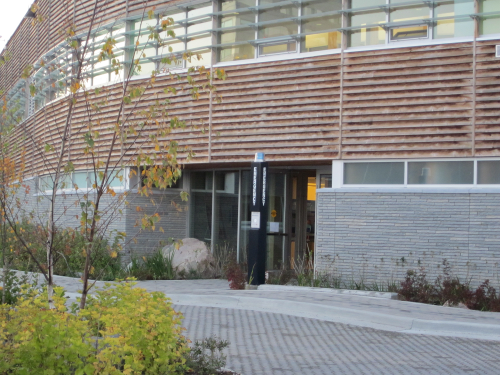
The first thing to note is that the LwLC is beautiful.  It was built with the landscape and the environment in mind, using a lot of natural or reclaimed materials, a green roof, and wonderful views of Ramsey Lake on the shores of which the centre stands.

The parking was a bit of an issue and I understand the reasons for this.  The builders wanted to encourage a more environmentally sustainable mode of travel, such as walking, cycling, or public transit.  Sadly, this would only work for individuals who work and/or live in the immediate university area.  The room in which the reading was held has a capacity of about 60 I believe.  There’s no way the cars of 60 attendees could fit into that wee parking lot.

This is unfortunate, because it makes the site unattractive for larger events where attendees from off-campus might want to participate in numbers.

This year’s LUminaries was co-sponsored by the English department, through Laurence Steven, the big squishy brain behind Your Scrivener Press, and by the English Arts Club, who are also behind the university’s new literary journal, Sulphur.   

The evening began with a meet and greet/author signing session out in the foyer of the centre.  I decided to hold off on picking up one of Scott’s books until his official launch this coming Thursday, October 11, 2012, at 8 pm (also at the LwLC).  I picked up Tesseracts 16, however, and Mark Leslie’s Haunted Hamilton.  I chatted up the authors, including John Forrest, but I must confess to selling Mr. Forrest short.  The books he had for sale were of Christmas stories and I wasn’t interested or yet in the mood for Christmas.

Laurence Steven began the reading more formally with a brief talk on popular fiction, its attraction, and its denigration in the literary/academic community.  Then he called John Forrest to the podium.

John was an educator and principal in his past career, but then turned his considerable talents to writing.  One of his claims to fame is that he’s had eleven stories published in various Chicken Soup for the Soul anthologies, three in the one about hockey.  That’s what he started with, his recounting of the ’72 Summit Series from the perspective of a young teacher working the sporting event into his teaching unit.

He then read part of a story from his story collection entitled Home for Christmas, about a WWII bomber tail gunner and his struggle to get home for Christmas.  Finally, he pulled out his first published short story, a humorous tale about purchasing condoms pending his vasectomy.

John’s first Christmas short story collection, published by YSP last year, has gone into three printings and was sold in Home Hardware stores as well as online and in book stores.  Home for Christmas has already sold out its first printing even though it hasn’t formally been launched yet!  John was dropping off boxes of his book to a couple of the local Home Hardware stores this week, so look for them in the Christmas home decor section.

Next, Scott Overton took the podium, and read three excerpts from his new novel Dead Air.  Without giving too much away, because I am going to blogging more about Scott in the next week or so, his novel is a thriller about a morning radio host in northern Ontario who has a strange dispute with a caller to his morning show and subsequently finds a hand-written threat on his desk.

Several possible love-interests, a snow mobile chase, and car trouble on a cold and stormy night are among the thrills in Dead Air.

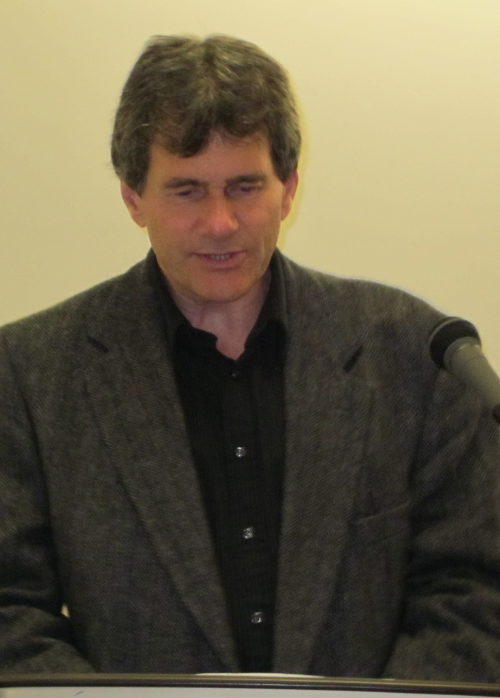
Then Mark Leslie read a humorous horror story about what it might really be like to be Frosty the Snowman and some of his poetry from his collection One Hand Screaming.  He also spoke about his experience at editor for Tesseracts 16.  He’s never cracked the anthology as a writer, but lost his “Tesseracts” virginity at 16 🙂

As you can see from the picture, Mark is a very animated presenter and performer, changing his voice for the various characters in his stories.

At that point, there was an intermission after which there was to be a Q&A session.  Unfortunately, it was what I like to call a “school night” and I had to get home to complete my interview responses for Brian Braden and Underground Book Reviews and then get to bed so I would be marginally coherent at work on Friday.

I’m sure it was a fantastic second half and I’m sorry I had to leave.

If anyone who was there would care to fill in the blanks in the comment section, please do so!

100 thousand poets for change in North Bay, September 29, 2012

Please note: this post originally appeared as a guest post on John Rice’s Keeper of the Sword blog on October 3, 2012.

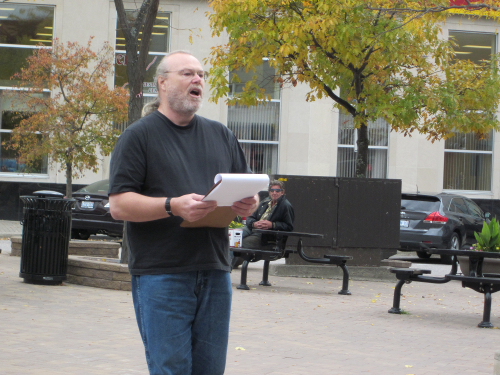
It was a grey autumn day when I set off for North Bay.  Then I picked up Kim Fahner, and the journey became a poetic road trip of epic proportions 🙂  Talked craft, poetry, fiction, blogging, social media, and Doctor Who!

Kim brought me back a gift from her recent trip to Ireland: Leanne O’Sullivan’s Cailleach: The Hag of Beara.  Lovely book.  Saving it for the weekend 🙂
The drive was blessedly uneventful and we arrived early enough to have lunch before the event started.

On the way back to the park for the reading, we were greeted by Father Forrest.  The White Water Gallery’s Youth Arts Initiative created puppets this summer.

Father Forrest was one of them and he stopped by the reading later on in the afternoon.

We walked on to the park where the poets and audience were already gathered.

Though the organizers, Kevin smith and Natalie Wilson had brought a PA system there wasn’t an outlet to power it.

Still, Kevin introduced the event and got underway promptly, explaining a little of the background of 100 Thousand Poets for Change.

100 Thousand Poets for Change was initially conceived by Michael Rothenberg and Terri Carrion in March, 2011, as a worldwide set of events to take place simultaneously on September 24, 2011. Literary event organizers volunteered to host associated events in their own cities or schools. ~Wikipedia

The first reader of the North Bay event was Laurie Kruk, professor at Nipissing University and author of Theories of the World, Loving the Alien, and the soon to be released, My Mother Never Told Stories.

She read several selections from her new book of poetry.

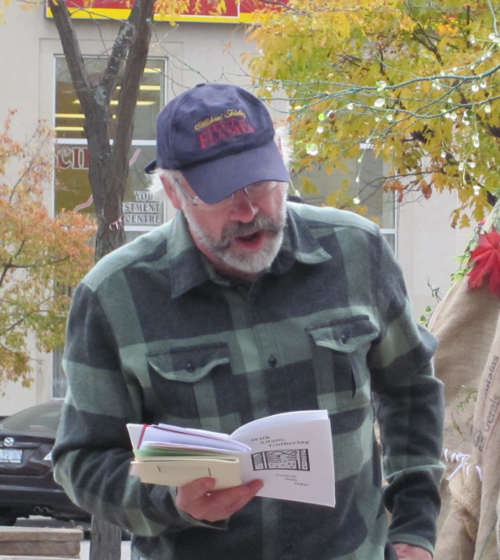
I was the next poet to read and only chose a couple of poems: “Manitou Sky” and Relatively Speaking.”

I started my set with a post on Jezebel regarding a Sikh woman and her response to what seemed a malicious picture posted as a critique on her appearance.  It was my way of commenting on how social media can be an avenue for positive change.

I finished my reading by offering some advice from Kristen Lamb in this season of political frenzy on how writers really change the world.

Following my set was Tim Robertson, poet and aphorist, that is, writer of aphorisms.

He started the session with a series of witticisms and then read a couple of his longer poems.

After Tim’s reading was a brief intermission where poets mingled and chatted.  I took a few moments to reacquaint myself with Natalie, with whom I’d contributed to NEOVerse, and Laurie, with whom I’d read on several occasions during my more active poet years.

The second half of the afternoon session began with Christine Charette, artist and poet.  Father Forrest visited at this point and remained around for her set.

Christine’s poetry has as its heart the issues of womanhood and motherhood and it did speak to the theme of change.

Denis Stokes read next.  He’s taught English in high school and at Nipissing University, and published poetry in print and online.  Denis’s poetry was definitely the poetry of Northern Ontario, evocative of its sights and sounds in the context of family and change.

Then Doyali Farah Islam took the stage, er, cobblestones 🙂  She published her first book of poetry, Yusuf and the Lotus Flower, in October of 2011.

Doyali is definitely influenced by Rumi, and her poetry brought a bit of the sacred to the assembly.

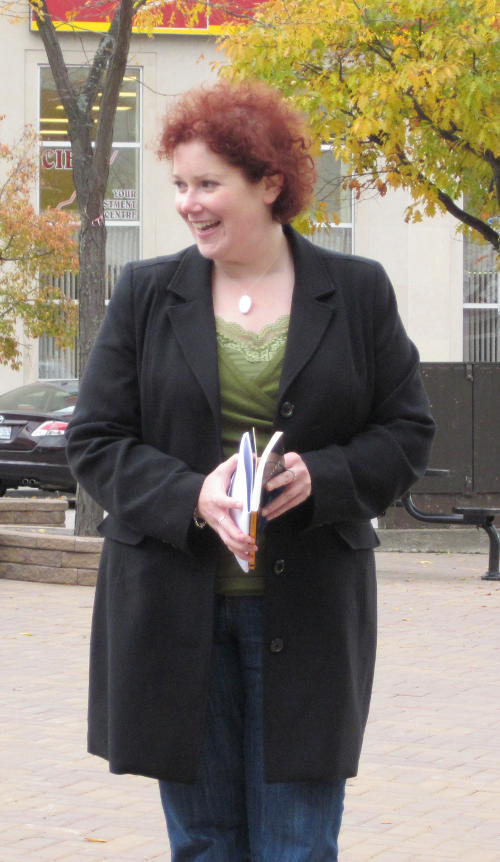
The last poet of the afternoon session was my friend, Kim Fahner, English teacher, and author of You must imagine the cold here and Braille on water.  Her new book of poetry, The Narcoleptic Madonna is due out this fall.

Kim is a great reader who interacts with her audience with humour and self-conscious grace.  Kim read from her new work.

Afterward, the poets mingled again.  Business cards and books were exchanged.  Though there was an evening session where Ken Stange, Kevin, and Natalie would be reading, Kim and I had to toddle off.  Nonetheless, I understand the evening reading at the Cornerstone Cafe was a great one, and the North Bay edition of the 100 thousand poets for change event a success.

And then, after a fortifying pumpkin spice chai latte at Twiggs, we were on the road again, chatting more about the day, poetry, creativity, and again, the fabulous Dr. who 🙂  David Tennant is one of Kim’s secret husbands, don’t you know.
The day ended with a lovely supper at Verdiccio’s where I had the chance to use the coupon I’d won on Facebook this summer.

All was ‘write’ with the world 🙂

For more information, please see the 100 Thousand Poets for Change North Bay Facebook page, or the Web page, graciously hosted by Ken Stange.

CanWrite! The Canadian Authors Association 2011 Conference

May 2-6, 2011.

Yes, I finally did it.  I managed to do something entirely nourishing to my writer’s soul.

I’d determined that I wanted to go to at least one conference week-long workshop last year and when the announcement went out in November 2010, I signed up right away.  Barbara Kyle, one of the workshop presenters, was also offering 20-page critiques for a nominal fee.  Again, I was in.

My next challenge was how to pay for the venture.  I applied for a Northern Arts Grant for professional development from the Ontario Arts Council, but was not accepted.  So, credit it was.  As far as conferences go, the CAA conference wasn’t expensive.  Even with my day job, I don’t make enough money to drop a thou and not feel it.  Still, it was time and long past that I made a substantial investment in my creative self.

Throughout February, March, and April the CAA conference organizers held little writing contests to get participants in the creative frame of mind.  I submitted to two of the three and though I didn’t even manage an honourable mention, they were interesting exercises and did serve to build a lovely feeling of anticipation.

I made my leave request at work as soon as I could, but operational requirements made it seems unlikely that it would be approved.  As the date of the conference approached, I began to worry that I’d have to withdraw.

Then my father passed away, April 9, 2011 and thoughts of the conference vanished.  For the week previous, Mom, a family friend, and I took turns watching vigil.  Dad had originally gone into the hospital March 18, 2010, and though he never recovered sufficiently to come home, his final illness and his ensuing struggle were completely unexpected.  Needless to say, Mom and I were devastated.

To paraphrase Forrest Gump: that’s all I have to say about that.

In the dizzying days following, my leave was miraculously approved.  Now the conference had a second purpose: I needed to get away and do something that did not involve Dad, his funeral arrangements, or my mom’s uncertain financial situation, all of which were consuming my life in large, ragged mouthfuls.

The drive to Grand Bend from Sudbury, though long, was relaxing.  There’s some beautiful country in Bruce and Gray counties, and now, there are lovely windmills and solar panels dotting the landscape.  I don’t understand the public resistance to wind and solar.  They’re some of the cleanest, greenest sources of energy around, and I didn’t find them ugly at all.  I rather thought them graceful, alien guardians, standing sentinel over the people and the land.  In any case, I arrived at the Pinedale Motor Inn in time for the evening meet and greet, and welcome barbeque.

I discovered that that year’s conference was a departure from previous years.  It was set up as a writers’ retreat with workshops and events, but with the afternoons off to enjoy the town and to write.  No maddened dash to attend competing workshops, this.  Never having attended any conference before, I didn’t have anything to compare it to, but it seemed like exactly what I needed.

I won a bottle of wine in a raffle.  We were off to a good start

The first workshop presenter was Sandy Plewis.  Her session was highly interactive with lots of writing exercises, but she depended heavily on secondary sources in her lectures.  She seemed pleasantly surprised at the willingness of the conference attendees to dig deep and write.  There was not a still pen in the house when it came time to complete an exercise.

Then came time for my critique with Barbara Kyle.

Globally, she was complementary.  My characters were interesting, their conflicts dynamic and immediate, but then, as the critique commenced, the shortcomings emerged: the pacing was too fast, my scenes lacked a sense of place, and I didn’t go deep enough into my characters’ hearts and minds.  And I was too subtle.  While I got a lot of good advice from Barbara, by the end of it, I was dizzy, hardly able to breathe.  I think it was a panic attack.  I wasn’t able to think about things clearly until much later in the day.

Barbara’s workshops, one based on The Writer’s Journey by Christopher Vogler, and the other on her own experiences as a first draft survivor, were illuminating.  Though not heavy on the writing, they were professional, and informative.  I had a revelation.

I’d read Vogler’s book, and its inspiration, Joseph Campbell’s The Hero’s Journey.  The guardian at the gates has been a repeated part of my development as a writer, and my past experiences with those guardians informed my inner critic, the biggest, baddest guardian of them all.  That’s what happened in the critique session.  Though intellectually, I knew that Barbara was giving me exactly what I needed to head into the next revision of my novel, to make it stronger, and better, emotionally, every negative that emerged seemed a confirmation of my worthlessness.

So … I confessed.  Spastically and awkwardly–which is the only way I can confess the deeply embarrassing–I told everyone about my struggle.

That afternoon, Lightning Strikes, a series of mini-workshops, took place, and in the evening, at the Mock Awards Ceremony, I received the “Best Attempt to Make Us Cry” award.

Even the annual general meeting was interesting.  As a professional member, I had a vote.

Overall, the CAA conference was a very rewarding experience, and one I hope to repeat.

Conferences can be fertile experiences.  Have you made a breakthrough at one?  New friends?  Networked connections?