Friday evening keynote: Zsuzsi Gartner

Last year, Zsuzsi decided to conduct a radical experiment.  She went off-line, not only withdrawing from social media, but also online banking, her cell phone, texting, and even her computer.

Here’s what she shared with us.

Being a writer, social media can be addictive.  “I’ll check email just one more time” becomes a three hour odyssey down the rabbit hole.  When she realized she was enslaved to email, Zsuzsi decided to do something about it.

So, no email, no texting, no computer, no debit, no nothing.  This took a while to set up.

In the process, she found a few things that promised to help with the project.  The “suicide” app kills your online ID.  Digital Detox blocks your access.  Camp Grounded is an adult summer camp where your tech toys are confiscated upon arrival.

Zsuzsi went through withdrawal.  She started reading a lot more though.  She read Henry James’s short stories, and Portrait of a Lady.  There was clarity in the pure experience of reading.

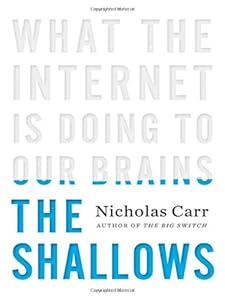
The Shallows: what the internet is doing to our brains Nicholas Carr

Cover of "The Shallows: What the Internet...

Cover via Amazon


Are we sacrificing our ability to read and think deeply?

Maryanne WolfThe Science of the Reading Brain

Is Google Making Us Stupid? (article in The Atlantic, 2008)  – Nicholas Carr.  Maybe not stupid, but lazy.

As a project, she redacted everything in her latest book that she sourced on Google.  Many pages had a quarter or more of the text blacked out.

She tried doing “real” research.  In a library.  With books, articles, and inter-library loan.  She has concerns about kids relying too heavily on Wikipedia and plagiarism in class.

English: An IBM Selectric typewriter, model 71...

English: An IBM Selectric typewriter, model 713 (Selectric I with 11″ writing line), circa 1970. (Photo credit: Wikipedia)

Zsuzsi started using an old IBM Selectric typewriter.  It forces her to think before typing. Nietzsche used a bizarre-looking typewriter and claimed it helped him write better.  “Go online and take a look at it,” she said, and of course, the irony was lost on none of us 😉  Once again ironic, the typewriter was considered the lap top of its time …

Our writing equipment informs our thoughts.  The medium has affected the prose.

Hemingway wrote description in long hand and dialogue on the typewriter.  Annie Proulx and Michael Ondaatje both write long hand.

The Russians are apparently using typewriters to create and send secret messages because there is no electronic footprint.

This experiment helped Zsuzsi engage more deeply with the world.

Behind the curtain: How mainstream publishing works

This was a fun panel with an author, an agent, and two editors.  They took us through the publication process at each stage, author, agent, and editor explaining how their part of the puzzle looks.  Then they fielded questions.

I’ve attended panels before that featured all publishers, or all editors, or all agents.  While informative, how everything dove-tailed was missing.  Occasionally, panelists might say that they couldn’t comment or speculate on what others in the process might do or experience.

‘Twas excellent.

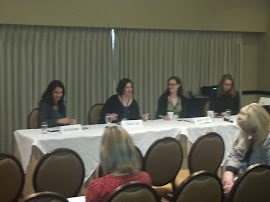
The behind the curtain panelists

The behind the curtain panelists

Panelists: Emily Ohanjanians, editor with Mira Books, the commercial fiction imprint of Harlequin; Eileen Cook, author of YA novels with Simon & Schuster and HarperCollins; Rachel Coyne, agent with Fine Print Literary; Sara Sargent, associate editor with HarperCollins’s children’s imprint, Balzer & Bray.

EC: We’ll start with the author’s search for an agent.  First you have to understand what an agent does.  Most are busy with their current authors and are not actively looking for new authors.  Do your research to find the best fit.  Newer agents will be more available.  Ultimately, it comes down to personal taste.  One agent may not like your voice or style, but another might love it.

RC: I receive 150 to 300 queries per week.  It’s impossible to respond individually.  When I started, that was my intention, but it just can’t be done.  Agents get rejected too, by editors.  There’s a certain disappointment when another agent snags an author from you, especially one that receives an award or does really well.  After I’ve agreed to take on an author, we have a one on one call to discuss next steps.  There is a two page author agreement.  It’s not a contract per se.  Standard percentage is 15% for domestic sales and 20% for foreign, TV, film, and other rights.  Most houses have one agent who is dedicated to subsidiary rights.  Once an author has signed on, the editing begins.  This could mean several rounds, back and forth.  Then the agent will submit to her first round editors.  Usually these are people the agent has an established relationship with.  Sometimes, if several editors are interested, an auction takes place.

SS: At HarperCollins, there are several meetings, one with the acquisitions team during which a profit/loss statement is generated.  The agent is advised of the proposed deal, and negotiation begins.  At the acquisition meeting, everyone sees the property.

EO: It’s the same at Mira, the meeting with the editorial director is followed by the acquisition board meeting, the agent is informed of the proposed deal, and negotiation follows.

Q: Once the book is sold, what happens?

RC: I would make recommendations to the author based on what they hope to achieve.  Usually there is a year between the deal and the publication date, so there is time to implement an author web site or blog, develop social media following, or begin on the next book.  The contract can take anywhere from two weeks to nine months to hammer out.  An advance might be $10,000.  Royalties could be 10%.  First you earn back your advance, then you begin to receive regular cheques.

Q: How does the editor work with the writer on further revisions?

EO: When the launch date is decided upon, it might be a year, or a year and a half, we work backwards, get our endorsements in place, schedule substantial, line, and copy edits, proofing, typesetting, cover art, blurbs, back cover copy, determine the meta data for online sale.

Q: So what happens when you write an editorial letter for the writer, and the writer refuses to budge?

SS: Usually I’ll read and mark up the copy, then prepare a three to ten page editorial letter for the author.  The author will usually sit with it for a few days, then I’ll meet with the author by phone and the author will indicate what they are willing to do and what they are not.  The biggest issue that comes up is characters that are not received as the author intended.  The next is the market: similar books may have tanked for specific reasons that have nothing to do with the quality of the writing.

EC: We work together to reach a solution.  e.g. I hate the character!  My character is brilliant!  How do I show it?

RC: The biggest asset a writer can have is the willingness to be edited.  I like to meet annually with my authors to find out what their plans are for the coming year.

Q: Describe your ideal author.

EO: An insecure author can become overwhelming.  20 emails a day can be draining.  An author coming out of another house might cause me to do some research.  Were there reasons for this?

EC: You have to own your neuroses as an author.  You must be open to communicate.

Q: If your author had to choose between a Canadian and American publisher, which would you recommend?

EC: Commission can be less with a Canadian publisher.  Most American publishers will include Canadian distribution.  The deal is for North American rights, not Canadian or American.  Canada is not considered a foreign market.  Really, your agent is a match-maker, trying to find the best possible home.  It used to be that agents had to be in New York, now they can be anywhere.

RC: There is a right agent and a right publisher for every author/project.

Q: What about e-rights?

SS: They are considered subsidiary rights.

Q: How often do you have to meet in person?

RC: Never if you don’t want to or can’t afford it.

Q: What is your education/experience?

SS: Placement with Disney/Hyperion, BA in English, then an MA in Journalism.

RC: Writer’s Digest Books, Donald Maass Agency, Forward Literary, then Fine Print Literary.

EO: BA in English literature/linguistics, job in finance, but I always wanted to be an editor.  I started working for magazines, then got on with Harlequin, took some courses from EAC and Ryerson in editing, and at every stage, working up through the ranks.

Q: What’s the difference for non-fiction?

EO: It’s based entirely on platform.  Not voice.  Not skill.  Who’s the audience for the book?

RC: Blog-books have been happening recently as well.  Narrative non-fiction works the same as fiction.

EC:  With a novel, you have to have the novel completed before you can query.

RC: With non-fiction, a proposal and platform is often enough.

Q: What should your word count be, and do you talk about series?

SS: Word count isn’t critical.  I’ve never rejected a book on the basis of length.  You should concentrate on one novel per query and treat it as a stand-alone.  It’s important to have a vision, though of how your writing future will look.

RC: We’re not looking so much at the concept, but the creativity of the author.

SS: With children’s literature, you have to be aware of the market.

EC: Not many YA novels are 300,000 words long, but submitting a 20,000 word novel would be too short.

Q: Can an author ever go direct to editor?

EO: If I have the time, I’ll always look.  Why not?  I could find a gem.

Q: When do you know when to stop editing and query?

EC: Write the best book you can.  No matter what you write, you can find an association (RWA, SFWA, etc.). These associations will often offer editing services, or members can serve as critique partners and beta readers.  When you do query, send out five at a time.

Q: Is a rejection a burned bridge?

RC: Not necessarily.  If you revise and resend, there’s a chance that the agent will not remember, but if they do, they are not likely to give you a second chance.  It’s better to try a new project.

Q: How long is it for an editor to respond to an agent?

RC: Between three months to a year sometimes, but the average is three to four weeks.  If there is a closing date or an auction, all interested parties are called.

Q: Do agents want to have input into the author’s platform?

RC: It’s more a matter of making suggestions, showing examples.

SS: In concert with publicity and marketing, publishers may advise.  But if you’re not comfortable on Twitter, you don’t have to use Twitter.

EC: Some agents will advise you with regard to your career in general.  Some agents will never go there.

Q: Have there been books you just couldn’t sell?

RC: Every agent has a book that they felt passionate about, but just couldn’t move.  I make every effort to sell every project, but between 60% and 90% of books signed actually sell.

EC: Hopefully you have more than one book in you.

EO: It’s often the second submission that sells.

RC: Some projects are bought on voice alone.

Q: If you’ve self-published, is it a deal-breaker?

RC: Only if it’s the self-published effort and it’s not sold well.  If it’s a different effort, no problem.

EC: They call us hybrid authors now.

Q: How about posting your work in progress on the internet?

RC: It depends on how much of your novel is out there, and at what stage.  If most of the novel is already “published,” I probably wouldn’t take it.  Do not blog your book.

Q: Can you self-publish one book and e-publish another?  Specifically, the rights on my first novel are reverting to me and I’d like to self-publish.  Meanwhile, I’m in negotiations for my second book.

EC: If your first book is erotica and your second is YA, then they’re not likely to get in each other’s way.

EO: If both books are comparable, you could offer the self-published book at a deep discount.

RC: It would be wise to check with the publisher about to put out your second novel if self-publishing your first is okay.

EO: Be up front with all interested parties.

This brings us to the end of Friday’s sessions.  I’ll have the Friday night and Saturday morning keynotes before moving on to Saturday’s sessions.  We’ll see how far I get tonight.  I’ll be travelling home tomorrow and won’t finish off whatever remains until Tuesday.
Research panel

This panel was a question and answer session.

Panelists: Anthony Dalton, Jack Whyte, Anne Perry, Diana Gabaldon, Susanna Kearsley

Q: Is it okay to use unusual names? e.g. in a historical novel set in Poland, the names are strangely spelled and not pronounced how a North American audience would be familiar with.

JW: If it’s appropriate to the historical setting, keep them.

DG: Find out how the names are treated in the time and culture you’re writing about.  e.g. Black Brian, or Mac Dubh.  Use nicknames or short forms.

AP: Are they named by profession, by an attribute?

SK: Have an outsider character learn how to pronounce the name.  Readers will remember after.

Q: How do you organize your research?

DG: I’ll have sticky tabs in the books I use for research and refer to them when necessary.

AP: I do much the same.

SK: I get documents from the archives (note: Susanna Kearsley used to be a museum curator) and organize them into binders, probably because I’m the daughter of an engineer.

AP: I find that most of the research I use in a first draft is later redacted.

JW: I recommend Scrivener (about $40).  It’s excellent for organizing your research, though it does fall down a bit in the final formatting of a manuscript.  Simply export to MS Word.

Q: How do you get translations?

SK: Try French translators, call your local university, see if they have a translation department, etc.

AD: French immersion teachers are also a good resource.

DG: Is it critical to the story?

AP: Don’t tell people what they don’t need to know.

Q: What gets questioned?

DG: Once you are immersed in the time period, you know what is likely to have happened.

AP: Research is often borne out.  In some cases, my educated guesses have later turned out to be correct.

SK: Historians can leave holes – they are bound by facts, or the lack of them.  Writers have to fill in the holes.

JW: Historians cannot speculate.

Q: Would it be okay to spell Welsh phonetically?

SK: Have an outsider character to help interpret.

DG: Language consists of three things: accent, dialect, and idiom.  For the Outlander series, they are conducting Gaelic classes.

AP: In practice, though signs might have Gaelic and English, few people actually speak Gaelic anymore.

JW: Rhythm is important.  Cadence.

AD: I researched an ocean crossing and read three accounts by three London travellers.  They were all different in spelling, etc.

Q: How do you pick out the pertinent bits?

SK: History is curated.  People save what they think is beautiful, or what has value to them.  Go back to the contemporary record, if possible.

The Daughter of TimeJosephine Tey.

Q: What if you’re dealing with several different languages?

DG: You bring in a translator.

SK: You use a dictionary, or you bring in an outsider.

JW: Tarzan of the Apes is an excellent interpretation of what it might be like to teach oneself a language.

SK: Another great example is The 13th Warrior.  There is a campfire scene where the camera pans around the Vikings and Antonio Banderas’s character catches a few words each round until suddenly, he understands what they’re saying.

Q: Who is the most interesting person you’ve researched that you haven’t written about?

AP: Torquemada.

SK: John Thomson.  He almost bankrupted Britain in the 1700s.  He told everyone a different story about what happened.

DG: Joseph Brant.

JW: William Paterson.  Founded the Bank of England and a Panamanian colony for the Scottish.  The colony was blockaded and eventually disappeared, though there is a native group who still paint themselves in tartan patterns.

Q: Whose diary would you like to fictionalize?

JW: Casca, the first man to stab Caesar.

AP: Faucher (?) He had albino genes. French Revolution.  The Butcher of Nantes.

DG: Thomas Paine.

SK: Geoffrey Plantagenet.

AD: Sir John Franklin.

Q: How do you find your research?

JW: Get to know the librarian in charge of the humanities section of your local public or university library, and ingratiate yourself shamelessly.

SK: Google Books.

Q: What are your favourite books to read?

SK: Diana Gabaldon and Nevil Shute.

JW: Roger Zelazny.  Really, it depends on how I feel when I get up in the morning.

AP: G. K. Chesterton’s poetry or crime writers like Michael Connelly.

DG: Celtic crime writers like Ian Rankin and Phil Rickman.

The Willing Suspension of Disbelief: Susanna Kearsley

One thing that I must comment upon with a traditional writing conference like SiWC (this is their 21st year) is the frustration of concurrent sessions.  I don’t think there was a time where I didn’t want to attend at least two of the sessions.

This is SO a first world problem, as Chuck Wendig would say.

RT's Giant Book Fair

RT’s Giant Book Fair (Photo credit: rtbookreviews)

So I got over my bad self and made some decisions.  My first one was to attend Susanna Kearsley’s session on writing supernatural aspects of stories convincingly.  Though my stories are all either straight out fantasy or science fiction, it’s always good to have a few more tools in the toolbox.

I’ve been a fan of Susanna since I took a workshop with her in Port Elgin in 1994 (possibly 1995?).  She’d just won the Catherine Cookson Award for her novel Mariana.

Here are my notes:

The mechanics

  • It starts with character.  You must have a likeable, trustworthy, relatable protagonist.
  • The protagonist can be the character who possesses supernatural skill, or they could be the biggest skeptic in the book.
  • Work on the principle of Ockham’s Razor first.  Stated succinctly, the simplest explanation is often the most correct.  People tend to rationalize the unknown.
  • Transition to deductive reasoning.  Think Sherlock Holmes: after every other possibility has been eliminated, what is left, no matter how unlikely, is the truth.
  • Respect both sides of the argument – believers and skeptics.
  • Time travel – paradox.  If you travel into the past and accidentally kill your grandfather, do you cease to exist?
  • Acknowledge accepted beliefs.
  • Research.  All psychology departments usually have parapsychology sub-departments.
  • Seek verisimilitude.
  • Your protagonist’s acceptance of the supernatural should be a gradual process.
  • You need a supporting character, someone who can help or guide your protagonist.  A true believer, or other expert in the area (professor, priest, exorcist, shaman, etc.)
  • Also, you need someone who is an even bigger skeptic than the protagonist.  As the protagonist proves to her or himself and the other skeptic that the supernatural is the only ‘rational’ explanation, he or she is also proving it to the reader.
  • Be aware of the difference between your characters and normal people.  Think of the bit of Eddie Murphy’s RAW of years ago: in the Amityville Horror, the family hears a voice say ‘get out’ and dismisses it, remaining to be assailed by the evil spirits resident in the house.  Murphy said that if the father in that story was a man of colour, he’d tell his family, “Nice place, sorry we can’t stay.  Pack your things, we’re leaving.”  Of course, there was more swearage involved 😉
  • In the handout – two accounts of a UFO sighting.  One from an air force pilot who went through the deductive reasoning process and eliminated all other reasonable alternatives until he was left with a UFO, the other from a man on LSD.  Which would you believe?  Make your protagonist reliable, unless that’s part of her or his journey, to prove what they saw despite obvious reasons not to.
  • Canadian psychic – George McMullen.  Psychometry.
  • Keep your world real, working by the rules you have established.  Naomi Novik made dragons believable.
  • Be consistent.
  • Don’t over-explain.
  • Be aware of our current level of understanding of the supernatural aspect you use in your novel.
  • Choose one thing.  Too much will overwhelm.
  • Stephen King uses wounded heroes.  They are more sympathetic.
  • No coincidence, contrivance, or anything too convenient.
  • We have been raised on nursery rhymes, fairy tales, myths, and legends – we are taught to accept the existence of magic.
  • Where/when we expect to find magic: isolated places and buildings, the woods, old houses, night time, fog or mist, the sea, transitional places like the shore, twilight, dawn, the witching hour.
  • Play with expectations, or play against them.  Against may be the more powerful technique, but it’s also the more difficult to pull off.
  • Avoid cliché.
  • Be aware of cultural biases.
  • Voice is important.  Communication is the goal of writing.  Aim for the grade eight level reader to reach the widest audience.
  • Genres: magic realism, modern gothic, paranormal, paranormal romance, historical.
  • Donald Maass has predicted that eventually, genre will be irrelevant.  It’s a marketing construct.
  • You can cross genres, but do not transcend them!
  • In historical fiction, there will be other explanations for things than there will be in a contemporary novel.
  • The outsider is a powerful thing.  Use this character to explain, gain perspective, but resist the urge to over-explain.
  • There are resources for research in the hand out:
  • http://www.parapsych.org
  • http://www.rhine.org
  • Also check out the Koestler institute of parapsychology.
  • GoogleBooks is a great resource for historical records.
  • Jstore is where you can obtain information from academic journals online.

Friday morning keynote

Each morning, a keynote speaker addresses the conference at breakfast.

For this first day of the conference, it was Simon Clews, Australian author.  His topic was brief, but carried impact: Love, Intimacy, and Hope.

Love is important in writing.

Conditions of love – John Armstrong.

Cover of "THE CONDITIONS OF LOVE: THE PHI...

Cover via Amazon

We write for the love of it, the love of words, and the love of communicating.

We write in the hope of achieving intimacy, reaching an audience, something that has never been more possible with self-publishing and the changes in the industry.

The power is shifting in the author’s favour.

Our audience loves to read and hopes for more words to satisfy that need.

We are the future of writing and publishing.

First, a few notes

Flight from Vancouver to Toronto

Flight from Vancouver to Toronto (Photo credit: Wikipedia)

My flight was seven hours.  I had to be at the airport (a 20 minute drive) an hour ahead of time, fly to Toronto and have a brief layover before boarding my connecting flight to Vancouver.  There’s a three hour time difference between Ontario and BC.

Having arrived in Vancouver, I had to then make my way to Surrey.  I asked hour much it would be for a shuttle.  Even the flat rate was more than I was prepared to spend.

So I back-tracked, bought a train ticket, and rode the sky train for another hour and a half.

At the terminus station, I still had to catch a taxi to get to the hotel.

So, altogether, I spent about ten hours in transit and though it was only four-ish when I got here, I was done.

I checked in, got to my room, and discovered something:

I had to pay for internet access, and I could only pay for either in-room or meeting room access.  I opted for room access, hoping that my smart(-er than me) phone would have enough connectivity to tweet.

After supper and a bath, I went to bed, about eleven pm Pacific, but about two am Eastern time.

I woke up at 3 am.

Though I did my best, I only managed to send one tweet before my phone bogged down altogether.  I haven’t been able to send or receive much of anything since.

Also, Kristin Nelson was unable to attend, her flight from Colorado having been cancelled due to the weather.

I dealt with these small disappointments and have since had an absolute blast (so far).  Will be posting the day’s sessions and my notes as I go, but these will likely be at least a day late.

Lauren Carter: Deep Character Workshop, Oct. 6, 2013

I spent the afternoon with Lauren Carter, her mother, Laura (a visual artist with a good feel for story), and five other wonderful writers talking, and writing, about character.

SwarmcoverLauren is on a tour to promote her literary dystopian novel, Swarm, which was released in September by Brindle & Glass publishing.  She’s been to Orillia and Blind River (both places she used to live), and has made a stop in Sudbury for a couple of days before she heads south to continue her journey.

As part of her Sudbury leg, Lauren agreed to offer a writing workshop for the Canadian Authors Association Roving Writers program.  Tomorrow night, she will be giving a reading at the south end branch of the Greater Sudbury Public Library as part of the Luminaries reading series.

Lauren indicated that nothing she had to teach was proprietary and so I’m going to offer a bit of a run down of her workshop.

  • Lauren is a firm believer that there are no rules in writing.
  • People come to writing as artists – organically.
  • Character is important in prose, even in plot-based fiction, someone has to be at the heart of the action.
  • The reader (and therefore the writer) must know those characters intimately.
  • Each writer will have her or his approach.
  • All great art begins at a point of absolute confusion.
  • Writers make decisions about their characters.

Eric Maisel – characters are not people, they are in the novel to serve the writer.

We then reviewed two writing samples: Matadora, by Elizabeth Ruth and Anne of Green Gables by Lucy Maud Montgomery.  We looked at the clues the writers offered about their characters, their backgrounds, the techniques used to engage the reader in the character, how descriptions were used, and so forth.

Lauren passed out a character development questionnaire put together by Kathy Page.  We didn’t use it, however.  Not yet.

Then followed the first of several writing assignments.  This first focused on character description.

Next, we wrote specifically about a possession or place specific to the character, like a purse, car, or room.

Then we focused in on a specific object within the last writing assignment and worked with that.

Finally, after having gotten to know our characters a bit better, Lauren guided us back to the questionnaire and focused the next writing assignment on that.  Having written through a few iterations of describing our characters through physicality, place, and possessions, it was not easier to enter into the details of the list and discover even more.

The last writing assignment took all that we’d learned about our characters and focused on plot. This was set up by another reading from Eric Maisel about “The writer as Experimental Psychologist” taken from his book, What Would your Character Do?

Essentially, plot is a matter of answering three questions:

  1. What does the character want?
  2. Why does the character want it?
  3. How will the character achieve his or her goal (or not)?

After that, it’s a matter of the author rigorously testing the hypothesis she or he has developed until all three questions are answered satisfactorily.

So first, we explored our characters’ psychological make-up; then, we answered the first of the three questions.

Each writing assignment was a free-write and delivered with the instruction to follow the writing wherever it led.  In several cases the characters did, as they are notoriously known to do, their own things 😉

It was a good workshop, and I was happy to have been part of it.

Workshop alert: Lauren Carter Oct 6, 2013

You may remember that I’ve become a member of the Program Committee for the Canadian Authors Association.

The committee is responsible for the annual conference, the Literary Awards, professional development of the membership, and something called the Roving Writers program.

I volunteered to be on the sub-committee for the Roving Writers and our first event will be in a scant week!

Author Lauren Carter will be coming to Sudbury as part of her book tour.  So on Sunday, Oct 6, from 1-4 pm at the Parkside Older Adult Centre in the YMCA building, she will be delivering a workshop on Deep Character.

Here’s the poster with the deets (including how to sign up):

RWTP_Carter Poster

The CAA office will be sending me a copy of the participant list and I will be taking payment (cash or cheque only, please) at the door. The discounted fee of $25 applies to members of the CAA only.

Light refreshments (fruit, muffins, water, and juice) will be provided.

I can’t thank the Sudbury Writers’ Guild enough for their assistance in getting this event off the ground.

Following that, on Monday, Oct 7, Lauren will be at the south end branch of the Greater Sudbury Public Library as part of the first LUminaries reading series.  This has nothing to do with the CAA or the Roving Writers, but I thought I’d spread the word.

She will, of course, have copies of her dystopian literary novel, Swarm, available for sale and signing.

Have a lovely evening!

Caturday Quickies: The launch of Spooky Sudbury

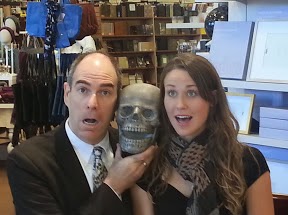
Spooked authors :)

Spooked authors 🙂

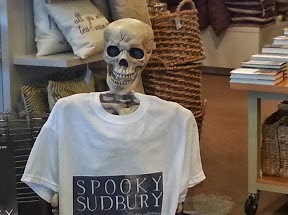
Barnaby

Barnaby

What was I up to today?

Between 11 am and 1 pm, I went to Chapters to celebrate the launch of Mark Leslie and Jenny Jelen’s Spooky Sudbury: True tales of the eerie and unexplained, which just happens to feature a wee tale from yours truly as well as a number of my friends: Kim Fahner, Mat Del Papa, Charlie Smith, Rob Sacchetto, and a pile of other local contributors.

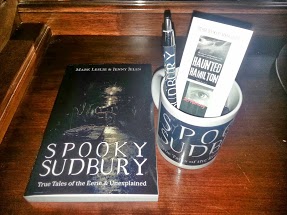
Upon my arrival, the gracious Mr. Leslie brought me my contributor’s copy and my Spooky

My Spooky Sudbury swag

My Spooky Sudbury swag

Sudbury Swag Bag.  I met Jenny, and hung out with Scott Overton, Kevin Closs, and a crowd of other people.  Really.  It was a crowd.

An hour into their three-hour stint at Chapters, Mark and Jenny were sold out.  Fans were heading down to Costco to buy copies and bring them back for Mark and Jenny to sign.

This afternoon, Mark and Jenny were at Coles in the New Sudbury Centre, and tomorrow morning, from 10 am to 12 pm, they will be at Costco.  This will be your last chance, Sudbury, get your copy of Spooky Sudbury before they’re all sold out and read the true tales of the unexplained through the month of October.

Getting interviewed-yes, the media was there too!

Mind you, you can always go online and order a copy.

Either way, it’s scary stuff, kids (in my best, Count Floyd voice)!

What writerly fun have you been up to this weekend?

Six questions with Jennifer J. Chow

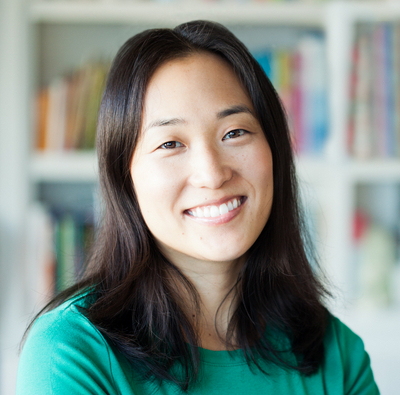
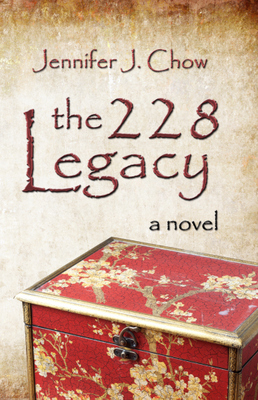
Jennifer is one of many online friends I’ve made through Wordsmith Studio.  I’m happy that her novel, The 228 Legacy, is published and that she’s agreed to this interview.

Jennifer J. Chow

Jennifer J. Chow
photo credit Julie Daniels

Jennifer J. Chow, a Chinese-American, married into the Taiwanese culture. The 228 Legacy was inspired by the family stories she heard after viewing photos of a two-million-person human chain commemorating 228. She has traveled multiple times to Taiwan and visited places dedicated to the incident. Her experience with the elderly comes from a gerontology specialization at Cornell University and her geriatric social work experience. You can visit her online at www.jenniferjchow.com, or follow her on Twitter and Facebook.

________________________________________________________________________

WG: Welcome, Jennifer!

Your new website’s tagline is “Asian-American fiction with a geriatric twist.” Your old blog’s was “Fortune cookie wisdom meets an Asian American writer’s life.” How does this change in tagline reflect your evolution as a writer?

JJC: The blog continues to reflect my fortune cookie life and how I’m twisted into the dual selves of my Asian-American identity. Plus, my posts still start off with a Chinese proverb, and the saying is woven into the content. When I evaluated my fiction writing, though, I discovered certain themes coming through. I enjoyed exploring various aspects of the Asian-American experience. Also, many of my stories contained older adult characters as key figures and examined the interplay between different generations, so I added in the “geriatric twist” to my tagline.

WG: How has your work in the geriatric field influenced your writing?

JJC: I’ve heard so many unique and interesting tales from my previous clients. They shared with me their life journeys and provided a lot of inspiration in my own stories. Additionally, I have a strong desire to shed light on the inner workings of people as they age. I also wanted to highlight older characters, individuals who are often caricatured in the arts—or not mentioned at all.

WG: When did the writing bug first bite you? Tell us the origin story of Jennifer J. Chow, author 🙂

JJC: I always wrote as a child, starting with a pencil on lined paper. During a field trip to the Natural History Museum of Los Angeles, I dropped a journal entry without realizing it. Later on, one of my schoolmates picked it up, asking, “What’s this? It reads like a story.” When I grew older, I borrowed my father’s typewriter for writing. I even remember him taking my childhood manuscripts and showing them to his colleagues at work.

WG: When I saw your book, I immediately thought of Amy Tan (The Joy Luck Club). Not that it’s a poor comparison to beg, but how is The 228 Legacy different?

JJC: I would be ecstatic to have my work compared to Amy Tan’s amazing novel. I’d like to defer this answer to a Goodreads member who summed it very well: “When I first described this book to someone (it spanning several generations, the historical context, mother/daughter relationships, immigrant and second-generation Asian American experience) I realized it sounded like I was describing an Amy Tan novel but in fact this book has a unique, American voice – It doesn’t indulge in magical realism of ancient lore or fortune cookie wisdom. Rather, the voice of the characters are immediately recognizable – maybe not extraordinary but are surviving the sometimes extraordinary circumstances surrounding them (whether it be a suffering spouse or parent, or a teenager witnessing abuse, or a military massacre). I learned about some Taiwanese history which as far as I know has never been touched upon in American fiction. But to me this book is fundamentally about caring – our innate need to care and be cared for. There was so much that resonated and that I recognized in these character’s stories. Just a wonderful book that I enjoyed very much.”

WG: How did your experience in the Amazon Breakthrough Novel Award competition contribute to your success as a novelist?

JJC: I think entering the competition gave me more confidence. When I realized that I had made it to the second round, I understood that other people might really be interested in this story. When the contest passed and I started submitting the manuscript to publishers, it also didn’t hurt to mention my experience with the ABNA competition.

WG: What’s next for you and The 228 Legacy?

JJC: I’m hoping that more people will become aware of my book and that readers of all cultural backgrounds will be able to relate to and learn from the book. A specific event I’m looking forward to is my book launch party on Sunday, September 15 at 4pm at Pages bookstore in Manhattan Beach, California. It’ll be a fun celebration of the book’s release, complete with an excerpt, reader testimonials, a raffle, and delicious Taiwanese snacks!

Thanks for a great interview, Jennifer! All the best with your future writing endeavours.

_______________________________________________________________________

The 228 Legacy

The 228 Legacy

Three generations in an all-female Taiwanese family living near Los Angeles in 1980 are each guarding personal secrets. Grandmother Silk finds out that she has breast cancer, as daughter Lisa loses her job, while pre-teen granddaughter Abbey struggles with a school bully. When Silk’s mysterious past comes out—revealing a shocking historical event that left her widowed—the truth forces the family to reconnect emotionally and battle their problems together.

A novel of cultural identity and long-standing secrets, The 228 Legacy weaves together multigenerational viewpoints, showing how heritage and history can influence individual behavior and family bonds.

“An impressive debut!  Moving, hopeful and triumphant.  A compelling read.” -Jane Porter, national bestselling author of The Good Daughter