Book review of Nail Your Novel by Roz Morris

Once again, this is a bit overdue. I finished reading the first of Roz’s NYN series last month, but my crazy life has run away with me again. I’ve had to pick and choose what I’m posting about.

First, a word about what’s coming up next weekend and how you can take part

Next weekend, on May 3, 2014, the Google Plus community @M2the5th will be holding its second online writing workshop with Roz. We’ll be starting out on Twitter with a Tweet chat and then moving to a Google Plus video call.

I posted previously on starting out with Tweet chats, for those who need a primer.

I’m not an expert with Google Plus video calls yet, but if you have a laptop with a camera and mic built in, or a desktop with an inexpensive camera and mic (I have a combo unit from Microsoft that works wonderfully) and a GooglePlus account, you can join in the fun.

All you have to do in Google Plus to prepare is download the hangout application, which doesn’t take long (depending on your connection speed). I like Google Plus for this kind of thing, because it’s user friendly and fairly intuitive. You don’t have to jump through a bunch of technical hoops to get started.

So if you want to take part, forward your name to either Lori Sailiata, or Amy Pabalan in the Twitter chat. One of them will be wrangling the hangout crowd and sending out invitations to join. Once you’ve received your invitation, simply accept, and your video feed should show up in the filmstrip section at the bottom of the hangout window.

Roz reports that she’s had to use Chrome as her browser for the best result, but I’m using Firefox and I haven’t had any difficulties yet. *seeks wood upon which to knock*

The review

What Amazon says:

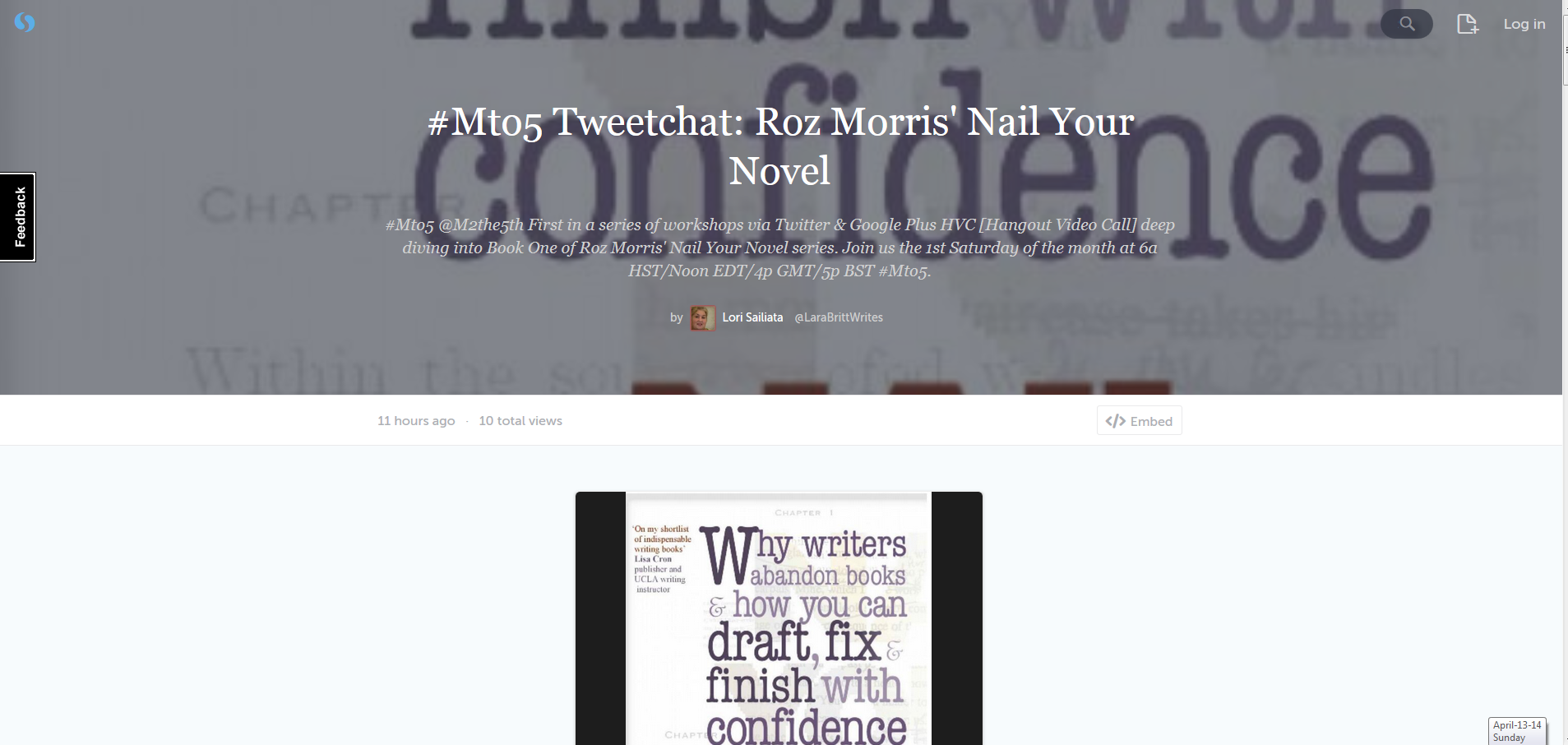
Nail Your NovelNail Your Novel: Why Writers Abandon Books and How You Can Draft, Fix and Finish With Confidence

‘This book should be used as a text in writing courses’

‘There are shedloads of books on how to write novels, and a lot of them are longer and considerably less useful’

‘I wish I’d had this book a long time ago’

‘The author has a proven track record as a writer of fiction, as opposed to writers of “how to write” books’

Are you writing a novel? Do you want to make sure you finish? Will you get lost and fizzle out? Will you spend more time reading about how to write than actually getting the words down?

Most books on novel-writing will make you read hundreds of pages about character arcs, inciting incidents, heroes’ journeys. It’s great to know that – but while you’re reading about it you’re not writing your book.

And what these books don’t tell you is how to use this learning and get the job done.

Nail Your Novel is a writing buddy – and mentor – in a book.

In 10 easy steps it will tell you:
*how to shape your big idea and make a novel out of it
*how to do your research and how to use it
*how to organise your time.
*how to plot and build characters
*when you’re going to hit problems and what to do about them
*how to write on the days you don’t feel inspired
*how to reread what you’ve written and polish it.

Along the way, Thumbnail Notes give tutorials about storytelling and storycraft – strictly when you need them. The author has written nearly a dozen novels that have made it into print – and this is how she did it.

You don’t even need to read the whole book before you get started. You read a section, then do as it says. And, once you’re finally satisfied, Nail Your Novel will tell you how to sell it to publishers and agents.

You’ve dreamed of writing a novel. Don’t procrastinate with another theory book. Don’t launch in, get stuck and throw your hard work in a drawer. Nail your novel.

My thoughts:

I’ve been reading writing craft books for years. In fact, one could say that I’m a writing craft book junkie. Yes, the support group will be starting shortly.

My approach in reading these books is to adopt those parts of the writer’s process that make sense to me and my ever-evolving process. I cherry pick, experiment, and incorporate as appropriate.

I would characterize Roz’s approach as organic, that is, her plotting activities arise naturally from the journaling, research, and gestation that most writers will normally engage in as a preparation to actual writing.

Her version of plotting will appeal to the avid pantser and her “gamification,” albeit non-technological, of structuring and plot-fixing activities will motivate even the most spreadsheet-phobic of writers. Having said that, plotting-oriented, or technophile writers will also find lots of tips and tricks to adapt for their use.

The techniques in Nail Your Novel can be used not only from the inception of your novel, but the writer can also engage in the process at later stages of novel writing. Having entered into Roz’s methodology with already drafted novels, I’m working through her beat sheet activity, adapting it to my own use as I prepare for future revision.

Roz even has activities to prepare the writer for querying or self-publication, whichever path the author chooses to pursue.

I’ve also felt validated in several instances as bits and pieces of my existing process appear in slightly different forms throughout Nail Your Novel.

For all the excellent content, Nail Your Novel is also a relatively quick read, well-organized, and easy to understand. Roz gets right to the heart of the matter and encourages reading writers to get their hands dirty, metaphorically speaking.

Her writing style embodies what she asks writers to strive for: clear, informative, and entertaining. Roz doesn’t waste a word.

Roz’s book receives my highest recommendation. It’s on my virtual writer’s shelf beside Ursula K. LeGuin’s, Jane Yolen’s, Donald Maass’s, and K.M. Weiland’s craft writing books and I’m sure I’ll be referring to it often.

My rating:

5 out of 5 stars.

About the author:Roz Morris

Roz Morris has nearly two decades of experience writing novels and helping floundering authors find their way. She is a senior book doctor for a major literary consultancy in London, writes fiction under her own name and has ghostwritten bestselling fiction for high-profile writers with major publishers, including Random House, Puffin, and Mammoth.

Ad Astra day 2: Unleashing your creativity

Panel: Karina Sumner-Smith; Alyx Harvey; Judith Hayman; Leslie Hudson; Sally Headford

SH: If you walk into a grade one class and ask, “who can sing?” everybody raises their hands. Ask, “who can dance?” and the same thing happens. By the time they get to grade six, children have learned the standards and expectations. Only a few of them raise their hands then.

JH: Take risks. Make mistakes. No one will know the difference.

SH: How do the writers on the panel deal with those standards and expectations?

KSS: I have groups of people who read my work at various stages. There are readers for the roughdrafts, then later, beta readers. You have to have a terrifying level of trust in your readers. Seek out your “perfect” reader.

LH: If someone says, “you suck,” it can shut you down. How do you deal with that?

KSS: Chocolate and wine.

LH: We are our own worst critics. The worst are the notes I leave for myself.

Q: As a visual artist, I have to be able to evaluate a piece on its own terms. I benefit most from honest, constructive, criticism. What do you prefer?

KSS: Sometimes I need people to be honest. When I’m feeling vulnerable, I need comfort and tea.

SH: When you get to a low point, what do you do?

LH: Walk the dogs.

KSS: Five-minute dance party.

SH: I need oxygen.

JH: I need repetitive tasks. I’m on the autistic spectrum.

LH: Napping is awesome. You fall asleep and an idea comes to you in your dreams.

KSS: I find creativity breeds creativity.

LH: I’ve gotten into mandalas in a big way. I like needlepoint. Or reasearch.

JH: We’re all a little bit insane. When we enter flow, it’s a sacred space.

SH: I think of it as an alternate reality where creativity exists.

JH: I enter into my creative space with visualization.

LH: You have to protect your creative time.

JH: My day job is easier. It’s structured. At home, it’s different, more challenging.

AH: A day job takes a big chunk out of your day.

Q: Do any of you find you have to make yourself create?

LH: Absolutely. Sometimes you have to tell yourself to sit down and write, honey.

AH: Yes. Do the work.

LH: Sometimes pressure is good. Deadlines motivate.

Q: Do you find having a creative community or space helps?

JH: February Album Writing Month. FAWM. I participate every year.

KSS: NaNoWriMo.

Q: When do you sleep?

SH: It’s incredibly important.

KSS: In your day job, deadlines dictate what you do. I’ve read a health study in which people who get one hour less sleep per night over a seven day period were found to perform worse than people who were drunk. Health studies are fun.

SH: The current work environment is terrible. Multitasking is a myth.

KSS: One in one hundred people can actually multitask. Odd are, it’s not you.

AH: Where do you get your inspiration from?

JH: Everywhere.

KSS: Compost. One day my blender broke and I thought, what if society was built around items that worked on magic instead of electricity, and they all started breaking?

AH: I love my I-pad. If I see something, I snap it.

SH: Too many things can get in the way. If you don’t have a way to capture your ideas, you’ll lose them.

KSS: You can use prompts, or themes.

LH: You train yourself to notice things.

JH: Folklore is the basis for my current song-a-week project.

Q: Is creativity about finding ways to work around our disabilities?

SH: Creativity is part of human culture. It’s part of our history.

JH: Creativity is a process, not a product.

AH: Enjoy the process!

LH: People think that if you’re an artist you have to be miserable. Or that there’s a link between creativity and mental illness. Schizophrenia. Bi-polar.

JH: When I’m feeling manic, creativity is a saving grace.

Q: How do you deal with falling short of your vision?

AH: Let it come out the way it wants. If you force it, your won’t be a s successful.

KSS: If you don’t like it, you can always do it over. Accept it if it’s part of your process.

And that was it.

I have to note, in case you find some of these sessions ending abruptly, that many of them ran to the last second and only broke up when the next group entered the room. Thank you’s and closing remarks were often lost in the shuffle.

More coming tomorrow.

Off to watch Orphan Black now. Clone club!

Ad Astra Day 2: It builds character

Panellists: Karen Dales; Patricia Briggs

Note: Steven Erikson was not able to attend this panel.

Humourous note: It builds the character or it gets the hose.

KD: Characters are the heart of your story.

PB: It’s all subjective, though. Everyone sees something different. The most important thing is that your characters be internally consistent.

KD: Who plays RPGs here? (Pause for show of hands) What the first thing you do in any game? (Create your character!) We have character sheets, even if they’re only in our heads. We have to become method actors for our characters.

PB: We have to step into their shoes. You have to look at the character’s purpose in the novel. If two characters serve the same purpose, one of them has to go. In Rosenkrantz and Guildenstern are Dead, for example, the title characters serve the same purpose in Shakespeare’s play. They are expendable. Every character has to have a problem to solve. In a series, when one problem is resolved, another has to crop up to take its place. My Mercy, she’s a coyote shape shifter and therefore Native. Her job had to fit. She has her own business. She’s a mechanic for Volkswagons. She likes to fix things.

KD: For my series, I actually used a character I’d built for an RPG in the past. A to Z. What gets them there? Characters have to be complex. Origins need to be pre-defined so we know how they will react to the situations they’re put in.

PB: Characters have to make decisions. With actors, every action has a purpose. What does this gesture mean? What does their body language convey? C.J. Cherryh says every scene must accomplish three things. Mercy was abandoned and taken in by a werewolf pack. She has issues with women and abandonment. She needs to make broken things work. Ben is an obnoxious, misogynist jerk, but once Mercy, and readers, learned why, he became sympathetic. What is the secret the character would kill for or die to protect?

Q: How to you reflect growth in your characters?

KD: Body language changes given circumstances. Everyone has a mask for different occasions. Underlying that is the same core character, though.

PB: You’re limited by word count, though. To fully develop one character takes a hundred pages. Give yourself time.

Q: How do you balance complexity and consistency?

PB: Mercy surprises me all the time, but that’s part of her nature as a shifter. Experienced writers can predict what will happen and how a character will react. Think about your friends and family. How well do you know them? Can you predict what they’ll do? Think about TV shows and the characters you see there.

KD: Circumstances dictate character behaviour, but consistency is where everything originates.

Q: What is your advice regarding negative endings and death?

PB: The reader feels betrayed. Lois McMaster Bujold does this extremely well, though. You have to set up your ending. It must feel like it’s the right thing, the only thing that can happen. The ending must fulfill the character in some way.

KD: I hate Disney’s happy endings. I love tragedy, but it has to have a purpose.

PB: George R.R. Martin does this well, too. It’s what the story demands. Barbara Hambly did it, though, and ended up losing audience as a result.

Q: What do you do about info-dump?

PB: Write it down as part of the character sketch and bring it out as the story demands.

Q: Do some characters deserve to die?

PB: I’ve killed characters who didn’t deserve it and I’ve let some characters who deserved death, live.

KD: Ask yourself what the story needs? One bad guy might need killing, another might not.

PB: Justice must be served. In Pitch Black, for example, the pilot would have sacrificed everyone else for her own survival. When she later dies to save everyone, there’s a sense of justice being served.

Q: My stories are plot driven. The advice I’ve been given so far hasn’t been helpful. For example, I was told that all characters have to have limitations and they have to suffer as a result.

PB: You have to avoid the “super” character.

KD: One must suffer to learn. It’s a common experience, but not necessarily universal. Characters can learn by overcoming adversity.

Ad Astra Day 2: The writing life

Panel: Julie Czerneda; Suzanne Church; Stephanie Bedwell Grimes; Karina Sumner-Smith; Ada Hoffman

JC: We’re starting out with our typical days. For me, that’s get up, exercise, write until breakfast, eat, write until lunch, eat, write until supper, take the evening off, sleep, repeat.

SC: Because of where I am in the publishing process, it’s social media and promotion until after dinner.

SBG: Things change depending on where you are in the process. I used to write in the evening. Now, I write in the mornings.

KSS: I had a day job. Then, we moved into a cottage. Now, I have a lot of time. I can work around other tasks. I’m trying different things to see what works. I write at least one hour per day. I’m a night person, but writing in the mornings works. My internal editor hasn’t woken up yet.

AH: I’m in grad school and I live alone. For 8 hours, I’m at my ‘day job’ and then I go home and write. I’m trying different things, too.

JC: Eventually, we all find that ‘sweet spot.’ I have a friend who is a New York Times Bestselling Author (NYTBSA) who used to have a day job. She didn’t adjuster her schedule when she stopped working, she just filled up the hours of her former day job with writing and burned out. I once wrote for 16 hours straight and I ended up in the hospital. Lesson learned. You have to take care of yourself.

SC: I’m a little obsessive-compulsive (OCD). I need a schedule to start my day. The only exception is Hockey. Everything stops for hockey.

SBG: I had a day job. Actually two at one point. You have to keep the well full.

JC: We renovate.

SC: I make time for cultural stuff. Galleries, theatre.

SBG: I’m guilt-driven.

AH: I like reading books by other authors, listening to music. I find poetry begets poetry.

JC: Even 15 minutes of something else is enough of a break: dishes, plants, whatever.

KSS: I like to put on some loud and stupid song and have a five minute dance break. (Mel’s note: Grey’s Anatomy!)

JC: I have dancing songs built into my play list.

SC: I have several play lists: one for NaNoWriMo, one for editing, one for those ‘dark and stormy’ days.

Q: Several of you are working on multiple projects. How do you stay organized?

AH: I work on one thing at a time. I’ll focus on short stories and novels for a while, and then take a poetry break.

KSS: I’m working on a sequel, so a lot of the world building and character development are done. If I work on a stand-alone, it requires that I keep my current project in my head all the time. It takes me a week to pull myself out of one project and get into another. If I have to work on multiple projects at once, I find setting up separate writing times works.

SBG: I tried working in the mornings on one project and in the evenings on another. Sometimes when I’m working on one book, another sells and I have to stop working on the first to address the editing. I usually stop everything else to work on an emergent issue, like edit notes.

SC: Once again, the OCD rears its head. I use spreadsheets. I have one for chapters, another for characters, a third for settings, and so forth.

KSS: No offence, but you’re crazy.

SC: I have a degree in mathematics. Analysis appeals to me.

JC: For the first ten years, I wrote while I was the editor of a science magazine. Currently, I might have as many as seven novels in various stages at once. An outline is indispensable. Your editor will wait as long as you’re up front with your delays. My first book took 17 years to get from inception to publication. My second took nine months.

Q: Where do you get your ideas?

SC: Smart phones. Take a picture, or write a note on the go.

JC: Take a nap.

Q: How do you prioritize your work?

JC: Length. A longer project takes more time and so might have to take priority.

SC: I work by deadline. I write one page every morning. I call it my 100 words.

JC: Neil Gaiman wrote Coraline that way.

Q: How much writing stops when you get a deal? How much time do you have to devote to promotion?

JC: It’s a myth that you have to promote your book, unless you self-publish. The way I look at it, if I don’t write, I don’t eat. I spend one morning on promotion per week.

SC: The first time out, it’s a learning curve. You have to learn what you can do and what you can’t.

KSS: Some people are not suited to promotion. Promotion can take over your life. Do the research. The number one thing is that you have a good book.

JC: Talk to your readers. That’s the most important thing, but it can be consuming. I don’t blog because it takes too much away from my writing.

Q: How do you balance relationships and writing?

JC: Writing isn’t selfish, but it’s hard for others to relate to. Communicate what you’re doing to your partner.

SC: My second spouse relates, but my first didn’t get it. I’d have to leave the house and go to Starbucks to write. My current spouse is very supportive. I travel with him on his commute into the city. While he works, I go to Starbucks to write. On the way home every day, I read to him what I’ve written. When I was working on a horrific SF book, I warned him that it would be dark. After the read, he turned to me and asked, “What the hell is wrong with you?”

JC: Before I was a professional writer, my writing was secret. My husband found my stories and read them. He bought me a typewriter, then a desk. If I was happy, then he was happy.

KSS: Share the joy. Let them know how a good writing day makes you feel, what the payoff is.

JC: And if they don’t get it, don’t make them feel guilty. They can also feel like you’re putting your writing first. You have to if you’re serious, but a solution could be to put them first. Go on a date, ask about their day, be present. Then, go write.

Q: How do you write when you’re exhausted?

SBG: Just do it. Give yourself permission to suck.

AH: I find writing gives me energy.

KSS: There are two kinds of tired: resistance and true exhaustion. Resistance is what most people call writer’s block. In that case just give yourself space, but stay on task. The words will come. If you’re truly exhausted, the only solution is sleep.

JC: Set up something fun to work on for the next day, a fight scene, or a sex scene. Write hot. Have a good breakfast and get to it.

Q: How do you stay motivated?

SC: Read. Aversion therapy. Set yourself a really nasty task as an alternative.

JC: Then you end up doing everything else.

AH: Treats. I’m not above bribery.

SBG: Will write for cookies.

Ad Astra, Day 1: Writing when you have a day job

Panelists: Marie Bilodeau; Karen Danylak; Ada Hoffman; Joel Sutherland

AH: Scheduling your writing is like another job in itself.

JS: Now that I have kids, I use my time more efficiently. I writer on my lunch hour at work.

KD: I’m in a similar situation, but I can’t write at work. I have to carve out time elsewhere. I can’t write every day either. How many of you manage to write every day?

JS: It’s not always a possibility.

AH: Some authors say that you must write everyday, but I find that advice can’t apply equally to everyone.

JS: I get depressed if I can’t, though.

AH: I think the advice might be meant to counteract the people who claim to be writers but never actually write.

JS: I commonly do what I can do. I ignore everyone else while I’m writing. I once attended a reading by a single mom with seven kids who wrote her first book on her bus commute. [Mel’s note: Joel later supplied the author’s name: Martine Leavitt.]

MB: You do what you have to, especially when your publisher has a contract for two books with six month deadlines. I did my research. I used to write in the morning. Life changed and now I write in the evenings. I do write every day. It may not be much, but I write something every day.

AH: If I’ve been away from writing for a couple of days, it takes a while for me to get back into it. I try to write every day and I find I miss it when I can’t.

KD: I beat myself up for a while. Ultimately, you have to be accountable for your choices.

MB: I burned out after Heirs of a Broken Land was complete. I couldn’t write for a while after.

JS: Full time writers often have a rich spouse or some other financial supports to rely on. A friend of mine got a $25,000 advance and I was jealous until I realized how far $25,000 goes.

AH: And what about health insurance?

KD: So the plan is to marry rich. Bose noise cancelling headphones really help me to focus. I put them on while my three kids are in gymnastics. Yes I’m that person. You have to learn to write anywhere. Don’t let Mom Guilt get you. That’s the worst. I have to leave the house sometimes, or before you know it, I’m doing laundry. I made up a Tuesday night course so I could get out of the house and write.

AH: I set myself a goal. I have to write so many words before I get to do the laundry.

MB: Writing in the evenings is more difficult than writing in the morning.

KD: “Who dropped you on your head and broke your ‘NO’ button?” You have to learn to say no.

JS: It helps if you don’t have friends.

KD: What’s your Kyrptonite (outside the day job)?

MB: Zombie novels. Netflix. Anything shiny. I write by candlelight so I don’t get distracted.

AH: I’m in a long distance relationship. When my boyfriend comes over nothing gets done.

JS: Relationships. Kids, I love reality TV.

KD: Sometimes I binge-watch something, but I have given up TV in general.

MB: What about binge writing? I’ve written for three days straight before. You get ridiculous word counts. I go to a convent, a silent retreat. They provide you with meals but otherwise leave you alone. I talk to Giant Jesus. And one time, one of the nuns scratched my ass.

KD: Sometimes I binge write, like when I’m away a cons. I’d recommend Sherry Peters, author and coach. She has an ebook: Silencing your inner saboteur. Stay off social media.

[Mel’s note: After the session, I approached Marie, whom I’d met years earlier when she came to Sudbury. We reconnected and she said the nicest thing, that she was fascinated by my journey (!) Unfortunately, I wasn’t able to meet up with her again before the convention was over. Online stalkage begins!]

Sundog Snippets: Renny DeGroot launches Family Business in Sudbury

Renny reading

Renny reading from Family Business

After the Tweet chat and HVC, I shot downtown to catch what I could of Renny’s book launch for her novel Family Business at the Fromagerie Elgin.

I managed to be in time for her reading and to purchase a book and get it signed.

Renny signing a book for a fan

Renny signing a book for a fan

The afternoon also included performances by one of the tenors Renny manages, and a classically trained pianist.

Music feeds the writerly soul.

Artisan cheeses, fruit, and baguettes were provided.

Though smaller than her Toronto launch, the afternoon met Renny’s expectations and generated additional publicity for her novel.

You should really check it out.


Here’s what Amazon says:

Family Business

Family Business

Set in the Netherlands against the backdrop of the Great Depression and through World War II, Family Business follows the story of Agatha Meijer and her sons, André and Johan, as they build their textile business, a business Agatha is determined her sons will carry on, regardless of their own desires. Family tension comes to a head when the boys each take a stand, sending all their lives spinning in directions none of them would have ever anticipated, and making each of them question the true meaning of loyalty, love, and freedom.


Sundog Snippets: Workshop with Roz Morris, part the first

Yesterday was a busy day.

First up, I had a Tweet chat, followed by a Google Plus hangout video call (HVC), with Roz Morris, Lori Sailiata, and Amy Pabalan for @M2the5th.

This was the first in what will be monthly workshops which will lead up to the release of Roz’s next Nail Your Novel.

Here is the Storify of the Twitter portion: https://storify.com/LaraBrittWrites/mto5-tweetchat-roz-morris-hel?awesm=sfy.co_jg2A

RozMorrisStorify

I’ll let the Storify speak for itself.

We did adjourn to Google Plus, but were unable to lure more than our core into the video chat. This was not recorded, because we want to invite newer users into a friendly, non-threatening space 🙂

For those of you who may not know, an HVC is much like Skype, or Facetime, if you’ve used either service. All you need to participate is a video camera, microphone, and a Google Plus account.

Many manufacturers now produce video camera and microphone in one, specifically for this kind of situation.

I have a Microsoft unit, and it’s worked swimmingly so far *looks for wood upon which to knock*.

The next events will be set up for the first Saturday of the month, the next one being May 3, 2014. The time has to be early enough for Roz in the UK, and late enough for Lori in Hawaii. So we’ve set it for 6 am HST, noon ESDT, and 5 pm BST.

It’s difficult to set a good time for everyone with a 12 hour time difference and daylight savings time complications.

We’re just happy that Roz has agreed to continue her involvement. She’s a busy author/entrepreneur, but, as you may be able to tell, so generous with her time and talents.

To stay in the know, please join us on the @M2the5th Google Plus community (linked above).

Please join us for the next @M2the5th Tweet chat and HVC. I’ll probably post something to get the newly initiated started with HVCs later this month. Yes, more writer tech commeth 🙂

Ad Astra Day 1: Myth-information in modern fantasy

Friday night session: Myth-information in modern fantasy.

Panel: Marie Bilodeau; Chadwick Ginther; Jen Frankel; Stephen B. Pearl; Katrina Guy

How do authors incorporate traditional lore and myths into their modern-day fantasy settings? Is it possible to make a witch burning pertinent in the twenty-first century? Discuss these, and other inflammatory questions, in this panel.

Sadly, I entered this session a bit late because of my travel turnarounds and check-in delays (and the fact that my room was possibly the furthest removed from the convention centre it could have been :P).

But here’s what I caught:

CG: Manitoba is the province in which there have been the most reported sasquatch sightings.

JF: Native legends are such a rich source of material. The Six Nations Reserve. Hoodoos.

SBP: In Europe and specifically the British Isles, the legends are equally rich. Take the stories of the Bogart.

MB: Why do we, as writers, depend so heavily on mythology? Are we lazy?

SBP: We’re tapping into something universal. Joseph Campbell was a smart man. Think what you will, but look at Robert Jordan’s work, particularly Dragon Reborn. The protagonist is comprised of bits and pieces of multiple mythologies, including Christianity and modern (Superman).

KG: In Simcoe County, there is this swamp which is reported to be haunted. The story goes that a monstrous baby was abandoned there. His spirit now haunts the swamp.

SBP: From the European tradition again, the trope of the unbaptised child recurs. In one instance, the person he haunts names him “Billy Bones,” and it turns out that was all he wanted: a name. Once he was named, his spirit became content and he disappeared.

JF: Where does urban legend cross the line into folktale? When does folktale become myth?

CG: In Winnipeg, there is the urban legend of “the hanging tree” out back of one of the courthouses. This was supposedly where the criminals were hung, but it’s really just a tree where an old tire swing was hung. The rope burn in the trunk was all it took for another, darker story to take hold in the imagination.

Q: There are real figures, such as the Black Donnelleys, that have become legend, tantamount to myth. What is it about these figures that attracts us? Is it the drama of their stories?

SBP: You have to be careful when you draw from myth or legend to stick to the principle, but make the situation suit the world of your novel. For example, I used a Japanese legend, rokurokubi, a demon which is a disembodied flying head. My work is paranormal, and I changed the flying head into the astral projection of a flying head, sent out to terrorize victims.

Q: What about the prevalence of mash-ups in Canadian horror and fantasy? For example, Jesuit priests and vampires?

MB: Myth informs our stories. My educational background is in religious and cultural studies.

SBP: To look at a modern interpretation of classical myth, look at The Almighty Johnsons.

CG: Also the current storyline in Thor comics.

JF: Drawing on myth is about the impact is has on us. For example, “everything comes in threes.” The supernatural tells us something deep about human nature. Mine those lessons for impact.

Q: Is it a challenge to be “boxed in” by mythology?

JF: The traditional, Voudoun zombie has been totally lost in the more modern “plague” zombie, or Romero’s zombies. Authors writing zombie stories now are somewhat constrained by what other authors have done with the trope.

MB: With fantasy, some people say it’s tame. It’s not a political genre. Science fiction is supposedly the avant garde genre, but if you dig down, it still draws on the same material.

CG: Joseph Campbell’s hero’s journey is cannon, if sexist.

SBP: The foundational myths go back as far as Aristotle.

KG: Fairy tales aren’t just Disney. I’ve visited a church where they have plaques from their sister church, half-way around the world, and stones from an ancient basilica. These are talismans as much as they are artefacts. We’re in touch with the fantastic every day. We walk past it and fail to recognize it.

JF: We can look back to connect the dots. The historical record. Why is “such and such” considered true? The writer translates this. What makes your character who they are? What makes us (humans) what we are?

SBF: The gift of perspective. Does the rabbit think the fox is “evil”? Extend that into your story’s mythology: is Dracula “evil”?

Q: What do you think of the trend of rewriting the classics with modern horror tropes? For example, Pride and Prejudice and Zombies?

CG: It’s a fun premise, but at the moment, it’s overdone.

MB: Let’s each give examples of our favourite authors who use mythology to finish off.

KG: Rick Riordan’s Percy Jackson series and the Kane chronicles. Tanya Huff.

SBP: Jim Butcher. The Time Life Enchanted Worlds series of books.

JF: 30 Indian Legends; Grimm’s Fairytales; Arthurian Legend.

CG: Gaiman’s American Gods; The Eddas; Song of the Vikings.

MB: The storytelling tradition, in all its variations.

Ad Astra 2014: The journey there (back again comes later!)

It’s been a challenging week. Having thrown my back out last Sunday, I was bed-bound Monday, but there was work to be done and I decided to go into work Tuesday through Thursday, hobbling like Quasimodo. I’ve blogged those lessons separately.

All week, I’ve been worried that I wouldn’t be able to make it to Ad Astra at all. But here I am, and I’m having a great time.

I had booked Friday off work so I could travel down. The opening sessions weren’t until 7 pm, so I figured that I wouldn’t have to leave until 1 or 2 pm to get here in time. I’d be able to have breakfast with Mom to make up for missing our standing date on Saturdays.

Friday morning, we had a power outage. It’s important that you know this. It has an impact. Later.

At noon, after breakfast and puzzling, I returned home and was going to call the car rental place to come pick me up, and pack while I waited. Unfortunately, I had to wait out some physical discomfort first.

I ended up calling them at 1 pm and was told that they’d be able to pick me up in a half an hour. I packed, as I had planned, and waited.

Turns out the driver went to the wrong residence (we have a couple of apartments up the hill and everyone goes there first).

So I finally got the car, signed the rental agreement, and got it home. It did not have heated seats as I’d hoped. My back would have appreciated a little heat for the drive.
The only things I had left to do were to check the weather for the weekend and to print out my Google maps route.

The problem was that the internet was out. I went into the basement and tried to reset the cable modem. I gave it the magic three tries, in fact, before I gave up. By this time, it was 2 pm and it was starting to rain.

Since the temperature was hovering around zero degrees, the rain was supposed to turn into freezing rain before long. I did not want to be driving in that.

So I called Mom and her internet was fine, so I packed the car, went over, and printed out what I needed. Unfortunately, her printer was out of colour ink and wouldn’t print the maps in grey scale. Plus, Google kept giving me instructions that included pulling several U-turns. A map wouldn’t help very much with that.

At 2:35, I was off, and it rained steadily all the way down.

I’d never actually been in this area of Toronto, well Richmond Hill, before, and so I just trusted that the U-turns were errors on Google’s part and tried to follow the directions otherwise.

Turns out that if a turn is greater than 90 degrees, Google calls it a U-turn. Still, I made the journey in four hours and found the hotel largely without incident

It took me about an hour to search fruitlessly for a parking space (there was also a medical conference, a tennis tournament, and at least one hockey tournament here), check in, finally find a parking spot (next to the bin), and make my way to the registration area.

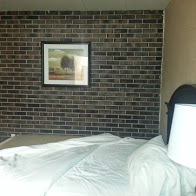
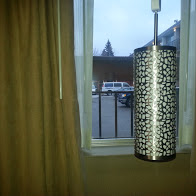
nicebutsmall1The room here is small, and set a half-floor down, but it has a heated bathroom floor and really, for one person, it’s all I need. I’ve just been spoiled travelling for my employer where upgrades are de rigueur.

I basically dropped everything at the room and hobbled.


nicebutsmall2nicebutsmall3

Registration was easy and I got a lovely little package of gifts including a book, Flashpoint trading cards (I think – it could be a booster pack for a game), and some consuite drink vouchers.

By then, I’d missed the opening ceremonies and the walking tour of the facilities. I attended two panels that night, saw, but did not approach Robert J. Sawyer (he was often talking with someone and I didn’t want to intrude), reconnected with Marie Bilodeau, who gave me an awesome compliment, and then had a very late supper while I listened to Klingon karaoke.

Just to be clear, people were not singing karaoke in Klingon, that was just the name of the event.

When I got back to my room, I discovered the microwave did not work. Another point against my sore back as I’d have to do without a warm wheat bag for the night. I got that fixed up this morning.

I’m going to begin blogging the sessions I attended, but only on the weekends. I have to go back to work next week, so I will not be spending my writing time with further bloggage. I’ve had to pace myself because of the back, so I shouldn’t be blogging Ad Astra forever. Just a few weeks. Probably enough to see me through to the next conference 😉

So that’s how I got here.

More fun to come.

Mischief managed: The M2the5th Twitterview with Roz Morris, March 29, 2014

For my second Twitterview hosting experience, I got to quiz Roz Morris.

Squeeeeee!

For those of you who don’t know, Roz is the ghost writer for some 12 bestselling novels.
She is also an editor and book doctor (are the two the same? Read the Storify linked below to find out!), and in recent years she’s self-published two novels under her own name and the first two books in her Nail Your Novel series, all bestsellers. She also writes articles all over the internet, teaches writing and self-publishing classes … the woman is amazing.

And so gracious with her time! When we proposed the Twitterview as the culmination of a month-long Roz Morris spotlight on the M2the5th Google Plus community, little did we suspect how engaged Roz would be. Lori Sailiata, Amy Pabalan, and I may have shared her blogs, videos, and articles, but she commented on every one, and we had some interesting conversations.

If you visit her web site (linked above), you can find out all about Roz, her consultancy services, her books, and everything else.

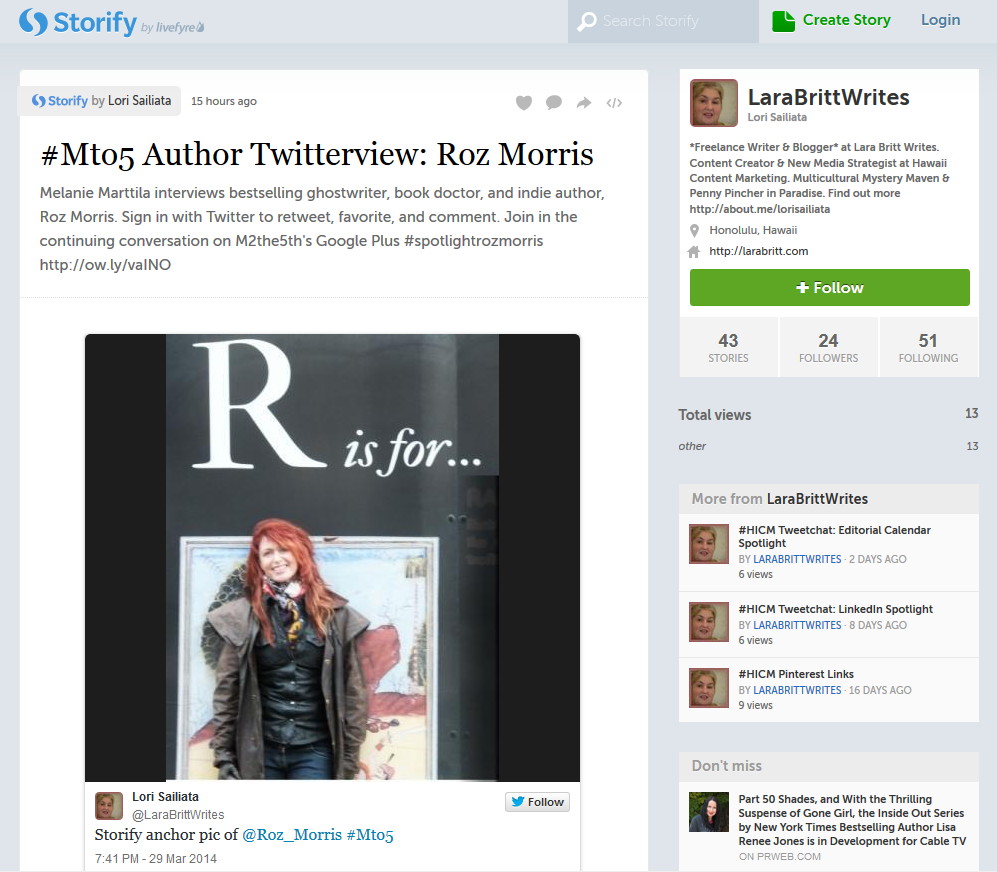
You can also read the Storify of the Twitterview (put together by chief Tweet wrangler, Lori): https://storify.com/LaraBrittWrites/mto5-twitterview-roz-morris

#Mto5 Roz Morris Twitterview Storify

#Mto5 Roz Morris Twitterview Storify

Yesterday’s Twitterview was a great time. It’s really a matter of controlled chaos, or mischief managed, if you like the Harry Potter allusion.

Not only is Roz a great writer and writing coach, but she also, as Amy learned, owns a horse, which boosted Roz’s cool quotient in Amy’s eyes. And if that wasn’t enough, Roz attended circus classes and tried out everything from juggling to the trapeze.

New Twitter friend Mark was active throughout the hour-long session, but other participants, including Porter Anderson, retweeted and shared some of Roz’s gems during and after the Twitterview.

And that’s not all!

M2the5th (Mostly Multicultural, Mysteries, Memoir, and Myth) will be holding weekly Nail Your Novel Tweet chats followed by video hangout workshops on Saturdays throughout April (except for Easter weekend). Join the Google Plus community for more details as they emerge.

We want to keep the Roz-love going because her third Nail Your Novel will be coming out this spring!

Wheeeee!