Tipsday: Writerly Goodness found on the interwebz, July 10-16, 2016

Got some goodies for you this week 🙂

Roz Morris shares three steps to a smoother writing style. Nail your novel.

If you just keep writing, will you get better? Barbara Baig guest posts on Jane Friedman’s blog. Later in the week, Elizabeth Sims guests with this post: internal dialogue is the greatest tool for gaining reader confidence.

K.M. Weiland offers seven reasons you need story theory. Helping writers become authors. She returns with more lessons from Marvel: how to write subtext in dialogue.

MJ Bush brings her usual awesome in her advanced techniques (and insights) for jaw-dropping dialogue. Writingeekery.

Sophie Masson shares a few tips on writing fiction for middle grade audiences. Writer Unboxed.

David Corbett builds on Heather Bouwman’s WU post of the week previous with Sisyphus, happiness, and the Abyss.

Lisa Cron explains why it’s crucial to write ugly. Writer Unboxed.

Marcy Kennedy returns with part three of her reading as a writer series (with links to part 1 and part 2).

Elizabeth Kauffman rounds up some of the DIYMFA launch team’s posts from the last weeks (with a lovely nod to one by yours truly). Gabriela Pereira interviews Emma Straub for DIYMFA Radio. And then Andree Neal writes a guest post for DIYMFA (you might notice her in the round up, as well).

S.L. Huang guest posts on Chuck Wendig’s Terribleminds on the subject of manpain (!)

David D. Levine: a passion for Mars. Tor.com

Posche Burke: on white writers, ‘daring’ topics, and the unappreciated legacy of Octavia Butler. The National Post.

Ayodeji Awosika shares the undisputed secret to becoming a great writer.  Creativity is a muscle. Be yourself.

How to be a writer: the map is the territory. Ramona Ausubel shares her winding path to publication. Literary Hub.

Award news!

Airship Ambassador interviews Holly Schofield.

Connie Verzak recaps the Outlander season 2 finale for Scotland Now. Oh, the feelz.

Rogue One: A Star Wars Story. Celebration reel.


See you Thursday for some weighty thoughty.

Tipsday

My favourite story archetype

QOTW 15: What’s Your Favorite Type of Story?

Now I want to know: what’s your favorite story archetype? If you need a refresher on these archetypes, look back at Chapter 11 to the section on conflict and power struggles. More importantly, I’d love to know why you chose that story type and whether you’re using it in your current work-in-progress (WIP).

content_QOTW-15

In presenting her QotW, Gabriela mentioned how much she enjoys underdog, or comeback stories.

I have to confess a fondness for the same. I tend to appreciate these stories in the context of the bildungsroman, or the classic story of a character who moves from innocence to experience, in short, the coming of age story.

In terms of the classics, a lot of Dickens’ works are of this type (Oliver Twist, Great Expectations).

I read (and write) a lot of fantasy, though. So I’ll give you a couple of examples from the genre.

I recently read (and enjoyed—a lot) Brent Weeks’s The Way of Shadows. In this novel, Azoth, a young guild rat, begins the story as a homeless orphan whose only aspiration is to stop being afraid all the time. In the attempt to attain his goal, he apprentices to a magical assassin, plays the part of a young noble in the course of his education, and eventually becomes the Night Angel, not by doing what’s expected of him, or what his master tells him to, but by doing what’s right.

Very Oliver Twist-ish, non?

An old favourite of mine is Mary Brown’s The Unlikely Ones. In this lovely fable, the protagonist, known only as Thing, is servant (slave) to a witch. She’s forced to wear a mask all the time because her mistress tells her how ugly she is.

Thing’s lie is very literal. She behaves like the Thing she’s always been told she was. Magic begins to happen when she starts to challenge the lie, however. What I like most about this novel is that Thing manages her transformation through acts of kindness.

My own novels, though I’d very much agree that my protagonists are all protectors, follow similar development and themes. Though they may all have special talents that eventually help them become ‘bigger than life’ characters, my protagonists begin their stories disadvantaged in some way. They have to learn through struggle and loss what they might become.

If you want to find out more about story archetypes, or any of the other writerly goodness that is DIYMFA visit the DIYMFA page!

Tomorrow: I’ll be sharing my notes on the final Ad Astra session I attended.

Next week: I’ll be starting on the panels and presentations I attended at the Canadian Writers’ Summit.

Thoughty Thursday: Things that made me go hmmmm on the interwebz, July 3-9, 2016

With all the shootings of African Americans and police this week, I must admit to despair. Others have posted much more eloquently than I. Here is one post that spoke to me.

Justin C. Cohen offers some advice for white people in the wake of the police murder of a black person.

David Wong explains why anxiety is the plague of the modern world. Cracked.

You must die to live. Science and non-duality.

This is a bit distressing. Chanty Binx speaks up after three years of harassment and a bizarre privacy breach. We Hunted the Mammoth.

Shahida Arabi shares twenty tactics highly manipulative narcissists, sociopaths, and psychopaths use to silence you. Thought Catalog.

Zack Beauchamp writes: Canada is the least xenophobic country in the western world. Vox.

But we have out problems:

How Karoli Kuns became a Hillary supporter after reading the candidate’s emails. Blue Nation Review.

Mike Wall covers Juno’s move into obit around Jupiter for Space.com. And Phil Plait covers the event for Slate.

This is the last thing Japan’s Black Hole satellite saw before it died. Ria Mizra for Gizmodo.

Maddie Stone reports that the prospects for alien life on Titan keep getting better. Gizmodo.

Why do you hate the sound of your own voice? ASAP Thought.


Dr. Seuss’s secret artwork is displayed at Vancouver gallery. CBC.

Animals transition to freedom as Argentina transforms zoo into a refuge. AP.

A woman uses an ancient Viking song to call cattle. LifeBuzz.

Lindsey Stirling: The Arena


See you Saturday!

Thoughty Thursday

Tipsday: Writerly Goodness found on the interwebz, July 3-9, 2016

Some very interesting posts and articles this week 🙂

K.M. Weiland continues her most common writing mistakes series with part 52: stagnant story conflict. Helping writers become authors. Becca Puglisi guest posts later in the week with four ways to choose the right story setting. Kate returns with more lessons from Marvel: how to transform your story with a moment of truth.

Must you have conflict in every scene, disaster in every act? Roz Morris says, yes, and no. Nail your novel.

Kathryn Craft shares ten ways to add a spark of fire to your fiction. Writer Unboxed.

Donald Maass explores how to stay ahead of yourself . . . and your reader. Writer Unboxed.

Heather Bouwman writes (in the) happy middles. Writer Unboxed.

Annie Neugebauer begins a new series for Writer Unboxed. The query letter, part one: the pitch.

Sara Letourneau looks at the protagonist-antagonist relationship in DIYMFA’s developing themes in your stories series.

Data mining reveals the six basic emotional arcs of storytelling. MIT Technology Review.

“The six basic emotional arcs are these:

A steady, ongoing rise in emotional valence, as in a rags-to-riches story such as Alice’s Adventures Underground by Lewis Carroll. A steady ongoing fall in emotional valence, as in a tragedy such as Romeo and Juliet. A fall then a rise, such as the man-in-a-hole story, discussed by Vonnegut. A rise then a fall, such as the Greek myth of Icarus. Rise-fall-rise, such as Cinderella. Fall-rise-fall, such as Oedipus.

Susan Spann busts some popular copyright myths. Writers in the storm.

Hugh Howey writes about an idea, broken. The Wayfarer.

Shakespeare and music.


Underwritten female character: the movie. (Bwahahahaha!)


What Mallory Ortberg learned about heterosexual female desire from decades of reading. The Toast.

Ted Ed: What makes something Kafkaesque?


Airship Ambassador interviews Colleen Anderson in four parts: part one, part two, part three, and part four.

Jen Doll explains how A Wrinkle in Time changed science fiction forever. One of my formative reads. Who’d a thunk it? Mental Floss.

Shawn Taylor wonders why Hollywood is ignoring Octavia Butler. Fusion.

The New York Times called this guy daring for “daring” to tackle slavery through science fiction. (Includes the author’s response.) J. Hotham for Slate.

Jonathan Barkan celebrates 30 years of Big Trouble in Little China. Bloody Disgusting.

Emily Asher-Perrin: Jupiter Ascending is a chilling look at our future, in more ways than one. Tor.com

Phil and I are looking forward to checking this one out. Netflix’s 1980’s science fiction throwback Stranger Things is must (binge) watch TV. i09

Until thoughty Thursday!

Tipsday

Trying new things with DIYMFA

Here is the QotW:

QOTW 14: Try a New Technique

Throughout the book, there are visual techniques, diagrams, and exercises to help your writing. These include story-mapping, the revision pyramid, the character compass, and so forth. This week, I want you to choose a technique that is new to you and try it out. Then report back and tell us how it went.

The technique I’ve chosen is TADA.

This is an acronym Gabriela created to assess character. The letters stand for Thoughts, Action, Dialogue, and Appearance.

The idea is that the writer wants to achieve a balance between all four aspects of character, and between characters, in each story. This could even be applied on a scene by scene basis.

So you can look at your characters individually, in scenes, in conjunction with one another, and overall in the story to ensure you’re keeping all of these character elements in the ratios you want.

To visualize this, Gabriela provided a graph, which she calls the character compass. It’s a circle with the letters T, A, D, and A distributed over the cardinal directions. Lines divide the circle into four with Thought and Dialogue, and Action and Appearance, in opposition to each other.
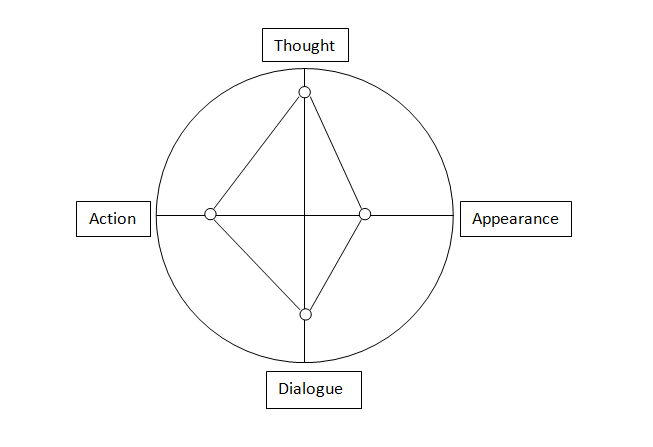
CharacterCompass

I’ve done my best to create a facsimile with Word’s drawing tools, print screen, and The Gimp 🙂

In this particular compass, I’m looking at one character, Ferathainn, in general.

She’s my protagonist and her POV is first person, past tense. There’s a lot of thought and internal monologue with Fer.

She’s studying to become a mage, but at the beginning of the novel, it’s all been theoretical. Her studies have prevented her from maintaining friendships, and so she lives in her head a lot. Part of her studies include rhetoric. Intonation and presentation can affect certain types of magick.

Fer’s been allowed (yes, allowed, it’s a plot thing) to study with her father, who is a bard, and her betrothed, who is an eleph finiris, or songmaster, because magick can be sung. She’s extended this part of her training to include dance, because she’s realized she needs a physical outlet after all this theory and rote memorization.

One of her small rebellions is that she also trains with her best friend, the forester, who teaches her how to fight. Primarily unarmed combat and survival skills.

So Fer is a heavily thinky character, with a good side order of dialogue and action. She doesn’t often consider her appearance, however. There aren’t a lot of mirrors in her little village. It’s not something she’s ever placed a lot of value on.

So I have to be careful when I write a scene about Fer alone, because she’s lopsided.

When she interacts with other characters, it’s primarily through dialogue and action, but I have to pay attention to their reactions to her physically. It’s actually very good for the show versus tell thing.

For example, Fer’s mother has to reach up to hug her, because Fer is tall. She’s of a height with her father, though. Through little interactions like this, readers form a picture of Fer in their minds over time.

When I switch POV to the other characters, they get to describe Fer, but I try not to have them do the ‘classical’ romantic inventory.

In early romances, which were often more adventure tales than what we think of as romances, when the hero meets the love interest for the first time, he waxes poetic and describes her from head to toe. Bad thing to do in a modern novel, though.

When Eoghan first ‘meets’ Fer, she’s all but dead. Having tried and failed to save victims of the war in the wake of the army’s passing, Eoghan decides he’s going to make his stand. He’s going to save this raggedy girl if it’s the last thing he does. Her appearance, other than the severity of her wounds, is secondary to his efforts.

When Dairragh first sees Fer, it’s from a distance, and it’s what she’s doing—performing magick—that makes its biggest impression on him. Dairragh hates all magi with a passion for the sake of the mage who murdered his parents and destroyed his home, including the people and gryphons that were his charge to protect.

So, of course, he hates Fer on sight and his prejudice colours his every interaction with her. At least initially.

The way I see it, readers are going to form an image of Fer in their heads that’s probably nothing like the way I see her. And that’s okay. They get ownership of my characters and my story on a reader by reader basis.

That’s what I want.

Gabriela’s TADA acronym and character compass are going to be one tool I take from the DIYMFA book and incorporate into my writing process.

Since I’m a plantser (part plotter, part pantser) I tend to pants my way through the first draft, but in revision, I can see the character compass being a very useful tool to evaluate how balanced my characters are in any given scene.

I hope I’ve given you enough of a run down that you might be able to make use of this technique yourself. Of course, you could always go buy Gabriela’s DIYMFA book and get a more detailed explanation of TADA and the character compass. The official release date was yesterday.

Jus’ sayin’.

content_QOTW-14

Thoughty Thursday: Things that made me go hmmmm on the interwebz, June 26-July 2, 2016

Lightheaded this week, but it’s all guaranteed to pop your mental corn 🙂

The Toronto Star posts all 113 of the new Order of Canada recipients. Yay, Canada!

Samantha Bee does an awesome job of summarizing Brexit for the rest of us. And David Tennant helps out, too! The Week.

The chief who said no. One northern village rejected residential schools and built their own instead. Bob Weber for The National Post.

Lindsay Harrison shares ten lessons her mother’s death taught her about healing and happiness. Tiny Buddha.

Sarah Schuster shares what it’s like to have high functioning anxiety. The Mighty.

Pride Toronto members respond to messages of hate. Robin Levinson King for The Toronto Star.

The next time someone says women aren’t the victims of harassment, show them this. Tickld

John Pavlovitz writes about young men, sex, and urge ownership (and why it’s not the girl’s problem). Standing ovation. Bravo, man.

Wonder Woman became the feminist hero the 70’s needed. Gwen Ihnat for the A.V. Club.

Julie D’Aubigny, also known as La Maupin, is profiled on Badass of the Week.

A small meteorite punches through the roof of a house in Thailand. Phil Plait for Slate.

Maddie Stone reports on Jupiter’s stunning northern lights. Gizmodo

One of my recent faves. Nothing but thieves – Trip switch.


See you Saturday!

Thoughty Thursday

Tipsday: Writerly Goodness found on the interwebz, June 26-July 2, 2016

Easing back on the overwhelm of writerly goodness this week. You’re welcome 🙂

K.M. Weiland shares five secrets of creating complex supporting characters. Helping writers become authors. Kate returns with more lessons from the Marvel movies: use minor characters to flesh out your protagonist.

Bonnie Randall guests on Janice Hardy’s Fiction University: the Pandora ’s Box of having ‘been there.’

Steven Pressfield: The Dude abides, but in what genre?

Jami Gold helps you strengthen your writing with rhetorical devices (and the angels sing—I lurve rhetorical devices).

Angela Ackerman guest posts on DIYMFA: the top five mistakes writers make when it comes to setting.

Oren Ashkenazi offers a counterpoint to his post of last week. Five bad ideas science fiction teaches us to love. Mythcreants

Kristiana Willsey says that hunger is the beginning of every folktale. The Toast

Tim Grahl: how to use fear to beat resistance.

Marcy Kennedy asks, is it important for writers to be readers? Spoiler: It’s an emphatic, duh, yes!

Jeff Goins tell us everything we need to know about Facebook Live on the Portfolio Life podcast.

Alice Adams considers the question, why does anyone write? Literary Hub

Lincoln Michel teaches you everything you wanted to know about book sales but were afraid to ask. Electric Lit

This is shameful. The journalist who risked her life going undercover in North Korea had her expose marketed as an Eat, Pray, Love-style memoir. Anna Merlan for Jezebel.

Alison Stine explores Labyrinth and the dark heart of childhood. The Atlantic.

I think these Game of Thrones/Legend of Korra mash ups are amazing. What about you? Movie Pilot

The Game of Thrones finale confirms game-changing fan theory. Entertainment Weekly.

Also, Game of Thrones showrunners confirm that there are only 13 to 15 episodes left. Wah! They really pulled last year’s plot poopers out of the fire this year. Oh well. i09

Germain Lussler wonders why more people aren’t talking about the Preacher series. Phil and I are enjoying it 🙂 i09 Later in the week, he reports that Preacher season two will return with 13 episodes. YAY!

AMC’s Preacher series is different from the comics, but you’ll probably really like it anyway. James Hibberd for Entertainment Weekly.

And that was your informal writerly earnings for the week.

See you Thursday!

Tipsday

Reviewing the four C’s of my to-be-read pile with DIYMFA

Here we are with question of the week thirteen!

QOTW 13: What’s On Your Reading List?

If you’re anything like me, you’ll never get around to reading every book on your to-read list. That’s why at DIY MFA I believe in reading with purpose and encourage you to focus on books in four main categories: comps, contextual, contemporary, and classics.

QOTW-13

As I mentioned previously, I have far too many books. It’s really to the point at which, if I were to be in my office when a serious earthquake hits, I’d probably die, buried under my to-be-read pile.

So it’s good that Gabriela limited this exercise and gave it some critical DIYMFA context 🙂

Comparative/competitive books

Because I’m working on multiple books in fantasy (and various sub-genres/categories, thereof) and science fiction, I’ve tried to line up a varied comp reading list.

  • One’s Aspect to the Sun – Sherry D. Ramsey (Canadian author, science fiction)
  • The Towers Trilogy – Karina Sumner-Smith (Canadian author, fantasy)
  • The Worldbreakers Saga – Kameron Hurley (American author, fantasy)
  • Binti – Nnedi Okorafor (American author, science fiction)
  • Signal to Noise – Silvia Moreno-Garcia (Canadian author, science fiction)

Some of these books are award-nominated and/or the authors are award-winning 🙂

Contextual books

These are books I’m reading to teach me something specific about craft/genre.

  • The Second Cadfael Omnibus – Ellis Peters
    My epic fantasy series is based in a world that is (I know, I know) derivative of medieval Europe, one of my characters is a postulant monk, and herbalism plays a role in the novels.
  • The Night Angel Trilogy – Brent Weeks
    I’m loving Weeks’s approach to worldbuilding. His world is a mash-up of European and Asian elements (and probably some others I’m not aware of, yet).
  • Under My Skin – Charles de Lint
    He’s a Canadian author of urban fantasy. A couple of my novels are YA urban fantasy. It’s good to learn from a master 😉
  • Children of Earth and Sky – Guy Gavriel Kay
    I would just love to be able to craft a story like Kay. His was one of the only books that moved me to tears.
  • Fish Tales – Sherri S. Tepper
    Just love where her books go in terms of plot and character. Science fiction with a hefty helping of social justice.

Contemporary books

  • The Madd Addam trilogy – Magaret Atwood
  • The Book of Negroes – Lawrence Hill
  • All the Light We Cannot See – Anthony Doerr
  • The Girl on the Train – Paula Hawkins
  • Quantum Night – Robert J. Sawyer

Classics

  • The Kalevala, the Finnish National Epic Poem (in translation)
    ‘Cause part of my heritage is Finn 🙂 And there’s magic and all sorts of cool stuff.
  • The Pickwick Papers – Charles Dickens
    Because I discovered I quite like Dickens 🙂
  • The Secret Garden – Frances Hodges Burnett
  • Boxen – C.S. Lewis and W.H. Lewis
  • The Great Gatsby – F. Scott Fitzgerald
    ‘Cause I never finished it in school—yeah, I know.

So there you go. You’ve had a peek at my TBR list.

I’ll be back tomorrow with my next chapter update.

Thoughty Thursday: Things that made me go hmmmm on the interwebz, June 19-25, 2016

Yes, I caught up on my YouTube viewing 😉 So, it’s another visual learning week.

Andrew J. Hawkins looks at the hyperloop pods competing in Elon Musk’s big race, later this year. The Verge.

Marissa Gertz presents astronaut, Tim Peake’s amazing photos from his time in space. TIME.

Does Pluto harbour an ocean under all that ice? Phil Plait for Slate. And later in the week, Hubble shows us the colours of the night.

Add This shares Dieter Ram’s ten principles of good design.

You see crisis after crisis. This is what we see. Attawapiskat youth create video. CBC.

Wab Kinew got on his soap box: five aboriginal stereotypes.


Before European Christians forced gender roles, Native Americans acknowledged five genders. Pearson McKinney for the Bipartisan Report.

I respond to Orlando from a Canadian perspective on my friend, Mel Walsh Jones’s blog, Mel’s Madness.

Vi Hart: Feeling sad about tragedy.


Russell Foster: Why do we sleep? Ted Talk.


Lena Dunham shares her conversation with Sheryl Sandberg. On navigating workplace culture, tackling personal issues, and (of course) leaning in. Esquire.

Women having a terrible time at parties in western art history. The Toast. On a sad note, I just heard that The Toast is . . . toast 😦

Adrienne Pieroth: she was done. Elephant Journal.

Eight amazing aquatic animals. ASAP Thought.


Science vs. art. ASAP Thought.


Tom Vanderbilt shares the secret of taste: why we like what we like. The Guardian.

How did the entire town of Ashley, Kansas, simply disappear? Gregory Burkhart for Blumhouse.com

The fun side of Sudbury, my city 🙂


Musical Tesla coils featuring Physics Girl. It’s Okay to be smart.


Northern Lights Festival Boreal announces that Steven Page will be the final headliner of this year’s event.

Also appearing at NLFB: Natalie McMaster and Donnell Leahy – here they are with The One.


And that was Thoughty Thursday.

Happy Canada Day and Happy Independence Day to all my friends, north and south of the border.

Happy weekend to all my other lovely friends out there 🙂

Thoughty Thursday

Tipsday: Writerly Goodness found on the interwebz, June 19-25, 2016

I have no idea where all this came from. It was a bountiful week for Writerly Goodness.

Julie Glover guest posts on Jami Gold’s blog: four steps to break grammar rules with style.

Anne Janzer guest posts on Jane Friedman’s blog: how to create an internal mindset conducive to writing.

Barbara O’Neal conducts an experiment in fostering creative flow. Writer Unboxed.

When you don’t want to write: Heather Webb on Writer Unboxed.

Joanna Penn discusses how to banish writer’s block with K.M. Weiland. The creative Penn.

How to plot a book: start with the antagonist. K.M. Weiland’s Helping writers become authors. Later in the week: how (not) to write satisfying action scenes. More lessons from the Marvel Universe movies.

Jami Gold wonders why “unlikable” can be a deal breaker for readers.

MJ Bush offers her keen insight into writing the perfect flaw. Writingeekery.

Dave King explores the work of a master for Writer Unboxed: Jaime Lannister and sympathetic monsters.

Kayla Dean explains how to use story archetypes to subvert expectations. DIYMFA.

DIYMFA radio, episode 100: Unleash your storytelling superpower with Gabriela Pereira.

C.S. Lakin takes a look at the first turning point in your novel. Live, write, thrive.

Chris Winkle offers three painless ways to patch plot holes. Mythcreants.

Jamie Raintree delves into the process of overcoming the emotional obstacles to a writing career. Writers in the Storm.

Five good ideas science fiction teaches us to fear. Oren Ashkenazi for Mythcreants.

Katherine Langrish shares some thoughts on writing meaningful fantasy. Tor.com

Women at WorldCon


Dan Blank: celebrate the arts where you live. Writer Unboxed.

Janet Reid lists the reasons she rejected 25 queries so you can avoid them. She later confesses: so I didn’t get it right the first time . . .

Sarah Negovetich: it’s not you, it’s really not.

Jonny Gellar’s Ted Talk: What makes a bestseller?


This is a weird story from the MFA world. Steven Galloway, chair of UBC’s creative writing program, was fired after an investigation, but under mysterious circumstances. Nobody’s willing to say exactly why. I think anyone reading the articles can infer, but . . . I’ll let y’all judge for yourselves.

Susan Spann explores the legal side of writing for anthologies. Writer Unboxed.

The Active Voice shares the story of Pauline Creeden, who lost her Amazon publishing account through no fault of her own.

Sadness. Lois Duncan died on June 15th at the age of 82. I loved her books. Publishers Weekly.

Jim C. Hines writes about racism and the backlash against black Hermione.

Cory Doctorow revisits Writing the Other, intensely practical advice for representing other cultures in fiction. BoingBoing

The Witch explores America’s essential fear of female power. Dianca Potts for Lenny.

Brainpickings presents Virginia Woolf’s thoughts on the connection between loneliness and creativity.

She-Ra and the fight against the token girl. Maria Teresa Hart for The Atlantic.

Publishers Weekly: Fall 2016 adult announcements in SF, fantasy, and horror.

Indie presses are starting bookstores. Jon Sealy for Literary Hub.

Chemistry explains why old books smell so good. Robin Burkes for Tech Times.

The short film, The Birch, may be creepy, but I think it’s rather heart rending warming 🙂 Rebekah McKendry for BlumHouse.com

James Whitbrook shares Geroge R.R. Martin and Stephen King in conversation: how the fuck to you write so fast? i09. Watch the whole talk. It’s awesome.

Who’s afraid of female Ghostbusters? Dave Itzkoff interviews the cast for The New York Times.

Michael Livingston gets medieval on Game of Thrones’ ‘battle of the bastards.’ Tor.com

Entertainment Weekly shares a sneak peek of the actors who will play Roger and Brianna on Outlander.

Exhausted? I am.

Until Thursday *waves*

Tipsday