The next chapter: July 2016 update

So, here we are again at a monthly update. August. Where has the year gone?

One of the great things about tracking your production (and this applies to all things, not just writing) is that you can look back and see the evidence of your work. It’s very comforting.

In addition to wrapping up my work in July this time, I’m going to review the year to date.

July

JulyProgress

This month, I finished my first review of Gerod and the Lions. As with the last couple of novels, I wasn’t twitching as I reread, reacquainted myself with the story, and worked on some of the flow issues I saw. One reason for the flow issues was that GatL was written in chunks, separated by work done on other projects.

Sometimes the gaps were months long, and it shows. I had to get my head back into Gerod’s world and each time I returned to it, it took a few days to recapture the feeling.

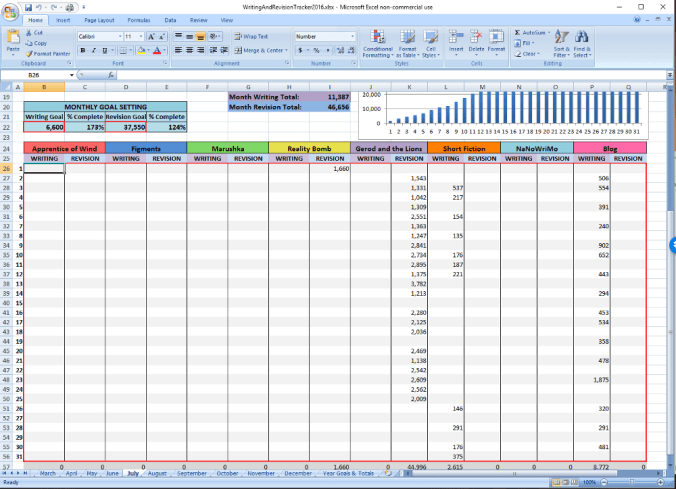
The draft comes in at 44,996 words, which is decent for a middle grade book and 124% of my revision goal for the month.

I also continued work on the short story, which I’ll be submitting for consideration soon. 2,615 words written on that.

And, of course, there was the blog, and since I continued to participate in the weekly challenges presented by Gabriela Pereira to her DIYMFA Street Team, I far outblogged my goal.

Between the short story and the blog, I wrote 173% of my goal for July.

I also had the pleasure of guest blogging a couple of times in July, once on Mel’s Madness, and later, on DIYMFA (holy cow!). I have another guest blog due out this month on Kristene Perron’s Warp World blog.

I continued querying.

Year-to-date

Please keep in mind that revision is a very different animal than writing. I’m not writing all these words from scratch. I’m rearranging words, rewriting sentences or paragraphs for flow, inserting or removing punctuation, and making notes for future revisions.

Writing equates to original words.

Month Revision Writing Projects
January 69,774 words 186% of goal 9,274 words 141% of goal Apprentice of Wind, blog
February 40,708 words 108% of goal 5,027 words 90% of goal Apprentice of Wind, blog
March 66,637 words 177% of goal 8,436 words 141% of goal AoW, Figments, Marushka, blog
April 37,478 words 100% of goal 10,498 words 187% of goal Marushka, blog
May 50,882 words 136% of goal 10,474 words 181% of goal Marushka, Reality Bomb, blog
June 48,009 words 128% of goal 12,013 words 207% of goal Reality Bomb, blog
July 46,656 words 124% of goal 11,387 words 173% of goal RB, Gerod and the Lions, short fiction, blog

 Now and the rest of the year

With GatL, I’ve finished reviewing all of my drafted novels. Many of them are still grossly underwritten, but at least I have a better idea now of where I’m going with each.

For August, I just finished up my short story, which I will now revise, and otherwise, the only writing I’m doing is on the blog.

I’ve taken some time off to consider the remainder of the year and what I want to do.

Under consideration are:

  • Assembling a poetry collection (going to submit to a local small press) – August
  • Organizing a collection of my non-SFF short fiction (again, targeted at the small publisher) – August
  • Outlining the third book in my epic fantasy series. I’ve already taken a shot at it, but I know I have to rework it. I’ll do this anyway, because it’s this year’s NaNoWriMo project, but it’s on the list. – concurrent with other projects through to the end of October
  • Returning to Initiate of Stone and AoW, to recapture the voice of the series and bring everything into line in light of the outlining and NaNo for the third book. I want to get to November steeped in the world and its characters. – September and October

Because the third in series is of the epic nature, I expect to be continuing the drafting well into December.

I’m also taking a bit of time to think out how I want to structure my writing year from here on out. Previous to 2016, my focus was on getting the words down. Great, but then I had six novels drafted, only one of which was ready for querying.

This year, I’m focusing on the revision of all those drafts. They won’t be completely ready to go, but I’ll be in a place where I can alternate writing and revision in the coming years.

I want to draft new work twice a year, and then work on revision in between. I don’t know exactly what form that’s going to take (except for NaNo), but I think it’s something I can do.

Other stuff

I’m heading out to WorldCon/MidAmeriCon II on the 17th. It will be my first big con, so I’m super excited. This will be my last convention or conference for the year, though. I’ve blown my budget.

As a result, though, I’m going on a blogging vacay. I’ll schedule my Thoughty Thursday curation for the 18th before I leave, but you won’t hear from me again until I’m back and recovered and ready to resume bloggage on the 27th. Sacrifices have to be made.

I’ve done the crazy and applied for Brenda Drake’s #PitchWars. I’ll find out how that goes on the 25th. Not saying more about it for now.

I’m investigating partnerships with an editor. I want something long term, a professional editor who can help me get my drafts into publishable states.

I signed up for a first five pages workshop with NLA. Again, I’ll leave the deets for later.

And that’s this writer’s life.

Next weekend, I’ll be continuing with my CWS 2016 reportage with my notes from the Writing Hard Truths panel.

The Next Chapter

Thoughty Thursday: Things that made me go hmmmm on the interwebz, July 24-30, 2016

And here we are in August . . . where has the year gone (so far)?

Jim C. Hines hosts a couple of special guests for this post on policing in problematic times.

Onto the good news . . .

Sudbury will get a new rooftop mural for this year’s Up Here Festival. CBC

Jennifer Wolkin recommends mindful eating for a healthier brain-gut connection. Mindful.

The discovery of the heart. Paul Kennedy’s Ideas, on CBC.

The Scottish Refugee Council: Courage.


Parmigiani Fleurier restores a 200 year old double barrel pistol and its animated songbird.


Nicole Prause: what women (don’t)  need. Nova’s secret life of scientists and engineers.


Bored Panda presents pictures of modern women wearing traditional Ukrainian crowns.

The Vintage News reports on crinolinemania, the dangerous Victorian fashion garment that killed nearly 3,000 women (!)

April Holloway reports: DNA testing on the 2,000 year old Paracas skulls may change anthropology. Ancient Origins.

It turns out you only need one hour of moderate activity to make up for a day’s sitting. Exactly what I didn’t need to hear (Mellie = sluggie). Jennifer Ouelette for Gizmodo.

Bill Gates, Warren Buffett, and Oprah Winfrey all use the five hour rule. Inc.

Dying is hard. Death Doulas want to help make it easier. Ellen McCarthy for The Washington Post.

Rosetta’s final resting place has been chosen. Phil Plait for Slate. Later in the week: A white dwarf zaps its red dwarf companion with a death ray.

Kevin Kelly wonders if we’re heading toward a Minority Report style future. Tech Insider.

Monarch butterfly population triples over last year. Terry Turner for Good News Network.

When a crow dies, other crows investigate. Katherine Ellen Foley for Quartz.

Watch the Chincoteague ponies complete their 91st annual swim. Jason Daley for the Smithsonian Magazine.

Humpback whales protect other sea animals from killer whale attacks, but no one knows why. IFLS.

Tony Wu captures amazing sperm whale rituals. bioGraphic

Happy Friday!

See you Saturday for July’s next chapter update 🙂

Thoughty Thursday

Tipsday: Writerly Goodness found on the interwebz, July 24-30, 2016

Yummy, soul-feeding stuff this week.

The first post of the week for K.M. Weiland was intensely personal. It was also inspirational. It was exactly what I needed to read as the world around me seems to be falling to pieces (though that’s more apparent in my Thoughty Thursday curation posts, of late). Read it, my writerly friends, and take heart. This is why we write: five reasons why writing is important to the world. Later in the week she cautions us: don’t make this mistake with story structure.

Bonnie Randall guest posts on Janice Hardy’s Fiction University. Once more with feeling: writing emotionally strong characters.

Chris Winkle offers five ways to restore tension in your novel. Mythcreants.

Two of my favourite writerly women: Joanna Penn interviews Roz Morris for the Creative Penn podcast. Finding your author voice.

Katharine Britton guest posts on Writer Unboxed. On the road to a first draft: when you don’t know where you’re going, any road will do.

Marcy Kennedy is back with part four of her reading as a writer series.

Kelly Harms: writing a book takes how long, now? Writers in the Storm.

Jami Gold shares more lessons learned from her recent RWA conference. Do you belong, or are you a fraud?

Shawn Coyne wonders if good enough is good enough . . . This post was a bit controversial for a friend. Yes, we need mentors; we need editors. I personally don’t think there’s anything wrong with learning through experimentation, practice, and study, however. The idea that writers aren’t good enough, that they can’t be good enough without the intervention of others can result in sensitive creatives believing that they are inherently worthless. Or, it can result in the following problems, which can be just as bad . . . Just sayin’.

Karen Woodward encourages us to let go of perfectionism.

Kristen Lamb explores stress and burnout . . . and how to get your writerly mojo back.

Heather Webb has some advice on what to do when you feel like you’re treading water. Writer Unboxed.

Kameron Hurley: the wisdom of the grind.

Jane Friedman offers a definition of author platform.

Constance Renfrow writes about the do’s and don’ts of query letters. DIYMFA. AND . . . I had the opportunity to guest post on DIYMFA thanks to my participation in Gabriela’s Street Team! Five things I’ve learned from being on the DIYMFA Street Team.

Camille DeAngelis says that having her book go out of print was a pretty great thing, after all. Publishers Weekly.

Lynn Neary: can serialized fiction turn binge watchers into binge readers? NPR.

Sudburian Matthew Heiti wins the Carter v. Cooper competition! The Northern Life.

Working girls: the Bröntes. Elizabeth Hardwick for The New York Review of Books.

Alex Kulaev for BookBaby: The Jungle Book is a beautiful film with flawed storytelling.

Orange is the New Black’s Samira Wiley joins the cast of Hulu’s adaptation of Margaret Atwood’s The Handmaid’s Tale. Amy McNeill for The National Post.

Katherine Trendacosta thinks Christophe Gans’ La Belle et La Bête (Beauty and the Beast) is the most beautiful thing she’s seen in ages. i09

We are not things: shining examples of women’s autonomy in science fiction. Delia Harrington for The MarySue.

Babylon 5’s Jerry Doyle dies at the age of 60. Sadness 😦 James Whitbrook for i09.

And that was your informal writerly learnings for the week.

See you Thursday!

Tipsday

Review of D.G. Valdron’s The Mermaid’s Tale

About the book:

themermaidstaleIn a city of majesty and brutality, of warring races and fragile alliances, a sacred mermaid has been brutally murdered. An abomination, a soulless Arukh is summoned to hunt the killer. As the world around the Arukh drifts into war and madness, her search for justice leads her on a journey to discover redemption and even beauty in the midst of chaos.

Published by Five Rivers Publishing.

My thoughts:

The Mermaid’s Tale is a fable of personhood wrapped in a murder mystery framed by a fantasy setting, peopled by familiar races that are presented in subtly original ways.

Valdron’s protagonist has no name. Most Arukh (orcs) don’t. The few that have been so graced have earned their names by distinguishing themselves from their mad and murderous brethren. Each race has its own name for the Arukh, but all of them translate to either abomination, or abortion.

The Arukh are the sterile offspring of vampires and goblins and considered to be soulless. They are housed in lodges and governed by trolls, dwarves, or vampires and are largely used as expendable troops in warfare, which the various races engage in frequently with one another.

Something horrible has happened, though. A mermaid, one of a race considered sacred, has been brutally murdered. The selk call upon the Arukh to investigate and find the killer. It is implied that this particular Arukh is known for her skill in this area, but not why.

As she investigates, the trail of the killer leads the Arukh to each of the races in turn and the world is eventually fleshed out very cleverly in the form of told tales and legends. The mystery is what first draws readers in, but the world and its stories are what compel readers to continue turning pages.

Valdron’s world is a young one of unmitigated violence and the Arukh’s life is one of degradation. She fails repeatedly in her quest and makes many wrong assumptions, but for all that, the story itself is one of hope and redemption and the climax and denouement are both satisfying and bittersweet.

Readers will be left wanting more (moar!) of Valdron’s world and more of his surprisingly complex protagonist.

I lurved The Mermaid’s Tale.

My rating:

Five out of five stars. I did say lurve, didn’t I?

About the author:DGValdron

Den Valdron, is a reclusive writer, originally from New Brunswick, currently living in Winnipeg, Manitoba. Over the years, he has published in print and online a variety of short stories of speculative fiction, and articles on obscure pop culture topics.

Like many writers, his previous occupations have included mechanic, carpenter, schoolteacher, journalist and ditch-digger. He is currently an aboriginal rights lawyer.

He loves B-movies and tries to be nice to people. The Mermaid’s Tale is his first published novel.

You can connect with Den on Facebook.

Thoughty Thursday: Things that made me go hmmmm on the interwebz, July 17-23, 2016

Less angsty this week, as promised, but there’s still some serious.

Germany finally apologizes for its other genocide—more than a century later. Lynsey Chutel for Quartz.

Physician groups representing 426,000 doctors demand a stop to gun violence. American Psychiatric Association.

How Americans came together after Orlando. Conor Friedersdorf for The Atlantic.

Jim C. Hines considers another pointless police shooting.

Ok. New direction.

Twelve female activists who are changing the world. Joe McCarthy for Global Citizen.

Got privilege? What Lori Lakin Hutcherson told a white friend asked her opinion about white privilege. Good Black News.

Why I’m a racist. Not what you think. Just read it. Beyond the Glass Wall.

Dr. Nadine Caron is Canada’s first female First Nations surgeon. CBC’s the Current.

Canadian doctors have successfully reversed the effect of MS in a patient using stem cells. Notable.ca

Chris Hadfield: Questions for a Star Man. Nova’s secret life of scientists and engineers.


Hubble takes a long look into the heart of the crab nebula. Phil Plait for Slate. Later, he shares a year of Earth’s days in time lapse.

A walk in the woods: how walks are improving mental health. S.A. Mathieson for The Guardian.

Jen Granneman lists twelve things every highly sensitive person needs. Introvert, dear.

Another brief dip, but it’s important.

Lauren McKeon breaks fifteen years of silence. Toronto Life.

The real reason women love witches. Anne Theriault for The Establishment.

Buzzfeed presents seventeen maps that will change the way you view the world.

An orca rescue on Newsiosity.

The Oregon Supreme Court rules that dogs are sentient beings and not merely property. Bark Post.

And on that positive note, I bid thee adieu.

Until the weekend.

Thoughty Thursday

Tipsday: Writerly Goodness found on the interwebz, July 17-23, 2016

I am pleased to present your informal writerly learnings for the week.

K.M. Weiland: four ways to verify if your story concept is strong enough. Helping writers become authors. Also: four places to find the best story conflict.

You know what your novel means, but does your reader? Roz Morris advises that you approch the problem with two mindsets. Nail your novel.

Liz Lazzara guest posts on Writer Unboxed. Storytelling: an exercise in empathy.

Jeanne Kisacky: the synergy of the first draft, whether you trim or embellish. Writer Unboxed.

Dan Blank presents a hobbit’s guide to launching your book. Writer Unboxed.

Pamela Hodges lists fourteen books that should be on every writer’s shelf. The Write Practice.

Jennifer Louden guest posts on Jane Friedman’s blog: five ways to develop your writer’s voice.

Karen Woodward: never give up your dreams.

Chris Winkle offers seven common causes of reader confusion. Mythcreants.

Gail Carriger lends her expertise to Janice Hardy’s Fiction University. How to write (and how not to write) an author bio.

Derek Newman-Stille interviews Kate Story for Through the Twisted Woods.

The Writer’s Block features Matt Murphy.

Victoria (V.E.) Schwab writes about the slow pursuit of overnight success.

Writing as resistance. Chris Hedges for Truth Dig.

Keeping up with the Wangs. (SF related.) The Economist.

Grant Munroe interviews Margaret Atwood for Literary Hub.

Gabrielle Bellot explains why Calvin and Hobbes is great literature. Literary Hub.

This live-action Futurama fan film is both incredibly impressive and creepy. Bryan Menegus for i09.

Coldplay and Michael J. Fox play a tribute to Back to the Future. The Hollywood Reporter.

The Vulture lists every major film reference in Stranger Things. This series is full of homage. Lurve.

John Squires shares what Stephen King thinks about Stranger Things. iHorror.

Germain Lussier presents the first Wonder Woman trailer. Yum! i09

Come back Thursday ya’ll and get ya’s some thoughty 🙂

Tipsday

The Canadian Writers’ Summit 2016: Achieving your dream: the shadow side

Disclaimer: I am not perfect and neither are my notes. If you notice anything that needs correction or clarification, please email me at melanie (dot) marttila (at) gmail (dot) com

Panellists: Suzanne Alyssa Andrew, Carrie Snyder, Maria Meindl, Heidi Reimer, Sarah Henstra (Moderator)

theshadowside

SH: Everyone talks about the struggle that precedes publication, but what about what happens afterward?

[Panellists introduced.]

What’s been your experience with the shadow side?

HR: I’ve been thinking about this because I achieved my creative goals and felt things nobody I knew had ever mentioned. I finished my novel and I felt depressed rather than elated. My spouse is an actor and he’s experienced in the art of letting go. In his world, it’s a recognized thing that all actors experience. It’s not in mine. When I won the Chatelaine contest, I was elated, and then terrified. I looked up their distribution and readership on line. That amount of exposure made me feel vulnerable. I physically recoiled. Something intensely private was about to become public. I talked to friends about my distress.

MM: I feel like I’ve confronted the connection between success and darkness in my life. My grandmother was Mona Gould. By the time I was a child in the 60’s, her poem, “This was My Brother at Dieppe” was everywhere. When her success faded, she turned to alcohol and became bitter. What I learned from that experience is that success is harmful. It can destroy you. When she died, I received boxes of her materials. It took me five years to sort through it. She started promoting her work at the age of eleven. Her poem was sponsored by an arms manufacturer, but she was a pacifist. She didn’t feel she could object. Now I understand that it’s not success that’s destructive, but the lack of a forum and the means to use it.

CS: I always wanted to be a writer. As I was driving in from Waterloo, I tried to figure out what that seven-year-old girl’s impulse was. I focused everything on becoming an author. I published by first book at the age of twenty-nine. It was written when I was twenty-six. It was another eight years before I published my second novel. In 2012, The Juliet Stories came out and was nominated for a Governor General’s Award. It was a huge moment for me. I embraced the high and I rode it. I wasn’t prepared for not winning, though. I mean, I knew I wasn’t going to but knowing it and experiencing it are two different things. They informed us ahead of the public announcement and I sat with the secret for a week. I felt ashamed. I was afraid of disappointing my kids and everyone else who’d been so supportive of me and my book. I didn’t know how to cope with it. I am so grateful for my blog because I was able to get my experience out there. I almost changed careers. I had my acceptance to McMaster’s midwifery program in one hand and the offer for The Girl Runner in the other. I thought I’d made a mistake in pursuing my dream. Now I’m making a living as a writer. It’s wonderful and it’s amazingly difficult at the same time. It’s hard to be here and to be vulnerable in front of you.

SAA: Everything you’ve all said resonates. I’ve just published my first novel and I, too, have always wanted to be a writer. I went on a book tour and it was the first time my family had heard me read my work. I play bass in a band. It’s a group, a community. We share. In literary circles, I find there’s a lack of transparency, especially about publishing in Canada. I think the reality’s worse than any of us realize. There’s a lot of pressure to market your own book. I invested in promotion. I’m a freelance writer. I don’t regret making that investment. At the time I figured, I’ll worry about it later. Well, it’s later and I’m feeling the financial impact. I have second book paralysis, knowing how hard it was promoting my first. Musicians are open and honest about the challenges. They offer each other advice and strategies. Authors in Canada don’t talk about these issues. We’re worried about seeming ungrateful. It’s very isolating. We need to be more vocal as a community.

SH: Can any of you comment further on shame and vulnerability?

CS: You’re novel is something you’ve worked on for years. It will be judged. There will be reviews. I’m a private person. I work through things in writing. It doesn’t feel right to be so exposed. To create anything of value, you have to go there, though. I was terrified of being changed by success. I can deal with rejection, but I have no experience in dealing with success.

SAA: It’s about being a creative person in the public sphere. You can get so involved in the persona you adopt for the media that you can start to feel schizophrenic. We don’t express our real feelings on social media. Everyone else seems more successful, happier. You compare yourself to others and find yourself wanting. There’s another reality to the one presented on Facebook.

HR: When I was published for the first time (I wrote an essay about the experience) I suffered anxiety and panic attacks. If it’s not discussed openely, everyone thinks it’s only them. I have a novel on submission. I received a rejection and felt relief. I know what to do with rejection. A ‘yes’ involves a whole other world. I was happy to stay in my identity as a rejected writer. You have to redefine yourself in light of success.

SH: Is this a question of gender? We’re all women on this panel.

MM: There’s a line between the inner and outer worlds of the author. There’s a free-floating shame still attached to being a woman and a woman writer in particular. Hélène Cixous once asked, “write? With what right?” We’ve internalized this social message. It’s about taking charge of the narrative. Take hold of the narrative. Be heard. It’s a gendered issue.

CS: Are there any men authors in the audience?

Aud: Yes. When the questions was asked, all the women were nodding and the men were shaking their heads. We don’t talk about the shadow side.

MM: The word authorship, etymologically, it means leadership, mastery. As a woman, I didn’t feel welcomed into that world.

SH: Many authors speak of their novels as their ‘book babies.’ There’s a stigma to post-partum depression. You’re not allowed to feel down after having a human baby. Have you found anything that helps?

SAA: Being someone who had this dream, I had high expectations. Being in a band dialled those expectations back. Check your expectations. Talk about it with other authors. What does success mean to you?

CS: Create a safe, private space in which to create. Don’t get down on yourself if you can’t create while you’re doing publicity. It’s not what I thought the job was. I have to remember why I write. I have to turn off all of my expectations. I’m still a writer, even if I never get published again. I wanted to make a living as a writer. I have. But there are worse things than not making a living as a writer.

HR: I did a releasing ritual. I needed to get all of that stuff out. Society says you should be happy. I felt loss. I had to write it out. I had to acknowledge the feelings and affirm what I wanted.

SH: How do you not miss the moment because you’re rushing on to the next fifty things you have to do? You have to celebrate your successes. Ania Szado says you also have to honour your losses.

MM: When my book came out, my Rabbi did a blessing over the book. It was a wonderful thing, on the Sabbath, so, no selling, no pressure. We were just honouring a life event.

SH: Do you want to say something about your definition of success?

MM: The more I thought about it, the more I realized how much others define success for us. We also internalize those definitions and move the bar.

CS: My ‘word of the year’ was success. It terrified me. To everyone else, it looks like success. To me, it doesn’t feel like success. It has a lot to do with what we expect.

SAA: Amy Winehouse’s definition of success was to sing. That’s it. When she got big, she imploded.

Q: What issues turn you on to writing?

CS: I write because I have something to say. Later, the issues grow out of what I’ve written.

SAA: Despite all the challenges of writing, we all have something to say. The joy of writing is in expressing something, of speaking to your readers.

Q: How do you relate to your readers and how is that relationship affected by the shadow side?

MM: I used to be more involved in small press publication. A man bought my book for a dollar and then returned later to tell me that he was moved. It was a wonderful feeling.

SAA: I started out on fire about online marketing. Eventually, I felt like I was speaking into the void. It wasn’t until I went on tour that I felt it was real. I could talk to people. Writers are rarefied outside Toronto.

CS: I was at a writers’ festival in BC and a woman gave me an envelope. In her letter she asked me how I had known her so intimately? She felt like I had written for her, to her. It was humbling.

SH: When I launched Mad Miss Mimic last year, a girl bought the book, sat down, and didn’t stop reading all night. My favourite thing is when parents send me pictures of their kids reading the books. It’s old school. One reader can change your world.

Q: What kind of support do you look for?

SAA: I get the best support from other writers. I have a wonderful agent, Samantha Haywood, and she held my hand through the process.

Q: What strategy do you use to deal with criticism?

CS: I bounce back really quickly now. I’m as polite as possible in person. Privately, I allow myself 24 hours of bleakness, and then I get over it.

SAA: A lot of critique says more about the critic than the writer.

Q: Do you get requests for information from aspiring writers?

CS: Yes. I have advice on my blog. I’ll respond to individual requests for advice from friends.

HR: Take me out for lunch and I’ll tell you whatever you want to know.

Q: How do you deal with family stuff?

HR: I write what I write and when it goes out into the world, I panic. The Chatelaine article reveals some personal information about my relationship with my dad. I had to tell him when I heard that it would be published. I was worried, but it was good. It’s best to deal with it directly.

And that was time.

Next week, I’m going to post another book review.  It’s a five-star so you can look forward to that 🙂

Be well until next I post, my friends.

Thoughty Thursday: Things that made me go hmmmm on the interwebz, July 10-16, 2016

There’s a lot of terrible things happening in the world today. Don’t worry I’m not all about the doom and gloom . . . just mostly.

A black police chief speaks out about the Dallas attacks. Juleyka Lantigua-Williams for The Atlantic.

Mother Jones shares President Obama’s speech at the Dallas Memorial.

Jim C. Hines offers some thoughts and links on Black Lives Matter.

Harvard study on police shootings and race offers some surprising results. The Tribunist. A friend conscientiously pointed me in the direction of a couple of other interpretations. Roland Fryer answers reader questions about his Harvard study. Amanda Cox for The New York Times. Dara Lind explains why she’s skeptical of Fryer’s study. Vox.

Henry Rollins: white America couldn’t handle what black America deals with every day. The L.A Times. My favourite bit: “I’m an educated, Caucasian, heterosexual male. Does this ensure I will have success and live the American Dream? Obviously it doesn’t, but it damn sure drops me on second base with a great opportunity to steal third.”

Locally, Paula Wharton invited the police chief to her home to talk race relations. CBC.

Scott Gilmore says that Canada’s racism problem is even worse than America’s. MacLean’s Magazine, January 22, 2015. I’d have preferred a more balanced look at the way both countries treat our Native North American peoples, or how we both treat our people of colour. Mixing it up doesn’t present either population in a way from which we could draw meaningful conclusions or find ways to take positive, supporting action.

Another  Canadian tragedy: Taliyah Marsman’s body found. CBC.

Well, this is no surprise . . . Canadians’ moral compass set differently from that of our neighbours to the south. Bruce Anderson and David Coletto present research for Abacus Data.

Let’s try for a little of the uplift, now.

Tara Isabella Burton explains why you should study theology, even if you don’t believe in god. The Atlantic.

The real story of the woman behind the Migrant Mother Depression era photos. The Vintage News.

Laurie Penny reports on life-hacks for the poor and aimless. What’s the real message behind the trend of self-care? The Baffler.

The Hurrian Hymn dates back to 1400 B.C. and it’s totally amazing 🙂 The Vintage News.

The spoon theory as explained by Christine Miserandino. ButYouDontLookSick.com

This photo of the Milky Way, taken in Namibia, looks like it was taken in the daytime. Photos are tricky. Phil Plait for Slate. He also presents evidence of a planet orbiting in a triple star system. Hubble shows us a beauty that hides a beast.

Jason Daley reports on a mission to Marianas Trench that records dozens of crazy deep sea creatures. Smithsonian Magazine.

This cyborg stingray is the coolest thing you’ll see all day. George Dvorsky for Gizmodo. Later in the week, George writes about ten predictions that should scare the hell out of you. Great fodder for SF? Methinks so!

Open Culture presents a 1965 video of Joni Mitchell performing . . . before she was Joni Mitchell.

I hope you’ve managed to pull some inspiration from this lot. I aim to be more uplifting next week. But we’ll see what fresh hell 2016 offers.

Practice gratitude. Breathe.

Be well.

Thoughty Thursday

Tipsday: Writerly Goodness found on the interwebz, July 10-16, 2016

Got some goodies for you this week 🙂

Roz Morris shares three steps to a smoother writing style. Nail your novel.

If you just keep writing, will you get better? Barbara Baig guest posts on Jane Friedman’s blog. Later in the week, Elizabeth Sims guests with this post: internal dialogue is the greatest tool for gaining reader confidence.

K.M. Weiland offers seven reasons you need story theory. Helping writers become authors. She returns with more lessons from Marvel: how to write subtext in dialogue.

MJ Bush brings her usual awesome in her advanced techniques (and insights) for jaw-dropping dialogue. Writingeekery.

Sophie Masson shares a few tips on writing fiction for middle grade audiences. Writer Unboxed.

David Corbett builds on Heather Bouwman’s WU post of the week previous with Sisyphus, happiness, and the Abyss.

Lisa Cron explains why it’s crucial to write ugly. Writer Unboxed.

Marcy Kennedy returns with part three of her reading as a writer series (with links to part 1 and part 2).

Elizabeth Kauffman rounds up some of the DIYMFA launch team’s posts from the last weeks (with a lovely nod to one by yours truly). Gabriela Pereira interviews Emma Straub for DIYMFA Radio. And then Andree Neal writes a guest post for DIYMFA (you might notice her in the round up, as well).

S.L. Huang guest posts on Chuck Wendig’s Terribleminds on the subject of manpain (!)

David D. Levine: a passion for Mars. Tor.com

Posche Burke: on white writers, ‘daring’ topics, and the unappreciated legacy of Octavia Butler. The National Post.

Ayodeji Awosika shares the undisputed secret to becoming a great writer.  Creativity is a muscle. Be yourself.

How to be a writer: the map is the territory. Ramona Ausubel shares her winding path to publication. Literary Hub.

Award news!

Airship Ambassador interviews Holly Schofield.

Connie Verzak recaps the Outlander season 2 finale for Scotland Now. Oh, the feelz.

Rogue One: A Star Wars Story. Celebration reel.


See you Thursday for some weighty thoughty.

Tipsday

Ad Astra 2016, day 2: Common mistakes from an editor’s perspective

Disclaimer: I am not perfect and neither are my notes. If you notice anything that needs correction or clarification, please email me at melanie (dot) marttila (at) gmail (dot) com

Panellists: Dominik Parisien, Linda Poitevin, Nina Munteanu

MostCommonMistakes

With this session, I chose a different approach. There was a lot of discussion and insight, with examples from various editing projects, none of which I was able to capture effectively on the page. The editors focused on the three parts of a story, the beginning, middle, and end, and, interestingly enough, they discussed three main problems with each part of a story.

As a result, this is a very point-form summary of the main points of the panel.

So here’s the description of the panel from the program:

Whether it’s easy-to-correct grammatical errors or awkward sentence structure, or more complex issues related to characterization, plot, or research, in this panel you’ll hear real editors share the most common mistakes that they see new or inexperienced writers make and tips on how to avoid them. They’ll tell you the things they encounter that have a simple fix, but also the things they encounter that are warning signs of larger problems.

Problems with beginnings

  • Not starting in the right place. Too early (prologues/backstory) or too late (character in danger immediately/no reader investment).
  • Not hooking the reader. If the reader puts the book down, you’re done before you’ve even gotten started.
  • Not having a distinctive, crisp voice.

Mel’s note: Most of these problems can only be solved by experience, either the author’s own, gained through practice, or by leveraging the experience of others, with the help of good critique partners/beta readers/freelance editor.

Problems with middles

  • Solving the character’s problem too early in the narrative. The story ends when the character achieves their goal.
  • Not knowing the story you’re telling/theme.
  • Presenting event after event to get the character from point A (the beginning) to point B (the end).

Mel’s note: Points two and three are related. If you don’t have a handle on your story and its theme, you’re most often going to end up with a series of unrelated events. My recommendation: read Steven Pressfield’s blog and books, and read to Shawn Coyne’s (Steven’s editor) Story Grid book and blog (and now podcast with Tim Grahl—excellent).

Problems with endings

  • Not ending (!).
  • Setting up for a series when the novel is a standalone, or failing to set up for another book when it’s a series.
  • No payoff for the reader/unsatisfactory ending.

Mel’s note: Begin with the ending in mind, even if you’re a die-hard pantser. Endings are torture if you’ve given them no thought until you get there and you’ll likely finish your draft with a hefty case of post-partum depression. Also, one of your editing exercises should be to ‘reverse engineer’ your story from the ending back to the beginning. You can see where important bits of foreshadowing need to be.

And that is my final entry in Ad Astra 2016 reportage. There were readings and launches and the Guest of Honour Brunch, but I wanted to enjoy those rather than record notes on them 😉

See you on Tipsday!