WorldCon 2016: The state of feminist fantasy

Disclaimer: I am not perfect and neither are my notes. If you notice anything that requires clarification or correction, please email me at melanie (dot) marttila (at) gmail (dot) com and I will fix things post-hasty.

FemFant

Panellists: Julia Rios, Ann Leckie, Dr. Janice M. Bogstad, Tessa Gratton

Joined in progress …

AL: In science fiction, feminist authors and novels are being recognized. Why isn’t this happening in fantasy?

JMB: In a culture where everyone is equal, can there be feminism? We’d have to step back and compare.

TG: The feminist conversation is very dynamic right now. Feminism is a tool for dismantling the patriarchy and the conversation is complicated by sexism, ageism, ableism, racism, etc. We can’t talk about feminism in isolation. There’s a lot of intersectionality. I think Kate Elliot and N.K. Jemisin are feminist fantasy authors.

AL: When someone looks at the genre from the outside, feminist fantasy isn’t identified as a sub-genre.

TG: Science fiction is more overtly political.

JR: When people talk about science fiction, everything gets lumped together. Aren’t the classical texts fantasy? Aren’t fairy tales fantasy? What happens when women authors retell myth and folklore? I’d put forth Catherynne M. Valente and Angela Carter as feminist fantasy authors.

JMB: People outside the genre depend on the frame. In academic circles, they call it the literature of the fantastic. Robin Hobb’s novels have feminist themes. Game of Thrones can be read as feminist. Does it have prominent female characters? Yes. Is it feminist fantasy, though? Perhaps that’s another discussion. How do we define fantasy separate from science fiction? Patricia Briggs and Kij Johnson write feminist stories. We’ve had realistic fiction for a very short period of time, relatively speaking. We’ve had fantasy forever. What else is Beowulf?

JR: Who influenced you as a writer?

TG: I have two big influences: Kate Elliot, because she interrogates the issues I want to explore, and Katharine Kerr.

AL: Andre Norton was a big influence on me. There’s a question as to whether she was feminist. C.J. Cherryh doesn’t consider herself a feminist. I didn’t identify as feminist initially.

JR: If an author identifies as feminist, are their novels feminist?

JMB: People describe a feminist author in relation to their work. Are there feminist themes, gestures, sentiments expressed in the work? We need to define our terms first. Is there a canon of feminist fantasy?

TG: I’m uncomfortable imposing a definition of feminism that doesn’t address intersectionality. You can’t talk about sexism in isolation.

JMB: The same people who wrote science fiction also wrote fantasy. Russ was a lesbian. Intersectionality was part of the discussion. We just didn’t call it that.

TG: Explorations of young adult feminist fantasy aren’t interested in anything before Twilight. It’s the opposite problem.

AL: In science fiction, all of the classic feminist authors are from the 70’s. But current novels are being used to say that this is a new conversation in isolation from history. We need perspective regardless.

And that was time.

This was the last of my session notes from WorldCon 2016.

Next weekend: I’m going to talk about changing things up on the blog a bit and reasons 🙂

Until then, as ever, be kind, be well, and stay strong. Tell your stories. We need them.

Thoughty Thursday: Things that made me go hmmmm on the interwebz, April 9-15, 2017

Pop that mental corn! It’s good for you!

Petula Dvorak: Mary Magdelene has been reviled as a prostitute. That’s not how she was portrayed in the Bible. The Washington Post

Angela Gemmill reports on the latest developments on a new combined art gallery and library for Sudbury. CBC

Drew Hayden Taylor considers smudging to be spiritual, but not religious. The Globe and Mail

Caitlin Thompson reports on the Heiltsuk village that is three times older than the pyramids and what it means for indigenous oral history. Coast Mountain News

Michaeleen Doucleff explains how scientists cracked a 50 year old mystery about measles. NPR

Andrew North: how Mongolia is getting palliative care right. Quartz

Belinda Luscombe: Sheryl Sandberg’s new book, Option B, is a guide for finding life after the death of a loved one. Time

Robyn Reisch explains why intelligent people choose to be less social. Intelligence.com

Dan Dowling says, here’s why you can’t stay focused. Entrepreneur

Olga Khazan examines recent studies that may prove difficult childhoods can improve cognition. The Atlantic

Alice G. Walton lists seven habits that may actually improve brain function. Forbes

Yes, you can measure white privilege. Michael Harriot for The Root.

Stephen Hui: five reasons why we should stop calling white people “Caucasian.” The Georgia Straight

Hannah Devlin discovers why AI programs exhibit racial and gender biases. The Guardian

Natalie Wolchover covers the retiree who discovered an elusive mathematical proof. Wired

Rob Waugh: Hubble just spotted something massive coming out of Uranus. Yes, you may giggle. Metro

Phil Plait shares a video from the ESA’s Gaia project: how the sky may look in 5 million years. Blastr

Physicists say they’ve created a fluid with negative mass. Holy crap is right. Fiona MacDonald for Science  Alert.

It’s okay to be smart looks at the relationship between dogs and humans.


And minute earth cover the feline side of the tale. Tail?


See you on the weekend!

Be well, my lovelies 🙂

thoughtythursday2016

Tipsday: Writerly Goodness found on the interwebz, April 9-15, 2017

And it’s been another lovely week for the writerly goodness 🙂

K.M. Weiland shows us how storytelling benefits everyone. Helping Writers Become Authors

Later in the week, Kate points out three ways to choose the right protagonist.

Roz Morris appreciates The Story of Your Life, on which Arrival was based. Nail Your Novel

Then Roz strolls over to Writers Helping Writers: planning the perfect love triangle.

David Corbett: is your character’s face the window to her soul? [Love the URL title: a face to launch a thousand words, or less. Hopefully less.] Writer Unboxed

Sarah Callender zooms in on third person narration. Writer Unboxed

Liz Michalski says, let your subconscious be your guide. Writer Unboxed

Susan Spann advises you how to request a reversion of publishing rights. Writers in the Storm

Jenna Moreci debunks writer’s block:


Bess Cozby shares the tale of how embracing minimalism made her a better (and happier) writer. DIY MFA

Gabriela Pereira interviews Kathleen Audet: finding your authentic image. They even talk semiotics (!) DIY MFA

Kristen Lamb schools us in deep POV: what it is and why readers love it. Later in the week Kristen takes us deeper into deep POV: how to immerse the reader in story.

Janice Hardy: six ways Netflix can make you a better writer. Fiction University

Later in the week Janice posts about how the wrong tone can change your whole novel.

Jami Gold tells you how to analyze your writing habits so you can improve on the bad ones.

Christine Frazier compares the hero with the secret good guy (and explains why every story needs a secret good guy). The Better Novel Project

Alex Segura explores the moments that keep you going as a writer. Terribleminds

Chris Winkle considers the big problem with uncertain endings. Mythcreants

Everyone (well, Chuck Wendig, Jim C. Hines, and Mary Robinette Kowal, anyway) has been writing about this debacle. I’ll just leave K. Tempest Bradford’s take on it here: OdysseyCon and why serial harassers are safe in out community.

Oh, and this: Bianna Wu offers her perspective on sexism and second chances. Jim C. Hines

Lessons from the Screenplay – Creating the ultimate antagonist in The Dark Knight.


The new World Fantasy Award design is revealed.

Helen Pluckrose explains postmodernism and its impact: how French “intellectuals” ruined the west. I have to say I hate postmodernism myself, and it’s probably because I never truly “got” it. Bleargh … AREO Magazine

Kristian Wilson: old books smell like chocolate and coffee according to science. Hey, who am I to argue with science? Bustle

Anna Pitoniak shares the writing lessons she learned as an editor for Random House. Literary Hub

Psyche Z. Ready offers a transgender reading of an ancient folktale. Tiny Donkey

James Whitbrook takes a look at the first Thor: Ragnarok trailer. i09

Brian Raftery shares The Last Jedi official trailer. Wired

Sense8 will be back May 5th!


And Orphan Black’s final season begins in June! Andy Swift for TV Line.

That was your informal writerly learnings for the week.

Come on back on Thursday for some thoughty.

In the meantime, be well.

tipsday2016

WorldCon 2016: Terraforming Terra

Disclaimer: I am not perfect and neither are my notes. If you notice anything that requires clarification or correction, please email me at melanie (dot) marttila (at) gmail (dot) com and I will fix things post-hasty.

Terraforming

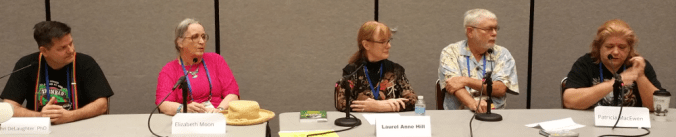
Panellists: John DeLaughter, Elizabeth Moon, Laurel Anne Hill (moderator), Gregory Benford, Patricia MacEwen

Joined in progress …

LAH: Haw can we reduce carbon dioxide, or eliminate excess carbon dioxide?

JD: Increase conservation.

LAH: It’s difficult to motivate large numbers of people to conserve, though.

PM: Hit people in the wallet.

EM: Stop killing plants to put in asphalt. Plants eliminate carbon dioxide.

JD: Green roofs.

EM: Green roofs are a good idea, but existing structures can’t support the extra weight or handle the water. Support the creation of parks, green space, city gardens as part of urban planning.

GB: The US is the only country in which tree populations have risen. It’s also the only industrialized country that’s reduced carbon dioxide emissions.

JD: Going for a clean energy solution means more nuclear power.

LAH: What about ocean iron fertilization?

JD: Life growth is based on the amount of the rarest nutrient in the ocean. That’s iron. So far, things haven’t worked out as well as they’ve hoped.

PM: California has lost an entire youth class of sea lions for three years running. It’s happening all over. Stop over-fishing. Lower polution.

LAH: There’s a great book, Stung, about the unprecedented increase in the numbers of jellyfish. They could be a vehicle for carbon capture and storage.

GB: Thirteen years ago there was a study done on farming waste and disposing of it underwater. There’s a place, 3.2 kilometres down just off Monterey Bay. CO2 is trapped in particles. Crabs eat them and it gets bound in their shells.

JD: In Louisiana, they burn their excess silage. They have ash fall. They call it “Cajun snow.”

GB: There is no will to do the necessary research.

JD: It’s going to take a long time for global warming to become serious enough for people to care.

LAH: Are efforts to reflect sunlight back into space effective?

GB: DARPA has a project. They want to pump sulphuric oxide into the atmosphere over the arctic. It will screen out enough of the sun to slow the melting of the polar ice cap. There is no will to proceed.

PM: There are 50 to 100 mile wide gaps in the ice in the arctic. We’re heading for a crisis.

JD: NASA is involving student observers in their S Cool project.

GB: They could also look into reflective paving materials and roofing mats.

PM: 95% of our living reefs are disintegrating.

And that was time.

Next weekend, I’ll be sharing the notes from my final WorldCon 2016 panel: The state of feminist fantasy.

Until then, be well, be kind, and stay strong, my friends 🙂

Thoughty Thursday: Things that made me go hmmmm on the interwebz, April 2-8, 2017

It’s a mixed bag of thoughty inspiration and entertainment this week to get your mental corn popping 🙂

Everyone is born creative, but schools educate us out of it. Tham Khai Meng for The Guardian.

Self-described woodland hellbitch Rachael Stephen wants to become more informed (since the world is on fire).


Dhruv Khullar: how social isolation is killing us. The New York Times

Alex Pasternack examines the vast, secretive face database that could instantly ID you in a crowd. Fast Company

Andrew Rosenblum: the factories of the future could float in space. Popular Mechanics

Mike Wall reports on the new campaign that hopes to produce a picture of a black hole. Space

Canker sores are … ew. But the Sci Show has some tips to fend them off and make them go away more quickly.


Veritasium looks at the Bayesian Theorem and its applications (including spam).


Joobin Bekhrad looks at Zoroastrianism, the obscure religion that shaped the west. BBC

Ephrat Livni reports that the Japanese practice of “forest bathing” has been scientifically proven to improve health. Quartz

Kabul’s Wushu warriors.


Signe Dean: squid and octopus evolution is officially weirder than we imagined. Science Alert

Pentatonix covers Bohemian Rhapsody.


I hope something got the ideas pinging off the inside of your skull (mental popcorn).

Be well until the weekend. Virtual hugs.

thoughtythursday2016

Tipsday: Writerly Goodness found on the interwebz, April 2-8, 2017

There’s so much writerly goodness out there, I wish I had more time to devote to curating these informal writerly learnings for you.

Aliette de Bodard guest posts on Terribleminds: in defense of uncanny punctuation. I love semicolons, too!

K.M. Weiland adds number 58 to her most common writing mistakes series: too much description. Helping Writers Become Authors

Later in the week, Kate shows you how to write stories your readers will remember.

Then, Kate pops over to Jerry Jenkins’ blog: two ways to find out if a scene deserves a place in your story.

Kathleen Jones guest posts on Jane Friedman’s blog: six ways to prepare for writing as a second career.

Angela Ackerman shows you how to use timelines to organize story details. Writers Helping Writers

Lisa Preston offers seven strategies for revising your novel. Writer’s Digest

Penny Sansevieri helps us decode Amazon keywords. Writers in the Storm

Fae Rowan shares five tips to get your characters—and you—through adversity. Writers in the Storm

Janice Hardy introduces us to a fun way to learn story structure. Writers in the Storm

Chris Winkle shares five signs your story is ableist. Mythcreants

Oren Ashkenazi looks at six objectively good stories and finds ways to make them better. Fabulous analysis. Mythcreants

Laurel K. Denton guest posts on Writer Unboxed: changing horses mid-stream (or how not to panic over a mid-book structure revision).

James Scott Bell asks, is your fiction big enough? Writer Unboxed

Donald Maass wants you to captivate readers with your opening lines: casting the spell. Writer Unboxed

Bryn Greenwood: write a book, save the world. Writer Unboxed

Kathryn Magendie explores this writing life. Writer Unboxed

Emily Wenstrom helps you grow your online platform in real life. DIY MFA

Shameless self-promotion time again: it’s me! Defining speculative fiction. DIY MFA

Gabriela Pereira interviews Susan Perabo for DIY MFA radio.

Bess Cozby offers five tips for revising your trunk novel. DIY MFA

Kristen Lamb: the single best way to become a mega-author. Later in the week, she follows up with how you can make all ads, marketing, and newsletters work better.

Jeff Lyons visits Jami Gold’s blog again: creating a strong moral premise for our story.

Michael Everest responds to a provocative post and explains the difference between giving up and giving in. Fantasy Faction

David Barnett responds to the same “failed novelist” post. The Guardian

Alex Brown unpacks Marvel’s “diversity doesn’t sell” argument and explains what diversity really means. Tor.com

The Hugo and Campbell awards finalists announced! Locus

This grammar vigilante stalks the Bristol night putting apostrophes in their right places. Ladies and gentlemen, the BBC gives you, the Apostrophiser!

I hope you learned something tasty 🙂

Be well until Thursday when you can come back for some thoughty inspiration!

tipsday2016

WorldCon 2016: Two suns in the sky

Disclaimer: I am not perfect and neither are my notes. If you notice anything that requires clarification or correction, please email me at melanie (dot) marttila (at) gmail (dot) com and I will fix things post-hasty.

TwoSuns

Panellists: Eva Elasigue, Courtney Schafer, [Mel’s note: Joe Haldeman was unable to attend.]

Joined in progress …

CS: Kepler discovers exoplanets by observing the subtle signs of a planet passing in front of its star. It’s focused on a small area and it’s only covered 3% of that space in detail so far. The number of exoplanets discovered is large, but only a fraction of circum-binary systems have planets that might be habitable. The planets discovered in those systems are massive, though. It’s exciting that so many planets have been discovered.

EE: One of Larry Niven’s conjectures is that a planet in a binary system would have an off-center core.

CS: It’s possible that a planet in a binary system could have a figure eight orbit. It could also be more easily ejected from the system. Since circum-binary systems are fairly common, there might be a large number of rogue planets out there. To discover the composition of a planet, you need to use spectroscopy.

Q: Is there publicly accessible software for fact-checking the plausibility of an invented system?

A: There are solar system simulators.

CS: You can also check with your local amateur astronomy club.

Q: Is Alpha Centauri A, Rigil Kentaurus, a binary star?

CS: That’s the current understanding. One thing to keep in mind is the force that would be exerted on planets in these systems. If we look at the moons of Jupiter, they need to have their own magnetospheres to maintain an atmosphere. Otherwise, Jupiter strips it away.

EE: You should check out Galaxy Zoo. It’s a citizen science initiative.

[At this point, the ideas starting coming fast and furious. To be honest, I’m not sure who said what.]

The most favorable binary systems for planets are those in which both stars are around 80% of the sun’s size. They’re also fairly close to each other. The minimum stable radius for a planet in a binary system is 2-4 times larger than [… sorry didn’t catch this. I think it’s Jupiter. Wikipedia indicates this would be correct. If the planet is a gas giant, it may not support life, but its moons might. Smaller stars would accommodate smaller planets, but the planets may not be habitable, depending on their orbits and the relative light and heat they receive from their suns.]

They probably didn’t form in their current orbit. There’s an instability in binary systems which could result in the planet spiralling into one of the stars, or being flung out of the system. Planets in binary systems would move around unless they could find a stable orbit.

There are also mismatched binary systems. A blue giant with a red dwarf, for example, or a sun-type star with a black hole.

And that was time.

For more information: If you Google the term circum-binary systems, you will find a lot. Navigate to dependable sources, like NASA, or Space.com (unlike yours truly). Or head for fun but dependable sites like Phil Plait’s Bad Astronomy column, currently hosted by Blastr.

Next week: we’re terraforming terra 🙂

Until next I blog, be well, be kind, and stay strong.

Thoughty Thursday: Things that made me go hmmmm on the interwebz, March 26-April 1, 2017

All sorts of stuff to get your mental corn popping this week.

Tad Friend exposes Silicon Valley’s quest for eternal life. The New Yorker

Gillian Anderson and Jennifer Nadel talk perimenopause and menopause. Lenny

Alex Myles: how being an empath can lead to adrenal fatigue, insomnia, and exhaustion. Elephant Journal

Lori Day: aging while female is not your worst nightmare. Feminist Current

Gisela Wolf says that people who hit the snooze button are more intelligent, more creative, and happier. The Independent

Veritasium: The science of thinking. You won’t learn anything unless you’re uncomfortable.


ASAP Science: This does not equal that. Correlation vs. causation.


Your animal life is over. Your machine life has just begun.” Mark O’Connell for The Guardian.

Ryan F. Mandelbaum reports on a new theory that connects dark matter, black holes, and gravitational waves. Gizmodo

Joanna Moorhead rediscovers her wild child cousin, surrealist painter Leonora Carrington. The Guardian

The Economist: can we know what animals are thinking? Medium

Jordan Pearson presents some of the evidence that proves cats are actually nice. Motherboard

Overtone singing never ceases to amaze me. Anna-Maria Hefele


For your listening pleasure: Minds Without Fear – Imogen Heap


And that was your thoughty for the week.

On the weekend, I’ll be covering more WorldCon 2016.

Be well until then, my friends.

thoughtythursday2016

Tipsday: Writerly Goodness found on the interwebz, March 26-April 1, 2017

Holy cow, lookit all the informal writerly learnings 🙂

K.M. Weiland covers seven stages of being a writer. Helping Writers Become Authors

Later in the week, Kate helps you notch up your scene conflict.

Fred Johnson guest posts on Jane Friedman’s blog: how to get violence right in your fiction.

Grace Wynter joins Writer Unboxed as a contributor: Look! Up in the sky! It’s a … writer?

Catherine McKenzie: are you tired of writing? Writer Unboxed

Tracy Hahn-Burkett helps you have patience over the long, long haul. Writer Unboxed

Jo Eberhardt unpacks the relationship between envy, perfectionism, and the work of writing. Writer Unboxed

Susan Spann: how to avoid pay to play publishing contracts. Writer Unboxed

Jenna Moreci: Show vs. Tell, part 2. When to tell.


Kimberly Brock has the blank page blues. Writers in the Storm

Kathryn Craft says we can do it all—but should we? Writers in the Storm

Ruth Harris shares some stress busters and burnout beaters. Anne R. Allen’s blog

Leanne Sowul: how one skeptic became a meditation convert. DIY MFA

Gabriela Pereira interviews Jessica Strawser for DIY MFA radio.

G. Myrthil explains why kid lit matters. DIY MFA

Linda Bernadette Burgess shares five ways to manage multiple creative passions. DIY MFA

Emily Temple says that if any literature is going to change the world, it’s going to be young adult. Literary Hub

Fantasy Faction explores sieges and siegecraft. Part one: attackers.

Jeff Lyons returns to Jami Gold’s blog: what is high concept and how can I create it?

Lilith Saint Crow stops by Terribleminds: when a short story won’t stay short for long.

Nina Munteanu: the power of myth in storytelling.

Bonnie Randall wonders, do sensitivity readers hurt or help our novels? Fiction University

Nathan Bransford says that the key to a great query letter is summarizing through specificity.

Barbara Kyle shares ten query letter tips.

Pamela Hodges explains how to edit your novel like a New York publisher. The Write Practice

John Koenig makes another entry in the Dictionary of Obscure Sorrows: morii.


S.B. Divya reveals the seed of her novel Runtime. Tor.com

Malka Older’s not predicting the future, she’s just observing the present. Tor.com

Sunny Moraine: resistance through speculative fiction. Tor.com

Leah Schnelbach revisits Nausicaä of the Valley of the Winds, twenty years on. Tor.com

Am I pathetic because I still love Buffy? I guess I’m not alone: Katharine Trendacosta shares pics from the Entertainment Weekly Buffy reunion photo shoot. i09

Three translators respond to Arrival. Susannah Greenblatt for Words without Borders.

Adam Frank explains how great science fiction shows like The Expanse prepare us for the future. NPR

Evan Narcisse shows us the Valerian trailer. i09

Hope you enjoyed the writerly goodness.

See you Thursday for some thoughty 🙂

Be well until then.

tipsday2016

The next chapter: March 2017 update

It’s April already.

Though I’m grateful for spring and the returning light, there still seems to be too much to do and too little time to do it in.

Still, things are progressing.

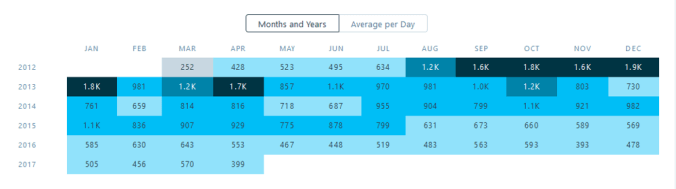
It took me a while after finishing Wavedancer to get my head around returning to Initiate of Stone. As you can see from the screenshot, the first eleven days of March were spent working through my opening chapter, long hand. I tried a few things and finally settled on one of them.

MarchProgress

Is it any better? I think so, but I’m hardly objective. Unfortunately, it’s added four pages to the ms. I’ve been trying to cut back in other areas but, so far, I haven’t been able to shrink the overall word count. There’s still work to be done.

You will also see that I only made 74% of my revision goal for the month. This is what happens.

I nearly met my writing goal for the blog at 97%.

But I didn’t revise any of my short fiction. Again. My head’s just not there. I know I should forge ahead, regardless.

To be specific:

51,552 words revised of 70,000 on IoS

5,648 words of 5,800 written on this blog

One distraction has been getting my travel arrangements made for the Writing Excuses Cruise. Most of them are in place. There are just three days between the cruise and WorldCon that I have to settle. I’m going to spend them in Finland. My hotel is booked.

A friend has lent me her Lonely Planet guide to Scandinavia. I’ve decided I’m going to spend one day visiting Marttila. Yes. There’s a city in Finland that’s shares my last name. That’s why I want to go.

I’m also trying to assemble my taxes (which melts my brain).

I continue to assemble the monthly newsletter for the Sudbury Writers’ Guild and I’m now on a couple of sub-committees for the Canadian Authors Association.

I like to keep myself busy?

Health-wise, I’ve had my first appointment with a specialist who will be able to help me, but I may have to wait for up to a year for the procedure to be performed. The hospital has cut operating time (grrr).

I’m walking more, despite a stubborn case of plantar fasciitis. I have new orthotics, but my feet are slow to adjust. I’m back to doing yoga in the mornings. I’m no longer on the iron supplement. For now. It doesn’t seem to have made a difference to my energy levels, one way or the other. Will keep y’all informed as to how things are going.

Work is chaotic. There was a site refit and so lots of disruption over the last month or so. Repeated packing and unpacking for painters, the installation of new workstations, and, finally, moving to a new workstation on another floor of the building. Everything should be in reasonable shape come Monday.

We voted on our latest contract offer, but we won’t know the results of all the votes until April 15th or so. I’m hopeful, but even if we ratify, it probably won’t be until September that we see anything in terms of our retroactive wage increases.

My back pay for my last acting position hasn’t been resolved yet, either. They say maybe June? They’ve missed every deadline so far, so I’m thinking August.

And people wonder why I’m not such an enthusiastic worker these days. Seriously?

The snow is melting, though, and we’re experiencing more days above zero (Celsius). The sun is out more. It’s brighter. I feel myself emerging from hibernation.

I’ll have another column out for DIY MFA next week, and a couple of lovely things to tell you about in next month’s update.

That’s it for me for now.

Until next I blog, be kind, be well, and stay strong. Remember: love is the greatest of magics.

The Next Chapter