Thoughty Thursday: Things that made me go hmmmm on the interwebz, June 3-9, 2018

It’s Friday eve! W00t! And now, to get your mental corn popping 🙂

Ashifa Kassam: the toxic legacy of Canada’s CIA brainwashing experiments. The Guardian

John J. Lennon: this place is crazy. A prisoner-journalist’s inside look at mental health in prison. Esquire

Katie Morton: how is ASD expressed differently in females?


Mihai Andrei reports that, after successfully passing trials, a Lyme disease vaccine may be available soon. ZME Science

Dirk Schulze-Makuch: fingerprints of Martian life. Air & Space Magazine

What Pacific Islanders want you to know. Buzzfeed video


State of emergency declared for Ontario’s turtles after hundreds are run over. Marina von Stackelberg for the CBC.

R.J. Wilson examines the reasons behind many of your dog’s interesting habits. URBO

We all know someone who can’t handle being hungry, AKA the hangry otter.


Have a lovely weekend and we’ll see you next Tipsday.

Until then, be well, be kind, and stay strong. The world needs your stories!

thoughtythursday2016

Tipsday: Writerly Goodness found on the interwebz, June 3-9, 2018

Another week, another batch of informal writerly learnings.

Jane Friedman excerpts from Tanya Hall’s Ideas, Influence, and Income: what to look for in a book publicist and tips for going it alone.

Donna Galanti offers eleven ways to find and connect with other authors in your genre. Writers in the Storm

Fae Rowan explains why you have to give your readers what they want. Writers in the Storm

Jenna Moreci shares her top ten hacks for your writing process.


Agent Barbara Poelle answers a question about word counts on Funny You Should Ask. Writer’s Digest

Nancy Johnson helps you find rhythm in your prose. Writer Unboxed

Donald Maass gives you the reason to build a box. Writer Unboxed

Kathryn Magendie explores rhythms in reading and writing. Writer Unboxed

James Scott Bell invites you to use the writer’s spice cabinet. Writers Helping Writers

Chrys Fey stopps by Writers Helping Writers to help you boost your creativity mindset naturally.

K.M. Weiland reviews Avengers: Infinity War and gives us four ways to write a better antagonist. Helping Writers Become Authors

Sara Letourneau provides a case study on revenge as a literary theme. DIY MFA

And here’s my latest column. Mythic structure: The Virgin’s Promise, part one. DIY MFA

Ashley Hilst shows you five ways to inject theme into your story (without being obvious). DIY MFA

Chris Winkle explains how to give your hero sympathetic problems. Mythcreants

Monday and Tuesday are under your workweek belt. Feel good about that.

Be well until Thursday!

tipsday2016

Thoughty Thursday: Things that made me go hmmmm on the interwebz, May 27-June 2, 2018

It’s time, once again, to get your mental corn popping. In a small way 🙂

Katie Mach reviews 18 historical beauty standards that we wouldn’t stand for today. Ranker

Why racism isn’t just a southern problem. MTV’s Decoded.


Thomas Lewton discovers that young Ethiopians are eying a fertile future in artificial intelligence. UnDark

The Daily Native News presents the first US map that displays “our own” Indigenous names and locations.

Allison C. Meier: the ancient forests that have defied urbanization. City Lab

Elisabeth Donnelly introduces us to Ann Baker, who is trying to breed the perfect housecat in the valley of the ragdolls. Topic

And now you have Friday to look forward to!

Be well until next Tipsday.

thoughtythursday2016

Join me over at DIY MFA for my latest column!

This time around, I’ve returned to mythic structure in an exploration of Kim Hudson’s The Virgin’s Promise, the feminine archetypical storytelling journey.

virginspromise

So hop on over and have a boo 🙂

Mythic Structure: The Vigrin’s Promise, Part One

See you back here on Thursday for a little thoughty.


Tipsday: Writerly Goodness found on the interwebz, May 27-June 2, 2018

Your informal writerly learnings are short and sweet this week. Trade wars and Harvey Weinstein on trial and the Rosanne debacle really took it out of me.

K.M. Weiland: how the truth your character believes defines your theme. Helping Writers Become Authors

Sharon Bially says, purpose is the missing link between your characters’ motives and depth. Writer Unboxed

Bryn Greenwood helps you find your empathy through Florida Man (or Florida Woman). Writer Unboxed

Becca Puglisi helps you create character empathy in your first few pages. Writers Helping Writers

Kristen Lamb explains how and why we writers are our own worst enemies. It’s called self-sabotage.

Jami Gold asks, how do you deal with writer burnout?

Oren Ashkenazi gives us five tips for creating an engaging space battle. Mythcreants

And that’s it for Tipsday.

Be well until Thoughty Thursday comes around.

tipsday2016

The next chapter: May 2018 update

Hello, all you writerly people!

It’s time for my next chapter update for May 2018.

Looks like I’m finding my stride. Things were going so well with the drafting of Playing with Fire, that I actually decided to take a purposeful break to read the draft to date. The problem I was encountering is that it’s taken me so long, relatively speaking, to draft the darned thing that I started to forget what I’d written way back in November (or December, January, February, March, or April!).

It’s been niggling at me for a while, and sometimes, I’d just go back to the chapter I suspected contained the bit I was looking to be refreshed on, but that got cumbersome, particularly since, once there, I’d start tweaking …

K.M. Weiland has been mentioning how she does a periodic re-read of her WIP, and I decided to give it a try. It was a nice rest, and a great way to tighten some of my plot threads, especially since I didn’t have to time to do much of an outline for this novel before I started drafting.
MayProgress

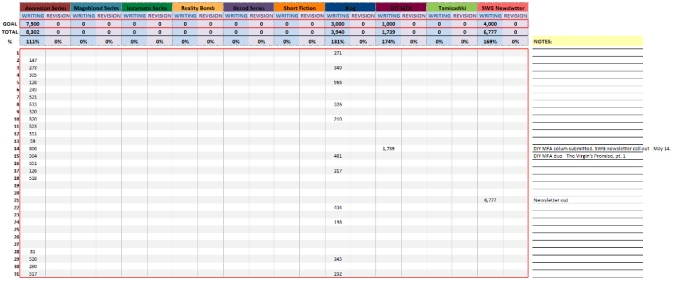
Even with the break, about nine days, I still managed to surpass my 7,500-word writing goal. I wrote 8,302 words, or 111%.

I’m enjoying the break from weekend blogging as well, and though I adjusted my blogging goal to 3,000 words, even with just the curation posts going up, I managed to write 3,940 words on the blog, or 131% of my goal.

I met my DIY MFA deadline with a long column of 1,739 words, or 174% of my goal, and aggregated my penultimate Sudbury Writers’ Guild newsletter at 6,777 words, or 169% of that goal.

So, it’s been a good month, writing-wise.

The burnout thing

I promised to tell you how the whole burnout thing was going.

Well, after a lot of soul-searching, pondering, and some all-out navel-gazing, I’ve finally figured out why I’ve suffered such a protracted burnout in the past year. And, let’s be clear, I’ve been struggling since at least the beginning of 2017. It might, in fact, be longer than that.

Part of it is historical. It’s my writing wound, the lie I believe about myself as a creative person and about my work. If you’re ever curious and you have the time, you can read the posts in the category, My History as a So-called Writer. That will give you the low-down.

The short version is that my creative life has been full of threshold guardians (in hero’s journey terms), who’ve blocked me, stunted my growth, and betrayed me in various fashions. When I finally found my way back to a consistent writing practice in 2007, I thought I’d conquered those demons. In that version of victory, all the naysayers were wrong, and I was just going to do what I wanted. Screw them.

That, it turns out, was only half the battle. It’s the bitter legacy those experiences left me with that make me innately distrustful of handing my work off to anyone else, whether a friend, beta reader, editor, or … anyone. I don’t believe that the advice I receive is in the story’s best interest. Or mine. I always see it in terms of a personal attack, though unconsciously. I’m aware of it now but, in the moment, I often slip back into old ways of thinking.

While I’ve had some writing success, that lie has never left me. It’s made finding a critique group difficult. It makes working with editors a bit fraught. It also leaves me thinking that I’m not, at heart, a good writer (passable good, not even great) and that people are just humouring me. It’s not merely imposter syndrome. It’s a deep distrust of anyone else’s opinion of my work.

There’s been a lot of self-sabotage involved, mostly unconscious.

This is what I’m working to overcome now. It’s a process. It’s going to take time.

The next piece of the puzzle is that, in January of 2016, after decades of what we thought was good health, Phil went to the clinic thinking he might have shingles, and came home (well, there was some bloodwork in there) with multiple diagnoses: type II diabetes, high blood pressure, high cholesterol, and possibly shingles.

He had no rash, though. Several months passed and the doctor said, fibromyalgia. Several more months passed, and they finally settled on widespread diabetic neuropathy. Until the doctor found the right combination of meds, there were some horrible times, but it all worked out. Eventually.

Two of the meds Phil was on were Lyrica (an antidepressant found to be effective for nerve pain) and Cymbalta (an anticonvulsant also found to be effective for nerve pain). Aside from managing his pain and elevating his mood (it has often been said of my husband that the inside of his skull is painted black), both medications increased the amount of melatonin in his system.

Phil, who had always been a night owl and considered sleep to be the enemy, was now getting the best sleep of his life. Things went well for a while.

Then, because he got a promotion that required occasional travel, Phil decided to stop both the Lyrica and Cymbalta. He couldn’t risk falling asleep at the wheel. Combine this with a progressively complex and worsening situation at his employer (ongoing) and things quickly went from bad to worse.

The health problems shook me, probably more than I’d care to admit. It was after Phil’s health situation resolved that I started to feel the real effects of the burnout.

But it was the work situation that broke the peace of our household. I was used to living with Mr. Grumpy Pants, but his problems at work followed him home and made everything more difficult. It was about that time that we brought Torvi home. The extra stress of bringing up puppy did not help.

Also in the mix was my great adventure of last year. Though Phil encouraged me to go, I felt horribly guilty about the expense. I’ll just be paying off the last of that debt this month.

Add to all that my own health problems. Though less life-threatening than Phil’s, they were affecting my quality of life. Now that most of them have been addressed, I’m in a much better place.

But every time I tried to dig myself out of the hole, emotionally speaking, in the last couple of years something popped up and dragged me back down. I’ve suffered several episodes of depression, panic attacks, and poor quality of sleep (resulting from the other two).

Most of these issues are resolving. I’ve had my ablation and other health issues are being investigated. I’ve lost about 25 pounds. I’ve gotten back to my regular writing practice and it’s feeling good. Torvi, at eight months and in her second obedience class, is becoming a good dog but, that too is a process.

Really, it’s just Phil’s work situation that’s the continuing problem but, though there’s still no end in sight, slow progress is being made. There’s hope that things might be largely sorted by the end of this year. We just have to hang in there.

I’m sure other world events have played their parts, but I’m actively seeking to minimize their effects on me.

I’ll keep you updated, for those who want to know.

My writerly event of the month

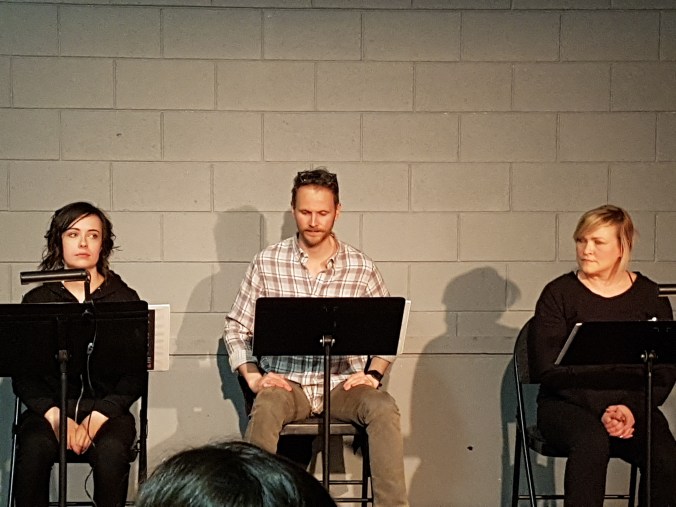
On May first (May Day, Beltaine—yes, I’m a paganish sort) I went to see the staged reading of the latest iteration of Kim Fahner’s play, Sparrows Over Slag. It was part of Play Smelter, which ran the rest of the week. It was fascinating to see the evolution of Kim’s play, of which I was privileged to read an early draft.
20180501_171021

She gave a lovely Q&A afterward that gave further insight into her process. Writing a play is a different beast than any other kind of writing, even screenplays.

Later that week, I had lunch with Kim, who was only in Sudbury for a couple of weeks around Play Smelter. She’s been in south western Ontario, working hard on her craft and trying to figure out her next steps, creatively.

Just chatting over lunch was a balm. We are soul sisters and that won’t change wherever she goes and whatever she chooses to do.

And that’s it for this month’s next chapter update.

Until the next time I blog, be well, be kind, and stay strong. The world needs your stories!
The Next Chapter

Thoughty Thursday: Things that made me go hmmmm on the interwebz, May 20-26, 2018

Happy Friday eve, everyone! Please enjoy these resources. It’s time to get your mental corn popping!

Philip Bump: 2018 has been deadlier for school children than for service members. The Washington Post

Jim C. Hines thinks too many men can’t handle being told no.

Kat Eschner says, sleeping in on the weekend might be good for you, but it’s not going to solve all your problems. Popular Science

How is ADHD different for an adult? Kati Morton


Inverse: your brain on meditation with Shannon Odell.


Charlotte Ahlin lists eleven real life inventions inspired by science fiction novels. I wasn’t sure whether to put this in Tipsday or here in Thoughty Thursday, but the thought won out. Bustle

Kevin Sieff profiles a 21st Century Noah’s ark in Malawi that strives to repopulate animals that have been wiped out. The Washington Post

Is this the beginning of the end for bees? Mind Foster

Guy Winch: why we need to take pet loss seriously. Scientific American

Tomorrow’s Friday. I hope you have a good one, and a great weekend to come! Looking forward 🙂

Be well until this weekend’s next chapter update. Yup, another month will have passed. Time marches on, but so do we.

thoughtythursday2016

Tipsday: Writerly Goodness found on the interwebz, May 20-26, 2018

You survived Monday, and that’s a good thing! Have a wee treat. Another week, another batch of informal writerly learnings!

A.K. Perry explores another of James Scott Bell’s signpost scenes—the argument against transformation. DIY MFA

Gabriela Pereira interviews Kimmery Martin about revising your book and getting it right. DIY MFA

I shared Kate Weiland’s list last week. Great minds think alike 🙂 Lisa Cron busts five writing myths that may be holding you back. DIY MFA

Vaughn Roycroft examines his biases and tropes: warrior women, #MeToo, and one writer’s evolving sensibilities. Writer Unboxed

Liz Michalski advises you to blow it up (where it is a practice that no longer serves you). Writer Unboxed

Julie Carrick Dalton shares her thoughts on finding second life in cast-off words. I might have to try her fire brick idea some day. I’m not craft-inclined enough to try the other stuff 🙂 Writer Unboxed

Janice Hardy helps you edit your novel without feeling overwhelmed. Later in the week, she wonders, how much really needs to be in your novel’s opening line? Fiction University

K.M. Weiland offers five logical steps to grow as a writer. Helping Writers Become Authors

Joanna Penn helps you find your writing community. The Creative Penn

Kristen Lamb: truth is the door between your greatest fears and your greatest self. Later in the week, Kristen shares five reasons to invest in rest (and avoid burnout).

Nathan Bransford offers a guide to literary agent etiquette.

Shawn Coyne explains how an agent figures out her pitch to publishers. Steven Pressfield

Remember that book that no one had ever heard of that shot straight to the NYT bestseller list? Well, Chris Winkle took one for the team and has some lessons from the rambling writing of Handbook for Mortals. Mythcreants

Then, Oren Ashkenaski shares seven ways to motivate a reluctant protagonist. Mythcreants

Jeanna Kadlec offers this writerly horoscope. Electric Lit

And that was tipsday. Come back on Thursday for your weekly dose of thoughty.

Until then, be well, my friends.

tipsday2016

Thoughty Thursday: Things that made me go hmmmm on the interwebz, May 13-19, 2018

Welcome to thoughty Thursday. You know what that means: tomorrow is Friday!

Jessica Bennett and Daniel Jones compile these 45 stories of sex and consent on campus. The New York Times

Megan Garber: David Foster Wallace and the dangerous romance of male genius. The Atlantic

Jim C. Hines offers some advice on setting boundaries.

Nicole Gallucci reports that ageism is becoming a major issue for corporations. The Globe and Mail

Tim Herrera lists three things that can help if you’re feeling burned out. The New York Times

Brian Resnick: 100 million Americans have chronic pain, but few use one of the best tools to treat it. Vox

SciShow Space: is there really an infinite multiverse?


Mary Schwager: new studies show humans love dogs more than other humans. I Love My Dog

This guy is a case in point. He bought 5,400 ball pit balls and made his dog the happiest dog in the world.


I hope something here got your mental corn popping.

Be well until next Tipsday!

thoughtythursday2016

Tipsday: Writerly Goodness found on the interwebz, May 13-19, 2018

Another week has passed and, look, you’ve survived Monday. Good on ya 🙂 Have some informal writerly learnings as a reward. You know you deserve it.

K.M. Weiland lists five lies writers believe that actually hold them back. Helping Writers Become Authors

Jenny Hansen shows you how to use the twelve stages of physical intimacy to build tension in your fiction. Writers in the Storm

Margie Lawson encourages you to go deeper than the cold, hard stare. Writers in the Storm

Scrivener guru Gwen Hernandez explains how to save every word using Scrivener’s snapshot feature. Writers in the Storm

Annie Neugebauer helps you find the best readers for your novel at every stage. Writer Unboxed

Porter Anderson watches the Canadian problem with Access Copyright with interest and alarm. Authors I know whose work was copied for academic packages used to get paid. Universities rebelled and now they get nothing. Advocacy and authors. Writer Unboxed.

Nina Munteanu: science fiction asks, are we worth saving?

Jami Gold helps you figure out if your writing is any good. Later in the week, she wonders how much of yourself in in your writing?

Brenda Joyce Patterson explains why your writing should invite readers in. DIY MFA

Gabriela Pereira interviews Dharma Kelleher about transgendered characters in literature. DIY MFA

Sara Letourneau offers some advice on conducting informal interviews for story research. Writers Helping Writers

Janice Hardy helps you take away elements to fix a problem scene. Fiction University

Mira Singer reviews three movies with the wrong main character. Then, Oren Ashkenazi says that “historical accuracy” isn’t a reason to exclude diversity. Arguments I wish I’d had when I tried to present my secondary world fantasy to my MFA class for critique. #mistakesnaivewritersmake Mythcreants

Joanna Penn explains how to monetize a creative podcast in her interview on the Podcraft podcast. The Creative Penn

John Koenig’s The Dictionary of Obscure Sorrows (is back!): Silience.


And Pâro.


Anna Lovind discovered that in order to nurture her dream of writing, she had to give up something else: knowing when it’s time to let a dream die.

Anika Burgess reveals the artful imperfection of medieval manuscript repair. Atlas Obscura

Andres Liptak reports on the new documentary that will explore the life and legacy of Ursula K. Le Guin. I’m looking out for this one! The Verge

And that was Tipsday.

Be well until Thursday rolls around and then come back to get your weekly dose of thoughty 🙂

tipsday2016