The next chapter: March 2020 update

And here we are with my first monthly writing update since covid-19 was declared a pandemic. What a difference a month makes.

A month of uncertainty and change

March came in like a lamb. It would leave that way, too, as if it knew that other events would play the lion. The first reports of a novel coronavirus had come out in November (hence the 19 in the virus name) from Wuhan and the first confirmed case in Canada was on January 15. We had no idea what was coming. At worst, I thought we’d be facing another SARS and Canada had weathered that. I’d worked through similar crises before. Or so I thought.

Then, on March 10, the first case was confirmed in Sudbury and a few days later, a second. On March 11, the World Health Organization (WHO) declared covid-19 a pandemic. On March 12, the school boards declared that all schools would shut down for two weeks following March break to enforce quarantine on travellers returning after March break. Our university and colleges closed, as well.

The next week was March break and the first of my coworkers went home on special leave because she had school-aged children. More followed. I had scheduled leave the Thursday and Friday of that week. That weekend, Phil and I made the decision to stop visiting my mom, stop having her pet sit Torvi while Phil was out and about. While there have been no documented cases of covid-19 in pets, if Phil or I are asymptomatic carriers, we could transfer the virus on her fur and as Phil continues to venture out for necessaries, the potential danger is continual. The weekend and the decision were fraught with anxiety and disappointment. When I returned to work on Monday (March 23), half of the office had been sent home to telework. On Tuesday, the rest of us were told to go home. I came in on Wednesday to finish up a few things and collect my plants.

I’ve been working from home since March 26.
2020-03-27 18.01.12

States of emergency were declared at the national and provincial levels. Schools were closed indefinitely, and plans made to teach students virtually. Social distancing was renamed physical distancing. I don’t go out except to walk Torvi and when I do, I’m sure to stay at least two metres away from other pedestrians. Phil is our designated shopping and fetching guy, which works because he’s otherwise unemployed. He’s also performing this service for our moms.

Things haven’t changed much for me. I’m still working (a blessing) but am doing so from home. I don’t have any more time than I normally do, and so I’m not engaging in binge-watching, catching up on learning activities, or seeking distraction. I’m distracted enough by the surreality of the situation.

This is the new normal. And yet changes continue to be announced every day. The chaos has me in a state on continual, low-grade anxiety.

The month in writing

I’d planned to take weekends off and intended to compensate with extra words during the week. This went swimmingly for the first few weeks until covid-19 started to make its presence felt. Then, all bets were off.

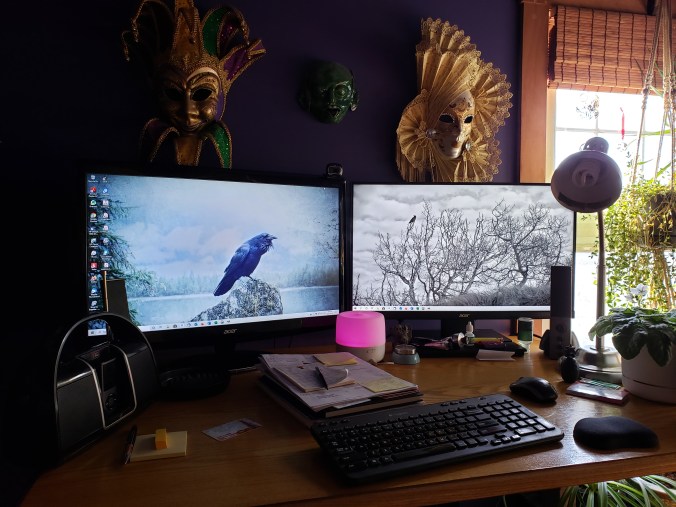
When I came home from the office with the mandate to work from home on March 24, Phil ordered me a second monitor. My workstation at the office has two monitors and we have enough applications open that it really does make things easier. The second monitor arrived on Friday and we set it up after I finished work for the day. After that, I was toast, but I’d planned not to write Friday through Sunday every week in March, anyway, so I didn’t think I would fall too far behind. But I’d already missed Wednesday. The workday was chaotic and the more I tried to finish up and pack up and move home, the more stuff happened that prevented me from doing so.

So, I didn’t write Friday or Saturday and when I got back to it on Monday, my progress was not what I’d hoped.
MarchProgress

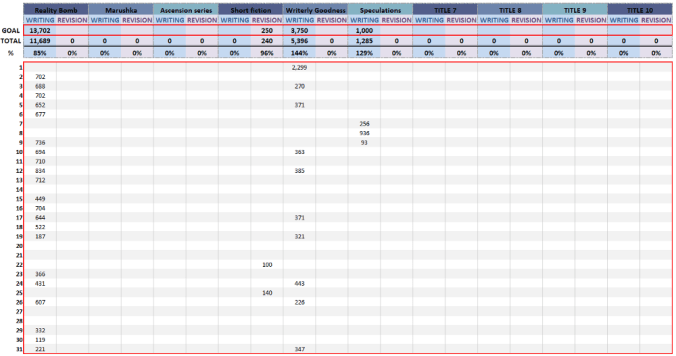
All this to say that I fell short on my drafting goals for the month again. Of my 13,702-word goal, I wrote 11,689 words, or 85%.

I blew my blogging goal away with my massive review of the split worlds series last month and wrote 5,396 words, or 144% of my 3,750-word goal.

I wrote my latest Speculations column in 1,285 words, or 129% of my 1,000-word goal. It should be coming out this week, so you can look forward to that.

I also revised a short story. There wasn’t as much revision as I’d thought. There was a lot more cutting than writing. I ended up writing 240 new words and cutting close to a thousand. I set myself a 250-word goal for the revision and accomplished 96% of it. I don’t count words cut.

I submitted the revised story to an SF magazine for their open reading period. Wish my words luck.

I received some awesome news that five of my speculative poems have been accepted for publication. I’ll be able to tell you more about that when they’re actually coming out. Stay tuned.

I also finished a critique for one of my partners in the online group and found the time to wrangle all the information I needed to submit our taxes. Yay me 🙂

Interestingly, at 18,370 of my total writing goal of 18,452 words, I came in at 99%. Between writing and revision, I accomplished 98% of my goals. I’ll take it.

Overall, I’m pleased with what I was able to accomplish this month, all things considered.

Filling the well

You wouldn’t think that I’d have anything to report here. You’d be wrong 😉

I’ve recently joined a Facebook group run by Lauren Carter and she organized an online reading through Zoom. I got to read poetry along with other poets, memoirists, non-fiction writers, and other novelists from all over North America. It was lovely and supporting and just the thing I needed.

What I’ve been watching and reading

March’s viewing included Locke & Key. Phil and I enjoyed it and are glad that the series in being renewed. We classified it as horror lite because of the juvenile protagonists. Although there was a truly horrific backstory that cropped up again in later episodes, it wasn’t overwhelming. The twist wasn’t terribly twisty, though. We had it figured out before the reveal. We liked the effects of the various keys and are looking forward to what the show has in store for next season.

We also burned through Altered Carbon. Season two takes place several centuries after the first. Takeshi Kovacs and Poe have travelled all over the known universe in search of Quellchrist Falconer and Tak has worn many different sleeves. The show opens on a scene in a lounge and the singer is Tak’s latest sleeve. She’s killed and Tak’s stack is taken. A virtual meeting with his new “employer” sees Tak lured into a protection detail in return for information on Quell. The bad news? Tak is back on Harlan’s World, the hellhole he and Poe escaped at the end of season one.

When he’s resleeved in Anthony Mackie’s buff body, Tak wakes to the chaos of his new employer’s assassination, which he is promptly framed for. Poe has meanwhile degraded because he refuses to relinquish his “memories” of Lizzie from season one. He glitches dangerously and seems to have an AI version of Alzheimer’s, often forgetting what he was saying, what he was doing, and where he is. The only “cure” is to reboot, resetting him to his factory state. Poe, of course, resists this because he would not only forget Lizzie, but Tak and all the adventures they’ve shared.

I highly recommend this one.

We also watched Aquaman (finally). Eye-candy aside, it was okay. Pretty standard DCEU fare.

This month’s reading started off with Robert J. Sawyer’s Calculating God. This was an older novel, published in 2000, and centers on an alien who comes to Earth, and specifically to the Royal Ontario Museum (ROM) in search of a paleontologist because God seems to be engineering the apocalypse. Sawyer plays with the idea that civilizations only evolve to the point where they either begin to colonize other planets, or they destroy themselves. Add to this the controversial idea of intelligent design. The aliens believe in God and that everything in the universe had been planned and balanced in such a way as to to create life in multiple forms and to direct its evolution.

Two alien species have joined forces to investigate the apparent destruction or disappearance of several other civilizations. Some have, in fact, destroyed themselves. Some have taken refuge in virtual existence to avoid destroying themselves. And one travels to a remote sector of the galaxy for mysterious reasons. An impending supernova (of Betelgeuse, no less) threatens Earth and the other two alien species and the aliens want to join forces with humans to solve the mystery. Thomas Jericho struggles with the aliens’ belief in God because he has lung cancer that’s going to kill him.

A secondary plot devised by two fundamentalist Christians who want to show us Godless Canadians how wrong we are complicates matters. The bombing of a nearby abortion clinic is only a prelude to their main attraction: destroying the ROM’s collection of Precambrian fossils. The ticking clock is threefold. Will the terrorists destroy the fossils, and everyone in the vicinity; will the cancer kill Jericho and doom the interstellar mission to potential failure; or will the supernova make it all pointless?

Sawyer has often said that his stories are, at heart, about optimism. Calculating God is no exception.

Next, I read Ed Willett’s Spirit Singer. The titular character, Amarynth, begins the novel as apprentice to her grandfather. A spirit singer’s job is to sing the souls of the dead into the afterlife, but there’s something wrong. A malevolent presence haunts the between world. It stalks and kills her grandfather, stranding the souls of the people of their village, and Amarynth doesn’t yet know enough to assume his duties. She must find help.

It was a decent YA fantasy, but nothing surprising.

The Gilded Wolves by Roshani Chokshi was another story. A heist plot set in 19th Century Paris in an alternate world in which Babel Fragments endow people with magic. There’s political intrigue and manipulation and a cast of characters that I loved. Not going to say much more because y’all should read this one for yourselves.

Aliette de Bodard’s The Tea Master and the Detective is not what you might expect from the title. The tea master is a disenfranchised ship mind who’s lost her crew and is trying to make ends meet by brewing “teas,” which seem to be neurochemical enhancers. The detective is one of ship mind’s clients who solves mysteries for fun. The mystery she draws the ship mind into? That of a young woman who seems to have voluntarily exposed herself to the deep spaces.

My classical selection of the month was Moby Dick. This was basically Melville’s love letter to the American whaling industry. The story itself could have been told in a small fraction of the words, but the novel is also a palimpsest. Every event becomes a story within the story. And then there’s the chapters on the categorization of whales, the difference between whale oil and spermaceti. I didn’t hate the book, but it was entirely too long.

Finally, I read Sabaa Tahir’s An Ember in the Ashes. I remember when it was being released that someone said it would be the next Game of Thrones. Not quite, but it was an enjoyable read. The characters were engaging, but I did get a little irritated by the duelling love triangles. The world building was excellent, and I have moved on to reading the second in the series.

And that was the month in this writer’s life.

Until next time, be well and stay safe, be kind, and stay strong. The world needs your stories.
The Next Chapter

Thoughty Thursday: Things that made me go hmmmm on the interwebz, March 22-28, 2020

In need of some distraction? You’re in luck. Thoughty Thursday is here to get your mental corn popping 🙂

Alex Beard: can AI ever replace the classroom? The Guardian

Laura Millan Lombrana: the post-virus economic recovery could be a green one. This is the hope of many people I know. Bloomberg

Elizabeth Landau discovers that the Fibonacci sequence is everywhere—even the stock market. The Smithsonian Magazine

Allison Meier: 18th Century lovers exchanged pictures of their eyes. JSTOR Daily

Stevie Keen shares ten photography projects you can do at home. Amateur Photographer

Eric Gross shares photographs of frozen waves in an alpine Colorado lake. PetaPixel

Jessica Stewart shares enchanting photos of Madeira’s Fanal Forest and its 500-year-old trees. My Modern Met

How Earth’s tides gave us life as we know it. SciShow Space

Tom Ward takes us inside Victor Vescovo’s mission to reach the bottom of all the world’s oceans. Wired

Ruth Doherty reports that Google Earth has released virtual tours of 31 of the world’s most incredible national parks. Country Living

Stella’s best leaf jumps of all time 🙂 Joy!

Lydia Schrandt shares ten of the best animal live cams for you to watch. 10 Best

PBS Eons answers the age-old question. The egg came first.

Thank you for stopping by. I hope you take away some inspiration for your next creative project, or just some interesting reading and entertainment to ease your isolation.

This weekend, I’ll be diving into my March next chapter update.

Until then, be well, be kind, and stay strong. Now, more than ever, the world needs your stories!

ThoughtyThursday2019

Tipsday: Writerly Goodness found on the interwebz, March 22-28, 2020

I hope you’re all keeping safe and well.

I’m now working from home and only leaving to walk the dog. Phil continues to be our designated shopper. We’re all remaining as isolated as possible given the circumstances.

While you’re at home, you might have the time to catch up on your informal writerly learnings.

Julianna Baggott is creating in the time of quarantine. Liz Michalski: sea glass. Heather Webb says, the beauty is in the words. John J Kelley: for the love of Moira—the arc of a memorable character. Writer Unboxed

K.M. Weiland touts the power of hopeful stories in a stressful time. Helping Writers Become Authors

E.J. Wenstrom explains how authors can build a true community of fans. Later in the week, Savannah Cordova lists five signs your story’s structure needs work. DIY MFA

Shaelin shares six ways to improve your craft. Reedsy

Barbara Linn Probst visit’s Jane Friedman’s blog to explain the when, why, and how of peer critique and professional editing.

Lisa Hall-Wilson explains how to write compelling emotional triggers. Ellen Buikema explores white space on the page. Writers in the Storm

The Take takes on the weird girl trope.

Chris Winkle helps you make the most of your narrative premise. Then, Oren Ashkenazi explains why zombies aren’t a good pandemic parallel. Mythcreants

Meg LaTorre shares ten fantasy tropes she loves. iWriterly

Jami Gold explains how point of view affects dialogue.

Nina Munteanu: dreams and perceptions and “the other.”

Robert Lee Brewer clarifies fable vs. parable vs. allegory. Writer’s Digest

Adrienne Westenfeld recommends the best books for distancing yourself from reality right now. Esquire

Open Culture introduces us to the world’s first author: the Sumerian High Priestess Enheduanna.

Thank you for visiting, and I hope you took away something to support your current work in progress.

Until Thursday, be well!

Tipsday2019

Thoughty Thursday: Things that made me go hmmmm on the interwebz, March 15-21, 2020

I’ve tried to stay clear of covid-related news. We’re all consuming enough of that and I want to create a space for inspiration and learning and just plain entertainment. Still, there’s covid-adjacent material. I couldn’t avoid it completely.

Still, I hope you can get your mental corn popping in a positive and relatively stress-free manner this week.

Sophia Quaglia says, this ancient fish with arms might be the reason we have hands. Inverse

The wild reasons older people need less sleep. SciShow

Dr. Tracey Marks explains what night terrors are. I used to have these … and sleepwalk. It’s why I have an interest 🙂

Amy McKeever explains why we evolved to feel panic. National Geographic

Diana does 20 easy experiments in about five minutes. You can try these at home! Physics Girl

Liz Hund shares ten iconic museums you can tour online. The Points Guy

Is everyone going crazy? Nothing but Thieves

Be well, be kind, and stay safe and strong. The world needs you … and your stories.

ThoughtyThursday2019

Tipsday: Writerly Goodness found on the interwebz, March 15-21, 2020

I hope you’re all staying safe and well in these troubling times. If you’re self-isolating or quarantining, you’ve probably already had a chance to see all the informal writerly learnings I share. If you haven’t, please see this as a helpful resource to spend you time productively if you’re having trouble concentrating for long stretches of time.

I am still working, but I work in employment that has been considered a critical service and, unfortunately, our virtual network is at capacity. Still, several of my colleagues are off because of the school and day care closures and I maintain social distancing to the degree possible. I bring lunch from home and eat at my desk. I have not travelled. When I don’t work, I only leave the house to walk the dog. My spouse is our designated shopper and is also taking care of shopping for our Moms. We’re all being as safe as we can.

Vaughn Roycroft: it’s the end of the world as we know it (and writing feels fine). Dave King says, do it again, do it again! Some practical advice about writing series. Barbara Linn Probst: 36 debut authors tell it like it is. Writer Unboxed

K.M. Weiland tackles five questions about how to manage multiple points of view in your stories. Helping Writers Become Authors

Then, she suggests five inspirational reads (if you’re self-isolating or quarantining).

And … six happy movies or series. This video came first, actually. Katie starts off by explaining her covid-19 inspired idea for a video series.

Emily E.J. Wenstrom: writing unlikable characters readers will root for. Jane Friedman

Lucy V. Hays explains why all writers need a structural toolbox. Writers Helping Writers

Shaelin discusses how to plan a series. Reedsy

And … the trilogy, specifically. Reedsy

Leanne Sowul helps you write through depression. Pamela Taylor wants you to create authentic details about food. Then, Gabriela Pereira interviews E.J. Wenstrom about bringing a fantasy series to a close. Rosie O’Neill shares five ways to rekindle inspiration for your current writing project. DIY MFA

Then, E.J. Wenstrom visited Fiction University to explain how she tricked her pantser brain into plotting.

Oren Ashkenazi provides six tips for avoiding repetitive conflict. Mythcreants

She never wrote more than a page a day, but now, Eden Robinson has a Canada Reads finalist book. CBC

Stay safe and be well. Take care.

Tipsday2019

Thoughty Thursday: Things that made me go hmmmm on the interwebz, March 8-14, 2020

There’s enough information on the interwebz about covid-19. I don’t need to add to the deluge here. But I have assembled a nice batch of resources to get your mental corm popping.

Joe looks at daylight saving time and whether it’s still a good idea. It’s okay to be smart

Katie Weeman: time has no meaning at the North Pole. Scientific American

Maria Popova: how Kepler invented science fiction and defended his mother in a witchcraft trial while revolutionizing our understanding of the universe. Brain Pickings

Stephanie Vozza explains how to tap into your brain’s four attention states to get more done. Fast Company

Tom Lamont tells the incredible tale of Dominic Van Allen, the homeless man who built a life underground. The Guardian

Jessica Stewart announces that a 100-year-old illustrated herbal has been available online since 2017. My Modern Met

When the Sahara was green. PBS Eons

Research shows that Mangrove conservation will pay for itself in flood protection. Phys.org

Sarah Keartes shares super macro photos that reveal the magical world of the tiniest creatures of the sea. Yes. It’s old, but it’s just so dang beautiful! Earth Touch News

Greta Keenan shares a recording of fish singing a dawn chorus on reefs just like birds. New Scientist

The Mind Circle shares pictures of Japanese and Siberian dwarf flying squirrels because they’re the cutest animals on the planet (!)

Ze Frank offers some true facts on the freaky nudebranchs.

Thanks for visiting. I hope you found something to inspire your next creative project (or at least entertain you).

Until next time, be well, be kind, and stay strong. The world needs your stories.

ThoughtyThursday2019

Tipsday: Writerly Goodness found on the interwebz, March 8-14, 2020

As the covid-19 crisis continues to escalate, keep calm and stock up on informal writerly learnings from the comfort of your home.

Sophie Masson advises us about creating and presenting writing workshops. Jim Dempsey: writing when you’re not writing. Juliet Marillier wants you to tell a tale for our times. Kathryn Craft says, let your protagonist’s light shine. Writer Unboxed

K.M. Weiland uses critique to demonstrate six tips for introducing characters. Helping Writers Become Authors

Jenna Moreci shares her favourite paranormal tropes.

Laurence MacNaughton shares a six-point story checklist for powerful scenes. Then, Janice Hardy offers a three-step plan for returning to a partially finished manuscript. Fiction University

Jami Gold helps you find the right pace for your story. Writers Helping Writers

Nathan Bransford: everything writers need to know about book series.

Sara Letourneau offers some writing exercises for exploring the theme of man and the natural world. Later in the week, Dave Chesson shares five tips for levelling up your craft. DIY MFA

Some great tips for creating a consistent writing habit. Reedsy

Becca Puglisi shares eights ways to hook readers at the ends of chapters. Then, Oren Ashkenazi analyzes five plot twists that are too obvious. He tackles some well-known, bestselling, award-nominated, or award-winning novels and, while I can see and might even agree with the assessments, I’ll note that it did not have a negative impact on my enjoyment of the novels (well, with one exception, but I won’t get into that here). I think many readers enjoy these books regardless of, or despite, these faulty plot twists and that writing something similar won’t necessarily hurt your chances of publication. You can always strive to do better, and I think that’s the point of the article. Still, take it in context (and don’t panic). Mythcreants

Robert Lee Brewer explains how to daringly and correctly use semicolons. Writer’s Digest

Thanks for stopping by and I hope you took away something to help with your current work in progress.

Now more than ever, be well, my writerly friends.

Tipsday2019

Thoughty Thursday: Things that made me go hmmmm on the interwebz, March 1-7, 2020

It’s time to get your mental corn popping. It’s also time to celebrate the coming weekend—happy Friday eve!

Brigit Katz: “David and Goliath” was once attributed to Giovanni Francesco Guerrieri, but it was actually painted by Artemisia Gentileschi. The Smithsonian Magazine

Priyanka Borpujari uncovers India’s forgotten power broker, Begum Samru. National Geographic

Eddie Linehan tells the tales of defiant Irish women in honour of International Women’s Day. A wee bit rambly, but that’s a storyteller for you 😉

Ian Hanington introduces us to the woman who discovered global warming—in 1856! The David Suzuki Foundation

Valerie Stimac tells you the best places to see the northern lights. Forbes

Aaron Kesel: physicist says parallel universes definitely exist and we may soon explore them. The Mind Unleashed

Veritasium explores the concept of many worlds with Sean Carroll.

Tesla’s solar panels a turning salt water into drinking water for 35,000 Kenyans. Return to Now

Jennifer Nalewicki explains how to surf Alaska’s bore tide. I don’t surf (and probably never will) but this is cool. The Smithsonian Magazine

Andrew Nikiforuk is talking to the botanist who talks to trees. The Tyee

AAA State of Play offers a clickable list of birds and the sounds they make.

Nara Schoenberg: near Fulton, a rare bald eagle thruple (two dads and a mom) comes together to mate and parent. The Chicago Tribune

Maddie Stone: the Great Barrier Reef is heading for a mass die-off of epic proportions. Vice

Sarah Cox: to understand BC’s push for the Coastal GasLink pipeline, think fracking, LNG Canada, and the site C dam. The Narwhale

Genevieve Carlton introduces us to meganeura, a prehistoric dragonfly with a two-foot wingspan. Ranker

Twisted Sifter shares a video that shows all the wildlife that crossed the fallen log over this stream.

Coming around to visual art again, someone created a guide on how to recognize famous artists and it’s surprisingly accurate (and funny). deMilked

Thanks for stopping by. I hope you found something to inspire your next creative project.

Until next time, be Well, be kind, and stay strong. The world needs your stories.

ThoughtyThursday2019

Tipsday: Writerly Goodness found on the interwebz, March 1-7, 2020

Welcome to the second week of March, the week that starts out with daylight savings time and International Women’s Day, proceeds through the full moon, and ends with Friday the 13th!

You’re going to need some informal writerly learnings to see you through.

Greer Macallister says, instead of promotion, try participation. Nancy Johnson: you had me at the title. Donald Maass: it can’t happen here. Bryn Greenwood can’t decide whether it’s a sophomore slump or derailment. Steven James: they just won’t understand. File in writers is weird. Writer Unboxed

K.M. Weiland: creativity vs. the ego, or, the value of unpublishable stories. Helping Writers Become Authors

James Scott Bell: synopsis writing made easy. Writers Helping Writers

Susanne Cokal lists four reasons to spend time with “bad” books. Jane Friedman

Nathan Bransford: you gotta tell the story. No matter what.

Shaelin offers eleven tips for new writers. I think these work for everyone. If nothing else, they’re good reminders. Reedsy

Jenn Walton explains how to deepen characters by assessing their fears. Sara Farmer introduces us to Jo March’s twisted sisters: the thrillers of Louisa May Alcott. Gabriela Pereira interviews Claire Waller about writing an unlikable but sympathetic protagonist. DIY MFA

Eldred Bird is colouring with words. Writers in the Storm

Kassandra Lamb explains the importance of backstory, or, how the brain connects the present with the past. Then, Janice Hardy shares three reasons your perfectly good scene is boring your readers.  Later in the week, Janice offers tips for showing character motivation. Fiction University

Jenna Moreci discusses the breaking point.

Chris Winkle explains how to describe female characters without degrading them. Then, Oren Ashkenazi recommends five questions to diagnose an overpowered hero. Mythcreants

Robert Lee Brewer extols the virtues of the Oxford, or serial, comma. Writer’s Digest

Sad news for the already small Canadian publishing scene. Bryan Eneas reports on the bankruptcy of Coteau books, closing their doors after 45 years. CBC

Thank you for visiting and I hope you came away with some fabulous resources to support your current work in progress.

Until Thursday, be well, my writerly friends 🙂

Tipsday2019

Thoughty Thursday: Things that made me go hmmmm on the interwebz, Feb 23-29, 2020

It was a news-heavy week. Take some time to get your mental corn popping.

Catharine Tunney: OPP arrest ten protestors at the Tyendinaga blockade site. CBC

Maria Cervantes reports on how Peruvian indigenous group wins suit to block oil exploration in Amazonian region. Reuters

SciShow Psych considers why we can’t remember our dreams.

Josh K. Elliott: Dagmar Turner plays the violin during brain surgery to retain her musical skills. Global

Lauren Smith: Leah Reddell creates “henna crowns” for women with cancer. HealthiNation

Elisha Fieldstadt reports that Katherine Johnson, the “computer” depicted in Hidden Figures has died at 101. NBC

Roy Allela invents gloves that turn sign language into audible speech. Black Business

Francky Knapp: the first man to reach the North Pole was an African American desk clerk the world forgot. Messy Nessy Chic

Ed Pilkington covers Harvey Weinstein’s conviction on two of five rape charges. The Guardian

Dr. Becky looks into the mystery of where all the antimatter has gone.

This solar-powered barge collects up to 50 tonnes of plastic waste a day. Return to Now

Greg Rosalsky explains why America is losing the toilet race. (I didn’t even know there was one …) NPR

Physics girl looks at the science of rainbows, fogbows, sun dogs, and glories …

James Burch: if dragons don’t exist, why are they everywhere? All Things Interesting

Max Knoblauch shares a video of a humpback whale breaching like some kind of hotshot dolphin. Mashable

Lisa Cinelli explains that your cat has a legitimate reason for getting hyper at bedtime. PopSugar

This is an old one, but funny. Bored Panda shares 30 pictures of animals that look like they’re about to drop the hottest albums of the year.

And that was a fairly full thoughty Thursday. Thank you for visiting and I hope you take away some ideas to inspire your next creative project.

Until next tipsday, be well, be kind, and stay strong. The world needs your stories.

ThoughtyThursday2019